

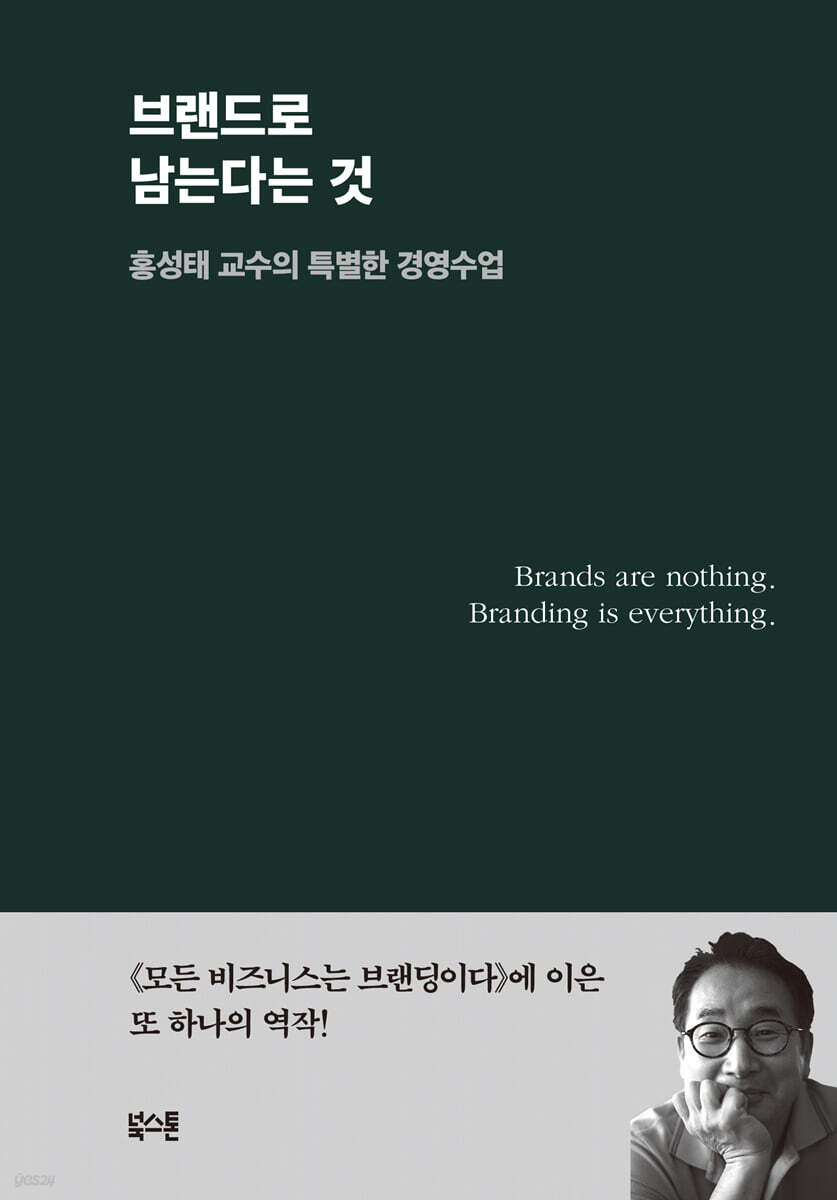
Remaining as a brand
 |
Description
Book Introduction
- A word from MD
- This is the new work of author Hong Seong-tae, who has raised topics on marketing through many books such as “All Business is Branding” and “Different Than Better.”
The main content is a conversation with a student who started a business about marketing, branding, and surviving after starting a business, and it explains the basics of marketing and branding in an easy-to-understand way with the topic of 'beginning'.
- Economic Management MD Kim Sang-geun
The practical branding bible following "Every Business is Branding"!
Is building a great brand essential for successful management? What is the difference between becoming a well-known brand and one with a distinct identity? With countless brands emerging and disappearing, what distinguishes those that survive? Professor Hong Seong-tae, a marketing expert familiar to the general public through bestsellers such as "All Businesses Are Branding," "Different Than Better," "Baemin-like," and "Growing Up," revisits the essence of branding in his new book, "Being a Brand."
The topic covered in previous works—"What should I do to create my own brand?"—remains relevant in this book as well.
What's strikingly different is that, beyond simply explaining how to successfully promote a brand, we've focused on writing practical guidelines based on firsthand observations and experiences in the field.
The author, who has worked with actual entrepreneurs, marketers, and practitioners from various companies to answer their concerns, explains practical methods for surviving as a brand in a conversational format with his students.
As the title suggests, it's good to be a famous brand, but it's also important to become an unforgettable brand with its own unique identity. This book will be a must-read for all companies and individuals who want to remain a brand.
Is building a great brand essential for successful management? What is the difference between becoming a well-known brand and one with a distinct identity? With countless brands emerging and disappearing, what distinguishes those that survive? Professor Hong Seong-tae, a marketing expert familiar to the general public through bestsellers such as "All Businesses Are Branding," "Different Than Better," "Baemin-like," and "Growing Up," revisits the essence of branding in his new book, "Being a Brand."
The topic covered in previous works—"What should I do to create my own brand?"—remains relevant in this book as well.
What's strikingly different is that, beyond simply explaining how to successfully promote a brand, we've focused on writing practical guidelines based on firsthand observations and experiences in the field.
The author, who has worked with actual entrepreneurs, marketers, and practitioners from various companies to answer their concerns, explains practical methods for surviving as a brand in a conversational format with his students.
As the title suggests, it's good to be a famous brand, but it's also important to become an unforgettable brand with its own unique identity. This book will be a must-read for all companies and individuals who want to remain a brand.
- You can preview some of the book's contents.
Preview
index
Header
Prologue | Planting Meaning and Adding Fun
Why on earth do we need branding?
So where should we start with branding?
If the beginning of branding is 'naming', what is the end point?
What exactly does branding involve?
I want to instill soul into our brand too.
How do you convey your brand concept in a way that's not boring?
Part 1.
The Birth of a Brand: Giving Meaning to a Name
Chapter 1.
Customer Orientation
How do we view our business from the customer's perspective?
I emphasize the 'essence of karma', but the content of my business is obvious.
How can we break free from fixed concepts?
We want to define our brand differently.
Are there any examples of companies in Korea that have truly discovered the essence of their business?
Even if the slogan is cool, will consumers even notice it?
What is experiential marketing?
Chapter 2 Condensation
How to Instill a Brand Concept in Customers' Minds
I want to convey the brand concept in an impactful way.
There's so much I want to say about our brand.
Is there a reason why the condensation work should be done together with the members?
As a marketer, I want to develop a sense of expression.
The problem is that it's not easy to find that one word that touches your heart.
Chapter 3 Creativity
How to creatively showcase your brand's concept
I want to express my concept creatively, but how should I do it?
How can we foster creativity in marketers?
How do you connect a concept to a creative outcome?
What should I keep in mind when choosing a marketing agency?
How do you come up with creative-looking concepts?
How do you creatively present your concept at customer touchpoints?
Chapter 4 Continuity
How to make your brand look consistent
To avoid looking boring, shouldn't you change the concept sometimes?
When sales slow down, the first thing we think about is changing the concept.
I often hear the word 'beginner's mind', but I really don't know what to do with it.
It's hard to maintain your identity as the world changes and your company grows.
I don't know about luxury goods, but is it easy for inexpensive consumer goods to insist on sustainability?
Chapter 5 Combination
How to strike a good balance between items
The number of items is increasing, but it is not easy to make a profit on all of them.
The key is to get a good hold of the signboard product, right?
Does the offline product composition method apply to online business as well?
What stands out when building an online portfolio?
The initial costs of organizing a community are high, but will the benefits be worth it?
Should startups prioritize branding or sales?
How can pivoting help you build your portfolio?
Chapter 6 Consistency
How to get members to work together as one
When talking about vision, don't you often hear examples of going to the moon?
Mission, vision, goal...
I'm confused because they seem similar.
Is it easy to find a vision that excites you, like going to Mars?
It's great to have a bold vision, but it's still vague.
Do setting ridiculously ambitious goals actually work?
How can vision-centered management take root effectively?
Chapter 7 Complementarity
How can organizations and their members grow together?
As the organization grows, the members' hearts do not match mine.
Does sense of ownership also have a meaning connected to internal branding?
How does internal branding connect to "uniqueness"?
Are there any other ways to encourage members to participate actively?
Chapter 8 Differentiation
How do we differentiate our brand?
I know differentiation is important, but it's so hard to find that point of differentiation.
They say that 'bottom-up marketing' is also the principle of differentiation.
Is there a way to make the difference easier for customers to understand?
How do you decide which product market to enter?
If you use the concept of fixation as a stepping stone, it will be easy to communicate the difference.
I find the concept of adding uniqueness to familiarity very useful.
How can we gain a competitive edge?
How can we achieve a difference in perception?
To be perceived as the first, the only, or the best?
Part 2.
Brand Experience: Adding Fun to Meaning
Chapter 9 Extrinsic Elements
How to Stimulate Customers' Wants
Teacher's Day is coming up, so I prepared a small gift.
People do spend more money on useless things.
Why is Gentle Monster holding an exhibition that has nothing to do with glasses?
Isn't fandom a useless thing?
There are many cases where a cult brand becomes popular and then disappears.
I would like to see our brand mentioned more often on social media.
Does the economics of uselessness directly translate into sales?
I had no idea there would be such a huge demand for something so useless.
Chapter 10 Entertainment
How to Dig Into Your Target Customers' Lives
Why is entertainment so important in every business these days?
How and when does marketing intervene in your prospects' daily lives?
Professor, you're using the term 'target customer' a lot today.
Is there a way to deeply understand people's thoughts and lives?
How do you determine who your target is among the countless consumers?
How do you find consumers who will respond to your marketing efforts?
They said to target narrowly, but will that generate enough sales?
Chapter 11: Esthetics
How can design be used in marketing?
Isn't the essence of design to attract people with its appearance?
Design determines the success or failure of marketing?
How can we maximize the effectiveness of our designs?
How do I connect my brand concept with my design?
As I get older, it's not easy to reflect trends.
Is there a good way to catch trends?
Aren't there different cultural codes flowing among the younger generation?
Does the postmodern trend in design also apply to branding?
Chapter 12 Emotion
How to Trigger Emotions and Influence Customer Behavior
I hear that each marketer has a different definition of emotional marketing.
For example, how can we use hearing in marketing?
Using touch in marketing is limited, right?
Since humans eat throughout their lives, isn't it obvious that they have a sense of taste?
Is there a role for olfactory branding?
All five senses are important, but don't we ultimately rely heavily on sight?
Chapter 13 Empathy
How to Develop Empathy Skills in Customer Engagement
When facts and empathy collide, which is more important?
Knowing your audience's personality can help with marketing?
How can you apply your customer's personality type to the sales process?
What are some things to keep in mind when using personality types in sales situations?
Which personality type is most empathetic?
Chapter 14 Ego
What persona should the brand be perceived as?
Does setting up a brand persona really work?
What is the difference between personality and persona?
Why should I create a persona?
How do I properly develop a persona?
These days, many CEOs are trying to highlight their personas.
Chapter 15.
Episode
How to create likability through story
The story is fiction, so should we use fiction in marketing?
But does that really help with branding?
What are the characteristics of an impactful brand story?
How about jumping on the bandwagon of a timely issue?
How do you create a story that grabs attention?
Chapter 16.
Diffusion
At what point do we enter the market?
As the number of startups increases, the 'product life cycle' theory is being highlighted again.
I understand the principle, but how do I use it strategically?
I see a lot of startups that don't last long despite their great technology.
How are new products accepted in the market?
Which consumer segment determines the success or failure of a new product?
Are there any examples of consumers' acceptance characteristics being effectively utilized?
Epilogue | Business is the process of perfecting one's own identity.
What additional studies should I do to become a better manager?
What are some lessons I should take away from branding?
Are you asking me to reflect on what it means to 'remain a brand'?
It's such a shame to end it.
Lastly, could you please give us a word?
Search
Prologue | Planting Meaning and Adding Fun
Why on earth do we need branding?
So where should we start with branding?
If the beginning of branding is 'naming', what is the end point?
What exactly does branding involve?
I want to instill soul into our brand too.
How do you convey your brand concept in a way that's not boring?
Part 1.
The Birth of a Brand: Giving Meaning to a Name
Chapter 1.
Customer Orientation
How do we view our business from the customer's perspective?
I emphasize the 'essence of karma', but the content of my business is obvious.
How can we break free from fixed concepts?
We want to define our brand differently.
Are there any examples of companies in Korea that have truly discovered the essence of their business?
Even if the slogan is cool, will consumers even notice it?
What is experiential marketing?
Chapter 2 Condensation
How to Instill a Brand Concept in Customers' Minds
I want to convey the brand concept in an impactful way.
There's so much I want to say about our brand.
Is there a reason why the condensation work should be done together with the members?
As a marketer, I want to develop a sense of expression.
The problem is that it's not easy to find that one word that touches your heart.
Chapter 3 Creativity
How to creatively showcase your brand's concept
I want to express my concept creatively, but how should I do it?
How can we foster creativity in marketers?
How do you connect a concept to a creative outcome?
What should I keep in mind when choosing a marketing agency?
How do you come up with creative-looking concepts?
How do you creatively present your concept at customer touchpoints?
Chapter 4 Continuity
How to make your brand look consistent
To avoid looking boring, shouldn't you change the concept sometimes?
When sales slow down, the first thing we think about is changing the concept.
I often hear the word 'beginner's mind', but I really don't know what to do with it.
It's hard to maintain your identity as the world changes and your company grows.
I don't know about luxury goods, but is it easy for inexpensive consumer goods to insist on sustainability?
Chapter 5 Combination
How to strike a good balance between items
The number of items is increasing, but it is not easy to make a profit on all of them.
The key is to get a good hold of the signboard product, right?
Does the offline product composition method apply to online business as well?
What stands out when building an online portfolio?
The initial costs of organizing a community are high, but will the benefits be worth it?
Should startups prioritize branding or sales?
How can pivoting help you build your portfolio?
Chapter 6 Consistency
How to get members to work together as one
When talking about vision, don't you often hear examples of going to the moon?
Mission, vision, goal...
I'm confused because they seem similar.
Is it easy to find a vision that excites you, like going to Mars?
It's great to have a bold vision, but it's still vague.
Do setting ridiculously ambitious goals actually work?
How can vision-centered management take root effectively?
Chapter 7 Complementarity
How can organizations and their members grow together?
As the organization grows, the members' hearts do not match mine.
Does sense of ownership also have a meaning connected to internal branding?
How does internal branding connect to "uniqueness"?
Are there any other ways to encourage members to participate actively?
Chapter 8 Differentiation
How do we differentiate our brand?
I know differentiation is important, but it's so hard to find that point of differentiation.
They say that 'bottom-up marketing' is also the principle of differentiation.
Is there a way to make the difference easier for customers to understand?
How do you decide which product market to enter?
If you use the concept of fixation as a stepping stone, it will be easy to communicate the difference.
I find the concept of adding uniqueness to familiarity very useful.
How can we gain a competitive edge?
How can we achieve a difference in perception?
To be perceived as the first, the only, or the best?
Part 2.
Brand Experience: Adding Fun to Meaning
Chapter 9 Extrinsic Elements
How to Stimulate Customers' Wants
Teacher's Day is coming up, so I prepared a small gift.
People do spend more money on useless things.
Why is Gentle Monster holding an exhibition that has nothing to do with glasses?
Isn't fandom a useless thing?
There are many cases where a cult brand becomes popular and then disappears.
I would like to see our brand mentioned more often on social media.
Does the economics of uselessness directly translate into sales?
I had no idea there would be such a huge demand for something so useless.
Chapter 10 Entertainment
How to Dig Into Your Target Customers' Lives
Why is entertainment so important in every business these days?
How and when does marketing intervene in your prospects' daily lives?
Professor, you're using the term 'target customer' a lot today.
Is there a way to deeply understand people's thoughts and lives?
How do you determine who your target is among the countless consumers?
How do you find consumers who will respond to your marketing efforts?
They said to target narrowly, but will that generate enough sales?
Chapter 11: Esthetics
How can design be used in marketing?
Isn't the essence of design to attract people with its appearance?
Design determines the success or failure of marketing?
How can we maximize the effectiveness of our designs?
How do I connect my brand concept with my design?
As I get older, it's not easy to reflect trends.
Is there a good way to catch trends?
Aren't there different cultural codes flowing among the younger generation?
Does the postmodern trend in design also apply to branding?
Chapter 12 Emotion
How to Trigger Emotions and Influence Customer Behavior
I hear that each marketer has a different definition of emotional marketing.
For example, how can we use hearing in marketing?
Using touch in marketing is limited, right?
Since humans eat throughout their lives, isn't it obvious that they have a sense of taste?
Is there a role for olfactory branding?
All five senses are important, but don't we ultimately rely heavily on sight?
Chapter 13 Empathy
How to Develop Empathy Skills in Customer Engagement
When facts and empathy collide, which is more important?
Knowing your audience's personality can help with marketing?
How can you apply your customer's personality type to the sales process?
What are some things to keep in mind when using personality types in sales situations?
Which personality type is most empathetic?
Chapter 14 Ego
What persona should the brand be perceived as?
Does setting up a brand persona really work?
What is the difference between personality and persona?
Why should I create a persona?
How do I properly develop a persona?
These days, many CEOs are trying to highlight their personas.
Chapter 15.
Episode
How to create likability through story
The story is fiction, so should we use fiction in marketing?
But does that really help with branding?
What are the characteristics of an impactful brand story?
How about jumping on the bandwagon of a timely issue?
How do you create a story that grabs attention?
Chapter 16.
Diffusion
At what point do we enter the market?
As the number of startups increases, the 'product life cycle' theory is being highlighted again.
I understand the principle, but how do I use it strategically?
I see a lot of startups that don't last long despite their great technology.
How are new products accepted in the market?
Which consumer segment determines the success or failure of a new product?
Are there any examples of consumers' acceptance characteristics being effectively utilized?
Epilogue | Business is the process of perfecting one's own identity.
What additional studies should I do to become a better manager?
What are some lessons I should take away from branding?
Are you asking me to reflect on what it means to 'remain a brand'?
It's such a shame to end it.
Lastly, could you please give us a word?
Search
Into the book
It's already been a few months.
One day, a student who had graduated a few years ago, started a company, and was rumored to be doing quite well came to visit.
He said that he started a startup with two friends and worked tirelessly for several years, cutting back on sleep and taking no vacations, just to survive.
However, as the number of people increased and sales volume grew, many new problems arose that were difficult to solve on their own.
In the past, we just had to focus on our respective roles with our partners, but now we had to think about what the company's mission and vision were, and we had to think anew about marketing, such as what message to send to what target.
After some friction, the two founding partners went their separate ways and hired professional staff, but they came to me because they felt they needed to establish a clear direction as the company's CEO.
I had a conversation with him about this and that for three or four hours.
I answered the questions sincerely, hoping that they would be of some help, but they said that although it was something I had learned in school, it all sounded new to them after actually doing it, and politely asked if I could come back next week.
Isn't it something you should not hesitate to ask for help from your beloved disciple?
So, I came back the following week, talked for three or four hours, and then went back, repeating this process for three months. My student always recorded our conversations, and I thought the content might be helpful to other marketers, so I asked if he could share the recordings with me, and he gladly sent me the files.
This book is a transcription and organization of that file.
---From the "Header"
I see many cases where people forget their soul, their mother, and just try to increase sales, shortening their lifespan.
Persistence doesn't mean not changing, it means constantly changing but not losing your mother.
The soul, core values, mother, the essence of karma...
These words all imply that while we must constantly adapt to changes in the market and customers, we must not forget our roots in order to remain unshaken and sustainable.
Sustainability is so important, yet so damn hard to maintain.
There's a saying by boxer Mike Tyson.
“Everyone has a plan till they get punched in the mouth.” When sales plummet, the essence of the business is lost.
When the CEO changes, the concept is shaken up, and even when the marketing manager or advertising agency changes, the concept is constantly being touched.
A brand's lifeblood is its concept, so if you change it so easily, will that concept stick in consumers' minds?
---“It’s hard to maintain your identity even as the world changes and the company grows.”
Anyway, in convenience stores that are sensitive to change, Buldak Bokkeum Myeon has been holding its ground for several years.
What's the secret? I repeat, to appear consistent, paradoxically, you have to constantly change.
No, evolution would be more accurate.
Let's see how Buldak Bokkeum Myeon has evolved. Buldak Bokkeum Myeon is a noodle dish without broth, so it has a clean spicy flavor.
Its unique spicy taste appeals to people, and as you know, Josh from the YouTube channel 'British Man' uploaded a video of British people trying to eat Buldak Bokkeum Myeon, which became a hot topic, and it has become a firm fixture on the shelves.
It doesn't stop there.
For those who like a spicy taste but don't like it too spicy, we made a limited edition of the soft Carbonara Buldak Bokkeum Myeon with added cream sauce, which was more popular than expected and became a regular product.
At the same time, they also released a spicy spicy chicken stir-fried noodle that is twice as spicy.
Even after that, they released limited edition products whenever they could to keep Buldak fans from getting bored.
Jjajang Buldak Bokkeum Myeon, Jjolbokki Buldak Bokkeum Myeon, Curry Buldak Bokkeum Myeon, Mala Buldak Bokkeum Myeon, Cool Buldak Bokkeum Myeon, etc.
Now, they make various categories of products under the brand name ‘Buldak.’
Have you tried the spicy chicken dumplings? There's also spicy chicken fried rice, spicy chicken tteokbokki, spicy chicken kimbap, and even spicy chicken half-boiled eggs.
This is why the brand called Fire Chicken never gets boring.
Actually, there are quite a few enthusiasts who eat Buldak, even though you may not be very interested.
While maintaining the core attribute of "Buldak"—spiciness—what other categories could it be categorized into? There's toothpaste, and there's lip balm.
Of course, it doesn't have buldak sauce, but it has a strong mint flavor to give it a refreshing feeling.
In short, the secret to the longevity of the Buldak brand is that it has maintained the characteristics of its "mother" brand, which is the spicy taste and image that Koreans like, while consistently making changes.
It's about maintaining the brand's consistency without boring consumers.
---“I don’t know about luxury goods, but is it easy for cheap consumer goods to insist on sustainability?”
The ultimate goal of branding is brand extension.
A signature item is a bridgehead that grabs people's attention, and the key is to expand using this as a springboard.
So to speak, we want to make it so that people can trust and buy whatever we sell under our 'brand' name without thinking too much about it.
For example, when you say 'Ottogi', curry comes to mind.
After planting a seed of affection in people's hearts with curry, we didn't stop there and prepared a variety of curries for sale.
Next, there are over 1,000 items, including ramen, ketchup, mayonnaise, and various seasonings, that are sold under the Ottogi name, some for profit, some for decoration.
After creating a signature, you use it as a springboard to continuously expand your product line. This is the main goal of branding.
However, there are some things to be careful about when expanding.
Items should be complementary or independent, not substitutes.
Eating a French fries or cola with a hamburger is 'complementary'.
Or, like the various items in a department store, they need to expand into 'independent' products that are unrelated to each other, but in many cases, they end up cannibalizing themselves by stocking 'alternative' products.
---“The key is to get a good hold of the signboard product?”
You said that 'concept' is the consumer's perception and image.
It's fascinating that we have to put this invisible thing into words, so it can only be expressed in metaphysical terms, but it's still a feeling that people have in common.
Clorox was the first bleach product to be released in the United States in 1913 and has been a market leader ever since.
The concept is 'Whiter & Brighter' so it's very clear.
But since it is a product used for laundry, we also made laundry detergent.
This did not work.
Why would that be? Perhaps people subconsciously assumed that washing with Clorox would make things whiter.
Later on, fabric stain removers, toilet cleaners, and drain cleaners all sold well.
These products all fit the concept of ‘whiter and brighter.’
---From "How can pivoting help you build a portfolio?"
The ultimate target that a brand should aim for is, to borrow Steve Jobs' expression, the "conscious minority."
The ripple effect created by that minority is by no means small.
What does it mean, specifically, to aim for a conscious minority? It means pursuing the object of one's aspirations.
In marketing, the object of envy is called a 'muse'.
Originally, the term muse referred to a goddess who inspired writers and artists, but in marketing, it means 'a target that inspires marketers.'
The marketing picture becomes clearer when you narrowly focus on this muse target.
---“They told me to target narrowly, but will sales be sufficient?”
Personality is literally my original character.
But we don't live like that.
Don't try to show others a trimmed and groomed appearance.
That's called a persona.
In psychological terms, it is sometimes divided into intrinsic and extrinsic personality.
For example, if a person with a blunt personality hears his daughter complain, "Daddy is too dry," he might retort, "What's wrong with me!" but wouldn't he take it to heart? Then, he might make a conscious effort to be gentle when meeting people.
The way you appear to others is your persona.
The important thing here is that other people don't know my real character, my personality.
They just react to my persona.
It's not that they react to my personality, but rather to the image I've cultivated and shown.
So you have to cultivate your persona well.
This shouldn't be viewed negatively, such as being hypocritical.
If you look at it as a process that requires effort, rather than living according to one's own nature and filling in one's shortcomings, then isn't this also a process that requires effort?
---From "What is the difference between personality and persona?"
In early 2021, Clubhouse, a voice-based social media platform, took the world by storm.
The timing was good, as the coronavirus pandemic was at its peak, and it was also an interesting strategy to initially limit participation to iPhones and iPads.
I guess they judged that there were many Apple users among the early adopters.
But why did this app, once rumored to be a "popular app," fall from grace so quickly? It was a failure to grasp the psychological characteristics of early adopters.
It's important for them to be admired as lifestyle leaders.
But when celebrities appeared in Clubhouse and dominated the game, the early adopters got fed up and left.
Moreover, as the number of older generations who create and operate rooms increases, they become more old-fashioned, giving long-winded lectures and lecturing, and the MZ generation also leaves.
Do you see how important it is to understand the characteristics of consumer groups at each stage of the product life cycle?
One day, a student who had graduated a few years ago, started a company, and was rumored to be doing quite well came to visit.
He said that he started a startup with two friends and worked tirelessly for several years, cutting back on sleep and taking no vacations, just to survive.
However, as the number of people increased and sales volume grew, many new problems arose that were difficult to solve on their own.
In the past, we just had to focus on our respective roles with our partners, but now we had to think about what the company's mission and vision were, and we had to think anew about marketing, such as what message to send to what target.
After some friction, the two founding partners went their separate ways and hired professional staff, but they came to me because they felt they needed to establish a clear direction as the company's CEO.
I had a conversation with him about this and that for three or four hours.
I answered the questions sincerely, hoping that they would be of some help, but they said that although it was something I had learned in school, it all sounded new to them after actually doing it, and politely asked if I could come back next week.
Isn't it something you should not hesitate to ask for help from your beloved disciple?
So, I came back the following week, talked for three or four hours, and then went back, repeating this process for three months. My student always recorded our conversations, and I thought the content might be helpful to other marketers, so I asked if he could share the recordings with me, and he gladly sent me the files.
This book is a transcription and organization of that file.
---From the "Header"
I see many cases where people forget their soul, their mother, and just try to increase sales, shortening their lifespan.
Persistence doesn't mean not changing, it means constantly changing but not losing your mother.
The soul, core values, mother, the essence of karma...
These words all imply that while we must constantly adapt to changes in the market and customers, we must not forget our roots in order to remain unshaken and sustainable.
Sustainability is so important, yet so damn hard to maintain.
There's a saying by boxer Mike Tyson.
“Everyone has a plan till they get punched in the mouth.” When sales plummet, the essence of the business is lost.
When the CEO changes, the concept is shaken up, and even when the marketing manager or advertising agency changes, the concept is constantly being touched.
A brand's lifeblood is its concept, so if you change it so easily, will that concept stick in consumers' minds?
---“It’s hard to maintain your identity even as the world changes and the company grows.”
Anyway, in convenience stores that are sensitive to change, Buldak Bokkeum Myeon has been holding its ground for several years.
What's the secret? I repeat, to appear consistent, paradoxically, you have to constantly change.
No, evolution would be more accurate.
Let's see how Buldak Bokkeum Myeon has evolved. Buldak Bokkeum Myeon is a noodle dish without broth, so it has a clean spicy flavor.
Its unique spicy taste appeals to people, and as you know, Josh from the YouTube channel 'British Man' uploaded a video of British people trying to eat Buldak Bokkeum Myeon, which became a hot topic, and it has become a firm fixture on the shelves.
It doesn't stop there.
For those who like a spicy taste but don't like it too spicy, we made a limited edition of the soft Carbonara Buldak Bokkeum Myeon with added cream sauce, which was more popular than expected and became a regular product.
At the same time, they also released a spicy spicy chicken stir-fried noodle that is twice as spicy.
Even after that, they released limited edition products whenever they could to keep Buldak fans from getting bored.
Jjajang Buldak Bokkeum Myeon, Jjolbokki Buldak Bokkeum Myeon, Curry Buldak Bokkeum Myeon, Mala Buldak Bokkeum Myeon, Cool Buldak Bokkeum Myeon, etc.
Now, they make various categories of products under the brand name ‘Buldak.’
Have you tried the spicy chicken dumplings? There's also spicy chicken fried rice, spicy chicken tteokbokki, spicy chicken kimbap, and even spicy chicken half-boiled eggs.
This is why the brand called Fire Chicken never gets boring.
Actually, there are quite a few enthusiasts who eat Buldak, even though you may not be very interested.
While maintaining the core attribute of "Buldak"—spiciness—what other categories could it be categorized into? There's toothpaste, and there's lip balm.
Of course, it doesn't have buldak sauce, but it has a strong mint flavor to give it a refreshing feeling.
In short, the secret to the longevity of the Buldak brand is that it has maintained the characteristics of its "mother" brand, which is the spicy taste and image that Koreans like, while consistently making changes.
It's about maintaining the brand's consistency without boring consumers.
---“I don’t know about luxury goods, but is it easy for cheap consumer goods to insist on sustainability?”
The ultimate goal of branding is brand extension.
A signature item is a bridgehead that grabs people's attention, and the key is to expand using this as a springboard.
So to speak, we want to make it so that people can trust and buy whatever we sell under our 'brand' name without thinking too much about it.
For example, when you say 'Ottogi', curry comes to mind.
After planting a seed of affection in people's hearts with curry, we didn't stop there and prepared a variety of curries for sale.
Next, there are over 1,000 items, including ramen, ketchup, mayonnaise, and various seasonings, that are sold under the Ottogi name, some for profit, some for decoration.
After creating a signature, you use it as a springboard to continuously expand your product line. This is the main goal of branding.
However, there are some things to be careful about when expanding.
Items should be complementary or independent, not substitutes.
Eating a French fries or cola with a hamburger is 'complementary'.
Or, like the various items in a department store, they need to expand into 'independent' products that are unrelated to each other, but in many cases, they end up cannibalizing themselves by stocking 'alternative' products.
---“The key is to get a good hold of the signboard product?”
You said that 'concept' is the consumer's perception and image.
It's fascinating that we have to put this invisible thing into words, so it can only be expressed in metaphysical terms, but it's still a feeling that people have in common.
Clorox was the first bleach product to be released in the United States in 1913 and has been a market leader ever since.
The concept is 'Whiter & Brighter' so it's very clear.
But since it is a product used for laundry, we also made laundry detergent.
This did not work.
Why would that be? Perhaps people subconsciously assumed that washing with Clorox would make things whiter.
Later on, fabric stain removers, toilet cleaners, and drain cleaners all sold well.
These products all fit the concept of ‘whiter and brighter.’
---From "How can pivoting help you build a portfolio?"
The ultimate target that a brand should aim for is, to borrow Steve Jobs' expression, the "conscious minority."
The ripple effect created by that minority is by no means small.
What does it mean, specifically, to aim for a conscious minority? It means pursuing the object of one's aspirations.
In marketing, the object of envy is called a 'muse'.
Originally, the term muse referred to a goddess who inspired writers and artists, but in marketing, it means 'a target that inspires marketers.'
The marketing picture becomes clearer when you narrowly focus on this muse target.
---“They told me to target narrowly, but will sales be sufficient?”
Personality is literally my original character.
But we don't live like that.
Don't try to show others a trimmed and groomed appearance.
That's called a persona.
In psychological terms, it is sometimes divided into intrinsic and extrinsic personality.
For example, if a person with a blunt personality hears his daughter complain, "Daddy is too dry," he might retort, "What's wrong with me!" but wouldn't he take it to heart? Then, he might make a conscious effort to be gentle when meeting people.
The way you appear to others is your persona.
The important thing here is that other people don't know my real character, my personality.
They just react to my persona.
It's not that they react to my personality, but rather to the image I've cultivated and shown.
So you have to cultivate your persona well.
This shouldn't be viewed negatively, such as being hypocritical.
If you look at it as a process that requires effort, rather than living according to one's own nature and filling in one's shortcomings, then isn't this also a process that requires effort?
---From "What is the difference between personality and persona?"
In early 2021, Clubhouse, a voice-based social media platform, took the world by storm.
The timing was good, as the coronavirus pandemic was at its peak, and it was also an interesting strategy to initially limit participation to iPhones and iPads.
I guess they judged that there were many Apple users among the early adopters.
But why did this app, once rumored to be a "popular app," fall from grace so quickly? It was a failure to grasp the psychological characteristics of early adopters.
It's important for them to be admired as lifestyle leaders.
But when celebrities appeared in Clubhouse and dominated the game, the early adopters got fed up and left.
Moreover, as the number of older generations who create and operate rooms increases, they become more old-fashioned, giving long-winded lectures and lecturing, and the MZ generation also leaves.
Do you see how important it is to understand the characteristics of consumer groups at each stage of the product life cycle?
---From "Which consumer group determines the success or failure of a new product?"
Publisher's Review
Professor Hong Seong-tae's very special management class
A profound conversation between a student and a master about branding.
'Why on earth do we need branding?'
'Where should I start with branding?'
'I want to define our brand differently.'
How can we foster creativity in marketers?
'I want to express the concept creatively, but how can I do it?'
The book begins with a curious question from a disciple who comes to see his master.
In the past, whether you were starting a business or working for a company, all you had to do was focus on your assigned tasks. But now, a student, burdened with worries about the company's vision and mission, even has to carefully approach the message he wants to send to his target audience, came to his teacher for advice.
This book was inspired by a 12-week conversation between a student and a master about marketing, branding, and surviving a startup. While the goal is to convey the content in an accessible manner, it is also grounded in the concerns and questions that all entrepreneurs and marketers face.
That's understandable, as the author, Professor Hong Seong-tae, founded and operates 'Mobive,' a hideout for actual marketers.
Mobiv, established to directly hear voices from the field, offers special branding lectures for marketers and practitioners, as well as a marketing program similar to a military academy that fosters young entrepreneurs.
The author says that while there are many places that teach marketing, such as performance marketing or how to become popular on social media, he often feels disappointed that there are few opportunities to learn about the fundamental principles of marketing and the essence of a brand.
There are many books that cover the success stories of brands, but there are few books that talk about how to create a brand and how to make it last.
“In ‘All Business is Branding’, the topic was ‘Better’, in ‘Different than Better’, the topic was ‘Different’, in ‘Baemin-like’, the topic was ‘Next’, and in ‘Growing Up’, the topic was ‘Keep-up’.
This time, as an extension of that, I want to go back to the ‘beginning’ mindset.
So, I wrote the book with companies that have just emerged from the startup phase and are entering the growth phase in mind.
But isn't this an era where change is so rapid that existing experiences and knowledge don't really apply?
Therefore, even if it is a large company that promotes growth, I believe it should approach management with the same "first-time" mindset as a startup.
“I hope that all marketers and managers who read this book, regardless of size, will have a chance to revisit their original intentions.” - From the preface.
The path to becoming a consistently loved brand, not just a successful one.
This book is broadly divided into two parts: the birth of a brand and the experience of a brand.
If the birth of a brand is a job that determines its meaning, then the experience of a brand is the work of adding fun to its meaning.
We also explain how to differentiate your brand and how to develop your business according to the product life cycle.
Each chapter is composed of questions and answers and contains actual conversations, so it is written in a colloquial style that makes it easy to listen to, but the content is specialized and specific as it answers the concerns students face in their work.
This book covers all the essential keywords in branding, including the definitions of market segmentation and product differentiation, the difference between persona and personality, branding based on target customers and the product life cycle, and finding a reason for existence using the concept of stickiness.
Above all, the greatest strength of this book is that, beyond its vivid examples and systematic theories, it contains solutions that encourage readers to pause at every point and reflect on how to apply them to their own brands.
This process of contemplation soon leads to proper 'branding'.
“The brand concept is the same.
It's not a skill to just decide nicely and put it on the first screen of a web page.
I think a lot while organizing and condensing the concept.
In that sense, 'brand' should be considered a verb, not a noun.
I would like to parody Eisenhower's famous quote like this:
“Brands are nothing.
Branding is everything. “While the wonderful results of condensation are important, the process of members putting a lot of thought into the process of condensing the concept together is meaningful in itself.” - From the text.
"Being a Brand" vividly shows the process of finding one's own unique color and remaining a beloved brand.
As we follow the struggles and efforts of a brand that has transformed people's lives and quietly permeated our daily lives, we find ourselves asking ourselves, "What kind of brand do I want to be remembered as?"
The author's final message, that instead of striving to become a big brand, he hopes to remain a brand that won't be easily forgotten, reminds us of what we must do and what we must be wary of in today's world, where countless brands are born and disappear.
This book will serve as an extremely practical and systematic guide not only for those who run their own brands or companies, aspiring entrepreneurs, marketers, but also for anyone interested in branding and anyone who has to manage their name throughout their lives.
A profound conversation between a student and a master about branding.
'Why on earth do we need branding?'
'Where should I start with branding?'
'I want to define our brand differently.'
How can we foster creativity in marketers?
'I want to express the concept creatively, but how can I do it?'
The book begins with a curious question from a disciple who comes to see his master.
In the past, whether you were starting a business or working for a company, all you had to do was focus on your assigned tasks. But now, a student, burdened with worries about the company's vision and mission, even has to carefully approach the message he wants to send to his target audience, came to his teacher for advice.
This book was inspired by a 12-week conversation between a student and a master about marketing, branding, and surviving a startup. While the goal is to convey the content in an accessible manner, it is also grounded in the concerns and questions that all entrepreneurs and marketers face.
That's understandable, as the author, Professor Hong Seong-tae, founded and operates 'Mobive,' a hideout for actual marketers.
Mobiv, established to directly hear voices from the field, offers special branding lectures for marketers and practitioners, as well as a marketing program similar to a military academy that fosters young entrepreneurs.
The author says that while there are many places that teach marketing, such as performance marketing or how to become popular on social media, he often feels disappointed that there are few opportunities to learn about the fundamental principles of marketing and the essence of a brand.
There are many books that cover the success stories of brands, but there are few books that talk about how to create a brand and how to make it last.
“In ‘All Business is Branding’, the topic was ‘Better’, in ‘Different than Better’, the topic was ‘Different’, in ‘Baemin-like’, the topic was ‘Next’, and in ‘Growing Up’, the topic was ‘Keep-up’.
This time, as an extension of that, I want to go back to the ‘beginning’ mindset.
So, I wrote the book with companies that have just emerged from the startup phase and are entering the growth phase in mind.
But isn't this an era where change is so rapid that existing experiences and knowledge don't really apply?
Therefore, even if it is a large company that promotes growth, I believe it should approach management with the same "first-time" mindset as a startup.
“I hope that all marketers and managers who read this book, regardless of size, will have a chance to revisit their original intentions.” - From the preface.
The path to becoming a consistently loved brand, not just a successful one.
This book is broadly divided into two parts: the birth of a brand and the experience of a brand.
If the birth of a brand is a job that determines its meaning, then the experience of a brand is the work of adding fun to its meaning.
We also explain how to differentiate your brand and how to develop your business according to the product life cycle.
Each chapter is composed of questions and answers and contains actual conversations, so it is written in a colloquial style that makes it easy to listen to, but the content is specialized and specific as it answers the concerns students face in their work.
This book covers all the essential keywords in branding, including the definitions of market segmentation and product differentiation, the difference between persona and personality, branding based on target customers and the product life cycle, and finding a reason for existence using the concept of stickiness.
Above all, the greatest strength of this book is that, beyond its vivid examples and systematic theories, it contains solutions that encourage readers to pause at every point and reflect on how to apply them to their own brands.
This process of contemplation soon leads to proper 'branding'.
“The brand concept is the same.
It's not a skill to just decide nicely and put it on the first screen of a web page.
I think a lot while organizing and condensing the concept.
In that sense, 'brand' should be considered a verb, not a noun.
I would like to parody Eisenhower's famous quote like this:
“Brands are nothing.
Branding is everything. “While the wonderful results of condensation are important, the process of members putting a lot of thought into the process of condensing the concept together is meaningful in itself.” - From the text.
"Being a Brand" vividly shows the process of finding one's own unique color and remaining a beloved brand.
As we follow the struggles and efforts of a brand that has transformed people's lives and quietly permeated our daily lives, we find ourselves asking ourselves, "What kind of brand do I want to be remembered as?"
The author's final message, that instead of striving to become a big brand, he hopes to remain a brand that won't be easily forgotten, reminds us of what we must do and what we must be wary of in today's world, where countless brands are born and disappear.
This book will serve as an extremely practical and systematic guide not only for those who run their own brands or companies, aspiring entrepreneurs, marketers, but also for anyone interested in branding and anyone who has to manage their name throughout their lives.
GOODS SPECIFICS
- Publication date: November 12, 2022
- Format: Hardcover book binding method guide
- Page count, weight, size: 560 pages | 680g | 135*194*37mm
- ISBN13: 9791191211849
- ISBN10: 1191211843
You may also like
카테고리
korean


korean

![GQ KOREA Mark (Monthly): December [2025]](http://librairie.coreenne.fr/cdn/shop/files/8ef265dbbfbf186523ed75ba7319009d.jpg?v=1765340328&width=3840)


