

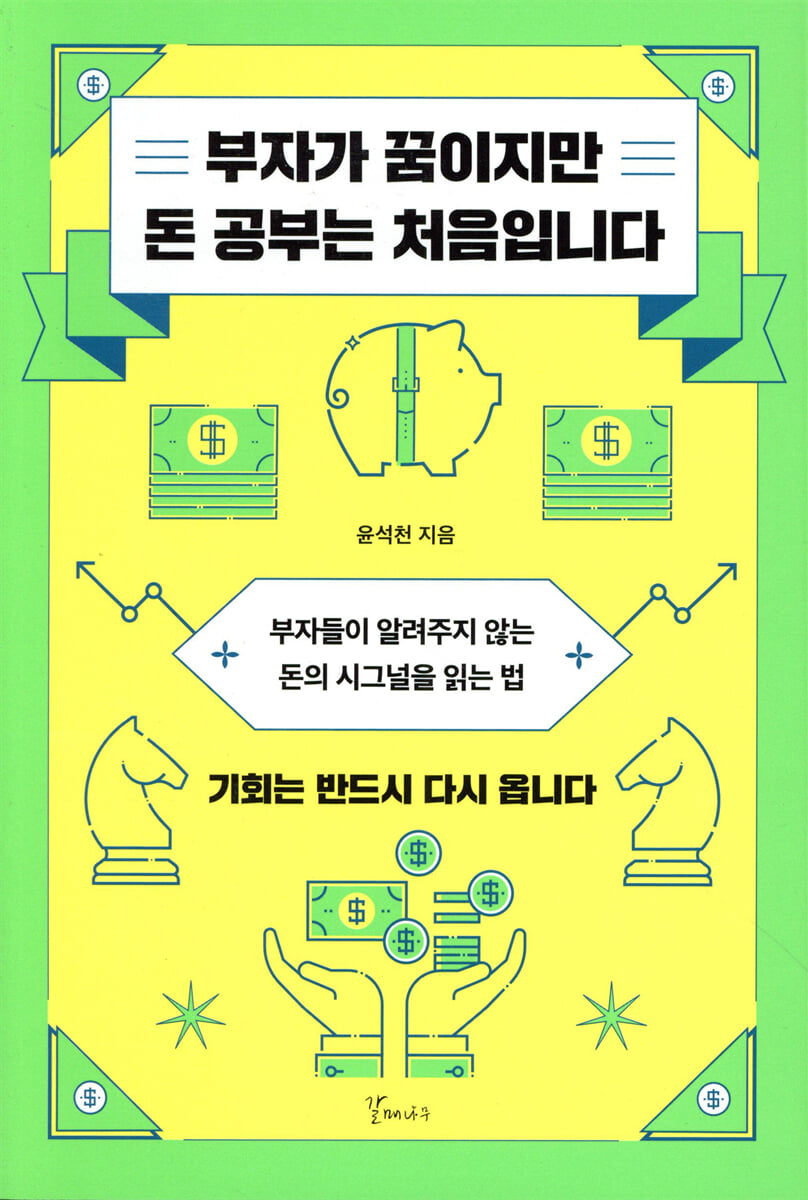
I dream of being rich, but this is my first time learning about money.
 |
Description
Book Introduction
I think everyone knows this
The fundamentals of investing that most people don't know “Now that the market is stagnant, we are at a crossroads. From young people preparing for their first investment in life, Even middle-aged people who are reminiscing about the bitter taste of many failures, You need to go back to the basics and check your current level. “You can’t miss this opportunity again.” - From the recommendation by Kim Young-ik (Professor, Graduate School of Economics, Sogang University) Economic commentator Yoon Seok-cheon explains Among the numerous 'smart money' The Timeless Investment Principles for Surviving Without Failure In 2022, global austerity measures are rapidly accelerating as overcoming inflation emerges as a pressing challenge across the globe. Companies and households that once took out loans under debt-incentive policies have fallen into a debt trap due to successive interest rate hikes. Many ordinary citizens who had followed the investment trend and rushed into the real estate and capital markets also missed the timing for confirming losses and were caught in the crossfire. In an atmosphere where even holding on is difficult, should we abandon the vain dream of economic freedom and return to the labor market, investing all in our savings? Have the golden days, when investment was the zeitgeist, simply vanished into a fleeting bubble? Author Yoon Seok-cheon retraces these economic trends, focusing on the failures of those who blindly dreamed of wealth but neglected their financial education. In particular, it is worth recalling that even during economic booms, the failure rate for novice investors was 20 percentage points higher than that of established investors. It is especially recommended that, rather than despairing, you build fundamental investment skills and establish principles. That way, you won't miss out on the next opportunity that comes your way. Only by closely observing the flow of money can one read the investment cycle and see the timing. In other words, by building a solid foundation, you can have a standard that will not be swept away by trends and open your eyes to imagine the future market. However, the reality is that investment-related content, including books and YouTube channels, is saturated with stocks, real estate, and now virtual assets. The overwhelming amount of information is often driven by someone's interests and often sensational. The author, who has been consistently dedicated to analyzing the economy and predicting the future, has organized the fundamentals of investment that "everyone seems to know, but most do not" to help those who have become broke and despaired due to failed investments and have taken on new challenges or made a comeback in this chaos. With so much information out there claiming to offer investment tips, I believe that only by mastering the fundamentals can you develop the discernment to select the best investment. The book, which consists of three parts, first examines the minimum conditions for achieving the 'economic freedom' that everyone dreams of. This book provides guidance on how to reinterpret the investment bubble caused by ultra-low interest rates and declining labor value in a changing environment and realize the dream of wealth. In Part 2, we organized the grammar of money, from basic economic knowledge to practical investment. We explore monetary signals in earnest, including the knowledge to interpret exchange rates, interest rates, and real estate policies, the insight to understand monetary phenomena and economic cycles, and the intuition to determine the timing of loss cuts based on the psychology and variables of market participants. Part 3 answers basic questions that investors should keep in mind from a beginner's perspective. It is worth reviewing the trial and error and using it as a standard to expand future possibilities. The star-studded pages, interspersed throughout, analyze current major economic issues, including inflation, taxing the wealthy, deglobalization, and Modern Monetary Theory (MMT), through the keen eye of an economic commentator. This will help you interpret the various factors that currently influence your investments and establish your own criteria. |
- You can preview some of the book's contents.
Preview
index
Entering, where is the asset market headed now?
Part 1: Why You Should Study Money Again Now: Opportunity Will Always Come Again
Chapter 1: "Suddenly Beggars": Now is the time to recover.
Surviving in a modern society where investment has become the zeitgeist
·Recover your losses by preparing before it's too late.
Chapter 2: Make Money Work for You
·How can I increase the value of the money I have?
·Work no longer guarantees a livelihood
In times of inflation, something inevitably rises.
Chapter 3: How the Rich Are Born
·The minimum amount of money needed for financial freedom
·Get out of the illusion that only you will make money.
·A leap toward freedom, a quantum jump
ISSUE&CHECK Korea's Bubble 2.0: Is Rising Household Debt Alright?
Part 2: The Money Signals the Rich Know: Reading the Grammar of Money Will Ensure Successful Investments
Chapter 4: When you see the flow of money, your eyes open to investing.
There is no market where everyone makes money.
· Read the variables that affect the asset market.
Chapter 5: Even in volatile markets, there are good investment times.
Investing is ultimately about understanding monetary phenomena.
·First signal: Watch interest rate movements.
Second Signal: Read Between the Lines of Government Policy
Third Signal: Read the Asset Market Cycle
ISSUE&CHECK The Return of Inflation: Modern Inflation Is Different from the Past
Chapter 6: Understanding Market Psychology Reduces Failure
·The art of reading volatile yet robust market sentiment
·Escape the mirage of adjustment and crash.
When will the market bubble burst?
·When you break the loss aversion tendency, the market becomes visible.
Chapter 7: Let's take a closer look at the emerging markets.
·What will the virtual asset market look like going forward?
·Where does the future of the NFT market come from?
·Virtual assets: So how should you invest?
ISSUE&CHECK Taxing the Rich: Do the World's Tax Systems Reflect the Needs of the Times?
Part 3: It's Not Risky to Prepare: Common Mistakes Beginner Investors Make
Chapter 8: There is no such thing as a guaranteed investment winner.
·Establish your own principles through studying money
·Reading economic articles properly will lead to profits.
ISSUE&CHECK Deglobalization: How Does the Global Situation Affect the Economy?
Chapter 9: Should I Pay Off Debt First or Invest?
The basics of investing begin with seed money.
·Leveraged investments that turn debt into profit
Investing is a battle of imagination.
Chapter 10: I lost money on my investment. Should I keep it or sell it?
·In a volatile asset market, is long-term investment truly advantageous?
·Safe assets serve as a solid cornerstone.
ISSUE&CHECK: Put it away and forget about it? You shouldn't blindly trust blue-chip stocks.
Chapter 11: How should we judge domestic and overseas investment?
·Why did the National Pension Service increase its overseas investment ratio?
·Recognize the pros and cons of domestic and overseas investment.
If you don't know the exchange rate, you'll lose even the profits you've made.
ISSUE&CHECK The Emergence of a New Monetary Policy: How Feasible Is MMT?
And for the economic freedom of all of us
Part 1: Why You Should Study Money Again Now: Opportunity Will Always Come Again
Chapter 1: "Suddenly Beggars": Now is the time to recover.
Surviving in a modern society where investment has become the zeitgeist
·Recover your losses by preparing before it's too late.
Chapter 2: Make Money Work for You
·How can I increase the value of the money I have?
·Work no longer guarantees a livelihood
In times of inflation, something inevitably rises.
Chapter 3: How the Rich Are Born
·The minimum amount of money needed for financial freedom
·Get out of the illusion that only you will make money.
·A leap toward freedom, a quantum jump
ISSUE&CHECK Korea's Bubble 2.0: Is Rising Household Debt Alright?
Part 2: The Money Signals the Rich Know: Reading the Grammar of Money Will Ensure Successful Investments
Chapter 4: When you see the flow of money, your eyes open to investing.
There is no market where everyone makes money.
· Read the variables that affect the asset market.
Chapter 5: Even in volatile markets, there are good investment times.
Investing is ultimately about understanding monetary phenomena.
·First signal: Watch interest rate movements.
Second Signal: Read Between the Lines of Government Policy
Third Signal: Read the Asset Market Cycle
ISSUE&CHECK The Return of Inflation: Modern Inflation Is Different from the Past
Chapter 6: Understanding Market Psychology Reduces Failure
·The art of reading volatile yet robust market sentiment
·Escape the mirage of adjustment and crash.
When will the market bubble burst?
·When you break the loss aversion tendency, the market becomes visible.
Chapter 7: Let's take a closer look at the emerging markets.
·What will the virtual asset market look like going forward?
·Where does the future of the NFT market come from?
·Virtual assets: So how should you invest?
ISSUE&CHECK Taxing the Rich: Do the World's Tax Systems Reflect the Needs of the Times?
Part 3: It's Not Risky to Prepare: Common Mistakes Beginner Investors Make
Chapter 8: There is no such thing as a guaranteed investment winner.
·Establish your own principles through studying money
·Reading economic articles properly will lead to profits.
ISSUE&CHECK Deglobalization: How Does the Global Situation Affect the Economy?
Chapter 9: Should I Pay Off Debt First or Invest?
The basics of investing begin with seed money.
·Leveraged investments that turn debt into profit
Investing is a battle of imagination.
Chapter 10: I lost money on my investment. Should I keep it or sell it?
·In a volatile asset market, is long-term investment truly advantageous?
·Safe assets serve as a solid cornerstone.
ISSUE&CHECK: Put it away and forget about it? You shouldn't blindly trust blue-chip stocks.
Chapter 11: How should we judge domestic and overseas investment?
·Why did the National Pension Service increase its overseas investment ratio?
·Recognize the pros and cons of domestic and overseas investment.
If you don't know the exchange rate, you'll lose even the profits you've made.
ISSUE&CHECK The Emergence of a New Monetary Policy: How Feasible Is MMT?
And for the economic freedom of all of us
Detailed image

Into the book
The experience of the 2008 financial crisis further fueled this.
Since the financial crisis, the gap between asset market participants and non-participants has widened dramatically.
When the financial crisis hit, real estate and stock markets around the world plummeted, but in reality, not many people saw this as an opportunity.
Meanwhile, the quick-witted "smart money" scooped up the plummeting assets at a low price and made astronomical profits when the economy recovered.
Those who watched this must have blamed themselves for not participating in the asset market.
“If I had bought Apple stocks back then, if I had bought an apartment in Seoul back then, if I had bought Bitcoin back then, I would be rich by now.”
This experience served as a great lesson and was deeply engraved in people's minds.
---From "Surviving in a Modern Society Where Investment Has Become the Zeitgeist"
Among asset markets, the real estate market is sensitive to interest rate changes.
I guess that's the only way.
The real estate market is a typical debt-dependent market.
(……) The real estate market cannot help but face downward pressure in a situation where interest rates continue to rise strongly.
The opposite case would also be true.
If low interest rates are expected to persist for a long time, there is no burden in taking out debt.
This is why the Korean real estate market has been booming over the past few years.
---From "Reading the Variables That Affect the Asset Market"
When deciding when to invest, the most important thing to consider is the direction of interest rates.
If it is certain that interest rates will continue to rise, you should avoid investing in risky assets, such as stocks, coins, and the real estate market, if possible.
At this point, the asset market has mostly already risen as much as it can.
It's time for both of us to say that we've made money.
At this time, ordinary people are easily shaken.
Even though it's late, I'm still anxious to invest so I don't fall behind any longer, so I literally take the plunge and invest.
Usually, this type of investment is mostly a case of cliche.
---From "First Signal: Watch Interest Rate Movements"
The Bank of Korea's base interest rate has been rising since August 2021.
The Bank of Korea strongly predicted that it would maintain this trend by raising interest rates, and it did so.
From a macro perspective, you can see that liquidity has been reduced.
On a micro level, real estate-related lending regulations are being implemented in earnest.
It has become very difficult to obtain housing loans and the size of credit loans has been drastically reduced.
Macro? Micro: The policy only began to take effect when the flow of funds into the real estate market tightened.
---From "The Second Signal: Reading Between the Lines of Government Policy"
Media such as newspapers and broadcasting emphasize publicness.
Most people vaguely believe that they are good.
I have absolutely no doubt that the information provided by the media is false or intentionally insensitive.
However, we must not forget that these media are also operated for someone's benefit.
These are all for-profit organizations and cannot be free from commercial interests.
Some of our country's economic newspapers have construction-related companies as major shareholders.
Broadcasting stations are no exception.
Pay close attention to the housing market-related articles reported in these newspapers and broadcasts.
It's all optimistic.
It would be a choice that suits the interests of the major shareholders.
The same goes for articles favorable to certain large corporations.
It would be difficult to write an article that would harm the interests of the largest advertisers.
---From "Establishing Your Own Principles Through Studying Money"
The future is always shrouded in fog.
At this point, investors should be able to envision the future based on sufficient 'thoughtfulness'.
As a stock investor, you need to be able to evaluate the future growth potential of an industry and determine how competitive a particular company's technology will be.
When investing in real estate, you need to be able to envision the future of the area.
At the same time, it is also important to understand the overall economic trends.
We need to make a macro judgment as to whether the current situation is one of money being released or a time of decline.
This kind of imagination is ultimately created by the ‘power of thought.’
As I said before, thoughts are the 'result of training'.
We must repeatedly consider what the future will look like under specific circumstances and conditions.
---From "Investing is a Battle of Imagination"
The question is whether the price is appropriate when purchasing the stock.
In general, there comes a point in time when every stock becomes 'overvalued' relative to its fair value.
No company can prosper forever.
Competitors are constantly emerging in the market.
Market conditions also change from moment to moment.
No matter how good a company is, it cannot monopolize the entire market.
(……) For Samsung Electronics stock to make a quantum jump, some new driving force is needed.
Whether it's system semiconductors or battlefield components.
Again, the average investor enters the market when the market is doing well and stock prices are at their peak.
The majority of people who bought Samsung Electronics stock fall into this category.
In short, I bought it at a high price when it was overvalued.
Since the financial crisis, the gap between asset market participants and non-participants has widened dramatically.
When the financial crisis hit, real estate and stock markets around the world plummeted, but in reality, not many people saw this as an opportunity.
Meanwhile, the quick-witted "smart money" scooped up the plummeting assets at a low price and made astronomical profits when the economy recovered.
Those who watched this must have blamed themselves for not participating in the asset market.
“If I had bought Apple stocks back then, if I had bought an apartment in Seoul back then, if I had bought Bitcoin back then, I would be rich by now.”
This experience served as a great lesson and was deeply engraved in people's minds.
---From "Surviving in a Modern Society Where Investment Has Become the Zeitgeist"
Among asset markets, the real estate market is sensitive to interest rate changes.
I guess that's the only way.
The real estate market is a typical debt-dependent market.
(……) The real estate market cannot help but face downward pressure in a situation where interest rates continue to rise strongly.
The opposite case would also be true.
If low interest rates are expected to persist for a long time, there is no burden in taking out debt.
This is why the Korean real estate market has been booming over the past few years.
---From "Reading the Variables That Affect the Asset Market"
When deciding when to invest, the most important thing to consider is the direction of interest rates.
If it is certain that interest rates will continue to rise, you should avoid investing in risky assets, such as stocks, coins, and the real estate market, if possible.
At this point, the asset market has mostly already risen as much as it can.
It's time for both of us to say that we've made money.
At this time, ordinary people are easily shaken.
Even though it's late, I'm still anxious to invest so I don't fall behind any longer, so I literally take the plunge and invest.
Usually, this type of investment is mostly a case of cliche.
---From "First Signal: Watch Interest Rate Movements"
The Bank of Korea's base interest rate has been rising since August 2021.
The Bank of Korea strongly predicted that it would maintain this trend by raising interest rates, and it did so.
From a macro perspective, you can see that liquidity has been reduced.
On a micro level, real estate-related lending regulations are being implemented in earnest.
It has become very difficult to obtain housing loans and the size of credit loans has been drastically reduced.
Macro? Micro: The policy only began to take effect when the flow of funds into the real estate market tightened.
---From "The Second Signal: Reading Between the Lines of Government Policy"
Media such as newspapers and broadcasting emphasize publicness.
Most people vaguely believe that they are good.
I have absolutely no doubt that the information provided by the media is false or intentionally insensitive.
However, we must not forget that these media are also operated for someone's benefit.
These are all for-profit organizations and cannot be free from commercial interests.
Some of our country's economic newspapers have construction-related companies as major shareholders.
Broadcasting stations are no exception.
Pay close attention to the housing market-related articles reported in these newspapers and broadcasts.
It's all optimistic.
It would be a choice that suits the interests of the major shareholders.
The same goes for articles favorable to certain large corporations.
It would be difficult to write an article that would harm the interests of the largest advertisers.
---From "Establishing Your Own Principles Through Studying Money"
The future is always shrouded in fog.
At this point, investors should be able to envision the future based on sufficient 'thoughtfulness'.
As a stock investor, you need to be able to evaluate the future growth potential of an industry and determine how competitive a particular company's technology will be.
When investing in real estate, you need to be able to envision the future of the area.
At the same time, it is also important to understand the overall economic trends.
We need to make a macro judgment as to whether the current situation is one of money being released or a time of decline.
This kind of imagination is ultimately created by the ‘power of thought.’
As I said before, thoughts are the 'result of training'.
We must repeatedly consider what the future will look like under specific circumstances and conditions.
---From "Investing is a Battle of Imagination"
The question is whether the price is appropriate when purchasing the stock.
In general, there comes a point in time when every stock becomes 'overvalued' relative to its fair value.
No company can prosper forever.
Competitors are constantly emerging in the market.
Market conditions also change from moment to moment.
No matter how good a company is, it cannot monopolize the entire market.
(……) For Samsung Electronics stock to make a quantum jump, some new driving force is needed.
Whether it's system semiconductors or battlefield components.
Again, the average investor enters the market when the market is doing well and stock prices are at their peak.
The majority of people who bought Samsung Electronics stock fall into this category.
In short, I bought it at a high price when it was overvalued.
---From "Put it in and forget it?: You shouldn't blindly trust blue chip stocks"
Publisher's Review
Opportunity will surely come again
Looking back at what we missed and analyzing what we need
Now is the time to start studying 'real money'
Investment enthusiasm is not what it used to be.
In fact, many people turned to savings and deposits, and the market shrank significantly.
However, the background that fueled the investment boom, namely the environment in which capital gains were prioritized over labor income and the inflation rate was overwhelmingly higher than the wage increase rate, remains unchanged from the past.
Moreover, in times of inflation, when the value of money declines, the question of how to protect asset values from falling is ultimately a continuum of investment.
The author has met with a variety of people and cases in the market, which has experienced a rapid boom along with the investment trend in recent years.
From those who were angry that they had become broke overnight after just sitting still, to those who believed what others said and ended up stuck in a topknot, to those who achieved the financial freedom that everyone dreams of by shrewdly managing the assets they had invested in over time, it was truly a diverse group of people in the 'age of investment.'
Among them, what was particularly unfortunate was the sight of people focusing on minor techniques without any fundamental knowledge amidst the near-saturated investment-related content in books and YouTube, or being swept away by sensational information driven by someone's interests.
So, I thought that it was more important for beginner investors, not just beginners, to build a solid foundation.
How should we weather this recession after 2022, when we enter a new phase? If another cycle returns and opportunities for wealth arise again, how can we seize them? The author emphasizes that vague dreams of wealth alone will only lead to repeating the same mistakes, and urges us to prepare with the same mindset we had when we first started.
In other words, let's go back and look at 'what is investment' and 'what is economic freedom' step by step, and add more specificity to our dreams.
Furthermore, it contains suggestions for how to break free from the illusion that only I can make money by facing the two faces of investment that inevitably involve risk, how to establish investment principles, why seed money is important and how to prepare it, and how to design the future based on a basic assessment of one's current level.
*If you have had this experience, you definitely need this book!
☞ I'm in my 20s and want to try my hand at investing, but I don't know where to start.
☞ A 30-year-old who jumped into the stock market without knowing what to do and ended up getting caught by a partner stock
☞ Everyone is calling for the FIRE tribe, but I wonder if I'm the only one in my 40s who doesn't know how to do it.
☞ A man in his 50s who is frustrated with being suddenly broke overnight and searches real estate YouTube channels.
☞ And you are the one who is preparing and waiting for the right time to come again!
Don't just follow others without understanding the grammar of money.
From the ability to read the flow of money to the ability to understand the psychology of market participants.
How to Read 'Money Signals'
Anyone enters the investment market with the goal of making money.
However, the majority enter and exit later than the 'smart money', increasing their losses.
I was definitely confident when I invested, but even the slightest sign of market fluctuations can cause me to waver.
The author emphasizes that reading "money signals" requires unwavering principles and patience, especially for novice investors.
What is most important at this time is basic economic knowledge.
Investing is ultimately about understanding monetary phenomena, and exchange rates, in particular, are an essential concept for understanding the Korean economy.
Therefore, we must pay attention to three key signals: interest rates, government policy, and asset market cycles.
For example, the author analyzes the failure of the 2017 real estate policy as being due to the misalignment of interest rates and policy gears.
At this time, anyone who decided on their real estate investment direction solely based on policy reports or the words of the Deputy Prime Minister for Economic Affairs would have suffered great losses.
This is because, contrary to the government's goals, the real estate market has not stabilized and has been soaring.
The author's analysis is that in order to change the flow of real estate, it is essential to redesign supply and demand while simultaneously controlling the liquidity of money, but this part has been overlooked.
In the same vein, while the real estate policy direction hasn't changed significantly, the real estate market began to stabilize in early 2022, thanks to the successful control of liquidity flowing into real estate.
As such, it is important for investors to keep in mind that market prices do not operate solely on policy alone and are influenced by numerous variables.
*If you have finally decided to invest, make sure to keep this in mind!
☞ If you are hesitant about following the government's market policy, check whether market liquidity is also being controlled.
☞ Interest rate hikes are a negative factor for the market, but if speculative momentum is formed, the negative effects are likely to be short-lived.
☞ Since overheating in the asset market is a result of credit expansion, it will soon undergo a cooling-off period by the government and central banks.
By understanding the psychology of market participants, we can minimize failures resulting from the unpredictability of the market.
Because market prices are ultimately determined by how many people have expectations about the market.
The author explains the "Pygmalion effect," "loss aversion," and "Black Swan syndrome" in the investment market, and points out why it is important to understand the psychology of market participants.
For example, in modern society, where economic and national stability are directly linked, the government actively intervenes to prevent economic decline, and usually announces when and how much interest rates will be raised before raising them.
At this time, those who read the policy flow first and prepare for it can fully anticipate a decline in market prices, and therefore, even a 'crash' will feel like a 'correction'.
This kind of predictable adjustment phase presents another opportunity for prepared investors.
This is because when investors pull out of the market and prices start to decline, they can buy assets that they would normally not have been able to afford at a low price.
From macroeconomic factors like policies and liquidity flows to microeconomic aspects like human psychology, investors who interpret market trends by considering various variables will be able to distinguish when to increase the proportion of safe assets and accumulate ammunition (money) and when to pick up assets that others have sold at a low price to generate profits later. This will lead to fail-proof investments that maintain initiative and are not swayed by others' opinions.
Accurately identify possibilities and threats
If you have prepared for mistakes and failures
Now is the time to draw the future market with sharp imagination!
If you've established your own criteria for not missing money signals and determining the optimal buying and selling points, it's time to move on to actual practice.
"My Dream is to Be Rich, but This is My First Time Learning About Money" covers the common mistakes and concerns of novice investors in three parts. It serves as a guide to help you consider the factors to watch out for and the direction to take in the investment market, a continuous series of choices and decisions.
☞ The interest rate on deposits is in the 2% range, but the interest rate on jeonse loans is over 6%.
Should I pay off my debt first or invest?
☞ Even blue chip stocks that experts trusted are falling. Should I keep them or sell them when I have lost money on my investment?
☞ With all kinds of conflicting information rife in broadcast and online media… How much can we trust economic articles?
☞ Everyone emphasizes diversification, but how should we judge domestic and overseas investments?
As the text states, there are no right answers or secrets to investing; only consistent study and preparation are necessary. The author explains what investors should keep in mind when making investments and what has been overlooked so far.
By comparing the pros and cons of each option, examining the opportunities and threats, and considering not only the immediate market situation, readers will be able to more concretely visualize how far they are willing to go and how much loss they can afford.
When investors are adequately prepared and prepared, they can look to the bigger picture without being swayed by small losses.
The author says, "Investing is a battle of imagination," meaning that imagination ultimately grows in those who think about and envision various variables and future markets, which in turn leads to proactive investment.
Hasty investments tend to lead to hasty investments.
As the bubble bursts and the market enters a new phase, I hope more people will read "I Dream of Being Rich, but This Is My First Time Learning About Money" and take a step closer to responsible, lifelong, healthy investing, achieving financial freedom and happiness.
Looking back at what we missed and analyzing what we need
Now is the time to start studying 'real money'
Investment enthusiasm is not what it used to be.
In fact, many people turned to savings and deposits, and the market shrank significantly.
However, the background that fueled the investment boom, namely the environment in which capital gains were prioritized over labor income and the inflation rate was overwhelmingly higher than the wage increase rate, remains unchanged from the past.
Moreover, in times of inflation, when the value of money declines, the question of how to protect asset values from falling is ultimately a continuum of investment.
The author has met with a variety of people and cases in the market, which has experienced a rapid boom along with the investment trend in recent years.
From those who were angry that they had become broke overnight after just sitting still, to those who believed what others said and ended up stuck in a topknot, to those who achieved the financial freedom that everyone dreams of by shrewdly managing the assets they had invested in over time, it was truly a diverse group of people in the 'age of investment.'
Among them, what was particularly unfortunate was the sight of people focusing on minor techniques without any fundamental knowledge amidst the near-saturated investment-related content in books and YouTube, or being swept away by sensational information driven by someone's interests.
So, I thought that it was more important for beginner investors, not just beginners, to build a solid foundation.
How should we weather this recession after 2022, when we enter a new phase? If another cycle returns and opportunities for wealth arise again, how can we seize them? The author emphasizes that vague dreams of wealth alone will only lead to repeating the same mistakes, and urges us to prepare with the same mindset we had when we first started.
In other words, let's go back and look at 'what is investment' and 'what is economic freedom' step by step, and add more specificity to our dreams.
Furthermore, it contains suggestions for how to break free from the illusion that only I can make money by facing the two faces of investment that inevitably involve risk, how to establish investment principles, why seed money is important and how to prepare it, and how to design the future based on a basic assessment of one's current level.
*If you have had this experience, you definitely need this book!
☞ I'm in my 20s and want to try my hand at investing, but I don't know where to start.
☞ A 30-year-old who jumped into the stock market without knowing what to do and ended up getting caught by a partner stock
☞ Everyone is calling for the FIRE tribe, but I wonder if I'm the only one in my 40s who doesn't know how to do it.
☞ A man in his 50s who is frustrated with being suddenly broke overnight and searches real estate YouTube channels.
☞ And you are the one who is preparing and waiting for the right time to come again!
Don't just follow others without understanding the grammar of money.
From the ability to read the flow of money to the ability to understand the psychology of market participants.
How to Read 'Money Signals'
Anyone enters the investment market with the goal of making money.
However, the majority enter and exit later than the 'smart money', increasing their losses.
I was definitely confident when I invested, but even the slightest sign of market fluctuations can cause me to waver.
The author emphasizes that reading "money signals" requires unwavering principles and patience, especially for novice investors.
What is most important at this time is basic economic knowledge.
Investing is ultimately about understanding monetary phenomena, and exchange rates, in particular, are an essential concept for understanding the Korean economy.
Therefore, we must pay attention to three key signals: interest rates, government policy, and asset market cycles.
For example, the author analyzes the failure of the 2017 real estate policy as being due to the misalignment of interest rates and policy gears.
At this time, anyone who decided on their real estate investment direction solely based on policy reports or the words of the Deputy Prime Minister for Economic Affairs would have suffered great losses.
This is because, contrary to the government's goals, the real estate market has not stabilized and has been soaring.
The author's analysis is that in order to change the flow of real estate, it is essential to redesign supply and demand while simultaneously controlling the liquidity of money, but this part has been overlooked.
In the same vein, while the real estate policy direction hasn't changed significantly, the real estate market began to stabilize in early 2022, thanks to the successful control of liquidity flowing into real estate.
As such, it is important for investors to keep in mind that market prices do not operate solely on policy alone and are influenced by numerous variables.
*If you have finally decided to invest, make sure to keep this in mind!
☞ If you are hesitant about following the government's market policy, check whether market liquidity is also being controlled.
☞ Interest rate hikes are a negative factor for the market, but if speculative momentum is formed, the negative effects are likely to be short-lived.
☞ Since overheating in the asset market is a result of credit expansion, it will soon undergo a cooling-off period by the government and central banks.
By understanding the psychology of market participants, we can minimize failures resulting from the unpredictability of the market.
Because market prices are ultimately determined by how many people have expectations about the market.
The author explains the "Pygmalion effect," "loss aversion," and "Black Swan syndrome" in the investment market, and points out why it is important to understand the psychology of market participants.
For example, in modern society, where economic and national stability are directly linked, the government actively intervenes to prevent economic decline, and usually announces when and how much interest rates will be raised before raising them.
At this time, those who read the policy flow first and prepare for it can fully anticipate a decline in market prices, and therefore, even a 'crash' will feel like a 'correction'.
This kind of predictable adjustment phase presents another opportunity for prepared investors.
This is because when investors pull out of the market and prices start to decline, they can buy assets that they would normally not have been able to afford at a low price.
From macroeconomic factors like policies and liquidity flows to microeconomic aspects like human psychology, investors who interpret market trends by considering various variables will be able to distinguish when to increase the proportion of safe assets and accumulate ammunition (money) and when to pick up assets that others have sold at a low price to generate profits later. This will lead to fail-proof investments that maintain initiative and are not swayed by others' opinions.
Accurately identify possibilities and threats
If you have prepared for mistakes and failures
Now is the time to draw the future market with sharp imagination!
If you've established your own criteria for not missing money signals and determining the optimal buying and selling points, it's time to move on to actual practice.
"My Dream is to Be Rich, but This is My First Time Learning About Money" covers the common mistakes and concerns of novice investors in three parts. It serves as a guide to help you consider the factors to watch out for and the direction to take in the investment market, a continuous series of choices and decisions.
☞ The interest rate on deposits is in the 2% range, but the interest rate on jeonse loans is over 6%.
Should I pay off my debt first or invest?
☞ Even blue chip stocks that experts trusted are falling. Should I keep them or sell them when I have lost money on my investment?
☞ With all kinds of conflicting information rife in broadcast and online media… How much can we trust economic articles?
☞ Everyone emphasizes diversification, but how should we judge domestic and overseas investments?
As the text states, there are no right answers or secrets to investing; only consistent study and preparation are necessary. The author explains what investors should keep in mind when making investments and what has been overlooked so far.
By comparing the pros and cons of each option, examining the opportunities and threats, and considering not only the immediate market situation, readers will be able to more concretely visualize how far they are willing to go and how much loss they can afford.
When investors are adequately prepared and prepared, they can look to the bigger picture without being swayed by small losses.
The author says, "Investing is a battle of imagination," meaning that imagination ultimately grows in those who think about and envision various variables and future markets, which in turn leads to proactive investment.
Hasty investments tend to lead to hasty investments.
As the bubble bursts and the market enters a new phase, I hope more people will read "I Dream of Being Rich, but This Is My First Time Learning About Money" and take a step closer to responsible, lifelong, healthy investing, achieving financial freedom and happiness.
GOODS SPECIFICS
- Publication date: October 27, 2022
- Page count, weight, size: 248 pages | 348g | 143*210*16mm
- ISBN13: 9791191842357
- ISBN10: 1191842355
You may also like
카테고리
korean


korean

![GQ KOREA Mark (Monthly): December [2025]](http://librairie.coreenne.fr/cdn/shop/files/8ef265dbbfbf186523ed75ba7319009d.jpg?v=1765340328&width=3840)


