

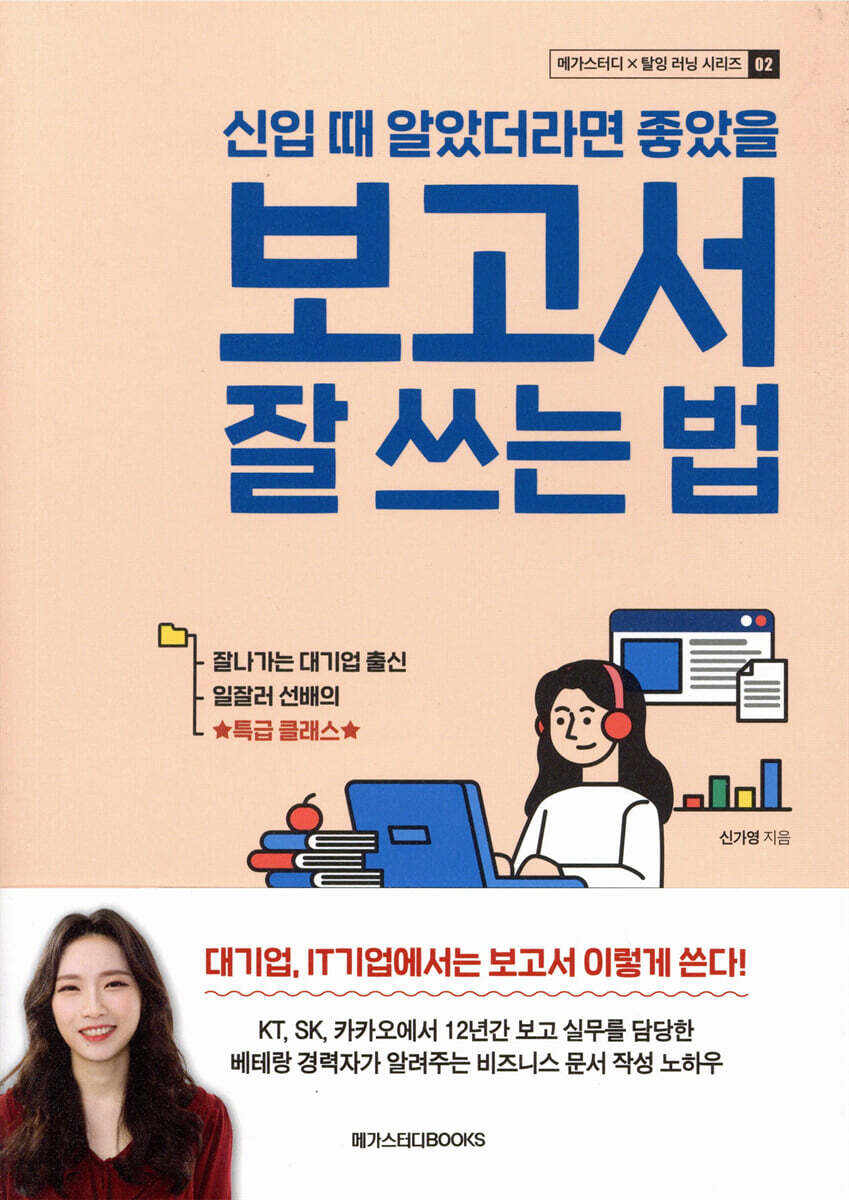
How to Write a Good Report: What I Wish I Knew When I Was a Newbie
 |
Description
Book Introduction
A veteran who has been in charge of reporting and practical work for 12 years at KT, SK, and Kakao has organized this.
"The Perfect Report Writing Guide" in One Volume In a company, there are many times when you have to communicate through documents. Reports, plans, proposals, meeting minutes, and even emails, Word, Excel, and messengers all fall under the scope of document communication. Document communication is something we encounter every day, but it is often a difficult process for both new employees and those with considerable experience. I search for various materials, put them together, and send them after much thought, but I often end up receiving comments asking for corrections. However, there is no one at the company who teaches you how to create good documents, and there are many times when you feel anxious about what to do when the deadline approaches. This book is written by a veteran who has experienced everything from conservative, traditional conglomerates to innovative IT platform giants, and is a popular tutor on the online and offline education platform 'Tal-ing'. It contains all the document writing know-how accumulated over 12 years of corporate life. From professional proposals to send to clients, to writing emails that are too trivial to ask about, this book clearly teaches all the basics of writing business documents needed in a company, divided into 4 key steps. In addition, FAQs and TIPs are placed at the end of each chapter, and the author has compiled answers to frequently asked questions about document writing from juniors and colleagues during his career. |
- You can preview some of the book's contents.
Preview
index
Prologue_ Learn report writing tips from a skilled senior, learn them today and use them tomorrow!
Chapter 1: A Well-Made, Directed Report
What's different about reports that pass at once?
* When you receive a work order, figure out three things:
* The report is tailored to the tastes of the person receiving the report, not to me.
The first step in understanding the intent of a report is to understand the recipient.
* Report writing usually proceeds like this
* Understand the characteristics of the person being reported to
Second step in understanding the intent of the report: understanding the purpose of the report.
* The report is divided into two purposes:
* If you want to increase the value of your report
* In order to modify the report, you must first know the cause.
How to perfectly understand the intent of a report, an interim report
* Two ways to accurately understand the intent of the report
* When is the best time to do an interim report?
* What is the best way to conduct an interim report?
* Who would be a good person to report to?
FAQ What should I do in this situation?
* Deadlines are always a burden
* I can't understand the team leader's work instructions all at once.
* It's difficult because the team leader and executives have different opinions.
* I'm curious about how to persuade the team leader.
Chapter 2: A Clear, Unconfusing Report
How to derive a message that matches the reporting intent
* What I most want to say through the report
* Message first? Research first?
* Characteristics of a good message suitable for reporting
How to weave a storyline so that dozens or hundreds of chapters speak with one voice.
* Flow of the report, storyline
* Why the report I wrote is being criticized
The storyline of the persuasive report
* Storyline that should vary depending on the reporting intent
* 3 Principles of Storylines for a Report That Doesn't Get Cracked
* This is how to structure a plan and proposal.
* Storyline tailored to the person receiving the report
Storyline for sharing
* The minutes should be organized like this
* The results report can be structured like this:
* This is how to structure your performance report.
* This is how to structure a trend survey
TIP_ How to express report contents clearly and concisely
* Extracting core keywords
* Use of compressed words or industry-common abbreviations
* Remove modifiers, unimportant content, and duplicate content
Chapter 3: A Solid, Irrefutable Report
Tips for Selecting Solid Data to Increase Reliability and Logic
* Four characteristics of solid data
Tips for Smart Data Management
* List all necessary materials without omission
* Collecting data internally
* Collecting data from outside
FAQ_ I want to find the information better
* I'm curious about how to get better at Googling.
* It's difficult to find statistics for specific markets.
Chapter 4: A Clean, Readable Report
The basic principles of a clean-looking slide: layout, consistency, and readability.
* Layout: Magic that makes the message clearly visible
* Unity: A prerequisite for looking neat and tidy.
* Readability: The basis of a friendly report that is considerate of the person receiving the report.
More concise than text! How to visualize message types.
* Six Types of Effectively Visualizing Your Message
* When creating a graph, be sure to follow these guidelines:
* Start working on PPT in earnest
Word, Excel, Email, Messenger: Professional-Looking Reporting Methods
* Word (or Hangul) writing method that makes even long texts easy to read
* How to write Excel as beautifully as PPT
* How to write an email so the recipient understands it the first time
* How to give quick and clear messenger feedback
FAQ_ I want to make better PPTs.
* I'm curious about how to choose PPT colors.
* Typos are only visible after submission
* The chart I drew is hard to see.
Chapter 1: A Well-Made, Directed Report
What's different about reports that pass at once?
* When you receive a work order, figure out three things:
* The report is tailored to the tastes of the person receiving the report, not to me.
The first step in understanding the intent of a report is to understand the recipient.
* Report writing usually proceeds like this
* Understand the characteristics of the person being reported to
Second step in understanding the intent of the report: understanding the purpose of the report.
* The report is divided into two purposes:
* If you want to increase the value of your report
* In order to modify the report, you must first know the cause.
How to perfectly understand the intent of a report, an interim report
* Two ways to accurately understand the intent of the report
* When is the best time to do an interim report?
* What is the best way to conduct an interim report?
* Who would be a good person to report to?
FAQ What should I do in this situation?
* Deadlines are always a burden
* I can't understand the team leader's work instructions all at once.
* It's difficult because the team leader and executives have different opinions.
* I'm curious about how to persuade the team leader.
Chapter 2: A Clear, Unconfusing Report
How to derive a message that matches the reporting intent
* What I most want to say through the report
* Message first? Research first?
* Characteristics of a good message suitable for reporting
How to weave a storyline so that dozens or hundreds of chapters speak with one voice.
* Flow of the report, storyline
* Why the report I wrote is being criticized
The storyline of the persuasive report
* Storyline that should vary depending on the reporting intent
* 3 Principles of Storylines for a Report That Doesn't Get Cracked
* This is how to structure a plan and proposal.
* Storyline tailored to the person receiving the report
Storyline for sharing
* The minutes should be organized like this
* The results report can be structured like this:
* This is how to structure your performance report.
* This is how to structure a trend survey
TIP_ How to express report contents clearly and concisely
* Extracting core keywords
* Use of compressed words or industry-common abbreviations
* Remove modifiers, unimportant content, and duplicate content
Chapter 3: A Solid, Irrefutable Report
Tips for Selecting Solid Data to Increase Reliability and Logic
* Four characteristics of solid data
Tips for Smart Data Management
* List all necessary materials without omission
* Collecting data internally
* Collecting data from outside
FAQ_ I want to find the information better
* I'm curious about how to get better at Googling.
* It's difficult to find statistics for specific markets.
Chapter 4: A Clean, Readable Report
The basic principles of a clean-looking slide: layout, consistency, and readability.
* Layout: Magic that makes the message clearly visible
* Unity: A prerequisite for looking neat and tidy.
* Readability: The basis of a friendly report that is considerate of the person receiving the report.
More concise than text! How to visualize message types.
* Six Types of Effectively Visualizing Your Message
* When creating a graph, be sure to follow these guidelines:
* Start working on PPT in earnest
Word, Excel, Email, Messenger: Professional-Looking Reporting Methods
* Word (or Hangul) writing method that makes even long texts easy to read
* How to write Excel as beautifully as PPT
* How to write an email so the recipient understands it the first time
* How to give quick and clear messenger feedback
FAQ_ I want to make better PPTs.
* I'm curious about how to choose PPT colors.
* Typos are only visible after submission
* The chart I drew is hard to see.
Detailed image
.jpg)
Publisher's Review
If you write your report like this, it will pass in one go!
The hard-hitting practical report writing know-how of a 'LAN cable shooter'!
- The second book in the Megastudy X Tal-ing Running series
- The #1 course in the field of business documentation writing, compiled into one book.
- The know-how of writing practical reports from successful seniors from KT, SK, and Kakao
[This kind of person definitely needs this book!]
· New employees who have difficulty communicating through documents within the company
· Office workers who feel overwhelmed every time they start a document and it takes a long time
· An employee with n years of experience who is asked to make revisions every time he submits a report
· A team leader who has a lot of work to review documents but is worried about how to give feedback.
· Planners who want to write documents in a more professional manner
How to Write Business Documents in 4 Steps
The author says that even seemingly daunting reporting requests can be easier to handle than you might think if you remember just a few essential principles. He clearly introduces each part of the four-step process that can be applied to the writing of all business documents.
① A well-written, well-directed report - Why use this? ▶ Understanding the intent
When a requester requests a document, there is a clear intention on his part.
And the principle of document writing is to quickly deliver the answer the requester wants.
To this end, we will inform you of the things you must check when you first receive work instructions.
② Clear, unambiguous reports - So what does that mean? ▶ Logical structure
When writing a full-fledged report, we explain how to derive key messages and establish an overall storyline.
In particular, it introduces the contents that must be included and their structure depending on the document type, such as a plan, proposal, or meeting minutes.
③ A solid, irrefutable report - is it trustworthy? ▶ Data collection
Describes how to collect the data necessary to support the report.
We will also look at how to collect and verify data, as well as how to manage and list that data by message.
④Clean, easy-to-read reports - Wow, that's pretty well-made! ▶ Visualization tips
To get your point across quickly and effectively, a clean visualization is key.
We explain the principles of clean-looking slides and how to visualize each message, and also share specific tips for effectively using diagrams and graphs.
We also introduce methods for writing messages that can be communicated clearly in Word, Excel, email, and messenger.
* Praise comments from students who took the author's report class
I think I'll be able to reduce a lot of trial and error when creating reports now.
I didn't know if it was a good report or a bad report, so I just used what looked good. Thank you for kindly explaining the concept.
I only had a vague idea of how to send emails and messengers, but I think I've finally fixed my mistakes. - S*
It feels like I'm learning step by step from a skilled shooter.
A class that clearly explains to-do and not-to-do! - Ma*
I'm currently a team leader, and there are many useful tips that I hope my subordinates will see. I'm studying them while receiving sympathy and comfort.
Even from the perspective of reporting to the Managing Director and CEO, there are many key and concise things to learn.
- An*hee
I had a hard time understanding and grasping the key points of the orders my boss gave me, but I received a lot of help with this.
I was able to figure out why my report was rejected and what was wrong with my previous report.
I think it will be very helpful for future document writing since I have a good grasp of the big picture of the document writing process.
- This*eul
I recently re-entered the workforce after a long career break, and since I didn't have to write many reports at my previous job, I was under a lot of stress from writing recent reports when I decided to take this class.
This seems like a great course for people like me who don't have much experience writing reports or are just starting out in society! - An*seon
I feel ashamed of my past, when my boss gave me a task, I would just jump into it without thinking deeply about why he gave me that task.
Now, I'm going to start by understanding the requester's intentions, just like you suggested! I wish I had had a mentor like you when I first joined the company.
- west*
I started working late, so I was always frustrated when I was told to rewrite reports. I didn't know what to do or how to rewrite them, so I was frustrated. But after taking this class, I knew exactly what was wrong!
Since the tutor has been working as a practitioner for a long time, the tips he gives from his experience really resonate with me.
- Ash*
People who are good at their jobs clearly point out what makes them different.
I really hated the reporting system that went back and forth uselessly, and to some extent, the reason was because of me..ㅎ To exaggerate a little, I think my work life can be divided into before and after taking this lecture.
- Park*Hyeon
The hard-hitting practical report writing know-how of a 'LAN cable shooter'!
- The second book in the Megastudy X Tal-ing Running series
- The #1 course in the field of business documentation writing, compiled into one book.
- The know-how of writing practical reports from successful seniors from KT, SK, and Kakao
[This kind of person definitely needs this book!]
· New employees who have difficulty communicating through documents within the company
· Office workers who feel overwhelmed every time they start a document and it takes a long time
· An employee with n years of experience who is asked to make revisions every time he submits a report
· A team leader who has a lot of work to review documents but is worried about how to give feedback.
· Planners who want to write documents in a more professional manner
How to Write Business Documents in 4 Steps
The author says that even seemingly daunting reporting requests can be easier to handle than you might think if you remember just a few essential principles. He clearly introduces each part of the four-step process that can be applied to the writing of all business documents.
① A well-written, well-directed report - Why use this? ▶ Understanding the intent
When a requester requests a document, there is a clear intention on his part.
And the principle of document writing is to quickly deliver the answer the requester wants.
To this end, we will inform you of the things you must check when you first receive work instructions.
② Clear, unambiguous reports - So what does that mean? ▶ Logical structure
When writing a full-fledged report, we explain how to derive key messages and establish an overall storyline.
In particular, it introduces the contents that must be included and their structure depending on the document type, such as a plan, proposal, or meeting minutes.
③ A solid, irrefutable report - is it trustworthy? ▶ Data collection
Describes how to collect the data necessary to support the report.
We will also look at how to collect and verify data, as well as how to manage and list that data by message.
④Clean, easy-to-read reports - Wow, that's pretty well-made! ▶ Visualization tips
To get your point across quickly and effectively, a clean visualization is key.
We explain the principles of clean-looking slides and how to visualize each message, and also share specific tips for effectively using diagrams and graphs.
We also introduce methods for writing messages that can be communicated clearly in Word, Excel, email, and messenger.
* Praise comments from students who took the author's report class
I think I'll be able to reduce a lot of trial and error when creating reports now.
I didn't know if it was a good report or a bad report, so I just used what looked good. Thank you for kindly explaining the concept.
I only had a vague idea of how to send emails and messengers, but I think I've finally fixed my mistakes. - S*
It feels like I'm learning step by step from a skilled shooter.
A class that clearly explains to-do and not-to-do! - Ma*
I'm currently a team leader, and there are many useful tips that I hope my subordinates will see. I'm studying them while receiving sympathy and comfort.
Even from the perspective of reporting to the Managing Director and CEO, there are many key and concise things to learn.
- An*hee
I had a hard time understanding and grasping the key points of the orders my boss gave me, but I received a lot of help with this.
I was able to figure out why my report was rejected and what was wrong with my previous report.
I think it will be very helpful for future document writing since I have a good grasp of the big picture of the document writing process.
- This*eul
I recently re-entered the workforce after a long career break, and since I didn't have to write many reports at my previous job, I was under a lot of stress from writing recent reports when I decided to take this class.
This seems like a great course for people like me who don't have much experience writing reports or are just starting out in society! - An*seon
I feel ashamed of my past, when my boss gave me a task, I would just jump into it without thinking deeply about why he gave me that task.
Now, I'm going to start by understanding the requester's intentions, just like you suggested! I wish I had had a mentor like you when I first joined the company.
- west*
I started working late, so I was always frustrated when I was told to rewrite reports. I didn't know what to do or how to rewrite them, so I was frustrated. But after taking this class, I knew exactly what was wrong!
Since the tutor has been working as a practitioner for a long time, the tips he gives from his experience really resonate with me.
- Ash*
People who are good at their jobs clearly point out what makes them different.
I really hated the reporting system that went back and forth uselessly, and to some extent, the reason was because of me..ㅎ To exaggerate a little, I think my work life can be divided into before and after taking this lecture.
- Park*Hyeon
GOODS SPECIFICS
- Publication date: September 29, 2022
- Page count, weight, size: 228 pages | 145*210*20mm
- ISBN13: 9791129708236
- ISBN10: 1129708233
You may also like
카테고리
korean


korean

![GQ KOREA Mark (Monthly): December [2025]](http://librairie.coreenne.fr/cdn/shop/files/8ef265dbbfbf186523ed75ba7319009d.jpg?v=1765340328&width=3840)


