

Infinite Game
 |
Description
Book Introduction
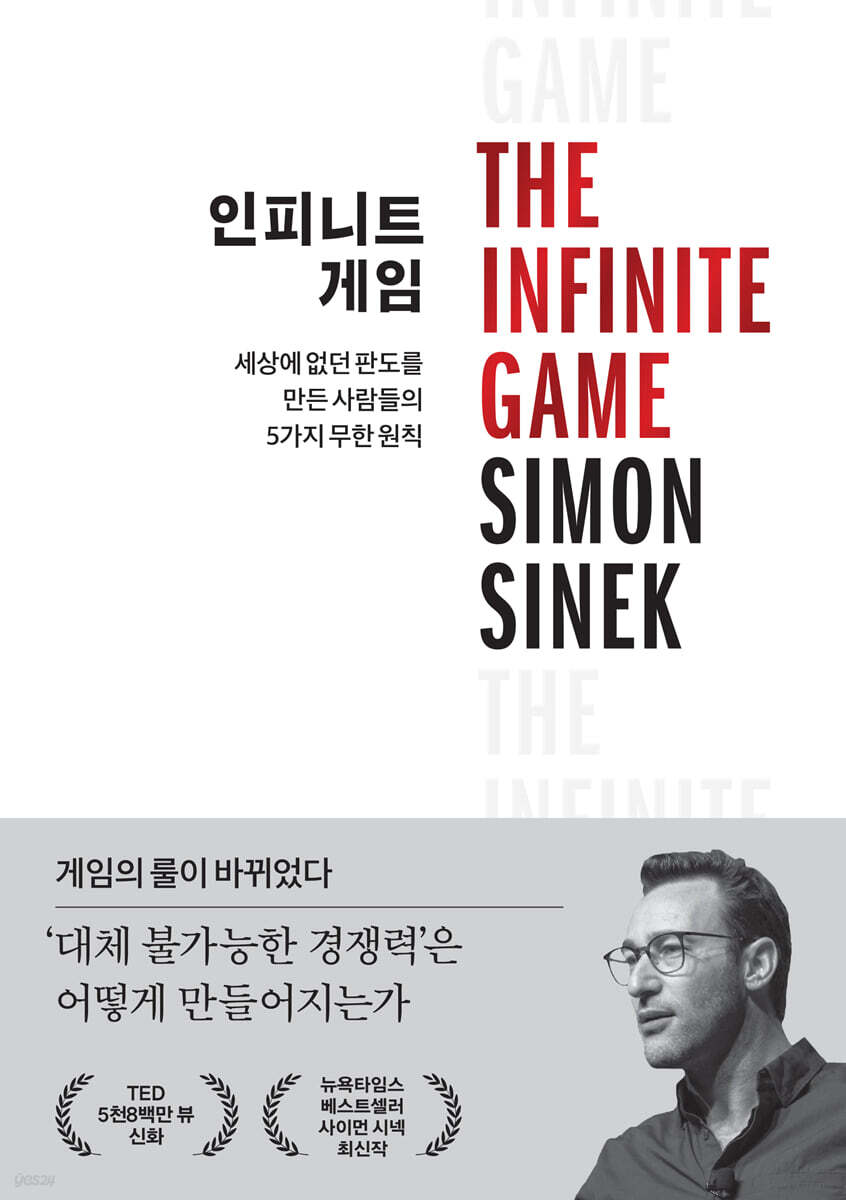
* The latest work by Simon Sinek, the protagonist of the 'Golden Circle Theory', which recorded 58 million views on TED. * Insights that follow the bestseller 『Start with Why』 Starting with "Why," Now Talking About "Unlimited Competitiveness." * Recommended by leading figures in the business world, "The greatest inspiration in all aspects of work and life." * Amazon, New York Times bestseller in economics and management The rules of the game have changed. We have been players of 'Yuhan Game' for a long time, searching for a clear finish line. However, today's market is moving into an era of 'infinite games' where there is no finish line, no competitors, no rules, and not even winners or losers. The finite game method that focuses on first place no longer works in infinite games. Infinite games require new strategies suited to infinite games. It is not about existing rules such as correct answers, rules, and formulas for success, but rather a strategy that is flexible and looks ahead even in times of change and crisis. So what is this infinite mindset that cuts through complex markets? And how should we play in this age of infinite games? Simon Sinek, who created the 'WHY syndrome' worldwide with his TED lecture on 'WHY', the core value that leads individuals and organizations to success, has now brought out an interesting concept called 'Infinite Game'. He deepens and expands on the insights he presented in his best-selling book, Start with Why, to discuss what we most need in today's unpredictable business world: "unlimited competitiveness." Simon Sinek, whose insightful messages have provided fresh inspiration and shock to millennials and global companies, will once again offer a new direction for your work and life. This contains a 'hidden card' for your next play. |
- You can preview some of the book's contents.
Preview
index
Introduction: The Power to Change Reality
victory
Chapter 1: Finite and Infinite Games: What Game Are You Playing Now?
Chapter 2: The starting point of all play
Chapter 3 Real Reason vs.
Fake reason
Chapter 4: The emergence of new titles
Chapter 5: Rebooting Capitalism
Chapter 6 How to Beat Numbers
Chapter 7: When you reveal your true face to your colleagues
Chapter 8: Thoughts That Secretly Ruin the Organization
Chapter 9 They are the Navy and We are Pirates
Chapter 10: Blow Up the Company
Chapter 11: The Courage to Push Your Thoughts Forward
Going out
victory
Chapter 1: Finite and Infinite Games: What Game Are You Playing Now?
Chapter 2: The starting point of all play
Chapter 3 Real Reason vs.
Fake reason
Chapter 4: The emergence of new titles
Chapter 5: Rebooting Capitalism
Chapter 6 How to Beat Numbers
Chapter 7: When you reveal your true face to your colleagues
Chapter 8: Thoughts That Secretly Ruin the Organization
Chapter 9 They are the Navy and We are Pirates
Chapter 10: Blow Up the Company
Chapter 11: The Courage to Push Your Thoughts Forward
Going out
Detailed image

Into the book
A game exists as long as there are two or more participants.
And games are divided into finite games and infinite games.
--- p.17
In an infinite game, time is given infinitely.
There is no end to the game, so there is virtually no concept of 'winning'.
The main purpose of an infinite game is to keep the game going and keep the game interesting.
--- p.18
To succeed in the endless game of business, we must abandon the habit of focusing on who is the winner and who is the best, and instead consider how to build a strong company that can survive in the game for a long time.
--- p.22
Finite game participants create products that they can sell to people, while infinite game participants create products that people want to buy.
--- p.26
I generally find it much easier to focus on short-term, finite-game goals than to struggle to realize an infinite-game vision of the future.
The same applies to running a business, especially when the business situation is difficult.
--- p.47
Pursuing a cause can help you find meaning in your work and life.
Having a purpose in mind allows you to focus on something bigger than the finite rewards and individual victories.
--- p.61
Developing the ability to discern between right and wrong causes can help you avoid losses as an investor, employee, or consumer.
Because you can identify and avoid companies that lack a clear cause.
--- p.86
Even when a finite game leader has good intentions, he or she often thinks, "I have to make money to do good things."
But infinite game leaders think, 'If you do good things, you'll make money.'
This is more of a way of life than a formula.
--- p.97
Just because a leader is an infinite game leader doesn't mean he or she is completely uninterested in the company's finite game profits.
However, the criterion for judging whether the profits help advance the company's infinite game vision is used.
--- p.108
Now we need to replace Friedman's logic.
We need to move beyond the narrow, profit-focused mindset and embrace a more nuanced definition that considers all the dynamic and diverse aspects that drive business.
--- p.139
Generally, the source of willpower exists within.
It is influenced by how good the leader's leadership skills are and how clear and strong the cause is.
Willpower is the sum total of all human factors that determine the health of a business.
--- p.151
When you work in a team you trust, you feel safe to be vulnerable.
It is possible to admit mistakes, be honest when you don't perform well, take responsibility for your actions, and ask for help.
--- p.169
A safety net is essential to foster trust between people.
A safety net is an environment where there is psychological safety among colleagues, where it is okay to expose one's vulnerabilities.
It refers to an atmosphere where it is easy to admit mistakes, express needs, and share fears or anxieties, and where people feel confident that the other person will not exploit that information and will genuinely help them when they ask for help.
--- p.181
When an organizational culture is unhealthy, people seek safety in rules.
That's why bureaucracy exists.
They believe that they can survive in the workplace only by strictly following the rules.
And in the process, all trust, both inside and outside the workplace, plummets.
In organizations with a healthy culture, people find security in their relationships.
High-performing teams are built on strong bonds.
--- p.195
A culture that overemphasizes quarterly or annual financial performance pressures employees to cut corners, break rules, and engage in unsavory behavior to meet assigned performance targets.
--- p.204
When competing with a traditional competitor, you become absorbed in the result, but when competing with a friendly rival, you become absorbed in the process.
Even a slight shift in perspective like this can quickly change your perspective on business.
--- p.245
With an infinite game mindset, you can enjoy abundance, but with a finite game mindset, you are always in a state of mental deficiency.
In an infinite game, the mindset of "I want to be the best" is a futile effort, and you must realize that many participants can do well at the same time.
--- p.247
Most companies cite 'market conditions', 'new technologies', or stock issues as the reasons for their failure, but that's not true.
The reason companies collapse is because their leaders fail to make the decision when fundamental flexibility is absolutely necessary.
The moment you abandon your cause, you also abandon fundamental flexibility.
--- p.267
It doesn't take much courage for a corporate leader to implement massive layoffs to squeeze out year-end results.
But it takes great courage to try other methods whose effectiveness has not yet been proven.
And games are divided into finite games and infinite games.
--- p.17
In an infinite game, time is given infinitely.
There is no end to the game, so there is virtually no concept of 'winning'.
The main purpose of an infinite game is to keep the game going and keep the game interesting.
--- p.18
To succeed in the endless game of business, we must abandon the habit of focusing on who is the winner and who is the best, and instead consider how to build a strong company that can survive in the game for a long time.
--- p.22
Finite game participants create products that they can sell to people, while infinite game participants create products that people want to buy.
--- p.26
I generally find it much easier to focus on short-term, finite-game goals than to struggle to realize an infinite-game vision of the future.
The same applies to running a business, especially when the business situation is difficult.
--- p.47
Pursuing a cause can help you find meaning in your work and life.
Having a purpose in mind allows you to focus on something bigger than the finite rewards and individual victories.
--- p.61
Developing the ability to discern between right and wrong causes can help you avoid losses as an investor, employee, or consumer.
Because you can identify and avoid companies that lack a clear cause.
--- p.86
Even when a finite game leader has good intentions, he or she often thinks, "I have to make money to do good things."
But infinite game leaders think, 'If you do good things, you'll make money.'
This is more of a way of life than a formula.
--- p.97
Just because a leader is an infinite game leader doesn't mean he or she is completely uninterested in the company's finite game profits.
However, the criterion for judging whether the profits help advance the company's infinite game vision is used.
--- p.108
Now we need to replace Friedman's logic.
We need to move beyond the narrow, profit-focused mindset and embrace a more nuanced definition that considers all the dynamic and diverse aspects that drive business.
--- p.139
Generally, the source of willpower exists within.
It is influenced by how good the leader's leadership skills are and how clear and strong the cause is.
Willpower is the sum total of all human factors that determine the health of a business.
--- p.151
When you work in a team you trust, you feel safe to be vulnerable.
It is possible to admit mistakes, be honest when you don't perform well, take responsibility for your actions, and ask for help.
--- p.169
A safety net is essential to foster trust between people.
A safety net is an environment where there is psychological safety among colleagues, where it is okay to expose one's vulnerabilities.
It refers to an atmosphere where it is easy to admit mistakes, express needs, and share fears or anxieties, and where people feel confident that the other person will not exploit that information and will genuinely help them when they ask for help.
--- p.181
When an organizational culture is unhealthy, people seek safety in rules.
That's why bureaucracy exists.
They believe that they can survive in the workplace only by strictly following the rules.
And in the process, all trust, both inside and outside the workplace, plummets.
In organizations with a healthy culture, people find security in their relationships.
High-performing teams are built on strong bonds.
--- p.195
A culture that overemphasizes quarterly or annual financial performance pressures employees to cut corners, break rules, and engage in unsavory behavior to meet assigned performance targets.
--- p.204
When competing with a traditional competitor, you become absorbed in the result, but when competing with a friendly rival, you become absorbed in the process.
Even a slight shift in perspective like this can quickly change your perspective on business.
--- p.245
With an infinite game mindset, you can enjoy abundance, but with a finite game mindset, you are always in a state of mental deficiency.
In an infinite game, the mindset of "I want to be the best" is a futile effort, and you must realize that many participants can do well at the same time.
--- p.247
Most companies cite 'market conditions', 'new technologies', or stock issues as the reasons for their failure, but that's not true.
The reason companies collapse is because their leaders fail to make the decision when fundamental flexibility is absolutely necessary.
The moment you abandon your cause, you also abandon fundamental flexibility.
--- p.267
It doesn't take much courage for a corporate leader to implement massive layoffs to squeeze out year-end results.
But it takes great courage to try other methods whose effectiveness has not yet been proven.
--- p.323
Publisher's Review
What is different about people who see one step ahead?
The thinking patterns of people who changed the flow of business
There are two players here.
One person runs hard towards the final destination.
But the other one is not interested in the success point that many people are looking at.
He is not interested in his competitors' performance and is only focused on his own play.
But everyone cheers for his play.
Even he is always one step ahead of others.
What on earth makes him so relaxed in this competitive world?
Simon Sinek, who has garnered worldwide attention for his lectures on the mindset of successful people and set an unprecedented record of 58 million TED views, has returned with a new book, The Infinite Game, which expands on his insights from his best-selling books, Start with Why and Leader Different.
In 『Start with Why』, we share the 'Why' perspective of those who created change and innovation, and in 『Leader Different』, we talk about their unique 'How', or method of action. In 『Infinite Game』, we present the specific strategies and implementation directions needed in the market called 'Infinite Game'.
Business is increasingly moving towards infinite games.
Finite games with clear objectives, such as soccer or chess, have fixed rules, clear competitors, and easily identifiable winners and losers, but infinite games with no rules or competitors require us to play differently.
So how should we move forward in this unprecedented new game?
The difference between a company that will disappear in 10 years and a company that will grow further,
“Are you playing a finite game or an infinite game?”
The rate at which companies are being eliminated from the game of business is accelerating.
The average lifespan of a company in the 1950s was just over 60 years.
On the other hand, it has not even been 20 years now.
Simon Sinek says that the reason companies fail is not simply technological innovation.
He analyzed companies and organizations that are disappearing and pointed out that the reason is not the technology itself, but rather the failure of leaders to properly prepare their companies for the future in a changing world.
People and companies that change the business landscape with bold judgment and ideas act as if they have seen the future.
But that is not prophecy.
According to Simon Sinek, there is a common pattern among companies that have survived resiliently through crises and have remained beloved for a long time.
That they have a vivid vision of a future that doesn't yet exist, a cause that excites them.
They are constantly searching for new ideas and technologies to make their cause a reality.
They welcome new competitors, are resilient in times of crisis, and are loved by many because they have a distinctive meaning in their work.
Individuals and organizations with a clear vision of their own will find this game enjoyable.
In finite games, you play to win the target in front of you, but infinite games, you play for a 'sustainable tomorrow'.
That's why people who play infinite games are one step ahead of others and one step ahead.
Their gaze is not on the present, but on the future.
Surviving in a complex market
Talking about 'irreplaceable competitiveness'
The titles of 'number one', 'victory', and 'best in the industry' are always thrilling.
Those of you who value goals and achievements have probably often experienced the sweet joy of victory.
But you probably soon became anxious again.
Because it's not a fight that ends with just one win.
Metrics like rankings, sales figures, stock performance, employee count, and market share are finite, and the results we so desperately desire are fleeting.
Faced with the limited metrics of these finite games, Simon Sinek poses a question from a different perspective.
What do you work for every day? Who are your real rivals? Are you willing to show weakness within your team? Are you willing to blow up the company? Do you have the courage to push your ideas forward?
He discusses the infinite game mindset, starting from a cause, focusing on the necessary open communication within a team, progressive competition with rivals, how to lead innovative ideas, and the mindset for pioneering courage.
And the book clearly reveals the differences between organizations that have the five infinite principles and those that do not, with various examples.
Why Apple welcomed IBM as its competitor in the personal computer market, why Four Seasons employees took such pride in their company and their work, why CVS, the largest drugstore chain in the US, still saw profits after it stopped selling cigarettes, and why people love Disney so much – at the heart of all these successes was a compelling infinite game mindset.
Expectations for my work,
Tomorrow's possibilities
Rather than presenting an abstract and vague vision, Simon Sinek presents a concrete picture of the infinite game mindset that moves people's hearts, drawing on vivid examples from various businesses.
As you follow these stories, you too will ask yourself what your own unique, infinite vision is in your work and life, and envision your own differentiated tomorrow.
“If you adopt an infinite game mindset, you’ll feel motivated every morning when you come to work, feel secure while you’re at work, and feel a sense of accomplishment at the end of the day,” he says.
People who have established their own vision and direction along with the principles of Infinite Game wake up every morning feeling full of motivation, feel a sense of stability with unwavering self-belief at work, and look forward to tomorrow when they leave work and end the day.
This book is about that change.
Transform the anxious present into anticipation for tomorrow.
An infinite game of captivating visions that will make your heart race will begin for you with this book.
The thinking patterns of people who changed the flow of business
There are two players here.
One person runs hard towards the final destination.
But the other one is not interested in the success point that many people are looking at.
He is not interested in his competitors' performance and is only focused on his own play.
But everyone cheers for his play.
Even he is always one step ahead of others.
What on earth makes him so relaxed in this competitive world?
Simon Sinek, who has garnered worldwide attention for his lectures on the mindset of successful people and set an unprecedented record of 58 million TED views, has returned with a new book, The Infinite Game, which expands on his insights from his best-selling books, Start with Why and Leader Different.
In 『Start with Why』, we share the 'Why' perspective of those who created change and innovation, and in 『Leader Different』, we talk about their unique 'How', or method of action. In 『Infinite Game』, we present the specific strategies and implementation directions needed in the market called 'Infinite Game'.
Business is increasingly moving towards infinite games.
Finite games with clear objectives, such as soccer or chess, have fixed rules, clear competitors, and easily identifiable winners and losers, but infinite games with no rules or competitors require us to play differently.
So how should we move forward in this unprecedented new game?
The difference between a company that will disappear in 10 years and a company that will grow further,
“Are you playing a finite game or an infinite game?”
The rate at which companies are being eliminated from the game of business is accelerating.
The average lifespan of a company in the 1950s was just over 60 years.
On the other hand, it has not even been 20 years now.
Simon Sinek says that the reason companies fail is not simply technological innovation.
He analyzed companies and organizations that are disappearing and pointed out that the reason is not the technology itself, but rather the failure of leaders to properly prepare their companies for the future in a changing world.
People and companies that change the business landscape with bold judgment and ideas act as if they have seen the future.
But that is not prophecy.
According to Simon Sinek, there is a common pattern among companies that have survived resiliently through crises and have remained beloved for a long time.
That they have a vivid vision of a future that doesn't yet exist, a cause that excites them.
They are constantly searching for new ideas and technologies to make their cause a reality.
They welcome new competitors, are resilient in times of crisis, and are loved by many because they have a distinctive meaning in their work.
Individuals and organizations with a clear vision of their own will find this game enjoyable.
In finite games, you play to win the target in front of you, but infinite games, you play for a 'sustainable tomorrow'.
That's why people who play infinite games are one step ahead of others and one step ahead.
Their gaze is not on the present, but on the future.
Surviving in a complex market
Talking about 'irreplaceable competitiveness'
The titles of 'number one', 'victory', and 'best in the industry' are always thrilling.
Those of you who value goals and achievements have probably often experienced the sweet joy of victory.
But you probably soon became anxious again.
Because it's not a fight that ends with just one win.
Metrics like rankings, sales figures, stock performance, employee count, and market share are finite, and the results we so desperately desire are fleeting.
Faced with the limited metrics of these finite games, Simon Sinek poses a question from a different perspective.
What do you work for every day? Who are your real rivals? Are you willing to show weakness within your team? Are you willing to blow up the company? Do you have the courage to push your ideas forward?
He discusses the infinite game mindset, starting from a cause, focusing on the necessary open communication within a team, progressive competition with rivals, how to lead innovative ideas, and the mindset for pioneering courage.
And the book clearly reveals the differences between organizations that have the five infinite principles and those that do not, with various examples.
Why Apple welcomed IBM as its competitor in the personal computer market, why Four Seasons employees took such pride in their company and their work, why CVS, the largest drugstore chain in the US, still saw profits after it stopped selling cigarettes, and why people love Disney so much – at the heart of all these successes was a compelling infinite game mindset.
Expectations for my work,
Tomorrow's possibilities
Rather than presenting an abstract and vague vision, Simon Sinek presents a concrete picture of the infinite game mindset that moves people's hearts, drawing on vivid examples from various businesses.
As you follow these stories, you too will ask yourself what your own unique, infinite vision is in your work and life, and envision your own differentiated tomorrow.
“If you adopt an infinite game mindset, you’ll feel motivated every morning when you come to work, feel secure while you’re at work, and feel a sense of accomplishment at the end of the day,” he says.
People who have established their own vision and direction along with the principles of Infinite Game wake up every morning feeling full of motivation, feel a sense of stability with unwavering self-belief at work, and look forward to tomorrow when they leave work and end the day.
This book is about that change.
Transform the anxious present into anticipation for tomorrow.
An infinite game of captivating visions that will make your heart race will begin for you with this book.
GOODS SPECIFICS
- Date of issue: June 14, 2022
- Page count, weight, size: 328 pages | 556g | 148*210*22mm
- ISBN13: 9788933871874
- ISBN10: 893387187X
You may also like
카테고리
korean


korean

![ELLE 엘르 스페셜 에디션 A형 : 12월 [2025]](http://librairie.coreenne.fr/cdn/shop/files/b8e27a3de6c9538896439686c6b0e8fb.jpg?v=1766436872&width=3840)


