

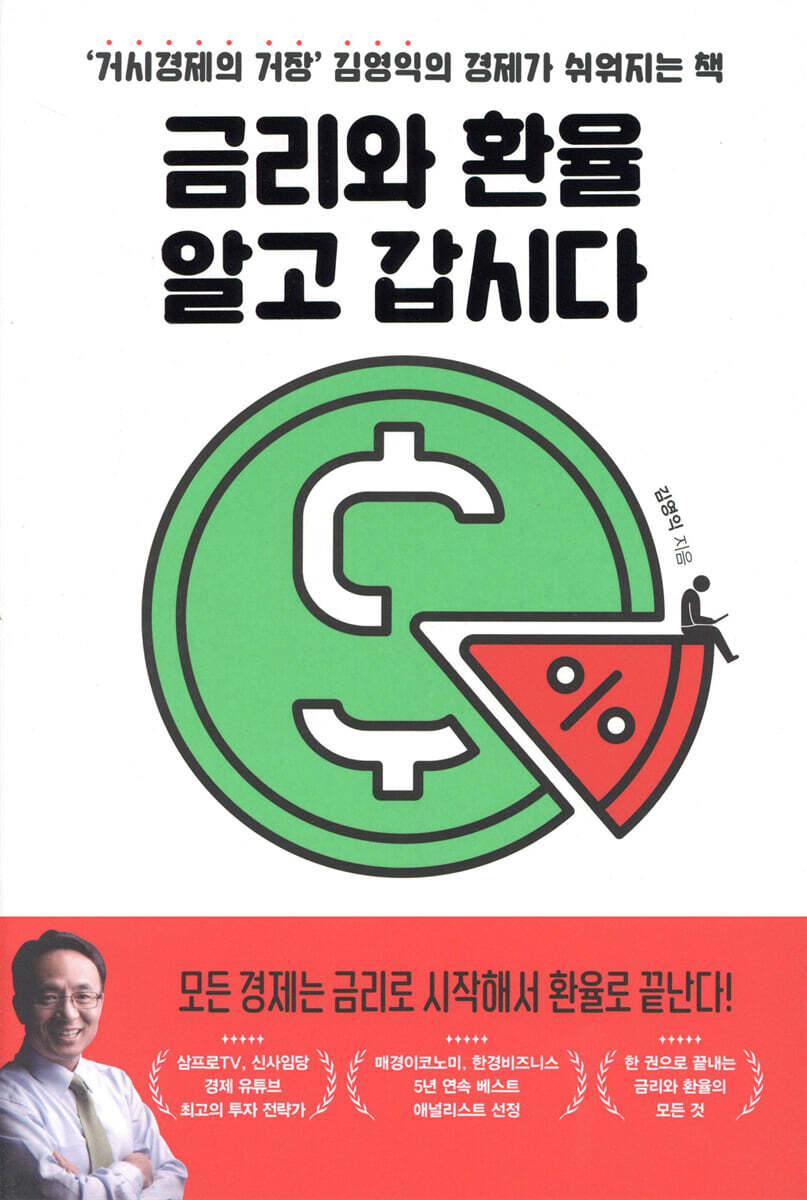
Let's learn about interest rates and exchange rates.
 |
Description
Book Introduction
Every economy begins with interest rates and ends with exchange rates!
Analyze economic trends with interest rates and predict the future with exchange rates!
It is no exaggeration to say that if you know interest rates and exchange rates, you have studied economics.
This is because interest rates and exchange rates comprehensively reflect domestic and international economic conditions.
There are many books on the impact or correlation between interest rates and exchange rates on stock prices, but it is difficult to find a book that analyzes the economy by focusing solely on interest rates and exchange rates.
So, Professor Kim Young-ik of Sogang University's Graduate School of Economics, known as the "Guru of Macroeconomics," analyzes difficult and complex economic theories and market situations one by one in "Let's Learn Interest Rates and Exchange Rates," and explains them clearly and easily with his own philosophy.
What we need now is not the simple concepts of interest rates and exchange rates.
It is a perspective that allows you to understand the current economic situation through interest rates and exchange rates, gain insight into the future, and grasp the flow of the economy more clearly.
This deep insight will help you make sound judgments and execute decisions even in times of crisis, such as rising (falling) interest rates, exchange rate fluctuations, and rising (falling) housing prices.
Analyze economic trends with interest rates and predict the future with exchange rates!
It is no exaggeration to say that if you know interest rates and exchange rates, you have studied economics.
This is because interest rates and exchange rates comprehensively reflect domestic and international economic conditions.
There are many books on the impact or correlation between interest rates and exchange rates on stock prices, but it is difficult to find a book that analyzes the economy by focusing solely on interest rates and exchange rates.
So, Professor Kim Young-ik of Sogang University's Graduate School of Economics, known as the "Guru of Macroeconomics," analyzes difficult and complex economic theories and market situations one by one in "Let's Learn Interest Rates and Exchange Rates," and explains them clearly and easily with his own philosophy.
What we need now is not the simple concepts of interest rates and exchange rates.
It is a perspective that allows you to understand the current economic situation through interest rates and exchange rates, gain insight into the future, and grasp the flow of the economy more clearly.
This deep insight will help you make sound judgments and execute decisions even in times of crisis, such as rising (falling) interest rates, exchange rate fluctuations, and rising (falling) housing prices.
- You can preview some of the book's contents.
Preview
index
Let's learn about interest rates and exchange rates.
Prologue: Let's learn about interest rates and exchange rates.
Part 1: Let's learn about interest rates
What is interest rate?
The origin of interest rates lies in credit.
In economics textbooks, the price paid for holding onto current consumption is called interest rate.
The Bank of Korea's monetary policy tool, the base interest rate
The Bank of Korea's base rate is the standard for all interest rates.
The base interest rate is determined by the Bank of Korea's Monetary Policy Committee.
You must read the monetary policy direction decision and minutes.
The distinction between doves and hawks is this:
Why does the Bank of Korea raise and lower the base interest rate?
How does the base interest rate affect prices?
The benchmark interest rate in the United States is the federal funds rate.
One method for determining the appropriate benchmark interest rate level is called the Taylor rule.
The impact of interest rate hikes on households and the self-employed
Household interest burden has increased due to interest rate hikes.
The burden on self-employed workers will increase further due to interest rate hikes.
When interest rates rise, it benefits households as a whole.
Simple and compound interest
Savings should be done with compound interest.
You need to know the Rule of 72
China's approach to US GDP is also due to the magic of compound interest.
Interest rates and bond prices are inversely related
When interest rates rise, bond prices fall.
Prices and interest rates are determined by the supply and demand for bonds.
You should invest in bonds during a period of falling interest rates.
Predicting the Future Economy with Interest Rates? The Term Structure of Interest Rates
The yield curve is a line connecting yields across bond maturities.
The short-term interest rate differential is ahead of the leading index.
The difference between short-term and long-term interest rates can also be used to predict future economic growth rates.
An inversion of the short-term and long-term interest rate differentials signals a recession.
Judging Financial Market Stability with Interest Rates? The Risk Structure of Interest Rates
When financial markets are unstable, risk premiums increase.
The relationship between currency and interest rates
As the money supply increases, interest rates fall due to the liquidity effect.
Interest rates rise again due to the income effect and Fisher effect.
Deposit and loan interest rates
You can see interest rate trends by looking at the weighted average interest rate.
The Federation of Banks of Korea compares deposit and loan interest rates.
First, how are loan interest rates determined?
Second, what types of loan interest rates are there?
Third, the Bank of Korea's base rate has been raised (lowered), but why aren't new loan rates raised (lowered) immediately?
Fourth, I got promoted. Is it possible to get a lower interest rate on my loan?
The relationship between interest rates and stock prices
When interest rates fall, stock prices rise.
Falling interest rates don't necessarily mean rising house prices.
The economic cycle, rather than interest rates, determines housing prices.
Interest rate outlook
Potential growth, which determines interest rates, continues to fall.
Savings are higher than investments, so there is a surplus of funds.
Interest rates are expected to fall as banks buy bonds.
Living in a Low Interest Rate Era
In an era of low interest rates, earned income is crucial.
In this era of low interest rates, you should also invest in stocks.
The Implications of Negative Real Interest Rates in the US
Real interest rates in the U.S. have fallen to their lowest levels since 1980.
The rise in nominal interest rates will reduce negative real interest rates.
Negative real interest rates were followed by a recession.
Part 2: Let's learn about exchange rates
Exchange rate display method
The exchange rate is the exchange rate between one country's currency and another country's currency.
It is correct to say that the value of the won has risen or fallen.
Exchange rate fluctuation factors
If our country's international balance of payments is in surplus, the value of the won rises.
If prices in our country rise more than prices in other countries, the value of the won will fall.
Interest rate differentials also have a significant impact on exchange rates.
Exchange rates fluctuate in the short term depending on factors such as expectations.
Exchange rates are also influenced by each country's monetary and fiscal policies.
Fluctuations in the value of the dollar have the most significant impact on the won/dollar exchange rate.
The exchange rate of the Korean Won against the Yen or Euro is determined by the fiscal exchange rate.
When buying or selling foreign currency at a foreign exchange bank, you must pay a fee.
Should I also deposit foreign currency?
You can also invest in dollars through ETFs.
The impact of exchange rates on macroeconomic variables
As the won appreciates, exports decline and corporate profitability worsens.
Some companies are positively affected by the rise in the value of the Korean Won.
The impact of exchange rates on individuals
Exchange rates also affect individual lives and investments.
Exchange rates are important to Mrs. Watanabe of Japan and Mrs. Kim of Korea.
Method of estimating the appropriate exchange rate
The appropriate level of the exchange rate is assessed using the real effective exchange rate.
The Korean won moves in the same direction as the yuan.
A representative exchange rate for purchasing power parity is the Big Mac Index.
U.S. Exchange Rate Report and Adequate Foreign Exchange Reserves
The United States may designate our country as a currency manipulator.
What is the appropriate amount of foreign exchange reserves?
The relationship between exchange rates and interest rates
When the won rises in value, interest rates fall.
The relationship between exchange rates and stock prices
When the won value rose, stock prices also rose.
As the won rose in value, stock prices of domestic industries rose further.
Central Bank Currency Swaps and Exchange Rate Stability
A swap is a financial technique that involves exchanging cash flows.
Here's why we swap currencies
currency war
The Plaza Accord was also a currency war.
After the Plaza Accord, the Korean economy enjoyed a "three lows boom."
Since the 2008 global financial crisis, a currency war has continued among advanced economies.
The currency war started by the United States has spread to Japan.
Since 2014, the European Central Bank has also participated in the currency war.
The 2020 COVID-19 economic crisis has reignited the currency war.
You can forecast the won/dollar exchange rate using the US-Korea base currency ratio.
US-China Hegemony War and Exchange Rate Outlook
US-China relations in the 2000s were complementary.
As the US-China imbalance is resolved, China will grow primarily through domestic demand.
China's GDP is projected to surpass that of the United States by 2030.
The US-China hegemony war could escalate into a financial war.
As China pursues financial power, capital market liberalization is expected.
The value of the yuan is likely to rise in the medium to long term.
Opportunities to increase wealth through finance are looming in China.
Global Economic Issues: Debt Traps and Asset Price Bubbles
The limits of debt-driven growth are coming.
China's corporate debt has surged, while the U.S.'s government debt has surged.
After the debt surge came the economic crisis.
Signs of a slowdown in global economic growth are emerging.
The Korean economy serves as a weather vane for the global economy.
A bubble has formed in asset prices.
The stock market bubble is at an all-time high.
The Fed's expansion of the money supply created a bubble.
Asset prices are more likely to experience a hard landing than a soft landing.
Detailed image

Into the book
Sometimes, you'll see articles in the newspaper categorizing Bank of Korea Monetary Policy Committee members into "doves" and "hawks."
The committee members who advocate for a looser monetary policy are called 'doves.'
Simply put, doves are those who argue that interest rates should be lowered and more money should be released to stimulate the economy.
Conversely, members who argue for raising interest rates or tightening monetary policy are labeled "hawks."
The minutes of the Monetary Policy Committee do not contain the names of the speakers, so it is impossible to know who is a dove and who is a hawk.
However, analysts who analyze bonds at securities firms' research centers often judge the inclinations of monetary policy committee members based on their usual remarks, distinguishing between doves and hawks.
When people see the stock market rising, they feel more anxious and sell more stocks, creating a vicious cycle.
That is, when there is bad news in the stock market, stock prices fall significantly.
In doing so, the dollar also often rises.
But when they see the exchange rate rising, stock market participants feel more ominous and sell more stocks.
In this way, exchange rates and stock prices move in a reciprocal manner.
The distinction between doves and hawks is this --- pp.31-32
Bond investments can be divided into ‘direct’ and ‘indirect’.
Direct investment is the direct purchase of bonds brokered by a financial company.
However, the problem is that there are numerous bonds and their prices vary depending on their credit rating and maturity.
In the stock market, the prices of individual stocks are known immediately, but this is not the case with bond prices.
So, it seems like it would be better to invest in bonds indirectly.
Asset management companies create and manage various bond funds.
If you go to a bank or securities company, you can subscribe to such funds regardless of the amount.
As of the end of October 2021, the balance of bond funds reached 132 trillion won.
Additionally, securities firms operate various bond wrap products.
Some securities firms are developing and selling wrap products that pay monthly interest.
Another indirect bond investment product is the bond ETF (exchange-traded fund).
This can also be invested in small amounts.
You should invest in bonds during a period of falling interest rates --- p.63
As interest rates fall, consumption and investment increase, as seen in the ripple effects of monetary policy.
Interest rates are defined as the price paid for refraining from spending, and as interest rates fall, the price paid for refraining from spending decreases, so households increase their consumption.
When interest rates fall, companies borrow money to invest.
For example, if the expected return on an investment is 5%, when the lending interest rate is 5%, the company will not borrow money to invest.
But if interest rates fall to 2%, companies will borrow money to invest.
Because the return you can earn from investing (5%) is greater than the interest you pay on borrowing.
When consumption and investment increase, the economy grows.
When we say economic growth, we usually mean an increase in gross domestic product (GDP). In terms of expenditure, GDP is calculated as [private consumption + investment + government consumption + exports - imports].
As you can see from this equation, when interest rates fall and consumption and investment increase, GDP, or the economy, grows and personal income also increases.
As our income increases, we tend to buy more goods and services.
In this case, the demand for money increases.
As the demand for money increases, interest rates rise.
Of course, this assumes that the supply of money is constant.
So, interest rates that had fallen due to the liquidity effect will rise again.
This is called the income effect.
Interest rates rise again due to the income effect and the Fisher effect --- pp. 79-80
The most important factor in determining stock prices is undoubtedly interest rates.
As seen in the stock price determination formula above, if we assume that dividends or corporate profit growth rates are constant, stock prices rise when interest rates fall.
When interest rates fall directly, investors look for other assets with higher expected returns than those rates.
One of them is stocks.
If the dividend yield of a stock is higher than the interest rate, some investment funds will flow into the stock market, increasing the demand for stocks and driving up stock prices.
Interest rates also indirectly act as a factor in driving up stock prices.
As we saw in the ripple effects of monetary policy, when interest rates fall, households increase consumption.
Companies also increase investment and employment.
This will increase household income and allow them to purchase more goods produced by businesses.
During this period, corporate profits increase, which in turn acts as a factor in driving up stock prices.
When interest rates fall, stock prices rise --- pp.98-99
Because our country's won is not a reserve currency, there are limitations to adjusting the exchange rate through monetary policy.
However, the US-ROK base currency rate leads the won/dollar exchange rate by about 9 months.
When Korea's base currency increased more than the US, the won/dollar exchange rate rose with a 9-month lag, and when the US released more money, the won/dollar exchange rate fell.
Recent trends show that since March 2020, the US has been printing money on a large scale, leading to a decline in the US-ROK base currency ratio, and the won/dollar exchange rate has fallen after a certain period of time.
The value of the won has risen.
As of June 2021, the US Federal Reserve continued to print more money than the Bank of Korea.
This suggests that the won's value will rise in the coming months.
Of course, the temporary increase in Korea's base currency compared to the US is acting as a factor in the rise in the won/dollar exchange rate.
You can forecast the won/dollar exchange rate using the US-Korea base currency ratio.
The committee members who advocate for a looser monetary policy are called 'doves.'
Simply put, doves are those who argue that interest rates should be lowered and more money should be released to stimulate the economy.
Conversely, members who argue for raising interest rates or tightening monetary policy are labeled "hawks."
The minutes of the Monetary Policy Committee do not contain the names of the speakers, so it is impossible to know who is a dove and who is a hawk.
However, analysts who analyze bonds at securities firms' research centers often judge the inclinations of monetary policy committee members based on their usual remarks, distinguishing between doves and hawks.
When people see the stock market rising, they feel more anxious and sell more stocks, creating a vicious cycle.
That is, when there is bad news in the stock market, stock prices fall significantly.
In doing so, the dollar also often rises.
But when they see the exchange rate rising, stock market participants feel more ominous and sell more stocks.
In this way, exchange rates and stock prices move in a reciprocal manner.
The distinction between doves and hawks is this --- pp.31-32
Bond investments can be divided into ‘direct’ and ‘indirect’.
Direct investment is the direct purchase of bonds brokered by a financial company.
However, the problem is that there are numerous bonds and their prices vary depending on their credit rating and maturity.
In the stock market, the prices of individual stocks are known immediately, but this is not the case with bond prices.
So, it seems like it would be better to invest in bonds indirectly.
Asset management companies create and manage various bond funds.
If you go to a bank or securities company, you can subscribe to such funds regardless of the amount.
As of the end of October 2021, the balance of bond funds reached 132 trillion won.
Additionally, securities firms operate various bond wrap products.
Some securities firms are developing and selling wrap products that pay monthly interest.
Another indirect bond investment product is the bond ETF (exchange-traded fund).
This can also be invested in small amounts.
You should invest in bonds during a period of falling interest rates --- p.63
As interest rates fall, consumption and investment increase, as seen in the ripple effects of monetary policy.
Interest rates are defined as the price paid for refraining from spending, and as interest rates fall, the price paid for refraining from spending decreases, so households increase their consumption.
When interest rates fall, companies borrow money to invest.
For example, if the expected return on an investment is 5%, when the lending interest rate is 5%, the company will not borrow money to invest.
But if interest rates fall to 2%, companies will borrow money to invest.
Because the return you can earn from investing (5%) is greater than the interest you pay on borrowing.
When consumption and investment increase, the economy grows.
When we say economic growth, we usually mean an increase in gross domestic product (GDP). In terms of expenditure, GDP is calculated as [private consumption + investment + government consumption + exports - imports].
As you can see from this equation, when interest rates fall and consumption and investment increase, GDP, or the economy, grows and personal income also increases.
As our income increases, we tend to buy more goods and services.
In this case, the demand for money increases.
As the demand for money increases, interest rates rise.
Of course, this assumes that the supply of money is constant.
So, interest rates that had fallen due to the liquidity effect will rise again.
This is called the income effect.
Interest rates rise again due to the income effect and the Fisher effect --- pp. 79-80
The most important factor in determining stock prices is undoubtedly interest rates.
As seen in the stock price determination formula above, if we assume that dividends or corporate profit growth rates are constant, stock prices rise when interest rates fall.
When interest rates fall directly, investors look for other assets with higher expected returns than those rates.
One of them is stocks.
If the dividend yield of a stock is higher than the interest rate, some investment funds will flow into the stock market, increasing the demand for stocks and driving up stock prices.
Interest rates also indirectly act as a factor in driving up stock prices.
As we saw in the ripple effects of monetary policy, when interest rates fall, households increase consumption.
Companies also increase investment and employment.
This will increase household income and allow them to purchase more goods produced by businesses.
During this period, corporate profits increase, which in turn acts as a factor in driving up stock prices.
When interest rates fall, stock prices rise --- pp.98-99
Because our country's won is not a reserve currency, there are limitations to adjusting the exchange rate through monetary policy.
However, the US-ROK base currency rate leads the won/dollar exchange rate by about 9 months.
When Korea's base currency increased more than the US, the won/dollar exchange rate rose with a 9-month lag, and when the US released more money, the won/dollar exchange rate fell.
Recent trends show that since March 2020, the US has been printing money on a large scale, leading to a decline in the US-ROK base currency ratio, and the won/dollar exchange rate has fallen after a certain period of time.
The value of the won has risen.
As of June 2021, the US Federal Reserve continued to print more money than the Bank of Korea.
This suggests that the won's value will rise in the coming months.
Of course, the temporary increase in Korea's base currency compared to the US is acting as a factor in the rise in the won/dollar exchange rate.
You can forecast the won/dollar exchange rate using the US-Korea base currency ratio.
--- pp.220-221
Publisher's Review
Interest rate hikes, exchange rate fluctuations, stock prices, inflation, housing prices, economic crisis indicators, etc.
Get a bird's eye view of domestic and international economic trends!
Interest rates reflect a country's economic growth rate and inflation rate.
Interest rates can be used to determine whether the current financial market is stable or unstable, and to forecast future economic conditions.
Interest rates are also closely related to our daily lives.
Some people save money at financial institutions to prepare for the future, while others take out loans to secure funds for marriage or purchasing a home.
At this time, you must choose between a fixed interest rate and a variable interest rate.
The exchange rate indicates the degree of a country's external soundness.
It not only affects macroeconomic variables such as the balance of payments and prices, but also directly and indirectly affects corporate sales and profits, and even individual lives.
As the saying goes, "The economic history of the United States is the history of the declining value of the dollar," exchange rates are an important factor in the competitiveness of each country.
The currency war between the US and China is not far removed from this.
Interest rates and exchange rates are key factors that drive the economy, but we don't know who controls them, how they should be moved to benefit or harm the economy, or how they change depending on economic conditions, trading partners, and transaction periods.
Interest rates and exchange rates, which people are curious about but no one can easily explain, are presented in a single book in an easy-to-understand manner through various examples of economics, prices, real estate, stocks, and economic crisis indicators.
From the basics of interest rates and exchange rates to essential financial knowledge.
Everything in one volume!
Part 1 of “Let’s Learn About Interest Rates and Exchange Rates” covers the basic theory of interest rates.
It also presented a method for predicting the economy, including economic growth, using interest rates.
We also provide tips on what to keep in mind when depositing money or taking out loans from financial institutions, why low interest rates are inevitable, and how to survive in this era of low interest rates.
Part 2 covers the concept and determinants of exchange rates.
We also examined the impact of exchange rates on macroeconomic variables and businesses and individuals.
We also looked at methods for estimating appropriate exchange rates and appropriate foreign exchange reserves.
Finally, we presented the mid- to long-term exchange rate outlook along with the recently unfolding currency war.
If you just remember the contents of this book, even those who don't know much about economics will be able to easily get started studying economics and see through the economic trends that are difficult to see even an inch ahead at a glance.
It will also serve as a welcome guide for investors who need practical advice more than ever before, as they read the capital markets.
Through this book, let's learn how interest rates and exchange rates affect the economy and respond wisely.
If you just passively follow the market flow, you will suffer losses without even knowing it.
Interest rates and exchange rates are directly and indirectly connected to everything from corporate management to personal life. Therefore, if you don't understand them, you will be forever left behind in this harsh capitalist society.
By understanding the capital market through the vast forest of interest rates and exchange rates, you can learn the know-how to survive an economic crisis.
GOODS SPECIFICS
- Publication date: December 10, 2021
- Page count, weight, size: 248 pages | 388g | 152*225*20mm
- ISBN13: 9791189352479
- ISBN10: 1189352478
You may also like
카테고리
korean


korean

![ELLE 엘르 스페셜 에디션 A형 : 12월 [2025]](http://librairie.coreenne.fr/cdn/shop/files/b8e27a3de6c9538896439686c6b0e8fb.jpg?v=1766436872&width=3840)


