

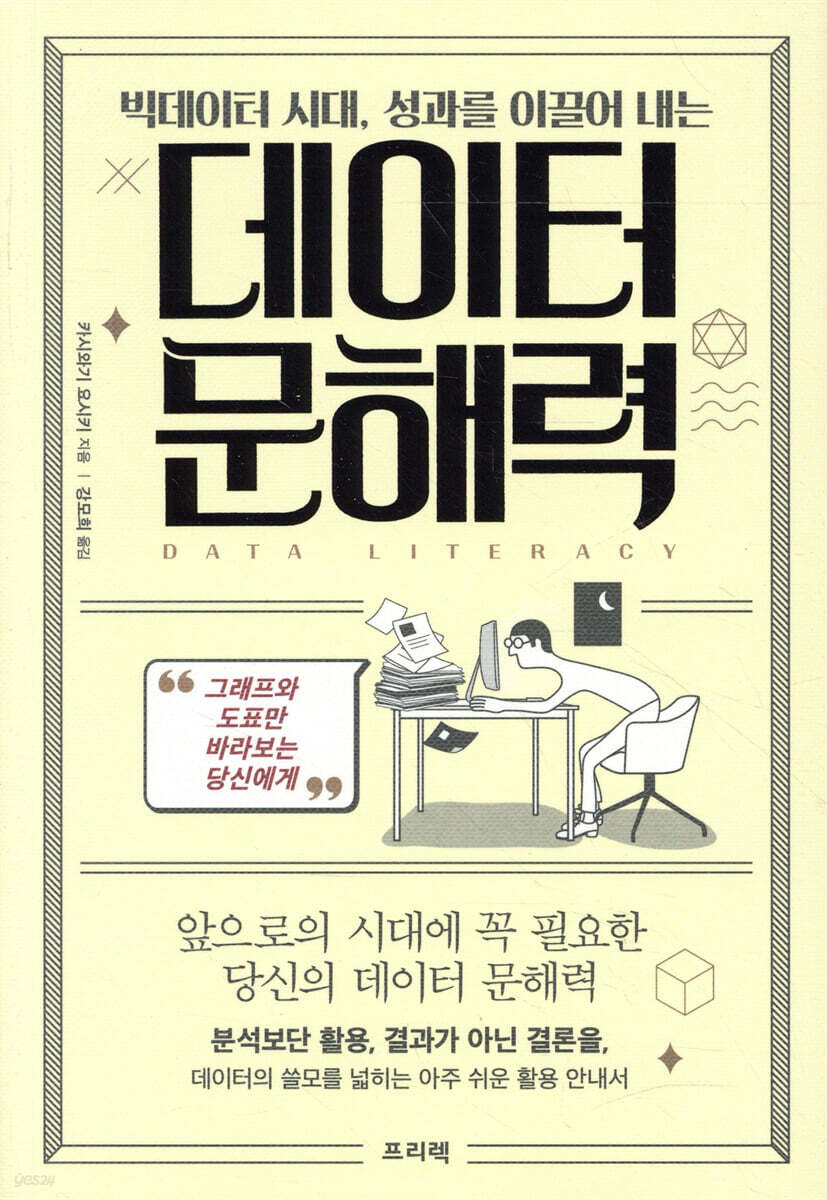
Data Literacy: Driving Performance in the Big Data Era
 |
Description
Book Introduction
"Your Data Literacy Essential for the Future"
Why do we need application skills rather than analysis methods?
Starting with artificial intelligence, which seemed unrelated to me, countless stories related to data are pouring out around me.
The first thing that comes to mind is the worry that I might fall behind if I don't know.
Data literacy will become more important in the future than ever before.
From academic disciplines like statistics and analytics to programming languages like Python and R, is it truly impossible to do anything without these knowledge and skills? In a world where machines are already overwhelmingly good at many things,
However, there are things that machines can and cannot do.
Data is an effective tool for communicating a broad and objective argument rationally to someone you've just met.
When there are no absolute answers, how can you communicate and make others understand your thoughts? Data literacy is the ability to turn insights gleaned from data into a narrative that leads to your own conclusions.
We guide you through the mindset and techniques to connect your goals and problems with the right data to produce valuable conclusions.
Why do we need application skills rather than analysis methods?
Starting with artificial intelligence, which seemed unrelated to me, countless stories related to data are pouring out around me.
The first thing that comes to mind is the worry that I might fall behind if I don't know.
Data literacy will become more important in the future than ever before.
From academic disciplines like statistics and analytics to programming languages like Python and R, is it truly impossible to do anything without these knowledge and skills? In a world where machines are already overwhelmingly good at many things,
However, there are things that machines can and cannot do.
Data is an effective tool for communicating a broad and objective argument rationally to someone you've just met.
When there are no absolute answers, how can you communicate and make others understand your thoughts? Data literacy is the ability to turn insights gleaned from data into a narrative that leads to your own conclusions.
We guide you through the mindset and techniques to connect your goals and problems with the right data to produce valuable conclusions.
- You can preview some of the book's contents.
Preview
index
Entering
Chapter 1: What We Need Next: Data Literacy: Utilization Over Analysis
_1.1 What machines do and what people do
__In a world where machines are overwhelmingly good at many things,
__The important thing is to know what skills you will need in the future.
__To produce valuable results
_1.2 Even if you learn statistics, why can't you use it?
__What is a valuable skill?
__Revisit what skills you absolutely must acquire
_1.3 Don't look at the data first - the answer is not in the data.
__Common challenges and problems faced by people who 'cannot utilize data'
__What knowledge is really needed in the future?
__The message this book wants to convey
Chapter 2: Are You Solving the Right Problem with the Right Data? ~Purposeful Thinking: Connecting Problems and Data to Fit Your Purpose~
_2.1 Two reasons why data utilization fails!
_2.2 Main Cause 1: The problem you are trying to solve is not clear (Are you solving the right problem?)
__The first thing to do is 'define the purpose and problem'
__Point 1: Is the language used specific and clear?
__Point 2: Are you distinguishing between the ‘problem’, ‘cause’, and ‘solution’?
__Case for 'problem definition'
_2.3 Main Cause 2: The problem you defined does not match the data you are using (Are you using the right data?)
The 'Indicator Mismatch' Problem: The Case of Wakimachi High School
The Problem of 'Indicator Mismatch': The Case of Yokohama National University
_2.4 Business Case Study Analysis
__Problems related to external affairs
__Problems that exist within the company
__Issues related to local government and administration
__Better define the purpose and problem
Chapter 3: "This is the Problem": How to Speak with Data ~ Understanding and Evaluating Phenomenon: The Power of Expressing the Problem ~
_3.1 Results and evaluations are different
__What is valuable information?
__Relationship between evaluation and priority
_3.2 When comparing, perspective is important.
__Do the conclusions match the data?
__Checkpoints when comparing
_3.3 The Art of Comparison
Common analysis patterns using __average
__See trends and changes
__Consider the deviation
__Summary of evaluation criteria
_3.4 Comparative Case Analysis
__When dealing with population issues
__When dealing with customer satisfaction
__Working hours, overtime hours
__In case of dealing with the status of use of public facilities
__Comparison Summary
Chapter 4: The Results Don't End ~Understanding the Cause: The Power to Take Action~
_4.1 The ultimate goal is 'action and judgment'
__Aren't you ending it with 'data organization'?
__Did you know that solutions must be implemented at the cause?
_4.2 Thinking and methods for finding causes in data
__How to identify cause candidates and specify indicators
__How to determine the problem, its cause, and whether there is a connection between them
__An example of analysis using scatter plots and correlation coefficients
_4.3 Things to know
__Is it a direct or indirect relationship?
__The cause may not be single, but multiple or complex.
__There are also non-linear relationships
__Correlation does not indicate causation
Chapter 5: Don't Obsess Over Techniques ~ Overall Composition: The Power to Create a Story (Logic) ~
_5.1 The ever-increasing number of 'method men'
__Revisit the problem-solving process
__Mistakes Everyone Makes in the Problem-Solving Process
__Identification of the 'cause' of the difference in results and validity
_5.2 The Structure of Becoming a Method Man ~ Two Meanings of 'Thinking' ~
__It's very likely that you'll forget the process
__The evaluation criteria are ambiguous?
__Which one do you 'think' about?
_5.3 Think persistently about the 'why (cause)'
The structure of __'cause' cannot be viewed simply.
__How many times should I repeat 'why?'?
5.4 Challenge Problem!
Chapter 6: "The Bottom Line" Summarize the Information ~Information Aggregation: The Power to Gather Information and Draw Conclusions~
_6.1 Results and conclusions are different
The Difference Between 'Result' and 'Conclusion': A Case of Not Understanding the Purpose
_6.2 The Difference Between 'Results' and 'Conclusions': A Case of Understanding Data Too Simplistically
__An example of effectively using graphs to draw conclusions
__Example of a conclusion using a graph
__An example where the graph itself can explain the conclusion
_6.3 Things to keep in mind when drawing conclusions
Is this a range that can be explained by data?
__cognitive bias (preconception)
__There is no single correct answer
Chapter 7: The Illusion of "Data Can Solve Problems" ~ The Power of Expanding Perspective: The Power of Data to Broaden Your Vision
_7.1 Think that there are no answers in the data
__Things to overcome to master data handling skills
__A logical way of thinking to find the most appropriate answer
__A process that logically and appropriately reviews the scope of analysis and the data to be used.
_7.2 Broadening your perspective broadens your scope of analysis.
__Structure problems using logical thinking
_7.3 The power to make the 'invisible' visible
__Mating
__self-denial
7.4 The ‘survival skills’ needed now and in the future
Chapter 8: How to Increase Individual and Organizational Data Utilization Capabilities ~Execution: The Power to Realize Literacy~
_8.1 Is the ‘environment’ in which the data will be utilized appropriate?
_8.2 What is the difference between successful individuals and organizations?
__Commonality 1: Leadership and responsibility established by teachers, team leaders, and department heads
__Commonality 2: The purpose is clear
__Common Point 3: Understand the difference and value between 'thinking' and 'working'
__Commonality 4: There is someone who can properly evaluate the results.
__To become a data literate person
Finally
Chapter 1: What We Need Next: Data Literacy: Utilization Over Analysis
_1.1 What machines do and what people do
__In a world where machines are overwhelmingly good at many things,
__The important thing is to know what skills you will need in the future.
__To produce valuable results
_1.2 Even if you learn statistics, why can't you use it?
__What is a valuable skill?
__Revisit what skills you absolutely must acquire
_1.3 Don't look at the data first - the answer is not in the data.
__Common challenges and problems faced by people who 'cannot utilize data'
__What knowledge is really needed in the future?
__The message this book wants to convey
Chapter 2: Are You Solving the Right Problem with the Right Data? ~Purposeful Thinking: Connecting Problems and Data to Fit Your Purpose~
_2.1 Two reasons why data utilization fails!
_2.2 Main Cause 1: The problem you are trying to solve is not clear (Are you solving the right problem?)
__The first thing to do is 'define the purpose and problem'
__Point 1: Is the language used specific and clear?
__Point 2: Are you distinguishing between the ‘problem’, ‘cause’, and ‘solution’?
__Case for 'problem definition'
_2.3 Main Cause 2: The problem you defined does not match the data you are using (Are you using the right data?)
The 'Indicator Mismatch' Problem: The Case of Wakimachi High School
The Problem of 'Indicator Mismatch': The Case of Yokohama National University
_2.4 Business Case Study Analysis
__Problems related to external affairs
__Problems that exist within the company
__Issues related to local government and administration
__Better define the purpose and problem
Chapter 3: "This is the Problem": How to Speak with Data ~ Understanding and Evaluating Phenomenon: The Power of Expressing the Problem ~
_3.1 Results and evaluations are different
__What is valuable information?
__Relationship between evaluation and priority
_3.2 When comparing, perspective is important.
__Do the conclusions match the data?
__Checkpoints when comparing
_3.3 The Art of Comparison
Common analysis patterns using __average
__See trends and changes
__Consider the deviation
__Summary of evaluation criteria
_3.4 Comparative Case Analysis
__When dealing with population issues
__When dealing with customer satisfaction
__Working hours, overtime hours
__In case of dealing with the status of use of public facilities
__Comparison Summary
Chapter 4: The Results Don't End ~Understanding the Cause: The Power to Take Action~
_4.1 The ultimate goal is 'action and judgment'
__Aren't you ending it with 'data organization'?
__Did you know that solutions must be implemented at the cause?
_4.2 Thinking and methods for finding causes in data
__How to identify cause candidates and specify indicators
__How to determine the problem, its cause, and whether there is a connection between them
__An example of analysis using scatter plots and correlation coefficients
_4.3 Things to know
__Is it a direct or indirect relationship?
__The cause may not be single, but multiple or complex.
__There are also non-linear relationships
__Correlation does not indicate causation
Chapter 5: Don't Obsess Over Techniques ~ Overall Composition: The Power to Create a Story (Logic) ~
_5.1 The ever-increasing number of 'method men'
__Revisit the problem-solving process
__Mistakes Everyone Makes in the Problem-Solving Process
__Identification of the 'cause' of the difference in results and validity
_5.2 The Structure of Becoming a Method Man ~ Two Meanings of 'Thinking' ~
__It's very likely that you'll forget the process
__The evaluation criteria are ambiguous?
__Which one do you 'think' about?
_5.3 Think persistently about the 'why (cause)'
The structure of __'cause' cannot be viewed simply.
__How many times should I repeat 'why?'?
5.4 Challenge Problem!
Chapter 6: "The Bottom Line" Summarize the Information ~Information Aggregation: The Power to Gather Information and Draw Conclusions~
_6.1 Results and conclusions are different
The Difference Between 'Result' and 'Conclusion': A Case of Not Understanding the Purpose
_6.2 The Difference Between 'Results' and 'Conclusions': A Case of Understanding Data Too Simplistically
__An example of effectively using graphs to draw conclusions
__Example of a conclusion using a graph
__An example where the graph itself can explain the conclusion
_6.3 Things to keep in mind when drawing conclusions
Is this a range that can be explained by data?
__cognitive bias (preconception)
__There is no single correct answer
Chapter 7: The Illusion of "Data Can Solve Problems" ~ The Power of Expanding Perspective: The Power of Data to Broaden Your Vision
_7.1 Think that there are no answers in the data
__Things to overcome to master data handling skills
__A logical way of thinking to find the most appropriate answer
__A process that logically and appropriately reviews the scope of analysis and the data to be used.
_7.2 Broadening your perspective broadens your scope of analysis.
__Structure problems using logical thinking
_7.3 The power to make the 'invisible' visible
__Mating
__self-denial
7.4 The ‘survival skills’ needed now and in the future
Chapter 8: How to Increase Individual and Organizational Data Utilization Capabilities ~Execution: The Power to Realize Literacy~
_8.1 Is the ‘environment’ in which the data will be utilized appropriate?
_8.2 What is the difference between successful individuals and organizations?
__Commonality 1: Leadership and responsibility established by teachers, team leaders, and department heads
__Commonality 2: The purpose is clear
__Common Point 3: Understand the difference and value between 'thinking' and 'working'
__Commonality 4: There is someone who can properly evaluate the results.
__To become a data literate person
Finally
Detailed image

Publisher's Review
Data literacy: the ability to read, interpret, and utilize data
Utilization rather than analysis, conclusion rather than result,
A very easy-to-use guide to expanding the value and usefulness of data.
“Because I want to achieve results by leveraging data, I tend to scrape together any data I can get my hands on from the internet or around me, process it into graphs and tables, and then wonder, ‘What can I explain with this?’
And when you come to your senses after a while, there are only a few curve graphs, bar graphs, and average tables lined up.” “What on earth am I supposed to say with this?” “Isn’t there a better way…?
16P
Data never gives you direct answers.
Even if you use the most advanced statistics and analysis methods.
Instead, it is more important than anything else to think specifically about 'what you want to know, what you want to do with it, and what data (indicators) you need to do that.'
26P
If you just collect data that you happen to see without any thought and draw a graph, you can't expect to come to a meaningful conclusion.
What you learn there are just minor discoveries that come by chance.
I have previously explained that there is no logic or objectivity in it.
42P
Concerns like, "I used data, but information isn't effectively derived," or "I can't analyze data skillfully" are not caused by the analysis method or statistics, but rather by an insufficient and inappropriate definition of the problem, as in the previous example.
Meanwhile, this isn't just a story about data utilization or analysis.
It's essentially the same even when data isn't being used, such as in general problem solving or logical thinking.
When setting up a problem, always ask yourself the following questions:
Am I clearly defining and solving the problem?
55P
When using data to create results, you should not convey your own thoughts and opinions.
You need to present your argument more rigorously, objectively, and logically so that the other person can understand.
Even if you are a beginner in data utilization, you should never forget this point.
88
It goes without saying that if you emotionally decide on a conclusion and then try to evaluate it with data, you may end up having to change the conclusion itself if the results are different from that conclusion.
If you force data into a conclusion, you need to be even more careful because it is putting the cart before the horse.
89P
If you're feeling overwhelmed or stuck trying to put what you've learned into practice, why not try thinking about it "simplistically"? This is what I always say in my lectures.
“Imagine that there is a third party right in front of you who has no idea about the problem you are currently facing or its context.
“If you wanted to explain the problem you are dealing with to that person using data, what data would you show them and how would you show them?”
129P
Rather than delving deeper into what causes something, we often suggest ideas along the lines of "it's better than doing nothing."
If we set up countermeasures with limited resources and time at the level of 'doing nothing', then in fact, doing nothing is better.
The most important thing is to objectively review methods that are expected to be effective and focus on them to maximize cost-effectiveness.
138P
The logical thinking we're talking about here isn't about individual data and analysis, but rather the thinking and organizing skills needed to solidify the overall story and increase the persuasiveness of the conclusion.
Without this, it will be difficult to persuade others, no matter how much high-quality data you collect and how well you analyze it with a perfect methodology.
The reason why persuasion is difficult is because it does not fit the overall flow and logic.
169P
If you think that you just need to come up with novel ideas, whether they are right or wrong, then you don't need data in the first place.
I call workers in this situation 'methodology men'.
Many people will agree when I say that the world is full of 'method men'.
174P
The process of reaching the result and conclusion is essentially the same.
Because a conclusion is something that is drawn based on results.
But the way of expressing it is different.
And those small differences can have a huge impact on how your message is conveyed to the other person and how well it is understood.
Understanding this difference is also an important element of data literacy.
195P
Another potential risk when humans collect information is a series of preconceived notions known as "cognitive biases."
No human being can make 100% objective and rational judgments, and various biased tendencies exist.
Regardless of our intentions, we often analyze information that is more favorable to us or interpret it in a way that is more favorable to us and draw conclusions.
Probably everyone has experienced it.
206P
You should not ask, 'What is the correct answer?'
The only things in this world that have only one correct answer are the exam questions given in school.
Which conclusion do you think is appropriate? Maintaining a firm stance of "creating your own correct answer and discussing it" is also a crucial element of data literacy.
208P
There is an overwhelming difference between the perception that 'you have to do it' and 'there is no particular problem if you don't do it.'
Does your organization and team prioritize "utilizing data" or "making logical suggestions and solving problems?" Because humans are frail, things that don't necessarily need to be done right away inevitably get prioritized lower.
Compared to the hassle of adding data utilization, 'must-dos', 'hanging out with friends', and 'going out for drinks tonight' will take priority.
While we say that 'data utilization is important,' there are many cases where in reality 'it is not particularly problematic not to do it.'
However, there are organizations that have introduced 'data utilization' into their systems and evaluations and explicitly stated it as a 'must-do' in their work systems.
Such organizations are 'moving forward'.
233P
‘Using data’ is not something that can be done with ‘sleight of hand’.
We must prioritize the essential flow of "setting the right goal, utilizing data accordingly, and drawing appropriately presented results to reach a conclusion," and carefully follow each step.
I hope that through this book you have realized that this is the essential condition for creating valuable results.
237P
Utilization rather than analysis, conclusion rather than result,
A very easy-to-use guide to expanding the value and usefulness of data.
“Because I want to achieve results by leveraging data, I tend to scrape together any data I can get my hands on from the internet or around me, process it into graphs and tables, and then wonder, ‘What can I explain with this?’
And when you come to your senses after a while, there are only a few curve graphs, bar graphs, and average tables lined up.” “What on earth am I supposed to say with this?” “Isn’t there a better way…?
16P
Data never gives you direct answers.
Even if you use the most advanced statistics and analysis methods.
Instead, it is more important than anything else to think specifically about 'what you want to know, what you want to do with it, and what data (indicators) you need to do that.'
26P
If you just collect data that you happen to see without any thought and draw a graph, you can't expect to come to a meaningful conclusion.
What you learn there are just minor discoveries that come by chance.
I have previously explained that there is no logic or objectivity in it.
42P
Concerns like, "I used data, but information isn't effectively derived," or "I can't analyze data skillfully" are not caused by the analysis method or statistics, but rather by an insufficient and inappropriate definition of the problem, as in the previous example.
Meanwhile, this isn't just a story about data utilization or analysis.
It's essentially the same even when data isn't being used, such as in general problem solving or logical thinking.
When setting up a problem, always ask yourself the following questions:
Am I clearly defining and solving the problem?
55P
When using data to create results, you should not convey your own thoughts and opinions.
You need to present your argument more rigorously, objectively, and logically so that the other person can understand.
Even if you are a beginner in data utilization, you should never forget this point.
88
It goes without saying that if you emotionally decide on a conclusion and then try to evaluate it with data, you may end up having to change the conclusion itself if the results are different from that conclusion.
If you force data into a conclusion, you need to be even more careful because it is putting the cart before the horse.
89P
If you're feeling overwhelmed or stuck trying to put what you've learned into practice, why not try thinking about it "simplistically"? This is what I always say in my lectures.
“Imagine that there is a third party right in front of you who has no idea about the problem you are currently facing or its context.
“If you wanted to explain the problem you are dealing with to that person using data, what data would you show them and how would you show them?”
129P
Rather than delving deeper into what causes something, we often suggest ideas along the lines of "it's better than doing nothing."
If we set up countermeasures with limited resources and time at the level of 'doing nothing', then in fact, doing nothing is better.
The most important thing is to objectively review methods that are expected to be effective and focus on them to maximize cost-effectiveness.
138P
The logical thinking we're talking about here isn't about individual data and analysis, but rather the thinking and organizing skills needed to solidify the overall story and increase the persuasiveness of the conclusion.
Without this, it will be difficult to persuade others, no matter how much high-quality data you collect and how well you analyze it with a perfect methodology.
The reason why persuasion is difficult is because it does not fit the overall flow and logic.
169P
If you think that you just need to come up with novel ideas, whether they are right or wrong, then you don't need data in the first place.
I call workers in this situation 'methodology men'.
Many people will agree when I say that the world is full of 'method men'.
174P
The process of reaching the result and conclusion is essentially the same.
Because a conclusion is something that is drawn based on results.
But the way of expressing it is different.
And those small differences can have a huge impact on how your message is conveyed to the other person and how well it is understood.
Understanding this difference is also an important element of data literacy.
195P
Another potential risk when humans collect information is a series of preconceived notions known as "cognitive biases."
No human being can make 100% objective and rational judgments, and various biased tendencies exist.
Regardless of our intentions, we often analyze information that is more favorable to us or interpret it in a way that is more favorable to us and draw conclusions.
Probably everyone has experienced it.
206P
You should not ask, 'What is the correct answer?'
The only things in this world that have only one correct answer are the exam questions given in school.
Which conclusion do you think is appropriate? Maintaining a firm stance of "creating your own correct answer and discussing it" is also a crucial element of data literacy.
208P
There is an overwhelming difference between the perception that 'you have to do it' and 'there is no particular problem if you don't do it.'
Does your organization and team prioritize "utilizing data" or "making logical suggestions and solving problems?" Because humans are frail, things that don't necessarily need to be done right away inevitably get prioritized lower.
Compared to the hassle of adding data utilization, 'must-dos', 'hanging out with friends', and 'going out for drinks tonight' will take priority.
While we say that 'data utilization is important,' there are many cases where in reality 'it is not particularly problematic not to do it.'
However, there are organizations that have introduced 'data utilization' into their systems and evaluations and explicitly stated it as a 'must-do' in their work systems.
Such organizations are 'moving forward'.
233P
‘Using data’ is not something that can be done with ‘sleight of hand’.
We must prioritize the essential flow of "setting the right goal, utilizing data accordingly, and drawing appropriately presented results to reach a conclusion," and carefully follow each step.
I hope that through this book you have realized that this is the essential condition for creating valuable results.
237P
GOODS SPECIFICS
- Publication date: March 8, 2021
- Page count, weight, size: 240 pages | 414g | 148*215*20mm
- ISBN13: 9788965402916
- ISBN10: 8965402913
You may also like
카테고리
korean


korean

![ELLE 엘르 스페셜 에디션 A형 : 12월 [2025]](http://librairie.coreenne.fr/cdn/shop/files/b8e27a3de6c9538896439686c6b0e8fb.jpg?v=1766436872&width=3840)


