

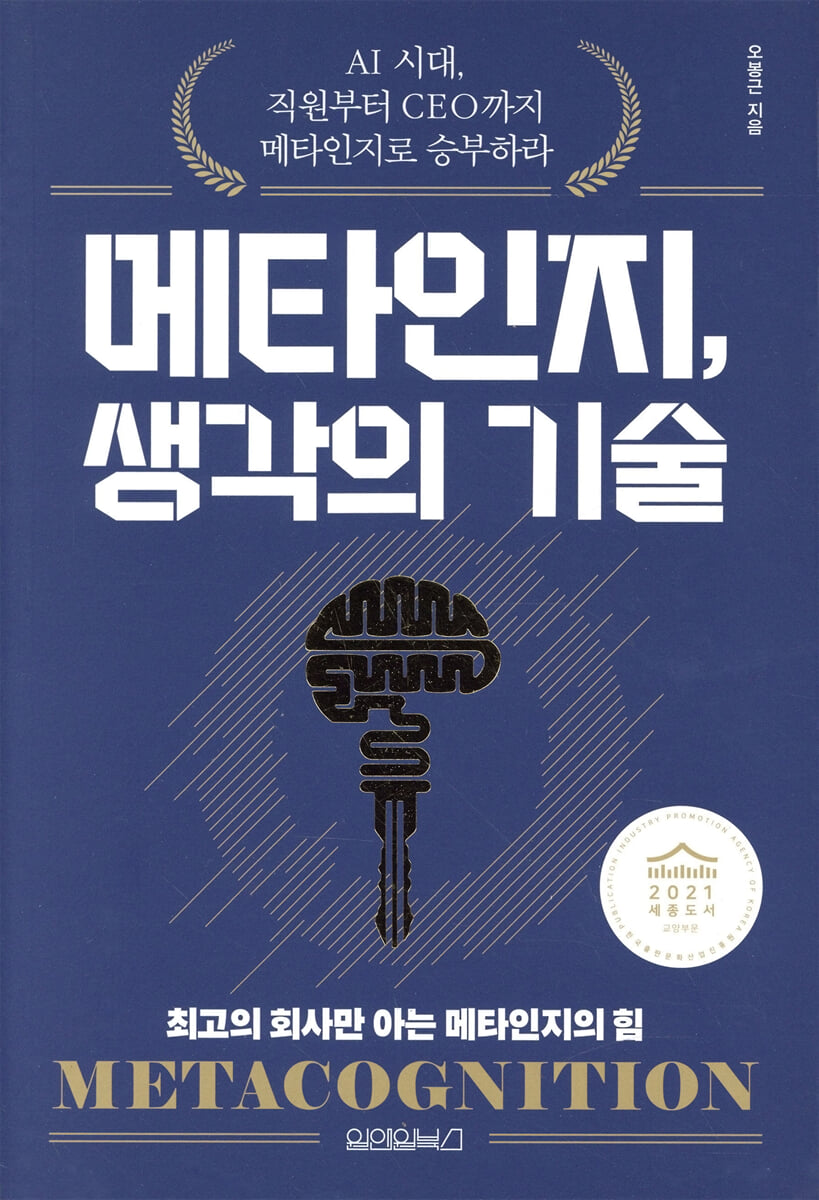
Metacognition, the art of thinking
 |
Description
Book Introduction
- A word from MD
- “I don’t know.” Sometimes, after exchanging a few words with AI, you’ll hear this answer.
And then it suddenly stops working.
We humans say, “I don’t know.
“Let’s find out more.” is a possible existence.
This is thanks to the metacognitive ability to constantly expand one's thinking through review.
This book provides answers to human capabilities.
- Economic Management MD Kang Min-ji
The power of metacognition known only to the best companies
Metacognition is the key to improving your work performance!
What are the characteristics of a successful worker? While they're often described as "having a work ethic," "being competent," or "having a knack for work," ultimately, a successful worker possesses superior metacognition.
Metacognition, simply put, means knowing what you know and what you don't know.
Furthermore, it means the ability to understand the purpose, procedure, situation and context of the work.
People with high metacognition also have high problem-solving skills, and problem-solving skills are considered one of the most essential competencies for work.
Ultimately, this means that metacognition is an important factor in determining work ability.
Only humans can understand and utilize the other person's thought and cognitive flow.
This is the competitiveness that is not threatened by AI.
The author, a man of exceptional metacognition who has achieved nine promotions at a global management consulting firm, has met numerous leaders and talents with outstanding metacognition.
Based on that experience, I wrote this book, which compiles everything I know about metacognition that can be utilized in the work environment.
It covers the basic concepts of metacognition, how to improve metacognition, and specific examples of the effects of metacognition in organizations.
If you want to know the secrets of how people with superior metacognition solve problems at work, open this book.
Metacognition is the key to improving your work performance!
What are the characteristics of a successful worker? While they're often described as "having a work ethic," "being competent," or "having a knack for work," ultimately, a successful worker possesses superior metacognition.
Metacognition, simply put, means knowing what you know and what you don't know.
Furthermore, it means the ability to understand the purpose, procedure, situation and context of the work.
People with high metacognition also have high problem-solving skills, and problem-solving skills are considered one of the most essential competencies for work.
Ultimately, this means that metacognition is an important factor in determining work ability.
Only humans can understand and utilize the other person's thought and cognitive flow.
This is the competitiveness that is not threatened by AI.
The author, a man of exceptional metacognition who has achieved nine promotions at a global management consulting firm, has met numerous leaders and talents with outstanding metacognition.
Based on that experience, I wrote this book, which compiles everything I know about metacognition that can be utilized in the work environment.
It covers the basic concepts of metacognition, how to improve metacognition, and specific examples of the effects of metacognition in organizations.
If you want to know the secrets of how people with superior metacognition solve problems at work, open this book.
- You can preview some of the book's contents.
Preview
index
Preface _ Metacognition: The Only Competency Needed in the AI Era
Chapter 1.
Why Metacognition Matters
Problem-solving skills remain key in the AI era.
Problem-solving skills are improved through metacognition.
Metacognition is the way forward in the AI era.
It allows people, not machines, to recognize you.
This is the most essential skill to avoid being dominated by AI.
AI Project Mentoring Notes - Understanding the Elements of Metacognition
Chapter 2.
Five Characteristics of People with High Metacognition
Know your direction clearly
Understand the context
Know the limits of experience and intuition
Understand the other person's intentions
Maintain consistency
AI Project Mentoring Notes - Understanding Metacognition Types
Chapter 3.
A metacognitive enhancement method that has never been seen before
There are ways to improve metacognition.
Before solving a problem, start with a key question.
Summarize the answers to the key questions.
Understand cognition above cognition
Understand the other person's metacognitive system
AI Project Mentoring Notes - Metacognition Enhancement Exercises
Chapter 4.
Examples of metacognition hidden around us
Know thyself
If you could live your life over again, what would you change?
Make metacognition a habit
Leading meetings with metacognition
Think about metacognition even when eating
AI Project Mentoring Notes - Approaching Metacognition
Chapter 5. Metacognition: A Key to Organizational Survival in the AI Era
Organizational metacognition is unique to humans.
If turnover is high, question organizational metacognition.
Repeated similar tasks can lead to a survival crisis.
Confirm your anxiety about the AI era.
Help them think like a CEO
AI Project Mentoring Notes: Avoiding Bias
Chapter 6.
Five Ways to Increase Organizational Metacognition
Make sure you know the purpose of the job
See if you doubt the alternatives presented.
Examine the issue: facts, know-how, or perspective.
Create a system that allows you to learn through the process.
Make sure you understand each other's different assumptions.
AI Project Mentoring Notes - Determining AI Application Areas
Chapter 7.
Organizational Metacognition Cases in Global Companies
Earn 10 billion won a year with metacognition
Failing with digital innovation
A company whose executives pick up trash does well.
If you think about the method, the result will change.
So where will AI be used?
AI Project Mentoring Notes - The End of Coding
Chapter 1.
Why Metacognition Matters
Problem-solving skills remain key in the AI era.
Problem-solving skills are improved through metacognition.
Metacognition is the way forward in the AI era.
It allows people, not machines, to recognize you.
This is the most essential skill to avoid being dominated by AI.
AI Project Mentoring Notes - Understanding the Elements of Metacognition
Chapter 2.
Five Characteristics of People with High Metacognition
Know your direction clearly
Understand the context
Know the limits of experience and intuition
Understand the other person's intentions
Maintain consistency
AI Project Mentoring Notes - Understanding Metacognition Types
Chapter 3.
A metacognitive enhancement method that has never been seen before
There are ways to improve metacognition.
Before solving a problem, start with a key question.
Summarize the answers to the key questions.
Understand cognition above cognition
Understand the other person's metacognitive system
AI Project Mentoring Notes - Metacognition Enhancement Exercises
Chapter 4.
Examples of metacognition hidden around us
Know thyself
If you could live your life over again, what would you change?
Make metacognition a habit
Leading meetings with metacognition
Think about metacognition even when eating
AI Project Mentoring Notes - Approaching Metacognition
Chapter 5. Metacognition: A Key to Organizational Survival in the AI Era
Organizational metacognition is unique to humans.
If turnover is high, question organizational metacognition.
Repeated similar tasks can lead to a survival crisis.
Confirm your anxiety about the AI era.
Help them think like a CEO
AI Project Mentoring Notes: Avoiding Bias
Chapter 6.
Five Ways to Increase Organizational Metacognition
Make sure you know the purpose of the job
See if you doubt the alternatives presented.
Examine the issue: facts, know-how, or perspective.
Create a system that allows you to learn through the process.
Make sure you understand each other's different assumptions.
AI Project Mentoring Notes - Determining AI Application Areas
Chapter 7.
Organizational Metacognition Cases in Global Companies
Earn 10 billion won a year with metacognition
Failing with digital innovation
A company whose executives pick up trash does well.
If you think about the method, the result will change.
So where will AI be used?
AI Project Mentoring Notes - The End of Coding
Detailed image

Into the book
The cognitive process of finding areas for improvement is closely related to 'metacognitive control,' another key element of metacognition.
Metacognitive control consists of cognitive activities such as planning something in advance and monitoring whether it is proceeding properly while performing it.
It also allows you to review the process afterward and create better methods and results the next time you go through a similar process.
This is simply called the evaluating process.
--- pp.39~41
Butler-type metacognition primarily involves spending a lot of time and careful planning to anticipate one's own and one's organization's preferences and the reactions of customers or stakeholders.
If we explain this in terms of metacognitive details, we can interpret that planning based on Know-What and Predicting the Reaction drives natural intellectual ability, that is, metacognition.
Generally, a common business model for professional groups such as law firms and accounting firms is to take on work from clients, demonstrate professional capabilities, and receive fees.
--- p.86
Many working people have forgotten how to ask questions.
However, the first step to strengthening metacognition is practicing defining key questions. Whether it's an AI implementation project or an ERP enhancement project, every task must have a purpose or direction.
In other words, the values your work pursues must be defined somewhere in your head.
Although this is a very common sense thing, many people fail to put it into practice.
--- pp.125~126
There are only two key points to strengthening social metacognition.
First, try to understand the other person's core question.
Second, try to understand the flow of thought and cognition that approaches solving the core question.
According to the AI technology roadmap of the Association for the Advancement of Artificial Intelligence (AAAI), metacognition, and among them, metacognition that understands social factors, is at the very end of the potential development of AI.
--- p.161
One company I worked for had a very high level of organizational metacognition.
At the beginning of each year, members had a specific list of what they needed to do to develop themselves and the company that year.
There was a thriving culture of providing feedback during work hours on what employees were doing well and what they could do better, and the year-end evaluations focused on how to develop the individual rather than on promotions or performance evaluations.
--- p.213
In the age of AI, empathy may not be what human organizations need to emphasize.
Rather, the ability to understand the other party's cognition, which is to understand the cognitive system through which each member of the organization views an issue, will be considered much more important.
Of course, this is because it is a realm that only humans can achieve.
Metacognitive control consists of cognitive activities such as planning something in advance and monitoring whether it is proceeding properly while performing it.
It also allows you to review the process afterward and create better methods and results the next time you go through a similar process.
This is simply called the evaluating process.
--- pp.39~41
Butler-type metacognition primarily involves spending a lot of time and careful planning to anticipate one's own and one's organization's preferences and the reactions of customers or stakeholders.
If we explain this in terms of metacognitive details, we can interpret that planning based on Know-What and Predicting the Reaction drives natural intellectual ability, that is, metacognition.
Generally, a common business model for professional groups such as law firms and accounting firms is to take on work from clients, demonstrate professional capabilities, and receive fees.
--- p.86
Many working people have forgotten how to ask questions.
However, the first step to strengthening metacognition is practicing defining key questions. Whether it's an AI implementation project or an ERP enhancement project, every task must have a purpose or direction.
In other words, the values your work pursues must be defined somewhere in your head.
Although this is a very common sense thing, many people fail to put it into practice.
--- pp.125~126
There are only two key points to strengthening social metacognition.
First, try to understand the other person's core question.
Second, try to understand the flow of thought and cognition that approaches solving the core question.
According to the AI technology roadmap of the Association for the Advancement of Artificial Intelligence (AAAI), metacognition, and among them, metacognition that understands social factors, is at the very end of the potential development of AI.
--- p.161
One company I worked for had a very high level of organizational metacognition.
At the beginning of each year, members had a specific list of what they needed to do to develop themselves and the company that year.
There was a thriving culture of providing feedback during work hours on what employees were doing well and what they could do better, and the year-end evaluations focused on how to develop the individual rather than on promotions or performance evaluations.
--- p.213
In the age of AI, empathy may not be what human organizations need to emphasize.
Rather, the ability to understand the other party's cognition, which is to understand the cognitive system through which each member of the organization views an issue, will be considered much more important.
Of course, this is because it is a realm that only humans can achieve.
--- p.279
Publisher's Review
Metacognition: A Thinking Technology Leading the AI Era
At a demonstration of the AI robot Sophia in 2018, Sophia was asked the following question:
“If there were an elderly person and a child in a fire, who would you save first?” Sophia replied, “I’m not yet at a level where I can make ethical decisions.”
It is a quick judgment that you do not know what you do not know.
Of course, it is something that has been learned in advance, but you can program it to make an immediate judgment that you do not know anything outside of a certain range.
But that doesn't mean it's hard to imagine Sophia mulling over the "old man and child" dilemma on the way back from the interview and trying to develop her own perspective.
On the other hand, most people will look back on the situation and think, "I wish I had responded this way earlier," and think about how to deal with similar situations in the future.
This process of metacognition is the act of evaluating, planning, and monitoring to identify the problem and come up with a better answer.
A study conducted by the BBC in collaboration with Oxford University and Deloitte found that numerous jobs, including telemarketers, stenographers, and financial accountants, are at high risk of being replaced by robots. To develop differentiated work skills that can keep pace with AI, we need to enhance our metacognition.
Metacognition is a uniquely human domain that AI cannot replicate no matter how much technology advances.
Develop your own unique competitive edge that cannot be replaced by AI.
Research on metacognition is still very limited.
However, the author says that work-related metacognition can be improved to some extent through regular practice.
First, it is important to organize the business background and problem situation and define the key questions related to it.
This is because you need to know the purpose of the work to be able to look at it from the perspective of your superior or work supervisor.
The second step in training to strengthen metacognition is to organize answers to key questions.
This can be trained through consistent structured practice, and is a routine practice in law school.
If office workers practice and make this way of thinking a habit, they can develop metacognition comparable to that of law school graduates.
The next step is to understand cognition above cognition.
People with high metacognitive skills can shift between higher and lower levels of cognition as needed.
Finally, it is also important to understand the other person's cognitive system.
Understanding the other person's intentions, understanding the other person's cognitive flow, and predicting their reactions is called social metacognition.
Simply understanding the other person's core question can greatly enhance social metacognition.
What is organizational metacognition that will determine the future of a company?
From employees to the CEO, compete with metacognition!
An organization's competitiveness is determined by metacognition.
Even if each member of an organization has excellent metacognition, the organization cannot achieve optimal results if it is not supported by organizational metacognition.
Especially if employee turnover is high, organizational metacognition needs to be questioned.
These companies usually have vague standards for promotion and compensation.
And it doesn't provide clear feedback to members about what they've done well and what they need to improve on in the future.
A case where a culture of command and obedience is developed is also a representative example of a breakdown in organizational metacognition.
Of course, there are ways to improve organizational metacognition.
The first thing to do is to make sure that your team members know the purpose of their work.
And it instills a culture in the organization that defines problems and questions proposed alternatives.
If an argument arises between members, it is a good idea to examine whether the cause is a difference in facts, know-how, or perspective.
Organizations with high levels of organizational metacognition are those that recognize and continuously develop talented individuals with excellent metacognition.
It is also an organization that continuously improves and grows based on objective judgment of the current situation.
This book presents various examples of companies with and without strong organizational metacognition, making it easy to understand how metacognition works in organizations.
If you master the metacognitive training methods presented in this book and actively apply them to your organization, you will be able to stand out as a leading company or talent in the AI era.
At a demonstration of the AI robot Sophia in 2018, Sophia was asked the following question:
“If there were an elderly person and a child in a fire, who would you save first?” Sophia replied, “I’m not yet at a level where I can make ethical decisions.”
It is a quick judgment that you do not know what you do not know.
Of course, it is something that has been learned in advance, but you can program it to make an immediate judgment that you do not know anything outside of a certain range.
But that doesn't mean it's hard to imagine Sophia mulling over the "old man and child" dilemma on the way back from the interview and trying to develop her own perspective.
On the other hand, most people will look back on the situation and think, "I wish I had responded this way earlier," and think about how to deal with similar situations in the future.
This process of metacognition is the act of evaluating, planning, and monitoring to identify the problem and come up with a better answer.
A study conducted by the BBC in collaboration with Oxford University and Deloitte found that numerous jobs, including telemarketers, stenographers, and financial accountants, are at high risk of being replaced by robots. To develop differentiated work skills that can keep pace with AI, we need to enhance our metacognition.
Metacognition is a uniquely human domain that AI cannot replicate no matter how much technology advances.
Develop your own unique competitive edge that cannot be replaced by AI.
Research on metacognition is still very limited.
However, the author says that work-related metacognition can be improved to some extent through regular practice.
First, it is important to organize the business background and problem situation and define the key questions related to it.
This is because you need to know the purpose of the work to be able to look at it from the perspective of your superior or work supervisor.
The second step in training to strengthen metacognition is to organize answers to key questions.
This can be trained through consistent structured practice, and is a routine practice in law school.
If office workers practice and make this way of thinking a habit, they can develop metacognition comparable to that of law school graduates.
The next step is to understand cognition above cognition.
People with high metacognitive skills can shift between higher and lower levels of cognition as needed.
Finally, it is also important to understand the other person's cognitive system.
Understanding the other person's intentions, understanding the other person's cognitive flow, and predicting their reactions is called social metacognition.
Simply understanding the other person's core question can greatly enhance social metacognition.
What is organizational metacognition that will determine the future of a company?
From employees to the CEO, compete with metacognition!
An organization's competitiveness is determined by metacognition.
Even if each member of an organization has excellent metacognition, the organization cannot achieve optimal results if it is not supported by organizational metacognition.
Especially if employee turnover is high, organizational metacognition needs to be questioned.
These companies usually have vague standards for promotion and compensation.
And it doesn't provide clear feedback to members about what they've done well and what they need to improve on in the future.
A case where a culture of command and obedience is developed is also a representative example of a breakdown in organizational metacognition.
Of course, there are ways to improve organizational metacognition.
The first thing to do is to make sure that your team members know the purpose of their work.
And it instills a culture in the organization that defines problems and questions proposed alternatives.
If an argument arises between members, it is a good idea to examine whether the cause is a difference in facts, know-how, or perspective.
Organizations with high levels of organizational metacognition are those that recognize and continuously develop talented individuals with excellent metacognition.
It is also an organization that continuously improves and grows based on objective judgment of the current situation.
This book presents various examples of companies with and without strong organizational metacognition, making it easy to understand how metacognition works in organizations.
If you master the metacognitive training methods presented in this book and actively apply them to your organization, you will be able to stand out as a leading company or talent in the AI era.
GOODS SPECIFICS
- Publication date: December 22, 2020
- Page count, weight, size: 320 pages | 482g | 152*225*30mm
- ISBN13: 9791170431527
- ISBN10: 1170431526
You may also like
카테고리
korean


korean

![ELLE 엘르 스페셜 에디션 A형 : 12월 [2025]](http://librairie.coreenne.fr/cdn/shop/files/b8e27a3de6c9538896439686c6b0e8fb.jpg?v=1766436872&width=3840)


