

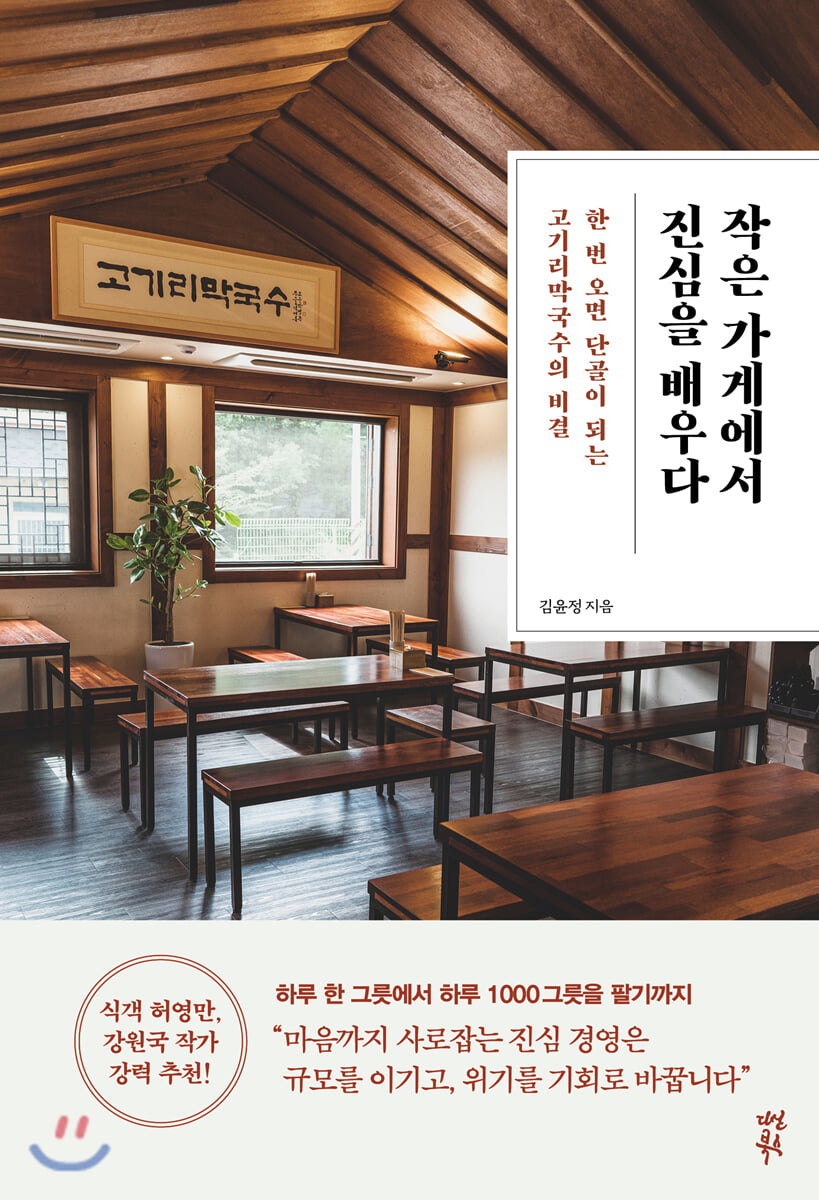
Learning sincerity in a small shop
 |
Description
Book Introduction
Highly recommended by Gourmet Heo Young-man and Kang Won-guk!
From selling one bowl a day to selling 1,000 bowls a day
Why are people so obsessed with a bowl of noodles!
“Management with sincerity that captures the heart
“Turning crises into opportunities”
This book contains the secrets and know-how of Kim Yun-jeong, the owner of Gogiri Makguksu, who grew a small shop in a remote village into a famous restaurant that attracts customers from all over the country.
In 2020, when consumption significantly declined due to COVID-19, Gogiri Makguksu achieved sales of 3 billion won for the first time in 8 years.
This achievement is all the more valuable because it was achieved after the author experienced great failure at his first store.
In an era of unsold products, CEO Kim Yun-jeong says there's something more important than the common success factors in the restaurant industry, such as location, interior design, and differentiated products.
In the highly competitive restaurant industry, existing success strategies alone can no longer be expected to attract customers or keep them coming back.
The last thing I found at this special noodle restaurant, where people wait in line for 2 hours a day, 1107 minutes a year (about 19 hours), is that they focus on each and every customer.
In particular, this book is the most specific and practical guide on how and from what perspective to apply relationship-centered management in the era of non-face-to-face interaction.
CEO Kim Yun-jeong dedicates herself to providing customers with the best products, while also examining what customers want and feel in the process.
For example, hygiene and taste are basic, and we provide service that even considers the flow of food consumption.
We maintain relationships both online and offline, meticulously reading the emotions and desires of our customers and addressing even the smallest inconveniences they may experience.
It is about comprehensively managing the guest experience from before they arrive until they leave with good memories.
However, at this time, the goal is to provide the best satisfaction to customers and lead them to return visits rather than increasing sales.
CEO Kim Yun-jeong says that this deepens the relationship between the host and the guest beyond a simple give-and-take relationship.
Through these efforts, Gogiri Makguksu, which has 'permeated' the hearts of each and every customer, has established itself as a 'brand'.
In a contactless environment, face-to-face experiences are becoming more intense.
When a customer who visits once is not only satisfied but also impressed, people gather and come back again.
The fate of individuals and organizations depends on how they build relationships with their customers.
Through this book, you will gain a new formula for success in the contactless era and gain insights to fully grow while maintaining your own value in an era of limitless competition.
Furthermore, it will be an opportunity to reflect on what values should be the foundation of our relationships and work.
From selling one bowl a day to selling 1,000 bowls a day
Why are people so obsessed with a bowl of noodles!
“Management with sincerity that captures the heart
“Turning crises into opportunities”
This book contains the secrets and know-how of Kim Yun-jeong, the owner of Gogiri Makguksu, who grew a small shop in a remote village into a famous restaurant that attracts customers from all over the country.
In 2020, when consumption significantly declined due to COVID-19, Gogiri Makguksu achieved sales of 3 billion won for the first time in 8 years.
This achievement is all the more valuable because it was achieved after the author experienced great failure at his first store.
In an era of unsold products, CEO Kim Yun-jeong says there's something more important than the common success factors in the restaurant industry, such as location, interior design, and differentiated products.
In the highly competitive restaurant industry, existing success strategies alone can no longer be expected to attract customers or keep them coming back.
The last thing I found at this special noodle restaurant, where people wait in line for 2 hours a day, 1107 minutes a year (about 19 hours), is that they focus on each and every customer.
In particular, this book is the most specific and practical guide on how and from what perspective to apply relationship-centered management in the era of non-face-to-face interaction.
CEO Kim Yun-jeong dedicates herself to providing customers with the best products, while also examining what customers want and feel in the process.
For example, hygiene and taste are basic, and we provide service that even considers the flow of food consumption.
We maintain relationships both online and offline, meticulously reading the emotions and desires of our customers and addressing even the smallest inconveniences they may experience.
It is about comprehensively managing the guest experience from before they arrive until they leave with good memories.
However, at this time, the goal is to provide the best satisfaction to customers and lead them to return visits rather than increasing sales.
CEO Kim Yun-jeong says that this deepens the relationship between the host and the guest beyond a simple give-and-take relationship.
Through these efforts, Gogiri Makguksu, which has 'permeated' the hearts of each and every customer, has established itself as a 'brand'.
In a contactless environment, face-to-face experiences are becoming more intense.
When a customer who visits once is not only satisfied but also impressed, people gather and come back again.
The fate of individuals and organizations depends on how they build relationships with their customers.
Through this book, you will gain a new formula for success in the contactless era and gain insights to fully grow while maintaining your own value in an era of limitless competition.
Furthermore, it will be an opportunity to reflect on what values should be the foundation of our relationships and work.
- You can preview some of the book's contents.
Preview
index
Recommendation
Side note: After a long journey, I am now here.
The story begins: How to capture the hearts of your guests
Chapter 1: Excitement: Business Begins Before Customers Arrive
- If you like it, keep going, and if you keep going, it gets deeper.
- A space to tell guests' stories
- Selling space
- Something more important than raising prices
- Let the waiting become excitement
- I only see small things
- The wonders of management by two different people
Chapter 2 Welcome: Sophisticated sincerity rather than flashy service
- The power to attract customers is more important than a good business location.
- Is this all there is on the menu?
- A menu with a reverse perspective
- The sound of a restaurant is what the restaurant makes.
- Is this the bathroom?
- Doing good for employees is the same as doing good for customers.
- Hygiene that is found in small places
- One person over a group
- The way to more people
Chapter 3: When the 'relationship' between guest and host becomes 'between'
- We take responsibility for your shoes.
- A customer who complains is still a customer
- I'll call your name.
- The language of noodle restaurants that touch the heart
- If you listen quietly rather than asking,
- Don't explain, just talk.
- Big data accumulated by observing customers
- Giving you a pleasant debt
- The big and small events of the noodle restaurant are also with the customers.
Chapter 4: Sincerity: Food comes from people.
- Makguksu that is not freshly made
- An attitude that cannot be quantified
- A taste born from countless experiences and experiments
- Details that determine taste
- Something unique created through repetition
- Follow the flow of customers instead of the flow of food.
- The more you know, the more delicious it becomes
Chapter 5: The Allure of a Store That Makes You Want to Return
- The unique feeling of a restaurant that makes you want to come back again
- Words of empathy before a quick response
- Things that shouldn't change even after a long time
- A restaurant you want to visit on a special day
- Time flowing with guests
- The moment an ordinary restaurant becomes special
- Sesame Oil Makguksu 2.0
The Final Story: What Ultimately Permeates the Guest's Heart
Acknowledgements
Side note: After a long journey, I am now here.
The story begins: How to capture the hearts of your guests
Chapter 1: Excitement: Business Begins Before Customers Arrive
- If you like it, keep going, and if you keep going, it gets deeper.
- A space to tell guests' stories
- Selling space
- Something more important than raising prices
- Let the waiting become excitement
- I only see small things
- The wonders of management by two different people
Chapter 2 Welcome: Sophisticated sincerity rather than flashy service
- The power to attract customers is more important than a good business location.
- Is this all there is on the menu?
- A menu with a reverse perspective
- The sound of a restaurant is what the restaurant makes.
- Is this the bathroom?
- Doing good for employees is the same as doing good for customers.
- Hygiene that is found in small places
- One person over a group
- The way to more people
Chapter 3: When the 'relationship' between guest and host becomes 'between'
- We take responsibility for your shoes.
- A customer who complains is still a customer
- I'll call your name.
- The language of noodle restaurants that touch the heart
- If you listen quietly rather than asking,
- Don't explain, just talk.
- Big data accumulated by observing customers
- Giving you a pleasant debt
- The big and small events of the noodle restaurant are also with the customers.
Chapter 4: Sincerity: Food comes from people.
- Makguksu that is not freshly made
- An attitude that cannot be quantified
- A taste born from countless experiences and experiments
- Details that determine taste
- Something unique created through repetition
- Follow the flow of customers instead of the flow of food.
- The more you know, the more delicious it becomes
Chapter 5: The Allure of a Store That Makes You Want to Return
- The unique feeling of a restaurant that makes you want to come back again
- Words of empathy before a quick response
- Things that shouldn't change even after a long time
- A restaurant you want to visit on a special day
- Time flowing with guests
- The moment an ordinary restaurant becomes special
- Sesame Oil Makguksu 2.0
The Final Story: What Ultimately Permeates the Guest's Heart
Acknowledgements
Detailed image
.jpg)
Into the book
I don't read books.
See the author.
A book is only as good as its author.
I have my own criteria for judging whether a book contains authenticity.
First, are you talking about your own experience?
Second, is there anything you would like to say to the readers?
Third, do you show yourself as you are?
This book meets all three of these requirements.
When you read a book, the writing matches the author's.
It contains her as she is.
Above all, it contains a heart that cares for the readers.
I feel a deep desire to be able to provide some comfort and courage to those who are having a hard time.
--- "Recommendation | Miracles of the Heart," pp. 5-6
I sat on the floor of my apartment in pitch-black darkness and cried, not knowing that my stockings were completely torn.
On the way home, the taxi driver listened to my crying for a long time and then said this.
“I don’t know why you’re crying so sadly, but I’ve lived a little longer than you, so no matter how difficult it is, it all passes.
So don't cry too much.
“Oh my, why are you crying like that?”
--- "Sidenote | After a Long Journey, Now Here," p. 18
I want to run a restaurant that has longevity.
As is the way of the world, the closer you get to the essence of life force, the stronger it becomes.
I believe that the more we get to the root of taste and the more we reach the hearts of others, the more we will be chosen by our customers, no matter what great crisis may arise.
Like music that is loved for a long time and still sounds good no matter how many decades or centuries pass.
--- "Chapter 1: Excitement | Business Begins Before Customers Arrive," pp. 45-46
The Baby Makguksu menu came from the heart of a mother who brought her child to eat noodles.
When I eat bibim guksu with my kids, I have to push the spicy seasoning to one side and rinse the seasoned part with water.
When I had to cut out just the amount my child would eat, it was difficult because the noodles would come out in a continuous stream without breaking.
When I first started the noodle restaurant, my daughter, who used to eat baby makguksu, is now eating adult makguksu with me.
How wonderful it is to now taste the same noodles.
--- "Chapter 2: Welcome | Sophisticated Sincerity Over Fancy Service," p. 111
This is how I learned to speak kind words to people.
And the people who taught me that word were called 'guests'.
Rather than the somewhat stiff and distant sound of ‘customer,’ the word ‘sonnim’ is pronounced with the affectionate ‘si-ot’ sound settling on the neat ‘ni-eun,’ and spreading out in the mouth as ‘nim.’
I decided to serve these people for the rest of my life.
--- "Chapter 3: When the 'relationship' between guest and host becomes a 'between,'" p. 176
After you've thought about the food and how to cook it over and over again, you should be able to see these things come out of your fingertips.
I mean, attitude towards ingredients, concentration, and respect for customers.
Guests recall the happiness of life from a meal shared with loved ones.
We believe that it is our calling to prepare that one meal and to connect wholeheartedly with our guests when we serve that one meal.
--- "Chapter 4: Sincerity | Food Comes from People," p. 218
The reason I started the noodle restaurant was actually to make a living.
But at some point, I realized that it wasn't about making money, but about the fun of doing business itself.
It was exciting to have new customers come in, and the most thrilling was when customers who had been there once came back.
For fun, I searched and searched for the reason why some customers come back again and again, and why they come back again.
--- "Chapter 5: Aftertaste | Food Comes from People," p. 251
I had a strong desire to write this book.
Whether you bought it on impulse because of the title, stumbled upon this article while flipping through the pages, or pondered it after viewing the "preview" section on an online bookstore, I hope that everyone who has come into contact with this book will be deeply immersed in my life.
If you just skim through it, it might be an obvious story.
But I wanted to convey the power of that ordinary story to many people.
It was only after 'giving it my all and sticking to the basics' ran through my life that I realized how important it was.
See the author.
A book is only as good as its author.
I have my own criteria for judging whether a book contains authenticity.
First, are you talking about your own experience?
Second, is there anything you would like to say to the readers?
Third, do you show yourself as you are?
This book meets all three of these requirements.
When you read a book, the writing matches the author's.
It contains her as she is.
Above all, it contains a heart that cares for the readers.
I feel a deep desire to be able to provide some comfort and courage to those who are having a hard time.
--- "Recommendation | Miracles of the Heart," pp. 5-6
I sat on the floor of my apartment in pitch-black darkness and cried, not knowing that my stockings were completely torn.
On the way home, the taxi driver listened to my crying for a long time and then said this.
“I don’t know why you’re crying so sadly, but I’ve lived a little longer than you, so no matter how difficult it is, it all passes.
So don't cry too much.
“Oh my, why are you crying like that?”
--- "Sidenote | After a Long Journey, Now Here," p. 18
I want to run a restaurant that has longevity.
As is the way of the world, the closer you get to the essence of life force, the stronger it becomes.
I believe that the more we get to the root of taste and the more we reach the hearts of others, the more we will be chosen by our customers, no matter what great crisis may arise.
Like music that is loved for a long time and still sounds good no matter how many decades or centuries pass.
--- "Chapter 1: Excitement | Business Begins Before Customers Arrive," pp. 45-46
The Baby Makguksu menu came from the heart of a mother who brought her child to eat noodles.
When I eat bibim guksu with my kids, I have to push the spicy seasoning to one side and rinse the seasoned part with water.
When I had to cut out just the amount my child would eat, it was difficult because the noodles would come out in a continuous stream without breaking.
When I first started the noodle restaurant, my daughter, who used to eat baby makguksu, is now eating adult makguksu with me.
How wonderful it is to now taste the same noodles.
--- "Chapter 2: Welcome | Sophisticated Sincerity Over Fancy Service," p. 111
This is how I learned to speak kind words to people.
And the people who taught me that word were called 'guests'.
Rather than the somewhat stiff and distant sound of ‘customer,’ the word ‘sonnim’ is pronounced with the affectionate ‘si-ot’ sound settling on the neat ‘ni-eun,’ and spreading out in the mouth as ‘nim.’
I decided to serve these people for the rest of my life.
--- "Chapter 3: When the 'relationship' between guest and host becomes a 'between,'" p. 176
After you've thought about the food and how to cook it over and over again, you should be able to see these things come out of your fingertips.
I mean, attitude towards ingredients, concentration, and respect for customers.
Guests recall the happiness of life from a meal shared with loved ones.
We believe that it is our calling to prepare that one meal and to connect wholeheartedly with our guests when we serve that one meal.
--- "Chapter 4: Sincerity | Food Comes from People," p. 218
The reason I started the noodle restaurant was actually to make a living.
But at some point, I realized that it wasn't about making money, but about the fun of doing business itself.
It was exciting to have new customers come in, and the most thrilling was when customers who had been there once came back.
For fun, I searched and searched for the reason why some customers come back again and again, and why they come back again.
--- "Chapter 5: Aftertaste | Food Comes from People," p. 251
I had a strong desire to write this book.
Whether you bought it on impulse because of the title, stumbled upon this article while flipping through the pages, or pondered it after viewing the "preview" section on an online bookstore, I hope that everyone who has come into contact with this book will be deeply immersed in my life.
If you just skim through it, it might be an obvious story.
But I wanted to convey the power of that ordinary story to many people.
It was only after 'giving it my all and sticking to the basics' ran through my life that I realized how important it was.
--- "The Ending Story | What Ultimately Seeps Into the Guest's Heart," p. 297
Publisher's Review
“Why do customers want to go back to that store?”
The secret behind a store that's always bustling with customers in a time when sales aren't high.
There is a restaurant where customers from all over the country come and wait for over an hour just to eat a bowl of 8,000 won Makguksu.
A restaurant where customers say, “It’s hard to eat just one bowl of Makguksu,” a closer look reveals the unique philosophy of owner Kim Yun-jeong of Gogiri Makguksu, who pays meticulous attention to every detail from the perspective of the “customer.”
'Gogiri Makguksu', a restaurant that becomes a regular once you visit, started as a small restaurant with eight tables in Gogiri, a remote mountain valley in Yongin.
Despite its unfavorable location, the store attracts over 1,000 customers a day, and in 2020, just eight years after opening, it achieved sales of 3 billion won.
This is not only because of the signature menu item, ‘Ddeulgireum Makguksu’, which has been highly praised by media outlets such as ‘Heo Young-man’s Baekban Travelogue’, ‘Wednesday Food Talk’, and ‘MBC Special’.
The author says that the secret to the restaurant's constant flow of customers, with some regulars having visited more than 70 times, lies in its "sincere management."
What makes this restaurant special is that it remembers each and every customer and actively expresses its gratitude, which has led to a large number of repeat customers.
No matter how good the food is or how much you treat your guests like royalty, you have to treat them with sincerity to turn one-time customers into regulars.
This book conveys the clear and powerful truth that the fundamental principle of business is to be meticulously considerate and considerate of the customer first.
The power of sincerity that captures the hearts of customers
Overcome scale and turn crisis into opportunity!
When times are good, any family will do well if they stick to the basics.
If it has a differentiated taste, reasonable price, and service, there is no problem.
But when a crisis comes, customers change.
When a recession persists and disasters like COVID-19 strike, people become economically and psychologically depressed.
In a situation where consumption is plummeting, self-employed workers cannot help but feel anxious.
Recently, the market situation has changed significantly due to the increase in packaging, delivery, and home meal replacements, and this concern is deepening.
But at this time, the person who feels the most anxious is the guest.
While customers seek to ensure hygiene and safety, they also look for unique, valuable services and products as choices become narrower.
In these times of crisis, the author's insights shine even brighter.
Before pursuing profit, he sincerely contemplated and diligently practiced the mindset and attitude necessary to ensure that customers would happily return, and through this, he was able to grow Gogiri Makguksu into a restaurant that would remain resilient even in times of crisis.
This book provides insights into the direction of innovation for businesses in recession, particularly for small brands to expand their influence in the market.
You will also feel the author's hope that not only business owners and aspiring entrepreneurs, but also CEOs of companies, will gain the wisdom and courage to overcome crises.
“I put my heart into it, and you came back to me again.”
The secret of a brand that each and every customer remembers
The era of competing based on where you go is over, and the era of competing based on what you want to do and are good at has arrived.
The story of the author, who loves Makguksu, opening a Makguksu restaurant and growing it into a brand is itself an example.
CEO Kim Yun-jeong actually experienced a major failure while running an izakaya about 10 years ago.
During those desperate times, I read books about business, entrepreneurship, and marketing and asked for advice from people around me.
However, in a situation where experience and know-how were lacking, the experts' books were merely idealistic and abstract.
Moreover, no matter how good a strategy is, it is important to actually apply and practice it according to one's own situation.
Above all, there was no secret to success.
However, the answer the author found is that if you put in your best effort and stick to the basics, customers will open their hearts.
In fact, many customers of Gogiri Makguksu voluntarily participate in promoting it.
They advertise dishes that aren't even on the menu, share experiences with each other during events, and when a typhoon comes, they share the noodle restaurant's waiting time on social media, acting as correspondents.
To achieve this, we have established a system to ensure that basic services such as taste, hygiene, and convenience are carried out smoothly, and we have also strived to build a genuine connection with our guests through warm, sincere smiles and touches.
CEO Kim Yun-jeong, seeking to provide some help to fellow CEOs facing difficulties due to COVID-19, explained the know-how of "sincere management" that she has practiced for the past nine years, not in theories or secrets, but in simple language based on her vivid experiences.
Sincere Management offers the most crucial insights for survival amidst unprecedented crises, such as pandemics and technology replacing human roles in contactless environments.
The secret behind a store that's always bustling with customers in a time when sales aren't high.
There is a restaurant where customers from all over the country come and wait for over an hour just to eat a bowl of 8,000 won Makguksu.
A restaurant where customers say, “It’s hard to eat just one bowl of Makguksu,” a closer look reveals the unique philosophy of owner Kim Yun-jeong of Gogiri Makguksu, who pays meticulous attention to every detail from the perspective of the “customer.”
'Gogiri Makguksu', a restaurant that becomes a regular once you visit, started as a small restaurant with eight tables in Gogiri, a remote mountain valley in Yongin.
Despite its unfavorable location, the store attracts over 1,000 customers a day, and in 2020, just eight years after opening, it achieved sales of 3 billion won.
This is not only because of the signature menu item, ‘Ddeulgireum Makguksu’, which has been highly praised by media outlets such as ‘Heo Young-man’s Baekban Travelogue’, ‘Wednesday Food Talk’, and ‘MBC Special’.
The author says that the secret to the restaurant's constant flow of customers, with some regulars having visited more than 70 times, lies in its "sincere management."
What makes this restaurant special is that it remembers each and every customer and actively expresses its gratitude, which has led to a large number of repeat customers.
No matter how good the food is or how much you treat your guests like royalty, you have to treat them with sincerity to turn one-time customers into regulars.
This book conveys the clear and powerful truth that the fundamental principle of business is to be meticulously considerate and considerate of the customer first.
The power of sincerity that captures the hearts of customers
Overcome scale and turn crisis into opportunity!
When times are good, any family will do well if they stick to the basics.
If it has a differentiated taste, reasonable price, and service, there is no problem.
But when a crisis comes, customers change.
When a recession persists and disasters like COVID-19 strike, people become economically and psychologically depressed.
In a situation where consumption is plummeting, self-employed workers cannot help but feel anxious.
Recently, the market situation has changed significantly due to the increase in packaging, delivery, and home meal replacements, and this concern is deepening.
But at this time, the person who feels the most anxious is the guest.
While customers seek to ensure hygiene and safety, they also look for unique, valuable services and products as choices become narrower.
In these times of crisis, the author's insights shine even brighter.
Before pursuing profit, he sincerely contemplated and diligently practiced the mindset and attitude necessary to ensure that customers would happily return, and through this, he was able to grow Gogiri Makguksu into a restaurant that would remain resilient even in times of crisis.
This book provides insights into the direction of innovation for businesses in recession, particularly for small brands to expand their influence in the market.
You will also feel the author's hope that not only business owners and aspiring entrepreneurs, but also CEOs of companies, will gain the wisdom and courage to overcome crises.
“I put my heart into it, and you came back to me again.”
The secret of a brand that each and every customer remembers
The era of competing based on where you go is over, and the era of competing based on what you want to do and are good at has arrived.
The story of the author, who loves Makguksu, opening a Makguksu restaurant and growing it into a brand is itself an example.
CEO Kim Yun-jeong actually experienced a major failure while running an izakaya about 10 years ago.
During those desperate times, I read books about business, entrepreneurship, and marketing and asked for advice from people around me.
However, in a situation where experience and know-how were lacking, the experts' books were merely idealistic and abstract.
Moreover, no matter how good a strategy is, it is important to actually apply and practice it according to one's own situation.
Above all, there was no secret to success.
However, the answer the author found is that if you put in your best effort and stick to the basics, customers will open their hearts.
In fact, many customers of Gogiri Makguksu voluntarily participate in promoting it.
They advertise dishes that aren't even on the menu, share experiences with each other during events, and when a typhoon comes, they share the noodle restaurant's waiting time on social media, acting as correspondents.
To achieve this, we have established a system to ensure that basic services such as taste, hygiene, and convenience are carried out smoothly, and we have also strived to build a genuine connection with our guests through warm, sincere smiles and touches.
CEO Kim Yun-jeong, seeking to provide some help to fellow CEOs facing difficulties due to COVID-19, explained the know-how of "sincere management" that she has practiced for the past nine years, not in theories or secrets, but in simple language based on her vivid experiences.
Sincere Management offers the most crucial insights for survival amidst unprecedented crises, such as pandemics and technology replacing human roles in contactless environments.
GOODS SPECIFICS
- Publication date: November 20, 2020
- Page count, weight, size: 304 pages | 448g | 140*205*30mm
- ISBN13: 9791130632117
- ISBN10: 1130632113
You may also like
카테고리
korean


korean

![ELLE 엘르 스페셜 에디션 A형 : 12월 [2025]](http://librairie.coreenne.fr/cdn/shop/files/b8e27a3de6c9538896439686c6b0e8fb.jpg?v=1766436872&width=3840)


