

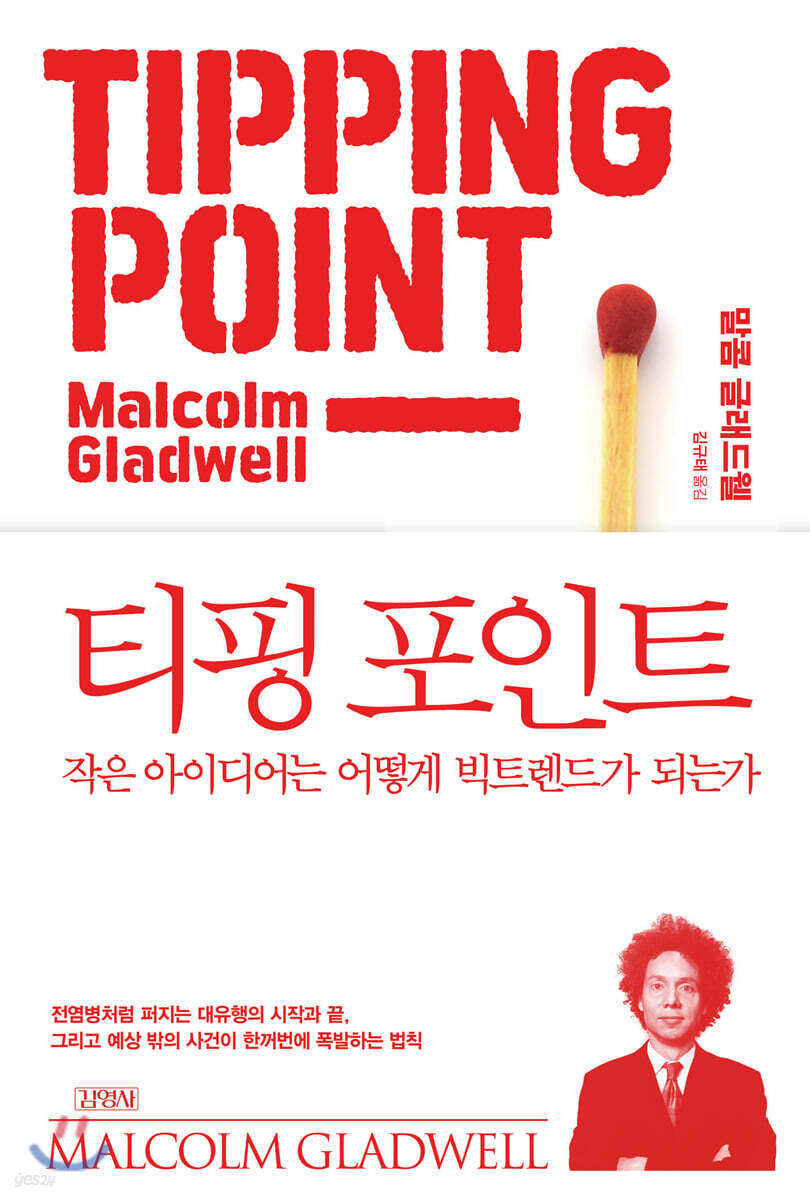
Tipping Point
 |
Description
Book Introduction
When The Tipping Point was first published 20 years ago, it attracted attention as a fresh exploration of the little-known phenomenon of “social fads.”
We now experience the incredible power of Internet meme culture on a daily basis, and the speed at which fake news spreads is incomparable to that of the past.
The 'tipping point' refers to that magical moment when a word, action, idea, or product becomes explosively popular.
Why did a song released years ago suddenly take over the internet? How did a book buried in the dust become a bestseller? "The Tipping Point" answers these questions.
A few people, a short message, a small situation can create a huge storm.
All about the tipping point, that magical moment when explosive change begins at breakneck speed.
We now experience the incredible power of Internet meme culture on a daily basis, and the speed at which fake news spreads is incomparable to that of the past.
The 'tipping point' refers to that magical moment when a word, action, idea, or product becomes explosively popular.
Why did a song released years ago suddenly take over the internet? How did a book buried in the dust become a bestseller? "The Tipping Point" answers these questions.
A few people, a short message, a small situation can create a huge storm.
All about the tipping point, that magical moment when explosive change begins at breakneck speed.
- You can preview some of the book's contents.
Preview
index
Introduction: Why Some Things Rise and Some Things Disappear
Chapter 1.
Few people, short messages, and dramatic situations: The three laws of fashion.
Chapter 2.
Connectors, Mavens, and Salesmen: The Law of the Few
Chapter 3.
Sesame Street and Blues Clues: The Law of Stickiness
Chapter 4.
Goetz and Crime in New York: The Law of Situational Power 1
Chapter 5.
Dunbar and 150: The Law of Situational Power 2
Chapter 6.
Rumors and Airwalk: Case Study 1
Chapter 7.
Suicide and Smoking: Case Study 2
Going Out: Believe in the Potential for Change
Reviews
Acknowledgements
main
Search
Recommendation
Chapter 1.
Few people, short messages, and dramatic situations: The three laws of fashion.
Chapter 2.
Connectors, Mavens, and Salesmen: The Law of the Few
Chapter 3.
Sesame Street and Blues Clues: The Law of Stickiness
Chapter 4.
Goetz and Crime in New York: The Law of Situational Power 1
Chapter 5.
Dunbar and 150: The Law of Situational Power 2
Chapter 6.
Rumors and Airwalk: Case Study 1
Chapter 7.
Suicide and Smoking: Case Study 2
Going Out: Believe in the Potential for Change
Reviews
Acknowledgements
main
Search
Recommendation
Detailed image

Into the book
If I can make you smile, I can make you happy.
If I can make you frown, I can make you sad.
In this sense, emotions are directed from the outside in.
If we think about emotions this way—that they come from the outside in rather than the inside out—we can understand why some people can have such a profound impact on others.
Anyway, some of us are very good at expressing our emotions and feelings.
This means that emotional contagion is much stronger than that of other people.
--- p.107
It seems like for something to be sticky it has to be direct.
Most people emphasize their words when they want them to be remembered.
Say it loudly and repeat it several times.
There's a saying in the advertising world that you have to show an ad at least six times for someone to remember it.
This adage is a useful lesson for companies like Coca-Cola and Nike, which can afford to spend hundreds of millions of dollars on marketing and flood every medium with their message.
But it's not very useful for those who want to popularize literacy with a small budget and an hour of public television.
--- p.117~118
He also doesn't deny that genes play a part in determining who we are.
Most psychologists believe that nature (p. genetics) explains about half of why we behave the way we do.
Zimbardo's argument is that there are certain times, places, and conditions in which much of that nature simply vanishes, and that there are instances in which you can take normal people from good schools, happy families, and pleasant neighborhoods, and powerfully influence their behavior simply by changing the details of the situations they face.
--- p.192~193
When we try to popularize an idea, an attitude, or a product, we try to change the audience in some small but important way.
We try to influence them to get swept up in what we are trying to popularize and turn their aversion into acceptance.
This can be achieved through the influence of a special type of person with a huge network of contacts.
This is the law of the few.
You just have to change what you're trying to convey and create a memorable message that sticks in people's minds and compels them to take action.
This is the law of stickiness.
I think both laws are intuitively understandable.
And it's important to remember that even small changes in circumstances can be just as important in creating trends.
But this fact seems to contradict some deeply ingrained assumptions about human nature.
--- p.205
To spark a trend, you need to focus your resources on a few key areas.
The law of the few says that connectors, mavens, and salespeople are the ones who spark word-of-mouth trends.
Anyone interested in sparking a word-of-mouth trend should focus their resources solely on these three groups.
Everyone else is not important.
--- p.314
Although the world of tipping points is difficult and unstable, there is also considerable hope.
Simply adjusting the size of the group can dramatically improve receptivity to new ideas.
By refining the way you present information, you can significantly increase its stickiness.
Simply by finding and contacting a few special people with strong social power, you can create a social trend.
Ultimately, the tipping point reaffirms the potential for change and the power of intelligent action.
Look around the world.
It may seem like an unchangeable, immovable place.
But that's not the case.
Just finding the right spot and giving it a little stimulation can bring about explosive changes.
--- p.318
One of the things that inspired me to write The Tipping Point was the mystery of word of mouth.
Word of mouth is a phenomenon that everyone seems to agree is important, but no one seems to know how to define.
The topic that readers talk to me about the most, and that I think about the most, is word of mouth.
If I can make you frown, I can make you sad.
In this sense, emotions are directed from the outside in.
If we think about emotions this way—that they come from the outside in rather than the inside out—we can understand why some people can have such a profound impact on others.
Anyway, some of us are very good at expressing our emotions and feelings.
This means that emotional contagion is much stronger than that of other people.
--- p.107
It seems like for something to be sticky it has to be direct.
Most people emphasize their words when they want them to be remembered.
Say it loudly and repeat it several times.
There's a saying in the advertising world that you have to show an ad at least six times for someone to remember it.
This adage is a useful lesson for companies like Coca-Cola and Nike, which can afford to spend hundreds of millions of dollars on marketing and flood every medium with their message.
But it's not very useful for those who want to popularize literacy with a small budget and an hour of public television.
--- p.117~118
He also doesn't deny that genes play a part in determining who we are.
Most psychologists believe that nature (p. genetics) explains about half of why we behave the way we do.
Zimbardo's argument is that there are certain times, places, and conditions in which much of that nature simply vanishes, and that there are instances in which you can take normal people from good schools, happy families, and pleasant neighborhoods, and powerfully influence their behavior simply by changing the details of the situations they face.
--- p.192~193
When we try to popularize an idea, an attitude, or a product, we try to change the audience in some small but important way.
We try to influence them to get swept up in what we are trying to popularize and turn their aversion into acceptance.
This can be achieved through the influence of a special type of person with a huge network of contacts.
This is the law of the few.
You just have to change what you're trying to convey and create a memorable message that sticks in people's minds and compels them to take action.
This is the law of stickiness.
I think both laws are intuitively understandable.
And it's important to remember that even small changes in circumstances can be just as important in creating trends.
But this fact seems to contradict some deeply ingrained assumptions about human nature.
--- p.205
To spark a trend, you need to focus your resources on a few key areas.
The law of the few says that connectors, mavens, and salespeople are the ones who spark word-of-mouth trends.
Anyone interested in sparking a word-of-mouth trend should focus their resources solely on these three groups.
Everyone else is not important.
--- p.314
Although the world of tipping points is difficult and unstable, there is also considerable hope.
Simply adjusting the size of the group can dramatically improve receptivity to new ideas.
By refining the way you present information, you can significantly increase its stickiness.
Simply by finding and contacting a few special people with strong social power, you can create a social trend.
Ultimately, the tipping point reaffirms the potential for change and the power of intelligent action.
Look around the world.
It may seem like an unchangeable, immovable place.
But that's not the case.
Just finding the right spot and giving it a little stimulation can bring about explosive changes.
--- p.318
One of the things that inspired me to write The Tipping Point was the mystery of word of mouth.
Word of mouth is a phenomenon that everyone seems to agree is important, but no one seems to know how to define.
The topic that readers talk to me about the most, and that I think about the most, is word of mouth.
--- p.323
Publisher's Review
A world-renowned business writer whose every published book has been a New York Times bestseller.
Malcolm Gladwell's The Tipping Point, the latest edition, is out now.
Why do some things rise and others disappear?
The law of pandemics that captivate people and shake the world
When The Tipping Point was first published 20 years ago, it attracted attention as a fresh exploration of the little-known phenomenon of “social fads.”
We now experience the incredible power of Internet meme culture on a daily basis, and the speed at which fake news spreads is incomparable to that of the past.
The 'tipping point' refers to that magical moment when a word, action, idea, or product becomes explosively popular.
Why did a song released years ago suddenly take over the internet? How did a book buried in the dust become a bestseller? "The Tipping Point" answers these questions.
Malcolm Gladwell analyzed the phenomenon of small ideas spreading like wildfire beyond a critical point using the framework of contagion.
Anyone interested in trends or wanting to create trends should read this book, as it remains useful even in explaining the current pandemic.
"The Tipping Point" is not a specific space in the past, but a fascinating report on all the social trends surrounding us "here and now," and a practical guide to what it takes to intentionally bring about positive change.
In addition to a new translation and new cover, the 2020 edition includes an “Afterword” filled with reader feedback and the author’s reflections after the first publication.
Every syndrome starts from a surprisingly small spark.
Three Characteristics of a Tipping Point
In the mid-1990s, Hershey's Puppy was a near-failed brand.
But at some point, word of mouth suddenly spread, sales skyrocketed, and it became a must-have item for young American men.
A similar phenomenon occurred in Brownsville, New York, a city notorious for crime.
Murders and drug trafficking dropped overnight.
The best way to understand this seemingly inexplicable change is to think of it as a pandemic.
The author says that ideas, products, messages, and actions spread like viruses.
There's a similar pattern between the rise of Hush Puppies and the decline in New York City's crime rate.
No one advertised that Hershey's Puppy was cool.
One or two kids showed off their fashion sense by wearing those shoes.
It wasn't that New York's criminals suddenly reformed in 1993.
It is fair to say that a very small number of criminals behaved very differently and that this was passed on to potential criminals.
People were “infected” with the Hush Puppies virus and the crime prevention virus in a short period of time.
This is the first characteristic of a tipping point.
The second characteristic is that very small causes can have enormous consequences.
One or two kids wore them because no one else did, and a very small number of criminals committed crimes under special circumstances.
As the number of people engaging in this behavior reached a critical mass, the same behavior exploded.
The third characteristic that is most important is that trends can rise and fall in an instant.
The name given to this dramatic moment is the tipping point.
“We set expectations over time.
But the world of tipping points is one where the unexpected is expected, where radical change is not just a possibility.
Contrary to all our expectations, the tipping point is a world of certainty.” A drop of just one degree, from 0.5 degrees Celsius to minus 0.5 degrees Celsius, is equivalent to rain turning to snow.
The world always turns upside down like this.
About the beginning and end of a pandemic that spreads like an epidemic.
3 Rules for Creating Trends
Malcolm Gladwell says there are laws that create social trends.
It's just a very small number of people, a short and memorable message, and a special situation.
1) Law of small numbers
20% of criminals commit 80% of crimes and 20% of drivers cause 80% of accidents.
The same goes for social change.
According to the “Law of the Few,” change begins with the word of mouth they spread.
In this book, they are classified into connectors, mavens, and salesmen.
A maven (Yiddish for "one who accumulates knowledge") is someone who has the information and social skills to start a word-of-mouth trend, and when their knowledge is passed on to connectors, the ripple effect increases.
Connectors are people with a huge network of connections who can have a huge impact on many people.
Salesmen captivate people with their powerful persuasive power.
Anyone who wants to create a trend, whether it's a shoe or an action, has to somehow utilize connectors, mavens, and salespeople.
You need to find someone or a way to translate the message into something the rest of the world can understand.
2) Law of stickiness
We tend to spend a lot of time thinking about how to increase the contagiousness of our messages.
How can we communicate our products or ideas to as many people as possible? But in communication, just as difficult as getting a message across is ensuring it doesn't just go in one ear and out the other.
“Stickiness” means that a message has an impact on someone.
The message is not erased from the mind and is engraved in the memory.
3) The law of power of circumstances
The Hush Puppies gained instant popularity because they were worn by kids in the East Village, a trendy area.
The East Village was an environment that helped others see those shoes in a new light.
The “power of circumstances” law shows that certain specific circumstances are key to changing behavior.
People are much more sensitive to situations than they appear.
This theory defines criminals as people who commit crimes not out of personal motivation, but in an environment that makes it easy to commit crime.
“The law of the few says that there are exceptional people who can spark a trend.
All we have to do is find those people.
The same goes for the lessons that stickiness teaches.
There is a simple way to package information so that it is undeniably irresistible in the right circumstances.
All we have to do is find the way.” Even great changes ultimately respond sensitively to the conditions and circumstances of the time and place in which they occur.
What we need to do is create that environment.
And all of this is necessary to bring about desirable change.
Malcolm Gladwell's The Tipping Point, the latest edition, is out now.
Why do some things rise and others disappear?
The law of pandemics that captivate people and shake the world
When The Tipping Point was first published 20 years ago, it attracted attention as a fresh exploration of the little-known phenomenon of “social fads.”
We now experience the incredible power of Internet meme culture on a daily basis, and the speed at which fake news spreads is incomparable to that of the past.
The 'tipping point' refers to that magical moment when a word, action, idea, or product becomes explosively popular.
Why did a song released years ago suddenly take over the internet? How did a book buried in the dust become a bestseller? "The Tipping Point" answers these questions.
Malcolm Gladwell analyzed the phenomenon of small ideas spreading like wildfire beyond a critical point using the framework of contagion.
Anyone interested in trends or wanting to create trends should read this book, as it remains useful even in explaining the current pandemic.
"The Tipping Point" is not a specific space in the past, but a fascinating report on all the social trends surrounding us "here and now," and a practical guide to what it takes to intentionally bring about positive change.
In addition to a new translation and new cover, the 2020 edition includes an “Afterword” filled with reader feedback and the author’s reflections after the first publication.
Every syndrome starts from a surprisingly small spark.
Three Characteristics of a Tipping Point
In the mid-1990s, Hershey's Puppy was a near-failed brand.
But at some point, word of mouth suddenly spread, sales skyrocketed, and it became a must-have item for young American men.
A similar phenomenon occurred in Brownsville, New York, a city notorious for crime.
Murders and drug trafficking dropped overnight.
The best way to understand this seemingly inexplicable change is to think of it as a pandemic.
The author says that ideas, products, messages, and actions spread like viruses.
There's a similar pattern between the rise of Hush Puppies and the decline in New York City's crime rate.
No one advertised that Hershey's Puppy was cool.
One or two kids showed off their fashion sense by wearing those shoes.
It wasn't that New York's criminals suddenly reformed in 1993.
It is fair to say that a very small number of criminals behaved very differently and that this was passed on to potential criminals.
People were “infected” with the Hush Puppies virus and the crime prevention virus in a short period of time.
This is the first characteristic of a tipping point.
The second characteristic is that very small causes can have enormous consequences.
One or two kids wore them because no one else did, and a very small number of criminals committed crimes under special circumstances.
As the number of people engaging in this behavior reached a critical mass, the same behavior exploded.
The third characteristic that is most important is that trends can rise and fall in an instant.
The name given to this dramatic moment is the tipping point.
“We set expectations over time.
But the world of tipping points is one where the unexpected is expected, where radical change is not just a possibility.
Contrary to all our expectations, the tipping point is a world of certainty.” A drop of just one degree, from 0.5 degrees Celsius to minus 0.5 degrees Celsius, is equivalent to rain turning to snow.
The world always turns upside down like this.
About the beginning and end of a pandemic that spreads like an epidemic.
3 Rules for Creating Trends
Malcolm Gladwell says there are laws that create social trends.
It's just a very small number of people, a short and memorable message, and a special situation.
1) Law of small numbers
20% of criminals commit 80% of crimes and 20% of drivers cause 80% of accidents.
The same goes for social change.
According to the “Law of the Few,” change begins with the word of mouth they spread.
In this book, they are classified into connectors, mavens, and salesmen.
A maven (Yiddish for "one who accumulates knowledge") is someone who has the information and social skills to start a word-of-mouth trend, and when their knowledge is passed on to connectors, the ripple effect increases.
Connectors are people with a huge network of connections who can have a huge impact on many people.
Salesmen captivate people with their powerful persuasive power.
Anyone who wants to create a trend, whether it's a shoe or an action, has to somehow utilize connectors, mavens, and salespeople.
You need to find someone or a way to translate the message into something the rest of the world can understand.
2) Law of stickiness
We tend to spend a lot of time thinking about how to increase the contagiousness of our messages.
How can we communicate our products or ideas to as many people as possible? But in communication, just as difficult as getting a message across is ensuring it doesn't just go in one ear and out the other.
“Stickiness” means that a message has an impact on someone.
The message is not erased from the mind and is engraved in the memory.
3) The law of power of circumstances
The Hush Puppies gained instant popularity because they were worn by kids in the East Village, a trendy area.
The East Village was an environment that helped others see those shoes in a new light.
The “power of circumstances” law shows that certain specific circumstances are key to changing behavior.
People are much more sensitive to situations than they appear.
This theory defines criminals as people who commit crimes not out of personal motivation, but in an environment that makes it easy to commit crime.
“The law of the few says that there are exceptional people who can spark a trend.
All we have to do is find those people.
The same goes for the lessons that stickiness teaches.
There is a simple way to package information so that it is undeniably irresistible in the right circumstances.
All we have to do is find the way.” Even great changes ultimately respond sensitively to the conditions and circumstances of the time and place in which they occur.
What we need to do is create that environment.
And all of this is necessary to bring about desirable change.
GOODS SPECIFICS
- Date of issue: September 1, 2020
- Page count, weight, size: 368 pages | 648g | 152*225*30mm
- ISBN13: 9788934990628
- ISBN10: 8934990627
You may also like
카테고리
korean


korean

![ELLE 엘르 스페셜 에디션 A형 : 12월 [2025]](http://librairie.coreenne.fr/cdn/shop/files/b8e27a3de6c9538896439686c6b0e8fb.jpg?v=1766436872&width=3840)


