

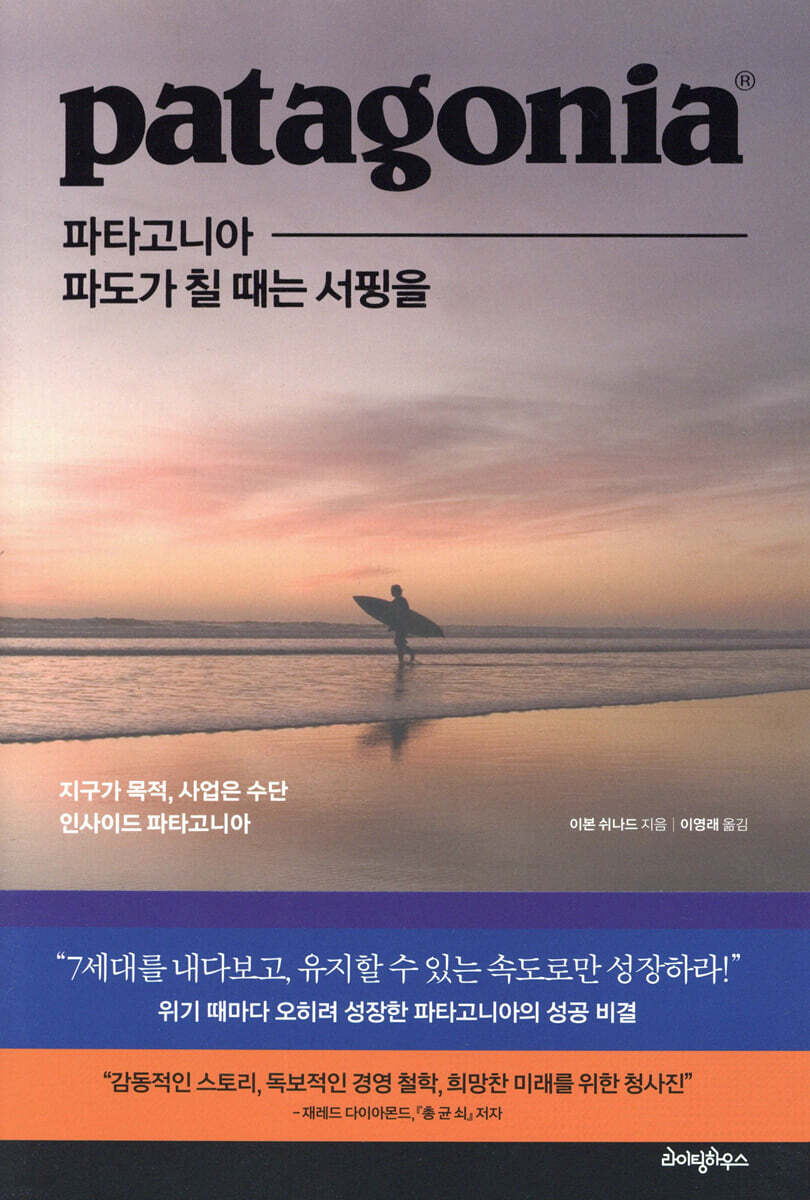
Patagonia, when the waves come, surf
 |
Description
Book Introduction
Amazon's #1 Environmental Ranking! A Business Handbook for the Environmentally-Critical Era Giving courage and inspiration to startup entrepreneurs around the world Patagonia founder Yvon Chouinard's 60-year management philosophy and inspiring life story Guns, Germs, and Steel by Jared Diamond highly recommended! All about Patagonia's overwhelming success by choosing the right thing and doing what you love! The world's leading outdoor company, known for its "Patagonia vest," which is often called the school uniform of Silicon Valley and Wall Street, and which causes a sellout frenzy whenever a new product is released. A company that has enjoyed record-breaking growth every year and has gained a passionate fan base around the world despite its campaign, “Don’t Buy Our Clothes,” and its appeal to consumers to repair and reuse their clothes as much as possible to protect the environment. This is the story of Patagonia, founded by legendary climber and environmental activist Yvon Chouinard. At the heart of all this success lies Yvon Chouinard's unique management philosophy of creating the best products while minimizing environmental impact. Yvon Chouinard, who runs a business to protect the planet, has achieved both business success and environmental protection, two goals that even environmentalists believed were incompatible, and as a result, Patagonia has written an overwhelming success story, overcoming two recessions over the past half-century. "Patagonia, Surfing the Waves" is the first book to reveal the secrets of Patagonia's success, which became the world's best by choosing the right thing and doing what they love, and Yvon Chouinard's 60-year management philosophy. Although it was initially published in the United States in 2005 as an in-house management philosophy manual, it was translated into ten languages, adopted as a textbook in high schools and universities, and used as a research resource at Harvard University. "Patagonia, Surfing the Waves" is a revised and expanded edition commemorating the 10th anniversary of its publication in 2016. It systematically and specifically organizes and discloses the eight management philosophies that Yvon Chouinard has always upheld as his convictions whenever Patagonia faces a crisis. Unusually for a business book, this book ranked first in the Amazon environmental category, and is considered one of the most influential books on grassroots environmental activists in the United States. It prophetically contains the principles and vision that companies should pursue in an era where environmental sustainability has become the norm, not just environmental friendliness. |
- You can preview some of the book's contents.
Preview
index
Introduction: A Market That Demands Endless Growth or a Planet That Needs Rest? - Naomi Klein
Revised and Expanded Edition: The Earth is the End, Business is the Means, the Patagonia Story
Prologue: How to Become Overwhelmingly Successful by Choosing the Right Thing and Doing What You Love
1.
history
From a dilapidated blacksmith shop in the backyard to becoming the world's leading outdoor company.
2.
philosophy
Product Design Philosophy
Production philosophy
Distribution philosophy
Marketing Philosophy
Financial Philosophy
Personnel Philosophy
Management Philosophy
Environmental Philosophy
Epilogue: Turning Back and Taking a Step Forward
Acknowledgements
References
annotation
Revised and Expanded Edition: The Earth is the End, Business is the Means, the Patagonia Story
Prologue: How to Become Overwhelmingly Successful by Choosing the Right Thing and Doing What You Love
1.
history
From a dilapidated blacksmith shop in the backyard to becoming the world's leading outdoor company.
2.
philosophy
Product Design Philosophy
Production philosophy
Distribution philosophy
Marketing Philosophy
Financial Philosophy
Personnel Philosophy
Management Philosophy
Environmental Philosophy
Epilogue: Turning Back and Taking a Step Forward
Acknowledgements
References
annotation
Detailed image

Into the book
One of my favorite quotes about entrepreneurship is, “If you want to know what an entrepreneur is, study a delinquent teenager.”
Flying youth speak through their actions.
“This really sucks.
“I’m going to do it my way.” I really didn’t want to be a businessman, so I needed a good reason to become one.
Luckily, there was something I absolutely did not want to lose, even as I expanded my business.
The point is that work should always be enjoyable.
On the way to work, I have to jump up the stairs two steps at a time because I'm so excited.
You should be surrounded by colleagues who can dress however they want and even work barefoot.
Flexible work arrangements allow you to surf when the waves are good, ski when the snow is falling, and stay home to care for your children when they are sick.
We need to blur the lines between work, play, and family.
Creative management that breaks away from existing rules and creates its own system gives me great satisfaction.
--- From "History"
Function-driven design is usually minimal.
As Dieter Rams, Braun's head of design, once said, "Good design is minimal design." Complexity is a sure sign that a functional need has not been addressed.
Take, for example, the difference between a Ferrari and a Cadillac in the 1960s.
Ferrari's sleek lines were well suited to its high-performance purpose.
Cadillac had no functional goal per se.
The Cadillac had a ton of horsepower, but no steering, suspension, torque, aerodynamics, or brakes to match.
If there is no concern about function, there is no use for design.
All that was needed was the comfort and power to transport the living room down the highway and onto the golf course.
So, to this basically hideous form, with fins at the back and a puffed-out front, all sorts of flashy but useless metal decorations were added.
When functionality doesn't guide design, imagination runs wild.
If you're designing a monster, you'll come up with something believable.
--- From "Product Design Philosophy"
The most important thing is our roots as a blacksmith who makes the best climbing gear in the world.
The beliefs, attitudes, and values of the free-thinking, independent climbers and surfers who worked there became the foundation of Patagonia's culture, and from that culture emerged an image: authentic, high-quality products made by the people who use them.
Our image has evolved to encompass the culture of a new generation of climbers, trail runners, anglers and surfers who strive to create the world's best outdoor apparel.
At its heart is the belief in preserving the wildness of nature and sport.
Our people have maintained certain values and beliefs that have been inherent in our company since its inception in the 1950s, while also incorporating others.
This refers to the will to take a strong stance on environmental issues.
--- From "Marketing Philosophy"
We never wanted to be a big company.
We want to be the best company, and we strive to be the best small company rather than the best big company.
To do this, you must exercise self-control.
The growth of one part of the company may be sacrificed for the growth of another part.
It's important to be clear about the limits of this "experiment," and to live within them, keeping in mind that the faster we push beyond them, the sooner the type of company we want will disappear.
--- From "Financial Philosophy"
Remember.
Work should be fun.
We value employees who live rich and balanced lives.
We have flexible working hours, and back when we were a blacksmith, whenever there was a two-meter wave, we would close the shop and go out and surf.
Our policy is to always provide flexible working arrangements as long as it does not negatively impact others.
A serious surfer doesn't plan to go surfing next Tuesday at 2 p.m.; he goes surfing when the waves, tide, and wind are perfect.
Skiing is best done when there is dry powder snow.
To avoid missing out on good times, a work environment that allows you to step forward at any time must be created.
This idea led to a flexible work schedule policy called "Surf when the waves come in."
--- From "Philosophy of Personnel"
The concept of natural growth for businesses helps us keep our size small enough to manage.
I think it's ideal to have no more than 100 people working in one place to ensure optimal communication and avoid bureaucracy.
This is consistent with the fact that democracy works well in small societies where people feel a sense of personal responsibility.
Sherpa, a small tribe living in the Himalayas.
(Translator's note) or Inuit (a people group living in northern Canada, Greenland, Alaska, etc. - Translator's note) villages do not need to hire sanitation workers or firefighters.
Everyone cares about the problems of the community.
There's no need for the police.
It is difficult to have evil intentions under peer pressure.
The most efficient city size is between 250,000 and 350,000, which has all the culture and amenities of a city and still has a manageable population, like Santa Barbara, Oakland, or Florence.
--- From "Management Philosophy"
One of the most difficult things for companies to do is to examine the environmental impact of their most successful products and, if they are negatively impacting the environment, to change them or remove them from the shelves.
Let's say you are the owner of a company that makes landmines.
You are the best employer who gives people jobs and benefits.
But I never thought about what landmines actually do.
One day you go to Bosnia or Cambodia or Mozambique and see innocent people being maimed and you realize, “This is what landmines do!”
Now you know what the product really does.
In this situation, should we quit the landmine (cigarette, fast food) business or continue?
Patagonia has also started to find these 'landmines' of ours.
--- From "Environmental Philosophy"
We all know that our current global economy, based on constant consumption and waste, is destroying our planet.
We are the sinners.
We are consumers who 'use up and destroy'.
We keep buying things we want but don't need.
It seems that there is no such thing as satisfaction for us.
Many people are questioning the frenetic consumer lifestyle as they see the consequences of an economic system that boasts cutting-edge technology but is also fraught with risks and hazards.
This is not to say that we should reject all technology.
The idea is to return to a reasonable level of technology and aim for a simpler life.
Flying youth speak through their actions.
“This really sucks.
“I’m going to do it my way.” I really didn’t want to be a businessman, so I needed a good reason to become one.
Luckily, there was something I absolutely did not want to lose, even as I expanded my business.
The point is that work should always be enjoyable.
On the way to work, I have to jump up the stairs two steps at a time because I'm so excited.
You should be surrounded by colleagues who can dress however they want and even work barefoot.
Flexible work arrangements allow you to surf when the waves are good, ski when the snow is falling, and stay home to care for your children when they are sick.
We need to blur the lines between work, play, and family.
Creative management that breaks away from existing rules and creates its own system gives me great satisfaction.
--- From "History"
Function-driven design is usually minimal.
As Dieter Rams, Braun's head of design, once said, "Good design is minimal design." Complexity is a sure sign that a functional need has not been addressed.
Take, for example, the difference between a Ferrari and a Cadillac in the 1960s.
Ferrari's sleek lines were well suited to its high-performance purpose.
Cadillac had no functional goal per se.
The Cadillac had a ton of horsepower, but no steering, suspension, torque, aerodynamics, or brakes to match.
If there is no concern about function, there is no use for design.
All that was needed was the comfort and power to transport the living room down the highway and onto the golf course.
So, to this basically hideous form, with fins at the back and a puffed-out front, all sorts of flashy but useless metal decorations were added.
When functionality doesn't guide design, imagination runs wild.
If you're designing a monster, you'll come up with something believable.
--- From "Product Design Philosophy"
The most important thing is our roots as a blacksmith who makes the best climbing gear in the world.
The beliefs, attitudes, and values of the free-thinking, independent climbers and surfers who worked there became the foundation of Patagonia's culture, and from that culture emerged an image: authentic, high-quality products made by the people who use them.
Our image has evolved to encompass the culture of a new generation of climbers, trail runners, anglers and surfers who strive to create the world's best outdoor apparel.
At its heart is the belief in preserving the wildness of nature and sport.
Our people have maintained certain values and beliefs that have been inherent in our company since its inception in the 1950s, while also incorporating others.
This refers to the will to take a strong stance on environmental issues.
--- From "Marketing Philosophy"
We never wanted to be a big company.
We want to be the best company, and we strive to be the best small company rather than the best big company.
To do this, you must exercise self-control.
The growth of one part of the company may be sacrificed for the growth of another part.
It's important to be clear about the limits of this "experiment," and to live within them, keeping in mind that the faster we push beyond them, the sooner the type of company we want will disappear.
--- From "Financial Philosophy"
Remember.
Work should be fun.
We value employees who live rich and balanced lives.
We have flexible working hours, and back when we were a blacksmith, whenever there was a two-meter wave, we would close the shop and go out and surf.
Our policy is to always provide flexible working arrangements as long as it does not negatively impact others.
A serious surfer doesn't plan to go surfing next Tuesday at 2 p.m.; he goes surfing when the waves, tide, and wind are perfect.
Skiing is best done when there is dry powder snow.
To avoid missing out on good times, a work environment that allows you to step forward at any time must be created.
This idea led to a flexible work schedule policy called "Surf when the waves come in."
--- From "Philosophy of Personnel"
The concept of natural growth for businesses helps us keep our size small enough to manage.
I think it's ideal to have no more than 100 people working in one place to ensure optimal communication and avoid bureaucracy.
This is consistent with the fact that democracy works well in small societies where people feel a sense of personal responsibility.
Sherpa, a small tribe living in the Himalayas.
(Translator's note) or Inuit (a people group living in northern Canada, Greenland, Alaska, etc. - Translator's note) villages do not need to hire sanitation workers or firefighters.
Everyone cares about the problems of the community.
There's no need for the police.
It is difficult to have evil intentions under peer pressure.
The most efficient city size is between 250,000 and 350,000, which has all the culture and amenities of a city and still has a manageable population, like Santa Barbara, Oakland, or Florence.
--- From "Management Philosophy"
One of the most difficult things for companies to do is to examine the environmental impact of their most successful products and, if they are negatively impacting the environment, to change them or remove them from the shelves.
Let's say you are the owner of a company that makes landmines.
You are the best employer who gives people jobs and benefits.
But I never thought about what landmines actually do.
One day you go to Bosnia or Cambodia or Mozambique and see innocent people being maimed and you realize, “This is what landmines do!”
Now you know what the product really does.
In this situation, should we quit the landmine (cigarette, fast food) business or continue?
Patagonia has also started to find these 'landmines' of ours.
--- From "Environmental Philosophy"
We all know that our current global economy, based on constant consumption and waste, is destroying our planet.
We are the sinners.
We are consumers who 'use up and destroy'.
We keep buying things we want but don't need.
It seems that there is no such thing as satisfaction for us.
Many people are questioning the frenetic consumer lifestyle as they see the consequences of an economic system that boasts cutting-edge technology but is also fraught with risks and hazards.
This is not to say that we should reject all technology.
The idea is to return to a reasonable level of technology and aim for a simpler life.
--- From "Epilogue"
Publisher's Review
[Fortune] 100 Best Companies to Work For!
Winner of the UN Earth Awards Entrepreneur Vision Category!
From starting in an old shed in our backyard to becoming the world's leading outdoor company,
Achieving the impossible goal of reconciling capitalism and ethics
The Full Story of Patagonia's Success
Yvon Chouinard, a nature lover and successful businessman, wrote this autobiographical business philosophy book, Patagonia: Surfing the Wave, to share the lessons he learned firsthand.
He spent most of the year on the rock faces of Yosemite and in the middle of summer, he sought refuge from the heat by traveling to the high mountains of Canada and the Alps. Always surrounded by nature, he started his career as a businessman in 1957 by starting 'Chouinard Equipment', a company that manufactures rock climbing equipment.
The first thing he made was a piton, but when he realized that it was damaging the rock face he loved, he started making and selling a chalk that did not damage the rock instead of a piton.
In 1964, he produced his first mail-order catalog, a one-page copy that included the warning: "Don't expect fast shipping during climbing season."
The business grew steadily, and in 1972, the clothing business was launched with the addition of rugby shirts to the catalog.
As the number of new colleagues grew and Patagonia grew, he realized he needed his own way of doing business.
Shinard Equipment was a small company that designed and built the world's best climbing gear for himself and his friends.
No one goes into business to make money.
Finally, he decides to use his business to find and implement solutions to the environmental crisis.
Based on this belief, Shinad developed functional fabrics that reduce environmental damage, made all cotton products with organic cotton, and introduced the 'Earth Tax', which uses 1% of annual sales to preserve and restore the natural environment.
Yvonne Chouinard has always tried to keep her life simple, and after realizing the severity of environmental problems, she reduced her consumption of material goods.
Even in running Patagonia, he never sacrificed his principles for money.
As a result, the brand captured the hearts of consumers with beautiful, timeless products that could be worn for a long time, and achieved unprecedented success by also fulfilling its goal of helping the planet.
He brilliantly demonstrated that things we once thought impossible—work and life, profit and social responsibility, business expansion and environmental protection—could all coexist.
And how that was possible is fully revealed in this book.
Look ahead to the 7th generation and grow only at a pace you can sustain!
Patagonia's 8 Secrets to Success: Growing 25% During Each Recession
All of Patagonia's products reflect the common philosophy of "if it's not the best, we don't make it."
Every product must be absolutely necessary. We don't produce 20 different types of pants with the same features just to increase sales. We don't advertise artificially, because customer trust can't be bought with advertising dollars.
Patagonia's consistent management policy is to grow 'naturally' by creating functional and simple products that can be used for a long time without being influenced by trends.
In the late 1980s, Patagonia was on the verge of reaching $1 billion in sales.
Yvon Chouinard, who started his humble business not to make money but to make equipment for his own use, followed the typical path to success.
We hired more employees and an MBA-trained CEO, and expanded our manufacturing and trading partners.
However, in 1991, the U.S. economy fell into a recession, and Patagonia also faced a crisis with plummeting sales and a buildup of inventory.
Yvon Chouinard, who was shocked when he heard from a famous management consultant he had sought for a solution, that he should “sell the company and create a non-profit environmental foundation.” He began to think with his colleagues about why Patagonia should continue in business.
Shinard and his colleagues all agreed that "a billion-dollar company is all well and good, but it's meaningless if we have to build a product we're not proud of."
They say, “Patagonia is a company created by people who love nature, and is rooted in their free-thinking, independent beliefs, attitudes, and values.
We have reorganized our business by sharing a clear sense of purpose and further strengthening our management philosophy: “Our top priority is to create the best products we use ourselves and to protect the nature we love.”
And then came the second recession in 2008.
Consumers became very conservative during the financial crisis and stopped buying trendy items.
Instead, I paid more for Patagonia's products, which are practical, versatile, and durable.
As a result, we were able to avoid the crisis and achieve even greater results, growing by more than 25%.
Yvon Chouinard's experience navigating the recession taught him that making the right decisions in any crisis requires a philosophy that permeates the entire business.
"Patagonia, Surfing When the Waves Hit" is the result of Yvon Chouinard's detailed and systematic organization of the eight management philosophies that formed the foundation of his success from founding Chouinard Equipment in an old shed in his backyard to making Patagonia the world's best outdoor company: design, production, distribution, marketing, finance, human resources, management, and environmental philosophies.
In this book, Yvon Chouinard finds a model for management and sustainability not in corporate America, but in the Iroquois Indians, who see seven generations into the future.
The Iroquois are said to have included representatives of the next seven generations in the tribal decision-making process.
This book, which delivers a weighty message to look ahead seven generations and grow only at a pace that can be maintained, has been called a management textbook for Silicon Valley CEOs and has established itself as a must-read for entrepreneurs in the era of the "necessary environment." It is also considered one of the books that has had the greatest influence on startup founders around the world.
Why are millennials around the world crazy about Patagonia?
Nature lovers come together to use business to benefit the planet.
An advertisement is published in the New York Times on Black Friday, the annual event that marks the biggest sale of the year in the United States.
This ad, which urged consumers not to buy the company's products with the outrageous tagline "Don't buy this jacket," paradoxically created a huge stir and brought attention to Patagonia's environmental philosophy.
Patagonia has consistently practiced environmental protection based on its mission statement, “We are in business to save our home, the Earth.”
After an internal evaluation revealed that cotton was the most environmentally damaging material, the company decided to make all cotton products from organic cotton starting in 1996.
Although the company suffered from enormous financial difficulties during the process, this bold move became the first in the outdoor industry to use organic cotton and influenced more companies to take on social responsibility.
Patagonia also offers free repair services through its own 'Worn Wear' program.
It encourages people to repair and wear products for as long as possible rather than consuming them new, in order to slightly slow down the cycle of product production, consumption, and disposal.
Patagonia has become a brand beloved by value-conscious millennials through its environmentally conscious efforts.
But if the sole purpose of all these actions was profit, Patagonia would not have been loved this much.
The biggest reason Patagonia has such a strong fan base compared to other brands is because of its unique sincerity, such as consistently donating 1% of its total sales to environmental organizations every year for the sake of the planet.
"Patagonia, Surfing When the Waves Hit" contains Patagonia's truer voice.
In this book, Yvonne Chouinard appeals to all sectors of society, including businesses, governments, and consumers, to participate in environmental protection, and presents a blueprint for the next seven generations.
Today, when various diseases and environmental pollution have become problems that can no longer be ignored, the message of this book resonates even more deeply.
Winner of the UN Earth Awards Entrepreneur Vision Category!
From starting in an old shed in our backyard to becoming the world's leading outdoor company,
Achieving the impossible goal of reconciling capitalism and ethics
The Full Story of Patagonia's Success
Yvon Chouinard, a nature lover and successful businessman, wrote this autobiographical business philosophy book, Patagonia: Surfing the Wave, to share the lessons he learned firsthand.
He spent most of the year on the rock faces of Yosemite and in the middle of summer, he sought refuge from the heat by traveling to the high mountains of Canada and the Alps. Always surrounded by nature, he started his career as a businessman in 1957 by starting 'Chouinard Equipment', a company that manufactures rock climbing equipment.
The first thing he made was a piton, but when he realized that it was damaging the rock face he loved, he started making and selling a chalk that did not damage the rock instead of a piton.
In 1964, he produced his first mail-order catalog, a one-page copy that included the warning: "Don't expect fast shipping during climbing season."
The business grew steadily, and in 1972, the clothing business was launched with the addition of rugby shirts to the catalog.
As the number of new colleagues grew and Patagonia grew, he realized he needed his own way of doing business.
Shinard Equipment was a small company that designed and built the world's best climbing gear for himself and his friends.
No one goes into business to make money.
Finally, he decides to use his business to find and implement solutions to the environmental crisis.
Based on this belief, Shinad developed functional fabrics that reduce environmental damage, made all cotton products with organic cotton, and introduced the 'Earth Tax', which uses 1% of annual sales to preserve and restore the natural environment.
Yvonne Chouinard has always tried to keep her life simple, and after realizing the severity of environmental problems, she reduced her consumption of material goods.
Even in running Patagonia, he never sacrificed his principles for money.
As a result, the brand captured the hearts of consumers with beautiful, timeless products that could be worn for a long time, and achieved unprecedented success by also fulfilling its goal of helping the planet.
He brilliantly demonstrated that things we once thought impossible—work and life, profit and social responsibility, business expansion and environmental protection—could all coexist.
And how that was possible is fully revealed in this book.
Look ahead to the 7th generation and grow only at a pace you can sustain!
Patagonia's 8 Secrets to Success: Growing 25% During Each Recession
All of Patagonia's products reflect the common philosophy of "if it's not the best, we don't make it."
Every product must be absolutely necessary. We don't produce 20 different types of pants with the same features just to increase sales. We don't advertise artificially, because customer trust can't be bought with advertising dollars.
Patagonia's consistent management policy is to grow 'naturally' by creating functional and simple products that can be used for a long time without being influenced by trends.
In the late 1980s, Patagonia was on the verge of reaching $1 billion in sales.
Yvon Chouinard, who started his humble business not to make money but to make equipment for his own use, followed the typical path to success.
We hired more employees and an MBA-trained CEO, and expanded our manufacturing and trading partners.
However, in 1991, the U.S. economy fell into a recession, and Patagonia also faced a crisis with plummeting sales and a buildup of inventory.
Yvon Chouinard, who was shocked when he heard from a famous management consultant he had sought for a solution, that he should “sell the company and create a non-profit environmental foundation.” He began to think with his colleagues about why Patagonia should continue in business.
Shinard and his colleagues all agreed that "a billion-dollar company is all well and good, but it's meaningless if we have to build a product we're not proud of."
They say, “Patagonia is a company created by people who love nature, and is rooted in their free-thinking, independent beliefs, attitudes, and values.
We have reorganized our business by sharing a clear sense of purpose and further strengthening our management philosophy: “Our top priority is to create the best products we use ourselves and to protect the nature we love.”
And then came the second recession in 2008.
Consumers became very conservative during the financial crisis and stopped buying trendy items.
Instead, I paid more for Patagonia's products, which are practical, versatile, and durable.
As a result, we were able to avoid the crisis and achieve even greater results, growing by more than 25%.
Yvon Chouinard's experience navigating the recession taught him that making the right decisions in any crisis requires a philosophy that permeates the entire business.
"Patagonia, Surfing When the Waves Hit" is the result of Yvon Chouinard's detailed and systematic organization of the eight management philosophies that formed the foundation of his success from founding Chouinard Equipment in an old shed in his backyard to making Patagonia the world's best outdoor company: design, production, distribution, marketing, finance, human resources, management, and environmental philosophies.
In this book, Yvon Chouinard finds a model for management and sustainability not in corporate America, but in the Iroquois Indians, who see seven generations into the future.
The Iroquois are said to have included representatives of the next seven generations in the tribal decision-making process.
This book, which delivers a weighty message to look ahead seven generations and grow only at a pace that can be maintained, has been called a management textbook for Silicon Valley CEOs and has established itself as a must-read for entrepreneurs in the era of the "necessary environment." It is also considered one of the books that has had the greatest influence on startup founders around the world.
Why are millennials around the world crazy about Patagonia?
Nature lovers come together to use business to benefit the planet.
An advertisement is published in the New York Times on Black Friday, the annual event that marks the biggest sale of the year in the United States.
This ad, which urged consumers not to buy the company's products with the outrageous tagline "Don't buy this jacket," paradoxically created a huge stir and brought attention to Patagonia's environmental philosophy.
Patagonia has consistently practiced environmental protection based on its mission statement, “We are in business to save our home, the Earth.”
After an internal evaluation revealed that cotton was the most environmentally damaging material, the company decided to make all cotton products from organic cotton starting in 1996.
Although the company suffered from enormous financial difficulties during the process, this bold move became the first in the outdoor industry to use organic cotton and influenced more companies to take on social responsibility.
Patagonia also offers free repair services through its own 'Worn Wear' program.
It encourages people to repair and wear products for as long as possible rather than consuming them new, in order to slightly slow down the cycle of product production, consumption, and disposal.
Patagonia has become a brand beloved by value-conscious millennials through its environmentally conscious efforts.
But if the sole purpose of all these actions was profit, Patagonia would not have been loved this much.
The biggest reason Patagonia has such a strong fan base compared to other brands is because of its unique sincerity, such as consistently donating 1% of its total sales to environmental organizations every year for the sake of the planet.
"Patagonia, Surfing When the Waves Hit" contains Patagonia's truer voice.
In this book, Yvonne Chouinard appeals to all sectors of society, including businesses, governments, and consumers, to participate in environmental protection, and presents a blueprint for the next seven generations.
Today, when various diseases and environmental pollution have become problems that can no longer be ignored, the message of this book resonates even more deeply.
GOODS SPECIFICS
- Date of issue: April 30, 2020
- Page count, weight, size: 424 pages | 616g | 152*225*30mm
- ISBN13: 9788998075712
- ISBN10: 8998075717
You may also like
카테고리
korean


korean

![GQ KOREA Mark (Monthly): December [2025]](http://librairie.coreenne.fr/cdn/shop/files/8ef265dbbfbf186523ed75ba7319009d.jpg?v=1765340328&width=3840)


