

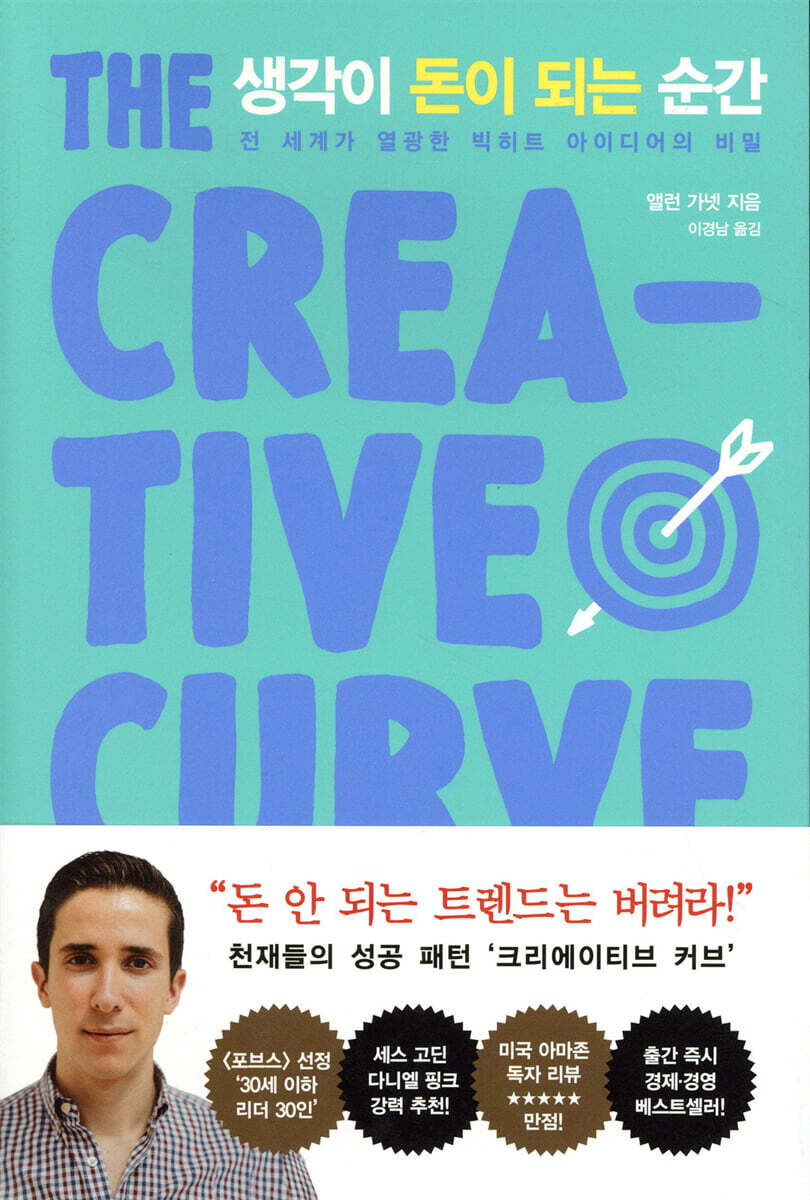
The moment when thoughts become money
 |
Description
Book Introduction
- A word from MD
-
The Secret to Success Behind Big Hit's IdeasThere's a formula for hit products! The author, a big data expert, reveals the "pattern of success" for the first time.
It also introduces four rules for coming up with big hit ideas.
Anyone can acquire creative talent by following these rules, even if they just didn't know how to do it until now.
January 4, 2019. Economics and Management PD Kim Joo-ri
“There’s a formula for things that hit!”
The science of turning ordinary ideas into big hits.
Picasso, Mozart, Steve Jobs, J.
K. Rowling… … .
Behind the big hit ideas that captivate people around the world and ultimately reap incredible profits, there's predictable science.
We are revealing the 'Creative Curve', the formula for success followed by genius creators.
What's amazing is that by simply copying this formula, anyone, not just a genius, can come up with a "money-making idea."
Alan Garnett, a big data expert selected as one of [Forbes] and [Inc.]'s '30 Under 30', is the CEO of TrekMavon, which provides marketing information to [Fortune] 500 companies such as GE, Microsoft, and Marriott. In this book, he reveals for the first time the patterns of success revealed through direct interviews with hundreds of genius creators around the world.
The science of turning ordinary ideas into big hits.
Picasso, Mozart, Steve Jobs, J.
K. Rowling… … .
Behind the big hit ideas that captivate people around the world and ultimately reap incredible profits, there's predictable science.
We are revealing the 'Creative Curve', the formula for success followed by genius creators.
What's amazing is that by simply copying this formula, anyone, not just a genius, can come up with a "money-making idea."
Alan Garnett, a big data expert selected as one of [Forbes] and [Inc.]'s '30 Under 30', is the CEO of TrekMavon, which provides marketing information to [Fortune] 500 companies such as GE, Microsoft, and Marriott. In this book, he reveals for the first time the patterns of success revealed through direct interviews with hundreds of genius creators around the world.
- You can preview some of the book's contents.
Preview
index
Prologue Patterns of Success
PART 1 Lies About Creativity
01 A work of dream
In Search of the Original Song | The Road to Yesterday
02 Learning to Lie
What People Want | Misguided Patterns | Optimal Tension
03 The Myth of the Birth of a Genius
A History of Creativity | In Search of the Middle Ages | The Vatican and the Colorist | Monsters and People | The IQ of Termites
04 What is talent?
13 Years of Drawing | The Road to Professionalism | An Artist's Paradise | Having a Purpose | The Plasticity of the Brain
05 Who is a genius?
Genius Creation Project | On the Hill
06 Creative Curve
Exposed Emotions | The Learning Potential of Racism | Love Kills Slowly | The Bonus of Being Different
| The Creative Curve | The Harsh Reality | When Less is More | The Process of Becoming Fluent | The Math Behind the Beatles
PART 2: The Laws of Creative Monetization
07 Law 1: Consumption
Is it luck? | A springboard for progress | A surprising principle | Digital giants | Ingenuity | The science of 'Aha!' moments | Latte art and brain processing | Laying the foundation
08 Law 2: Imitation
The Cinderella Formula | The Origins of Constraints | The Science of Popular Music | Remix Culture | The Franklin Method | Modern Applications
09 Law 3: Creative Community
Master Teacher | Anyone Can Learn | Clustering | Conflicting Collaborators | Stop, Collaborate, and Listen | Modern Muse | The Race for Perspective | The Surprising Power of Loft | Celebrity Promoters | Insiders vs.
Outsiders | Creative Communities | Important Side Notes
10 Law 4: Repetition
Ice Cream Tears | Conceptualization | Compression | Curation | Feedback | Film Data | Getting Inside the Frame | Risky Experiments | The President's Data | Heidi's Other Job
Epilogue Your Pattern
Consumption and Constraint | Repetition, the Creation of the World | Community | Parting Words
Acknowledgements
main
PART 1 Lies About Creativity
01 A work of dream
In Search of the Original Song | The Road to Yesterday
02 Learning to Lie
What People Want | Misguided Patterns | Optimal Tension
03 The Myth of the Birth of a Genius
A History of Creativity | In Search of the Middle Ages | The Vatican and the Colorist | Monsters and People | The IQ of Termites
04 What is talent?
13 Years of Drawing | The Road to Professionalism | An Artist's Paradise | Having a Purpose | The Plasticity of the Brain
05 Who is a genius?
Genius Creation Project | On the Hill
06 Creative Curve
Exposed Emotions | The Learning Potential of Racism | Love Kills Slowly | The Bonus of Being Different
| The Creative Curve | The Harsh Reality | When Less is More | The Process of Becoming Fluent | The Math Behind the Beatles
PART 2: The Laws of Creative Monetization
07 Law 1: Consumption
Is it luck? | A springboard for progress | A surprising principle | Digital giants | Ingenuity | The science of 'Aha!' moments | Latte art and brain processing | Laying the foundation
08 Law 2: Imitation
The Cinderella Formula | The Origins of Constraints | The Science of Popular Music | Remix Culture | The Franklin Method | Modern Applications
09 Law 3: Creative Community
Master Teacher | Anyone Can Learn | Clustering | Conflicting Collaborators | Stop, Collaborate, and Listen | Modern Muse | The Race for Perspective | The Surprising Power of Loft | Celebrity Promoters | Insiders vs.
Outsiders | Creative Communities | Important Side Notes
10 Law 4: Repetition
Ice Cream Tears | Conceptualization | Compression | Curation | Feedback | Film Data | Getting Inside the Frame | Risky Experiments | The President's Data | Heidi's Other Job
Epilogue Your Pattern
Consumption and Constraint | Repetition, the Creation of the World | Community | Parting Words
Acknowledgements
main
Detailed image
Into the book
The purpose of this book is to reveal the truth hidden within hit works of art.
There is a clear scientific basis behind the works that many people are enthusiastic about.
And today, thanks to advances in neuroscience, we have unprecedented ability to decipher and unravel the structures of the "inspiration" that create popular works.
--- pp.5-6
I will explain to you in detail the pattern I discovered.
This book is neither a marketing book nor a self-help book.
This book is a guide to help you understand the patterns that lead to great success in creative fields.
You'll learn the history of creative thinking and how it has evolved from the Greek era to today's dazzlingly fast-moving world of Snapchat and Instagram.
Beyond uncovering the neuroscience behind trend creation, you'll learn the four patterns that highly creative and successful people follow to increase their chances of mainstream success—and understand the science behind why these patterns work so well.
--- p.35
You've probably heard the term '10,000-hour rule' before.
This term was first introduced by Malcolm Gladwell in his 2008 bestseller Outliers.
(Omitted) The basis for this law was K., a Swedish professor at Florida State University.
Anders Ericsson (K.
This is a research paper by Anders Ericsson.
Professor Ericsson, who was the first to study the problem of skill acquisition, said there was some misunderstanding.
Strictly speaking, this rule did not mean that.
“Gladwell misread my paper,” he told me.
The 10,000-hour rule has two major flaws.
First, this law ignores the fact that it's not how much time you spend on learning a skill, but how you spend that time that matters.
--- p.81~82
Because of pervasive cultural beliefs like the "inspiration theory of creativity," people believe that only innovative and groundbreakingly different ideas are the secret to success.
The problem is that in this case, you risk ending up with an idea that's too far left on the creative curve.
This idea is poorly timed.
It's so new and so different.
In other words, it is completely unfamiliar.
Novelists who belong here publish books no one likes, composers write melodies no one will listen to, and startups create things no one will use.
Herman Melville, who wrote Moby-Dick, did just that.
Moby Dick failed to move readers even decades after its author's death.
--- p.134
Cultural awareness is the ability to identify where an idea falls on the creative curve.
Perhaps this is an ability that is beyond the range of thinking of ordinary people.
Food critics, cutting-edge artists, and visionary mobile app founders have a keen understanding of consumer behavior, but the average person doesn't know how to acquire that ability.
However, cultural awareness can be acquired by anyone.
In this chapter, we will examine the crucial role that consumption plays in acquiring these skills, the reasons why consumption makes this possible, and the detailed processes involved.
This will also help us understand how consumption plays a role in increasing "Aha!" moments with a clear purpose.
--- p.160
I call people who are good to work with “conflicting collaborators.”
It's best not to collaborate with someone who works so well together that they don't put any pressure on each other at all.
Because our goal is to find people who can help us identify our flaws and overcome them.
Ideal collaborators offer different perspectives and complement each other's weaknesses.
Creative work is ultimately about teamwork.
--- p.252
There are many benefits to understanding the characteristics of your target audience in more detail in your creative work.
Those who succeed by leveraging data-driven, iterative processes don't view the creative act as a series of eureka moments or sudden revelations, but rather as a process of gaining a clearer understanding of the creative curve.
Whether you're a writer, a filmmaker, or an ice cream flavor maker, if you take steps to drive data and listen to your audience, you'll be rewarded accordingly.
There is a clear scientific basis behind the works that many people are enthusiastic about.
And today, thanks to advances in neuroscience, we have unprecedented ability to decipher and unravel the structures of the "inspiration" that create popular works.
--- pp.5-6
I will explain to you in detail the pattern I discovered.
This book is neither a marketing book nor a self-help book.
This book is a guide to help you understand the patterns that lead to great success in creative fields.
You'll learn the history of creative thinking and how it has evolved from the Greek era to today's dazzlingly fast-moving world of Snapchat and Instagram.
Beyond uncovering the neuroscience behind trend creation, you'll learn the four patterns that highly creative and successful people follow to increase their chances of mainstream success—and understand the science behind why these patterns work so well.
--- p.35
You've probably heard the term '10,000-hour rule' before.
This term was first introduced by Malcolm Gladwell in his 2008 bestseller Outliers.
(Omitted) The basis for this law was K., a Swedish professor at Florida State University.
Anders Ericsson (K.
This is a research paper by Anders Ericsson.
Professor Ericsson, who was the first to study the problem of skill acquisition, said there was some misunderstanding.
Strictly speaking, this rule did not mean that.
“Gladwell misread my paper,” he told me.
The 10,000-hour rule has two major flaws.
First, this law ignores the fact that it's not how much time you spend on learning a skill, but how you spend that time that matters.
--- p.81~82
Because of pervasive cultural beliefs like the "inspiration theory of creativity," people believe that only innovative and groundbreakingly different ideas are the secret to success.
The problem is that in this case, you risk ending up with an idea that's too far left on the creative curve.
This idea is poorly timed.
It's so new and so different.
In other words, it is completely unfamiliar.
Novelists who belong here publish books no one likes, composers write melodies no one will listen to, and startups create things no one will use.
Herman Melville, who wrote Moby-Dick, did just that.
Moby Dick failed to move readers even decades after its author's death.
--- p.134
Cultural awareness is the ability to identify where an idea falls on the creative curve.
Perhaps this is an ability that is beyond the range of thinking of ordinary people.
Food critics, cutting-edge artists, and visionary mobile app founders have a keen understanding of consumer behavior, but the average person doesn't know how to acquire that ability.
However, cultural awareness can be acquired by anyone.
In this chapter, we will examine the crucial role that consumption plays in acquiring these skills, the reasons why consumption makes this possible, and the detailed processes involved.
This will also help us understand how consumption plays a role in increasing "Aha!" moments with a clear purpose.
--- p.160
I call people who are good to work with “conflicting collaborators.”
It's best not to collaborate with someone who works so well together that they don't put any pressure on each other at all.
Because our goal is to find people who can help us identify our flaws and overcome them.
Ideal collaborators offer different perspectives and complement each other's weaknesses.
Creative work is ultimately about teamwork.
--- p.252
There are many benefits to understanding the characteristics of your target audience in more detail in your creative work.
Those who succeed by leveraging data-driven, iterative processes don't view the creative act as a series of eureka moments or sudden revelations, but rather as a process of gaining a clearer understanding of the creative curve.
Whether you're a writer, a filmmaker, or an ice cream flavor maker, if you take steps to drive data and listen to your audience, you'll be rewarded accordingly.
--- pp.310-311
Publisher's Review
“How much do you think it is?”
The Secret Behind Big Hit's Ideas That Captured the World
The Beatles' "Yesterday" is the most recorded song in world music history, with over 3,000 different versions arranged, and ranks 4th in worldwide music revenue.
As many people know, this song originated from a melody that Beatles member Paul McCartney heard in a dream.
JK
The Harry Potter series written by Rowling has sold 8.7 trillion won worth of books as of 2016, excluding movie rights, theme parks, exhibitions, plays, and various additional merchandise.
The idea of a magical world full of creative ideas suddenly popped into Rowling's head while she was stuck on a delayed train to London.
The stories of genius creators like Steve Jobs, who described creativity as an organic process, or Mozart, who composed all his music in his head without the aid of a piano, always include an "Aha!" moment.
Whether it's writing a best-selling novel, painting a captivating picture, or developing a fast-spreading mobile app, there's often a mysterious element involved that defies rational thought or logic.
These elements seem to be the exclusive domain of 'geniuses' and not of insignificant mortals like us.
Is it really true that creative ideas that guarantee commercial success come like that?
The 'Pattern of Success' Discovered by a Big Data Expert
Creative Curve
Allen Gannett, a big data expert and CEO of TrackMaven, which provides marketing data and analytics services to companies, wrote this book to reveal the truth hidden in hit creations.
He spent two years, starting in 2017, interviewing world-renowned creative leaders.
I've dined and chatted with celebrity chefs, best-selling novelists, top artists, serial entrepreneurs with astonishing success rates, and even top YouTubers, and I've even Skyped with some of today's most promising creative leaders.
In addition, I have exchanged opinions and communicated with leading scholars in the fields of creativity, genius, and neuroscience research.
So what did he discover? The myths surrounding creativity were nothing more than myths, and there was a clear scientific basis behind the works that captivated so many people around the world.
Creators who have had hits have a pattern of leveraging it to create them.
Marketing genius Alan Garnett, who was named one of Forbes and Inc.'s "30 Under 30," discovered that there are two seemingly contradictory impulses that drive a song, a product, or an idea to become a trend and be recognized by many people.
In other words, people want what is familiar, but they also look for something different.
It's about wanting the comfort of home or the familiar, like an old friend, while also seeking the potential reward of new and unusual stimulation.
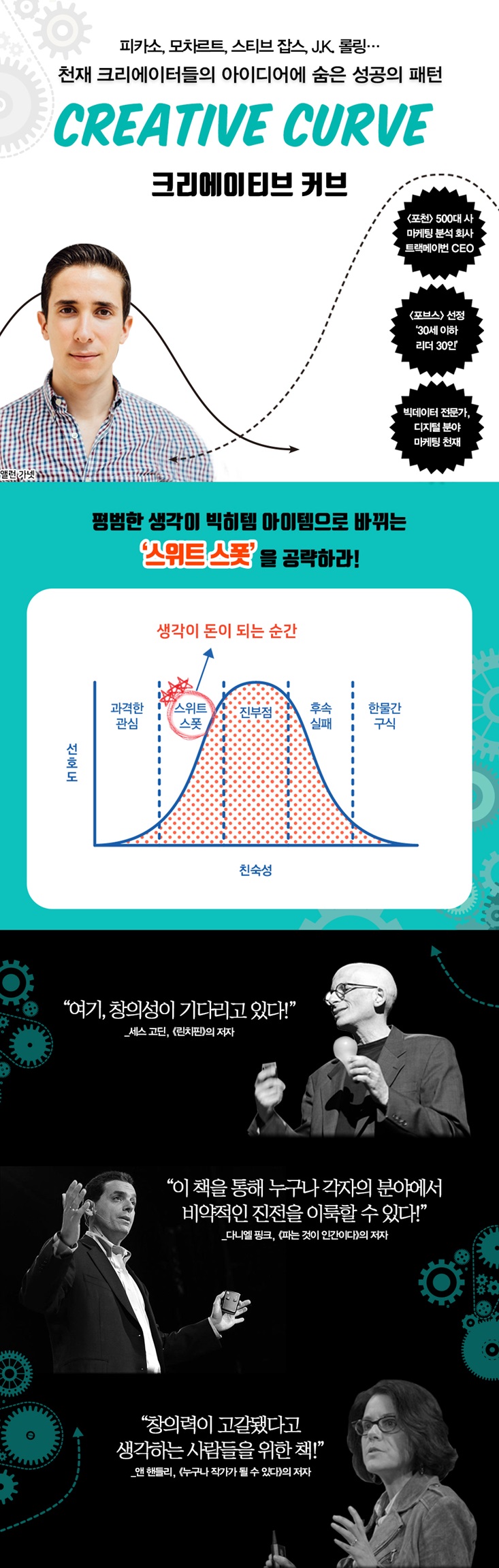
The tension that arises from these contradictory impulses creates a bell-shaped curve in the relationship between 'preference' and 'familiarity', which is the 'creative curve'.
The "sweet spot" where ordinary ideas become big hits.
The Four Laws of Creativity
The key is to reach the "sweet spot" on the creative curve where preference and familiarity, safety and surprise, similarity and difference maintain optimal tension.
This is because this is the moment when ‘thoughts become money.’
Ultimately, creative talent is the ability to understand the dynamics of the creative curve and use it in a way that works in the mainstream world.
Genius creators understand the familiar and use just enough novelty to anticipate audiences' reactions, then vary their artistic style to keep their creations relevant and engaging, without reaching the point of cliche.
In Part 1, the author exposes the blatant lie of the "inspiration theory of creativity," which holds that brilliant ideas come in a lightning bolt. In Part 2, he introduces four laws for acquiring creative talent: consumption, imitation, creative community, and repetition.
The Creative Curve is a pattern accessible to most people, intuitive but learnable, and free of mysticism.
By following these four rules, you can experience amazing and powerful moments of inspiration and insight, even without inhaling hallucinogenic drugs.
Even if you weren't born with extraordinary superpowers like the X-Men, you can still create great works of art or build a great business.
Do you want to become a great creator by developing truly profitable ideas? Marketing genius Seth Godin has you covered.
“Creativity awaits here!”
The Secret Behind Big Hit's Ideas That Captured the World
The Beatles' "Yesterday" is the most recorded song in world music history, with over 3,000 different versions arranged, and ranks 4th in worldwide music revenue.
As many people know, this song originated from a melody that Beatles member Paul McCartney heard in a dream.
JK
The Harry Potter series written by Rowling has sold 8.7 trillion won worth of books as of 2016, excluding movie rights, theme parks, exhibitions, plays, and various additional merchandise.
The idea of a magical world full of creative ideas suddenly popped into Rowling's head while she was stuck on a delayed train to London.
The stories of genius creators like Steve Jobs, who described creativity as an organic process, or Mozart, who composed all his music in his head without the aid of a piano, always include an "Aha!" moment.
Whether it's writing a best-selling novel, painting a captivating picture, or developing a fast-spreading mobile app, there's often a mysterious element involved that defies rational thought or logic.
These elements seem to be the exclusive domain of 'geniuses' and not of insignificant mortals like us.
Is it really true that creative ideas that guarantee commercial success come like that?
The 'Pattern of Success' Discovered by a Big Data Expert
Creative Curve
Allen Gannett, a big data expert and CEO of TrackMaven, which provides marketing data and analytics services to companies, wrote this book to reveal the truth hidden in hit creations.
He spent two years, starting in 2017, interviewing world-renowned creative leaders.
I've dined and chatted with celebrity chefs, best-selling novelists, top artists, serial entrepreneurs with astonishing success rates, and even top YouTubers, and I've even Skyped with some of today's most promising creative leaders.
In addition, I have exchanged opinions and communicated with leading scholars in the fields of creativity, genius, and neuroscience research.
So what did he discover? The myths surrounding creativity were nothing more than myths, and there was a clear scientific basis behind the works that captivated so many people around the world.
Creators who have had hits have a pattern of leveraging it to create them.
Marketing genius Alan Garnett, who was named one of Forbes and Inc.'s "30 Under 30," discovered that there are two seemingly contradictory impulses that drive a song, a product, or an idea to become a trend and be recognized by many people.
In other words, people want what is familiar, but they also look for something different.
It's about wanting the comfort of home or the familiar, like an old friend, while also seeking the potential reward of new and unusual stimulation.
The tension that arises from these contradictory impulses creates a bell-shaped curve in the relationship between 'preference' and 'familiarity', which is the 'creative curve'.
The "sweet spot" where ordinary ideas become big hits.
The Four Laws of Creativity
The key is to reach the "sweet spot" on the creative curve where preference and familiarity, safety and surprise, similarity and difference maintain optimal tension.
This is because this is the moment when ‘thoughts become money.’
Ultimately, creative talent is the ability to understand the dynamics of the creative curve and use it in a way that works in the mainstream world.
Genius creators understand the familiar and use just enough novelty to anticipate audiences' reactions, then vary their artistic style to keep their creations relevant and engaging, without reaching the point of cliche.
In Part 1, the author exposes the blatant lie of the "inspiration theory of creativity," which holds that brilliant ideas come in a lightning bolt. In Part 2, he introduces four laws for acquiring creative talent: consumption, imitation, creative community, and repetition.
The Creative Curve is a pattern accessible to most people, intuitive but learnable, and free of mysticism.
By following these four rules, you can experience amazing and powerful moments of inspiration and insight, even without inhaling hallucinogenic drugs.
Even if you weren't born with extraordinary superpowers like the X-Men, you can still create great works of art or build a great business.
Do you want to become a great creator by developing truly profitable ideas? Marketing genius Seth Godin has you covered.
“Creativity awaits here!”
GOODS SPECIFICS
- Date of publication: December 20, 2018
- Page count, weight, size: 356 pages | 580g | 145*215*30mm
- ISBN13: 9788925565163
- ISBN10: 8925565161
You may also like
카테고리
korean


korean

![ELLE 엘르 스페셜 에디션 A형 : 12월 [2025]](http://librairie.coreenne.fr/cdn/shop/files/b8e27a3de6c9538896439686c6b0e8fb.jpg?v=1766436872&width=3840)


