

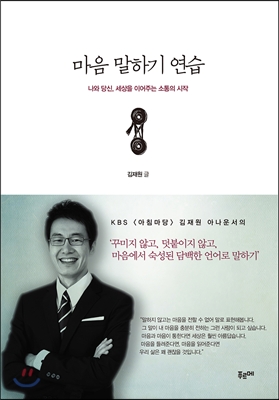
Practice speaking your mind
 |
Description
Book Introduction
Without embellishment, without addition,
Speaking in a simple language that has matured from the heart
An essay by KBS Morning Plaza announcer Kim Jae-won.
As an announcer, the author constantly ponders and realizes how to create a smooth communication between viewers and performers. This book contains everything about 'speaking in a way that moves the hearts of others.'
Unlike current affairs programs, entertainment programs, and information programs, MCs of humanistic programs are expected to play a proactive role in showing people and providing inspiration.
The author, who has been hosting a humanistic program for a long time, explains the host's attitude using "Morning Plaza" as an example.
Advice such as letting the guest tell the story they want to tell first to ensure a smooth conversation, inducing laughter with answers rather than questions, listening to the guest's story as much as possible, and giving meaning to the guest's life with praise and encouragement are examples that can serve as examples for aspiring announcers.
Moreover, the author encourages me to become the MC of my own life by replacing my life with a humanistic program.
Sometimes, you may encounter a guest you dislike, or be flustered by a sudden accident. However, if you overcome these difficulties by making your parents, friends, teachers, and colleagues your guests, staff, and audience, you can end your life in a wonderful way.
In another person's life, we can read the author's message to live a proactive life based on empathy and cooperation rather than competition, in the encouragement to faithfully fulfill the roles of audience and staff.
Speaking in a simple language that has matured from the heart
An essay by KBS Morning Plaza announcer Kim Jae-won.
As an announcer, the author constantly ponders and realizes how to create a smooth communication between viewers and performers. This book contains everything about 'speaking in a way that moves the hearts of others.'
Unlike current affairs programs, entertainment programs, and information programs, MCs of humanistic programs are expected to play a proactive role in showing people and providing inspiration.
The author, who has been hosting a humanistic program for a long time, explains the host's attitude using "Morning Plaza" as an example.
Advice such as letting the guest tell the story they want to tell first to ensure a smooth conversation, inducing laughter with answers rather than questions, listening to the guest's story as much as possible, and giving meaning to the guest's life with praise and encouragement are examples that can serve as examples for aspiring announcers.
Moreover, the author encourages me to become the MC of my own life by replacing my life with a humanistic program.
Sometimes, you may encounter a guest you dislike, or be flustered by a sudden accident. However, if you overcome these difficulties by making your parents, friends, teachers, and colleagues your guests, staff, and audience, you can end your life in a wonderful way.
In another person's life, we can read the author's message to live a proactive life based on empathy and cooperation rather than competition, in the encouragement to faithfully fulfill the roles of audience and staff.
- You can preview some of the book's contents.
Preview
index
first
conversation
hug
action
habit
seeds
Language is a tree
Horse tree
River of Thoughts
Language power is national power
Knowledge information power
Adaptability to conversational environments
Mood control ability
Correct expression
listening skills
ad lib
Resistance to negative language
Situational awareness control
Language practice
Language stretching
Drama play
Language diary
communication
language
Tone-deaf, beat-deaf, speech-deaf
Baek kimchi
Language is a forest
Language is a miracle
Language is a gift
Language myths
Living, breathing language
Language is a medium
Language is biology
Language is the wind
Language is different
Language is the universe
Language is happiness
Language is self-esteem
Language is reflection
Empathy
Delete friend
10 minute relationship
880 words of space
Discussion is inclusive
Language salt shaker
MC
Show people
MC's qualifications
liberal arts program
The host's attitude
The presenter's language characteristics
The host's attitude
Interviewer's attitude
MC's mindset
Heart and mind
MC of my life
audience
hour
shared area
improvisation
encouragement
life
First memory
unconscious
inferiority complex
principle
partner
mom
cold
Regret
blast furnace
practice
cheering
thanks
Son of the Wilderness
Parents' hearts
dream
mind
trust
conversation
hug
action
habit
seeds
Language is a tree
Horse tree
River of Thoughts
Language power is national power
Knowledge information power
Adaptability to conversational environments
Mood control ability
Correct expression
listening skills
ad lib
Resistance to negative language
Situational awareness control
Language practice
Language stretching
Drama play
Language diary
communication
language
Tone-deaf, beat-deaf, speech-deaf
Baek kimchi
Language is a forest
Language is a miracle
Language is a gift
Language myths
Living, breathing language
Language is a medium
Language is biology
Language is the wind
Language is different
Language is the universe
Language is happiness
Language is self-esteem
Language is reflection
Empathy
Delete friend
10 minute relationship
880 words of space
Discussion is inclusive
Language salt shaker
MC
Show people
MC's qualifications
liberal arts program
The host's attitude
The presenter's language characteristics
The host's attitude
Interviewer's attitude
MC's mindset
Heart and mind
MC of my life
audience
hour
shared area
improvisation
encouragement
life
First memory
unconscious
inferiority complex
principle
partner
mom
cold
Regret
blast furnace
practice
cheering
thanks
Son of the Wilderness
Parents' hearts
dream
mind
trust
Into the book
I wish what we say was like white kimchi.
I would like to show myself as I am.
I would like to see my true self revealed in its raw form, without any decoration, makeup, or additions.
It's just a clear feeling.
I would like to speak more clearly and cleanly, without being strong or challenging.
I hope it's a fermented word again.
Sometimes pickled vegetables are tasty, but only once or twice.
I would like to speak words that reveal a deep, fermented flavor, rather than words that are spit out immediately after mixing and not matured in the mind. ---p.110
Language is a forest.
People come together and form relationships around language.
They are intertwined and open and close their relationships with each other.
It can give unexpected comfort and leave wounds that are difficult to heal.
They come together to create a beautiful world, and sometimes they create a terrible place that you never want to return to.
Even in the forest of language, there are bright places, dark places, clear places, and murky places.
Some places are open, some places are blocked.
Language is a living, breathing space where human beings interact and form relationships. ---p.113
A person speaks 120 words per minute, but can hear 1,000 words per minute.
While someone speaks 120 words, the 880-word gap is filled with other thoughts.
A good speaker competes with the audience's other thoughts with new ideas. ---p.153
Always, all, everything… … I am very careful with these words.
The word 'always' is not always correct.
The word 'all' does not include everything.
The word 'all' is also a lie.
I hope we don't fall into the trap of "always," "all," and "all." ---p.198
Why do all exercises only use one ball? Exercises with two balls don't keep the audience engaged.
Please keep your speech focused on one topic.
It's not for you, it's for the audience.
If a ball flies in, it's easy to catch.
When multiple balls fly at you at once, it's difficult to catch even one.
The audience will also have a hard time understanding the multiple messages you've given. ---p.220
I had to suppress my desire to give up about twelve times.
You can hear the sound of digging a well.
Wow, they are amazing people.
If you're feeling tired from stumbling on a rock right now, have a glass of water and cheer up.
That water is not just water.
This is the result of someone enduring and digging. ---p.236
You are now running a 100-meter race.
We're only passing 16 meters now.
You will see the friend in front of you, but you will not see the friend behind you.
But if you look from the stands, you're all going in a single file, 16 meters apart.
Don't worry.
Now it begins.
Don't be proud, don't be discouraged.
Because there are still 84 meters left.---p.272
The fruit of my life is produced more by my relationships than by my actions.
In the tree of life, there are as many 'you's' as 'me's' that are important fertilizers.
I would like to show myself as I am.
I would like to see my true self revealed in its raw form, without any decoration, makeup, or additions.
It's just a clear feeling.
I would like to speak more clearly and cleanly, without being strong or challenging.
I hope it's a fermented word again.
Sometimes pickled vegetables are tasty, but only once or twice.
I would like to speak words that reveal a deep, fermented flavor, rather than words that are spit out immediately after mixing and not matured in the mind. ---p.110
Language is a forest.
People come together and form relationships around language.
They are intertwined and open and close their relationships with each other.
It can give unexpected comfort and leave wounds that are difficult to heal.
They come together to create a beautiful world, and sometimes they create a terrible place that you never want to return to.
Even in the forest of language, there are bright places, dark places, clear places, and murky places.
Some places are open, some places are blocked.
Language is a living, breathing space where human beings interact and form relationships. ---p.113
A person speaks 120 words per minute, but can hear 1,000 words per minute.
While someone speaks 120 words, the 880-word gap is filled with other thoughts.
A good speaker competes with the audience's other thoughts with new ideas. ---p.153
Always, all, everything… … I am very careful with these words.
The word 'always' is not always correct.
The word 'all' does not include everything.
The word 'all' is also a lie.
I hope we don't fall into the trap of "always," "all," and "all." ---p.198
Why do all exercises only use one ball? Exercises with two balls don't keep the audience engaged.
Please keep your speech focused on one topic.
It's not for you, it's for the audience.
If a ball flies in, it's easy to catch.
When multiple balls fly at you at once, it's difficult to catch even one.
The audience will also have a hard time understanding the multiple messages you've given. ---p.220
I had to suppress my desire to give up about twelve times.
You can hear the sound of digging a well.
Wow, they are amazing people.
If you're feeling tired from stumbling on a rock right now, have a glass of water and cheer up.
That water is not just water.
This is the result of someone enduring and digging. ---p.236
You are now running a 100-meter race.
We're only passing 16 meters now.
You will see the friend in front of you, but you will not see the friend behind you.
But if you look from the stands, you're all going in a single file, 16 meters apart.
Don't worry.
Now it begins.
Don't be proud, don't be discouraged.
Because there are still 84 meters left.---p.272
The fruit of my life is produced more by my relationships than by my actions.
In the tree of life, there are as many 'you's' as 'me's' that are important fertilizers.
---p.281
Publisher's Review
1.
No need for fancy rhetoric
《Speaking from the Heart Practice》 does not simply teach you how to speak well or how to be a flashy speaker.
Because speaking that moves the heart is something more than just a 'secret' that can be explained or achieved.
The author wrote this book with the belief that speaking from the heart comes from a upright character built through thorough self-reflection, deep thoughts cultivated through continuous self-development, and correct language refined with consideration for others.
This book begins with 'understanding the listener's mind,' which is the most easily overlooked skill for those who want to speak well.
Even if something is important to me, if the listener is not ready to listen, the conversation will go astray.
Or even if you are having a conversation about a single topic, if you only assert your own opinions, in the end, only your own words will remain.
Therefore, the author recommends that the first condition for speaking well is to develop a mind that is considerate of others.
The second condition is a single word of sincerity.
The author proves the power of a single, truthful word through his encounter with Australian youth Nick Vujicic.
Nick Vujic, who is famous for his warm hugs despite having no arms or legs, was so desperate that he decided to commit suicide at the age of nine and drowned himself in a bathtub. However, he was moved by a Bible verse about a person who was born blind and became a person who spreads hope to the world.
The reason his lectures have the power to move people's hearts is because he reveals his own disability as it is and speaks of the preciousness of life from his own experience without embellishment.
2.
A language story from an announcer who loves language more than anyone else.
The third condition is correct and accurate language.
If the other person misunderstands what I said, it is because I did not use the right words to express my thoughts.
To convey his feelings accurately by using the right language, the author always studies and researches language.
The author's continuous study of language is evident in books such as "Language is a Gift", which explains the origin of language; "Language is a Star", which compares language to infinite stars; "Language is Happiness", which expresses gratitude for an environment where one can use one's native language; and "Language is Self-Esteem", which organizes the characteristics of language into eight words using the initials of the alphabet: Linked, Atlas, Nationality, Globalization, Ubiquity, Asset, Goods, and Economy. These books are as in-depth and interesting as any linguist's research.
It also serves as an opportunity to once again reflect on the preciousness of our language and the joy of speaking.
It is also interesting to compare language skills to physical strength, defining basic physical strength as knowledge and information power, flexibility as the ability to adapt to a conversational environment, cardiopulmonary function as the ability to control mood, and muscular strength as the ability to express oneself correctly.
Knowledge information power is the intelligence that can flexibly lead a conversation, adaptability to the conversation environment is the ability to change one's speech pattern according to the situation, mood control is the power to inject positive elements into a conversation, and correct expression power is accurate pronunciation, correct vocabulary, and an appropriate voice.
The author recommends three methods for developing this ability: 'language stretching', which involves constructing and expressing sentences through small talk or thoughts; 'drama play', which involves viewing conversational situations as dramas to gauge the other person's tendencies and intentions; and 'language journaling', which involves consciously recording what you say to understand your conversational tendencies.
It doesn't require great skill, but it does require persistent effort.
3.
Live your life like an MC!
Unlike current affairs programs, entertainment programs, and information programs, MCs of humanistic programs are expected to play a proactive role in showing people and providing inspiration.
The author, who has been hosting a humanistic program for a long time, explains the host's attitude using "Morning Plaza" as an example.
Advice such as letting the guest tell the story they want to tell first to ensure a smooth conversation, inducing laughter with answers rather than questions, listening to the guest's story as much as possible, and giving meaning to the guest's life with praise and encouragement are examples that can serve as examples for aspiring announcers.
Moreover, the author encourages me to become the MC of my own life by replacing my life with a humanistic program.
Sometimes, you may encounter a guest you dislike, or be flustered by a sudden accident. However, if you overcome these difficulties by making your parents, friends, teachers, and colleagues your guests, staff, and audience, you can end your life in a wonderful way.
In another person's life, we can read the author's message to live a proactive life based on empathy and cooperation rather than competition, in the encouragement to faithfully fulfill the roles of audience and staff.
4.
For those who are afraid to speak
'Words are not impossible because they each have their own raw meaning.
The author encourages those who are afraid to speak up, saying, “It’s just that everyone does things differently.”
This book introduces what speaking is, how to express your thoughts, and how to build strong relationships with others. It will be of great help to those who want to communicate with love, communicate for success, and express their emotions properly.
No need for fancy rhetoric
《Speaking from the Heart Practice》 does not simply teach you how to speak well or how to be a flashy speaker.
Because speaking that moves the heart is something more than just a 'secret' that can be explained or achieved.
The author wrote this book with the belief that speaking from the heart comes from a upright character built through thorough self-reflection, deep thoughts cultivated through continuous self-development, and correct language refined with consideration for others.
This book begins with 'understanding the listener's mind,' which is the most easily overlooked skill for those who want to speak well.
Even if something is important to me, if the listener is not ready to listen, the conversation will go astray.
Or even if you are having a conversation about a single topic, if you only assert your own opinions, in the end, only your own words will remain.
Therefore, the author recommends that the first condition for speaking well is to develop a mind that is considerate of others.
The second condition is a single word of sincerity.
The author proves the power of a single, truthful word through his encounter with Australian youth Nick Vujicic.
Nick Vujic, who is famous for his warm hugs despite having no arms or legs, was so desperate that he decided to commit suicide at the age of nine and drowned himself in a bathtub. However, he was moved by a Bible verse about a person who was born blind and became a person who spreads hope to the world.
The reason his lectures have the power to move people's hearts is because he reveals his own disability as it is and speaks of the preciousness of life from his own experience without embellishment.
2.
A language story from an announcer who loves language more than anyone else.
The third condition is correct and accurate language.
If the other person misunderstands what I said, it is because I did not use the right words to express my thoughts.
To convey his feelings accurately by using the right language, the author always studies and researches language.
The author's continuous study of language is evident in books such as "Language is a Gift", which explains the origin of language; "Language is a Star", which compares language to infinite stars; "Language is Happiness", which expresses gratitude for an environment where one can use one's native language; and "Language is Self-Esteem", which organizes the characteristics of language into eight words using the initials of the alphabet: Linked, Atlas, Nationality, Globalization, Ubiquity, Asset, Goods, and Economy. These books are as in-depth and interesting as any linguist's research.
It also serves as an opportunity to once again reflect on the preciousness of our language and the joy of speaking.
It is also interesting to compare language skills to physical strength, defining basic physical strength as knowledge and information power, flexibility as the ability to adapt to a conversational environment, cardiopulmonary function as the ability to control mood, and muscular strength as the ability to express oneself correctly.
Knowledge information power is the intelligence that can flexibly lead a conversation, adaptability to the conversation environment is the ability to change one's speech pattern according to the situation, mood control is the power to inject positive elements into a conversation, and correct expression power is accurate pronunciation, correct vocabulary, and an appropriate voice.
The author recommends three methods for developing this ability: 'language stretching', which involves constructing and expressing sentences through small talk or thoughts; 'drama play', which involves viewing conversational situations as dramas to gauge the other person's tendencies and intentions; and 'language journaling', which involves consciously recording what you say to understand your conversational tendencies.
It doesn't require great skill, but it does require persistent effort.
3.
Live your life like an MC!
Unlike current affairs programs, entertainment programs, and information programs, MCs of humanistic programs are expected to play a proactive role in showing people and providing inspiration.
The author, who has been hosting a humanistic program for a long time, explains the host's attitude using "Morning Plaza" as an example.
Advice such as letting the guest tell the story they want to tell first to ensure a smooth conversation, inducing laughter with answers rather than questions, listening to the guest's story as much as possible, and giving meaning to the guest's life with praise and encouragement are examples that can serve as examples for aspiring announcers.
Moreover, the author encourages me to become the MC of my own life by replacing my life with a humanistic program.
Sometimes, you may encounter a guest you dislike, or be flustered by a sudden accident. However, if you overcome these difficulties by making your parents, friends, teachers, and colleagues your guests, staff, and audience, you can end your life in a wonderful way.
In another person's life, we can read the author's message to live a proactive life based on empathy and cooperation rather than competition, in the encouragement to faithfully fulfill the roles of audience and staff.
4.
For those who are afraid to speak
'Words are not impossible because they each have their own raw meaning.
The author encourages those who are afraid to speak up, saying, “It’s just that everyone does things differently.”
This book introduces what speaking is, how to express your thoughts, and how to build strong relationships with others. It will be of great help to those who want to communicate with love, communicate for success, and express their emotions properly.
GOODS SPECIFICS
- Date of issue: April 11, 2013
- Page count, weight, size: 296 pages | 390g | 145*210*20mm
- ISBN13: 9788992650823
- ISBN10: 8992650825
You may also like
카테고리
korean


korean

![ELLE 엘르 스페셜 에디션 A형 : 12월 [2025]](http://librairie.coreenne.fr/cdn/shop/files/b8e27a3de6c9538896439686c6b0e8fb.jpg?v=1766436872&width=3840)


