

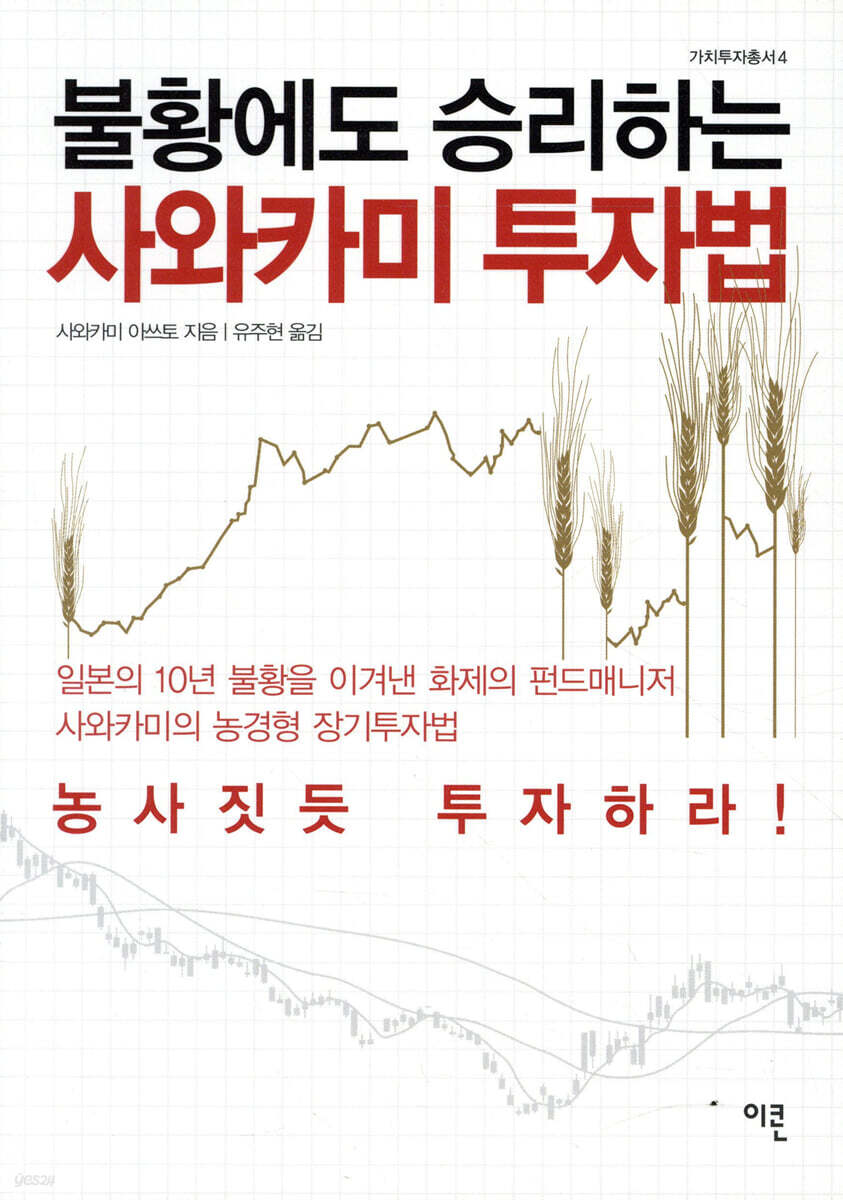
Sawakami's Investment Method for Winning Even in a Recession
 |
Description
Book Introduction
This book explains the investment methods of Sawakami Investment Trust, a popular investment management company that has been generating high returns by rejecting large-scale fund management offers from institutional investors, citing its management philosophy of "helping individual investors build long-term wealth," and operating only the "Sawakami Fund," a stock-type fund for clients who share the same long-term investment philosophy.
This book emphasizes that economic recessions and stock market crashes are investment opportunities, and explains how effective long-term investment is when the stock market is depressed, using the example of the U.S. stock market, which experienced a 15-fold increase from 1982 to 2000. It also emphasizes that long-term investment greatly contributes to building individual long-term wealth and establishing a safety net for the national economy.
Author Atsuto Sawakami presents the concept of agricultural investment, which involves buying companies that are considered gems at a low price in the stock market, where it is difficult to distinguish between the wheat and the chaff, and leisurely waiting for the harvest. He also suggests good strategies for accumulating time in investment and for discerning the right timing.
This book will help you rethink the fundamentals of investing and provide valuable guidance on how to achieve stable returns.
This book emphasizes that economic recessions and stock market crashes are investment opportunities, and explains how effective long-term investment is when the stock market is depressed, using the example of the U.S. stock market, which experienced a 15-fold increase from 1982 to 2000. It also emphasizes that long-term investment greatly contributes to building individual long-term wealth and establishing a safety net for the national economy.
Author Atsuto Sawakami presents the concept of agricultural investment, which involves buying companies that are considered gems at a low price in the stock market, where it is difficult to distinguish between the wheat and the chaff, and leisurely waiting for the harvest. He also suggests good strategies for accumulating time in investment and for discerning the right timing.
This book will help you rethink the fundamentals of investing and provide valuable guidance on how to achieve stable returns.
- You can preview some of the book's contents.
Preview
index
Recommendation | Introduction
Chapter 1: Now It's Long-Term Investment
1.
A recession that made it impossible to see even an inch ahead
2.
The economy is alive
3.
The stock market is sensitive to economic conditions.
4.
Can you buy at a market that's hitting record lows every day?
5.
Even if you don't put in the effort, you can do the basics
Chapter 2: Long-Term Investing: Anyone Can Do It!
1.
Long-term investing begins with a sense of growth.
2.
The power that accumulates over time
3.
Think about investing in your daily life
4.
Predict major economic trends
5.
The basics are long-term investment in the 'buy and hold' style.
6.
Risk-Return Mindset
7.
Risk is just part of the ups and downs of the game.
8.
Doubling your profits in 6 or 7 years is certainly possible.
Chapter 3: The Economy Has Four Seasons
1.
The economies of all countries are growing upward.
2.
There is no such thing as a never-ending recession.
3.
Long-term investors always anticipate "economic ups and downs."
4.
There are times to buy and sell stocks depending on the interest rate cycle.
5.
Asset allocation is the foundation of long-term investing.
Chapter 4: Conditions for Becoming a Long-Term Investor
1.
Can you buy when performance is poor?
2.
Can you buy at worst and sell at best?
3.
Is it possible to act faster than the market movement?
4.
Can you still buy with a smile even in a recession?
5.
Can you become an enthusiastic supporter of a company?
6.
Can you maintain your own investment rhythm?
7.
Can you buy during a bear market?
8.
If you observe the stock price crash closely,
Chapter 5: What Information Means to Long-Term Investors
1.
Discovering various possibilities from one phenomenon
2.
Flowcharts: A Powerful Tool for Long-Term Investors
3.
Challenge the unknown world
4.
The 2-3-5 Rule of Viewing Stocks
5.
20% of research is a thorough analysis of the company of interest.
6.
30% of research is about examining the business environment the company is in.
7.
50% of research is about how to navigate long distances.
Chapter 6: Fundamentals of Balance Sheet Analysis
1.
Changes in the balance sheet are a report of investment ideas.
2.
Aren't there hidden, invisible wastes in management?
3.
Efficient use of capital determines corporate value.
4.
Beware of excessive cash holdings
5.
Are financial operations strategic?
Chapter 7: Finding Long-Term Investment Stocks is the Ultimate Brain Game
1.
It's difficult to succeed with high-tech stocks.
2.
Unsung Heroes of Long-Term Investment: Mid- to Large-Cap Market-Related Stocks
3.
From now on, added value analysis is the keyword.
Chapter 8: Buying Japanese Companies Responding to a Mature Economy
1.
Companies that make profits even during recessions
2.
The Tripolar Trend in Japanese Companies
3.
There are plenty of good companies.
In closing | Translator's Note
Chapter 1: Now It's Long-Term Investment
1.
A recession that made it impossible to see even an inch ahead
2.
The economy is alive
3.
The stock market is sensitive to economic conditions.
4.
Can you buy at a market that's hitting record lows every day?
5.
Even if you don't put in the effort, you can do the basics
Chapter 2: Long-Term Investing: Anyone Can Do It!
1.
Long-term investing begins with a sense of growth.
2.
The power that accumulates over time
3.
Think about investing in your daily life
4.
Predict major economic trends
5.
The basics are long-term investment in the 'buy and hold' style.
6.
Risk-Return Mindset
7.
Risk is just part of the ups and downs of the game.
8.
Doubling your profits in 6 or 7 years is certainly possible.
Chapter 3: The Economy Has Four Seasons
1.
The economies of all countries are growing upward.
2.
There is no such thing as a never-ending recession.
3.
Long-term investors always anticipate "economic ups and downs."
4.
There are times to buy and sell stocks depending on the interest rate cycle.
5.
Asset allocation is the foundation of long-term investing.
Chapter 4: Conditions for Becoming a Long-Term Investor
1.
Can you buy when performance is poor?
2.
Can you buy at worst and sell at best?
3.
Is it possible to act faster than the market movement?
4.
Can you still buy with a smile even in a recession?
5.
Can you become an enthusiastic supporter of a company?
6.
Can you maintain your own investment rhythm?
7.
Can you buy during a bear market?
8.
If you observe the stock price crash closely,
Chapter 5: What Information Means to Long-Term Investors
1.
Discovering various possibilities from one phenomenon
2.
Flowcharts: A Powerful Tool for Long-Term Investors
3.
Challenge the unknown world
4.
The 2-3-5 Rule of Viewing Stocks
5.
20% of research is a thorough analysis of the company of interest.
6.
30% of research is about examining the business environment the company is in.
7.
50% of research is about how to navigate long distances.
Chapter 6: Fundamentals of Balance Sheet Analysis
1.
Changes in the balance sheet are a report of investment ideas.
2.
Aren't there hidden, invisible wastes in management?
3.
Efficient use of capital determines corporate value.
4.
Beware of excessive cash holdings
5.
Are financial operations strategic?
Chapter 7: Finding Long-Term Investment Stocks is the Ultimate Brain Game
1.
It's difficult to succeed with high-tech stocks.
2.
Unsung Heroes of Long-Term Investment: Mid- to Large-Cap Market-Related Stocks
3.
From now on, added value analysis is the keyword.
Chapter 8: Buying Japanese Companies Responding to a Mature Economy
1.
Companies that make profits even during recessions
2.
The Tripolar Trend in Japanese Companies
3.
There are plenty of good companies.
In closing | Translator's Note
Into the book
If experts like institutional investors were to carefully analyze the Sawakami Fund, they might dismiss it, saying, "What? There's nothing special about its management."
Typically, institutional investor management involves closely analyzing changes in corporate performance, appropriately assessing market trends, and then trading nimbly.
It's a very cool image.
But Sawakami Fund is like a fool who only knows one thing: buying cheap things during a market crash or in the middle of a recession.
Even if the stock I bought goes up, I don't think about taking profits at all.
It is useless to expect that they will show some of the tricks of improvising management as befitting an institutional investor.
No matter how you look at it, it just seems like they are continuing to buy slowly.
If we compare over time, the Sawakami Fund's performance is above average.
Why do I get such good results when I can't find a razor-sharp taste anywhere?
In fact, this is the essence of long-term investing.
It may seem like lazy operation, but it hides the power of a dull knife.
Everything depends on how you think about it, so if you maintain a 10% annual performance for 7 years, your managed assets will double.
If the operation can double in 7 years, it would be a performance of 10% per year.
Rather than obsessively trying to increase your grades by 10% every year, it's much more comfortable to think, "I just need to double it in seven years."
It's good for your mental health, and if it doubles in 7 years, it doesn't feel like such a difficult thing.
If it doubles in 6 years, it would be considered as operating at 12% per year.
This is the greatest strength of long-term investing.
Long-term investors continue to invest leisurely and comfortably.
I feel like I'm jogging towards a highly achievable goal.
I never feel like I'm making an investment that would make my face contort with nervousness.
It really feels like farming or gardening.
When autumn comes, what is ripe will ripen, and when the time comes for flowers to bloom, they will bloom.
The farmer believes so, makes a seedbed, and sows the seeds.
Make sure you do what you need to do without any hesitation.
There is no need to worry about operating performance every year.
Discover future value that others may not realize and buy it quickly.
Next, we just wait for others to realize its value and flock to it.
And when you think it has risen quite a bit, sell it and harvest the fruit.
It is surprisingly common for long-term investors to spontaneously buy and quickly take profits, creating opportunities for price increases and decreases.
Long-term investors anticipate major economic trends and take action in advance.
Even though it's just that, the result is that you often end up buying near the bottom of the stock price and selling near the ceiling.
Meanwhile, most Japanese institutional investors operate in a group-like manner, believing that they are not afraid of crossing red lights as long as everyone else does, making it difficult for them to act according to their own will and judgment.
So, they always hesitate to buy, saying things like, "We need to confirm that the market has bottomed out," or "We need to confirm that performance has recovered."
Meanwhile, the upward trend begins.
And once a strong upward trend is confirmed, they buy recklessly without even considering the risks.
In such cases, they tend to justify their purchases by making statements such as, “This business model will last for 10 or 20 years.”
Of course, I don't consider things like selling at all.
Buy, buy, buy again and reach the peak of the market.
And then one day, when the market suddenly starts to crash, you're left scrambling to sell.
Typically, institutional investor management involves closely analyzing changes in corporate performance, appropriately assessing market trends, and then trading nimbly.
It's a very cool image.
But Sawakami Fund is like a fool who only knows one thing: buying cheap things during a market crash or in the middle of a recession.
Even if the stock I bought goes up, I don't think about taking profits at all.
It is useless to expect that they will show some of the tricks of improvising management as befitting an institutional investor.
No matter how you look at it, it just seems like they are continuing to buy slowly.
If we compare over time, the Sawakami Fund's performance is above average.
Why do I get such good results when I can't find a razor-sharp taste anywhere?
In fact, this is the essence of long-term investing.
It may seem like lazy operation, but it hides the power of a dull knife.
Everything depends on how you think about it, so if you maintain a 10% annual performance for 7 years, your managed assets will double.
If the operation can double in 7 years, it would be a performance of 10% per year.
Rather than obsessively trying to increase your grades by 10% every year, it's much more comfortable to think, "I just need to double it in seven years."
It's good for your mental health, and if it doubles in 7 years, it doesn't feel like such a difficult thing.
If it doubles in 6 years, it would be considered as operating at 12% per year.
This is the greatest strength of long-term investing.
Long-term investors continue to invest leisurely and comfortably.
I feel like I'm jogging towards a highly achievable goal.
I never feel like I'm making an investment that would make my face contort with nervousness.
It really feels like farming or gardening.
When autumn comes, what is ripe will ripen, and when the time comes for flowers to bloom, they will bloom.
The farmer believes so, makes a seedbed, and sows the seeds.
Make sure you do what you need to do without any hesitation.
There is no need to worry about operating performance every year.
Discover future value that others may not realize and buy it quickly.
Next, we just wait for others to realize its value and flock to it.
And when you think it has risen quite a bit, sell it and harvest the fruit.
It is surprisingly common for long-term investors to spontaneously buy and quickly take profits, creating opportunities for price increases and decreases.
Long-term investors anticipate major economic trends and take action in advance.
Even though it's just that, the result is that you often end up buying near the bottom of the stock price and selling near the ceiling.
Meanwhile, most Japanese institutional investors operate in a group-like manner, believing that they are not afraid of crossing red lights as long as everyone else does, making it difficult for them to act according to their own will and judgment.
So, they always hesitate to buy, saying things like, "We need to confirm that the market has bottomed out," or "We need to confirm that performance has recovered."
Meanwhile, the upward trend begins.
And once a strong upward trend is confirmed, they buy recklessly without even considering the risks.
In such cases, they tend to justify their purchases by making statements such as, “This business model will last for 10 or 20 years.”
Of course, I don't consider things like selling at all.
Buy, buy, buy again and reach the peak of the market.
And then one day, when the market suddenly starts to crash, you're left scrambling to sell.
--- From the text
Publisher's Review
Invest like you farm!
The fund manager who overcame Japan's 10-year recession
Sawakami's Agricultural Long-Term Investment Method
“If investments represented by derivative financial products or hedge funds are called ‘hunting investments,’ the long-term investments introduced in this book can be called ‘farming investments.’”
Long-term investing doesn't have the same glamour as hunting, but it's a method that, with the accumulation of time, energy, and simple effort, can produce good results time and time again."
Sawakami Investment Trust, a hotly contested asset management company
Sawakami Investment Trust, which has become a benchmark for the Japanese investment industry by taking a completely different approach from existing investment trust companies under the banner of long-term investment.
Although the company has attracted attention for its rapid growth, with assets under management increasing 45-fold in just 5 years through word of mouth alone without any special sales activities, its management style of rejecting large-scale fund management offers from institutional investors, citing its management philosophy of “helping individual investors build long-term wealth,” and operating only the “Sawakami Fund,” a stock-type fund for clients who share its commitment to long-term investment, is also impressive.
This book, "Sawakami Investment Method for Winning Even in a Recession," is written by Atsuto Sawakami, the CEO of the much-talked-about Sawakami Investment Trust and fund manager of the Sawakami Fund, who personally explains his long-term investment method.
It's time for long-term investing - a market downturn is an investment opportunity.
In this book, the author emphasizes that economic recessions and stock market crashes are investment opportunities, and explains how effective long-term investment is when the stock market is depressed, using the example of the U.S. stock market, which experienced a 15-fold increase from 1982 to 2000.
The U.S. economy, which had been in a slump so severe that it was described as a "desperate economic state of twin deficits," a "destroying manufacturing industry," and a "giant second-rate nation," began to recover in 1992.
However, the stock price increase from 1992 to 2000, which can be considered an economic recovery period, was only 3.4 times.
So what happened to the 15-fold increase from 1982 to 2000? Surprisingly, it rose 4.4-fold over the ten years from 1982 to 1992, a period fraught with recession.
(4.4*3.4=14.96, based on the Dow Jones Industrial Average's 30 industrial stocks)
The 15-fold increase was possible because there were individual and institutional investors who quietly invested for the long term even in the face of a prolonged economic downturn and bleak economic outlook.
Without long-term investors, the stock market decline and market downturn would have been even more severe, and the US economy's spectacular recovery might have been only half-baked.
In this way, long-term investment not only helped individuals build long-term wealth, but also served as a safety net for the national economy.
Long-term investment that anyone can do
The author emphasizes that when jade is being sold indiscriminately, buying companies that are worth jade at a low price and leisurely waiting for the time to bear fruit is beneficial not only to individual investors but also to the economy as a whole.
And he compares long-term investment to 'agricultural investment' and tells us to invest like farming.
“The seeds are sown in the spring, receive plenty of hot summer sunlight, and only then do they bear fruit in the fall.
Crops do not grow against the grace of the sun.
Even if you sow seeds in winter, they will not sprout.
Even if you sow seeds in spring, you will never harvest fruit before the rainy season.
“Investing is the same.”
In other words, just as crops need time to absorb the benefits of nature to grow, it takes time to see returns on investments. The key to investing is the timing of sowing seeds and the belief that the accumulated time will yield great results.
If you deeply understand this point and consistently grasp the major trends of the economy, you can comfortably and leisurely enjoy long-term investment without having to know difficult theories.
Long-term investment should be done like this.
So, what about long-term investing? The author's argument can be summarized as follows.
Living in a Recession: There is no such thing as a recession that never ends.
Long-term investors in the U.S. bought stocks during the recession and reaped the fruits of a 15-fold increase.
Become an enthusiastic supporter of a company: Find a company that shares your dreams and vision.
Maintain your investment rhythm: Be aware of market prices and never lose sight of your investment perspective.
Buy when the stock price crashes: Being able to buy when the price crashes is the litmus test of long-term investing.
Discover multiple possibilities in one phenomenon: Look for changes that will be reflected in stock prices.
Use your imagination to predict future trends: To make a successful investment, you must have both imagination and logic.
The 2, 3, and 5 Rules for Stock Market Research: 20% of your research should be devoted to analyzing the company you're interested in, 30% should be devoted to examining the business environment the company is in, and the remaining 50% should be devoted to inferring how the company will fare in the long run.
Changes in the balance sheet are a report on investment ideas: We examine changes with a focus on fund efficiency.
Long-term investment in cutting-edge technology stocks is difficult to succeed in: If you really want to buy, buy within a reasonable financial range and feel like you're playing a game.
Unsung heroes of long-term investment: mid- and large-cap market-related stocks: While individual companies are the primary targets of long-term investment, market-related stocks with strong industry investment characteristics are also suitable for long-term investment if the timing is right.
Let's go back to basics
The Japanese economy, which has emerged from a recession lasting more than a decade, is beginning to recover, and Japan's long-term investments have overcome the recession and are now beginning to reap the rewards.
Following the author's explanation, there are many lessons that Korean investors can learn from Japan's experience.
Above all, this book makes you rethink the fundamentals of investing.
The behavior of investors in the stock market so far has been closer to 'buying' stocks than 'investing' in companies.
However, if you recognize yourself as a true 'investor' and look for investment targets, the story is different.
Long-term investments, which involve identifying companies with potential for long-term growth and increased profits, purchasing them at an early stage, and holding them for the long term, not only help investors build their personal wealth, but also support the healthy growth of companies and contribute to the sustainable development of the national economy.
Considering these points, long-term investment looking ahead 10 or 20 years can be an enjoyable challenge for investors.
The fund manager who overcame Japan's 10-year recession
Sawakami's Agricultural Long-Term Investment Method
“If investments represented by derivative financial products or hedge funds are called ‘hunting investments,’ the long-term investments introduced in this book can be called ‘farming investments.’”
Long-term investing doesn't have the same glamour as hunting, but it's a method that, with the accumulation of time, energy, and simple effort, can produce good results time and time again."
Sawakami Investment Trust, a hotly contested asset management company
Sawakami Investment Trust, which has become a benchmark for the Japanese investment industry by taking a completely different approach from existing investment trust companies under the banner of long-term investment.
Although the company has attracted attention for its rapid growth, with assets under management increasing 45-fold in just 5 years through word of mouth alone without any special sales activities, its management style of rejecting large-scale fund management offers from institutional investors, citing its management philosophy of “helping individual investors build long-term wealth,” and operating only the “Sawakami Fund,” a stock-type fund for clients who share its commitment to long-term investment, is also impressive.
This book, "Sawakami Investment Method for Winning Even in a Recession," is written by Atsuto Sawakami, the CEO of the much-talked-about Sawakami Investment Trust and fund manager of the Sawakami Fund, who personally explains his long-term investment method.
It's time for long-term investing - a market downturn is an investment opportunity.
In this book, the author emphasizes that economic recessions and stock market crashes are investment opportunities, and explains how effective long-term investment is when the stock market is depressed, using the example of the U.S. stock market, which experienced a 15-fold increase from 1982 to 2000.
The U.S. economy, which had been in a slump so severe that it was described as a "desperate economic state of twin deficits," a "destroying manufacturing industry," and a "giant second-rate nation," began to recover in 1992.
However, the stock price increase from 1992 to 2000, which can be considered an economic recovery period, was only 3.4 times.
So what happened to the 15-fold increase from 1982 to 2000? Surprisingly, it rose 4.4-fold over the ten years from 1982 to 1992, a period fraught with recession.
(4.4*3.4=14.96, based on the Dow Jones Industrial Average's 30 industrial stocks)
The 15-fold increase was possible because there were individual and institutional investors who quietly invested for the long term even in the face of a prolonged economic downturn and bleak economic outlook.
Without long-term investors, the stock market decline and market downturn would have been even more severe, and the US economy's spectacular recovery might have been only half-baked.
In this way, long-term investment not only helped individuals build long-term wealth, but also served as a safety net for the national economy.
Long-term investment that anyone can do
The author emphasizes that when jade is being sold indiscriminately, buying companies that are worth jade at a low price and leisurely waiting for the time to bear fruit is beneficial not only to individual investors but also to the economy as a whole.
And he compares long-term investment to 'agricultural investment' and tells us to invest like farming.
“The seeds are sown in the spring, receive plenty of hot summer sunlight, and only then do they bear fruit in the fall.
Crops do not grow against the grace of the sun.
Even if you sow seeds in winter, they will not sprout.
Even if you sow seeds in spring, you will never harvest fruit before the rainy season.
“Investing is the same.”
In other words, just as crops need time to absorb the benefits of nature to grow, it takes time to see returns on investments. The key to investing is the timing of sowing seeds and the belief that the accumulated time will yield great results.
If you deeply understand this point and consistently grasp the major trends of the economy, you can comfortably and leisurely enjoy long-term investment without having to know difficult theories.
Long-term investment should be done like this.
So, what about long-term investing? The author's argument can be summarized as follows.
Living in a Recession: There is no such thing as a recession that never ends.
Long-term investors in the U.S. bought stocks during the recession and reaped the fruits of a 15-fold increase.
Become an enthusiastic supporter of a company: Find a company that shares your dreams and vision.
Maintain your investment rhythm: Be aware of market prices and never lose sight of your investment perspective.
Buy when the stock price crashes: Being able to buy when the price crashes is the litmus test of long-term investing.
Discover multiple possibilities in one phenomenon: Look for changes that will be reflected in stock prices.
Use your imagination to predict future trends: To make a successful investment, you must have both imagination and logic.
The 2, 3, and 5 Rules for Stock Market Research: 20% of your research should be devoted to analyzing the company you're interested in, 30% should be devoted to examining the business environment the company is in, and the remaining 50% should be devoted to inferring how the company will fare in the long run.
Changes in the balance sheet are a report on investment ideas: We examine changes with a focus on fund efficiency.
Long-term investment in cutting-edge technology stocks is difficult to succeed in: If you really want to buy, buy within a reasonable financial range and feel like you're playing a game.
Unsung heroes of long-term investment: mid- and large-cap market-related stocks: While individual companies are the primary targets of long-term investment, market-related stocks with strong industry investment characteristics are also suitable for long-term investment if the timing is right.
Let's go back to basics
The Japanese economy, which has emerged from a recession lasting more than a decade, is beginning to recover, and Japan's long-term investments have overcome the recession and are now beginning to reap the rewards.
Following the author's explanation, there are many lessons that Korean investors can learn from Japan's experience.
Above all, this book makes you rethink the fundamentals of investing.
The behavior of investors in the stock market so far has been closer to 'buying' stocks than 'investing' in companies.
However, if you recognize yourself as a true 'investor' and look for investment targets, the story is different.
Long-term investments, which involve identifying companies with potential for long-term growth and increased profits, purchasing them at an early stage, and holding them for the long term, not only help investors build their personal wealth, but also support the healthy growth of companies and contribute to the sustainable development of the national economy.
Considering these points, long-term investment looking ahead 10 or 20 years can be an enjoyable challenge for investors.
GOODS SPECIFICS
- Date of issue: November 4, 2009
- Page count, weight, size: 272 pages | 378g | 148*210*20mm
- ISBN13: 9788990831767
- ISBN10: 8990831768
You may also like
카테고리
korean


korean

![ELLE 엘르 스페셜 에디션 A형 : 12월 [2025]](http://librairie.coreenne.fr/cdn/shop/files/b8e27a3de6c9538896439686c6b0e8fb.jpg?v=1766436872&width=3840)


