

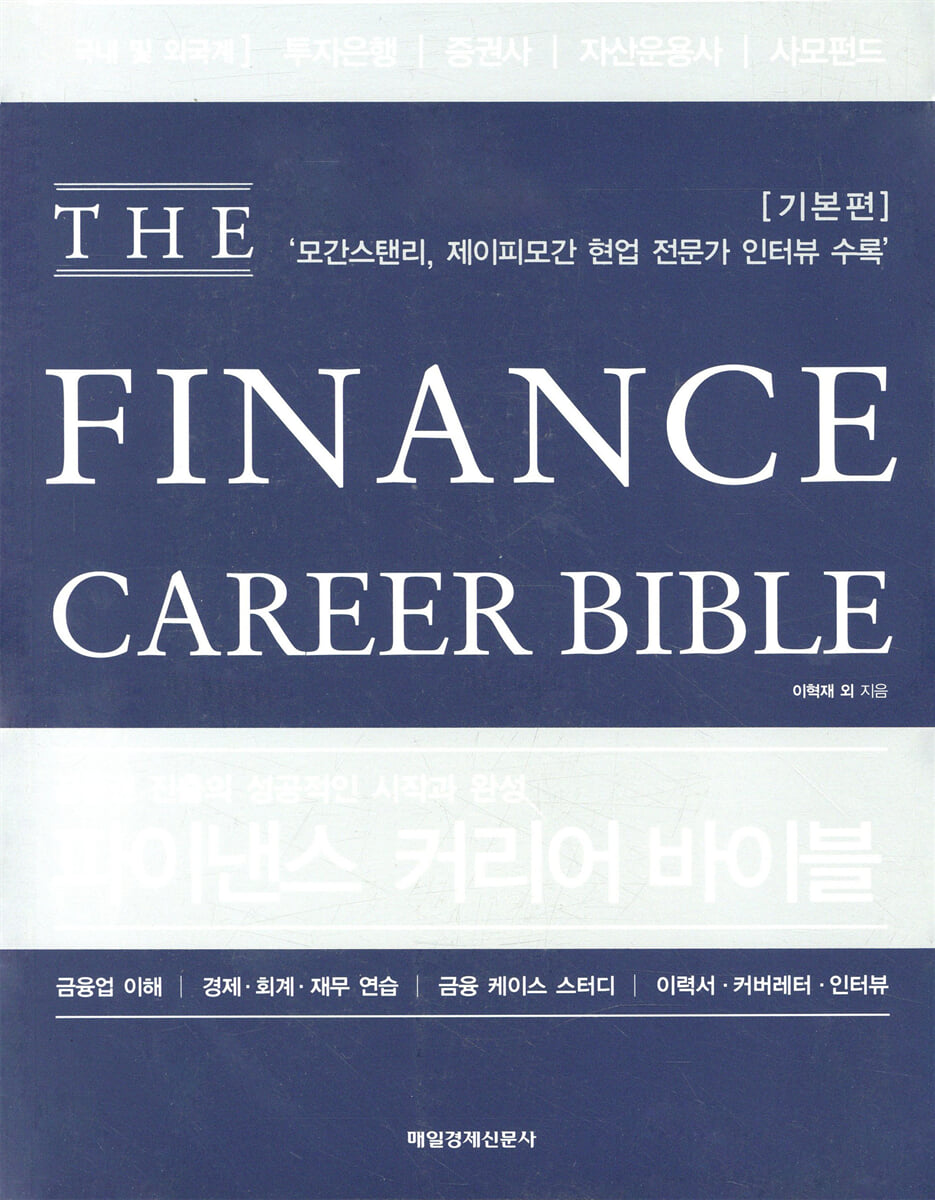
Finance Career Bible
 |
Description
Book Introduction
This book provides information, knowledge, and practical examples of the work through interviews with 98 current employees working at top domestic and foreign financial companies. The text first introduces the detailed work and roles of domestic and foreign investment banks, securities firms, asset management companies, and private equity funds. Here, we provide more vivid information through daily work in the relevant financial department and interviews with 19 people from Morgan Stanley, JP Morgan, etc. Based on interviews with professionals, the book focuses on the most essential aspects of accounting, finance, and economics, and provides knowledge that can be encountered in actual work environments based on a theoretical foundation. We've added a Q&A corner here, focusing on questions people have right before and after joining the company. Additionally, it includes guidance from professionals on resumes, cover letters, and interviews necessary for preparing for employment in the financial sector. A word from the North Sommelier! This book is useful for those preparing for internships or employment in domestic or international financial institutions, those considering a career change within or outside the financial sector, those considering moving to a different financial sector within the financial sector or entering the financial sector from outside the financial sector, and anyone interested in the financial industry and planning to work in the future. Related sites http://www.financecareerbible.com |
- You can preview some of the book's contents.
Preview
index
index
Recommendation
West Gate
Book Map
Step 01 Understanding the Industry
Overview of the financial industry
1.
Understanding Financial Markets 2.
Understanding the Finance Department
Introduction to the Capital Market Integration Act
Corporate Finance Department
1.
Job Introduction 2.
Business Model 3.
Relations with other departments 4.
Success Factor 5.
course
A Life in a Day ∥ A Day in the Life of a Corporate Finance Manager
Real Coach ∥ Morgan Stanley_Interview with a Corporate Finance Expert
DCM Department
1.
Job Introduction 2.
Business Model 3.
Relations with other departments 4.
Success Factor 5.
course
A Life in a Day ∥ A Day in the Life of a DCM Department
Real Coach ∥ Interview with a JP Morgan Bond Capital Markets Expert
ECM department
1.
Job Introduction 2.
Business Model 3.
Relations with other departments 4.
Success Factor 5.
course
Real Coach ∥ Morgan Stanley_ Bond Sales and Trading Expert Interview
Equity Research Department
1.
Job Introduction 2.
Business Model 3.
Relations with other departments 4.
Success Factor 5.
course
A Life in a Day ∥ A Day in the Life of a Stock Research Analyst
Real Coach ∥ Interview with Morgan Stanley's Stock Market Research Expert
Stock Sales & Trading Department
1.
Job Introduction 2.
Business Model 3.
Relations with other departments 4.
Success Factor 5.
course
A Life in a Day ∥ A Day in the Life of a Stock Sales & Trading Department
Real Coach ∥ Interview with JP Morgan's Derivatives Expert
Bond Sales & Trading Department
1.
Job Introduction 2.
Business Model 3.
Relations with other departments 4.
Success Factor 5.
course
A Day in the Life of a Bond Sales & Trading Department
Real Coach ∥ Interview with a JP Morgan Bond Sales Expert
Real Coach ∥ Interview with Morgan Stanley Bond Trading Expert
asset management company
1.
Job Introduction 2.
Business Model 3.
Relations with other departments 4.
Success Factor 5.
course
A Life in a Day ∥ A Day in the Life of an Asset Management Company's Sales Department
Real Coach ∥ Interview with an MBA Student on His Internship Experience
Equity Investment Department
1.
Job Introduction 2.
Business Model 3.
Relations with other departments 4.
Success Factor 5.
course
Real Coach ∥ Interview with an Overseas College Student on Their Internship Experience
private equity fund
1.
Job Introduction 2.
Business Model 3.
Relations with other departments 4.
Success Factor 5.
course
Real Coach ∥ Interview with a Korean college student about their internship experience
Step 02 Practice practical knowledge
accounting
1.
Overview of Financial Statements 2.
Understanding Financial Statements 3.
Financial Statement Analysis Framework 4.
Relationships between financial statements
Real Coach ∥Certification for entering/working in the financial sector
Finance (Valuation)
1.
Valuation Overview 2.
Valuation Method 3.
Discounted Cash Flow Method 4.
Similar Business Comparison Act
Financial Experts' Recommended Books: Understanding Valuation in-Depth
economy
1.
Understanding macroeconomic factors and their impact on individual companies 2.
The Impact of Macroeconomic Factors on the Financial Market
Financial Experts' Recommended Books ∥ Understanding Economics in-depth
Step 03 Case Study
Stock Analysis
1.
Introduction to Stock Analysis Methodology 2.
Technical Analysis 3.
Stock Analysis by Industry
Financial Experts' Recommended Books ∥ Learn the Philosophy of Stock Investment
Corporate Public Offering & Bond Issuance Process
1.
Method 2 of corporate financing.
Corporate Public Offering Process 3.
Analysis of corporate disclosure cases (1) 4.
Analysis of corporate disclosure cases (2) 5.
Bond issuance process 6.
Types of bonds and classification methods 7.
8. Credit rating criteria for bonds.
Status of domestic bond issuance
Financial Experts' Recommended Books: A Glimpse into Bond Sales & Trading
Mergers and acquisitions
1.
What is M&A? 2.
M&A participant 3.
M&A Process (Sell-Side Standard) 4.
M&A Methods and Financing Methods 5.
M&A Evaluation 6.
M&A Case Analysis
Financial Experts' Recommended Books ∥ A Glimpse into Wall Street Life
subprime mortgage crisis
1.
The subprime mortgage crisis that shook the global financial market 2.
Development process
Financial Experts' Recommended Books ∥ Experience the Life of an Investment Banker
Step 04 Employment Process
Resume
1.
2. Before writing your resume.
Basic Resume Structure 3.
4 Things to keep in mind when writing a resume.
Checklist 5 for Writing an Effective Resume.
Resume examples
Real Coach ∥ Interview with a Financial Expert? Resume Coach
Cover letter
1.
2. Before writing a cover letter.
Basic structure of a cover letter 3.
4 Things to keep in mind when writing a cover letter.
Checklist 5 for Writing an Effective Cover Letter.
Cover letter example
Real Coach ∥ Interview with a Headhunter
Interview
1.
2. Before the interview.
Basic interview structure 3.
4 Things to keep in mind during interviews
Checklist for a Successful Interview 5.
Practical Interview Examples
Real Coach ∥ Interview Coach with Financial Experts
supplement
Glossary of terms
Recommendation
West Gate
Book Map
Step 01 Understanding the Industry
Overview of the financial industry
1.
Understanding Financial Markets 2.
Understanding the Finance Department
Introduction to the Capital Market Integration Act
Corporate Finance Department
1.
Job Introduction 2.
Business Model 3.
Relations with other departments 4.
Success Factor 5.
course
A Life in a Day ∥ A Day in the Life of a Corporate Finance Manager
Real Coach ∥ Morgan Stanley_Interview with a Corporate Finance Expert
DCM Department
1.
Job Introduction 2.
Business Model 3.
Relations with other departments 4.
Success Factor 5.
course
A Life in a Day ∥ A Day in the Life of a DCM Department
Real Coach ∥ Interview with a JP Morgan Bond Capital Markets Expert
ECM department
1.
Job Introduction 2.
Business Model 3.
Relations with other departments 4.
Success Factor 5.
course
Real Coach ∥ Morgan Stanley_ Bond Sales and Trading Expert Interview
Equity Research Department
1.
Job Introduction 2.
Business Model 3.
Relations with other departments 4.
Success Factor 5.
course
A Life in a Day ∥ A Day in the Life of a Stock Research Analyst
Real Coach ∥ Interview with Morgan Stanley's Stock Market Research Expert
Stock Sales & Trading Department
1.
Job Introduction 2.
Business Model 3.
Relations with other departments 4.
Success Factor 5.
course
A Life in a Day ∥ A Day in the Life of a Stock Sales & Trading Department
Real Coach ∥ Interview with JP Morgan's Derivatives Expert
Bond Sales & Trading Department
1.
Job Introduction 2.
Business Model 3.
Relations with other departments 4.
Success Factor 5.
course
A Day in the Life of a Bond Sales & Trading Department
Real Coach ∥ Interview with a JP Morgan Bond Sales Expert
Real Coach ∥ Interview with Morgan Stanley Bond Trading Expert
asset management company
1.
Job Introduction 2.
Business Model 3.
Relations with other departments 4.
Success Factor 5.
course
A Life in a Day ∥ A Day in the Life of an Asset Management Company's Sales Department
Real Coach ∥ Interview with an MBA Student on His Internship Experience
Equity Investment Department
1.
Job Introduction 2.
Business Model 3.
Relations with other departments 4.
Success Factor 5.
course
Real Coach ∥ Interview with an Overseas College Student on Their Internship Experience
private equity fund
1.
Job Introduction 2.
Business Model 3.
Relations with other departments 4.
Success Factor 5.
course
Real Coach ∥ Interview with a Korean college student about their internship experience
Step 02 Practice practical knowledge
accounting
1.
Overview of Financial Statements 2.
Understanding Financial Statements 3.
Financial Statement Analysis Framework 4.
Relationships between financial statements
Real Coach ∥Certification for entering/working in the financial sector
Finance (Valuation)
1.
Valuation Overview 2.
Valuation Method 3.
Discounted Cash Flow Method 4.
Similar Business Comparison Act
Financial Experts' Recommended Books: Understanding Valuation in-Depth
economy
1.
Understanding macroeconomic factors and their impact on individual companies 2.
The Impact of Macroeconomic Factors on the Financial Market
Financial Experts' Recommended Books ∥ Understanding Economics in-depth
Step 03 Case Study
Stock Analysis
1.
Introduction to Stock Analysis Methodology 2.
Technical Analysis 3.
Stock Analysis by Industry
Financial Experts' Recommended Books ∥ Learn the Philosophy of Stock Investment
Corporate Public Offering & Bond Issuance Process
1.
Method 2 of corporate financing.
Corporate Public Offering Process 3.
Analysis of corporate disclosure cases (1) 4.
Analysis of corporate disclosure cases (2) 5.
Bond issuance process 6.
Types of bonds and classification methods 7.
8. Credit rating criteria for bonds.
Status of domestic bond issuance
Financial Experts' Recommended Books: A Glimpse into Bond Sales & Trading
Mergers and acquisitions
1.
What is M&A? 2.
M&A participant 3.
M&A Process (Sell-Side Standard) 4.
M&A Methods and Financing Methods 5.
M&A Evaluation 6.
M&A Case Analysis
Financial Experts' Recommended Books ∥ A Glimpse into Wall Street Life
subprime mortgage crisis
1.
The subprime mortgage crisis that shook the global financial market 2.
Development process
Financial Experts' Recommended Books ∥ Experience the Life of an Investment Banker
Step 04 Employment Process
Resume
1.
2. Before writing your resume.
Basic Resume Structure 3.
4 Things to keep in mind when writing a resume.
Checklist 5 for Writing an Effective Resume.
Resume examples
Real Coach ∥ Interview with a Financial Expert? Resume Coach
Cover letter
1.
2. Before writing a cover letter.
Basic structure of a cover letter 3.
4 Things to keep in mind when writing a cover letter.
Checklist 5 for Writing an Effective Cover Letter.
Cover letter example
Real Coach ∥ Interview with a Headhunter
Interview
1.
2. Before the interview.
Basic interview structure 3.
4 Things to keep in mind during interviews
Checklist for a Successful Interview 5.
Practical Interview Examples
Real Coach ∥ Interview Coach with Financial Experts
supplement
Glossary of terms
Into the book
In the corporate finance department, there are people who aim to build their careers and advance to executive positions within the department.
In these cases, it varies from person to person, but it is possible to be promoted to an executive position with at least 2-3 years of work experience.
However, in order to be promoted to a senior level, there are several qualities that must be possessed in addition to work ability.
Therefore, these too must be cultivated to build a successful career.
Some people move to the buy side based on their experience in corporate finance.
In particular, many people are entering the hedge fund or private equity sectors, as the nature of the work is similar to that of corporate finance departments.
Among private equity funds, those working in venture funds or buyout funds must be able to comprehensively assess investment attractiveness based on analysis of the target company, macro market conditions, and an assessment of the company's industry.
The above series of steps are very similar to the process a corporate finance department goes through to prepare for a merger or acquisition.
Due to these similarities in work, there are many cases of corporate finance departments moving into hedge and private equity fields.
--- Among the corporate finance departments
If the format of the writing is not perfect, the applicant will appear disorganized and unprepared to the hiring manager.
The most common examples are grammatical mistakes, errors in notation format, and spelling.
These are mistakes you must avoid if you want to make a good impression on hiring managers.
Secondly, be careful not to use expressions that seem to differentiate between 'I' and 'you', such as 'your company' or 'your program', or to overuse 'I'.
Instead, if you mention the company name directly, it can give a more intimate feel and also show your interest in their company.
there is.
Also, it is not good to use overly clichéd expressions or long-winded expressions to emphasize your intellectual abilities.
Clichés are not memorable, and using long-winded expressions can actually be detrimental as the sentence structure or content becomes out of sync.
In these cases, it varies from person to person, but it is possible to be promoted to an executive position with at least 2-3 years of work experience.
However, in order to be promoted to a senior level, there are several qualities that must be possessed in addition to work ability.
Therefore, these too must be cultivated to build a successful career.
Some people move to the buy side based on their experience in corporate finance.
In particular, many people are entering the hedge fund or private equity sectors, as the nature of the work is similar to that of corporate finance departments.
Among private equity funds, those working in venture funds or buyout funds must be able to comprehensively assess investment attractiveness based on analysis of the target company, macro market conditions, and an assessment of the company's industry.
The above series of steps are very similar to the process a corporate finance department goes through to prepare for a merger or acquisition.
Due to these similarities in work, there are many cases of corporate finance departments moving into hedge and private equity fields.
--- Among the corporate finance departments
If the format of the writing is not perfect, the applicant will appear disorganized and unprepared to the hiring manager.
The most common examples are grammatical mistakes, errors in notation format, and spelling.
These are mistakes you must avoid if you want to make a good impression on hiring managers.
Secondly, be careful not to use expressions that seem to differentiate between 'I' and 'you', such as 'your company' or 'your program', or to overuse 'I'.
Instead, if you mention the company name directly, it can give a more intimate feel and also show your interest in their company.
there is.
Also, it is not good to use overly clichéd expressions or long-winded expressions to emphasize your intellectual abilities.
Clichés are not memorable, and using long-winded expressions can actually be detrimental as the sentence structure or content becomes out of sync.
--- From the cover letter
Publisher's Review
A must-read for anyone who wants to succeed in finance.
The economic downturn caused by the financial crisis is leading to a continuing employment crisis.
Moreover, the reality is that it is not easy to enter the field you want due to a lack of job information.
The "Finance Career Bible" was born from the practical needs of those who wish to enter the financial sector and those who have already entered it.
Many people aspire to enter the financial sector, but there has been no book that provides accurate information and background knowledge about the financial sector that truly interests them.
Until now, people who wanted to enter the financial sector prepared by gathering information from acquaintances or from the internet.
Additionally, even those who have already entered the financial sector and want to move to another financial industry often have to go through difficult channels to obtain information due to the lack of accurate and professional guides.
While the job search process that everyone must go through to enter the financial sector is arduous, it's not as difficult as you might think with the right guidance and information.
To meet these most basic needs, 'Step 1.
Understanding the Industry" contains detailed explanations of the work and roles of domestic and foreign investment banks, securities firms, asset management companies, and private equity funds through interviews with 98 current employees at top domestic and foreign financial companies.
Furthermore, to provide practical information about each financial industry, the book details the daily work of each financial department and career development guidelines related to the industry. Furthermore, you can hear the voices of real-life financial professionals through interviews with 19 professionals from companies like Morgan Stanley and JP Morgan.
If you want to work in the financial industry, you need a thorough understanding of the relevant business and department, as well as the background knowledge and skills to handle the duties of that department.
'Step 2.
In 'Practicing Practical Knowledge', the most essential content in accounting, finance (valuation), and economics is explained based on interviews with professionals, and it is organized to enable practical practice.
Each part is based on a theoretical foundation and describes knowledge that can be encountered in real-world work environments. A Q&A session is also provided, focusing on questions that people who are about to or just after joining a company are curious about.
'Step 3.
The 'Case Study' provided practical cases needed by the department.
We introduce the most common cases, such as stock analysis, M&A, stock issuance, and bond issuance.
Furthermore, the author encourages readers to practice extensively by reading readily available financial articles and writings, building on their understanding of the processes and frameworks presented in each case study.
Finally, 'Step 4.
The 'Employment Process' section contains detailed guidance from industry professionals on the resumes, cover letters, and interviews required for employment.
We introduce how to effectively write about your career in the financial industry, from the structure of your resume and cover letter to paragraph structure.
When preparing for an interview, you're probably most curious about what questions you'll be asked.
To answer these questions, we have included detailed questions from interviews with top financial companies in Seoul, Yeouido, and elsewhere.
Readers of the Finance Career Bible
1.
Undergraduate students, master's and doctoral students, and those preparing for internships or employment in domestic and foreign financial institutions
2. MBA graduates, MBA graduates, and those preparing for employment in domestic or foreign financial institutions after graduation
3.
People considering a career change within or outside the financial sector, moving to another financial industry within the financial sector, or entering the financial sector from outside the financial sector.
4.
People who are interested in the financial industry and want to work in the financial industry in the future
The economic downturn caused by the financial crisis is leading to a continuing employment crisis.
Moreover, the reality is that it is not easy to enter the field you want due to a lack of job information.
The "Finance Career Bible" was born from the practical needs of those who wish to enter the financial sector and those who have already entered it.
Many people aspire to enter the financial sector, but there has been no book that provides accurate information and background knowledge about the financial sector that truly interests them.
Until now, people who wanted to enter the financial sector prepared by gathering information from acquaintances or from the internet.
Additionally, even those who have already entered the financial sector and want to move to another financial industry often have to go through difficult channels to obtain information due to the lack of accurate and professional guides.
While the job search process that everyone must go through to enter the financial sector is arduous, it's not as difficult as you might think with the right guidance and information.
To meet these most basic needs, 'Step 1.
Understanding the Industry" contains detailed explanations of the work and roles of domestic and foreign investment banks, securities firms, asset management companies, and private equity funds through interviews with 98 current employees at top domestic and foreign financial companies.
Furthermore, to provide practical information about each financial industry, the book details the daily work of each financial department and career development guidelines related to the industry. Furthermore, you can hear the voices of real-life financial professionals through interviews with 19 professionals from companies like Morgan Stanley and JP Morgan.
If you want to work in the financial industry, you need a thorough understanding of the relevant business and department, as well as the background knowledge and skills to handle the duties of that department.
'Step 2.
In 'Practicing Practical Knowledge', the most essential content in accounting, finance (valuation), and economics is explained based on interviews with professionals, and it is organized to enable practical practice.
Each part is based on a theoretical foundation and describes knowledge that can be encountered in real-world work environments. A Q&A session is also provided, focusing on questions that people who are about to or just after joining a company are curious about.
'Step 3.
The 'Case Study' provided practical cases needed by the department.
We introduce the most common cases, such as stock analysis, M&A, stock issuance, and bond issuance.
Furthermore, the author encourages readers to practice extensively by reading readily available financial articles and writings, building on their understanding of the processes and frameworks presented in each case study.
Finally, 'Step 4.
The 'Employment Process' section contains detailed guidance from industry professionals on the resumes, cover letters, and interviews required for employment.
We introduce how to effectively write about your career in the financial industry, from the structure of your resume and cover letter to paragraph structure.
When preparing for an interview, you're probably most curious about what questions you'll be asked.
To answer these questions, we have included detailed questions from interviews with top financial companies in Seoul, Yeouido, and elsewhere.
Readers of the Finance Career Bible
1.
Undergraduate students, master's and doctoral students, and those preparing for internships or employment in domestic and foreign financial institutions
2. MBA graduates, MBA graduates, and those preparing for employment in domestic or foreign financial institutions after graduation
3.
People considering a career change within or outside the financial sector, moving to another financial industry within the financial sector, or entering the financial sector from outside the financial sector.
4.
People who are interested in the financial industry and want to work in the financial industry in the future
GOODS SPECIFICS
- Date of issue: August 1, 2023
- Page count, weight, size: 436 pages | 769g | 180*230*30mm
- ISBN13: 9788974425678
- ISBN10: 897442567X
You may also like
카테고리
korean


korean

![ELLE 엘르 스페셜 에디션 A형 : 12월 [2025]](http://librairie.coreenne.fr/cdn/shop/files/b8e27a3de6c9538896439686c6b0e8fb.jpg?v=1766436872&width=3840)


