

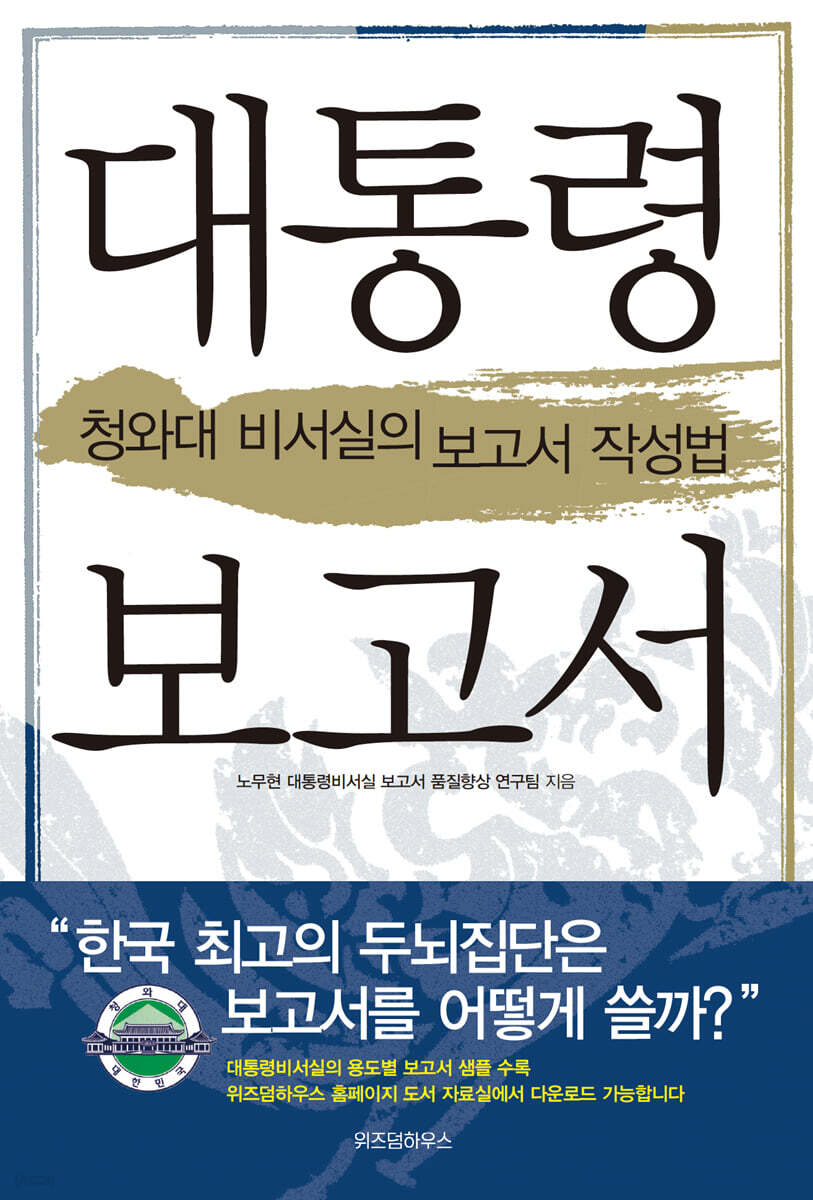
Presidential Report
 |
Description
Book Introduction
The phrase "the difficulty of writing a report" might sound ridiculous to someone who hasn't experienced it, but it's a problem that anyone who has ever written any kind of report will deeply sympathize with.
The problem is not only that there is no standardized report to date, but also that its scope of use is diverse and that each company and each user considers it to be important in different ways.
"The President's Report" is a book that stands out for its efforts to challenge the standardization of numerous reports written for different users and purposes and to create user-centered reports.
As the title suggests, this book began with the recognition of the problems with the Office of the President's own reports. In this book, the authors argue that reports are not just a tedious and formal process, but the "foundation of innovation."
This is because the report must include not only awareness of the current issue, but also the most reasonable alternative and information to the final decision maker.
When reports are innovative, organizations are innovative.
There's a reason why people who write good reports are recognized.
The problem is not only that there is no standardized report to date, but also that its scope of use is diverse and that each company and each user considers it to be important in different ways.
"The President's Report" is a book that stands out for its efforts to challenge the standardization of numerous reports written for different users and purposes and to create user-centered reports.
As the title suggests, this book began with the recognition of the problems with the Office of the President's own reports. In this book, the authors argue that reports are not just a tedious and formal process, but the "foundation of innovation."
This is because the report must include not only awareness of the current issue, but also the most reasonable alternative and information to the final decision maker.
When reports are innovative, organizations are innovative.
There's a reason why people who write good reports are recognized.
- You can preview some of the book's contents.
Preview
index
Part 1: Introductory Report Writing Course | Covering the Basics First
Chapter 1 | The Reality and Practice of Report Writing
Chapter 2 | Four Problems in Report Writing
Chapter 3 | Standard Procedures for Report Preparation and Processing
Chapter 4 | Report Development Method and Standard Format
Chapter 5 | How to Write a Report That Gets Praised
Chapter 6 | Tips for Writing Reports
Specialized Course on Writing Reports Part 2 | Choose the Report That Fits Your Purpose
Chapter 1 | Classification of Report Types
Chapter 2 | Policy Report
Chapter 3 | Situation and Information Report
Chapter 4 | Meeting Report
Chapter 5 | Event Report
Part 3: Field Trip | How the Office of the President Works
Chapter 1 | The Work Structure of the Office of the President: Until the State Administration System Became Established
Chapter 2 | Report Field Sketches: Stories from Administrators Running in the Field
Chapter 1 | The Reality and Practice of Report Writing
Chapter 2 | Four Problems in Report Writing
Chapter 3 | Standard Procedures for Report Preparation and Processing
Chapter 4 | Report Development Method and Standard Format
Chapter 5 | How to Write a Report That Gets Praised
Chapter 6 | Tips for Writing Reports
Specialized Course on Writing Reports Part 2 | Choose the Report That Fits Your Purpose
Chapter 1 | Classification of Report Types
Chapter 2 | Policy Report
Chapter 3 | Situation and Information Report
Chapter 4 | Meeting Report
Chapter 5 | Event Report
Part 3: Field Trip | How the Office of the President Works
Chapter 1 | The Work Structure of the Office of the President: Until the State Administration System Became Established
Chapter 2 | Report Field Sketches: Stories from Administrators Running in the Field
Publisher's Review
Background | A Report That Moves the President, A Report That Moves the President
As of June 2007, there were about 20 active learning (innovation) clubs within the Office of the President, which were voluntary innovation-promoting organizations. In early 2005, an innovation club called the 'Report Quality Improvement Research Team' was launched, centered around employees who sympathized with the issues surrounding report writing methods.
They created the "Report Writing Manual" through their activities from April to October 2005.
This manual was evaluated as the best innovation case of the Blue House and has been flooded with requests for lectures from various government ministries. This "Report Writing Manual" became the basis for the "Presidential Report."
The president's awareness of the problem also played a part in the publication of this book.
The total number of reports directly handled by the President during the ten months from November 2004 to August 2005 was 2,104.
This means that 210 reports were processed per month.
Some of these reports can be skimmed in a few minutes, while others are dozens of pages long and take an hour to pore over.
Given the President's busy schedule, reading and processing dozens of reports a day is a significant burden.
Moreover, even though it was a report that went all the way to the president, the format was different depending on who wrote it.
This created an urgent need for a report that was clear in its purpose and efficient and concise.
It has been nearly 60 years since the establishment of the Republic of Korea government, but the problem is that the numerous reports submitted to the president during that time remain in the Office of the President.
It's not just the report that's gone missing.
The know-how to assist the president in making policy decisions on major national issues also disappeared without a trace with the change of government.
The 'Report Moved by the President', which began with the President's awareness of the problem, has now been reborn as the 'Report that Moves the President' and is being used in various major national issues.
Book Content | How to Write a Report That Satisfies Both Authors and Consumers
The problem with the report is not limited to the Office of the President.
Report writing skills are essential for effective communication and improved work productivity.
As office workers, we write and encounter reports every day, but writing efficient and productive reports is not easy.
In this respect, the innovation report of the Office of the President can be said to be an excellent example of 'innovation demonstrated by working people in the field.'
This book, written by authors who frequently write reports, analyzes the problems of various reports, discusses and organizes specific writing methods, and identifies best practices.
What stands out in the innovation report of the Secretary's Office is that it is 'innovation tailored to the eye level of the user.'
This is the principle that applies regardless of the report type, from report planning to writing, and it is the philosophy that runs through this book.
The most important thing I focused on while writing the book was 'standardizing' the report.
To create a generalized and objective standard report, we sought to reflect the opinions of a variety of people, including not only civil servants but also academia, businesses, and research institutes.
Although this book began as a report to the President, its scope can be applied to improving organizational efficiency and productivity.
Book Structure | Detailed Guide to Writing Reports Tailored to Your Purpose and Use
This book is divided into beginner and expert courses according to the reader's level.
Part 1 is an introductory course on report writing, pointing out problems with reports currently being written and describing the requirements for a good report, standard writing procedures, and general report writing methods.
We introduce common mistakes made when writing reports and how to write praiseworthy reports, along with examples.
In Part 2, report types were categorized into policy reports, situation/information reports, meeting reports, and event reports, and writing methods for each type were introduced.
This is designed to be easily referenced by readers who want to know professional report writing techniques or who want to find information in a manual format.
It also contains useful information for civil servants and office workers who have experience writing reports.
In Part 3, we visited the Presidential Office and introduced in a light-hearted manner how work is actually done in the office.
Additionally, we provide a selection of good examples from reports prepared by the Office of the President for download.
It will be of great help in writing reports that satisfy both the report writer and the recipient.
Now it's time to demonstrate your skills through your report.
A one-page report that moves the president. Use the secrets on your boss!
*Report sample download link (publisher Wisdom House website)
https://bit.ly/3g2zmCe
As of June 2007, there were about 20 active learning (innovation) clubs within the Office of the President, which were voluntary innovation-promoting organizations. In early 2005, an innovation club called the 'Report Quality Improvement Research Team' was launched, centered around employees who sympathized with the issues surrounding report writing methods.
They created the "Report Writing Manual" through their activities from April to October 2005.
This manual was evaluated as the best innovation case of the Blue House and has been flooded with requests for lectures from various government ministries. This "Report Writing Manual" became the basis for the "Presidential Report."
The president's awareness of the problem also played a part in the publication of this book.
The total number of reports directly handled by the President during the ten months from November 2004 to August 2005 was 2,104.
This means that 210 reports were processed per month.
Some of these reports can be skimmed in a few minutes, while others are dozens of pages long and take an hour to pore over.
Given the President's busy schedule, reading and processing dozens of reports a day is a significant burden.
Moreover, even though it was a report that went all the way to the president, the format was different depending on who wrote it.
This created an urgent need for a report that was clear in its purpose and efficient and concise.
It has been nearly 60 years since the establishment of the Republic of Korea government, but the problem is that the numerous reports submitted to the president during that time remain in the Office of the President.
It's not just the report that's gone missing.
The know-how to assist the president in making policy decisions on major national issues also disappeared without a trace with the change of government.
The 'Report Moved by the President', which began with the President's awareness of the problem, has now been reborn as the 'Report that Moves the President' and is being used in various major national issues.
Book Content | How to Write a Report That Satisfies Both Authors and Consumers
The problem with the report is not limited to the Office of the President.
Report writing skills are essential for effective communication and improved work productivity.
As office workers, we write and encounter reports every day, but writing efficient and productive reports is not easy.
In this respect, the innovation report of the Office of the President can be said to be an excellent example of 'innovation demonstrated by working people in the field.'
This book, written by authors who frequently write reports, analyzes the problems of various reports, discusses and organizes specific writing methods, and identifies best practices.
What stands out in the innovation report of the Secretary's Office is that it is 'innovation tailored to the eye level of the user.'
This is the principle that applies regardless of the report type, from report planning to writing, and it is the philosophy that runs through this book.
The most important thing I focused on while writing the book was 'standardizing' the report.
To create a generalized and objective standard report, we sought to reflect the opinions of a variety of people, including not only civil servants but also academia, businesses, and research institutes.
Although this book began as a report to the President, its scope can be applied to improving organizational efficiency and productivity.
Book Structure | Detailed Guide to Writing Reports Tailored to Your Purpose and Use
This book is divided into beginner and expert courses according to the reader's level.
Part 1 is an introductory course on report writing, pointing out problems with reports currently being written and describing the requirements for a good report, standard writing procedures, and general report writing methods.
We introduce common mistakes made when writing reports and how to write praiseworthy reports, along with examples.
In Part 2, report types were categorized into policy reports, situation/information reports, meeting reports, and event reports, and writing methods for each type were introduced.
This is designed to be easily referenced by readers who want to know professional report writing techniques or who want to find information in a manual format.
It also contains useful information for civil servants and office workers who have experience writing reports.
In Part 3, we visited the Presidential Office and introduced in a light-hearted manner how work is actually done in the office.
Additionally, we provide a selection of good examples from reports prepared by the Office of the President for download.
It will be of great help in writing reports that satisfy both the report writer and the recipient.
Now it's time to demonstrate your skills through your report.
A one-page report that moves the president. Use the secrets on your boss!
*Report sample download link (publisher Wisdom House website)
https://bit.ly/3g2zmCe
GOODS SPECIFICS
- Date of publication: July 13, 2007
- Page count, weight, size: 285 pages | 548g | 153*224*20mm
- ISBN13: 9788960860292
- ISBN10: 8960860298
You may also like
카테고리
korean


korean

![ELLE 엘르 스페셜 에디션 A형 : 12월 [2025]](http://librairie.coreenne.fr/cdn/shop/files/b8e27a3de6c9538896439686c6b0e8fb.jpg?v=1766436872&width=3840)


