

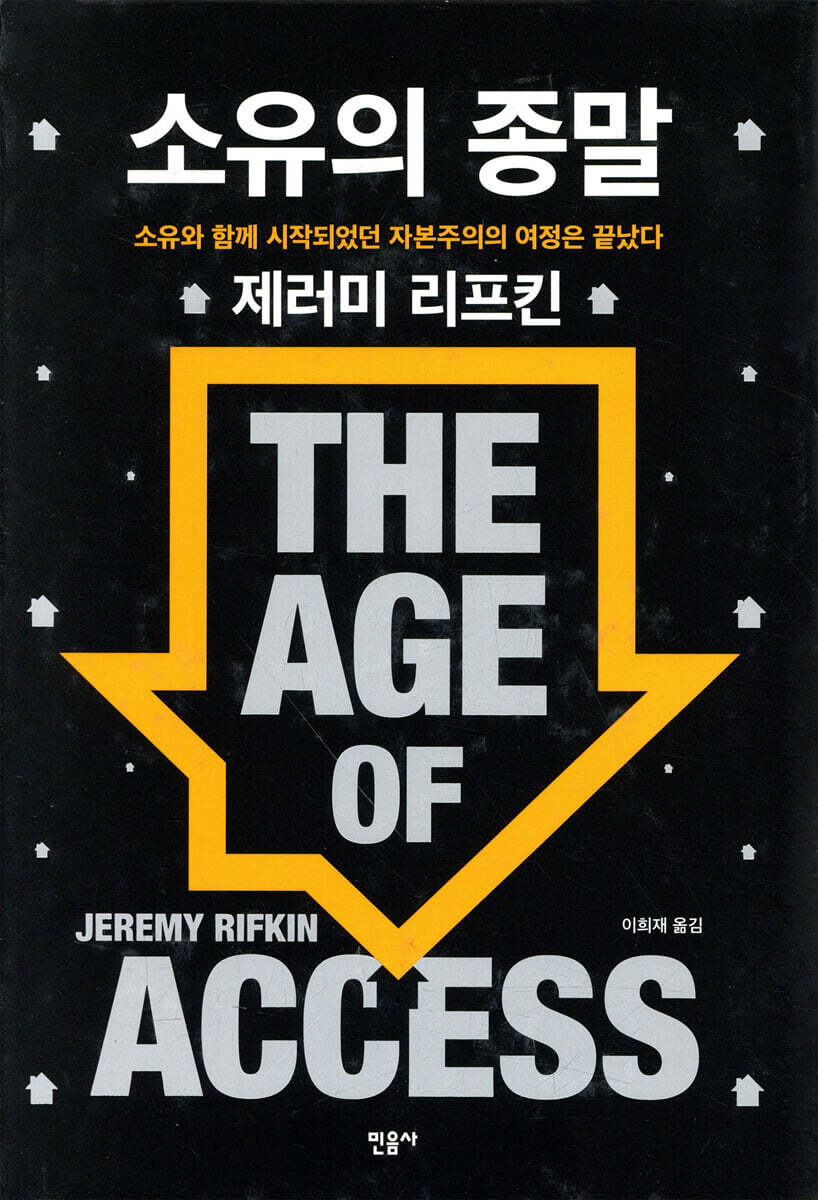
The End of Ownership
 |
Description
Book Introduction
No more need for 'ownership'
The age of connectivity is coming.
"The End of Ownership" is the third book in a series by world-renowned futurist Jeremy Rifkin, which presents a vision for the future of technology, the environment, and the global economy. It presents a vision for the future of humanity from a different perspective than his previously published books, "The End of Work" and "The Biotech Age."
In this book, Rifkin declares that capitalism, which began with 'ownership' and 'commodification,' has now entered a new phase.
People no longer want to 'own' things, but rather 'access' them temporarily.
Rifkin uses the term "access," which means access, entry, approach, and access rights rental, as a keyword to define the new era.
Connectivity encompasses more than simply connecting to a computer or network.
A consistent trend found not only on the Internet but also in various real-world sectors such as automobiles, homes, appliances, factories, and chain stores is connectivity.
The age of connectivity is coming.
"The End of Ownership" is the third book in a series by world-renowned futurist Jeremy Rifkin, which presents a vision for the future of technology, the environment, and the global economy. It presents a vision for the future of humanity from a different perspective than his previously published books, "The End of Work" and "The Biotech Age."
In this book, Rifkin declares that capitalism, which began with 'ownership' and 'commodification,' has now entered a new phase.
People no longer want to 'own' things, but rather 'access' them temporarily.
Rifkin uses the term "access," which means access, entry, approach, and access rights rental, as a keyword to define the new era.
Connectivity encompasses more than simply connecting to a computer or network.
A consistent trend found not only on the Internet but also in various real-world sectors such as automobiles, homes, appliances, factories, and chain stores is connectivity.
- You can preview some of the book's contents.
Preview
index
Part 1: Capitalism's New Frontier
1.
The age of connectivity is coming.
2.
The day the market is pushed by the network
3.
Weightless Economy
4.
monopoly of intellectual property
5.
Service World
6.
The commodification of human relationships
7.
Connection as Life
Part 2: Capitalism Draining Culture
8.
The New Culture of Capitalism
9.
In search of cultural veins
10.
Postmodern
11.
Connected and non-connected people
12.
Towards an Ecology of Culture and Capitalism
main
Translator's Note
1.
The age of connectivity is coming.
2.
The day the market is pushed by the network
3.
Weightless Economy
4.
monopoly of intellectual property
5.
Service World
6.
The commodification of human relationships
7.
Connection as Life
Part 2: Capitalism Draining Culture
8.
The New Culture of Capitalism
9.
In search of cultural veins
10.
Postmodern
11.
Connected and non-connected people
12.
Towards an Ecology of Culture and Capitalism
main
Translator's Note
Into the book
The management assumptions that govern the age of connectivity are quite different from those that governed the age of markets.
In the new world, markets give way to networks, and sellers and buyers become suppliers and users.
Virtually everything is connected.
--- p.14
Restoring the proper balance between cultural and commercial spheres may be the most difficult challenge facing the connected age.
Just as natural resources faced the risk of being depleted due to human overuse in the industrial age, cultural resources may also be depleted at any time due to excessive pursuit of profit.
--- p.21
In a networked economy where product life cycles are getting shorter and the mobility of goods and services is expanding by the day, what is lacking is human attention, not things.
Giving away items for free to attract potential customers will become an increasingly popular marketing strategy.
--- p.142
We are entering a new phase of capitalism, one we have never experienced before.
All the economic totems we have upheld so far are crumbling one by one.
What takes its place is a commercial idol fit for a new era in history.
--- p.169
The extent to which we transform our living spaces from ownership to access will depend on the superiority of two sensibilities about who we are and how we want to live in the 21st century.
--- p.198
Today, as the global economy shifts once again from the consumption of goods and services to the consumption of experiences, human nature is also undergoing a transformation.
The perspective of the new, ever-changing human type living in the age of connectivity is completely different from that of our parents' or grandparents' generation.
--- p.297
Civic education is a key tool for restoring an ecosystem where culture and commerce coexist in harmony.
But if culture is to regain its former high place in human relations, more fundamental changes must take place.
--- p.377
The age of connectivity will force us to ask ourselves the fundamental question: "In what direction do we want to reshape our most basic human relationships with others?"
Because access is not only a matter of level of participation, but also of type of participation.
It's not simply a question of who gets access, but what types of experiences and worlds are worth accessing and pursuing.
The nature of the society we create in the 21st century will depend on this answer.
In the new world, markets give way to networks, and sellers and buyers become suppliers and users.
Virtually everything is connected.
--- p.14
Restoring the proper balance between cultural and commercial spheres may be the most difficult challenge facing the connected age.
Just as natural resources faced the risk of being depleted due to human overuse in the industrial age, cultural resources may also be depleted at any time due to excessive pursuit of profit.
--- p.21
In a networked economy where product life cycles are getting shorter and the mobility of goods and services is expanding by the day, what is lacking is human attention, not things.
Giving away items for free to attract potential customers will become an increasingly popular marketing strategy.
--- p.142
We are entering a new phase of capitalism, one we have never experienced before.
All the economic totems we have upheld so far are crumbling one by one.
What takes its place is a commercial idol fit for a new era in history.
--- p.169
The extent to which we transform our living spaces from ownership to access will depend on the superiority of two sensibilities about who we are and how we want to live in the 21st century.
--- p.198
Today, as the global economy shifts once again from the consumption of goods and services to the consumption of experiences, human nature is also undergoing a transformation.
The perspective of the new, ever-changing human type living in the age of connectivity is completely different from that of our parents' or grandparents' generation.
--- p.297
Civic education is a key tool for restoring an ecosystem where culture and commerce coexist in harmony.
But if culture is to regain its former high place in human relations, more fundamental changes must take place.
--- p.377
The age of connectivity will force us to ask ourselves the fundamental question: "In what direction do we want to reshape our most basic human relationships with others?"
Because access is not only a matter of level of participation, but also of type of participation.
It's not simply a question of who gets access, but what types of experiences and worlds are worth accessing and pursuing.
The nature of the society we create in the 21st century will depend on this answer.
--- p.392
Publisher's Review
No more need for 'ownership'
The age of connectivity is coming.
"The End of Ownership" is the third book in a series by world-renowned futurist Jeremy Rifkin, which presents a vision for the future of technology, the environment, and the global economy. It presents a vision for the future of humanity from a different perspective than his previously published books, "The End of Work" and "The Biotech Age."
In this book, Rifkin declares that capitalism, which began with 'ownership' and 'commodification,' has now entered a new phase.
People no longer want to 'own' things, but rather 'access' them temporarily.
Rifkin uses the term "access," which means access, entry, approach, and access rights rental, as a keyword to define the new era.
Connectivity encompasses more than simply connecting to a computer or network.
A consistent trend found not only on the Internet but also in various real-world sectors such as automobiles, homes, appliances, factories, and chain stores is connectivity.
The era of rapidly changing innovation
We pay for experience and time
Access is a temporary right.
The opposite of access is ownership.
People find ownership burdensome.
The industrial age was an age of ownership.
Companies increase their market share by selling many products, and consumers expand their sphere of presence by purchasing and owning many products in the market.
However, in an era of rapid change and innovation, it is disadvantageous to be obsessed with ownership.
Companies want to be like Nike, which owns no factories and operates only with its brand.
Ford no longer wants to sell cars, but rather lease them to customers, creating an ongoing relationship with them.
Instead of owning a car, customers lease it and change cars as new models come out.
What's important to a business is to build lasting relationships with its customers.
In a rapidly changing society, securing customers' attention and time by any means necessary becomes the key to survival.
While increasing market share used to be the top priority, companies now strive to increase their customers' time share.
Nowadays, companies don't just sell things, they just give them away.
Once a relationship is established with a customer, they then take control of the customer's time by selling the right to access services or other areas.
Making life more convenient by turning everything imaginable into a service.
When the time comes, we will replace the air conditioner and replace the carpet.
The calculation is that you can grow much faster by upgrading and maintaining your installed facilities rather than struggling to sell more products.
The fact that everything in the world is becoming a service means that capitalism is changing from a system based on the exchange of goods to a system based on access to the realm of experience.
When you contract with an air conditioner service provider rather than buying the air conditioner itself, you are paying for the experience you get from it.
In this respect, in the new capitalism, the dimension of time is much more important than the dimension of material.
Rather than commodifying places and things and trading them in the marketplace, we now have access to each other's time and insights, and borrow what we need.
And what mediates it is money.
There are increasingly cases where we buy other people's time, other people's consideration and affection, other people's empathy and attention with money.
It is not only entertainment and play that is bought, but even manners and courtesy are bought.
The time we enjoy is measured precisely.
Our lives are becoming increasingly commodified, and the line between utility and profit is increasingly blurred.
monopoly of cultural products and intellectual property
As connectivity becomes increasingly important in our lives, intellectual property rights become increasingly stringent.
For example, if you run a McDonald's chain, the owner of that store is buying the right to temporarily access the brand.
Even if you open a store by investing your own money, nothing goes as you wish.
If a cloned animal is created and patented, the patent owner can exercise intellectual property rights over all descendants of that animal.
The person who bought the animal must pay an additional connection fee in the form of a royalty each time the animal's offspring is born.
If someone is cured of an illness by receiving a transplant of a specific genetic factor at a hospital, the time will come when that person's descendants will also have to pay an access fee for the genes they inherited from their parents.
The commercialization of exclusive culture and the depletion of local culture.
The Shadow Cast by the Age of Connection
According to Rifkin, historically, culture has always preceded commerce.
Commerce was an outgrowth of culture.
But now things have changed.
Culture has been reduced to nothing more than a source of material for commercialization.
Rifkin's diagnosis is that cultural capitalism is thoroughly excavating and commercializing the cultural diversity that humanity has developed over thousands of years, but paradoxically, in the process, cultural diversity is disappearing.
Preserving cultural diversity is just as important as preserving biodiversity, says Rifkin.
If even the cultural sphere, which can be considered the last bastion of human values, is completely absorbed by the commercial sphere, social trust will plummet and the foundation of a healthy civil society will completely collapse.
Human civilization is in crisis.
Providing ample educational opportunities to everyone to overcome computer illiteracy and enable them to roam cyberspace without restrictions will not automatically solve the problems of the new age of connectivity.
Because when nearly every aspect of our existence becomes a paid activity, ultimately we ourselves become commodities, and the commercial sphere holds the power to determine the fate of individuals and groups.
Rifkin argues that only by preserving cultural diversity rooted in geographical space can human civilization be maintained.
Just as natural resources faced the risk of being depleted due to overuse in the industrial age, cultural resources may also be depleted at any time due to excessive pursuit of profit.
Finding sustainable ways to preserve and enhance cultural diversity is a challenge of this century.
Reading the currents flowing beneath the scattered phenomena
Rifkin's writing
Rifkin, straddling the natural sciences, social sciences, and humanities, presents a comprehensive picture of the direction in which human society is moving from a higher vantage point than anyone else.
There are countless scholars who have criticized the fearsome profit-seeking logic of capitalism, but what makes Rifkin stand out is his specific and empirical critique.
Rifkin does not stop at listing phenomena; he has a keen eye for discerning the underlying currents of phenomena that appear completely unrelated on the surface.
He presents the connections and flows between seemingly unrelated things like using rental cars, fusion music, and genetic engineering.
Recognized for his insight and vision in reading macro trends, Rifkin advises presidents on policy matters in several countries and frequently speaks at conferences in business, labor, and civil society.
He has lectured at numerous universities around the world and founded the Economic Trends Research Foundation, a non-profit organization, to actively engage in enlightenment and monitoring activities to protect the public sphere of society.
Rifkin's insight comes from passion and diligence.
It took me a full six years to write The End of Ownership.
350 books, 1,000 papers, 50,000 index cards, and 2,000 footnotes were mobilized.
This book vividly depicts the crisis that new capitalism could bring to human civilization.
However, because it explains with Rifkin's characteristically sharp insight how capitalism will function in the future, it is also a worthy read as a strategy book for surviving the fierce competition ahead, whether the author intended it or not.
The age of connectivity is coming.
"The End of Ownership" is the third book in a series by world-renowned futurist Jeremy Rifkin, which presents a vision for the future of technology, the environment, and the global economy. It presents a vision for the future of humanity from a different perspective than his previously published books, "The End of Work" and "The Biotech Age."
In this book, Rifkin declares that capitalism, which began with 'ownership' and 'commodification,' has now entered a new phase.
People no longer want to 'own' things, but rather 'access' them temporarily.
Rifkin uses the term "access," which means access, entry, approach, and access rights rental, as a keyword to define the new era.
Connectivity encompasses more than simply connecting to a computer or network.
A consistent trend found not only on the Internet but also in various real-world sectors such as automobiles, homes, appliances, factories, and chain stores is connectivity.
The era of rapidly changing innovation
We pay for experience and time
Access is a temporary right.
The opposite of access is ownership.
People find ownership burdensome.
The industrial age was an age of ownership.
Companies increase their market share by selling many products, and consumers expand their sphere of presence by purchasing and owning many products in the market.
However, in an era of rapid change and innovation, it is disadvantageous to be obsessed with ownership.
Companies want to be like Nike, which owns no factories and operates only with its brand.
Ford no longer wants to sell cars, but rather lease them to customers, creating an ongoing relationship with them.
Instead of owning a car, customers lease it and change cars as new models come out.
What's important to a business is to build lasting relationships with its customers.
In a rapidly changing society, securing customers' attention and time by any means necessary becomes the key to survival.
While increasing market share used to be the top priority, companies now strive to increase their customers' time share.
Nowadays, companies don't just sell things, they just give them away.
Once a relationship is established with a customer, they then take control of the customer's time by selling the right to access services or other areas.
Making life more convenient by turning everything imaginable into a service.
When the time comes, we will replace the air conditioner and replace the carpet.
The calculation is that you can grow much faster by upgrading and maintaining your installed facilities rather than struggling to sell more products.
The fact that everything in the world is becoming a service means that capitalism is changing from a system based on the exchange of goods to a system based on access to the realm of experience.
When you contract with an air conditioner service provider rather than buying the air conditioner itself, you are paying for the experience you get from it.
In this respect, in the new capitalism, the dimension of time is much more important than the dimension of material.
Rather than commodifying places and things and trading them in the marketplace, we now have access to each other's time and insights, and borrow what we need.
And what mediates it is money.
There are increasingly cases where we buy other people's time, other people's consideration and affection, other people's empathy and attention with money.
It is not only entertainment and play that is bought, but even manners and courtesy are bought.
The time we enjoy is measured precisely.
Our lives are becoming increasingly commodified, and the line between utility and profit is increasingly blurred.
monopoly of cultural products and intellectual property
As connectivity becomes increasingly important in our lives, intellectual property rights become increasingly stringent.
For example, if you run a McDonald's chain, the owner of that store is buying the right to temporarily access the brand.
Even if you open a store by investing your own money, nothing goes as you wish.
If a cloned animal is created and patented, the patent owner can exercise intellectual property rights over all descendants of that animal.
The person who bought the animal must pay an additional connection fee in the form of a royalty each time the animal's offspring is born.
If someone is cured of an illness by receiving a transplant of a specific genetic factor at a hospital, the time will come when that person's descendants will also have to pay an access fee for the genes they inherited from their parents.
The commercialization of exclusive culture and the depletion of local culture.
The Shadow Cast by the Age of Connection
According to Rifkin, historically, culture has always preceded commerce.
Commerce was an outgrowth of culture.
But now things have changed.
Culture has been reduced to nothing more than a source of material for commercialization.
Rifkin's diagnosis is that cultural capitalism is thoroughly excavating and commercializing the cultural diversity that humanity has developed over thousands of years, but paradoxically, in the process, cultural diversity is disappearing.
Preserving cultural diversity is just as important as preserving biodiversity, says Rifkin.
If even the cultural sphere, which can be considered the last bastion of human values, is completely absorbed by the commercial sphere, social trust will plummet and the foundation of a healthy civil society will completely collapse.
Human civilization is in crisis.
Providing ample educational opportunities to everyone to overcome computer illiteracy and enable them to roam cyberspace without restrictions will not automatically solve the problems of the new age of connectivity.
Because when nearly every aspect of our existence becomes a paid activity, ultimately we ourselves become commodities, and the commercial sphere holds the power to determine the fate of individuals and groups.
Rifkin argues that only by preserving cultural diversity rooted in geographical space can human civilization be maintained.
Just as natural resources faced the risk of being depleted due to overuse in the industrial age, cultural resources may also be depleted at any time due to excessive pursuit of profit.
Finding sustainable ways to preserve and enhance cultural diversity is a challenge of this century.
Reading the currents flowing beneath the scattered phenomena
Rifkin's writing
Rifkin, straddling the natural sciences, social sciences, and humanities, presents a comprehensive picture of the direction in which human society is moving from a higher vantage point than anyone else.
There are countless scholars who have criticized the fearsome profit-seeking logic of capitalism, but what makes Rifkin stand out is his specific and empirical critique.
Rifkin does not stop at listing phenomena; he has a keen eye for discerning the underlying currents of phenomena that appear completely unrelated on the surface.
He presents the connections and flows between seemingly unrelated things like using rental cars, fusion music, and genetic engineering.
Recognized for his insight and vision in reading macro trends, Rifkin advises presidents on policy matters in several countries and frequently speaks at conferences in business, labor, and civil society.
He has lectured at numerous universities around the world and founded the Economic Trends Research Foundation, a non-profit organization, to actively engage in enlightenment and monitoring activities to protect the public sphere of society.
Rifkin's insight comes from passion and diligence.
It took me a full six years to write The End of Ownership.
350 books, 1,000 papers, 50,000 index cards, and 2,000 footnotes were mobilized.
This book vividly depicts the crisis that new capitalism could bring to human civilization.
However, because it explains with Rifkin's characteristically sharp insight how capitalism will function in the future, it is also a worthy read as a strategy book for surviving the fierce competition ahead, whether the author intended it or not.
GOODS SPECIFICS
- Date of issue: May 25, 2001
- Format: Hardcover book binding method guide
- Page count, weight, size: 448 pages | 684g | 152*225*30mm
- ISBN13: 9788937424755
- ISBN10: 8937424754
You may also like
카테고리
korean


korean

![GQ KOREA Mark (Monthly): December [2025]](http://librairie.coreenne.fr/cdn/shop/files/8ef265dbbfbf186523ed75ba7319009d.jpg?v=1765340328&width=3840)


