

Critical Business Paradigm
 |
Description
Book Introduction
Critical Businesses Create Social Innovation
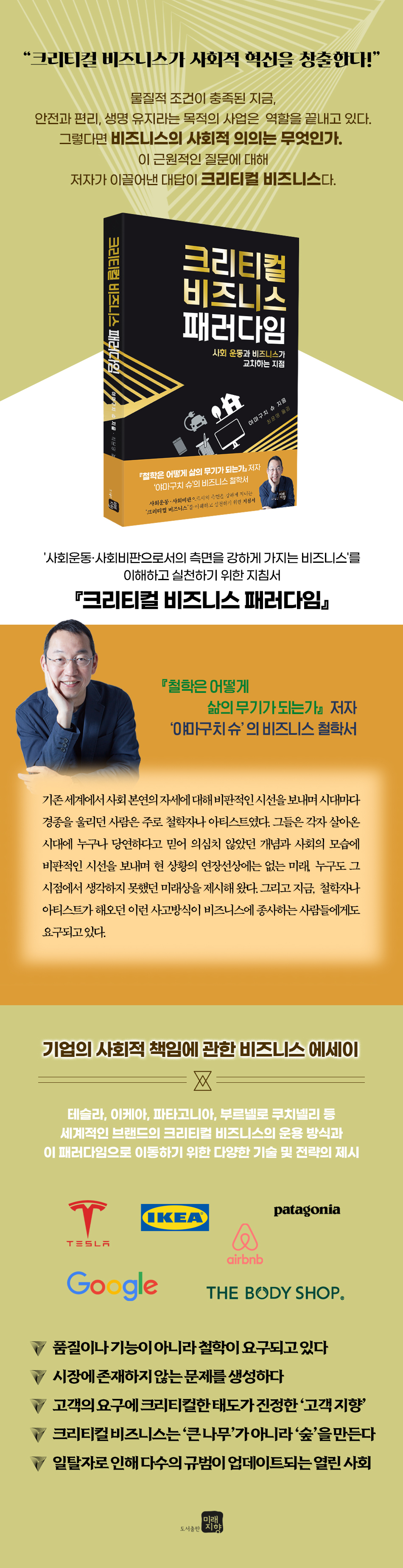
Shu Yamaguchi, author of "How Philosophy Becomes a Weapon for Life"
Business Essay on Corporate Social Responsibility
Now that humanity's long-held desire to meet the basic material requirements for survival has been fully realized, the author argues that businesses focused on creating a safe, comfortable, and convenient society may have already fulfilled their historical role.
So what is the social significance of business now? The author's answer to this fundamental question is "critical business."
While social businesses aim to solve problems already recognized across society, critical businesses begin by “posing new problems.”
Problems are not discovered through observation, but are created when we critically examine the values and ideas we have taken for granted and present an ideal image different from the present.
These critical businesses have the potential to solve dilemmas facing us in three areas: economic, social, and environmental.
This article specifically describes what the new concept of 'critical business' is, why this new paradigm is necessary, and how it is implemented.
Using examples from well-known global brands such as Tesla, IKEA, Patagonia, and Brunello Cucinelli, the book explains various patterns of critical business and presents technologies and ideas for moving to this paradigm.
Shu Yamaguchi, author of "How Philosophy Becomes a Weapon for Life"
Business Essay on Corporate Social Responsibility
Now that humanity's long-held desire to meet the basic material requirements for survival has been fully realized, the author argues that businesses focused on creating a safe, comfortable, and convenient society may have already fulfilled their historical role.
So what is the social significance of business now? The author's answer to this fundamental question is "critical business."
While social businesses aim to solve problems already recognized across society, critical businesses begin by “posing new problems.”
Problems are not discovered through observation, but are created when we critically examine the values and ideas we have taken for granted and present an ideal image different from the present.
These critical businesses have the potential to solve dilemmas facing us in three areas: economic, social, and environmental.
This article specifically describes what the new concept of 'critical business' is, why this new paradigm is necessary, and how it is implemented.
Using examples from well-known global brands such as Tesla, IKEA, Patagonia, and Brunello Cucinelli, the book explains various patterns of critical business and presents technologies and ideas for moving to this paradigm.
- You can preview some of the book's contents.
Preview
index
Entering 6
Chapter 1: What is the Critical Business Paradigm? 13
Chapter 2: Critical Business Stakeholders 45
Chapter 3: The Social Resource of Rebellion 73
Chapter 4: Background of the Critical Business Paradigm 91
Chapter 5: Critical Business Practices and Diversity That Transformed Society 115
Chapter 6: Ten Bullets for Activists 153
Chapter 7 Future Tasks 195
In conclusion 216
Book Guide for Activists 223
Chapter 1: What is the Critical Business Paradigm? 13
Chapter 2: Critical Business Stakeholders 45
Chapter 3: The Social Resource of Rebellion 73
Chapter 4: Background of the Critical Business Paradigm 91
Chapter 5: Critical Business Practices and Diversity That Transformed Society 115
Chapter 6: Ten Bullets for Activists 153
Chapter 7 Future Tasks 195
In conclusion 216
Book Guide for Activists 223
Detailed image
Into the book
Life expectancy has nearly doubled, infant mortality has fallen to one in 100, and advances in education, the development of specific remedies for numerous fatal diseases, and the vast improvement in standards of food, clothing, and shelter have enabled millions of people to live with their basic material needs met.
We must never forget that most of these achievements are being realized through productivity improvements and innovations in business.
The potential of business is immeasurable.
More than just a means of providing goods or services, it has a profound impact on our lives, values, and the very nature of society.
Therefore, I believe that it is a good idea to utilize the power of business to solve social problems and issues.
--- p.28
Critical business initiatives inevitably raise new questions, not ones discovered through observation, but rather ones that arise only when ideas that many people have taken for granted are critically examined and an idealized version of the current state is presented.
Therefore, in the process of starting a critical business, a shift in values and worldview is inevitable for stakeholders, including customers.
--- p.43
In conclusion, if we continue to conform to the loose needs and desires of customers through the affirmative business paradigm, the entire social landscape will eventually be pulled in a loose direction, which will also lead to the loss of global competitiveness in that market.
Therefore, we currently need a critical business paradigm that can elevate customers' aesthetic and ethical sensibilities.
--- p.50
Critical businesses pursue not only economic profits but also social transformation and value creation.
Therefore, we pursue a different approach from the 'zero-sum game' mindset that is often seen in existing business models, namely, 'a plus-sum game that expands the entire market.'
The paradigm is completely different.
--- p.62
Benjamin's argument is that history does not unfold simply by moving forward; rather, it unfolds through the accumulation of disgust and discomfort at the sight unfolding before our eyes.
It is often said that a vision that excites people moves society forward, but the trigger for that vision is often a strong sense of discomfort at the sight unfolding before our eyes.
--- p.77
The 'rebellious' have an essential value in society.
Critical businesses can embody this rebellious spirit, be socially responsible, and empower people to make improvements.
By applying Camus's philosophy to critical business, companies can become not only agents of economic activity, but also play a crucial role in promoting social justice and ethics.
Rebellion is the first step toward acknowledging the injustices of the past and creating a better future.
--- p.79
The engine that drives critical business is not the expectation of economic gain, but the expectation of solving social problems.
Adam Smith, a philosopher who left a fundamental reflection on capitalism, pointed out in his book The Theory of Moral Sentiments that what moves society is 'morality based on empathy with others.'
If society is fundamentally driven by empathy, those who practice critical business must make the most of this resource.
--- p.161
As I have said, society changes not by the majority, but rather by the claims of the minority.
When a deviant or minority group rebels against the dominant values or norms of society, the previously stable environment and system are shaken.
Such conflicts between the minority and the majority eventually create the following stable state, and thus society changes.
That is what is meant by 'open society' here.
If everyone adheres to existing norms and no one rebels, society will be extremely stable and orderly, but change will not occur and history will stop there.
A society in which the same values are always held as the norm and have strong authority may not have crime, but it also does not have creation.
We must never forget that most of these achievements are being realized through productivity improvements and innovations in business.
The potential of business is immeasurable.
More than just a means of providing goods or services, it has a profound impact on our lives, values, and the very nature of society.
Therefore, I believe that it is a good idea to utilize the power of business to solve social problems and issues.
--- p.28
Critical business initiatives inevitably raise new questions, not ones discovered through observation, but rather ones that arise only when ideas that many people have taken for granted are critically examined and an idealized version of the current state is presented.
Therefore, in the process of starting a critical business, a shift in values and worldview is inevitable for stakeholders, including customers.
--- p.43
In conclusion, if we continue to conform to the loose needs and desires of customers through the affirmative business paradigm, the entire social landscape will eventually be pulled in a loose direction, which will also lead to the loss of global competitiveness in that market.
Therefore, we currently need a critical business paradigm that can elevate customers' aesthetic and ethical sensibilities.
--- p.50
Critical businesses pursue not only economic profits but also social transformation and value creation.
Therefore, we pursue a different approach from the 'zero-sum game' mindset that is often seen in existing business models, namely, 'a plus-sum game that expands the entire market.'
The paradigm is completely different.
--- p.62
Benjamin's argument is that history does not unfold simply by moving forward; rather, it unfolds through the accumulation of disgust and discomfort at the sight unfolding before our eyes.
It is often said that a vision that excites people moves society forward, but the trigger for that vision is often a strong sense of discomfort at the sight unfolding before our eyes.
--- p.77
The 'rebellious' have an essential value in society.
Critical businesses can embody this rebellious spirit, be socially responsible, and empower people to make improvements.
By applying Camus's philosophy to critical business, companies can become not only agents of economic activity, but also play a crucial role in promoting social justice and ethics.
Rebellion is the first step toward acknowledging the injustices of the past and creating a better future.
--- p.79
The engine that drives critical business is not the expectation of economic gain, but the expectation of solving social problems.
Adam Smith, a philosopher who left a fundamental reflection on capitalism, pointed out in his book The Theory of Moral Sentiments that what moves society is 'morality based on empathy with others.'
If society is fundamentally driven by empathy, those who practice critical business must make the most of this resource.
--- p.161
As I have said, society changes not by the majority, but rather by the claims of the minority.
When a deviant or minority group rebels against the dominant values or norms of society, the previously stable environment and system are shaken.
Such conflicts between the minority and the majority eventually create the following stable state, and thus society changes.
That is what is meant by 'open society' here.
If everyone adheres to existing norms and no one rebels, society will be extremely stable and orderly, but change will not occur and history will stop there.
A society in which the same values are always held as the norm and have strong authority may not have crime, but it also does not have creation.
--- p.211~212
Publisher's Review
Business Essay on Corporate Social Responsibility
Over the past century, our average lifespan has nearly doubled, infant mortality has fallen to a hundredth of its pre-existing level, medicines for deadly diseases have been developed, and food, clothing, and shelter have improved dramatically, enabling many people to meet their basic material needs.
And it is a well-known fact that most of these achievements were realized through productivity improvements and innovations in business.
In this way, business is more than just a means of providing goods or services; it has a profound impact on our lives, values, and the very nature of society.
However, now that the basic material conditions for survival, a long-held desire of mankind, have been met in abundance, business seems to be losing its social significance.
The author argues that business may have already fulfilled its historical role in creating a safe, comfortable, and convenient society.
So what is the social significance of business now? The author's answer to this fundamental question is "critical business."
According to the author, critical business has the potential to solve dilemmas in all three areas: economic, social, and environmental.
In fact, the issue of the social significance of the business conducted by for-profit companies is being adopted as a major agenda in various conferences, including the World Economic Forum.
In this situation, the author argues that business can still have social significance if there is the beginning of a new paradigm, which the author calls "critical business," a business that has the character of a social movement or social criticism.
Critical Business Creates Social Innovation
People often think that a vision that excites people moves society forward, but the trigger for that vision is often a strong sense of discomfort at what is unfolding before our eyes.
While social business aims to solve problems that are already recognized as 'problematic' in society at large, critical business begins by 'presenting a new problem'.
That is, the concept is that 'all problems do not exist unless they are cognitively created.'
Problems are not discovered through observation, but are created only when we critically examine the values and ideas that we have taken for granted and accepted until now, and present an ideal image different from the present.
If everyone adheres to existing norms and values and no one rebels against them, society will be stable and orderly, but change and creation will not occur, and history will stop there.
In that sense, society changes not through the claims of the majority, but rather through the claims of the minority.
When a small number of deviant or rebels rebel against the dominant values or norms of society, the previously stable environment and system are shaken.
Such conflicts between the minority and the majority eventually lead to the creation of a stable state, and this is how society changes.
This article specifically describes what the new concept of 'critical business' is, why this new paradigm is necessary, and how it works.
Using examples from well-known global brands such as Tesla, IKEA, Patagonia, and Brunello Cucinelli, the book explains the various patterns of critical business and presents the technologies and values needed to move toward this paradigm.
Shu Yamaguchi, author of "How Philosophy Becomes a Weapon for Life"
A business philosophy book for understanding and practicing business with a strong social movement and social criticism aspect.
“Uneducated experts are the greatest threat to our civilization.
“We need liberal arts now more than ever to rebuild the basic human values that are being lost due to the constant pursuit of specialization, segmentation, functionalism, efficiency, and short-term profit.” _Robert Hutchins, former president of the University of Chicago Philosopher Albert Camus, in his book “The Rebel,” says that the act of rebellion establishes an individual’s existence and becomes the driving force for social change.
Critical businesses can embody this rebellious spirit, be socially responsible, and empower people to make improvements.
By applying Camus's philosophy to critical business, companies can play a significant role not only as subjects of economic activity but also in promoting social justice and ethics.
In the existing world, those who have sounded the alarm in each era by taking a critical view of the original attitude of society have mainly been philosophers and artists.
They have cast a critical eye on the concepts and social aspects that everyone took for granted in their respective eras, and have proposed a future that is not an extension of the current situation, a future that no one could have imagined at that time.
And now, this way of thinking, which philosophers and artists have always had, is also being demanded from people in business.
Over the past century, our average lifespan has nearly doubled, infant mortality has fallen to a hundredth of its pre-existing level, medicines for deadly diseases have been developed, and food, clothing, and shelter have improved dramatically, enabling many people to meet their basic material needs.
And it is a well-known fact that most of these achievements were realized through productivity improvements and innovations in business.
In this way, business is more than just a means of providing goods or services; it has a profound impact on our lives, values, and the very nature of society.
However, now that the basic material conditions for survival, a long-held desire of mankind, have been met in abundance, business seems to be losing its social significance.
The author argues that business may have already fulfilled its historical role in creating a safe, comfortable, and convenient society.
So what is the social significance of business now? The author's answer to this fundamental question is "critical business."
According to the author, critical business has the potential to solve dilemmas in all three areas: economic, social, and environmental.
In fact, the issue of the social significance of the business conducted by for-profit companies is being adopted as a major agenda in various conferences, including the World Economic Forum.
In this situation, the author argues that business can still have social significance if there is the beginning of a new paradigm, which the author calls "critical business," a business that has the character of a social movement or social criticism.
Critical Business Creates Social Innovation
People often think that a vision that excites people moves society forward, but the trigger for that vision is often a strong sense of discomfort at what is unfolding before our eyes.
While social business aims to solve problems that are already recognized as 'problematic' in society at large, critical business begins by 'presenting a new problem'.
That is, the concept is that 'all problems do not exist unless they are cognitively created.'
Problems are not discovered through observation, but are created only when we critically examine the values and ideas that we have taken for granted and accepted until now, and present an ideal image different from the present.
If everyone adheres to existing norms and values and no one rebels against them, society will be stable and orderly, but change and creation will not occur, and history will stop there.
In that sense, society changes not through the claims of the majority, but rather through the claims of the minority.
When a small number of deviant or rebels rebel against the dominant values or norms of society, the previously stable environment and system are shaken.
Such conflicts between the minority and the majority eventually lead to the creation of a stable state, and this is how society changes.
This article specifically describes what the new concept of 'critical business' is, why this new paradigm is necessary, and how it works.
Using examples from well-known global brands such as Tesla, IKEA, Patagonia, and Brunello Cucinelli, the book explains the various patterns of critical business and presents the technologies and values needed to move toward this paradigm.
Shu Yamaguchi, author of "How Philosophy Becomes a Weapon for Life"
A business philosophy book for understanding and practicing business with a strong social movement and social criticism aspect.
“Uneducated experts are the greatest threat to our civilization.
“We need liberal arts now more than ever to rebuild the basic human values that are being lost due to the constant pursuit of specialization, segmentation, functionalism, efficiency, and short-term profit.” _Robert Hutchins, former president of the University of Chicago Philosopher Albert Camus, in his book “The Rebel,” says that the act of rebellion establishes an individual’s existence and becomes the driving force for social change.
Critical businesses can embody this rebellious spirit, be socially responsible, and empower people to make improvements.
By applying Camus's philosophy to critical business, companies can play a significant role not only as subjects of economic activity but also in promoting social justice and ethics.
In the existing world, those who have sounded the alarm in each era by taking a critical view of the original attitude of society have mainly been philosophers and artists.
They have cast a critical eye on the concepts and social aspects that everyone took for granted in their respective eras, and have proposed a future that is not an extension of the current situation, a future that no one could have imagined at that time.
And now, this way of thinking, which philosophers and artists have always had, is also being demanded from people in business.
GOODS SPECIFICS
- Date of issue: October 20, 2025
- Page count, weight, size: 232 pages | 360g | 140*210*14mm
- ISBN13: 9791185851389
- ISBN10: 1185851380
You may also like
카테고리
korean


korean

![GQ KOREA Mark (Monthly): December [2025]](http://librairie.coreenne.fr/cdn/shop/files/8ef265dbbfbf186523ed75ba7319009d.jpg?v=1765340328&width=3840)


