

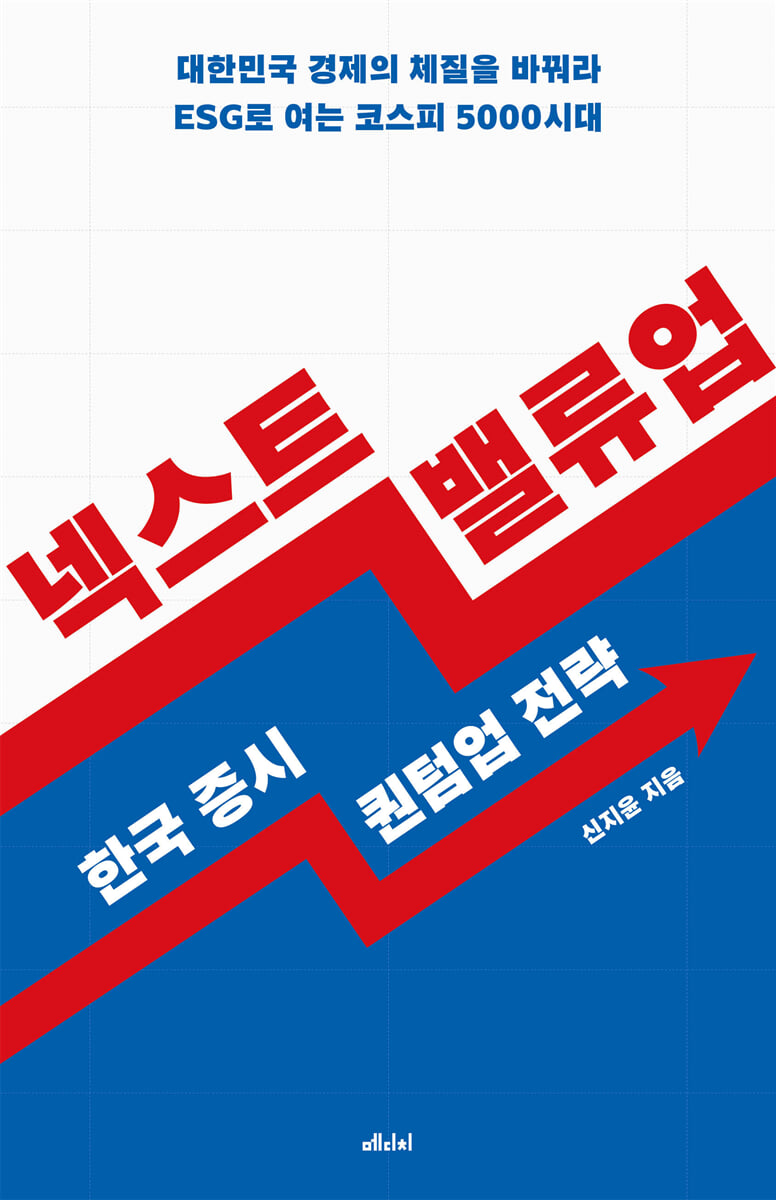
Next Value Up
 |
Description
Book Introduction
Change the constitution of the Korean economy
KOSPI 5000 is not a goal, but a blueprint.
Serious reflection and proposals for the future of the Korean economy
“Why is Korea Electric Power Corporation (KEPCO) undervalued compared to Kansai Electric Power Company (KEPCO)?”
This is a question that points to a problem for one company and a structural vulnerability in the Korean economy.
The Korean stock market is still trapped in the swamp of the 'Korea discount.'
Companies' stock prices remain low relative to their performance, and the government is trying to boost stock prices by promoting value-up policies, but market confidence is still lacking.
Now that the KOSPI has surpassed 4,000 points, is it time to take a breather? The author argues that the undervaluation of the Korean stock market is not a problem of individual companies, but a "structural problem," and suggests a new direction for value-building that the government, companies, and investors must work together to create.
Value-up is not a government policy, but a market promise.
The government should send signals, but let the market move on its own.
Investors should focus on long-term value, while companies should restore trust and secure the future through governance reform and ESG innovation.
《Next Value Up》 reexamines this structural problem from the perspective of the entire economic system.
The book first weaves together diverse agendas, including power supply and demand in the AI era, climate crisis response, climate finance and climate tech, the National Pension Service's long-term capital strategy, the global ESG paradigm shift, and the Lee Jae-myung administration's economic vision.
'Next Value Up' is not simply a stock price stimulus or a short-term event by the government.
This is a national strategy that fundamentally changes the constitution of the Korean economy and serves as a starting point for pursuing sustainable growth through bold and resolute ESG implementation.
The author's alternative crosses policy and reason.
The author contemplates a major transformation of the Korean electric power industry and emphasizes that ESG is not a "fad" but a practical tool for boosting corporate ROE.
It also emphasizes that the national pension should function as a 'market infrastructure' rather than simply a retirement fund.
“Value-up is not a policy, but a culture; it is not a number, but a system.” 《Next Value-Up》 is a challenge and proposal to all those contemplating the next leap forward for the Korean economy.
KOSPI 5000 is not a goal, but a blueprint.
Serious reflection and proposals for the future of the Korean economy
“Why is Korea Electric Power Corporation (KEPCO) undervalued compared to Kansai Electric Power Company (KEPCO)?”
This is a question that points to a problem for one company and a structural vulnerability in the Korean economy.
The Korean stock market is still trapped in the swamp of the 'Korea discount.'
Companies' stock prices remain low relative to their performance, and the government is trying to boost stock prices by promoting value-up policies, but market confidence is still lacking.
Now that the KOSPI has surpassed 4,000 points, is it time to take a breather? The author argues that the undervaluation of the Korean stock market is not a problem of individual companies, but a "structural problem," and suggests a new direction for value-building that the government, companies, and investors must work together to create.
Value-up is not a government policy, but a market promise.
The government should send signals, but let the market move on its own.
Investors should focus on long-term value, while companies should restore trust and secure the future through governance reform and ESG innovation.
《Next Value Up》 reexamines this structural problem from the perspective of the entire economic system.
The book first weaves together diverse agendas, including power supply and demand in the AI era, climate crisis response, climate finance and climate tech, the National Pension Service's long-term capital strategy, the global ESG paradigm shift, and the Lee Jae-myung administration's economic vision.
'Next Value Up' is not simply a stock price stimulus or a short-term event by the government.
This is a national strategy that fundamentally changes the constitution of the Korean economy and serves as a starting point for pursuing sustainable growth through bold and resolute ESG implementation.
The author's alternative crosses policy and reason.
The author contemplates a major transformation of the Korean electric power industry and emphasizes that ESG is not a "fad" but a practical tool for boosting corporate ROE.
It also emphasizes that the national pension should function as a 'market infrastructure' rather than simply a retirement fund.
“Value-up is not a policy, but a culture; it is not a number, but a system.” 《Next Value-Up》 is a challenge and proposal to all those contemplating the next leap forward for the Korean economy.
- You can preview some of the book's contents.
Preview
index
Prologue: Why the Korean Stock Market Now?
Chapter 1: KOSPI 5000 Target: Let's Fix the Structure
The Lee Jae-myung administration aims for 'structure', not 'stock prices' / The long tunnel of stagnation, the Korean stock market deeply troubled / Becoming an uninvited guest / The trap of undervaluation, a market with paralyzed fundraising functions / Promising ventures' leaving Korea, cracks in market trust / Collapsed trust in the capital market, 'Korean wealth' shaken / Concentration in real estate, structural imbalance in wealth / Retirement pensions, from 'deferred wages' to 'investment assets' / It's time to change the system: The beginning of Value-Up 2.0
Chapter 2: The Political Economy of Kilowatts: KEPCO's Risks in the AI Era
AI is expensive / The golden age of AI, the power war has begun / SMR revived by AI, a reversal of the energy paradigm / A questionable first defeat: Transmission grid issues / Korea's ability to solve system problems revealed by power problems / A smarter power generation structure, rather than more transmission grids / Distribute demand: A new balance created by self-sufficiency / Solutions to lower peak demand and the return of ESS / Korea's power industry trapped in the framework of the industrialization era / An opportunity for a reversal created by AI / The inside story of KEPCO's problem: Public enterprise governance and responsibility / 'Sell KEPCO' means 'Sell Korea'
Chapter 3: Blind Spots in Korea's Climate Policy: Electricity
Climate crisis, we were not prepared / Davos warned of the 'economics of climate' / The key to responding to climate change is the redesign of electricity / Korea's starting point for carbon reduction is ultimately electricity / RE100, Korea facing the toughest test / How will Samsung Electronics and SK Hynix achieve RE100? / Carbon becomes a tariff: Trade barriers created by CBAM / CCA, the beginning of the American-style carbon race / Carbon emissions intensity, Korea's slow transition / The challenge of decarbonizing electricity generation / The paradox of an industrial powerhouse, the share of renewable energy at the bottom of the G20 / The shadow of coal: The ongoing crisis created by past policies
Chapter 4: Starting Lines for Climate Finance and Climate Tech
Climate change triple whammy / Korea's climate finance is just starting out / The spark of private climate finance that venture capital must ignite / The cost of 'net zero': Time to face reality / Renewable energy PF, the first test bed for climate finance / Climate tech, beyond technology, into business / The Bank of Korea's warning: 'Climate technology investment' has stalled / Climate tech investment, unable to keep up with the world's pace / Climate tech unicorn companies dominated by the US and China / Current status of Korean climate tech: Hydrogen and CCUS / CCS: Storage is more difficult than capture / Climate tech and carbon markets must coexist / There will be no KOSPI 5,000 without climate finance / The next unicorn will come from 'climate tech'
Chapter 5: From Strengthening Shareholder Rights to the Korea Premium
'Who Cares Wins', the beginning of ESG and the shift in investment philosophy / ESG and shareholder capitalism, conflict or evolution / Value investing and ESG, sustainability where fundamentals meet / ESG investing, beyond stakeholder capitalism / ESG vs.
Responsible investing: A similar yet different investment philosophy / ESG investing must evolve into sustainable value-add / The era of "governance value-add" ushered in by the revision of the Commercial Act
Chapter 6: The National Pension Service, a Market Ally: A Sustainable Driver for Quantum Up
The Wall of 'Asia's 8th Place': The Reality of Korea's Corporate Governance / CalPERS's Shareholder Action: A Laboratory That Changed Businesses / The National Pension Service's Awakening: Following the CalPERS Effect / Stewardship Code: Beyond Declaration and into Practice / ESG Investment: The Shadow of the Global 3rd Largest Pension / Competition Between Korean and Japanese Pension Funds: Why Japan's GPIF Is Ahead / Shareholder Activism in Asia: Korea Is Changing Too / Towards a 'Korea Premium': Raise the Voice of Institutions / The Gap in ESG Implementation: Cooperation Between the Government and the Market Is the Answer
Chapter 7: Trump 2.0: The Return of Policy Risk and the Realignment of ESG
ESG, a market that has slowed but is evolving / Sustainable finance, becoming a new standard for global capital / The Trump era's backlash: the silent 'greenhushing' of ESG / Energy duopoly: American pragmatism that expanded both oil and solar / Texas' solar power and the pursuit of American practicality / Europe, the birthplace of ESG, the impact of the 'omnibus package' / Pragmatism over speed: the EU's new balance point / Why Korea must not miss the turning point of ESG
Chapter 8: Policy, Market, and Governance: The Triangular Framework of Lee Jae-myung's Economy
The speed of climate response will determine the outcome over the next five years / Traces of two administrations, lessons from energy transition policies / A pragmatic government stands at the test of climate policy / The reality and solutions of the three major tasks: NDC, emissions trading, and climate disclosure / Climate leadership is completed through execution / Reading the direction of climate and energy in the Lee Jae-myung administration's national blueprint / Companies and investors, survival strategies in the era of climate risk / 'Labor heading towards death': The harsh reality of industrial sites / Mobilizing all resources, including ESG, to achieve zero major accidents / The dilemma of a semiconductor superpower: The debate over the 52-hour workweek / Finding a balance between reduced work hours, flexibility, and sustainability / Korea's corporate governance at an inflection point, the first step toward restoring trust / Angry shareholders demand innovation in corporate governance / Governance reform, the beginning of a reevaluation of the Korean stock market
Chapter 9: Towards the Korea Premium: The Next Cycle's Investment Grammar
The potential of Korea's ESG disclosures, drawing attention from global capital / The virtuous cycle of ESG will usher in the era of Value-Up 2.0 / Value-Up 2.0: A joint blueprint for investors, companies, and the government / The first principle of investment: "Don't fight the government" / Simple but effective: Four strategies that will move the market
Epilogue Why, what, and how do we change?
Chapter 1: KOSPI 5000 Target: Let's Fix the Structure
The Lee Jae-myung administration aims for 'structure', not 'stock prices' / The long tunnel of stagnation, the Korean stock market deeply troubled / Becoming an uninvited guest / The trap of undervaluation, a market with paralyzed fundraising functions / Promising ventures' leaving Korea, cracks in market trust / Collapsed trust in the capital market, 'Korean wealth' shaken / Concentration in real estate, structural imbalance in wealth / Retirement pensions, from 'deferred wages' to 'investment assets' / It's time to change the system: The beginning of Value-Up 2.0
Chapter 2: The Political Economy of Kilowatts: KEPCO's Risks in the AI Era
AI is expensive / The golden age of AI, the power war has begun / SMR revived by AI, a reversal of the energy paradigm / A questionable first defeat: Transmission grid issues / Korea's ability to solve system problems revealed by power problems / A smarter power generation structure, rather than more transmission grids / Distribute demand: A new balance created by self-sufficiency / Solutions to lower peak demand and the return of ESS / Korea's power industry trapped in the framework of the industrialization era / An opportunity for a reversal created by AI / The inside story of KEPCO's problem: Public enterprise governance and responsibility / 'Sell KEPCO' means 'Sell Korea'
Chapter 3: Blind Spots in Korea's Climate Policy: Electricity
Climate crisis, we were not prepared / Davos warned of the 'economics of climate' / The key to responding to climate change is the redesign of electricity / Korea's starting point for carbon reduction is ultimately electricity / RE100, Korea facing the toughest test / How will Samsung Electronics and SK Hynix achieve RE100? / Carbon becomes a tariff: Trade barriers created by CBAM / CCA, the beginning of the American-style carbon race / Carbon emissions intensity, Korea's slow transition / The challenge of decarbonizing electricity generation / The paradox of an industrial powerhouse, the share of renewable energy at the bottom of the G20 / The shadow of coal: The ongoing crisis created by past policies
Chapter 4: Starting Lines for Climate Finance and Climate Tech
Climate change triple whammy / Korea's climate finance is just starting out / The spark of private climate finance that venture capital must ignite / The cost of 'net zero': Time to face reality / Renewable energy PF, the first test bed for climate finance / Climate tech, beyond technology, into business / The Bank of Korea's warning: 'Climate technology investment' has stalled / Climate tech investment, unable to keep up with the world's pace / Climate tech unicorn companies dominated by the US and China / Current status of Korean climate tech: Hydrogen and CCUS / CCS: Storage is more difficult than capture / Climate tech and carbon markets must coexist / There will be no KOSPI 5,000 without climate finance / The next unicorn will come from 'climate tech'
Chapter 5: From Strengthening Shareholder Rights to the Korea Premium
'Who Cares Wins', the beginning of ESG and the shift in investment philosophy / ESG and shareholder capitalism, conflict or evolution / Value investing and ESG, sustainability where fundamentals meet / ESG investing, beyond stakeholder capitalism / ESG vs.
Responsible investing: A similar yet different investment philosophy / ESG investing must evolve into sustainable value-add / The era of "governance value-add" ushered in by the revision of the Commercial Act
Chapter 6: The National Pension Service, a Market Ally: A Sustainable Driver for Quantum Up
The Wall of 'Asia's 8th Place': The Reality of Korea's Corporate Governance / CalPERS's Shareholder Action: A Laboratory That Changed Businesses / The National Pension Service's Awakening: Following the CalPERS Effect / Stewardship Code: Beyond Declaration and into Practice / ESG Investment: The Shadow of the Global 3rd Largest Pension / Competition Between Korean and Japanese Pension Funds: Why Japan's GPIF Is Ahead / Shareholder Activism in Asia: Korea Is Changing Too / Towards a 'Korea Premium': Raise the Voice of Institutions / The Gap in ESG Implementation: Cooperation Between the Government and the Market Is the Answer
Chapter 7: Trump 2.0: The Return of Policy Risk and the Realignment of ESG
ESG, a market that has slowed but is evolving / Sustainable finance, becoming a new standard for global capital / The Trump era's backlash: the silent 'greenhushing' of ESG / Energy duopoly: American pragmatism that expanded both oil and solar / Texas' solar power and the pursuit of American practicality / Europe, the birthplace of ESG, the impact of the 'omnibus package' / Pragmatism over speed: the EU's new balance point / Why Korea must not miss the turning point of ESG
Chapter 8: Policy, Market, and Governance: The Triangular Framework of Lee Jae-myung's Economy
The speed of climate response will determine the outcome over the next five years / Traces of two administrations, lessons from energy transition policies / A pragmatic government stands at the test of climate policy / The reality and solutions of the three major tasks: NDC, emissions trading, and climate disclosure / Climate leadership is completed through execution / Reading the direction of climate and energy in the Lee Jae-myung administration's national blueprint / Companies and investors, survival strategies in the era of climate risk / 'Labor heading towards death': The harsh reality of industrial sites / Mobilizing all resources, including ESG, to achieve zero major accidents / The dilemma of a semiconductor superpower: The debate over the 52-hour workweek / Finding a balance between reduced work hours, flexibility, and sustainability / Korea's corporate governance at an inflection point, the first step toward restoring trust / Angry shareholders demand innovation in corporate governance / Governance reform, the beginning of a reevaluation of the Korean stock market
Chapter 9: Towards the Korea Premium: The Next Cycle's Investment Grammar
The potential of Korea's ESG disclosures, drawing attention from global capital / The virtuous cycle of ESG will usher in the era of Value-Up 2.0 / Value-Up 2.0: A joint blueprint for investors, companies, and the government / The first principle of investment: "Don't fight the government" / Simple but effective: Four strategies that will move the market
Epilogue Why, what, and how do we change?
Into the book
This book does not cover stock price forecasts or investment techniques.
Rather, it focuses on the new crises and opportunities that South Korea faces.
The stock market rebound is just the beginning.
The key questions are how to transform the economic structure and what strategies to employ through the lens of ESG. ESG is not simply a marketing tool.
It is a practical solution that can actually increase a company's ROE and lower its COE, thereby raising its stock price.
Furthermore, ESG can play an important role in national administration.
E(environment) climate change response, S(society) information protection and worker rights protection, and G(governance) advancement are the core agendas of ESG and also the mission of a pragmatic government.
--- p.7, from “Prologue: Why the Korean Stock Market Now?”
The basics of asset allocation are simple.
The expected return on assets must exceed the inflation rate.
If the rate of return is lower than the inflation rate, it is effectively negative.
If you rely on these assets for a long time, you will become poorer and poorer.
Korea's household asset allocation is not a stable mix, as it is difficult to keep up with inflation over the long term.
The direction to go is clear.
It is necessary to reduce real estate and increase financial assets, but within financial assets, increase funds or increase the proportion of insurance and pensions with a higher proportion of risky assets.
Pensions are especially important.
However, if the slump in the Korean stock market is structural and difficult to escape, such a change in asset allocation is unlikely to occur naturally.
This is precisely why the stock market must be saved.
--- p.26, from “Chapter 1: KOSPI 5000 Target, Let’s Fix the Structure”
Electrification is not something that can be achieved just by KEPCO.
Replacing the massive fossil fuel energy used in steel, cement, plastics production, shipping, and aviation with electricity represents a major shift in industrial structure.
However, it is clear that Korea Electric Power Corporation is at the center of the concerns about electrification.
KEPCO's responsibilities include expanding renewable energy, expanding the infrastructure needed for the AI era, and supporting climate finance and climate technology development.
Korea Electric Power Corporation (KEPCO), which should be leading important national projects, is now becoming an obstacle.
Even if it is not called a restructuring of the electric power industry, there is much discussion about the need for change in Korea Electric Power Corporation (KEPCO) and the electric power industry, including topics such as electricity rates, governance, and the introduction of competition.
It's time to consider, "Isn't KEPCO blocking the nation's value-added?"
Because a flexible yet robust power grid is the foundation of competitiveness for the country's industries.
Low electricity bills and power outage rates should not be left as mere boasts of the past.
--- p.71, from “Chapter 2: Political Economy of Kilowatts, Risks in Korea Electric Power in the AI Era”
Korea is the country with the most difficulty implementing RE100 in the manufacturing supply chain.
Now, in Korea, not only large corporations but also exporting SMEs are facing pressure from their primary suppliers to implement RE100.
Companies with operations in Korea will find it difficult to procure renewable energy even if they try to respond to RE100, so if left unchecked, these companies could decide to leave Korea.
More importantly, Korea may be excluded from the list of candidates when overseas primary suppliers decide on new supply chains.
This is a dire reality created by the mistakes of the previous administration, which did not foster solar energy and even framed it with disdain.
--- p.85, from “Chapter 3 Blind Spots in Korea’s Climate Policy: Electricity”
The value-up of each company is the value-up of the country.
Current value-up programs and governance reforms alone are not enough to increase national value.
Governance reform is progressing smoothly under the Lee Jae-myung administration.
A major milestone was reached with the revision of the Commercial Act, and supplementary legislation is being implemented in succession.
Dividend expansion and stock cancellation are relatively easy steps that should have been taken for governance reform.
There may be some noise in the process, but I expect it to go smoothly.
(…) The government must find policies that increase profits in cooperation with businesses, while also focusing on reducing investment risks in the Korean stock market.
If we neglect to address climate change, our core business will suffer in the future.
When businesses suffer, the national economy ultimately suffers.
This is why the government's role is important.
The Financial Services Commission should be held accountable for shareholder returns and value-added, while the government at the highest levels should consider climate change response measures to prevent Korea's "value-added."
--- p.134~135, from “Chapter 4: Starting Line of Climate Finance and Climate Tech”
ESG investing is literally an investment, not a donation or charity.
ESG investing now aims to carefully examine how ESG factors, both as risks and opportunities for a company, are reflected in corporate value before making investment decisions. From an ESG perspective, risks and opportunities for a company must also be financially significant.
This is defined in the Sustainability Disclosure Act as financial materiality.
ESG investing is linked to value investing because it is a framework for financial choices that directly impact financial statement items and required rates of return.
The value-added growth of the Korean stock market must be sustainable. ESG investing is the driving force behind this growth.
It is difficult to usher in an era of Korea Premium solely through maximizing shareholder value without considering sustainability.
First of all, the revision of the Commercial Act made it possible to begin a great transformation of G.
Can't stop.
Pursuing sustainability with an eye on E and S is a global trend of the times and the way to strengthen corporate competitiveness.
--- p.148~149, from “Chapter 5: From Strengthening Shareholder Rights to Korea Premium”
To increase the value of the Korean stock market, improving corporate governance is essential. However, simply enacting laws is not enough; investment is also necessary.
Pension funds like CalPERS are suitable investors to lead this effort.
There is a concept called universal investor.
Refers to large institutional investors who invest in various assets across the entire market and effectively own a portion of the overall economy.
Because universal investors diversify their investments across a wide range of assets, their performance reflects the overall economic trends.
Because of these characteristics, they do not focus solely on short-term profits, but also consider positive externalities such as systemic risk, long-term sustainability, market fairness and stability, and the value of public goods.
The universal investor in Korea is undoubtedly the National Pension Service.
--- p.158, from “Chapter 6 National Pension, an ally of the market: Sustainable driving force of quantum up”
It is said that stock prices precede performance and move in tandem with expectations.
This means that stock prices reflect the expectations of the industry.
Renewable energy stocks react sensitively to the government's future energy policies.
Since President Trump took office for the second term, nuclear power stocks have risen significantly, but stocks related to energy transition, including solar energy, have also been performing relatively well.
During Trump's four years in office (with a midterm evaluation still to come), contradictory policies will likely become more prevalent than they are now.
The prediction that "Trump's re-election means the end of climate change action" is likely to prove to be a mistake.
--- p.189, from “Chapter 7 Trump 2.0, The Return of Policy Risk and the Realignment of ESG”
Investors should carefully examine policy changes and the resulting changes in corporate behavior when selecting investment targets.
We need to avoid companies that are expected to see a decline in performance due to increasing switching costs, and instead look for companies that can truly capture future growth through climate technology.
In Korea, the cost of energy transition has been minimal so far.
Imagine Scope 3 disclosures, financial emissions regulations kick in, and the cost of carbon emissions rises.
Climate technology represents a new area of opportunity, but the process for identifying promising companies remains unsystematic.
Therefore, in-depth analysis and study of this field is required.
Candidates include companies poised to thrive amidst shifts in electricity governance, renewable energy supply chains encompassing manufacturing and operations related to the expansion of the renewable energy roadmap and the creation of RE100 industrial complexes, and financial and technology companies leading transition finance or decarbonization.
A star company that will become a leading player in climate technology has not yet emerged.
For investors, both crises and opportunities are quietly emerging.
--- p.212~213, from “Chapter 8 Policy, Market, Governance, the Triangular Frame of Lee Jae-myung’s Economy”
The Lee Jae-myung administration appears likely to become the focal point for connecting the ESG cycle.
The government's national governance plan serves as a compass. ESG finance has been promoted alongside AI and venture capital! Furthermore, concrete plans are being developed for each of the E, S, and G sectors, and their implementation is proceeding swiftly.
The feature is the connection between G governance and the stock market.
In the darkness, the virtuous cycle of ESG is faintly flickering.
The KOSPI reaching 5,000 points is President Lee Jae-myung's campaign promise.
From the beginning of his term, the president has shown a strong will to improve investment conditions in the stock market.
The president has effectively put an end to the debate on stock transfer taxes, which has been a sensitive issue within the ruling party.
The Korea Premium was also emphasized in the national policy plan.
The Lee Jae-myung administration's plan is to improve governance while also raising stock prices.
Rather, it focuses on the new crises and opportunities that South Korea faces.
The stock market rebound is just the beginning.
The key questions are how to transform the economic structure and what strategies to employ through the lens of ESG. ESG is not simply a marketing tool.
It is a practical solution that can actually increase a company's ROE and lower its COE, thereby raising its stock price.
Furthermore, ESG can play an important role in national administration.
E(environment) climate change response, S(society) information protection and worker rights protection, and G(governance) advancement are the core agendas of ESG and also the mission of a pragmatic government.
--- p.7, from “Prologue: Why the Korean Stock Market Now?”
The basics of asset allocation are simple.
The expected return on assets must exceed the inflation rate.
If the rate of return is lower than the inflation rate, it is effectively negative.
If you rely on these assets for a long time, you will become poorer and poorer.
Korea's household asset allocation is not a stable mix, as it is difficult to keep up with inflation over the long term.
The direction to go is clear.
It is necessary to reduce real estate and increase financial assets, but within financial assets, increase funds or increase the proportion of insurance and pensions with a higher proportion of risky assets.
Pensions are especially important.
However, if the slump in the Korean stock market is structural and difficult to escape, such a change in asset allocation is unlikely to occur naturally.
This is precisely why the stock market must be saved.
--- p.26, from “Chapter 1: KOSPI 5000 Target, Let’s Fix the Structure”
Electrification is not something that can be achieved just by KEPCO.
Replacing the massive fossil fuel energy used in steel, cement, plastics production, shipping, and aviation with electricity represents a major shift in industrial structure.
However, it is clear that Korea Electric Power Corporation is at the center of the concerns about electrification.
KEPCO's responsibilities include expanding renewable energy, expanding the infrastructure needed for the AI era, and supporting climate finance and climate technology development.
Korea Electric Power Corporation (KEPCO), which should be leading important national projects, is now becoming an obstacle.
Even if it is not called a restructuring of the electric power industry, there is much discussion about the need for change in Korea Electric Power Corporation (KEPCO) and the electric power industry, including topics such as electricity rates, governance, and the introduction of competition.
It's time to consider, "Isn't KEPCO blocking the nation's value-added?"
Because a flexible yet robust power grid is the foundation of competitiveness for the country's industries.
Low electricity bills and power outage rates should not be left as mere boasts of the past.
--- p.71, from “Chapter 2: Political Economy of Kilowatts, Risks in Korea Electric Power in the AI Era”
Korea is the country with the most difficulty implementing RE100 in the manufacturing supply chain.
Now, in Korea, not only large corporations but also exporting SMEs are facing pressure from their primary suppliers to implement RE100.
Companies with operations in Korea will find it difficult to procure renewable energy even if they try to respond to RE100, so if left unchecked, these companies could decide to leave Korea.
More importantly, Korea may be excluded from the list of candidates when overseas primary suppliers decide on new supply chains.
This is a dire reality created by the mistakes of the previous administration, which did not foster solar energy and even framed it with disdain.
--- p.85, from “Chapter 3 Blind Spots in Korea’s Climate Policy: Electricity”
The value-up of each company is the value-up of the country.
Current value-up programs and governance reforms alone are not enough to increase national value.
Governance reform is progressing smoothly under the Lee Jae-myung administration.
A major milestone was reached with the revision of the Commercial Act, and supplementary legislation is being implemented in succession.
Dividend expansion and stock cancellation are relatively easy steps that should have been taken for governance reform.
There may be some noise in the process, but I expect it to go smoothly.
(…) The government must find policies that increase profits in cooperation with businesses, while also focusing on reducing investment risks in the Korean stock market.
If we neglect to address climate change, our core business will suffer in the future.
When businesses suffer, the national economy ultimately suffers.
This is why the government's role is important.
The Financial Services Commission should be held accountable for shareholder returns and value-added, while the government at the highest levels should consider climate change response measures to prevent Korea's "value-added."
--- p.134~135, from “Chapter 4: Starting Line of Climate Finance and Climate Tech”
ESG investing is literally an investment, not a donation or charity.
ESG investing now aims to carefully examine how ESG factors, both as risks and opportunities for a company, are reflected in corporate value before making investment decisions. From an ESG perspective, risks and opportunities for a company must also be financially significant.
This is defined in the Sustainability Disclosure Act as financial materiality.
ESG investing is linked to value investing because it is a framework for financial choices that directly impact financial statement items and required rates of return.
The value-added growth of the Korean stock market must be sustainable. ESG investing is the driving force behind this growth.
It is difficult to usher in an era of Korea Premium solely through maximizing shareholder value without considering sustainability.
First of all, the revision of the Commercial Act made it possible to begin a great transformation of G.
Can't stop.
Pursuing sustainability with an eye on E and S is a global trend of the times and the way to strengthen corporate competitiveness.
--- p.148~149, from “Chapter 5: From Strengthening Shareholder Rights to Korea Premium”
To increase the value of the Korean stock market, improving corporate governance is essential. However, simply enacting laws is not enough; investment is also necessary.
Pension funds like CalPERS are suitable investors to lead this effort.
There is a concept called universal investor.
Refers to large institutional investors who invest in various assets across the entire market and effectively own a portion of the overall economy.
Because universal investors diversify their investments across a wide range of assets, their performance reflects the overall economic trends.
Because of these characteristics, they do not focus solely on short-term profits, but also consider positive externalities such as systemic risk, long-term sustainability, market fairness and stability, and the value of public goods.
The universal investor in Korea is undoubtedly the National Pension Service.
--- p.158, from “Chapter 6 National Pension, an ally of the market: Sustainable driving force of quantum up”
It is said that stock prices precede performance and move in tandem with expectations.
This means that stock prices reflect the expectations of the industry.
Renewable energy stocks react sensitively to the government's future energy policies.
Since President Trump took office for the second term, nuclear power stocks have risen significantly, but stocks related to energy transition, including solar energy, have also been performing relatively well.
During Trump's four years in office (with a midterm evaluation still to come), contradictory policies will likely become more prevalent than they are now.
The prediction that "Trump's re-election means the end of climate change action" is likely to prove to be a mistake.
--- p.189, from “Chapter 7 Trump 2.0, The Return of Policy Risk and the Realignment of ESG”
Investors should carefully examine policy changes and the resulting changes in corporate behavior when selecting investment targets.
We need to avoid companies that are expected to see a decline in performance due to increasing switching costs, and instead look for companies that can truly capture future growth through climate technology.
In Korea, the cost of energy transition has been minimal so far.
Imagine Scope 3 disclosures, financial emissions regulations kick in, and the cost of carbon emissions rises.
Climate technology represents a new area of opportunity, but the process for identifying promising companies remains unsystematic.
Therefore, in-depth analysis and study of this field is required.
Candidates include companies poised to thrive amidst shifts in electricity governance, renewable energy supply chains encompassing manufacturing and operations related to the expansion of the renewable energy roadmap and the creation of RE100 industrial complexes, and financial and technology companies leading transition finance or decarbonization.
A star company that will become a leading player in climate technology has not yet emerged.
For investors, both crises and opportunities are quietly emerging.
--- p.212~213, from “Chapter 8 Policy, Market, Governance, the Triangular Frame of Lee Jae-myung’s Economy”
The Lee Jae-myung administration appears likely to become the focal point for connecting the ESG cycle.
The government's national governance plan serves as a compass. ESG finance has been promoted alongside AI and venture capital! Furthermore, concrete plans are being developed for each of the E, S, and G sectors, and their implementation is proceeding swiftly.
The feature is the connection between G governance and the stock market.
In the darkness, the virtuous cycle of ESG is faintly flickering.
The KOSPI reaching 5,000 points is President Lee Jae-myung's campaign promise.
From the beginning of his term, the president has shown a strong will to improve investment conditions in the stock market.
The president has effectively put an end to the debate on stock transfer taxes, which has been a sensitive issue within the ruling party.
The Korea Premium was also emphasized in the national policy plan.
The Lee Jae-myung administration's plan is to improve governance while also raising stock prices.
--- p.234, from “Chapter 9: Towards the Korea Premium, Investment Grammar for the Next Cycle”
Publisher's Review
“KOSPI 5000 is not a number, but a unit of trust.”
“The undervaluation of the Korean economy is not a corporate problem, but a systemic problem.”
“The country that controls the climate is ultimately the country that controls electricity.”
“Value-up is not a policy to raise stock prices, but a reform to restore trust.”
“If retirement pensions don’t move, the Korean economy will never move.”
“ESG is not a moral language, it is an investment language.
“Trust becomes capital.”
“The National Pension Service is no longer an investor, but a sovereign of the market.”
“Climate policy is not an environmental issue, but a matter of industrial survival.”
“In the era of Trump 2.0, ESG is not disappearing.
“It just gets smarter.”
“The Korea premium is not a stock price premium, but a premium of trust.”
These are the words that come to mind after reading “Next Value Up.”
《Next Value Up》 is not simply a book about “raising stock prices.”
This is a proposal to rebuild the 'value system' of the Korean economy.
Above all, it presents a vision to redesign the Korean economy into a trust-based system.
The "KOSPI 5000" proposed by the Lee Jae-myung administration is not a numerical goal, but rather signifies a reorganization of policy, market, and governance.
The author explores the root causes of the "Korea Discount" from various angles, including distrust in the capital market, inefficient governance, a real estate-focused asset structure, and passive management of pension funds.
And the alternative proposed is ‘Value Up 2.0’.
This is not about increasing stock prices, but rather about creating a structural increase in corporate value, that is, an institutional structure to increase ROE (return on equity) and reduce COE (cost of equity).
Set against the backdrop of an era intertwined with AI, the climate crisis, and energy transition, the book analyzes the triple risks facing the Korean capital market—electricity, climate, and finance.
By diagnosing KEPCO's debt structure, rigidity in electricity rates, bottlenecks in renewable energy, and the absence of climate finance, it offers the insight that "a country that governs the climate is a country that governs electricity."
Furthermore, it presents a Korean model of "market democracy" through the National Pension Service's stewardship, transparency in ESG disclosure, strengthening shareholder rights, and expanding responsible investment by pension funds.
The core that runs through all of this is a ‘society where trust becomes capital.’
As global investors begin to take notice of Korea's Environmental, Social, and Governance (ESG) Disclosure System (KSSB), the Korean economy's next leap forward hinges on institutional trust in transparency, fairness, and consistency.
"Next Value Up" is an "economics of trust" that combines capital, climate, and policy into a single language, and is a practical manifesto designing the next cycle of the Korean capital market.
●The goal of reaching KOSPI 5000 is possible! How? How?
Why can't the Korean stock market escape the shackles of "undervaluation"? This book goes beyond simple stock price debates and confronts the structural limitations of the Korean economy head-on.
The Lee Jae-myung administration's "KOSPI 5000" is not a numerical ambition, but a declaration to "fix the structure."
In the early 2020s, when foreign capital was flowing out and even domestic investors were turning away, the Korean stock market was an "uninvited guest" on the global stage.
Venture companies headed to the U.S. market because they were not properly valued, and IPOs, the main source of corporate funding, lost credibility.
As the capital market failed to function properly, the nation's wealth also faltered.
A society where retirement pensions are only at the level of deposit returns, and most assets are tied up in real estate.
Korea has become a country of 'sleeping money' rather than 'working money'.
The author proposes a transformation of the political, financial, and social systems to break this vicious cycle.
The reason the government should target 'governance structure' rather than stock prices is the starting point of the attempt to expand directors' duty of loyalty to shareholders through revisions to the Commercial Act and to transform retirement pensions into 'investment assets' rather than 'deferred wages.'
"Restoring trust is more important than the rise in the index." Only when money flowing from real estate flows into industry, from short-term speculation to long-term value, and from closed corporate governance to open capital markets will the "KOSPI 5000" become a reality.
Korea's Electricity Risk: The Risk Called "KEPCO"
Competition in the AI era is no longer a battle of data.
It's a power war.
The author addresses the structural risks faced by Korea Electric Power Corporation (KEPCO) at the intersection of AI, semiconductors, and the power grid. As AI shifts the industrial paradigm, a new "kilowatt political economy" has emerged. AI data centers demand massive amounts of power, and without a stable power transmission network, national competitiveness cannot be maintained.
However, Korea still remains stuck in the centralized power system of the industrial era.
Bottlenecks in the energy transition, such as grid saturation, limitations in renewable energy adoption, and local government licensing issues, are concentrated at KEPCO. Amidst the global trend of an "electricity renaissance" fueled by AI, KEPCO is actually holding back change.
The reality of KEPCO is still stuck in the inertia of the past.
The electricity rate system remains unchanged from 20 years ago, and transmission network licensing is blocked by conflict between local governments and residents.
If Korea Electric Power Corporation fails to achieve both the "marketization of electricity" and the "balance of publicness," it could become the biggest risk holding back the AI era.
Failure to transition to energy will soon lead to a collapse of national competitiveness.
To achieve sustainable value-added, KEPCO must break free from its old framework and produce "smarter electricity," not just "more electricity."
This is a warning that it cannot be too late: "If we do not understand the future of electricity, there is no future for our country."
●Talking about climate in the language of economics
2023 and 2024 were years when Earth experienced record-breaking temperatures.
Less than a decade after the Paris Agreement, the international community is already concerned about the failure to achieve the 1.5°C target.
However, Korea is still unable to break away from its coal-centric energy structure, and its carbon neutrality roadmap is losing its effectiveness.
To achieve carbon neutrality by 2050, the share of electricity in final energy needs to double or triple from the current level, but the electrification rate remains at around 20%.
The transition in high-energy sectors such as transportation, heating, and industry is delayed, and the government's plans remain at a declarative level.
The book identifies the rigidity of Korea's electricity policy and the absence of renewable energy infrastructure as vulnerabilities in Korea's climate response.
Despite the power sector accounting for 35% of total greenhouse gas emissions, reductions in private coal power generation are minimal and expansion of renewable energy is slow.
The book also highlights changes in the international trade order, such as RE100 (Renewable Energy 100%) and the Carbon Border Adjustment Mechanism (CBAM).
Global companies such as Samsung Electronics and SK Hynix are already struggling to secure renewable energy by entering into overseas power purchase agreements (PPAs), but the institutional barriers in the domestic electricity market remain high.
In the harsh reality that “no electricity, no exports,” Korea stands on the threshold of a world where carbon will soon become a tariff.
For Korea's climate policy to truly move toward value-added, it must redesign electricity and reimagine the entire energy system.
Climate policy should be viewed not simply as an environmental agenda, but as a core economic strategy for national competitiveness.
Electricity reform is the answer to the climate crisis, and it is the only way for Korea to overcome the "carbon era."
ESG: A New Shareholder Principle Combining Profit and Ethics
The undervaluation of the Korean economy is called the 'Korea discount.'
The author argues that to solve this age-old problem, we must create “a market where shareholders are respected and a capital structure that builds trust.”
The key is ‘strengthening shareholder rights.’
Shareholder capitalism is a traditional model that maximizes shareholder profits, but ESG is an "evolved form of risk management" that considers both corporate sustainability and social responsibility.
Today, savvy investors are beginning to view ethics and sustainability as part of a company's value, not just financial returns.
Next Value Up defines ESG as “a new shareholder philosophy that combines profit and ethics.”
In other words, ESG is not a cost, but risk management, and it is the language of long-term value creation.
In the same vein, major global pension funds are adopting the Principles for Responsible Investment (PRI) and companies are strengthening their disclosure of non-financial information.
The author also points out the full-scale spread of 'activist investing' and 'stewardship codes'.
As pension funds and institutional investors become more directly involved in the ESG management of their investee companies, the era of "active shareholderism" is dawning in the Korean market.
As a result, shareholder return policies such as stock buybacks and cancellations, and dividend increases are increasing explosively.
As of the first half of 2025, the scale of treasury stock cancellation has already exceeded the total for the previous year.
This is not a simple market event, but a signal that the Korean capital market has entered a phase of trust.
●National Pension Service's Hosiwoobo
The National Pension Service's adoption of the Stewardship Code, or "principles of fiduciary responsibility," in 2018 was a declaration.
From then on, the National Pension Service began to transform from a “pension that holds stocks” to a “pension that monitors the sustainability of companies.”
Although there was criticism that it was “pension socialism,” the National Pension Service has been developing its role as a market watcher by observing the market with the eyes of a tiger and walking silently like an ox.
The proportion of internal shareholders in Korean companies is approximately 40%, and treasury stock and shares held by related parties remain strong.
Within this, the National Pension Service functions as the ‘axis of market democracy’ representing a large number of external shareholders.
Now, a single vote from the National Pension Service is not just a voting right, but a signal that determines the direction of national capital.
The National Pension Service's stewardship activities are becoming more concrete every year.
Topics that could lead to tangible changes in corporate behavior, such as increasing dividends, adjusting executive compensation limits, legal violation risks, responding to climate change, industrial safety, and limiting investments in coal phase-out, have been brought to the National Pension Service's "dialogue table."
Beyond simply exercising voting rights, they have evolved into "responsible investors" who manage the company's climate risk and governance structure.
The author suggests the direction in which the National Pension Service should proceed through a comparison with Japan's GPIF (Government Pension Investment Fund).
Just as Japan pioneered the adoption of the stewardship code and spearheaded innovation in corporate governance, Korea's National Pension Service must now become a "leader in market reform," not just a mere "follower."
The National Pension Service currently manages over 1,000 trillion won in assets, of which responsible investment assets alone amount to 700 trillion won.
This is the force that will soon set the ethical standards for the Korean capital market.
The Trump 2.0 Era: Realigning ESG
As the world moves toward a green transition, America under Trump 2.0 has returned to its "dual pragmatism" of simultaneously growing oil, shale, and solar energy.
The author closely tracks how this shift is causing cracks in the global ESG market.
Trump's return is not simply a political event.
It means “the return of policy risk.”
As the global consensus toward carbon neutrality and ESG falters, multinational corporations and global capital are shifting from "greenwashing" to "green hushing," a survival strategy that involves refusing to address ESG.
However, this book says that it is not a 'retreat of ESG' but a 'realignment of ESG'.
The speed slowed down, but the direction did not change.
The climate crisis and energy transition are now irreversible structural trends in the global economy, and sustainable finance remains the common language of global capital.
Wall Street's biggest asset managers still run ESG funds, and European central banks are incorporating carbon risk into their monetary policies.
What's interesting is the new interpretation of American pragmatism.
In Texas, oil and solar coexist, and AI and data centers have become the biggest consumers of renewable energy.
The paradox of the Trump era is not found in “conservatism that ignores the environment,” but in “pragmatism that redeploys energy to politics.”
《Next Value Up》 concludes as follows:
“ESG is not going away.
“It’s just a compromise with reality and an evolution into a more strategic language.” The era of Trump 2.0 is not a regression of ESG, but a litmus test that verifies true sustainability.
“The undervaluation of the Korean economy is not a corporate problem, but a systemic problem.”
“The country that controls the climate is ultimately the country that controls electricity.”
“Value-up is not a policy to raise stock prices, but a reform to restore trust.”
“If retirement pensions don’t move, the Korean economy will never move.”
“ESG is not a moral language, it is an investment language.
“Trust becomes capital.”
“The National Pension Service is no longer an investor, but a sovereign of the market.”
“Climate policy is not an environmental issue, but a matter of industrial survival.”
“In the era of Trump 2.0, ESG is not disappearing.
“It just gets smarter.”
“The Korea premium is not a stock price premium, but a premium of trust.”
These are the words that come to mind after reading “Next Value Up.”
《Next Value Up》 is not simply a book about “raising stock prices.”
This is a proposal to rebuild the 'value system' of the Korean economy.
Above all, it presents a vision to redesign the Korean economy into a trust-based system.
The "KOSPI 5000" proposed by the Lee Jae-myung administration is not a numerical goal, but rather signifies a reorganization of policy, market, and governance.
The author explores the root causes of the "Korea Discount" from various angles, including distrust in the capital market, inefficient governance, a real estate-focused asset structure, and passive management of pension funds.
And the alternative proposed is ‘Value Up 2.0’.
This is not about increasing stock prices, but rather about creating a structural increase in corporate value, that is, an institutional structure to increase ROE (return on equity) and reduce COE (cost of equity).
Set against the backdrop of an era intertwined with AI, the climate crisis, and energy transition, the book analyzes the triple risks facing the Korean capital market—electricity, climate, and finance.
By diagnosing KEPCO's debt structure, rigidity in electricity rates, bottlenecks in renewable energy, and the absence of climate finance, it offers the insight that "a country that governs the climate is a country that governs electricity."
Furthermore, it presents a Korean model of "market democracy" through the National Pension Service's stewardship, transparency in ESG disclosure, strengthening shareholder rights, and expanding responsible investment by pension funds.
The core that runs through all of this is a ‘society where trust becomes capital.’
As global investors begin to take notice of Korea's Environmental, Social, and Governance (ESG) Disclosure System (KSSB), the Korean economy's next leap forward hinges on institutional trust in transparency, fairness, and consistency.
"Next Value Up" is an "economics of trust" that combines capital, climate, and policy into a single language, and is a practical manifesto designing the next cycle of the Korean capital market.
●The goal of reaching KOSPI 5000 is possible! How? How?
Why can't the Korean stock market escape the shackles of "undervaluation"? This book goes beyond simple stock price debates and confronts the structural limitations of the Korean economy head-on.
The Lee Jae-myung administration's "KOSPI 5000" is not a numerical ambition, but a declaration to "fix the structure."
In the early 2020s, when foreign capital was flowing out and even domestic investors were turning away, the Korean stock market was an "uninvited guest" on the global stage.
Venture companies headed to the U.S. market because they were not properly valued, and IPOs, the main source of corporate funding, lost credibility.
As the capital market failed to function properly, the nation's wealth also faltered.
A society where retirement pensions are only at the level of deposit returns, and most assets are tied up in real estate.
Korea has become a country of 'sleeping money' rather than 'working money'.
The author proposes a transformation of the political, financial, and social systems to break this vicious cycle.
The reason the government should target 'governance structure' rather than stock prices is the starting point of the attempt to expand directors' duty of loyalty to shareholders through revisions to the Commercial Act and to transform retirement pensions into 'investment assets' rather than 'deferred wages.'
"Restoring trust is more important than the rise in the index." Only when money flowing from real estate flows into industry, from short-term speculation to long-term value, and from closed corporate governance to open capital markets will the "KOSPI 5000" become a reality.
Korea's Electricity Risk: The Risk Called "KEPCO"
Competition in the AI era is no longer a battle of data.
It's a power war.
The author addresses the structural risks faced by Korea Electric Power Corporation (KEPCO) at the intersection of AI, semiconductors, and the power grid. As AI shifts the industrial paradigm, a new "kilowatt political economy" has emerged. AI data centers demand massive amounts of power, and without a stable power transmission network, national competitiveness cannot be maintained.
However, Korea still remains stuck in the centralized power system of the industrial era.
Bottlenecks in the energy transition, such as grid saturation, limitations in renewable energy adoption, and local government licensing issues, are concentrated at KEPCO. Amidst the global trend of an "electricity renaissance" fueled by AI, KEPCO is actually holding back change.
The reality of KEPCO is still stuck in the inertia of the past.
The electricity rate system remains unchanged from 20 years ago, and transmission network licensing is blocked by conflict between local governments and residents.
If Korea Electric Power Corporation fails to achieve both the "marketization of electricity" and the "balance of publicness," it could become the biggest risk holding back the AI era.
Failure to transition to energy will soon lead to a collapse of national competitiveness.
To achieve sustainable value-added, KEPCO must break free from its old framework and produce "smarter electricity," not just "more electricity."
This is a warning that it cannot be too late: "If we do not understand the future of electricity, there is no future for our country."
●Talking about climate in the language of economics
2023 and 2024 were years when Earth experienced record-breaking temperatures.
Less than a decade after the Paris Agreement, the international community is already concerned about the failure to achieve the 1.5°C target.
However, Korea is still unable to break away from its coal-centric energy structure, and its carbon neutrality roadmap is losing its effectiveness.
To achieve carbon neutrality by 2050, the share of electricity in final energy needs to double or triple from the current level, but the electrification rate remains at around 20%.
The transition in high-energy sectors such as transportation, heating, and industry is delayed, and the government's plans remain at a declarative level.
The book identifies the rigidity of Korea's electricity policy and the absence of renewable energy infrastructure as vulnerabilities in Korea's climate response.
Despite the power sector accounting for 35% of total greenhouse gas emissions, reductions in private coal power generation are minimal and expansion of renewable energy is slow.
The book also highlights changes in the international trade order, such as RE100 (Renewable Energy 100%) and the Carbon Border Adjustment Mechanism (CBAM).
Global companies such as Samsung Electronics and SK Hynix are already struggling to secure renewable energy by entering into overseas power purchase agreements (PPAs), but the institutional barriers in the domestic electricity market remain high.
In the harsh reality that “no electricity, no exports,” Korea stands on the threshold of a world where carbon will soon become a tariff.
For Korea's climate policy to truly move toward value-added, it must redesign electricity and reimagine the entire energy system.
Climate policy should be viewed not simply as an environmental agenda, but as a core economic strategy for national competitiveness.
Electricity reform is the answer to the climate crisis, and it is the only way for Korea to overcome the "carbon era."
ESG: A New Shareholder Principle Combining Profit and Ethics
The undervaluation of the Korean economy is called the 'Korea discount.'
The author argues that to solve this age-old problem, we must create “a market where shareholders are respected and a capital structure that builds trust.”
The key is ‘strengthening shareholder rights.’
Shareholder capitalism is a traditional model that maximizes shareholder profits, but ESG is an "evolved form of risk management" that considers both corporate sustainability and social responsibility.
Today, savvy investors are beginning to view ethics and sustainability as part of a company's value, not just financial returns.
Next Value Up defines ESG as “a new shareholder philosophy that combines profit and ethics.”
In other words, ESG is not a cost, but risk management, and it is the language of long-term value creation.
In the same vein, major global pension funds are adopting the Principles for Responsible Investment (PRI) and companies are strengthening their disclosure of non-financial information.
The author also points out the full-scale spread of 'activist investing' and 'stewardship codes'.
As pension funds and institutional investors become more directly involved in the ESG management of their investee companies, the era of "active shareholderism" is dawning in the Korean market.
As a result, shareholder return policies such as stock buybacks and cancellations, and dividend increases are increasing explosively.
As of the first half of 2025, the scale of treasury stock cancellation has already exceeded the total for the previous year.
This is not a simple market event, but a signal that the Korean capital market has entered a phase of trust.
●National Pension Service's Hosiwoobo
The National Pension Service's adoption of the Stewardship Code, or "principles of fiduciary responsibility," in 2018 was a declaration.
From then on, the National Pension Service began to transform from a “pension that holds stocks” to a “pension that monitors the sustainability of companies.”
Although there was criticism that it was “pension socialism,” the National Pension Service has been developing its role as a market watcher by observing the market with the eyes of a tiger and walking silently like an ox.
The proportion of internal shareholders in Korean companies is approximately 40%, and treasury stock and shares held by related parties remain strong.
Within this, the National Pension Service functions as the ‘axis of market democracy’ representing a large number of external shareholders.
Now, a single vote from the National Pension Service is not just a voting right, but a signal that determines the direction of national capital.
The National Pension Service's stewardship activities are becoming more concrete every year.
Topics that could lead to tangible changes in corporate behavior, such as increasing dividends, adjusting executive compensation limits, legal violation risks, responding to climate change, industrial safety, and limiting investments in coal phase-out, have been brought to the National Pension Service's "dialogue table."
Beyond simply exercising voting rights, they have evolved into "responsible investors" who manage the company's climate risk and governance structure.
The author suggests the direction in which the National Pension Service should proceed through a comparison with Japan's GPIF (Government Pension Investment Fund).
Just as Japan pioneered the adoption of the stewardship code and spearheaded innovation in corporate governance, Korea's National Pension Service must now become a "leader in market reform," not just a mere "follower."
The National Pension Service currently manages over 1,000 trillion won in assets, of which responsible investment assets alone amount to 700 trillion won.
This is the force that will soon set the ethical standards for the Korean capital market.
The Trump 2.0 Era: Realigning ESG
As the world moves toward a green transition, America under Trump 2.0 has returned to its "dual pragmatism" of simultaneously growing oil, shale, and solar energy.
The author closely tracks how this shift is causing cracks in the global ESG market.
Trump's return is not simply a political event.
It means “the return of policy risk.”
As the global consensus toward carbon neutrality and ESG falters, multinational corporations and global capital are shifting from "greenwashing" to "green hushing," a survival strategy that involves refusing to address ESG.
However, this book says that it is not a 'retreat of ESG' but a 'realignment of ESG'.
The speed slowed down, but the direction did not change.
The climate crisis and energy transition are now irreversible structural trends in the global economy, and sustainable finance remains the common language of global capital.
Wall Street's biggest asset managers still run ESG funds, and European central banks are incorporating carbon risk into their monetary policies.
What's interesting is the new interpretation of American pragmatism.
In Texas, oil and solar coexist, and AI and data centers have become the biggest consumers of renewable energy.
The paradox of the Trump era is not found in “conservatism that ignores the environment,” but in “pragmatism that redeploys energy to politics.”
《Next Value Up》 concludes as follows:
“ESG is not going away.
“It’s just a compromise with reality and an evolution into a more strategic language.” The era of Trump 2.0 is not a regression of ESG, but a litmus test that verifies true sustainability.
GOODS SPECIFICS
- Date of issue: November 14, 2025
- Page count, weight, size: 256 pages | 143*221*20mm
- ISBN13: 9791157064861
You may also like
카테고리
korean


korean

![GQ KOREA Mark (Monthly): December [2025]](http://librairie.coreenne.fr/cdn/shop/files/8ef265dbbfbf186523ed75ba7319009d.jpg?v=1765340328&width=3840)


