

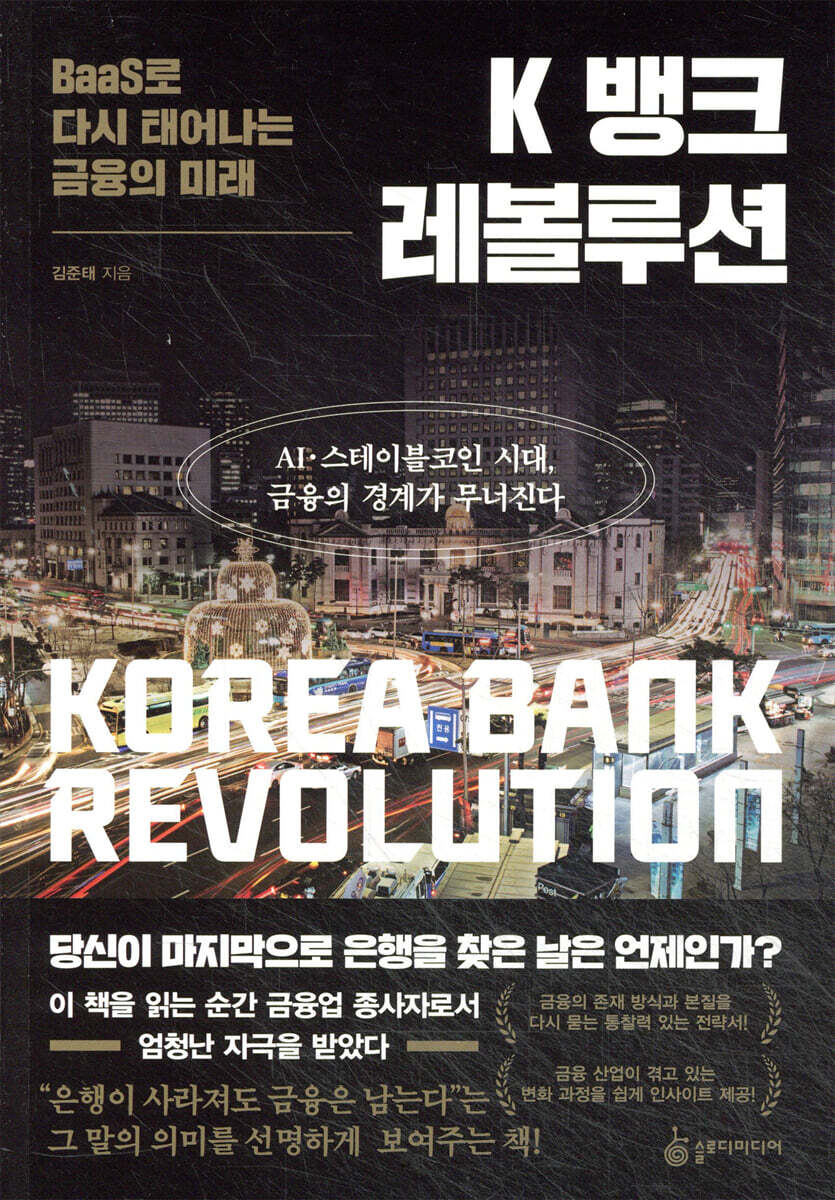
K Bank Revolution
 |
Description
Book Introduction
An insightful strategy book that re-examines the very nature and existence of finance!
Provides easy insight into the changing landscape of the financial industry!
A must-read for all financial professionals!
When was the last time you visited a bank?
The moment I read this book, I felt a tremendous sense of inspiration as a person working in the financial industry.
“Even if banks disappear, finance will remain.”
A book that clearly shows the meaning of that word!
Can you remember the last time you went to the bank? You probably took your seal, pulled out your ID, and walked in to get some documents issued or send money overseas.
But now I don't go there anymore.
Whether you're opening an account, transferring money, getting a loan, or applying for a card, you can handle everything with just your smartphone.
It's as if the space called a bank never existed in the first place.
We have already entered the era of 'bankless banks' without even realizing it.
In recent years, finance has been integrating into platforms.
Banking functions are naturally embedded in the commerce apps, mobility apps, and delivery platforms we use every day.
Pay without registering a card, and when you pay, points are accumulated and stored like assets.
As you shop, you earn points, deposit them, and use the deposited amount to shop again.
Banks are nowhere, but finance is everywhere.
This book is the story of a 'bank' at that turning point.
Focusing on domestic cases, we examine the concept and structure of BaaS, global trends, actual use models, and the strategic convergence of commerce and finance.
Beyond simply introducing the technology, we want to ask why this change began, who is driving it, and how it might evolve in the future.
In an age without banks, what financial services should we choose? And how should banks survive? This book is an attempt to answer these questions.
We follow how today's 'banks' were created, where they are headed, and what they should be redefined by.
Provides easy insight into the changing landscape of the financial industry!
A must-read for all financial professionals!
When was the last time you visited a bank?
The moment I read this book, I felt a tremendous sense of inspiration as a person working in the financial industry.
“Even if banks disappear, finance will remain.”
A book that clearly shows the meaning of that word!
Can you remember the last time you went to the bank? You probably took your seal, pulled out your ID, and walked in to get some documents issued or send money overseas.
But now I don't go there anymore.
Whether you're opening an account, transferring money, getting a loan, or applying for a card, you can handle everything with just your smartphone.
It's as if the space called a bank never existed in the first place.
We have already entered the era of 'bankless banks' without even realizing it.
In recent years, finance has been integrating into platforms.
Banking functions are naturally embedded in the commerce apps, mobility apps, and delivery platforms we use every day.
Pay without registering a card, and when you pay, points are accumulated and stored like assets.
As you shop, you earn points, deposit them, and use the deposited amount to shop again.
Banks are nowhere, but finance is everywhere.
This book is the story of a 'bank' at that turning point.
Focusing on domestic cases, we examine the concept and structure of BaaS, global trends, actual use models, and the strategic convergence of commerce and finance.
Beyond simply introducing the technology, we want to ask why this change began, who is driving it, and how it might evolve in the future.
In an age without banks, what financial services should we choose? And how should banks survive? This book is an attempt to answer these questions.
We follow how today's 'banks' were created, where they are headed, and what they should be redefined by.
- You can preview some of the book's contents.
Preview
index
Recommendation 4
Prologue: When was the last time you visited a bank branch?
Chapter 1: Finance is Leaving Banks and Moving to Platforms
01 The era of banks disappearing and platforms taking over 19
Experience finance on a platform instead of a bank 20
What is BaaS and Why Is It Getting So Much Attention? 30
What's the difference between this and open banking? 33
02 Why do companies need financial functions? 36
The boundaries between industries are collapsing 37
38 Reasons Why Companies Like Coupang and Kakao Are Entering the Financial Industry
What opportunities can banks seize? 49
03 How is the world changing? 53
The Story of the Card Created by Apple and Goldman Sachs 55
Banks Created by Telecom Companies: Case Study 58 in Europe
API Connector: What is Plaid's role? 61
Chapter 2: What's Changing in Banking Now?
01 Why would a bank want to be part of a platform? 69
In an era of shrinking profits, 70 banks are finding new ways.
Experiments for Non-Interest Income 73
What are the strategies of the first-moving banks? 81
02 Experiment 83: Making Finance Fun, Like Shopping
What if you could create an account with points and even withdraw them? 86
Why 'Shopping Savings' Arrived: 87 Reasons
The way we choose financial products is changing, becoming more like shopping.
03 Why Commerce Companies and Banks Are Connecting 93
Coupang, Naver, SSG… Why do commerce companies need banks? 94
The era of converting customers' shopping history into credit is 98.
PLCC, Points, and Affiliate Cards: A New Financial Economy 101
Chapter 3: What's More Memorable Than Banks: Platforms
01 People trust platforms more than banks 109
Experience is more important than brand 110
Good UX Builds Trust 112
Banks are being erased from experience 113
02 Customers Want Benefits and Experiences More Than Interest 116
Real benefits are more important than interest 117
119 points are better than deposits and recharging is better than savings.
How Does Generation MZ Choose Finance? 121
03 Why Do Commerce Companies Want to Provide Direct Finance? 123
More than just fee savings 123
124 'Lock-in Strategy' to Retain Customers
Platform Strategy 125: Partnering with Banks
04 Data Creates a New Financial Order 131
Finance is changing, driven by data 131
What information can a typical bank have? 132
Banking Models That Grow with Platforms 133
05 Now Industry Embraces Finance 135
Farmstack 136: Connecting Agriculture, Commerce, and Finance
Financial Services in Autonomous Vehicles 142
What strategies should I learn? 146
Chapter 4: How Far Will Future Finance Evolve?
01 What model is banking evolving to? 153
The era of the traditional banking model is coming to an end. 155
What are the conditions for creating an innovative financial ecosystem? 162
02 How Will Blockchain and Digital Assets Transform Finance? 165
Are Bitcoin, NFTs, and Tokens Just Investments? 166
The Impact of Digital Assets on Financial Services 169
03 Where is the global financial industry headed? 172
What are the trends in overseas financial markets? 174
What are the global standards for financial services? 177
04 Customized Finance Created by AI and Big Data 180
How AI Will Make Finance Smarter? 181
An era where financial products that are just right for you are automatically suggested 184
05 Why is ESG important to finance? 186
Environmental and social values become the standards of finance 188
What should sustainable finance look like? 190
Chapter 5: What kind of finance will we encounter in 10 years?
01 Can Banks Continue to Exist? 197
What Will Banks Look Like in the BaaS Era? 198
Platformized Banks vs.
199 banks left in the backend
Can Platform 02 Fully Embrace Finance? 201
Naver, Kakao, and Coupang Expand Their Financial Capabilities 202
How are platforms overcoming the barriers of financial regulation? 204
03 Who Will Create Financial "Trust" in the Future? 207
Can Technology Create Trust? Brands or Institutions? 208
Who will be the "trustworthy entity" of future finance? 209
04 What it Means for Finance to Be Democratized 212
The era where everyone can design their own finances is coming. 213
The Coexistence of Local Finance, Decentralized Finance, and Data-Driven Finance 214
05 What questions will we be asking in 10 years? 216
Is the current BaaS trend sustainable? 217
Will banks still exist in 10 years? 218
What will finance look like for us? 219
Epilogue: Even if banks disappear, finance will remain. 221
Prologue: When was the last time you visited a bank branch?
Chapter 1: Finance is Leaving Banks and Moving to Platforms
01 The era of banks disappearing and platforms taking over 19
Experience finance on a platform instead of a bank 20
What is BaaS and Why Is It Getting So Much Attention? 30
What's the difference between this and open banking? 33
02 Why do companies need financial functions? 36
The boundaries between industries are collapsing 37
38 Reasons Why Companies Like Coupang and Kakao Are Entering the Financial Industry
What opportunities can banks seize? 49
03 How is the world changing? 53
The Story of the Card Created by Apple and Goldman Sachs 55
Banks Created by Telecom Companies: Case Study 58 in Europe
API Connector: What is Plaid's role? 61
Chapter 2: What's Changing in Banking Now?
01 Why would a bank want to be part of a platform? 69
In an era of shrinking profits, 70 banks are finding new ways.
Experiments for Non-Interest Income 73
What are the strategies of the first-moving banks? 81
02 Experiment 83: Making Finance Fun, Like Shopping
What if you could create an account with points and even withdraw them? 86
Why 'Shopping Savings' Arrived: 87 Reasons
The way we choose financial products is changing, becoming more like shopping.
03 Why Commerce Companies and Banks Are Connecting 93
Coupang, Naver, SSG… Why do commerce companies need banks? 94
The era of converting customers' shopping history into credit is 98.
PLCC, Points, and Affiliate Cards: A New Financial Economy 101
Chapter 3: What's More Memorable Than Banks: Platforms
01 People trust platforms more than banks 109
Experience is more important than brand 110
Good UX Builds Trust 112
Banks are being erased from experience 113
02 Customers Want Benefits and Experiences More Than Interest 116
Real benefits are more important than interest 117
119 points are better than deposits and recharging is better than savings.
How Does Generation MZ Choose Finance? 121
03 Why Do Commerce Companies Want to Provide Direct Finance? 123
More than just fee savings 123
124 'Lock-in Strategy' to Retain Customers
Platform Strategy 125: Partnering with Banks
04 Data Creates a New Financial Order 131
Finance is changing, driven by data 131
What information can a typical bank have? 132
Banking Models That Grow with Platforms 133
05 Now Industry Embraces Finance 135
Farmstack 136: Connecting Agriculture, Commerce, and Finance
Financial Services in Autonomous Vehicles 142
What strategies should I learn? 146
Chapter 4: How Far Will Future Finance Evolve?
01 What model is banking evolving to? 153
The era of the traditional banking model is coming to an end. 155
What are the conditions for creating an innovative financial ecosystem? 162
02 How Will Blockchain and Digital Assets Transform Finance? 165
Are Bitcoin, NFTs, and Tokens Just Investments? 166
The Impact of Digital Assets on Financial Services 169
03 Where is the global financial industry headed? 172
What are the trends in overseas financial markets? 174
What are the global standards for financial services? 177
04 Customized Finance Created by AI and Big Data 180
How AI Will Make Finance Smarter? 181
An era where financial products that are just right for you are automatically suggested 184
05 Why is ESG important to finance? 186
Environmental and social values become the standards of finance 188
What should sustainable finance look like? 190
Chapter 5: What kind of finance will we encounter in 10 years?
01 Can Banks Continue to Exist? 197
What Will Banks Look Like in the BaaS Era? 198
Platformized Banks vs.
199 banks left in the backend
Can Platform 02 Fully Embrace Finance? 201
Naver, Kakao, and Coupang Expand Their Financial Capabilities 202
How are platforms overcoming the barriers of financial regulation? 204
03 Who Will Create Financial "Trust" in the Future? 207
Can Technology Create Trust? Brands or Institutions? 208
Who will be the "trustworthy entity" of future finance? 209
04 What it Means for Finance to Be Democratized 212
The era where everyone can design their own finances is coming. 213
The Coexistence of Local Finance, Decentralized Finance, and Data-Driven Finance 214
05 What questions will we be asking in 10 years? 216
Is the current BaaS trend sustainable? 217
Will banks still exist in 10 years? 218
What will finance look like for us? 219
Epilogue: Even if banks disappear, finance will remain. 221
Detailed image

Into the book
Financial services are now just one of the app's features.
We use commerce, pay in installments, call taxis, choose simple payment options, and even sign up for insurance based on platform recommendations.
Customers 'use' finance, but they are not necessarily 'conscious' of it.
What matters is not where finance begins, but how seamlessly it integrates into the experience.
Platforms are no longer simply a service window.
Design the flow of experience and naturally insert finance into it.
Finance is no longer a starting point, but rather a function invoked in the flow of the platform.
Rather than worrying about “which bank should I use?”, it’s important to ask “which app is included?”
This change stemmed from customer expectations.
As users' desire for fast, easy, and uncomplicated finance grew louder, platforms embraced their demands, and finance followed suit.
--- p.19
The platform doesn't persuade customers.
Rather, we embed finance as a function in the spaces where customers spend their time.
The function is so natural that users experience it without even realizing that it is finance.
KakaoTalk has now become a prominent presence in the financial sector.
So, what role will existing financial institutions play in this structure? The platform assumes all the central roles—backend connecting accounts and funds, executor providing transaction technology, and wholesaler supplying products—while financial institutions play supporting roles.
Although Kakao Pay Securities has only been around for a short time, it has already helped millions of people experience investing.
Securities are no longer just a tool for experts.
KakaoTalk has even turned investing into something that can be started easily.
Beyond the success story of one company, this is a condensed version of how platforms are changing the structure and perception of finance.
--- p.30
Savings are made through Toss, loans are made through Kakao, payments are made through Baemin, insurance is made through Naver Pay, and investments and asset management are made through KakaoTalk.
Throughout all this, banks have been operating, but their presence has become increasingly faint.
Finance hasn't disappeared.
Finance still exists, but the first financial encounter customers have is no longer with a bank.
Finance now operates hidden within the platform's functionality, and customers experience it as part of their daily lives, not as finance.
The structure that allows finance to enter the platform is Banking as a Service, or BaaS, at its core.
BaaS stands for ‘Banking as a Service.’
Until now, banks were one huge system.
You had to log into your banking app to get a loan at the counter, transfer money from a separate system, and create an account.
All financial functions operated only in banks.
But now it's different.
All of these functions, including account opening, savings and deposit product recommendations, real-time remittances, loan execution, and insurance connection, are modularized and provided externally in the form of an API Application Programming Interface.
In other words, the core functions of the bank have been dismantled and converted into services that can be connected to third-party platforms.
--- p.31
BaaS is not just a technological change, but a turning point that will change the very nature of finance.
In the past, finance was at the center of services.
To do anything, you had to go to a bank first, and finance was the starting point and the core.
But with the introduction of BaaS, finance began to be absorbed as a 'piece' of other services.
Now, finance is naturally invoked in the flow of shopping, paying, checking hospital bills, connecting to loss insurance, and automatically paying with points while taking a taxi.
In this structure, banks are no longer the main characters.
Finance is no longer an independent destination, but a utility integrated into the service flow.
Users experience finance without being aware of it.
BaaS poses an important question to the existing financial order.
Is it true that only financial institutions can handle finance? With BaaS, we've entered an era where platforms, commerce, and even content companies can provide their own financial services.
This means that beyond technological advancements, the power of finance is shifting from ‘licenses’ to ‘points of contact.’
In the past, only licensed banks could handle finance, but now, platforms with customers provide the financial experience.
And in the process, banks must reposition themselves as providers of functionality.
How can we maintain control over functionality while losing customer touchpoints? The answer to this dilemma lies in the BaaS architecture.
BaaS is no longer an experimental concept.
BaaS is already a part of our daily lives, and behind the financial experiences we encounter several times a day, BaaS is always working quietly but powerfully.
In this era of complete financial redesign, banks have become functional and platforms have become symbols of trust.
--- p.32~33
It's no coincidence that finance is permeating other industries.
All the changes in our daily lives—commerce embracing payments, mobility providing insurance, and points turning into investments—are made possible not only by technological advancements, but also by changes in the very structure of the industry.
We live in an era where the boundaries between industries are disappearing.
As the traditionally separate lines of business and industry become increasingly blurred, consumers are moving along the flow of experience rather than being tied to specific industries.
In this flow, finance is no longer an independent industry, but rather a connecting tool that amplifies value by combining with other industries.
As finance shifts from a "stand-alone industry" to a "structure that naturally blends into other industries," BaaS becomes a key design method that enables this shift.
--- p.36
Coupang is not a financial company.
South Korea's largest e-commerce platform, an icon of logistics innovation, and synonymous with fast delivery.
However, the natural integration of finance into the fast and convenient shopping experience started quite early.
The first financial entry was the 'Seller Settlement System'.
Unlike open markets, Coupang operates its own fulfillment system and has been running both direct purchases and a marketplace.
From a seller's perspective, the most important issue was how quickly settlement could be achieved, and Coupang solved this problem with its financial function.
It allows sellers to recover their funds early as soon as they make a sale.
This may seem like a simple settlement function, but in reality, Coupang has created a structure that ‘lends funds forward’ like a bank.
Sellers were able to secure liquidity without loans, and Coupang was able to increase seller loyalty.
--- p.40~41
The most recent change is even more symbolic. SSG announced that it will launch the "SSG KB Bank Parking Account" in April 2025 in partnership with KB Kookmin Bank.
On the surface, it is a deposit management function, but in reality, it is a BaaS-type embedded financial model that provides deposit services within a shopping platform.
Customers can connect their SSG MONEY prepaid recharge to their KB Kookmin Bank account, recharge as much as they need, and keep the remainder in a deposit status.
Deposits earn daily interest and can be used immediately for withdrawals or payments. While this financial service is provided by KB Bank, customers perceive this account as an asset management service offered by SSG.COM.
This product is an innovative financial service that has received special treatment under the financial regulatory sandbox. In essence, it represents a case where banking functions are fully integrated into the platform UX.
--- p.43
Banks have traditionally relied on interest income as their core source of revenue.
The difference between the loan interest rate and the deposit interest rate, known as the interest margin, was the structure through which banks could generate stable profits.
However, as the era of low interest rates and low growth continued, this structure reached its limits.
With profits fluctuating sensitively to market interest rates, financial authorities' policy regulations, and customer loss due to interest rate competition, it is no longer possible to secure stable profits based solely on the expected margin.
The bigger problem is that the customers are not staying at the bank.
Users can send money through KakaoTalk, compare insurance on Naver, and experience payments, settlements, and installment payments on Coupang or SSG.COM.
Even digital financial platforms like Kakao Bank and Toss have established themselves on users' smartphones before traditional banks.
Existing banking apps have a high number of downloads, but their daily active users (DAU) are low, and they have become a channel that customers do not actively seek out for asset management.
Banks sell products, but the platform holds the customer's initiative.
BaaS doesn't signal the end of banking.
Rather, banks have redefined themselves as "service infrastructure" and adopted a strategy to protect and expand finance in new ways.
As platforms take center stage, the importance of banks providing the functionality grows.
What matters now is not which bank a customer uses in their app, but which platform the bank is hiding within.
--- p.50~52
Goldman Sachs was responsible for all financial entities.
From credit screening, limit setting, revolving operation, risk management, and settlement system, it was clearly Goldman Sachs that took on the role of the "bank" for the service called Apple Card.
But what's surprising is that Goldman Sachs isn't at the forefront of the service.
The card design didn't feature the Goldman Sachs logo, and the app screens contained little recognizable bank branding.
All relationships were built around Apple, with Goldman Sachs serving as a backend partner, providing only functionality.
This wasn't just a simple branding strategy.
This was an example of how the BaaS structure was realized.
The bank was broken down into functional units that make up the service and quietly permeated the flow within the platform.
Users no longer have to visit financial institutions directly; they simply consume the financial services they need through the platform.
Why did Goldman Sachs embrace this structure? They have long been a leading Wall Street investment bank, serving corporate clients, ultra-high-net-worth individuals, and institutional investors.
--- p.56
Fidor Bank was not an IT company.
However, they attempted a strategic shift, not a ‘technologization of banks’, but a ‘transformation of the role of banks’.
Internet banking not only emphasizes convenience, but also creates a structure in which the bank's infrastructure connects with more businesses and customer contact points are transferred to external platforms, but the bank still provides essential financial functions.
This demonstrates that BaaS isn't the exclusive domain of startups or tech companies, but rather a model that existing banks can transform and implement.
What does the case of Fidor Bank demonstrate? Banks can also become platforms.
Just as platforms are absorbing finance, there are also ways for banks to transform themselves into API providers.
Even if you don't absorb all of the user relationships, you can coexist with the platform while maintaining ownership of its features.
This is why Fidor Bank is considered to be leading the way in BaaS.
Instead of protecting finance, they chose to divide and connect it.
And it proved that this could be a strategy to turn banks into platforms.
--- p.60
The existing banking system was closed.
Each bank operated with its own data formats, security systems, and authentication procedures, and the technical barriers and regulatory risks were too high for external companies to connect directly through APIs.
Plaid solved this problem.
By pre-standardizing technical connections with banks, external platforms can call the functions of numerous banks simply by connecting to Plaid's API.
In this way, Plaid transformed complex financial backends into a product that can be connected with a single API.
This allows banks to flexibly share customer data, and platforms to quickly and securely integrate financial functions.
BaaS is not a complete structure that is completed simply by directly connecting the platform and the bank.
To make it work, it needs a technical foundation that manages authentication, processes data, ensures regulatory compliance, and standardizes financial information into APIs.
Plaid is the company that laid the foundation.
The name 'API connector' may seem simple, but it actually served as a catalyst for the proliferation of BaaS architecture across the market.
--- p.62
Woori Bank has partnered with Baedal Minjok to connect banking services to the payment flow of a platform closely related to daily life.
Additionally, Kookmin Bank linked the Point Mall within the 'Liiv Mate' app and designed a structure that allows users to purchase subscription products or shop using financial points.
Meanwhile, Shinhan Bank sought to provide data-based consumption reports, asset changes, and customized financial product suggestions through its MyData-based 'SOL rich' service.
Banks have repeatedly experimented with integrating finance into various contexts, such as payments, shopping, and asset management, but they have either lacked a clear revenue model or failed to deeply connect with customers' expectations and journeys.
The platform was there, and the features were there, but users were asking, “Why do we need to do this in a banking app?”
Although ‘bank-created content’ existed, there was a lack of verification as to whether the content was created ‘in the place where banks should be.’
The limitations of expanding non-interest income ultimately boil down to the failure of channel switching.
The products offered by banks are still competitive.
The problem is that the channels, timing, and context to deliver that product have disappeared.
In the digital financial era, who is positioned along the customer journey has become more important than the product itself, and banks are increasingly being pushed back along this path.
It is a structure that allows you to create products, but not make them usable.
The bank now asks the question again.
"Can't our features be sold even if they're not our products? Can't our infrastructure be used repeatedly even if they're not our namesakes?" --- p.74
In this flow, the strategies banks can choose become clear.
The starting point of BaaS is not to own the entire function, but to divide it into small pieces and open it up for external use.
This is a method of dividing various financial functions existing within the bank into small modules and providing them to the outside in the form of an API.
For example, you can isolate the authentication function, link the account opening process to the membership registration process on another platform, integrate the payment function into the shopping mall's payment process, integrate the loan limit inquiry function into a used car trading app, and integrate a credit rating algorithm into the e-commerce subscription structure.
Throughout this process, banks are transforming their capabilities into marketable tools, structured to be called upon and used whenever needed.
Banks no longer try to control everything themselves.
Instead, they are restructuring their offerings to work across platforms and generate recurring revenue based on usage.
In other words, the future of banking is moving toward an era where profits are determined by “where and how functions are used.”
--- p.84
Ultimately, banks are creating new profit structures not through ownership, but through the way their functions are 'used'.
It is repetitive, predictable, and provides the basis for designing stable revenue over a wider range than traditional product-based sales.
The structure of splitting functions, quietly infiltrating users' flow, and generating revenue each time they are used raises new questions for banks.
"How far can we expand now?" In the past, expansion was explained in terms of numbers: the number of branches, the number of new accounts, and the number of cards issued.
However, the current expansion is determined by how many different contexts the function can fit into.
With more platforms, more diverse industries, and more streamlined workflows, banks are now expanding their reach beyond customers to contexts.
This strategy changes the very mindset of banks.
--- p.91
For commerce platforms, finance is not just a means to facilitate payments; it's also a core technology for retaining customers longer, engaging them more frequently, and conducting deeper analytics.
In this flow, commerce does not partner with banks.
Bringing the functions of a bank directly into the system.
The starting point of this strategy is mostly Pay and PLCC.
'Pay' brings customers' payment routines into the platform, and 'PLCC' is a tool that turns external finance into platform loyalty.
In addition, there have been recent attempts to convert accumulated points into assets.
Some platforms are experimenting with structures that pay interest on accumulated points or regularly settle balances.
This makes points work like assets rather than just marketing tools.
Coupang is at the forefront.
Coupang goes beyond a fast delivery platform and integrates payment, accrual, refund, and settlement into a single system through Coupang Pay.
Coupang completed its registration as an electronic financial service provider through its subsidiary Coupang Pay in 2020 and has been gradually integrating banking functions such as prepaid payments, remittances, and automatic settlements into its platform.
In particular, Coupang Money is a rechargeable prepaid payment method, but in reality, it blurs the lines between points, savings, and e-commerce-only cash, and operates as a closed currency system used only within the Coupang ecosystem.
--- p.96
Banks are no longer places that create credit.
Credit is created externally, and banks are responsible for interpreting and commercializing that credit data.
At this point, the role of BaaS is crucial.
The platform analyzes customer data to determine who needs financial services, and banks provide appropriate financial functions to those customers through BaaS APIs.
All financial functions implemented within the platform, such as short-term deferred payments, small loans, and reward-linked savings, are models that require banks to provide them as functional units through a BaaS structure.
For example, if you have been making regular purchases at least five times a month for the past three months, processed all payments with Coupang Money, and have no history of refunds, the platform may determine that it can offer deferred payment up to a limit of 200,000 won based on this data.
Based on this, the bank calls the loan/payment API, and credit and products are updated together based on the usage results.
--- p.100
Finance is still deeply embedded in our daily lives, but banks are being forgotten.
When people use financial products, they remember more clearly where they had the experience than where they created it.
For example, when you open a savings account, you say, “I signed up for it through Toss,” and when you take out a loan, you say, “I took care of it through Kakao.”
When making a payment, naturally say, “I paid with Naver Pay.”
This shift in perception isn't just due to the brand's frequent exposure.
This is because the entire process of a customer using finance is designed within the platform's UX.
All steps, from search and comparison to sign-up, execution, and management, are integrated into a single flow, with the bank remaining a backend that only provides functions such as account opening, payments, and loans.
--- p.110
Banks are entities that appear and disappear within the experience created by the platform, like APIs that are called when needed.
In the past, banking apps were the only entry point into finance.
Now, the flow has changed to one where finance is naturally encountered within the platform.
The way customers start saving on Toss, take out loans on KakaoTalk, and manage payments and points on Naver demonstrates that the platform, not the bank, designs and leads the customer's financial journey.
In line with this trend, the bank's name is increasingly pushed to the back.
Sometimes, after receiving a product recommendation on a platform, you only find out what bank product it is at the end.
Banks have become structures hidden within the flow of experience, rather than objects of choice.
And customers don't feel any inconvenience at all even though the bank is out of sight.
This is evidence that banks are being erased from experience.
But this change is not so much a departure from banking as a reassignment of roles.
--- p.114
BaaS is a financial innovation model that allows various platforms to provide financial services beyond the role of traditional banks.
This provides better services to consumers and opens the way for non-financial companies to enter the existing financial system.
In particular, commerce companies are looking to leverage BaaS not only for cost savings, but also because it enables customer lock-in, financial branding, and various platform strategies.
Commerce companies that adopt BaaS can save on the huge upfront investment costs associated with partnering with traditional banks or building their own financial services.
Running a bank the traditional way requires significant costs and time, including regulatory compliance, infrastructure development, and systems for managing customer data.
--- p.123
Naver is strengthening its customer lock-in strategy through its simple payment service, Naver Pay.
The recently introduced credit payment service allows customers to use not only their balance but also the post-payment feature when paying for products with Naver Pay.
Here, Naver Pay point accumulation benefits are linked to various areas such as Smart Store, Naver Shopping, and content subscriptions, allowing customers to experience integrated payment and finance within the Naver ecosystem.
This method of providing payment methods and financial services together within a platform is a strategy that simultaneously achieves financial branding and customer lock-in effects.
Customers tend to want to handle all functions within a platform they are familiar with rather than using other financial services separately.
This is a prime example of a commerce company internalizing finance or leveraging a bank's infrastructure to enhance customer experience.
The BaaS model allows commerce companies and banks to leverage each other's strengths to create synergy.
--- p.128
The trend of finance being embedded into platforms clearly demonstrates the essence of BaaS.
But recently, there has been a reverse trend.
This is a structure in which industry embraces finance, or in other words, traditional non-financial industries either embed financial functions within themselves or connect with external financial institutions to provide them to their customers.
This trend goes beyond simply selling financial products. As financial elements like data, transactions, settlement, and credit ratings are integrated into the flow of industrial activities such as production, distribution, sales, delivery, and consumption, finance begins to operate as an inevitable structure rather than a connected function.
Representative examples can be seen in fields such as agriculture, logistics, autonomous vehicles, and commerce.
For example, in agriculture, loans, insurance, and factoring based on crop, logistics, and settlement data are naturally linked to finance.
In the case of autonomous vehicles, the vehicle will soon become a platform, and all consumption activities that occur while in motion will become a point of contact for financial services.
--- p.135
Electric vehicle-based autonomous taxis can automatically process fare payments upon arrival at their destination, and link fare details with insurance companies and financial institutions to perform credit analysis or apply discounts based on usage history.
Users are connected to financial services simply by getting into their car, without any separate action.
This trend is evolving beyond the financialization of transportation to the spatialization of finance.
The interior of a vehicle is not only a space for passengers, but also a space for shopping, consuming content, and even consulting and signing up for financial products.
It's no longer a distant future when self-driving cars offer content streaming services, recommend specific paid subscriptions, or expose insurance products to passengers and encourage them to sign up.
Vehicles are now focused on “what to do while driving” rather than “driving,” and in this process, finance becomes a system that is naturally connected and executed.
--- p.143
Bankless finance is evolving beyond the hands of platform companies to a form that is not in the hands of anyone else.
We are entering a new era of experimentation with 'decentralization' in finance.
In this structure, finance no longer relies on organization, authority, or physical infrastructure.
Instead, it is implemented as a system that operates based on code, consensus, and algorithms on technologies such as blockchain, smart contracts, digital wallets, and decentralized autonomous organizations (DAOs).
These systems are called 'decentralized finance'.
It is commonly referred to as DeFi (Decentralized Finance), and its most key features are as follows:
First, finance works without bank accounts.
--- p.160
Finance has long been driven by real assets.
Physical or traditional forms of assets such as cash, real estate, deposits, and securities were the foundation of finance.
But now, that foundation is in a period of upheaval: digitalized, decentralized, and redefined.
Assets no longer need to be visible, can be traded without central authority, and can be code rather than currency.
The key driving force behind these changes is digital assets.
Digital assets don't just refer to cryptocurrencies. Their scope is expanding to include NFTs, stablecoins, central bank digital currencies, virtual real estate, and even economic assets within the metaverse.
These are all connected by the fact that they are creating new value outside the traditional financial system and building trust on technology.
Beyond the emergence of new assets, this trend raises questions about where and how finance itself can exist.
--- p.165
Finance was originally an industry designed to be borderless.
Each country's central bank issued its own currency, and different financial regulations and accounting standards were effective only within its borders.
It was a world where the dollar was used only in the United States, the yen only in Japan, and the won only in Korea.
But as technology breaks down financial boundaries, assets become digitized, and customers migrate onto platforms, the established order begins to shake.
Today, finance is shifting its structure to one where it follows the path of the internet rather than national borders, is designed around user experience rather than institutions, and platforms and communities hold power rather than institutions.
Finance is no longer confined to the institutions of a particular country.
Digital assets, global fintech, and borderless payment systems demonstrate that finance is evolving into an infrastructure that can operate anytime, anywhere.
--- p.172
The very way we build financial trust will change.
In the past, trust was all about government guarantees and bank brands.
But now, technology-based trust mechanisms, such as blockchain transparency, smart contract automation, and community-based decision-making structures, are becoming core trust assets for services.
For a service to be accepted globally, its reliability must also be established according to global standards.
We have entered an era where structure is more important than branding, open source code is more important than advertising, and global verification is more important than local sentiment.
In this trend, internationally accepted financial services will evolve beyond simply crossing borders into an integrated structure where technology, systems, users, and platforms operate simultaneously.
And at the heart of that structure will not be a single bank, but an ecosystem that connects various industries, technologies, and user networks.
--- p.179
The evolution of AI is also challenging the very nature of finance.
Human-centered finance builds trust based on emotions and experiences.
But AI makes decisions based on numbers, probabilities, and patterns.
We live in an era where human intuition is disappearing and algorithmic interpretation is central.
This maximizes financial efficiency while also demanding new standards for financial accountability, fairness, and transparency. Is AI always right? Can customers understand algorithms? Does biased data hinder fair financial practices? As technology advances, the ethics and design philosophy of finance must become more sophisticated.
We explore how artificial intelligence and data technologies are transforming the financial industry.
It's not just a question of automation.
Data-driven finance is evolving into a structure that goes beyond human-created rules.
And within that structure, we must face a new question: “What criteria should we use to design and judge finance?”
--- p.181
AI-based financial innovation is progressing in two directions simultaneously.
One is hyper-personalization, and the other is hyper-automation.
Hyper-personalization is about understanding each customer's needs and journey through data and providing tailored financial solutions.
Hyperautomation is a structure in which technology handles the entire process from solution design, recommendation, and execution without human intervention.
Customers get answers without asking questions, get approval without applying, and access finance without making a decision.
These changes present new challenges for traditional financial institutions.
Finance can no longer survive with a product-centric structure.
We need a design that is customer-centric, and even more so, customer behavior-centric.
At the same time, we must have the technical capabilities and ethical standards for how we collect, interpret, and use data.
Issues like privacy, algorithmic transparency, and fairness in recommendation systems become conditions of trust, not functionality.
Finance will increasingly operate in a hidden manner.
Customers no longer choose their finances directly.
Apps, platforms, or AI read customers' lives and design their finances.
The smoother and more sophisticated this process becomes, the more deeply and quietly finance permeates customers' lives.
And at that moment, we will face a new definition of finance for customers, not finance that suits customers.
--- p.185
As banks increasingly step back and platforms take over the financial experience, the following question naturally arises:
"So, can the platform truly embrace finance on its own?" This question isn't a question of technology or customer touchpoints.
The key lies in the institutional boundaries of financial activity and the structure of trust.
Digital platforms like Kakao, Naver, Coupang, and Toss already offer a variety of financial services, including payments, points, remittances, reward points, loan brokerage, and insurance recommendations, all within their own brands.
From the consumer's perspective, this entire process is so natural and routine that it feels like "the platform is doing the financing."
However, legally, most of these services operate based on collaboration with existing financial institutions such as banks, credit card companies, and insurance companies.
--- p.201
A representative example is the launch of Toss Bank.
Toss, originally a remittance-focused fintech, has acquired a banking license, marking a symbolic event in which the platform has emerged at the forefront of finance.
This is not simply an expansion of functionality, but rather an exceptional case in which a platform has embraced the institutional framework and acquired the status of a financial institution.
Conversely, there are ways for platforms to mimic finance without being licensed.
For example, some platforms allow users to charge, store, and use their points like an account, and provide benefits called rewards based on the use of points.
In practice, it functions like a deposit and interest, but because it is nominally packaged as points, it can avoid regulation.
Furthermore, loan brokerage platforms have grown by comparing, recommending, and connecting products from numerous financial institutions, claiming that they do not directly execute loans.
At this time, customers search for information and check the terms within the platform, and the actual loan execution takes place in the bank's system.
--- p.205
The expression “democratization of finance” often leads to misunderstandings.
While this may seem like a sign that anyone can invest, anyone can borrow, and anyone can control their money, it actually implies a much deeper, more structural change.
Democratizing finance doesn't just mean increasing accessibility.
Rather, it means that finance is moving away from the monopoly of certain groups and institutions, and that power and roles are being decentralized among individuals, regions, platforms, technologies, and various entities.
As we move away from centralized financial systems, finance is being restructured to become more decentralized, connected, and personalized.
Blockchain-based decentralized finance enables financial transactions without intermediaries, while local currencies and community-based financial platforms offer new financial possibilities to marginalized economic entities not captured by traditional financial institutions.
--- p.212
We are now at a huge turning point.
Banking functions are being absorbed into platforms, and the main players in finance are being restructured.
But no one can say exactly where this change is headed.
Rather, what is needed now is not an assertion, but a question.
In ten years, will finance be faster and more transparent than it is today? Or will excessive reliance on technology create new inequalities? Discussing the BaaS model goes beyond the question of technological advancement and raises fundamental questions about the identity, responsibility, and role of finance.
In an era where platforms shape finance, what kind of role will banks play? Can data replace trust? Can finance become more democratic? And what kind of financial services will we choose amidst this shift? This article explores these questions.
This is not intended to provide a definitive answer, but rather to serve as a starting point for thinking about how to prepare for the next decade.
We use commerce, pay in installments, call taxis, choose simple payment options, and even sign up for insurance based on platform recommendations.
Customers 'use' finance, but they are not necessarily 'conscious' of it.
What matters is not where finance begins, but how seamlessly it integrates into the experience.
Platforms are no longer simply a service window.
Design the flow of experience and naturally insert finance into it.
Finance is no longer a starting point, but rather a function invoked in the flow of the platform.
Rather than worrying about “which bank should I use?”, it’s important to ask “which app is included?”
This change stemmed from customer expectations.
As users' desire for fast, easy, and uncomplicated finance grew louder, platforms embraced their demands, and finance followed suit.
--- p.19
The platform doesn't persuade customers.
Rather, we embed finance as a function in the spaces where customers spend their time.
The function is so natural that users experience it without even realizing that it is finance.
KakaoTalk has now become a prominent presence in the financial sector.
So, what role will existing financial institutions play in this structure? The platform assumes all the central roles—backend connecting accounts and funds, executor providing transaction technology, and wholesaler supplying products—while financial institutions play supporting roles.
Although Kakao Pay Securities has only been around for a short time, it has already helped millions of people experience investing.
Securities are no longer just a tool for experts.
KakaoTalk has even turned investing into something that can be started easily.
Beyond the success story of one company, this is a condensed version of how platforms are changing the structure and perception of finance.
--- p.30
Savings are made through Toss, loans are made through Kakao, payments are made through Baemin, insurance is made through Naver Pay, and investments and asset management are made through KakaoTalk.
Throughout all this, banks have been operating, but their presence has become increasingly faint.
Finance hasn't disappeared.
Finance still exists, but the first financial encounter customers have is no longer with a bank.
Finance now operates hidden within the platform's functionality, and customers experience it as part of their daily lives, not as finance.
The structure that allows finance to enter the platform is Banking as a Service, or BaaS, at its core.
BaaS stands for ‘Banking as a Service.’
Until now, banks were one huge system.
You had to log into your banking app to get a loan at the counter, transfer money from a separate system, and create an account.
All financial functions operated only in banks.
But now it's different.
All of these functions, including account opening, savings and deposit product recommendations, real-time remittances, loan execution, and insurance connection, are modularized and provided externally in the form of an API Application Programming Interface.
In other words, the core functions of the bank have been dismantled and converted into services that can be connected to third-party platforms.
--- p.31
BaaS is not just a technological change, but a turning point that will change the very nature of finance.
In the past, finance was at the center of services.
To do anything, you had to go to a bank first, and finance was the starting point and the core.
But with the introduction of BaaS, finance began to be absorbed as a 'piece' of other services.
Now, finance is naturally invoked in the flow of shopping, paying, checking hospital bills, connecting to loss insurance, and automatically paying with points while taking a taxi.
In this structure, banks are no longer the main characters.
Finance is no longer an independent destination, but a utility integrated into the service flow.
Users experience finance without being aware of it.
BaaS poses an important question to the existing financial order.
Is it true that only financial institutions can handle finance? With BaaS, we've entered an era where platforms, commerce, and even content companies can provide their own financial services.
This means that beyond technological advancements, the power of finance is shifting from ‘licenses’ to ‘points of contact.’
In the past, only licensed banks could handle finance, but now, platforms with customers provide the financial experience.
And in the process, banks must reposition themselves as providers of functionality.
How can we maintain control over functionality while losing customer touchpoints? The answer to this dilemma lies in the BaaS architecture.
BaaS is no longer an experimental concept.
BaaS is already a part of our daily lives, and behind the financial experiences we encounter several times a day, BaaS is always working quietly but powerfully.
In this era of complete financial redesign, banks have become functional and platforms have become symbols of trust.
--- p.32~33
It's no coincidence that finance is permeating other industries.
All the changes in our daily lives—commerce embracing payments, mobility providing insurance, and points turning into investments—are made possible not only by technological advancements, but also by changes in the very structure of the industry.
We live in an era where the boundaries between industries are disappearing.
As the traditionally separate lines of business and industry become increasingly blurred, consumers are moving along the flow of experience rather than being tied to specific industries.
In this flow, finance is no longer an independent industry, but rather a connecting tool that amplifies value by combining with other industries.
As finance shifts from a "stand-alone industry" to a "structure that naturally blends into other industries," BaaS becomes a key design method that enables this shift.
--- p.36
Coupang is not a financial company.
South Korea's largest e-commerce platform, an icon of logistics innovation, and synonymous with fast delivery.
However, the natural integration of finance into the fast and convenient shopping experience started quite early.
The first financial entry was the 'Seller Settlement System'.
Unlike open markets, Coupang operates its own fulfillment system and has been running both direct purchases and a marketplace.
From a seller's perspective, the most important issue was how quickly settlement could be achieved, and Coupang solved this problem with its financial function.
It allows sellers to recover their funds early as soon as they make a sale.
This may seem like a simple settlement function, but in reality, Coupang has created a structure that ‘lends funds forward’ like a bank.
Sellers were able to secure liquidity without loans, and Coupang was able to increase seller loyalty.
--- p.40~41
The most recent change is even more symbolic. SSG announced that it will launch the "SSG KB Bank Parking Account" in April 2025 in partnership with KB Kookmin Bank.
On the surface, it is a deposit management function, but in reality, it is a BaaS-type embedded financial model that provides deposit services within a shopping platform.
Customers can connect their SSG MONEY prepaid recharge to their KB Kookmin Bank account, recharge as much as they need, and keep the remainder in a deposit status.
Deposits earn daily interest and can be used immediately for withdrawals or payments. While this financial service is provided by KB Bank, customers perceive this account as an asset management service offered by SSG.COM.
This product is an innovative financial service that has received special treatment under the financial regulatory sandbox. In essence, it represents a case where banking functions are fully integrated into the platform UX.
--- p.43
Banks have traditionally relied on interest income as their core source of revenue.
The difference between the loan interest rate and the deposit interest rate, known as the interest margin, was the structure through which banks could generate stable profits.
However, as the era of low interest rates and low growth continued, this structure reached its limits.
With profits fluctuating sensitively to market interest rates, financial authorities' policy regulations, and customer loss due to interest rate competition, it is no longer possible to secure stable profits based solely on the expected margin.
The bigger problem is that the customers are not staying at the bank.
Users can send money through KakaoTalk, compare insurance on Naver, and experience payments, settlements, and installment payments on Coupang or SSG.COM.
Even digital financial platforms like Kakao Bank and Toss have established themselves on users' smartphones before traditional banks.
Existing banking apps have a high number of downloads, but their daily active users (DAU) are low, and they have become a channel that customers do not actively seek out for asset management.
Banks sell products, but the platform holds the customer's initiative.
BaaS doesn't signal the end of banking.
Rather, banks have redefined themselves as "service infrastructure" and adopted a strategy to protect and expand finance in new ways.
As platforms take center stage, the importance of banks providing the functionality grows.
What matters now is not which bank a customer uses in their app, but which platform the bank is hiding within.
--- p.50~52
Goldman Sachs was responsible for all financial entities.
From credit screening, limit setting, revolving operation, risk management, and settlement system, it was clearly Goldman Sachs that took on the role of the "bank" for the service called Apple Card.
But what's surprising is that Goldman Sachs isn't at the forefront of the service.
The card design didn't feature the Goldman Sachs logo, and the app screens contained little recognizable bank branding.
All relationships were built around Apple, with Goldman Sachs serving as a backend partner, providing only functionality.
This wasn't just a simple branding strategy.
This was an example of how the BaaS structure was realized.
The bank was broken down into functional units that make up the service and quietly permeated the flow within the platform.
Users no longer have to visit financial institutions directly; they simply consume the financial services they need through the platform.
Why did Goldman Sachs embrace this structure? They have long been a leading Wall Street investment bank, serving corporate clients, ultra-high-net-worth individuals, and institutional investors.
--- p.56
Fidor Bank was not an IT company.
However, they attempted a strategic shift, not a ‘technologization of banks’, but a ‘transformation of the role of banks’.
Internet banking not only emphasizes convenience, but also creates a structure in which the bank's infrastructure connects with more businesses and customer contact points are transferred to external platforms, but the bank still provides essential financial functions.
This demonstrates that BaaS isn't the exclusive domain of startups or tech companies, but rather a model that existing banks can transform and implement.
What does the case of Fidor Bank demonstrate? Banks can also become platforms.
Just as platforms are absorbing finance, there are also ways for banks to transform themselves into API providers.
Even if you don't absorb all of the user relationships, you can coexist with the platform while maintaining ownership of its features.
This is why Fidor Bank is considered to be leading the way in BaaS.
Instead of protecting finance, they chose to divide and connect it.
And it proved that this could be a strategy to turn banks into platforms.
--- p.60
The existing banking system was closed.
Each bank operated with its own data formats, security systems, and authentication procedures, and the technical barriers and regulatory risks were too high for external companies to connect directly through APIs.
Plaid solved this problem.
By pre-standardizing technical connections with banks, external platforms can call the functions of numerous banks simply by connecting to Plaid's API.
In this way, Plaid transformed complex financial backends into a product that can be connected with a single API.
This allows banks to flexibly share customer data, and platforms to quickly and securely integrate financial functions.
BaaS is not a complete structure that is completed simply by directly connecting the platform and the bank.
To make it work, it needs a technical foundation that manages authentication, processes data, ensures regulatory compliance, and standardizes financial information into APIs.
Plaid is the company that laid the foundation.
The name 'API connector' may seem simple, but it actually served as a catalyst for the proliferation of BaaS architecture across the market.
--- p.62
Woori Bank has partnered with Baedal Minjok to connect banking services to the payment flow of a platform closely related to daily life.
Additionally, Kookmin Bank linked the Point Mall within the 'Liiv Mate' app and designed a structure that allows users to purchase subscription products or shop using financial points.
Meanwhile, Shinhan Bank sought to provide data-based consumption reports, asset changes, and customized financial product suggestions through its MyData-based 'SOL rich' service.
Banks have repeatedly experimented with integrating finance into various contexts, such as payments, shopping, and asset management, but they have either lacked a clear revenue model or failed to deeply connect with customers' expectations and journeys.
The platform was there, and the features were there, but users were asking, “Why do we need to do this in a banking app?”
Although ‘bank-created content’ existed, there was a lack of verification as to whether the content was created ‘in the place where banks should be.’
The limitations of expanding non-interest income ultimately boil down to the failure of channel switching.
The products offered by banks are still competitive.
The problem is that the channels, timing, and context to deliver that product have disappeared.
In the digital financial era, who is positioned along the customer journey has become more important than the product itself, and banks are increasingly being pushed back along this path.
It is a structure that allows you to create products, but not make them usable.
The bank now asks the question again.
"Can't our features be sold even if they're not our products? Can't our infrastructure be used repeatedly even if they're not our namesakes?" --- p.74
In this flow, the strategies banks can choose become clear.
The starting point of BaaS is not to own the entire function, but to divide it into small pieces and open it up for external use.
This is a method of dividing various financial functions existing within the bank into small modules and providing them to the outside in the form of an API.
For example, you can isolate the authentication function, link the account opening process to the membership registration process on another platform, integrate the payment function into the shopping mall's payment process, integrate the loan limit inquiry function into a used car trading app, and integrate a credit rating algorithm into the e-commerce subscription structure.
Throughout this process, banks are transforming their capabilities into marketable tools, structured to be called upon and used whenever needed.
Banks no longer try to control everything themselves.
Instead, they are restructuring their offerings to work across platforms and generate recurring revenue based on usage.
In other words, the future of banking is moving toward an era where profits are determined by “where and how functions are used.”
--- p.84
Ultimately, banks are creating new profit structures not through ownership, but through the way their functions are 'used'.
It is repetitive, predictable, and provides the basis for designing stable revenue over a wider range than traditional product-based sales.
The structure of splitting functions, quietly infiltrating users' flow, and generating revenue each time they are used raises new questions for banks.
"How far can we expand now?" In the past, expansion was explained in terms of numbers: the number of branches, the number of new accounts, and the number of cards issued.
However, the current expansion is determined by how many different contexts the function can fit into.
With more platforms, more diverse industries, and more streamlined workflows, banks are now expanding their reach beyond customers to contexts.
This strategy changes the very mindset of banks.
--- p.91
For commerce platforms, finance is not just a means to facilitate payments; it's also a core technology for retaining customers longer, engaging them more frequently, and conducting deeper analytics.
In this flow, commerce does not partner with banks.
Bringing the functions of a bank directly into the system.
The starting point of this strategy is mostly Pay and PLCC.
'Pay' brings customers' payment routines into the platform, and 'PLCC' is a tool that turns external finance into platform loyalty.
In addition, there have been recent attempts to convert accumulated points into assets.
Some platforms are experimenting with structures that pay interest on accumulated points or regularly settle balances.
This makes points work like assets rather than just marketing tools.
Coupang is at the forefront.
Coupang goes beyond a fast delivery platform and integrates payment, accrual, refund, and settlement into a single system through Coupang Pay.
Coupang completed its registration as an electronic financial service provider through its subsidiary Coupang Pay in 2020 and has been gradually integrating banking functions such as prepaid payments, remittances, and automatic settlements into its platform.
In particular, Coupang Money is a rechargeable prepaid payment method, but in reality, it blurs the lines between points, savings, and e-commerce-only cash, and operates as a closed currency system used only within the Coupang ecosystem.
--- p.96
Banks are no longer places that create credit.
Credit is created externally, and banks are responsible for interpreting and commercializing that credit data.
At this point, the role of BaaS is crucial.
The platform analyzes customer data to determine who needs financial services, and banks provide appropriate financial functions to those customers through BaaS APIs.
All financial functions implemented within the platform, such as short-term deferred payments, small loans, and reward-linked savings, are models that require banks to provide them as functional units through a BaaS structure.
For example, if you have been making regular purchases at least five times a month for the past three months, processed all payments with Coupang Money, and have no history of refunds, the platform may determine that it can offer deferred payment up to a limit of 200,000 won based on this data.
Based on this, the bank calls the loan/payment API, and credit and products are updated together based on the usage results.
--- p.100
Finance is still deeply embedded in our daily lives, but banks are being forgotten.
When people use financial products, they remember more clearly where they had the experience than where they created it.
For example, when you open a savings account, you say, “I signed up for it through Toss,” and when you take out a loan, you say, “I took care of it through Kakao.”
When making a payment, naturally say, “I paid with Naver Pay.”
This shift in perception isn't just due to the brand's frequent exposure.
This is because the entire process of a customer using finance is designed within the platform's UX.
All steps, from search and comparison to sign-up, execution, and management, are integrated into a single flow, with the bank remaining a backend that only provides functions such as account opening, payments, and loans.
--- p.110
Banks are entities that appear and disappear within the experience created by the platform, like APIs that are called when needed.
In the past, banking apps were the only entry point into finance.
Now, the flow has changed to one where finance is naturally encountered within the platform.
The way customers start saving on Toss, take out loans on KakaoTalk, and manage payments and points on Naver demonstrates that the platform, not the bank, designs and leads the customer's financial journey.
In line with this trend, the bank's name is increasingly pushed to the back.
Sometimes, after receiving a product recommendation on a platform, you only find out what bank product it is at the end.
Banks have become structures hidden within the flow of experience, rather than objects of choice.
And customers don't feel any inconvenience at all even though the bank is out of sight.
This is evidence that banks are being erased from experience.
But this change is not so much a departure from banking as a reassignment of roles.
--- p.114
BaaS is a financial innovation model that allows various platforms to provide financial services beyond the role of traditional banks.
This provides better services to consumers and opens the way for non-financial companies to enter the existing financial system.
In particular, commerce companies are looking to leverage BaaS not only for cost savings, but also because it enables customer lock-in, financial branding, and various platform strategies.
Commerce companies that adopt BaaS can save on the huge upfront investment costs associated with partnering with traditional banks or building their own financial services.
Running a bank the traditional way requires significant costs and time, including regulatory compliance, infrastructure development, and systems for managing customer data.
--- p.123
Naver is strengthening its customer lock-in strategy through its simple payment service, Naver Pay.
The recently introduced credit payment service allows customers to use not only their balance but also the post-payment feature when paying for products with Naver Pay.
Here, Naver Pay point accumulation benefits are linked to various areas such as Smart Store, Naver Shopping, and content subscriptions, allowing customers to experience integrated payment and finance within the Naver ecosystem.
This method of providing payment methods and financial services together within a platform is a strategy that simultaneously achieves financial branding and customer lock-in effects.
Customers tend to want to handle all functions within a platform they are familiar with rather than using other financial services separately.
This is a prime example of a commerce company internalizing finance or leveraging a bank's infrastructure to enhance customer experience.
The BaaS model allows commerce companies and banks to leverage each other's strengths to create synergy.
--- p.128
The trend of finance being embedded into platforms clearly demonstrates the essence of BaaS.
But recently, there has been a reverse trend.
This is a structure in which industry embraces finance, or in other words, traditional non-financial industries either embed financial functions within themselves or connect with external financial institutions to provide them to their customers.
This trend goes beyond simply selling financial products. As financial elements like data, transactions, settlement, and credit ratings are integrated into the flow of industrial activities such as production, distribution, sales, delivery, and consumption, finance begins to operate as an inevitable structure rather than a connected function.
Representative examples can be seen in fields such as agriculture, logistics, autonomous vehicles, and commerce.
For example, in agriculture, loans, insurance, and factoring based on crop, logistics, and settlement data are naturally linked to finance.
In the case of autonomous vehicles, the vehicle will soon become a platform, and all consumption activities that occur while in motion will become a point of contact for financial services.
--- p.135
Electric vehicle-based autonomous taxis can automatically process fare payments upon arrival at their destination, and link fare details with insurance companies and financial institutions to perform credit analysis or apply discounts based on usage history.
Users are connected to financial services simply by getting into their car, without any separate action.
This trend is evolving beyond the financialization of transportation to the spatialization of finance.
The interior of a vehicle is not only a space for passengers, but also a space for shopping, consuming content, and even consulting and signing up for financial products.
It's no longer a distant future when self-driving cars offer content streaming services, recommend specific paid subscriptions, or expose insurance products to passengers and encourage them to sign up.
Vehicles are now focused on “what to do while driving” rather than “driving,” and in this process, finance becomes a system that is naturally connected and executed.
--- p.143
Bankless finance is evolving beyond the hands of platform companies to a form that is not in the hands of anyone else.
We are entering a new era of experimentation with 'decentralization' in finance.
In this structure, finance no longer relies on organization, authority, or physical infrastructure.
Instead, it is implemented as a system that operates based on code, consensus, and algorithms on technologies such as blockchain, smart contracts, digital wallets, and decentralized autonomous organizations (DAOs).
These systems are called 'decentralized finance'.
It is commonly referred to as DeFi (Decentralized Finance), and its most key features are as follows:
First, finance works without bank accounts.
--- p.160
Finance has long been driven by real assets.
Physical or traditional forms of assets such as cash, real estate, deposits, and securities were the foundation of finance.
But now, that foundation is in a period of upheaval: digitalized, decentralized, and redefined.
Assets no longer need to be visible, can be traded without central authority, and can be code rather than currency.
The key driving force behind these changes is digital assets.
Digital assets don't just refer to cryptocurrencies. Their scope is expanding to include NFTs, stablecoins, central bank digital currencies, virtual real estate, and even economic assets within the metaverse.
These are all connected by the fact that they are creating new value outside the traditional financial system and building trust on technology.
Beyond the emergence of new assets, this trend raises questions about where and how finance itself can exist.
--- p.165
Finance was originally an industry designed to be borderless.
Each country's central bank issued its own currency, and different financial regulations and accounting standards were effective only within its borders.
It was a world where the dollar was used only in the United States, the yen only in Japan, and the won only in Korea.
But as technology breaks down financial boundaries, assets become digitized, and customers migrate onto platforms, the established order begins to shake.
Today, finance is shifting its structure to one where it follows the path of the internet rather than national borders, is designed around user experience rather than institutions, and platforms and communities hold power rather than institutions.
Finance is no longer confined to the institutions of a particular country.
Digital assets, global fintech, and borderless payment systems demonstrate that finance is evolving into an infrastructure that can operate anytime, anywhere.
--- p.172
The very way we build financial trust will change.
In the past, trust was all about government guarantees and bank brands.
But now, technology-based trust mechanisms, such as blockchain transparency, smart contract automation, and community-based decision-making structures, are becoming core trust assets for services.
For a service to be accepted globally, its reliability must also be established according to global standards.
We have entered an era where structure is more important than branding, open source code is more important than advertising, and global verification is more important than local sentiment.
In this trend, internationally accepted financial services will evolve beyond simply crossing borders into an integrated structure where technology, systems, users, and platforms operate simultaneously.
And at the heart of that structure will not be a single bank, but an ecosystem that connects various industries, technologies, and user networks.
--- p.179
The evolution of AI is also challenging the very nature of finance.
Human-centered finance builds trust based on emotions and experiences.
But AI makes decisions based on numbers, probabilities, and patterns.
We live in an era where human intuition is disappearing and algorithmic interpretation is central.
This maximizes financial efficiency while also demanding new standards for financial accountability, fairness, and transparency. Is AI always right? Can customers understand algorithms? Does biased data hinder fair financial practices? As technology advances, the ethics and design philosophy of finance must become more sophisticated.
We explore how artificial intelligence and data technologies are transforming the financial industry.
It's not just a question of automation.
Data-driven finance is evolving into a structure that goes beyond human-created rules.
And within that structure, we must face a new question: “What criteria should we use to design and judge finance?”
--- p.181
AI-based financial innovation is progressing in two directions simultaneously.
One is hyper-personalization, and the other is hyper-automation.
Hyper-personalization is about understanding each customer's needs and journey through data and providing tailored financial solutions.
Hyperautomation is a structure in which technology handles the entire process from solution design, recommendation, and execution without human intervention.
Customers get answers without asking questions, get approval without applying, and access finance without making a decision.
These changes present new challenges for traditional financial institutions.
Finance can no longer survive with a product-centric structure.
We need a design that is customer-centric, and even more so, customer behavior-centric.
At the same time, we must have the technical capabilities and ethical standards for how we collect, interpret, and use data.
Issues like privacy, algorithmic transparency, and fairness in recommendation systems become conditions of trust, not functionality.
Finance will increasingly operate in a hidden manner.
Customers no longer choose their finances directly.
Apps, platforms, or AI read customers' lives and design their finances.
The smoother and more sophisticated this process becomes, the more deeply and quietly finance permeates customers' lives.
And at that moment, we will face a new definition of finance for customers, not finance that suits customers.
--- p.185
As banks increasingly step back and platforms take over the financial experience, the following question naturally arises:
"So, can the platform truly embrace finance on its own?" This question isn't a question of technology or customer touchpoints.
The key lies in the institutional boundaries of financial activity and the structure of trust.
Digital platforms like Kakao, Naver, Coupang, and Toss already offer a variety of financial services, including payments, points, remittances, reward points, loan brokerage, and insurance recommendations, all within their own brands.
From the consumer's perspective, this entire process is so natural and routine that it feels like "the platform is doing the financing."
However, legally, most of these services operate based on collaboration with existing financial institutions such as banks, credit card companies, and insurance companies.
--- p.201
A representative example is the launch of Toss Bank.
Toss, originally a remittance-focused fintech, has acquired a banking license, marking a symbolic event in which the platform has emerged at the forefront of finance.
This is not simply an expansion of functionality, but rather an exceptional case in which a platform has embraced the institutional framework and acquired the status of a financial institution.
Conversely, there are ways for platforms to mimic finance without being licensed.
For example, some platforms allow users to charge, store, and use their points like an account, and provide benefits called rewards based on the use of points.
In practice, it functions like a deposit and interest, but because it is nominally packaged as points, it can avoid regulation.
Furthermore, loan brokerage platforms have grown by comparing, recommending, and connecting products from numerous financial institutions, claiming that they do not directly execute loans.
At this time, customers search for information and check the terms within the platform, and the actual loan execution takes place in the bank's system.
--- p.205
The expression “democratization of finance” often leads to misunderstandings.
While this may seem like a sign that anyone can invest, anyone can borrow, and anyone can control their money, it actually implies a much deeper, more structural change.
Democratizing finance doesn't just mean increasing accessibility.
Rather, it means that finance is moving away from the monopoly of certain groups and institutions, and that power and roles are being decentralized among individuals, regions, platforms, technologies, and various entities.
As we move away from centralized financial systems, finance is being restructured to become more decentralized, connected, and personalized.
Blockchain-based decentralized finance enables financial transactions without intermediaries, while local currencies and community-based financial platforms offer new financial possibilities to marginalized economic entities not captured by traditional financial institutions.
--- p.212
We are now at a huge turning point.
Banking functions are being absorbed into platforms, and the main players in finance are being restructured.
But no one can say exactly where this change is headed.
Rather, what is needed now is not an assertion, but a question.
In ten years, will finance be faster and more transparent than it is today? Or will excessive reliance on technology create new inequalities? Discussing the BaaS model goes beyond the question of technological advancement and raises fundamental questions about the identity, responsibility, and role of finance.
In an era where platforms shape finance, what kind of role will banks play? Can data replace trust? Can finance become more democratic? And what kind of financial services will we choose amidst this shift? This article explores these questions.
This is not intended to provide a definitive answer, but rather to serve as a starting point for thinking about how to prepare for the next decade.
--- p.216
Publisher's Review
“Where will finance go if banks disappear?”
Will banks still exist in 10 years?
What will the future of finance look like?
Finance that started in commerce, finance that operates in mobility.
A world where credit is created based on consumer data, savings replace deposits, and algorithms offer personalized financial advice.
And increasingly, the entities designing all these structures are not banks, but platforms, brands, technologies, and data.
Now we must face the following question:
Where will finance head in the next decade? Is the current BaaS trend truly sustainable? Can platforms ultimately become banks? Or will they once again falter in the face of regulatory and institutional barriers? This is the most crucial question.
Who will create trust in the future of finance? While there's no definitive answer to this question, one thing is clear.
Finance can function without banks.
Finance will function, connect, and grow even without banks at its core.
Although the form has disappeared, the function is rather expanding and becoming more sophisticated.
So we can say this:
Even if banks disappear, finance will remain.
And more precisely, finance goes further without banks.
Because it is not an industry but a function, not a space but a relationship, not a brand but a design method itself.
And now, the design is no longer just for banks.
Will banks still exist in 10 years?
What will the future of finance look like?
Finance that started in commerce, finance that operates in mobility.
A world where credit is created based on consumer data, savings replace deposits, and algorithms offer personalized financial advice.
And increasingly, the entities designing all these structures are not banks, but platforms, brands, technologies, and data.
Now we must face the following question:
Where will finance head in the next decade? Is the current BaaS trend truly sustainable? Can platforms ultimately become banks? Or will they once again falter in the face of regulatory and institutional barriers? This is the most crucial question.
Who will create trust in the future of finance? While there's no definitive answer to this question, one thing is clear.
Finance can function without banks.
Finance will function, connect, and grow even without banks at its core.
Although the form has disappeared, the function is rather expanding and becoming more sophisticated.
So we can say this:
Even if banks disappear, finance will remain.
And more precisely, finance goes further without banks.
Because it is not an industry but a function, not a space but a relationship, not a brand but a design method itself.
And now, the design is no longer just for banks.
GOODS SPECIFICS
- Date of issue: November 1, 2025
- Page count, weight, size: 232 pages | 146*209*20mm
- ISBN13: 9791167852847
- ISBN10: 1167852842
You may also like
카테고리
korean


korean

![GQ KOREA Mark (Monthly): December [2025]](http://librairie.coreenne.fr/cdn/shop/files/8ef265dbbfbf186523ed75ba7319009d.jpg?v=1765340328&width=3840)


