

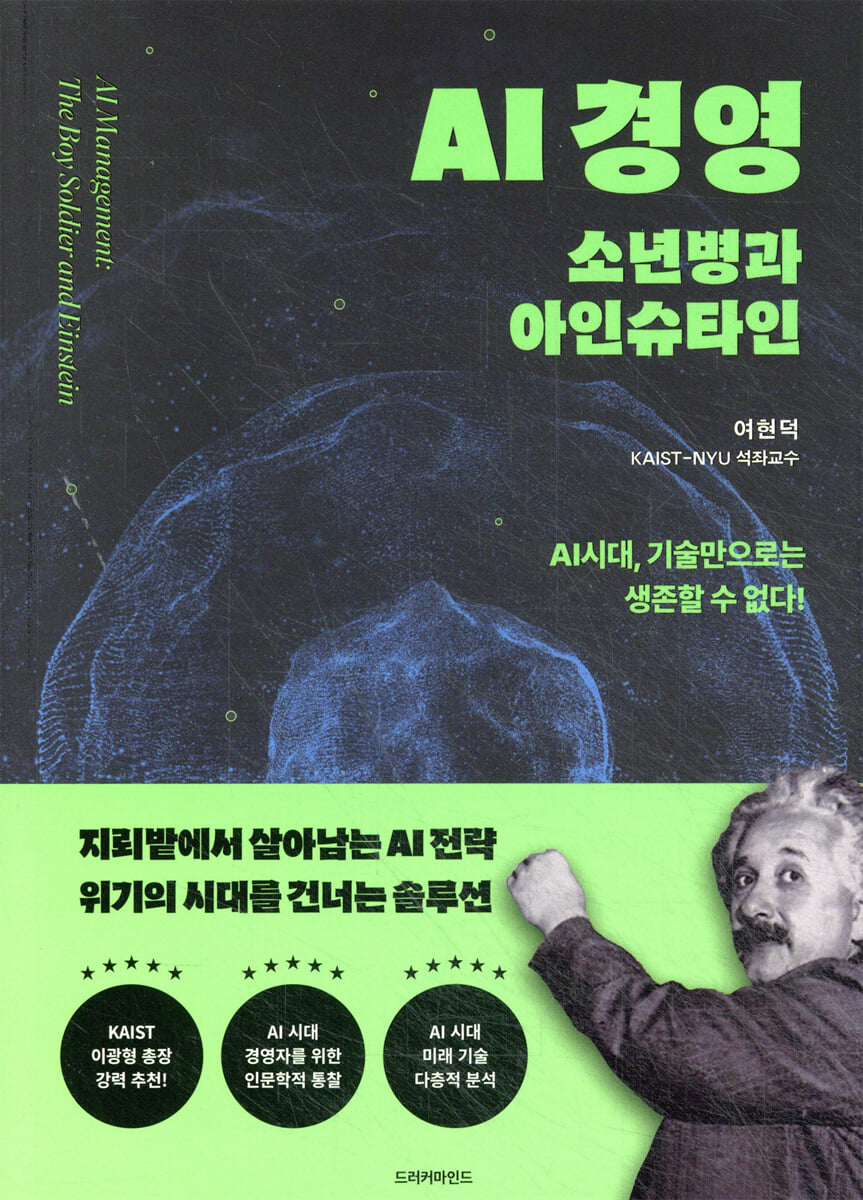
AI Management: Child Soldiers and Einstein
 |
Description
Book Introduction
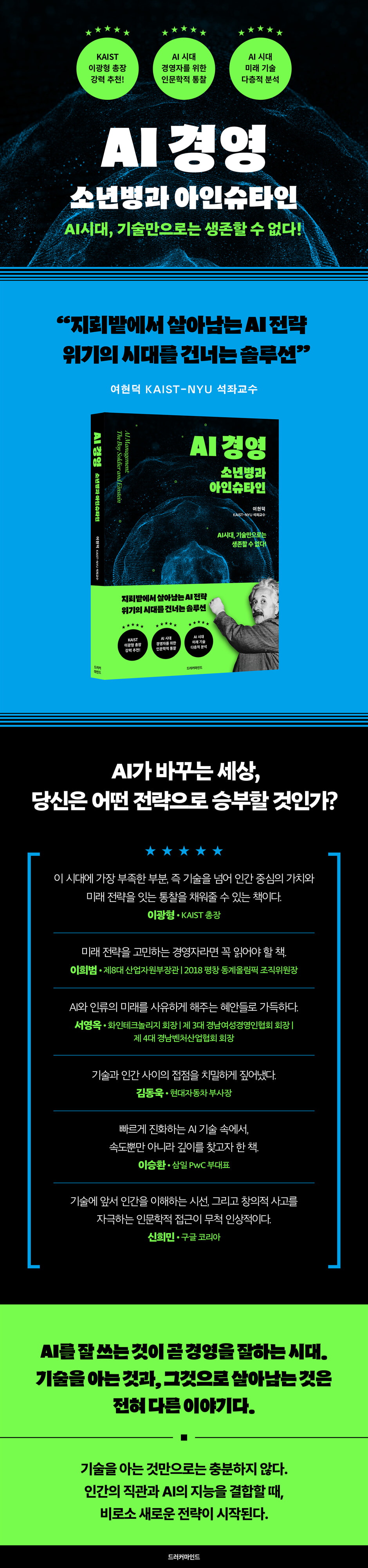
Beyond the rapid pace of AI technology change, we offer humanistic insights essential for management and AI utilization.
Professor Yeo Hyeon-deok, who is the director of KAIST G-School and head of the AI Management Program at the Graduate School of Technology Management, has published a book titled “AI Management: Child Soldiers and Einstein” by Druckermind.
"AI Management: Child Soldiers and Einstein" analyzes the multifaceted transformations of AI technology and delves into the new challenges and opportunities facing people, organizations, and businesses in the AI era. While AI is no longer a technology of the future but a buzzword of the present, many managers and organizations still hesitate when faced with the question, "How should we leverage AI?"
This is not simply a problem of utilizing technology, but rather a problem of perspective on AI, depth of understanding, and the changing management paradigm.
The author unravels the story from the case of a boy soldier clearing a minefield and Einstein's intuition.
This series explores how AI and humans can create collaborative intelligence (CQ) by crossing the boundaries of humanities, science, history, and art, from 'human AI' that communicates with companion animals, to emotional AI that reads emotions, and even the implications behind the illusions and limitations of LLM (Large-Scale Language Model).
However, the core message of this book is not limited to technical explanations, but rather the insights leaders need in today's rapidly changing environment and a new perspective on AI, humans, and organizations.
"Managing AI: Child Soldiers and Einstein" presents precisely this perspective, providing a strategic framework for interpreting and responding to complex environments.
The odd combination of a boy soldier and Einstein may seem dissonant at first, but it's actually a powerful metaphor that makes us think about AI and the future of humanity.
Here, 'child soldiers' symbolize members who act repetitively and passively according to orders within the organization.
They are loyal to given rules and procedures, but may lack creativity or critical thinking.
On the other hand, 'Einstein' symbolizes leadership, imagination, and insight that solve problems and design the future with creative thinking and innovative ideas.
In other words, 'boy soldier' is a role that performs simple repetitive tasks in the AI era, while 'Einstein' is a role that creates new value and leads management innovation by utilizing AI.
The author emphasizes that these two types of harmony and transition are essential in the era of AI management.
In Greco-Roman mythology, Prometheus stole fire from the gods and gave it to humans, and was punished terribly in return.
Today, the rapid development of generative AI is becoming a powerful tool for humanity, like a new 'fire'.
It could be a fire that threatens humanity, or it could be a fire that warms us.
Einstein emphasized that “new types of thinking are essential for humanity to survive and advance to higher levels.”
In an era of AI revolution where hope and concern intersect, we need a clear compass.
True change and innovation can only flourish on the philosophical foundation of "AI that embraces everyone" and "technology that centers on human dignity."
To put it very simply, there are two paths forward for us.
One is the 'cyborg path', which pursues technological advancement of AI itself, and the other is the 'chiron path', which seeks to make AI share beneficial human values and goals.
This book will serve as a practical guide for leaders contemplating sustainable AI management and practitioners, broadening their horizons and developing useful strategies for AI adoption. It will serve as a valuable guide for AI researchers, experts, business leaders, and anyone contemplating a new management paradigm.
Furthermore, the book's appeal lies in its perspective that future AI will be a strategic resource for management innovation, and that it should be understood as an "enhancer" rather than a "substitute," and a partner for collaboration rather than a competitor. Furthermore, the book emphasizes that in the business landscape that AI will transform, "people" will still be at the center of strategy, and that it meticulously analyzes the points of contact to suggest a direction for management.
Beyond the ordinary management and humanities book, "Managing AI: Child Soldiers and Einstein" offers insights for navigating complex times. It is a must-read for leaders who must make decisions in uncertain environments.
Professor Yeo Hyeon-deok, who is the director of KAIST G-School and head of the AI Management Program at the Graduate School of Technology Management, has published a book titled “AI Management: Child Soldiers and Einstein” by Druckermind.
"AI Management: Child Soldiers and Einstein" analyzes the multifaceted transformations of AI technology and delves into the new challenges and opportunities facing people, organizations, and businesses in the AI era. While AI is no longer a technology of the future but a buzzword of the present, many managers and organizations still hesitate when faced with the question, "How should we leverage AI?"
This is not simply a problem of utilizing technology, but rather a problem of perspective on AI, depth of understanding, and the changing management paradigm.
The author unravels the story from the case of a boy soldier clearing a minefield and Einstein's intuition.
This series explores how AI and humans can create collaborative intelligence (CQ) by crossing the boundaries of humanities, science, history, and art, from 'human AI' that communicates with companion animals, to emotional AI that reads emotions, and even the implications behind the illusions and limitations of LLM (Large-Scale Language Model).
However, the core message of this book is not limited to technical explanations, but rather the insights leaders need in today's rapidly changing environment and a new perspective on AI, humans, and organizations.
"Managing AI: Child Soldiers and Einstein" presents precisely this perspective, providing a strategic framework for interpreting and responding to complex environments.
The odd combination of a boy soldier and Einstein may seem dissonant at first, but it's actually a powerful metaphor that makes us think about AI and the future of humanity.
Here, 'child soldiers' symbolize members who act repetitively and passively according to orders within the organization.
They are loyal to given rules and procedures, but may lack creativity or critical thinking.
On the other hand, 'Einstein' symbolizes leadership, imagination, and insight that solve problems and design the future with creative thinking and innovative ideas.
In other words, 'boy soldier' is a role that performs simple repetitive tasks in the AI era, while 'Einstein' is a role that creates new value and leads management innovation by utilizing AI.
The author emphasizes that these two types of harmony and transition are essential in the era of AI management.
In Greco-Roman mythology, Prometheus stole fire from the gods and gave it to humans, and was punished terribly in return.
Today, the rapid development of generative AI is becoming a powerful tool for humanity, like a new 'fire'.
It could be a fire that threatens humanity, or it could be a fire that warms us.
Einstein emphasized that “new types of thinking are essential for humanity to survive and advance to higher levels.”
In an era of AI revolution where hope and concern intersect, we need a clear compass.
True change and innovation can only flourish on the philosophical foundation of "AI that embraces everyone" and "technology that centers on human dignity."
To put it very simply, there are two paths forward for us.
One is the 'cyborg path', which pursues technological advancement of AI itself, and the other is the 'chiron path', which seeks to make AI share beneficial human values and goals.
This book will serve as a practical guide for leaders contemplating sustainable AI management and practitioners, broadening their horizons and developing useful strategies for AI adoption. It will serve as a valuable guide for AI researchers, experts, business leaders, and anyone contemplating a new management paradigm.
Furthermore, the book's appeal lies in its perspective that future AI will be a strategic resource for management innovation, and that it should be understood as an "enhancer" rather than a "substitute," and a partner for collaboration rather than a competitor. Furthermore, the book emphasizes that in the business landscape that AI will transform, "people" will still be at the center of strategy, and that it meticulously analyzes the points of contact to suggest a direction for management.
Beyond the ordinary management and humanities book, "Managing AI: Child Soldiers and Einstein" offers insights for navigating complex times. It is a must-read for leaders who must make decisions in uncertain environments.
index
Part 1
Humans in the AI Age: The Child Soldier and Einstein
The Boy Soldier in the Minefield, Einstein, and the Mindless AI
Hesse's Wisdom, Love, and Large-Scale Language Models (LLMs)
The Dream of a Painter Who Painted Only One Woman for 15 Years and AI-CQ
Humans and AI: Emotional Artificial Intelligence 2AI
Autumn's Vegetarians and AI Hallucination
AI Winter vs. AI Autumn in the History of AI
Part 2
Bees: Living with AI, the Intrusive Human Being
Furry baby pets and human AI
How to live with the alien Vulcans, the "AI Tribe"
Is Beauty Innocent? Phryne and the AI Judge
Hippocrates, the AI doctor who never sleeps 24 hours a day
In the AI era, which is more important: the dog or the grandmother?
The Trolley's Dilemma
Firing by AI Algorithms: Beauty Doesn't Matter to AI Interviewers
Cancer Diagnosis and Medical Services (MaaS) in the AI Era
Human vs. AI Referees at the Olympics
Is AI anti-art? The antithesis and thesis.
Part 3
Guerrilla: Innovative AI that Transcends Everyday Life
Artificial Intelligence as a Game Changer
Honeybees and AI Guerillas
The Dilemma of Innovators and Good AI
History+AI_Creation at the edge of chaos
Game-changing AI innovations in the soccer industry
Denmark's AI Sovereignty Created by 'WiGobi'
Reverse aging and artificial intelligence that turn back time
Red Teams and Black Swans in AI Systems
AI Hubo Wars: The Robot's "Hand" Shakes Its Body
AI innovation that turns the heat wave crisis into an opportunity
Part 4
DeepMind Management in the AI Era and the Sage Chiron
My Unknown Mind: DeepMind's Management Algorithm
AI and humans, like the immortal sage Chiron
The Secret to an AI Researcher's Nobel Prize
Another AI - Hubo's Struggle for Recognition
AI Accelerationism and the Technology of the Trump Deal
The AI Talent War and K-Talent Strategy
Humans in the AI Age: The Child Soldier and Einstein
The Boy Soldier in the Minefield, Einstein, and the Mindless AI
Hesse's Wisdom, Love, and Large-Scale Language Models (LLMs)
The Dream of a Painter Who Painted Only One Woman for 15 Years and AI-CQ
Humans and AI: Emotional Artificial Intelligence 2AI
Autumn's Vegetarians and AI Hallucination
AI Winter vs. AI Autumn in the History of AI
Part 2
Bees: Living with AI, the Intrusive Human Being
Furry baby pets and human AI
How to live with the alien Vulcans, the "AI Tribe"
Is Beauty Innocent? Phryne and the AI Judge
Hippocrates, the AI doctor who never sleeps 24 hours a day
In the AI era, which is more important: the dog or the grandmother?
The Trolley's Dilemma
Firing by AI Algorithms: Beauty Doesn't Matter to AI Interviewers
Cancer Diagnosis and Medical Services (MaaS) in the AI Era
Human vs. AI Referees at the Olympics
Is AI anti-art? The antithesis and thesis.
Part 3
Guerrilla: Innovative AI that Transcends Everyday Life
Artificial Intelligence as a Game Changer
Honeybees and AI Guerillas
The Dilemma of Innovators and Good AI
History+AI_Creation at the edge of chaos
Game-changing AI innovations in the soccer industry
Denmark's AI Sovereignty Created by 'WiGobi'
Reverse aging and artificial intelligence that turn back time
Red Teams and Black Swans in AI Systems
AI Hubo Wars: The Robot's "Hand" Shakes Its Body
AI innovation that turns the heat wave crisis into an opportunity
Part 4
DeepMind Management in the AI Era and the Sage Chiron
My Unknown Mind: DeepMind's Management Algorithm
AI and humans, like the immortal sage Chiron
The Secret to an AI Researcher's Nobel Prize
Another AI - Hubo's Struggle for Recognition
AI Accelerationism and the Technology of the Trump Deal
The AI Talent War and K-Talent Strategy
Detailed image
Into the book
Marvin Minsky, a pioneer in artificial intelligence, viewed intelligence not as some kind of "magic" operation, but as the sum total of "agents."
In other words, intelligence is seen as an organization of countless agents that perform functions such as giving commands to the body to raise the right hand or raise the left foot.
When learning is introduced to the agent, a 'K-line', or knowledge line, is created.
--- p.12
There is an important point here that should not be missed.
The key factor that improved ChatGPT's performance was ultimately human feedback that judged the quality of the results generated by the AI model.
In other words, the answer to AI's intelligence (AIQ) lies in the process of coevolution with human intelligence, rather than ultimately replacing humans.
--- p.14
Professor Yoshua Bengio of the University of Montreal, considered the father of deep learning today, questions whether LLM can be considered general intelligence (AGI) because it deviates from the prevailing worldview. While LLM can generate text through pattern recognition and repetition of training data, he expresses skepticism about its ability to truly grasp the concepts or meaning of the human world.
It is similar to the assumption made by Alan Turing 50 years ago that if a machine cannot be distinguished from a human in a question and answer through the Turing test, then the machine has passed the Turing test and has minimal intelligence. --- p.20
MIT Media Lab professor Rosalind Picard is developing methodologies for programming emotions using 'affective AI' technology and is launching startups that can apply them to industrial settings.
A representative example is Affectiva, an emotional AI company founded in Boston with his Egyptian disciple, Lana.
Affectiva aims to improve road safety and passenger experience by monitoring driver status and passenger experience.
--- p.32
Depending on the human-AI collaboration method, joint intelligence can be classified as either the 'centaur' type or the 'cyborg' type.
The Centaur type is a cooperative model that helps each other while taking on the roles of humans and AI, like the half-man, half-horse characters of Greek mythology.
The cyborg type is a form in which humans and AI are fully integrated in real time.
For example, the former type is one in which a doctor makes a final diagnosis by referring to an AI diagnostic tool, while the latter type is one that is integrated into a patient's body, such as an artificial heart or brain-computer interface.
--- p.64
Today, there are many countries that have armored AI with national ideology.
They hold national identity, protection of their own language and culture, and geopolitical independence as their core ideologies.
India is pursuing digital independence by developing its own AI model, Krutrim, which reflects its unique linguistic and cultural context. The UAE is also pursuing digital independence by developing the Falcon AI model through state-owned enterprise G42.
However, it is ironic that the company has formed strategic partnerships with Huawei and Tencent and is working with Microsoft and Nvidia to secure its own AI chips.
--- p.141
The second type is 'multidisciplinary fusion robotics', which includes many autonomous robot companies today, such as Rainbow Robotics, Boston Dynamics, Tesla, Figure, and Agility Robotics.
They are accelerating the development of auto-hubos suitable for various demand sources based on the convergence of AI, robotics, control systems, and sensor technologies.
If you give them nicknames, their personalities are well revealed.
Boston Dynamics Atlas is a “robot gymnast,” Tesla Optimus is a “factory workaholic,” Figure AI (Figure 01) is a “job assistant digital intern,” Agility Robotics Digit is a “logistics deliveryman,” and Rainbow Robotics is a “techno artist,” all demonstrating a high level of craftsmanship.
--- p.
183
Meanwhile, Chiron was a special type of centaur wise enough to teach knowledge to humans, and was also the teacher of countless heroes such as Hercules and Achilles.
The centaur Chiron symbolizes a good hero who helps the needy.
For example, the news that a woman paralyzed from the waist down in the UK completed the London Marathon in 17 days wearing 'ReWalk Robotics' is a good example of AI successfully combining with humans.
--- p.208
Why did Herbert Simon start with political science? It was also because he wanted to solve practical problems.
He chose political science because he had a deep interest in decision-making in society and organizations.
So why did Simon later shift his interests to cognitive science, economics, management, psychology, and computer science?
--- p.
218
Competing in the AI talent war with only astronomical financial resources like global big tech companies is a losing battle.
Korea must win the talent war not only with its financial power but also with its attractiveness.
In other words, intelligence is seen as an organization of countless agents that perform functions such as giving commands to the body to raise the right hand or raise the left foot.
When learning is introduced to the agent, a 'K-line', or knowledge line, is created.
--- p.12
There is an important point here that should not be missed.
The key factor that improved ChatGPT's performance was ultimately human feedback that judged the quality of the results generated by the AI model.
In other words, the answer to AI's intelligence (AIQ) lies in the process of coevolution with human intelligence, rather than ultimately replacing humans.
--- p.14
Professor Yoshua Bengio of the University of Montreal, considered the father of deep learning today, questions whether LLM can be considered general intelligence (AGI) because it deviates from the prevailing worldview. While LLM can generate text through pattern recognition and repetition of training data, he expresses skepticism about its ability to truly grasp the concepts or meaning of the human world.
It is similar to the assumption made by Alan Turing 50 years ago that if a machine cannot be distinguished from a human in a question and answer through the Turing test, then the machine has passed the Turing test and has minimal intelligence. --- p.20
MIT Media Lab professor Rosalind Picard is developing methodologies for programming emotions using 'affective AI' technology and is launching startups that can apply them to industrial settings.
A representative example is Affectiva, an emotional AI company founded in Boston with his Egyptian disciple, Lana.
Affectiva aims to improve road safety and passenger experience by monitoring driver status and passenger experience.
--- p.32
Depending on the human-AI collaboration method, joint intelligence can be classified as either the 'centaur' type or the 'cyborg' type.
The Centaur type is a cooperative model that helps each other while taking on the roles of humans and AI, like the half-man, half-horse characters of Greek mythology.
The cyborg type is a form in which humans and AI are fully integrated in real time.
For example, the former type is one in which a doctor makes a final diagnosis by referring to an AI diagnostic tool, while the latter type is one that is integrated into a patient's body, such as an artificial heart or brain-computer interface.
--- p.64
Today, there are many countries that have armored AI with national ideology.
They hold national identity, protection of their own language and culture, and geopolitical independence as their core ideologies.
India is pursuing digital independence by developing its own AI model, Krutrim, which reflects its unique linguistic and cultural context. The UAE is also pursuing digital independence by developing the Falcon AI model through state-owned enterprise G42.
However, it is ironic that the company has formed strategic partnerships with Huawei and Tencent and is working with Microsoft and Nvidia to secure its own AI chips.
--- p.141
The second type is 'multidisciplinary fusion robotics', which includes many autonomous robot companies today, such as Rainbow Robotics, Boston Dynamics, Tesla, Figure, and Agility Robotics.
They are accelerating the development of auto-hubos suitable for various demand sources based on the convergence of AI, robotics, control systems, and sensor technologies.
If you give them nicknames, their personalities are well revealed.
Boston Dynamics Atlas is a “robot gymnast,” Tesla Optimus is a “factory workaholic,” Figure AI (Figure 01) is a “job assistant digital intern,” Agility Robotics Digit is a “logistics deliveryman,” and Rainbow Robotics is a “techno artist,” all demonstrating a high level of craftsmanship.
--- p.
183
Meanwhile, Chiron was a special type of centaur wise enough to teach knowledge to humans, and was also the teacher of countless heroes such as Hercules and Achilles.
The centaur Chiron symbolizes a good hero who helps the needy.
For example, the news that a woman paralyzed from the waist down in the UK completed the London Marathon in 17 days wearing 'ReWalk Robotics' is a good example of AI successfully combining with humans.
--- p.208
Why did Herbert Simon start with political science? It was also because he wanted to solve practical problems.
He chose political science because he had a deep interest in decision-making in society and organizations.
So why did Simon later shift his interests to cognitive science, economics, management, psychology, and computer science?
--- p.
218
Competing in the AI talent war with only astronomical financial resources like global big tech companies is a losing battle.
Korea must win the talent war not only with its financial power but also with its attractiveness.
--- p.238
GOODS SPECIFICS
- Date of issue: October 7, 2025
- Page count, weight, size: 242 pages | 378g | 147*204*14mm
- ISBN13: 9791194192442
- ISBN10: 1194192440
You may also like
카테고리
korean


korean

![ELLE 엘르 스페셜 에디션 A형 : 12월 [2025]](http://librairie.coreenne.fr/cdn/shop/files/b8e27a3de6c9538896439686c6b0e8fb.jpg?v=1766436872&width=3840)


