

History of AI
 |
Description
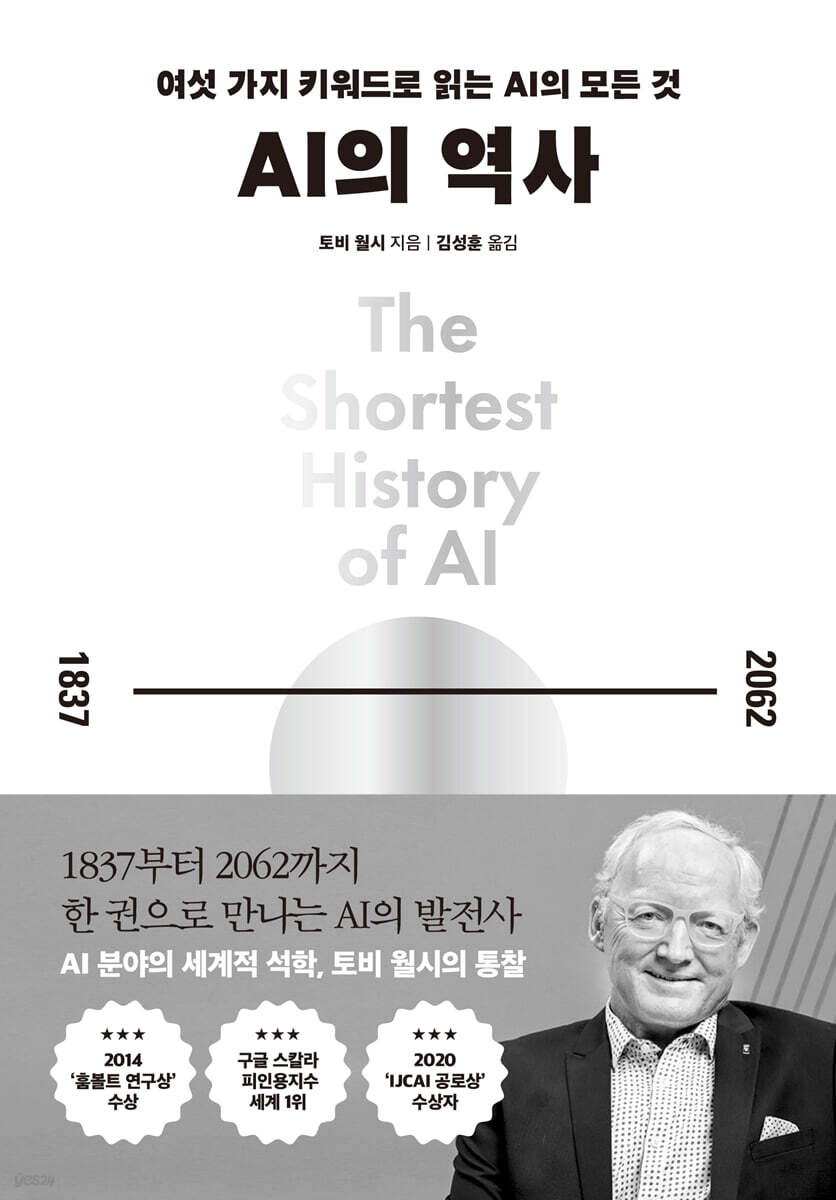
Book Introduction
From 1837 to 2062
The History of AI in One Volume
We have entered an era where we cannot complete homework without ChatGPT and housework becomes a hassle without a smart home system.
AI now goes beyond simply answering questions.
They provide psychological counseling, talk to you like friends, create photos in the animation style you want, and if you give them a topic, they create books and music in less than half a day.
While smartphones have transformed our daily lives over the past 20 years, AI is changing them dozens of times faster.
In an era where the key competitive advantage is whether we will be able to take our jobs from AI or empower it, do we truly understand AI? If not, what do we need to know right now? The Sejong Institute has published a book that answers these questions: "A History of AI."
Written by world-renowned AI expert Toby Walsh, this book charts the vast development of artificial intelligence since the 1800s.
It is a vast drama written by countless scholars, researchers, and companies through successes and failures, collaborations and competitions. It is also a report summarizing the rise and fall of the IT business, and a future forecast that foresees the changes to come.
To understand new technologies and revolutions, we must first examine how and why they were first researched.
This book provides a glimpse into the challenges and achievements of artificial intelligence research, which began with the questions, "Can machines think like humans?" and "Can robots replace human work?" over the past 100 years to reach its current state.
Above all, "A History of AI" is special in that it is the first history book to organize the past and present of AI, and also a prediction book that looks into the future.
The value of this book shines even brighter because it is the only book that provides a comprehensive overview of AI's past, present, and future in a single volume.
For readers who want to understand how artificial intelligence has changed the world and how it will continue to change in the future, this book will be an essential guide.
The History of AI in One Volume
We have entered an era where we cannot complete homework without ChatGPT and housework becomes a hassle without a smart home system.
AI now goes beyond simply answering questions.
They provide psychological counseling, talk to you like friends, create photos in the animation style you want, and if you give them a topic, they create books and music in less than half a day.
While smartphones have transformed our daily lives over the past 20 years, AI is changing them dozens of times faster.
In an era where the key competitive advantage is whether we will be able to take our jobs from AI or empower it, do we truly understand AI? If not, what do we need to know right now? The Sejong Institute has published a book that answers these questions: "A History of AI."
Written by world-renowned AI expert Toby Walsh, this book charts the vast development of artificial intelligence since the 1800s.
It is a vast drama written by countless scholars, researchers, and companies through successes and failures, collaborations and competitions. It is also a report summarizing the rise and fall of the IT business, and a future forecast that foresees the changes to come.
To understand new technologies and revolutions, we must first examine how and why they were first researched.
This book provides a glimpse into the challenges and achievements of artificial intelligence research, which began with the questions, "Can machines think like humans?" and "Can robots replace human work?" over the past 100 years to reach its current state.
Above all, "A History of AI" is special in that it is the first history book to organize the past and present of AI, and also a prediction book that looks into the future.
The value of this book shines even brighter because it is the only book that provides a comprehensive overview of AI's past, present, and future in a single volume.
For readers who want to understand how artificial intelligence has changed the world and how it will continue to change in the future, this book will be an essential guide.
- You can preview some of the book's contents.
Preview
index
Prologue: The Beginning of AI · 11
Part 1: The Age of Symbols
Idea 1: Exploring the Answer · 41
The First Artificial Mathematician | Extracting the Essence of a Problem | The Limits of Exploration
Idea 2: Making the Best Numbers · 62
The First AI Game | AI Chess | The First AI Champion | Perfect Play | Coping with Uncertainty
Idea 3: Follow the Rule · 83
The First Expert System | Bottleneck
Intermission Robots Are Coming · 96
Moravec's Paradox | The First Robot | Elmer and Elsie | Lost in Space | Roomba | Stanley | Sophia
Part 2: The Age of Learning
Idea 4: On Artificial Intelligence · 123
Artificial Neurons | Deep Learning | Learning Strategies | Transformers | Word Vectors | General Purpose Technologies | Eliza | Scaling Laws
Idea 5: Reward Your Success · 175
DeepMind | Ready | Move 37 | Protein Folding | That's Basic, Watson | Human Feedback
Idea 6: Reasoning About Belief · 203
Part 3: The Future
AI Achievements · 221
Singularity | The End of Work | Future Challenges
Acknowledgements
References
Part 1: The Age of Symbols
Idea 1: Exploring the Answer · 41
The First Artificial Mathematician | Extracting the Essence of a Problem | The Limits of Exploration
Idea 2: Making the Best Numbers · 62
The First AI Game | AI Chess | The First AI Champion | Perfect Play | Coping with Uncertainty
Idea 3: Follow the Rule · 83
The First Expert System | Bottleneck
Intermission Robots Are Coming · 96
Moravec's Paradox | The First Robot | Elmer and Elsie | Lost in Space | Roomba | Stanley | Sophia
Part 2: The Age of Learning
Idea 4: On Artificial Intelligence · 123
Artificial Neurons | Deep Learning | Learning Strategies | Transformers | Word Vectors | General Purpose Technologies | Eliza | Scaling Laws
Idea 5: Reward Your Success · 175
DeepMind | Ready | Move 37 | Protein Folding | That's Basic, Watson | Human Feedback
Idea 6: Reasoning About Belief · 203
Part 3: The Future
AI Achievements · 221
Singularity | The End of Work | Future Challenges
Acknowledgements
References
Detailed image

Into the book
Most scientific fields cannot be traced back to a specific starting date.
But AI is different.
Monday, June 18, 1956, was the first day of an eight-week workshop aimed at building intelligent machines, and this meeting became the starting point for the field of AI.
--- p.13
Perhaps the most brilliant intellectual to have conceived of thinking machines before 1956 was the British mathematician Alan Turing.
Time magazine selected Turing as one of the 100 most important people of the 20th century.
He, more than anyone else, contributed to the birth of the digital age we live in today.
--- p.23
Although there are few games left that challenge computers, games have played a significant role in the history of AI.
Games are a good choice for automation because their rules are precise and there is a clear winner.
And usually winning the game requires a fair amount of intelligence.
So games have provided a simple, ideal world in which to develop thinking machines and to quantify and evaluate their progress.
--- p.81
Comparing AI to a robot's "brain" is an oversimplification, but it captures an important truth.
Innovations in artificial intelligence, particularly in areas like computer vision, sensor fusion, and motion planning, have paved the way for breakthroughs in robotics. As AI algorithms become more sophisticated in their ability to perceive the world, understand language, and determine complex behaviors, robots have become increasingly capable and useful.
Therefore, the advancement of AI technology has been crucial in enabling robots to take on new roles.
--- p.97
The first problem that plagued the perceptron (the first artificial neural network structure) was that it could not learn even simple concepts such as 'odd' and 'even'.
Hinton quickly showed that adding an intermediate, or hidden, layer of neurons would allow the network to learn more complex functions, not just odd and even.
But Hinton didn't stop at simply adding one layer; he popularized the concept of "deep learning," which uses multiple layers of neural networks.
--- p.135
The overall idea behind ChatGPT is simple.
This is similar to the autocomplete feature on your smartphone, but a much more powerful version.
For auto-complete, smartphones have a dictionary containing words and their frequency of use.
When you type the word 'APP', the auto-complete feature tells you that the most likely word to complete it is 'APPLE'.
ChatGPT takes this one step further.
--- p.161
The AI singularity is the point at which our developed AI systems become so smart that they redesign themselves to become even smarter.
New, smarter AI systems can then redesign themselves to become even smarter, creating a snowball effect.
Unlike biological evolution, which takes thousands of years, such recursive performance improvements can happen overnight.
Then, artificial intelligence will quickly surpass human intelligence.
--- p.225
The next 10 to 20 years will be a challenging time. Technologies like AI can help solve these problems.
But to use AI effectively, we need to learn lessons from history.
For example, social media should have been a warning about how technology is disrupting our lives.
Now we are trying to further accelerate this disruption through AI.
If so, we must learn from the lessons of the past. Couldn't this book on the history of AI be a good starting point?
But AI is different.
Monday, June 18, 1956, was the first day of an eight-week workshop aimed at building intelligent machines, and this meeting became the starting point for the field of AI.
--- p.13
Perhaps the most brilliant intellectual to have conceived of thinking machines before 1956 was the British mathematician Alan Turing.
Time magazine selected Turing as one of the 100 most important people of the 20th century.
He, more than anyone else, contributed to the birth of the digital age we live in today.
--- p.23
Although there are few games left that challenge computers, games have played a significant role in the history of AI.
Games are a good choice for automation because their rules are precise and there is a clear winner.
And usually winning the game requires a fair amount of intelligence.
So games have provided a simple, ideal world in which to develop thinking machines and to quantify and evaluate their progress.
--- p.81
Comparing AI to a robot's "brain" is an oversimplification, but it captures an important truth.
Innovations in artificial intelligence, particularly in areas like computer vision, sensor fusion, and motion planning, have paved the way for breakthroughs in robotics. As AI algorithms become more sophisticated in their ability to perceive the world, understand language, and determine complex behaviors, robots have become increasingly capable and useful.
Therefore, the advancement of AI technology has been crucial in enabling robots to take on new roles.
--- p.97
The first problem that plagued the perceptron (the first artificial neural network structure) was that it could not learn even simple concepts such as 'odd' and 'even'.
Hinton quickly showed that adding an intermediate, or hidden, layer of neurons would allow the network to learn more complex functions, not just odd and even.
But Hinton didn't stop at simply adding one layer; he popularized the concept of "deep learning," which uses multiple layers of neural networks.
--- p.135
The overall idea behind ChatGPT is simple.
This is similar to the autocomplete feature on your smartphone, but a much more powerful version.
For auto-complete, smartphones have a dictionary containing words and their frequency of use.
When you type the word 'APP', the auto-complete feature tells you that the most likely word to complete it is 'APPLE'.
ChatGPT takes this one step further.
--- p.161
The AI singularity is the point at which our developed AI systems become so smart that they redesign themselves to become even smarter.
New, smarter AI systems can then redesign themselves to become even smarter, creating a snowball effect.
Unlike biological evolution, which takes thousands of years, such recursive performance improvements can happen overnight.
Then, artificial intelligence will quickly surpass human intelligence.
--- p.225
The next 10 to 20 years will be a challenging time. Technologies like AI can help solve these problems.
But to use AI effectively, we need to learn lessons from history.
For example, social media should have been a warning about how technology is disrupting our lives.
Now we are trying to further accelerate this disruption through AI.
If so, we must learn from the lessons of the past. Couldn't this book on the history of AI be a good starting point?
--- p.234
Publisher's Review
Toby Walsh, a world-renowned AI expert
Answering Hopes and Concerns Surrounding AI Technology and Industry
Professor Toby Walsh, a world-renowned authority on artificial intelligence, recently visited Korea and delivered lectures on "The Limits of Artificial Intelligence and the Rise of Humanistic AI" and "The Future of Human-Centered AI" at the World Knowledge Forum 2025. Having deeply reflected on the nature and future of AI, he met with Korean readers during his visit by introducing the Korean edition of his new book, "The Shortest History of AI," titled "The History of AI: Everything You Need to Know About AI in Six Keyword Guides."
There are generally two perspectives on AI.
There are two groups: those who are optimistic and look forward to the future, imagining how convenient life will be, and those who worry about what will happen if AI takes away jobs or dominates humans.
While those who are quick to embrace trends and fads are excited by the advancements in AI, others fear losing their jobs and careers.
In this book, Toby Walsh meticulously examines the most concerning and questionable aspects of AI and provides clear answers.
He reassures readers by stating that “AI has already surpassed human capabilities in narrow domains such as chess, X-ray reading, and turbine failure prediction,” but that “while existing AI systems are impressive and sometimes a little worrisome, we still have a long way to go to reach the ultimate goal of catching up with the rich intelligence of all humans.”
《A Brief History of AI》 shows that while AI may seem like an overnight phenomenon that will reshape the world, like most technological advancements, it was the result of a long period of preparation.
As it turns out, AI has been ingrained in our daily lives for decades, and the accumulated research and effort has recently resulted in the release of various tools and systems in various fields, including ChatGPT.
The author warns that the rapid pace of advancement in artificial intelligence poses several clearly visible risks.
The global economy will grapple with massive unemployment and income inequality, democracy could be threatened by misinformation and disinformation, and robots, now weapons of mass destruction, could horribly change the face of war, he warns.
It is not difficult to imagine various negative consequences beyond the areas he pointed out.
But the author also emphasizes the great advantages of artificial intelligence.
In fact, AI is already playing a major role in improving human life.
For example, the recently developed antibiotic Halicin was discovered through artificial intelligence, not human intelligence, and is contributing to the health of countless people.
AI is also helping us in many ways, such as analyzing brain scans to detect early signs of Alzheimer's disease, preventing financial fraud, and predicting maintenance schedules for aging water pipes to prevent problems before they occur.
Therefore, understanding and exploring artificial intelligence is a much more profound process and topic of discussion than simply developing technologies that improve individual living standards.
This book, without missing a beat, asks two fundamental questions that delve into the core of human existence.
"What makes human intelligence so special?" and "Can we actually build human intelligence within silicon?" The answers to these two questions can be found in "A History of AI."
Symbols, predictions, rules, learning, rewards, and probabilities
An easy-to-read AI textbook with six keywords
《History of AI》 is composed of three parts, six chapters, and an intermission.
Part 1 of "A History of AI," "The Age of Symbols," follows the exciting early journey of AI as it evolved from a simple calculator to a self-thinking being, following three ideas: symbols, predictions, and rules.
Since ancient times, humans have laid the foundation for AI by combining various symbols such as numbers, pictures, and letters with logical reasoning.
Since the official emergence of AI at Dartmouth in 1956, the possibilities of surpassing human strategic thinking have been explored through games and problem solving, leading to innovations that have become the cornerstones of today's AI, such as expert systems, logical programming, and management rules.
The wisdom and legacy accumulated through periods of prosperity and recession are vividly displayed.
The 'intermission' between parts 1 and 2 covers the history of robotics.
While some machines are as simple as robots used in massive manufacturing plants for automobiles and appliances, AI innovations in computer vision, sensor fusion, and motion planning have ushered in new breakthroughs in robotics.
This chapter provides a fascinating account of the evolution of robotics, from the world's first robots, Elmer and Elsie, to space robots from novels and movies, the home robot Roomba, the pioneer of autonomous driving, Stanley, and the humanoid robot Sophia.
Part 2, "The Age of Learning," shows how AI has rapidly developed, focusing on three ideas: learning, reward, and probability.
AI research, which began with the question posed by Alan Turing, known as the father of computer science, “Can computers learn like humans?”, led to Walter Pitts and Warren McCulloch’s first neural network, Frank Rosenblatt’s perceptron, and Geoffrey Hinton’s deep neural network, leading to today’s deep learning.
It also includes fascinating anecdotes about the many trials and errors experienced during the process, as well as the fascinating stories of eccentric scientists.
After decades of research, backed by GPUs and massive amounts of data, AI is finally reaching practical application.
OpenAI revolutionized language models with GPT and ChatGPT, while DeepMind transformed the landscape of Go and life sciences with AlphaGo and AlphaFold, respectively. IBM demonstrated the potential of AI in chess and quiz competitions.
The author vividly tells the story of how AI, which started as a single idea, grew into a learning tool that surpasses human imagination, and the scientists, technologies, and companies behind it.
The final third part focuses on ‘the future transformed by AI.’
According to the AI Index published last year, the amount of online data essential to AI technology and the number of AI-related patents are doubling every two years, and this pace is expected to accelerate even further in the future.
So, will these advancements in AI be beneficial or detrimental to humans?
There has always been concern that technology threatens human life.
Even during the Industrial Revolution and with the advent of the internet and smartphones, our daily lives changed dramatically. AI will do the same, dramatically altering the way we are born, live, work, and play.
But what makes this AI revolution different from previous ones is its speed.
The Industrial Revolution took over 50 years to unfold, electricity took several decades to become widespread, and the internet took about a decade, but AI evolves in just one year.
Even if it's fast, it's too fast.
This is why we need to think seriously about the future of AI.
While most focus solely on the future of labor and jobs brought about by AI, the author points out that a much wider range of fields will be affected by AI, including healthcare, education, mobility, copyright, personal information, finance, responsibility, ethics, open source, and even ontological issues.
According to him, the next 10 to 20 years will be a time of great challenge.
Answering Hopes and Concerns Surrounding AI Technology and Industry
Professor Toby Walsh, a world-renowned authority on artificial intelligence, recently visited Korea and delivered lectures on "The Limits of Artificial Intelligence and the Rise of Humanistic AI" and "The Future of Human-Centered AI" at the World Knowledge Forum 2025. Having deeply reflected on the nature and future of AI, he met with Korean readers during his visit by introducing the Korean edition of his new book, "The Shortest History of AI," titled "The History of AI: Everything You Need to Know About AI in Six Keyword Guides."
There are generally two perspectives on AI.
There are two groups: those who are optimistic and look forward to the future, imagining how convenient life will be, and those who worry about what will happen if AI takes away jobs or dominates humans.
While those who are quick to embrace trends and fads are excited by the advancements in AI, others fear losing their jobs and careers.
In this book, Toby Walsh meticulously examines the most concerning and questionable aspects of AI and provides clear answers.
He reassures readers by stating that “AI has already surpassed human capabilities in narrow domains such as chess, X-ray reading, and turbine failure prediction,” but that “while existing AI systems are impressive and sometimes a little worrisome, we still have a long way to go to reach the ultimate goal of catching up with the rich intelligence of all humans.”
《A Brief History of AI》 shows that while AI may seem like an overnight phenomenon that will reshape the world, like most technological advancements, it was the result of a long period of preparation.
As it turns out, AI has been ingrained in our daily lives for decades, and the accumulated research and effort has recently resulted in the release of various tools and systems in various fields, including ChatGPT.
The author warns that the rapid pace of advancement in artificial intelligence poses several clearly visible risks.
The global economy will grapple with massive unemployment and income inequality, democracy could be threatened by misinformation and disinformation, and robots, now weapons of mass destruction, could horribly change the face of war, he warns.
It is not difficult to imagine various negative consequences beyond the areas he pointed out.
But the author also emphasizes the great advantages of artificial intelligence.
In fact, AI is already playing a major role in improving human life.
For example, the recently developed antibiotic Halicin was discovered through artificial intelligence, not human intelligence, and is contributing to the health of countless people.
AI is also helping us in many ways, such as analyzing brain scans to detect early signs of Alzheimer's disease, preventing financial fraud, and predicting maintenance schedules for aging water pipes to prevent problems before they occur.
Therefore, understanding and exploring artificial intelligence is a much more profound process and topic of discussion than simply developing technologies that improve individual living standards.
This book, without missing a beat, asks two fundamental questions that delve into the core of human existence.
"What makes human intelligence so special?" and "Can we actually build human intelligence within silicon?" The answers to these two questions can be found in "A History of AI."
Symbols, predictions, rules, learning, rewards, and probabilities
An easy-to-read AI textbook with six keywords
《History of AI》 is composed of three parts, six chapters, and an intermission.
Part 1 of "A History of AI," "The Age of Symbols," follows the exciting early journey of AI as it evolved from a simple calculator to a self-thinking being, following three ideas: symbols, predictions, and rules.
Since ancient times, humans have laid the foundation for AI by combining various symbols such as numbers, pictures, and letters with logical reasoning.
Since the official emergence of AI at Dartmouth in 1956, the possibilities of surpassing human strategic thinking have been explored through games and problem solving, leading to innovations that have become the cornerstones of today's AI, such as expert systems, logical programming, and management rules.
The wisdom and legacy accumulated through periods of prosperity and recession are vividly displayed.
The 'intermission' between parts 1 and 2 covers the history of robotics.
While some machines are as simple as robots used in massive manufacturing plants for automobiles and appliances, AI innovations in computer vision, sensor fusion, and motion planning have ushered in new breakthroughs in robotics.
This chapter provides a fascinating account of the evolution of robotics, from the world's first robots, Elmer and Elsie, to space robots from novels and movies, the home robot Roomba, the pioneer of autonomous driving, Stanley, and the humanoid robot Sophia.
Part 2, "The Age of Learning," shows how AI has rapidly developed, focusing on three ideas: learning, reward, and probability.
AI research, which began with the question posed by Alan Turing, known as the father of computer science, “Can computers learn like humans?”, led to Walter Pitts and Warren McCulloch’s first neural network, Frank Rosenblatt’s perceptron, and Geoffrey Hinton’s deep neural network, leading to today’s deep learning.
It also includes fascinating anecdotes about the many trials and errors experienced during the process, as well as the fascinating stories of eccentric scientists.
After decades of research, backed by GPUs and massive amounts of data, AI is finally reaching practical application.
OpenAI revolutionized language models with GPT and ChatGPT, while DeepMind transformed the landscape of Go and life sciences with AlphaGo and AlphaFold, respectively. IBM demonstrated the potential of AI in chess and quiz competitions.
The author vividly tells the story of how AI, which started as a single idea, grew into a learning tool that surpasses human imagination, and the scientists, technologies, and companies behind it.
The final third part focuses on ‘the future transformed by AI.’
According to the AI Index published last year, the amount of online data essential to AI technology and the number of AI-related patents are doubling every two years, and this pace is expected to accelerate even further in the future.
So, will these advancements in AI be beneficial or detrimental to humans?
There has always been concern that technology threatens human life.
Even during the Industrial Revolution and with the advent of the internet and smartphones, our daily lives changed dramatically. AI will do the same, dramatically altering the way we are born, live, work, and play.
But what makes this AI revolution different from previous ones is its speed.
The Industrial Revolution took over 50 years to unfold, electricity took several decades to become widespread, and the internet took about a decade, but AI evolves in just one year.
Even if it's fast, it's too fast.
This is why we need to think seriously about the future of AI.
While most focus solely on the future of labor and jobs brought about by AI, the author points out that a much wider range of fields will be affected by AI, including healthcare, education, mobility, copyright, personal information, finance, responsibility, ethics, open source, and even ontological issues.
According to him, the next 10 to 20 years will be a time of great challenge.
GOODS SPECIFICS
- Date of issue: September 30, 2025
- Page count, weight, size: 240 pages | 434g | 150*215*15mm
- ISBN13: 9791163730231
- ISBN10: 1163730238
You may also like
카테고리
korean


korean

![GQ KOREA Mark (Monthly): December [2025]](http://librairie.coreenne.fr/cdn/shop/files/8ef265dbbfbf186523ed75ba7319009d.jpg?v=1765340328&width=3840)


