

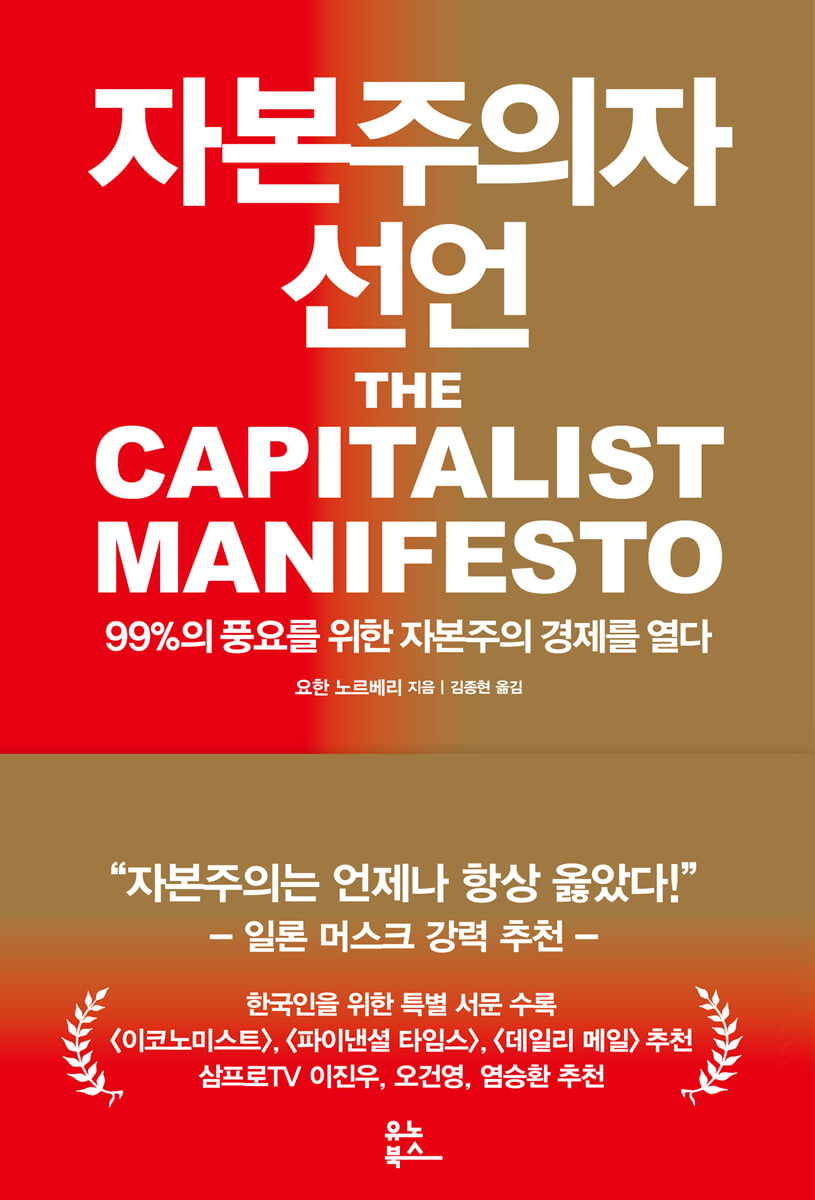
Capitalist Manifesto
 |
Description
Book Introduction
"Capitalism has always been right!" - Highly recommended by Elon Musk
★ Amazon bestseller immediately after publication
★ Recommended by [The Economist], [The Financial Times], and [The Daily Mail]
★ Recommended by Sampro TV's Lee Jin-woo, Oh Geon-young, and Yeom Seung-hwan
Is this generation having a harder time than the previous generation?
Do America First and High Tariffs Benefit a Country More?
Are the capitalists the exploiters and the workers the exploited?
Can money buy happiness, freedom, solidarity, and the environment?
A new future for wealth and growth presented by an economic historian after extensive research.
Johan Norberg, an economic historian who has studied the international economy and capitalism for decades, a columnist for leading economic publications such as [The Wall Street Journal], [Reason], and [The Spectator], and an economic documentary director, presents the future of a capitalist economy for the 99%.
The book became an Amazon bestseller immediately after its publication and received rave reviews from media outlets, experts, and businesspeople around the world.
It is a hot topic in Korea that has been receiving attention from major media outlets and economic experts even before its publication.
The international situation fluctuates every day.
Since President Trump took office, the United States has shaken the global trade order with its shocking tariff policies, and the hegemony competition between the United States and China has entered a new phase with a technological competition.
With the protracted war between Russia and Ukraine and the slowdown in globalization, countries around the world are turning to protectionism and self-preservation.
Inflation, high interest rates, and high prices are putting pressure on households and increasing generational conflict.
Additionally, environmental issues caused by climate change, refugee issues, and racial conflicts spread anxiety across countries and generations.
In this situation, capitalism is facing a crisis and is pointed out as the cause of all problems.
But just as it drove unprecedented growth in the past, capitalism remains the most powerful system capable of guiding and reorganizing the present and future.
In "The Capitalist Manifesto," Johan Norberg, after extensive research and investigation, answers the question, "Why do we need to discuss capitalism again now?" and discusses a new capitalism.
This book, which explores where capitalism is today, where it should go in the future, and the choices that nations and individuals must make within the capitalist system, presents a fascinating story and data-driven approach in nine chapters.
From Trump's tariff bomb and the future of Xi Jinping and China's socialist economy to the story of shifting left-right policies, the relationship between government subsidies and economic growth, the story of hotels that demonstrate income inequality and the narrowing of the gap, the real profit structure of capitalists, the competition between Starbucks and neighborhood cafes, and understanding symbiotic capitalism through a cup of coffee.
The author's exceptional storytelling and insight will help you understand the essence of the market economy and economic freedom.
In uncertain times, it is a compass offering choices to those seeking greater prosperity and freedom.
★ Amazon bestseller immediately after publication
★ Recommended by [The Economist], [The Financial Times], and [The Daily Mail]
★ Recommended by Sampro TV's Lee Jin-woo, Oh Geon-young, and Yeom Seung-hwan
Is this generation having a harder time than the previous generation?
Do America First and High Tariffs Benefit a Country More?
Are the capitalists the exploiters and the workers the exploited?
Can money buy happiness, freedom, solidarity, and the environment?
A new future for wealth and growth presented by an economic historian after extensive research.
Johan Norberg, an economic historian who has studied the international economy and capitalism for decades, a columnist for leading economic publications such as [The Wall Street Journal], [Reason], and [The Spectator], and an economic documentary director, presents the future of a capitalist economy for the 99%.
The book became an Amazon bestseller immediately after its publication and received rave reviews from media outlets, experts, and businesspeople around the world.
It is a hot topic in Korea that has been receiving attention from major media outlets and economic experts even before its publication.
The international situation fluctuates every day.
Since President Trump took office, the United States has shaken the global trade order with its shocking tariff policies, and the hegemony competition between the United States and China has entered a new phase with a technological competition.
With the protracted war between Russia and Ukraine and the slowdown in globalization, countries around the world are turning to protectionism and self-preservation.
Inflation, high interest rates, and high prices are putting pressure on households and increasing generational conflict.
Additionally, environmental issues caused by climate change, refugee issues, and racial conflicts spread anxiety across countries and generations.
In this situation, capitalism is facing a crisis and is pointed out as the cause of all problems.
But just as it drove unprecedented growth in the past, capitalism remains the most powerful system capable of guiding and reorganizing the present and future.
In "The Capitalist Manifesto," Johan Norberg, after extensive research and investigation, answers the question, "Why do we need to discuss capitalism again now?" and discusses a new capitalism.
This book, which explores where capitalism is today, where it should go in the future, and the choices that nations and individuals must make within the capitalist system, presents a fascinating story and data-driven approach in nine chapters.
From Trump's tariff bomb and the future of Xi Jinping and China's socialist economy to the story of shifting left-right policies, the relationship between government subsidies and economic growth, the story of hotels that demonstrate income inequality and the narrowing of the gap, the real profit structure of capitalists, the competition between Starbucks and neighborhood cafes, and understanding symbiotic capitalism through a cup of coffee.
The author's exceptional storytelling and insight will help you understand the essence of the market economy and economic freedom.
In uncertain times, it is a compass offering choices to those seeking greater prosperity and freedom.
- You can preview some of the book's contents.
Preview
index
Recommendation
Elon Musk's book that explains capitalism beyond success.
Lee Jin-woo | A must-read economics book in this time of prosperity and crisis.
Oh Geon-young | Breaking down prejudices, rich case studies, and inspiring insights
Yeom Seung-hwan | A masterpiece that conveys the values we need now.
Praise from the press
Special Preface to the Korean Edition: For a Nation That Believes in the Values of an Open Society and Markets
To begin, why I call myself a capitalist
As a result of the capitalist debate of the 2000s, globalization must be pursued more actively.
The 2010s' anti-capitalist cry: Excessive globalization is exploiting developed countries.
The era that opened under Reagan and Thatcher is now closed under Trump and Truss.
Progressive and conservative policies that don't know whose policies they are
Why are we talking about capitalism again now?
Chapter 1.
Capitalist vs.
non-capitalist
: What caused explosive economic growth?
- Poverty rates, mortality rates, and illiteracy rates have been cut in half over the past 30 years since globalization.
-The spread of capitalism from Britain to Eastern Europe
-Why is Latin America an exception?
-Why hasn't Africa developed?
A country where you can enjoy the freedom of seeing your grandchildren
- An era in which the average annual growth rate of poor countries exceeded that of developed countries.
A strong leader creates a weak nation.
-How do populists ruin a country's economy?
Chapter 2.
Growth vs.
redistribution
: Can a market economy be planned?
-1% difference in economic growth rate
The conflicting relationship between short-term welfare spending and economic growth rates.
-Capitalism in a cup of coffee
-The story of a black passenger in America and a Dalit worker in India
-Invisible hand and visible hand
-Freedom of economic rights that respect 'yours' and 'mine'
-Shouldn't the government intervene when a crisis occurs?
Chapter 3.
Growing a Pie vs.
zero-sum
: Whose jobs did we lose?
- In other countries, machines took your job?
- Opportunity to upgrade to a hotel suite
-For modern people suffering from work stress
- Insecurity and stability, time and income, flexibility and compulsion, growth and elimination
-Do you think Chinese imports will create jobs in the country?
-A system of despair that forces people to become poor
-After Brexit in the UK
Chapter 4.
Billionaire vs.
we
: Are the rich thieves who exploit workers to make money?
-The story of a straw hat business that took place in a certain village.
-2.2% of profits taken by capitalists
-Great-grandmother's great-grandfather's great-grandmother's time machine
-Thomas Piketty and the survivors of the Forbes 400 Billionaires list
-If the money of the rich is shared with the poor
-Does inequality kill people?
-Clique capitalists who only want their own interests
-Zombie companies created by policies
Chapter 5.
Giants vs.
Challengers
: Is there any market left to delve into the monopoly market?
-Companies compete, not monopolize.
-The idea that the company is a fraud
-Do corporations encourage consumption, or do people enjoy consumption?
-The Impact of Web Capitalism on Us
Why Big Tech Can Remain a Leader
-Data is sand
Chapter 6.
Government-led vs.
market leader
: Where do innovation and growth begin?
-People who claim that corporate innovation and growth begin with the government.
-What's hidden behind the successful government-led industrial policy
- Vasa, built by the Swedish royal family, and welfare entrepreneurs who earn national money
-The Last Frontier
Chapter 7.
China vs.
world
: Who will be the winner of the competition for hegemony?
Privatization spread like fleas across the continent
-The Chinese authorities have never thought about reform.
The counterattack of Maoism that has raised its head again
-Would China have been less of a threat if it were poorer than it is now?
Xi Jinping returns to the past
-Will you go out into the economic market or will you be trapped in an economic prison?
Chapter 8.
Environment vs.
growth
: Which comes first, the environment or growth?
-If we stop growing, will environmental problems be solved?
An unexpected way to reduce the human footprint on Earth.
-Why you don't have to worry about depleting any resources
The richer you become, the more you can protect the environment.
-Why domestic production and tariffs are not beneficial
- Carbon tax, carbon border tax, and carbon pricing and tax debate
Chapter 9.
Capitalism vs.
humanity
: Can we find meaning in life under capitalism?
-A rebuttal to the claim that there is no meaning in life under capitalism.
-Are we really lonely and hurting?
-An experiment proving that there are more altruistic people in capitalist societies.
-On the happiness of our society
-The true meaning of economic freedom
In closing, to all capitalists who pursue progress and freedom:
A Capitalist's Perspective on Today
A Roman Emperor's Song Contest
annotation
Elon Musk's book that explains capitalism beyond success.
Lee Jin-woo | A must-read economics book in this time of prosperity and crisis.
Oh Geon-young | Breaking down prejudices, rich case studies, and inspiring insights
Yeom Seung-hwan | A masterpiece that conveys the values we need now.
Praise from the press
Special Preface to the Korean Edition: For a Nation That Believes in the Values of an Open Society and Markets
To begin, why I call myself a capitalist
As a result of the capitalist debate of the 2000s, globalization must be pursued more actively.
The 2010s' anti-capitalist cry: Excessive globalization is exploiting developed countries.
The era that opened under Reagan and Thatcher is now closed under Trump and Truss.
Progressive and conservative policies that don't know whose policies they are
Why are we talking about capitalism again now?
Chapter 1.
Capitalist vs.
non-capitalist
: What caused explosive economic growth?
- Poverty rates, mortality rates, and illiteracy rates have been cut in half over the past 30 years since globalization.
-The spread of capitalism from Britain to Eastern Europe
-Why is Latin America an exception?
-Why hasn't Africa developed?
A country where you can enjoy the freedom of seeing your grandchildren
- An era in which the average annual growth rate of poor countries exceeded that of developed countries.
A strong leader creates a weak nation.
-How do populists ruin a country's economy?
Chapter 2.
Growth vs.
redistribution
: Can a market economy be planned?
-1% difference in economic growth rate
The conflicting relationship between short-term welfare spending and economic growth rates.
-Capitalism in a cup of coffee
-The story of a black passenger in America and a Dalit worker in India
-Invisible hand and visible hand
-Freedom of economic rights that respect 'yours' and 'mine'
-Shouldn't the government intervene when a crisis occurs?
Chapter 3.
Growing a Pie vs.
zero-sum
: Whose jobs did we lose?
- In other countries, machines took your job?
- Opportunity to upgrade to a hotel suite
-For modern people suffering from work stress
- Insecurity and stability, time and income, flexibility and compulsion, growth and elimination
-Do you think Chinese imports will create jobs in the country?
-A system of despair that forces people to become poor
-After Brexit in the UK
Chapter 4.
Billionaire vs.
we
: Are the rich thieves who exploit workers to make money?
-The story of a straw hat business that took place in a certain village.
-2.2% of profits taken by capitalists
-Great-grandmother's great-grandfather's great-grandmother's time machine
-Thomas Piketty and the survivors of the Forbes 400 Billionaires list
-If the money of the rich is shared with the poor
-Does inequality kill people?
-Clique capitalists who only want their own interests
-Zombie companies created by policies
Chapter 5.
Giants vs.
Challengers
: Is there any market left to delve into the monopoly market?
-Companies compete, not monopolize.
-The idea that the company is a fraud
-Do corporations encourage consumption, or do people enjoy consumption?
-The Impact of Web Capitalism on Us
Why Big Tech Can Remain a Leader
-Data is sand
Chapter 6.
Government-led vs.
market leader
: Where do innovation and growth begin?
-People who claim that corporate innovation and growth begin with the government.
-What's hidden behind the successful government-led industrial policy
- Vasa, built by the Swedish royal family, and welfare entrepreneurs who earn national money
-The Last Frontier
Chapter 7.
China vs.
world
: Who will be the winner of the competition for hegemony?
Privatization spread like fleas across the continent
-The Chinese authorities have never thought about reform.
The counterattack of Maoism that has raised its head again
-Would China have been less of a threat if it were poorer than it is now?
Xi Jinping returns to the past
-Will you go out into the economic market or will you be trapped in an economic prison?
Chapter 8.
Environment vs.
growth
: Which comes first, the environment or growth?
-If we stop growing, will environmental problems be solved?
An unexpected way to reduce the human footprint on Earth.
-Why you don't have to worry about depleting any resources
The richer you become, the more you can protect the environment.
-Why domestic production and tariffs are not beneficial
- Carbon tax, carbon border tax, and carbon pricing and tax debate
Chapter 9.
Capitalism vs.
humanity
: Can we find meaning in life under capitalism?
-A rebuttal to the claim that there is no meaning in life under capitalism.
-Are we really lonely and hurting?
-An experiment proving that there are more altruistic people in capitalist societies.
-On the happiness of our society
-The true meaning of economic freedom
In closing, to all capitalists who pursue progress and freedom:
A Capitalist's Perspective on Today
A Roman Emperor's Song Contest
annotation
Detailed image

Into the book
Twenty years ago I wrote a book called In Defense of Global Capitalism.
I never imagined I would write a book like that.
This is because capitalism was considered a world of greedy monopolists and powerful landowners.
But as I studied the world, I realized that in societies where markets are virtually non-existent, only the elite are protected as citizens and wield the most power.
Paradoxically, it was capitalism itself that threatened those in power.
Voluntary contracts based on free markets and private property were at its core.
The reason for defending capitalism is not that capitalists always act well, but that when they do not, free competition and opportunity for choice control them.
---From "Why I Called Myself a Capitalist"
'How can we create wealth?' As the memory of these failures fades, a new generation of politicians often repeats the same mistakes.
Those who forget past failures are tempted to try irrational policies such as protectionism, state-led industrial policies, rigid regulations, and excessive taxes.
This only stifles the momentum of economic growth.
The damage is borne entirely by the most vulnerable.
Furthermore, it threatens the world economy itself, which has been the most powerful driving force behind human development.
The past 20 years have been a series of turmoil.
We have had to endure shocking events, pandemics, and wars.
Yet, these 20 years were the most prosperous period in human history.
During this period, extreme poverty decreased by 70%.
This means that since I first advocated global capitalism, 138,000 people have been lifted out of poverty every day.
138,000 people per day.
People of all ages and genders escaped poverty every day.
Even taking into account the temporary increase during the pandemic, this figure is still an overwhelming achievement.
This progress must be preserved and expanded further.
---From "Why I Called Myself a Capitalist"
It has become clear that capitalism's success stories are not confined to the West.
Then a new narrative emerged.
“A few developing countries may be able to enter the world market, but only because they are so small that they are negligible.” But today, we hear the opposite argument.
“Developing countries may succeed, but only because they are so big.”
---From "The Spread of Capitalism from Britain to Eastern Europe"
A dictator who complains that economic growth is too slow is like a farmer who has no patience to wait for the harvest.
He gains popularity by allowing people to eat their fill of seeds, but eventually the remaining seeds run out, leaving even less food for the next season.
Ultimately, it's about consuming until other people's harvest runs out.
As Margaret Thatcher said, if you use up everything that belongs to others, you can no longer sustain yourself.
---From "How Populists Destroy the National Economy"
The wealthier a country is, the longer and healthier its people live, and the better its outcomes are across nearly every quality-of-life indicator.
Of course, economic growth has also become a powerful means of exploiting nature.
But as we will see in Chapter 8, wealthier countries are better able to protect their environment and repair damage.
The moment a country decides to make this a priority, its problem-solving capabilities also become stronger.
This means that no matter what values we value, we should prefer a society with a faster-growing economy.
Moreover, no matter what crisis or disaster may arise in the future, it is much more advantageous to face it with greater wealth, higher knowledge, and more advanced technology.
We must constantly move forward.
One reason is that the problems we previously solved often lead to new, unexpected problems.
---From "1% Difference in Economic Growth Rate"
If the 1950s and 1960s were the golden age of the Western labor market, why do most people who worked during that era remember their experiences as "dirt, exhaustion, boredom, broken bodies, and exhausted minds"? The reason workers went to such lengths to ensure their children received a better education was because they wanted them to pursue different types of jobs.
A steelworker in Pennsylvania warned his children:
“If you come in here, you might not even be able to get out.
Even if you go out, you could lose an arm, an eye, or a leg.
You have to do something for yourselves.”
---From "Were your jobs taken away by machines in other countries?"
Capitalism is a surprisingly advantageous system even for non-capitalists.
Entrepreneurs work day and night, taking on debt, mortgaging their homes, and neglecting their friends and family.
And even if he overcomes all difficulties and succeeds, he only takes home 2.2%.
Meanwhile, we take the other 98% while lying on the couch watching a movie.
This is because goods and services can be availed at lower prices, which increases purchasing power.
This is a form of inequality that benefits us all.
The more profits entrepreneurs generate, the more value we capture from the 98%.
Even if you only get 2.2% of the billions of dollars in profits, you could become the next Ingvar Kamprad, Bill Gates, or Elon Musk.
And the hope of standing shoulder to shoulder with them inspires a sense of challenge in countless people.
---From "2.2% of profits taken by capitalists"
Degrowth could make the climate more dangerous to humans.
Because we need prosperity and technology to adapt to climate change.
Although rich countries experience natural disasters no less frequently than poor countries, they are much more effective at reducing the damage to life and health.
According to the International Disaster Database, the likelihood of dying from climate-related disasters such as droughts, floods, storms, wildfires, and heat waves has decreased by more than 90% since the 1950s.
This is not because the frequency of natural disasters has decreased, but because material abundance, technology, architecture, and healthcare have advanced.
If we had kept our growth rate at 0% since the 1950s, atmospheric carbon dioxide would have increased less, but about 500,000 more people would have lost their lives to climate disasters each year.
---From "Will environmental problems be solved if we stop growing?"
When you have money, you can think about things other than money.
Prosperity changes our preferences.
As individuals, we are made to think about how our actions impact the local environment; as consumers, we are made to consider how products are produced; and as voters, we are made to choose politicians who will protect the West Coast.
Moreover, wealthier economies can devote more resources to research, development, and consumption of green technologies.
---From "The richer you become, the more you can protect the environment"
The habit of thinking in terms of mutual benefit seems to foster a sense of the presence and needs of others.
Of course, researchers do not deny that strong standards of justice exist even in societies without markets.
However, such standards are mainly limited to traditional norms that must be observed in relationships with relatives or friends.
People who are not accustomed to interacting with outsiders often view them as threats or opportunities for short-term gain.
On the other hand, people who engage in transactions on a daily basis have norms that require them to show a certain level of openness and generosity when dealing with outsiders.
This attitude helps us find common ground with strangers.
These norms are encouraged and rewarded because people want to associate with and do business with kind and generous people.
Friedrich Engels, a colleague of Marx, admitted this in 1844:
“The kinder you are, the more you benefit.
“This is the humanity of the transaction.”
---From "Experiment Proving That There Are More Altruistic People in Capitalist Society"
The most important word in the phrase “economic freedom” is not “economy,” but “freedom.”
We are all different and have different needs.
The likelihood of finding true enjoyment in our relationships, communities, work, and consumption increases only when we are given the freedom to choose.
Not everyone works tirelessly and pursues material rewards, and one of the advantages of an open society is that it doesn't require that lifestyle.
Pre-pandemic surveys from the Western world suggest that over the past few years, 20 to 50 percent of workers have chosen less demanding jobs for less pay, reduced hours, turned down promotions, or moved to quieter neighborhoods to focus on their families, make their daily lives easier, or simply reduce stress.
If you hate the 'rat race' life, you can escape it.
Of course, this is only possible if you live in a country with high enough productivity and economic growth to make such a choice without catastrophic consequences for your personal finances.
This is what capitalism makes possible.
---From "The True Meaning of Economic Freedom"
In this book, I show that the changes that have occurred in the global capitalist system—such as recessions, wars, and pandemics—did not come at the cost of lost good jobs, stagnant wages, or unprecedented inequality.
I argued that (in the grand scheme of things) there was not a new class of super-rich or monopolies that exploited us, but rather that their innovation and productivity led to a more equitable distribution of important technologies, goods, and services.
And we present several studies that show that we don't have to sacrifice the environment or quality of life to achieve these results.
Rather, it is primarily wealthy market economy countries that have the will and resources to protect the environment.
While data on self-rated happiness should be treated with caution, it is noteworthy that the highest levels of life satisfaction are found in wealthy, individualistic, and capitalist countries.
---From "To All Capitalists Who Pursue Progress and Freedom"
Freedom and progress can be a challenge for you too.
Capitalist supporters of the world, we have nothing to lose.
Apart from restrictions, tariff barriers, building regulations and exploitative taxes.
We have a world to win.
I never imagined I would write a book like that.
This is because capitalism was considered a world of greedy monopolists and powerful landowners.
But as I studied the world, I realized that in societies where markets are virtually non-existent, only the elite are protected as citizens and wield the most power.
Paradoxically, it was capitalism itself that threatened those in power.
Voluntary contracts based on free markets and private property were at its core.
The reason for defending capitalism is not that capitalists always act well, but that when they do not, free competition and opportunity for choice control them.
---From "Why I Called Myself a Capitalist"
'How can we create wealth?' As the memory of these failures fades, a new generation of politicians often repeats the same mistakes.
Those who forget past failures are tempted to try irrational policies such as protectionism, state-led industrial policies, rigid regulations, and excessive taxes.
This only stifles the momentum of economic growth.
The damage is borne entirely by the most vulnerable.
Furthermore, it threatens the world economy itself, which has been the most powerful driving force behind human development.
The past 20 years have been a series of turmoil.
We have had to endure shocking events, pandemics, and wars.
Yet, these 20 years were the most prosperous period in human history.
During this period, extreme poverty decreased by 70%.
This means that since I first advocated global capitalism, 138,000 people have been lifted out of poverty every day.
138,000 people per day.
People of all ages and genders escaped poverty every day.
Even taking into account the temporary increase during the pandemic, this figure is still an overwhelming achievement.
This progress must be preserved and expanded further.
---From "Why I Called Myself a Capitalist"
It has become clear that capitalism's success stories are not confined to the West.
Then a new narrative emerged.
“A few developing countries may be able to enter the world market, but only because they are so small that they are negligible.” But today, we hear the opposite argument.
“Developing countries may succeed, but only because they are so big.”
---From "The Spread of Capitalism from Britain to Eastern Europe"
A dictator who complains that economic growth is too slow is like a farmer who has no patience to wait for the harvest.
He gains popularity by allowing people to eat their fill of seeds, but eventually the remaining seeds run out, leaving even less food for the next season.
Ultimately, it's about consuming until other people's harvest runs out.
As Margaret Thatcher said, if you use up everything that belongs to others, you can no longer sustain yourself.
---From "How Populists Destroy the National Economy"
The wealthier a country is, the longer and healthier its people live, and the better its outcomes are across nearly every quality-of-life indicator.
Of course, economic growth has also become a powerful means of exploiting nature.
But as we will see in Chapter 8, wealthier countries are better able to protect their environment and repair damage.
The moment a country decides to make this a priority, its problem-solving capabilities also become stronger.
This means that no matter what values we value, we should prefer a society with a faster-growing economy.
Moreover, no matter what crisis or disaster may arise in the future, it is much more advantageous to face it with greater wealth, higher knowledge, and more advanced technology.
We must constantly move forward.
One reason is that the problems we previously solved often lead to new, unexpected problems.
---From "1% Difference in Economic Growth Rate"
If the 1950s and 1960s were the golden age of the Western labor market, why do most people who worked during that era remember their experiences as "dirt, exhaustion, boredom, broken bodies, and exhausted minds"? The reason workers went to such lengths to ensure their children received a better education was because they wanted them to pursue different types of jobs.
A steelworker in Pennsylvania warned his children:
“If you come in here, you might not even be able to get out.
Even if you go out, you could lose an arm, an eye, or a leg.
You have to do something for yourselves.”
---From "Were your jobs taken away by machines in other countries?"
Capitalism is a surprisingly advantageous system even for non-capitalists.
Entrepreneurs work day and night, taking on debt, mortgaging their homes, and neglecting their friends and family.
And even if he overcomes all difficulties and succeeds, he only takes home 2.2%.
Meanwhile, we take the other 98% while lying on the couch watching a movie.
This is because goods and services can be availed at lower prices, which increases purchasing power.
This is a form of inequality that benefits us all.
The more profits entrepreneurs generate, the more value we capture from the 98%.
Even if you only get 2.2% of the billions of dollars in profits, you could become the next Ingvar Kamprad, Bill Gates, or Elon Musk.
And the hope of standing shoulder to shoulder with them inspires a sense of challenge in countless people.
---From "2.2% of profits taken by capitalists"
Degrowth could make the climate more dangerous to humans.
Because we need prosperity and technology to adapt to climate change.
Although rich countries experience natural disasters no less frequently than poor countries, they are much more effective at reducing the damage to life and health.
According to the International Disaster Database, the likelihood of dying from climate-related disasters such as droughts, floods, storms, wildfires, and heat waves has decreased by more than 90% since the 1950s.
This is not because the frequency of natural disasters has decreased, but because material abundance, technology, architecture, and healthcare have advanced.
If we had kept our growth rate at 0% since the 1950s, atmospheric carbon dioxide would have increased less, but about 500,000 more people would have lost their lives to climate disasters each year.
---From "Will environmental problems be solved if we stop growing?"
When you have money, you can think about things other than money.
Prosperity changes our preferences.
As individuals, we are made to think about how our actions impact the local environment; as consumers, we are made to consider how products are produced; and as voters, we are made to choose politicians who will protect the West Coast.
Moreover, wealthier economies can devote more resources to research, development, and consumption of green technologies.
---From "The richer you become, the more you can protect the environment"
The habit of thinking in terms of mutual benefit seems to foster a sense of the presence and needs of others.
Of course, researchers do not deny that strong standards of justice exist even in societies without markets.
However, such standards are mainly limited to traditional norms that must be observed in relationships with relatives or friends.
People who are not accustomed to interacting with outsiders often view them as threats or opportunities for short-term gain.
On the other hand, people who engage in transactions on a daily basis have norms that require them to show a certain level of openness and generosity when dealing with outsiders.
This attitude helps us find common ground with strangers.
These norms are encouraged and rewarded because people want to associate with and do business with kind and generous people.
Friedrich Engels, a colleague of Marx, admitted this in 1844:
“The kinder you are, the more you benefit.
“This is the humanity of the transaction.”
---From "Experiment Proving That There Are More Altruistic People in Capitalist Society"
The most important word in the phrase “economic freedom” is not “economy,” but “freedom.”
We are all different and have different needs.
The likelihood of finding true enjoyment in our relationships, communities, work, and consumption increases only when we are given the freedom to choose.
Not everyone works tirelessly and pursues material rewards, and one of the advantages of an open society is that it doesn't require that lifestyle.
Pre-pandemic surveys from the Western world suggest that over the past few years, 20 to 50 percent of workers have chosen less demanding jobs for less pay, reduced hours, turned down promotions, or moved to quieter neighborhoods to focus on their families, make their daily lives easier, or simply reduce stress.
If you hate the 'rat race' life, you can escape it.
Of course, this is only possible if you live in a country with high enough productivity and economic growth to make such a choice without catastrophic consequences for your personal finances.
This is what capitalism makes possible.
---From "The True Meaning of Economic Freedom"
In this book, I show that the changes that have occurred in the global capitalist system—such as recessions, wars, and pandemics—did not come at the cost of lost good jobs, stagnant wages, or unprecedented inequality.
I argued that (in the grand scheme of things) there was not a new class of super-rich or monopolies that exploited us, but rather that their innovation and productivity led to a more equitable distribution of important technologies, goods, and services.
And we present several studies that show that we don't have to sacrifice the environment or quality of life to achieve these results.
Rather, it is primarily wealthy market economy countries that have the will and resources to protect the environment.
While data on self-rated happiness should be treated with caution, it is noteworthy that the highest levels of life satisfaction are found in wealthy, individualistic, and capitalist countries.
---From "To All Capitalists Who Pursue Progress and Freedom"
Freedom and progress can be a challenge for you too.
Capitalist supporters of the world, we have nothing to lose.
Apart from restrictions, tariff barriers, building regulations and exploitative taxes.
We have a world to win.
---From "To All Capitalists Who Pursue Progress and Freedom"
Publisher's Review
"Capitalism has always been right!" - Highly recommended by Elon Musk
★ Amazon bestseller immediately after publication
★ A hot topic that has caught the attention of journalists, economic experts, and businesspeople
★ Recommended by [The Economist], [The Financial Times], and [The Daily Mail]
★ Recommended by Sampro TV: Lee Jin-woo, Oh Geon-young, and Yeom Seung-hwan
★ Includes a special preface for Koreans
Johan Norberg, an economic historian who has studied capitalism and the international economy for decades, a columnist for influential economic publications such as [The Wall Street Journal], [Reason], and [The Spectator], and an economic documentary director, presents a capitalist economy for the 99% after extensive research.
The Capitalist Manifesto became an Amazon bestseller immediately after its publication, and was highly praised by media outlets and experts around the world.
Why should we talk about capitalism now?
The world is now in the midst of a turmoil that involves not only trade, technology, and security, but also generational, regional, racial, and environmental issues.
The United States is shaking up the trade order with high tariffs and exchange rate pressure.
The competition for hegemony between countries, including the United States, China, and Russia, and between global corporations has become more intense.
The protracted war continues to lead to geopolitical and technological stagnation.
The aftermath leads to high interest rates and high prices, which increases conflict not only between generations but also within the same generation.
Let's look at our country.
Jobs are shrinking and wages are unstable.
Growth potential is declining, and national welfare is being criticized as a short-term policy that is merely aimed at gaining popularity.
Competition for jobs due to technology outflow and the influx of foreign workers has long been a matter of debate.
In the midst of competition and conflict, solidarity is disappearing throughout society.
The perception that workers are consumed like parts by giant capitalists and the barrier that they can never rise above a certain level further deepen the sense of inequality.
Accordingly, both young and middle-aged people complain of anxiety and a sense of deprivation.
The environment is also serious.
Disasters caused by climate change are occurring one after another.
Climate risk is now a key variable threatening the real economy.
Waste and pollution are being pushed to poorer regions and countries.
Capitalism is facing a crisis due to these complex problems.
The aforementioned domestic and international risks hinder efficiency and growth, and weaken competition and innovation.
Some say that the current reality of a return to protectionism and country-first policies is the "true face of capitalism."
But this is a misunderstanding.
In the midst of the upheaval, the original form of capitalism has faded considerably.
The Capitalist Manifesto begins at this very point.
Author Johan Norberg confesses that he once viewed capitalism as a world of greedy monopolists and powerful landowners.
But decades of studying the history of economic systems and policies have taught me that capitalism is the very thing that threatens those in power.
The reason he declared that 'one must become a capitalist' was not because capitalists always behave well, but because when they do not behave well, free competition and opportunity for choice control them.
Capitalism has driven unprecedented growth in the past.
And it is the most powerful system that will continue to calm the turbulent political situation and correct the chaotic order.
He says that the conflicts and crises we face will be resolved when we restore the principles of capitalism and resolve them with a capitalist mindset.
This book is a practical declaration that goes beyond partisan logic and presents a direction and standard for how as many people as possible can live better lives.
A Capitalist Economy for the 99%
The Capitalist Manifesto presents a fascinating account of past, present, and future economic issues in nine chapters, backed up by numerous statistics and research findings.
Based on this, it is said that open markets and competition are the key to solving the problem.
We discuss everything from how capitalism has been applied differently around the world, to whether a market economy can be planned, whether current generations are living harder than past generations, whether nationalism and high tariffs benefit countries more, whether capitalists exploit and workers are exploited, and whether money can buy happiness, freedom, solidarity, and the environment.
Here are nine stories that will shatter your preconceptions about capitalism.
#1.
Capitalism in a Cup of Coffee: The Story of a Black Passenger in America
We can talk about the capitalist world we live in without even realizing it with a single cup of coffee, consumed millions of times a day.
Every cup of coffee we drink involves farmers in Brazil, cocoa growers in Africa, sugarcane plantations in Southeast Asia, oil tankers in the Middle East, and logistics, roasting, and baristas around the world.
People of different languages, skin colors, and nationalities work together for their own benefit to complete a cup of coffee.
It is not the result of control by any one power or state, but rather the result of voluntary transactions and fierce competition.
A cup of coffee connects the world.
Has profit-driven capitalism led to racism? There's a surprising truth.
Until the late 19th century, most transportation in the South was operated by private companies.
They were after profit, not racism.
Black passengers were also important customers, and discrimination only resulted in lost sales and additional costs.
But southern state governments took issue with this.
The reason was that “greedy capitalists also provide services to black people.”
Eventually, the government introduced racial segregation laws, the so-called "Jim Crow laws."
Private transport companies opposed it, refused to follow the law and even filed lawsuits.
The government then arrested and fined employees, and threatened management with prison sentences to enforce discrimination.
Discrimination is a product of politics, not the capitalist market.
In this way, capitalism has broken down the barriers created by politics and connected people.
However, the misconception that globalization and technological change have taken away jobs still persists.
#2.
Losing jobs to machines in other countries? Why domestic production and tariffs aren't beneficial.
White male voters in America's Rust Belt region strongly supported Donald Trump.
The Rust Belt was once the heart of American manufacturing, but since the 1970s, globalization and automation have led to a sharp decline in jobs as factories have moved overseas or closed.
White men who were skilled manufacturing workers lost their stable, high-paying jobs and were pushed into unstable, low-paying jobs in the service industry and irregular jobs.
Trump has been emphasizing protectionism and anti-globalization since his campaign promise to “bring factories back to America” and “bring back jobs,” and as part of this, he has been pressuring trading partners with tariffs.
But when historian Daniel Clark interviewed hundreds of Detroit workers in the Rust Belt at the time, a very different story emerged.
What they remembered was rapid restructuring, precarious employment, and frequent unemployment.
The memory of the 'golden age' is the story of a very small number of workers who maintained regular employment for a long time.
The myth of a "golden age of manufacturing" was a partial illusion, and capitalism did not take their jobs elsewhere.
When talking about jobs and technology, China cannot be left out.
Let's take the iPhone as an example.
The United States is looking to bring in manufacturing plants.
President Trump couldn't understand why Apple was assembling its phones halfway around the world, and insisted that the factories be brought back to the United States, saying that "China is the biggest beneficiary."
However, the analysis results were different.
At the time, the iPhone 7 was selling for $649, but the share taken for assembly and manufacturing in China was only $8.50, or 1.3% of the total.
The remaining 98.7% went to component manufacturers, designers, engineers, software developers, marketing and sales personnel, and taxes in many countries, including the United States.
By shifting assembly to cheaper locations, the United States was able to maintain high-value-added jobs instead of low-wage, manual labor, and keep its products price competitive.
Forcing this into the United States would result in skyrocketing labor costs, leading to consumer prices soaring, and Apple losing ground to Chinese smartphone manufacturers in the global market.
Ultimately, the question is not 'where to keep jobs' but 'which jobs to keep'.
Instead of focusing on assembly lines, we need to focus on competitive fields like design, research, engineering, and marketing to generate more added value and income.
And this is a far more realistic solution than forcibly reviving old factories, as the Rust Belt manufacturing myth suggests.
#3.
For modern people suffering from work stress
Many people today feel that work life is becoming increasingly difficult, full of change, constant job changes, and demands for higher intensity work.
But is this feeling because things are worse than they were before?
The research results are just the opposite.
The period when most jobs were created and lost was the early industrialization period, and the period when the least jobs changed was recent.
The pace of structural change during the economic boom we remember was five times faster than it is now.
At that time, it wasn't just about moving to a different company in the same city; it was about moving to a new area with your entire family.
Today, that proportion has fallen to less than 10%, an all-time low, driven by digital work and the gig economy.
Working hours have also been reduced.
Since industrialization, annual working hours have been cut in half, and from 1960 to 2017, the average across major countries decreased by about 20%.
We start working later, retire earlier, and live longer after retirement.
Workplace safety has also been greatly improved.
That doesn't mean the anxiety is completely unfounded.
Increasing competition, work intensity, and employment flexibility increase subjective anxiety.
However, objective indicators of job quality point in the opposite direction.
According to a Gallup survey, the percentage of Americans who say they are "completely satisfied" with their jobs has increased from 35% to 56% over the past 25 years, and if you include those who say they are "somewhat satisfied," that number rises to 9 out of 10 workers.
Satisfaction with workload also increased by a third, and dissatisfaction rates were cut in half.
#4.
A chance to upgrade to a hotel suite
There is a huge hotel.
Higher floors mean bigger rooms with better views, and suites even come with luxury bedding and espresso machines.
The first floor is a simple room, and the first people staying here are usually young people who have just found their first job or people who have just immigrated.
What's special about this hotel is that everyone starts on the lower floor when they check in, but can move up to the upper floors as time goes by.
When you get promoted or move to a better job, you naturally move up to the second floor, third floor, and further up to a suite.
The person who used the suite room checks out one day, and new freshmen move into the empty room.
In fact, 70% of people who start their jobs at minimum wage move to higher-paying jobs within just one year.
In 1980, 15% of all workers earned below the minimum wage, but by 2020, that proportion had fallen to 1.5%.
Class mobility is also active.
Of course, these 'stairs' are steeper than in the past.
This is because the income gap between classes has widened.
But the opportunity to climb those stairs did not decrease.
In fact, many people are making their lives better financially.
If the starting salary had been too high, the number of people who could enter this hotel would have decreased in the first place.
The current structure leaves open the possibility for more people to move up to the suites.
#5.
2.2% of the profits taken by capitalists
One thing is certain in capitalism: wealth is not distributed equally.
In recent decades, a tiny minority of the ultra-wealthy—the top 1%—have captured most of the wealth, leaving everyone else behind.
Why do capitalists have so much wealth? Elon Musk said this is "a must-read for everyone."
There is a story about a poor village.
A laborer came to a poor village.
He borrowed money to buy raw materials and tools, and had the farm girls weave straw and the boys make straw hats.
He paid the promised wages on time, paid off his loans and raw material costs, and still made a small profit.
The profits motivated more efficient production, better designs, and bigger markets, and as the business grew, the entire town came alive.
The workers' lot improved, the hungry got food, and he, who had been a worker, now became a capitalist.
Then one day, a young man who came as a summer worker spoke to the villagers.
“This capitalist became rich through your labor.
He is a thief.”
People fell for his words and took the hat maker's money and machinery.
But soon I realized.
Now there is no one to pay wages, no one to buy raw materials or repair machines, and no one to open new markets.
Soon the profits and wages disappeared, and the village fell into poverty again.
No worker would risk his savings to build a factory here.
The point is clear.
The capitalist's work is productive, and the capitalist is the last one in the supply chain to be rewarded.
After customers are satisfied, employees are paid, raw material suppliers and subcontractors are paid, and banks receive interest, what remains is 'profit'.
So, a high profit margin is proof that all participants have already been compensated and that the company has successfully created the value we want.
Before demanding that profits be returned to society, we must remember that the profits themselves are already a contribution to society.
Profit is not something you take from others, but rather something you take for yourself a portion of the value they have created for you.
How much of that fraction is actually worth? Nobel laureate in economics William Nordhaus studied the additional profits innovators and entrepreneurs earn beyond the normal rate of return on investment when introducing new products, technologies, and methods into the economy.
After analyzing 50 years of statistics, he concluded that greedy capitalists accounted for only 2.2% of the social value created through innovation.
This is despite the patent protection and preemptive effect.
#6.
crony capitalists who only want their own interests
In every crisis, the central bank lowers interest rates and releases money.
It was the same when the dot-com bubble burst, when the 2008 financial crisis hit, and when the pandemic brought the economy to a halt.
Stock prices rose and real estate prices soared, but the profits went to the wealthy financial elite and speculators.
Meanwhile, most citizens paid the price in the form of inflation and rising national debt.
The problem is that people take greater risks when they believe they will be saved if they fail.
In fact, the number of "zombie companies" that are unable to make a profit and even pay their debt interest increased from one in 20 in the late 1980s to one in six after the pandemic.
Thanks to ultra-low interest rates and unlimited liquidity, they kept themselves afloat by issuing bonds, and in the process, they tied up industrial resources and human resources, hindering productivity growth.
The Bank for International Settlements analyzes that a 1 percentage point increase in the proportion of zombie companies reduces productivity growth by 0.1 percentage points.
Ultimately, when the market's self-regulating function is weakened, the economy becomes increasingly slow and stagnant growth becomes entrenched.
The essence of capitalism lies in the balance between profit and loss.
If they are competitive, they don't need government support, and if they aren't, they should be driven out.
But if the government bears even the losses, the economy is bound to become sick.
#7.
If we stop growing, will our environmental problems be solved?
Reveals surprising facts about environmental issues.
Many people take for granted the idea that 'economic growth is proportional to environmental destruction.'
But studies tracking several countries for decades suggest the opposite trend.
When national income exceeds a certain level, interest in and protection of the environment increases rapidly.
The research team concluded that “income growth and environmental improvement move in the same direction in the long run.”
This is because investments in waste treatment facilities, sewage treatment systems, air and water quality improvement, and wildlife protection begin in earnest from this point on.
Yale University measures ecological sustainability in 180 countries around the world.
Surprisingly, the top 37 countries were all wealthy Western democracies, while the bottom ranks were mostly African and poor Asian countries.
“Environmental performance is strongly linked to national wealth,” the researchers concluded.
The reason is clear.
Because when you have money, you can think about things other than money.
Wealthy societies invest in clean air, safe water, and green technologies.
Innovations like catalytic converters, electric cars, and appliances that run on half the energy were all born in this environment.
The same goes for plastic.
While wealthy countries mostly manage this through recycling and incineration, poorer countries lack treatment infrastructure, leading to waste flowing from landfills into rivers and oceans.
90% of ocean plastic comes from Asia and Africa.
The Philippines alone produces seven times more carbon dioxide than the entire European and North American countries combined.
The way to protect the environment is not to stop growth, but to reinvest the wealth and technology gained through growth into improving the environment.
Prosperity is the surest solution to protecting the Earth.
What we need now is not to backtrack, but to speed up.
#8.
An experiment proving that there are more altruistic people in a capitalist society.
It's easy to accept that capitalism's logic is correct in that it makes us freer and more prosperous, creates better jobs and greater opportunities, and even helps solve environmental problems.
However, many people dispute the claim that capitalism is 'making us happier'.
Capitalism is portrayed as an inhumane and lonely place where people work, perform, endure stress, fight to win, and accumulate more and more unnecessary things that they cannot take with them when they die.
But this is not true.
Free capitalism does not ignore the meaning of life.
Rather, it helps more people to find meaning in their lives.
There is a study that targeted 152 countries around the world.
Psychologists examined seven altruistic behaviors: willingness to donate blood, organs, or bone marrow; charitable giving; volunteering; helping strangers; and caring for animals.
As a result, the more individualistic and market-oriented a country is, the more likely its citizens are to help strangers.
This correlation persisted even after accounting for income, health, and education levels.
Just like the principle that says, "If you want to help others, put on your oxygen mask first," the more stable your life becomes, the more energy and will you have to help others.
Here's another interesting experiment.
Participants are given a certain amount of money and asked to offer some of it to another anonymous participant.
If the person receiving the offer accepts it, they receive money; if they reject it, neither person receives a penny.
Initially, we expected that 'people would rationally suggest as little as possible'.
But the reality was different.
Participants in wealthy market economies, in particular, were most likely to split the offer in half, and offers of less than 30% were often rejected as they felt insulted.
This experiment has been replicated in societies ranging from Missouri to Mongolia, from industrial cities to hunter-gatherer communities.
The results were clear.
The more active the market participation in a society, the more tolerant people were, and the more they punished unfairness even at the cost of personal loss.
It has been proven that the habit of dealing fairly with strangers comes from market experience.
Ultimately, it was the experience of trading freely, interacting voluntarily, and meeting each other's needs that made capitalism so powerful that it allowed people to trust and help a wider range of others.
#9.
The True Meaning of Economic Freedom
An international team of researchers analyzed decades of global data and found that as incomes rise, individual happiness also rises, and as a country's per capita GDP rises, so does the average happiness of its citizens.
Western Europe, North America, Australia and New Zealand recorded the highest levels of happiness in the world, while Africa, South Asia and the Middle East recorded the lowest.
Interestingly, Latin America had higher happiness levels relative to its income level, while former communist countries had lower happiness levels relative to their prosperity.
Dutch happiness researcher Ruth Beinhoven summarized it this way:
“The more personalized a society becomes, the happier its citizens become.”
The relationship between economic freedom and happiness is also unexpected.
This correlation was more pronounced among low-income groups than among wealthy groups.
Because the free market gave them autonomy and choice.
While wealthy people already have a wealth of choices, for low-income people, financial freedom gives them the power to design their lives.
Thanks to this, citizens of capitalist society have the freedom to get off the 'hamster wheel'.
Between 20 and 50 percent of workers in Western countries have chosen less demanding jobs for less pay, reduced hours, turned down promotions, or moved to quieter areas.
The reason was simple.
It was to spend time with family, reduce stress, and simplify life.
This choice is possible because it supports productivity and economic growth.
Capitalism gives us not only the freedom to earn more, but also the freedom to enjoy more with less.
So some people chase wealth, while others slow down their pace of life.
The important thing is that the choice is entirely up to the individual.
Ultimately, capitalism gives us not only the freedom to earn more, but also the freedom to live happily while earning less.
The only book that paints a new future of wealth and growth
Capitalism is the most powerful system capable of reclaiming lost direction and reorganizing order.
The Capitalist Manifesto is a compelling story and data-driven book that proves that capitalism is not just a profit-seeking system, but a force for better opportunities, a cleaner environment, and a more altruistic society.
Through statistics and case studies, it dispels the prejudice that capitalism exacerbates inequality and conflict, and suggests how we can rebuild capitalism for the 99%.
Anyone who reads this book will be able to look at capitalism, which they have previously thought of vaguely or negatively without knowing much about, from a correct perspective.
Moreover, you will not find a better compass to look at the current situation as a whole than this book.
From what perspective will you view money, wealth, and the world? What attitude will you adopt in living in a capitalist world? And will you live as a capitalist?
Johan Norberg says:
The most important word in the phrase “economic freedom” is not “economy,” but “freedom.”
If we want to continuously create opportunities, efficiency, and new jobs for all, the old and inefficient must be discarded.
This world needs fair competition, more players driving innovation and growth, and more mechanisms to eliminate inefficiencies.
This book strongly calls for a return from competition and confrontation to cooperation and coexistence, from exploitation and exhaustion to transformation and recovery, and from barriers and inequality to opportunity and fairness.
Capitalism is the basis of every nation and every individual in the world.
In a time of turmoil, this book offers clear guidance and insights across political factions on which economic path we should choose.
★ Amazon bestseller immediately after publication
★ A hot topic that has caught the attention of journalists, economic experts, and businesspeople
★ Recommended by [The Economist], [The Financial Times], and [The Daily Mail]
★ Recommended by Sampro TV: Lee Jin-woo, Oh Geon-young, and Yeom Seung-hwan
★ Includes a special preface for Koreans
Johan Norberg, an economic historian who has studied capitalism and the international economy for decades, a columnist for influential economic publications such as [The Wall Street Journal], [Reason], and [The Spectator], and an economic documentary director, presents a capitalist economy for the 99% after extensive research.
The Capitalist Manifesto became an Amazon bestseller immediately after its publication, and was highly praised by media outlets and experts around the world.
Why should we talk about capitalism now?
The world is now in the midst of a turmoil that involves not only trade, technology, and security, but also generational, regional, racial, and environmental issues.
The United States is shaking up the trade order with high tariffs and exchange rate pressure.
The competition for hegemony between countries, including the United States, China, and Russia, and between global corporations has become more intense.
The protracted war continues to lead to geopolitical and technological stagnation.
The aftermath leads to high interest rates and high prices, which increases conflict not only between generations but also within the same generation.
Let's look at our country.
Jobs are shrinking and wages are unstable.
Growth potential is declining, and national welfare is being criticized as a short-term policy that is merely aimed at gaining popularity.
Competition for jobs due to technology outflow and the influx of foreign workers has long been a matter of debate.
In the midst of competition and conflict, solidarity is disappearing throughout society.
The perception that workers are consumed like parts by giant capitalists and the barrier that they can never rise above a certain level further deepen the sense of inequality.
Accordingly, both young and middle-aged people complain of anxiety and a sense of deprivation.
The environment is also serious.
Disasters caused by climate change are occurring one after another.
Climate risk is now a key variable threatening the real economy.
Waste and pollution are being pushed to poorer regions and countries.
Capitalism is facing a crisis due to these complex problems.
The aforementioned domestic and international risks hinder efficiency and growth, and weaken competition and innovation.
Some say that the current reality of a return to protectionism and country-first policies is the "true face of capitalism."
But this is a misunderstanding.
In the midst of the upheaval, the original form of capitalism has faded considerably.
The Capitalist Manifesto begins at this very point.
Author Johan Norberg confesses that he once viewed capitalism as a world of greedy monopolists and powerful landowners.
But decades of studying the history of economic systems and policies have taught me that capitalism is the very thing that threatens those in power.
The reason he declared that 'one must become a capitalist' was not because capitalists always behave well, but because when they do not behave well, free competition and opportunity for choice control them.
Capitalism has driven unprecedented growth in the past.
And it is the most powerful system that will continue to calm the turbulent political situation and correct the chaotic order.
He says that the conflicts and crises we face will be resolved when we restore the principles of capitalism and resolve them with a capitalist mindset.
This book is a practical declaration that goes beyond partisan logic and presents a direction and standard for how as many people as possible can live better lives.
A Capitalist Economy for the 99%
The Capitalist Manifesto presents a fascinating account of past, present, and future economic issues in nine chapters, backed up by numerous statistics and research findings.
Based on this, it is said that open markets and competition are the key to solving the problem.
We discuss everything from how capitalism has been applied differently around the world, to whether a market economy can be planned, whether current generations are living harder than past generations, whether nationalism and high tariffs benefit countries more, whether capitalists exploit and workers are exploited, and whether money can buy happiness, freedom, solidarity, and the environment.
Here are nine stories that will shatter your preconceptions about capitalism.
#1.
Capitalism in a Cup of Coffee: The Story of a Black Passenger in America
We can talk about the capitalist world we live in without even realizing it with a single cup of coffee, consumed millions of times a day.
Every cup of coffee we drink involves farmers in Brazil, cocoa growers in Africa, sugarcane plantations in Southeast Asia, oil tankers in the Middle East, and logistics, roasting, and baristas around the world.
People of different languages, skin colors, and nationalities work together for their own benefit to complete a cup of coffee.
It is not the result of control by any one power or state, but rather the result of voluntary transactions and fierce competition.
A cup of coffee connects the world.
Has profit-driven capitalism led to racism? There's a surprising truth.
Until the late 19th century, most transportation in the South was operated by private companies.
They were after profit, not racism.
Black passengers were also important customers, and discrimination only resulted in lost sales and additional costs.
But southern state governments took issue with this.
The reason was that “greedy capitalists also provide services to black people.”
Eventually, the government introduced racial segregation laws, the so-called "Jim Crow laws."
Private transport companies opposed it, refused to follow the law and even filed lawsuits.
The government then arrested and fined employees, and threatened management with prison sentences to enforce discrimination.
Discrimination is a product of politics, not the capitalist market.
In this way, capitalism has broken down the barriers created by politics and connected people.
However, the misconception that globalization and technological change have taken away jobs still persists.
#2.
Losing jobs to machines in other countries? Why domestic production and tariffs aren't beneficial.
White male voters in America's Rust Belt region strongly supported Donald Trump.
The Rust Belt was once the heart of American manufacturing, but since the 1970s, globalization and automation have led to a sharp decline in jobs as factories have moved overseas or closed.
White men who were skilled manufacturing workers lost their stable, high-paying jobs and were pushed into unstable, low-paying jobs in the service industry and irregular jobs.
Trump has been emphasizing protectionism and anti-globalization since his campaign promise to “bring factories back to America” and “bring back jobs,” and as part of this, he has been pressuring trading partners with tariffs.
But when historian Daniel Clark interviewed hundreds of Detroit workers in the Rust Belt at the time, a very different story emerged.
What they remembered was rapid restructuring, precarious employment, and frequent unemployment.
The memory of the 'golden age' is the story of a very small number of workers who maintained regular employment for a long time.
The myth of a "golden age of manufacturing" was a partial illusion, and capitalism did not take their jobs elsewhere.
When talking about jobs and technology, China cannot be left out.
Let's take the iPhone as an example.
The United States is looking to bring in manufacturing plants.
President Trump couldn't understand why Apple was assembling its phones halfway around the world, and insisted that the factories be brought back to the United States, saying that "China is the biggest beneficiary."
However, the analysis results were different.
At the time, the iPhone 7 was selling for $649, but the share taken for assembly and manufacturing in China was only $8.50, or 1.3% of the total.
The remaining 98.7% went to component manufacturers, designers, engineers, software developers, marketing and sales personnel, and taxes in many countries, including the United States.
By shifting assembly to cheaper locations, the United States was able to maintain high-value-added jobs instead of low-wage, manual labor, and keep its products price competitive.
Forcing this into the United States would result in skyrocketing labor costs, leading to consumer prices soaring, and Apple losing ground to Chinese smartphone manufacturers in the global market.
Ultimately, the question is not 'where to keep jobs' but 'which jobs to keep'.
Instead of focusing on assembly lines, we need to focus on competitive fields like design, research, engineering, and marketing to generate more added value and income.
And this is a far more realistic solution than forcibly reviving old factories, as the Rust Belt manufacturing myth suggests.
#3.
For modern people suffering from work stress
Many people today feel that work life is becoming increasingly difficult, full of change, constant job changes, and demands for higher intensity work.
But is this feeling because things are worse than they were before?
The research results are just the opposite.
The period when most jobs were created and lost was the early industrialization period, and the period when the least jobs changed was recent.
The pace of structural change during the economic boom we remember was five times faster than it is now.
At that time, it wasn't just about moving to a different company in the same city; it was about moving to a new area with your entire family.
Today, that proportion has fallen to less than 10%, an all-time low, driven by digital work and the gig economy.
Working hours have also been reduced.
Since industrialization, annual working hours have been cut in half, and from 1960 to 2017, the average across major countries decreased by about 20%.
We start working later, retire earlier, and live longer after retirement.
Workplace safety has also been greatly improved.
That doesn't mean the anxiety is completely unfounded.
Increasing competition, work intensity, and employment flexibility increase subjective anxiety.
However, objective indicators of job quality point in the opposite direction.
According to a Gallup survey, the percentage of Americans who say they are "completely satisfied" with their jobs has increased from 35% to 56% over the past 25 years, and if you include those who say they are "somewhat satisfied," that number rises to 9 out of 10 workers.
Satisfaction with workload also increased by a third, and dissatisfaction rates were cut in half.
#4.
A chance to upgrade to a hotel suite
There is a huge hotel.
Higher floors mean bigger rooms with better views, and suites even come with luxury bedding and espresso machines.
The first floor is a simple room, and the first people staying here are usually young people who have just found their first job or people who have just immigrated.
What's special about this hotel is that everyone starts on the lower floor when they check in, but can move up to the upper floors as time goes by.
When you get promoted or move to a better job, you naturally move up to the second floor, third floor, and further up to a suite.
The person who used the suite room checks out one day, and new freshmen move into the empty room.
In fact, 70% of people who start their jobs at minimum wage move to higher-paying jobs within just one year.
In 1980, 15% of all workers earned below the minimum wage, but by 2020, that proportion had fallen to 1.5%.
Class mobility is also active.
Of course, these 'stairs' are steeper than in the past.
This is because the income gap between classes has widened.
But the opportunity to climb those stairs did not decrease.
In fact, many people are making their lives better financially.
If the starting salary had been too high, the number of people who could enter this hotel would have decreased in the first place.
The current structure leaves open the possibility for more people to move up to the suites.
#5.
2.2% of the profits taken by capitalists
One thing is certain in capitalism: wealth is not distributed equally.
In recent decades, a tiny minority of the ultra-wealthy—the top 1%—have captured most of the wealth, leaving everyone else behind.
Why do capitalists have so much wealth? Elon Musk said this is "a must-read for everyone."
There is a story about a poor village.
A laborer came to a poor village.
He borrowed money to buy raw materials and tools, and had the farm girls weave straw and the boys make straw hats.
He paid the promised wages on time, paid off his loans and raw material costs, and still made a small profit.
The profits motivated more efficient production, better designs, and bigger markets, and as the business grew, the entire town came alive.
The workers' lot improved, the hungry got food, and he, who had been a worker, now became a capitalist.
Then one day, a young man who came as a summer worker spoke to the villagers.
“This capitalist became rich through your labor.
He is a thief.”
People fell for his words and took the hat maker's money and machinery.
But soon I realized.
Now there is no one to pay wages, no one to buy raw materials or repair machines, and no one to open new markets.
Soon the profits and wages disappeared, and the village fell into poverty again.
No worker would risk his savings to build a factory here.
The point is clear.
The capitalist's work is productive, and the capitalist is the last one in the supply chain to be rewarded.
After customers are satisfied, employees are paid, raw material suppliers and subcontractors are paid, and banks receive interest, what remains is 'profit'.
So, a high profit margin is proof that all participants have already been compensated and that the company has successfully created the value we want.
Before demanding that profits be returned to society, we must remember that the profits themselves are already a contribution to society.
Profit is not something you take from others, but rather something you take for yourself a portion of the value they have created for you.
How much of that fraction is actually worth? Nobel laureate in economics William Nordhaus studied the additional profits innovators and entrepreneurs earn beyond the normal rate of return on investment when introducing new products, technologies, and methods into the economy.
After analyzing 50 years of statistics, he concluded that greedy capitalists accounted for only 2.2% of the social value created through innovation.
This is despite the patent protection and preemptive effect.
#6.
crony capitalists who only want their own interests
In every crisis, the central bank lowers interest rates and releases money.
It was the same when the dot-com bubble burst, when the 2008 financial crisis hit, and when the pandemic brought the economy to a halt.
Stock prices rose and real estate prices soared, but the profits went to the wealthy financial elite and speculators.
Meanwhile, most citizens paid the price in the form of inflation and rising national debt.
The problem is that people take greater risks when they believe they will be saved if they fail.
In fact, the number of "zombie companies" that are unable to make a profit and even pay their debt interest increased from one in 20 in the late 1980s to one in six after the pandemic.
Thanks to ultra-low interest rates and unlimited liquidity, they kept themselves afloat by issuing bonds, and in the process, they tied up industrial resources and human resources, hindering productivity growth.
The Bank for International Settlements analyzes that a 1 percentage point increase in the proportion of zombie companies reduces productivity growth by 0.1 percentage points.
Ultimately, when the market's self-regulating function is weakened, the economy becomes increasingly slow and stagnant growth becomes entrenched.
The essence of capitalism lies in the balance between profit and loss.
If they are competitive, they don't need government support, and if they aren't, they should be driven out.
But if the government bears even the losses, the economy is bound to become sick.
#7.
If we stop growing, will our environmental problems be solved?
Reveals surprising facts about environmental issues.
Many people take for granted the idea that 'economic growth is proportional to environmental destruction.'
But studies tracking several countries for decades suggest the opposite trend.
When national income exceeds a certain level, interest in and protection of the environment increases rapidly.
The research team concluded that “income growth and environmental improvement move in the same direction in the long run.”
This is because investments in waste treatment facilities, sewage treatment systems, air and water quality improvement, and wildlife protection begin in earnest from this point on.
Yale University measures ecological sustainability in 180 countries around the world.
Surprisingly, the top 37 countries were all wealthy Western democracies, while the bottom ranks were mostly African and poor Asian countries.
“Environmental performance is strongly linked to national wealth,” the researchers concluded.
The reason is clear.
Because when you have money, you can think about things other than money.
Wealthy societies invest in clean air, safe water, and green technologies.
Innovations like catalytic converters, electric cars, and appliances that run on half the energy were all born in this environment.
The same goes for plastic.
While wealthy countries mostly manage this through recycling and incineration, poorer countries lack treatment infrastructure, leading to waste flowing from landfills into rivers and oceans.
90% of ocean plastic comes from Asia and Africa.
The Philippines alone produces seven times more carbon dioxide than the entire European and North American countries combined.
The way to protect the environment is not to stop growth, but to reinvest the wealth and technology gained through growth into improving the environment.
Prosperity is the surest solution to protecting the Earth.
What we need now is not to backtrack, but to speed up.
#8.
An experiment proving that there are more altruistic people in a capitalist society.
It's easy to accept that capitalism's logic is correct in that it makes us freer and more prosperous, creates better jobs and greater opportunities, and even helps solve environmental problems.
However, many people dispute the claim that capitalism is 'making us happier'.
Capitalism is portrayed as an inhumane and lonely place where people work, perform, endure stress, fight to win, and accumulate more and more unnecessary things that they cannot take with them when they die.
But this is not true.
Free capitalism does not ignore the meaning of life.
Rather, it helps more people to find meaning in their lives.
There is a study that targeted 152 countries around the world.
Psychologists examined seven altruistic behaviors: willingness to donate blood, organs, or bone marrow; charitable giving; volunteering; helping strangers; and caring for animals.
As a result, the more individualistic and market-oriented a country is, the more likely its citizens are to help strangers.
This correlation persisted even after accounting for income, health, and education levels.
Just like the principle that says, "If you want to help others, put on your oxygen mask first," the more stable your life becomes, the more energy and will you have to help others.
Here's another interesting experiment.
Participants are given a certain amount of money and asked to offer some of it to another anonymous participant.
If the person receiving the offer accepts it, they receive money; if they reject it, neither person receives a penny.
Initially, we expected that 'people would rationally suggest as little as possible'.
But the reality was different.
Participants in wealthy market economies, in particular, were most likely to split the offer in half, and offers of less than 30% were often rejected as they felt insulted.
This experiment has been replicated in societies ranging from Missouri to Mongolia, from industrial cities to hunter-gatherer communities.
The results were clear.
The more active the market participation in a society, the more tolerant people were, and the more they punished unfairness even at the cost of personal loss.
It has been proven that the habit of dealing fairly with strangers comes from market experience.
Ultimately, it was the experience of trading freely, interacting voluntarily, and meeting each other's needs that made capitalism so powerful that it allowed people to trust and help a wider range of others.
#9.
The True Meaning of Economic Freedom
An international team of researchers analyzed decades of global data and found that as incomes rise, individual happiness also rises, and as a country's per capita GDP rises, so does the average happiness of its citizens.
Western Europe, North America, Australia and New Zealand recorded the highest levels of happiness in the world, while Africa, South Asia and the Middle East recorded the lowest.
Interestingly, Latin America had higher happiness levels relative to its income level, while former communist countries had lower happiness levels relative to their prosperity.
Dutch happiness researcher Ruth Beinhoven summarized it this way:
“The more personalized a society becomes, the happier its citizens become.”
The relationship between economic freedom and happiness is also unexpected.
This correlation was more pronounced among low-income groups than among wealthy groups.
Because the free market gave them autonomy and choice.
While wealthy people already have a wealth of choices, for low-income people, financial freedom gives them the power to design their lives.
Thanks to this, citizens of capitalist society have the freedom to get off the 'hamster wheel'.
Between 20 and 50 percent of workers in Western countries have chosen less demanding jobs for less pay, reduced hours, turned down promotions, or moved to quieter areas.
The reason was simple.
It was to spend time with family, reduce stress, and simplify life.
This choice is possible because it supports productivity and economic growth.
Capitalism gives us not only the freedom to earn more, but also the freedom to enjoy more with less.
So some people chase wealth, while others slow down their pace of life.
The important thing is that the choice is entirely up to the individual.
Ultimately, capitalism gives us not only the freedom to earn more, but also the freedom to live happily while earning less.
The only book that paints a new future of wealth and growth
Capitalism is the most powerful system capable of reclaiming lost direction and reorganizing order.
The Capitalist Manifesto is a compelling story and data-driven book that proves that capitalism is not just a profit-seeking system, but a force for better opportunities, a cleaner environment, and a more altruistic society.
Through statistics and case studies, it dispels the prejudice that capitalism exacerbates inequality and conflict, and suggests how we can rebuild capitalism for the 99%.
Anyone who reads this book will be able to look at capitalism, which they have previously thought of vaguely or negatively without knowing much about, from a correct perspective.
Moreover, you will not find a better compass to look at the current situation as a whole than this book.
From what perspective will you view money, wealth, and the world? What attitude will you adopt in living in a capitalist world? And will you live as a capitalist?
Johan Norberg says:
The most important word in the phrase “economic freedom” is not “economy,” but “freedom.”
If we want to continuously create opportunities, efficiency, and new jobs for all, the old and inefficient must be discarded.
This world needs fair competition, more players driving innovation and growth, and more mechanisms to eliminate inefficiencies.
This book strongly calls for a return from competition and confrontation to cooperation and coexistence, from exploitation and exhaustion to transformation and recovery, and from barriers and inequality to opportunity and fairness.
Capitalism is the basis of every nation and every individual in the world.
In a time of turmoil, this book offers clear guidance and insights across political factions on which economic path we should choose.
GOODS SPECIFICS
- Date of issue: August 21, 2025
- Page count, weight, size: 416 pages | 732g | 152*224*25mm
- ISBN13: 9791171831289
- ISBN10: 1171831285
You may also like
카테고리
korean


korean

![GQ KOREA Mark (Monthly): December [2025]](http://librairie.coreenne.fr/cdn/shop/files/8ef265dbbfbf186523ed75ba7319009d.jpg?v=1765340328&width=3840)


