

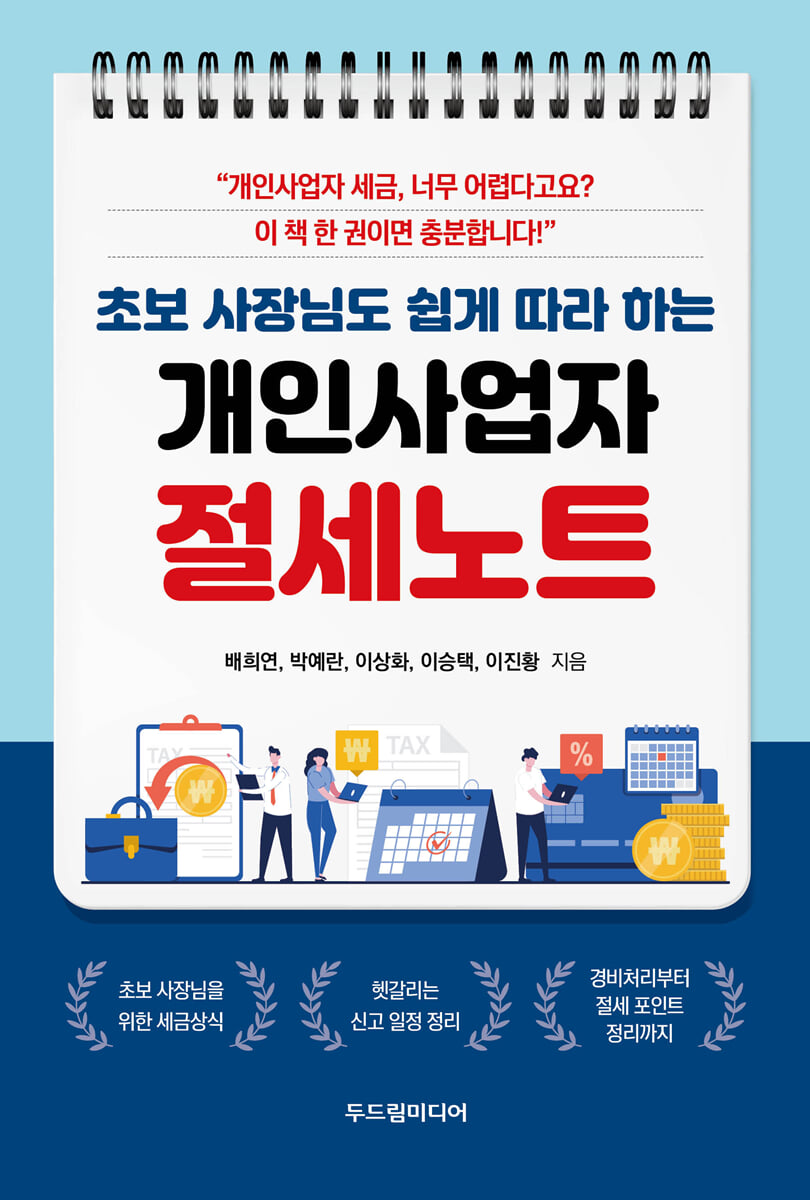
A tax-saving guide for self-employed individuals that even novice business owners can easily follow.
 |
Description
Book Introduction
No More Tax Worries! A Must-Read for New Business Owners
When I first started a business under my own name, the first wall I encountered was definitely 'taxes'.
If you leave it to the experts, it's difficult to understand everything, and if you try to figure it out yourself, each term feels daunting.
This book is for novice business owners who are at that very moment of uncertainty.
For those who have left their jobs and started their own business for the first time, those who are considering registering a business for the first time because their hobby has become profitable, or even self-employed people who are always worried about not having enough money despite doing well in business, this book is a practical introduction to taxes written by authors who understand such "initial anxiety" better than anyone else.
Taxes may seem difficult and distant, but they are actually essential for running your business stably.
Knowing where your money comes from and where it goes will reduce vague anxiety and make your business's direction clearer.
This book does not simply list tax knowledge.
Based on situations that CEOs may actually encounter, it provides friendly and clear explanations, from the basics that must be known to practical skills that no one has ever explained easily.
This book is a solid guide to help first-time business owners become friends with taxes.
The one book I need right now to protect myself from taxes and focus fully on my business.
I recommend this book to anyone looking for a practical guide that will replace fear with understanding and replace feelings of helplessness with the power to execute.
When I first started a business under my own name, the first wall I encountered was definitely 'taxes'.
If you leave it to the experts, it's difficult to understand everything, and if you try to figure it out yourself, each term feels daunting.
This book is for novice business owners who are at that very moment of uncertainty.
For those who have left their jobs and started their own business for the first time, those who are considering registering a business for the first time because their hobby has become profitable, or even self-employed people who are always worried about not having enough money despite doing well in business, this book is a practical introduction to taxes written by authors who understand such "initial anxiety" better than anyone else.
Taxes may seem difficult and distant, but they are actually essential for running your business stably.
Knowing where your money comes from and where it goes will reduce vague anxiety and make your business's direction clearer.
This book does not simply list tax knowledge.
Based on situations that CEOs may actually encounter, it provides friendly and clear explanations, from the basics that must be known to practical skills that no one has ever explained easily.
This book is a solid guide to help first-time business owners become friends with taxes.
The one book I need right now to protect myself from taxes and focus fully on my business.
I recommend this book to anyone looking for a practical guide that will replace fear with understanding and replace feelings of helplessness with the power to execute.
index
Preface · 4
PART 01.
It starts with business registration.
Tax Calendar for Beginner Business Owners · 14
Why Your Business Address Is Important When Starting a Business · 16
When registering a business, be mindful of these things! · 17
Why is choosing an industry important? · 20
Learn about industry codes and expense ratios · 23
How do I register a business? · 25
Checklist after Business Registration · 28
Joint Ownership: Should I Do It? (Pros and Cons, Precautions, Tax Payment Methods) · 36
I just need to save you once! Is it okay if I lend you my business name? · 38
Key Differences Between Freelancers and Self-Employed Individuals · 40
For your first transaction, be sure to check your business registration and whether the business is closed or inactive when receiving a tax invoice! · 44
What is the cash receipt system? · 47
What is a business account, and which businesses are required to report a business account? · 50
Shopping Mall Required (Mail-Order Sales Business Report) · 53
What happens if you don't register as a business when selling on social media marketplaces? · 55
Tax Guide for Overseas Direct Purchase Agencies · 58
Tax Guide for Individual Media Creators, including YouTubers and Influencers · 61
Checklist Before Closing Your Business · 64
PART 02.
VAT is not my money
When do I report and pay value-added tax? · 70
What if I filed my VAT incorrectly or missed the filing deadline? · 72
Can I get a quick VAT refund? · 75
Let's learn about VAT sales and purchase taxes · 77
What types of purchase tax are not deductible? · 82
Same cost, but different income tax and value-added tax? · 86
Value-Added Tax (VAT) Victory Tax-Saving Strategy · 91
What's the difference between general and simplified taxpayers? · 95
Let's find out the difference between general and simplified taxpayers through calculations · 101
Value-Added Tax from Purchase to Transfer of Commercial Real Estate · 105
Will VAT be levied on a comprehensive transfer of a business? · 112
When should I issue a tax invoice? · 116
What should I do if I haven't received a tax invoice? Take advantage of the buyer-issued tax invoice system! · 119
PART 03.
Employee employment and the four major insurances
What are the benefits of hiring employees? · 124
Do I need to sign an employment contract when I hire an employee? · 127
Let's learn about the four major insurances and the minimum wage · 129
Health Insurance Dependent Registration Requirements · 132
What types of withholding taxes must be paid when paying labor costs, and what are the reporting deadlines? · 135
Documents to be submitted to the National Tax Service when paying labor costs · 138
A Complete Guide to Year-End Tax Settlement! · 140
Should I Join the Retirement Pension System? · 144
How much severance pay should I give my employee when he or she resigns? · 147
PART 04.
The Year's Harvest! Mastering Comprehensive Income Tax
Learn about comprehensive income tax targets, reporting, and payment periods. · 152
What is double-entry bookkeeping? (Distinction between those subject to simple accounting and those required to use double-entry bookkeeping) · 155
Be sure to keep supporting documentation for your expenses · 157
Comprehensive Income Tax Expenses: Get Proper Recognition · 160
Are there certain types of income that are included in your comprehensive income tax and others that are not? (The Differences Between Comprehensive Taxation, Classified Taxation, and Separate Taxation) · 164
I have financial income (interest, dividends). Do I need to pay more taxes? · 168
Reduce your taxes by taking income deductions! (Types of comprehensive income tax deductions for self-employed individuals) · 171
Comprehensive Income Tax Calculation Methods Even Beginners Can Understand · 174
What is a fall report? (The difference between a base report and a fall report.) · 179
Items and limits for entertainment expenses · 183
How much tax savings does interest on a loan have? · 186
What is an interim income tax payment? · 190
I'm renting out my home. Do I need to file an income tax return? · 194
PART 05.
The more you know, the more common sense you see
The Difference Between Tax Evasion and Tax Avoidance · 200
Tax Savings = Expense Processing (Everything About Business Cards) · 202
Tax Savings = Expense Processing (Comprehensive Expense Documentation) · 205
What problems arise from failing to report sales? · 209
My tax bill is higher than I expected. Is there a way to split the payment? · 212
Disadvantages of Missing Reporting and Payment · 214
Small Business and Small Business Owner Income Deductions and Pension Account Tax Credits · 218
If you're renting, get a tax deduction. · 223
I am a self-employed person and I made a donation.
Are there any tax benefits? · 226
Learn about tax deduction requirements for startups, small and medium-sized enterprises, etc. · 229
Let's learn about the requirements for special tax breaks for small and medium-sized businesses. · 233
Learn about the Integrated Employment Tax Credit · 237
Benefits for Purchasing Tangible and Intangible Assets for Business Use (Integrated Investment Tax Credit) · 243
Venture Businesses and Tax Benefits · 248
Tax Benefits Related to Research and Development · 252
Gift Tax Benefits for Startup Funds and Business Succession · 256
Tax Savings for Corporate Conversion and Incorporation · 261
PART 01.
It starts with business registration.
Tax Calendar for Beginner Business Owners · 14
Why Your Business Address Is Important When Starting a Business · 16
When registering a business, be mindful of these things! · 17
Why is choosing an industry important? · 20
Learn about industry codes and expense ratios · 23
How do I register a business? · 25
Checklist after Business Registration · 28
Joint Ownership: Should I Do It? (Pros and Cons, Precautions, Tax Payment Methods) · 36
I just need to save you once! Is it okay if I lend you my business name? · 38
Key Differences Between Freelancers and Self-Employed Individuals · 40
For your first transaction, be sure to check your business registration and whether the business is closed or inactive when receiving a tax invoice! · 44
What is the cash receipt system? · 47
What is a business account, and which businesses are required to report a business account? · 50
Shopping Mall Required (Mail-Order Sales Business Report) · 53
What happens if you don't register as a business when selling on social media marketplaces? · 55
Tax Guide for Overseas Direct Purchase Agencies · 58
Tax Guide for Individual Media Creators, including YouTubers and Influencers · 61
Checklist Before Closing Your Business · 64
PART 02.
VAT is not my money
When do I report and pay value-added tax? · 70
What if I filed my VAT incorrectly or missed the filing deadline? · 72
Can I get a quick VAT refund? · 75
Let's learn about VAT sales and purchase taxes · 77
What types of purchase tax are not deductible? · 82
Same cost, but different income tax and value-added tax? · 86
Value-Added Tax (VAT) Victory Tax-Saving Strategy · 91
What's the difference between general and simplified taxpayers? · 95
Let's find out the difference between general and simplified taxpayers through calculations · 101
Value-Added Tax from Purchase to Transfer of Commercial Real Estate · 105
Will VAT be levied on a comprehensive transfer of a business? · 112
When should I issue a tax invoice? · 116
What should I do if I haven't received a tax invoice? Take advantage of the buyer-issued tax invoice system! · 119
PART 03.
Employee employment and the four major insurances
What are the benefits of hiring employees? · 124
Do I need to sign an employment contract when I hire an employee? · 127
Let's learn about the four major insurances and the minimum wage · 129
Health Insurance Dependent Registration Requirements · 132
What types of withholding taxes must be paid when paying labor costs, and what are the reporting deadlines? · 135
Documents to be submitted to the National Tax Service when paying labor costs · 138
A Complete Guide to Year-End Tax Settlement! · 140
Should I Join the Retirement Pension System? · 144
How much severance pay should I give my employee when he or she resigns? · 147
PART 04.
The Year's Harvest! Mastering Comprehensive Income Tax
Learn about comprehensive income tax targets, reporting, and payment periods. · 152
What is double-entry bookkeeping? (Distinction between those subject to simple accounting and those required to use double-entry bookkeeping) · 155
Be sure to keep supporting documentation for your expenses · 157
Comprehensive Income Tax Expenses: Get Proper Recognition · 160
Are there certain types of income that are included in your comprehensive income tax and others that are not? (The Differences Between Comprehensive Taxation, Classified Taxation, and Separate Taxation) · 164
I have financial income (interest, dividends). Do I need to pay more taxes? · 168
Reduce your taxes by taking income deductions! (Types of comprehensive income tax deductions for self-employed individuals) · 171
Comprehensive Income Tax Calculation Methods Even Beginners Can Understand · 174
What is a fall report? (The difference between a base report and a fall report.) · 179
Items and limits for entertainment expenses · 183
How much tax savings does interest on a loan have? · 186
What is an interim income tax payment? · 190
I'm renting out my home. Do I need to file an income tax return? · 194
PART 05.
The more you know, the more common sense you see
The Difference Between Tax Evasion and Tax Avoidance · 200
Tax Savings = Expense Processing (Everything About Business Cards) · 202
Tax Savings = Expense Processing (Comprehensive Expense Documentation) · 205
What problems arise from failing to report sales? · 209
My tax bill is higher than I expected. Is there a way to split the payment? · 212
Disadvantages of Missing Reporting and Payment · 214
Small Business and Small Business Owner Income Deductions and Pension Account Tax Credits · 218
If you're renting, get a tax deduction. · 223
I am a self-employed person and I made a donation.
Are there any tax benefits? · 226
Learn about tax deduction requirements for startups, small and medium-sized enterprises, etc. · 229
Let's learn about the requirements for special tax breaks for small and medium-sized businesses. · 233
Learn about the Integrated Employment Tax Credit · 237
Benefits for Purchasing Tangible and Intangible Assets for Business Use (Integrated Investment Tax Credit) · 243
Venture Businesses and Tax Benefits · 248
Tax Benefits Related to Research and Development · 252
Gift Tax Benefits for Startup Funds and Business Succession · 256
Tax Savings for Corporate Conversion and Incorporation · 261
Into the book
If you are running a business, signing up for Hometax is essential.
Nowadays, most transactions and supporting documents are managed electronically.
For example, electronic tax invoices can be issued through Hometax, and issuance and receipt details can be viewed through Hometax.
Additionally, you will register various business-related documents on Hometax.
That is why we can say that signing up for Hometax is essential.
If you are a self-employed person, you can sign up in one of two ways.
One way is to register as an individual, log in, and then use the Hometax menu to switch to business status. The other way is to register as a business owner and manage Hometax.
If you share your Hometax ID and password with employees or others, we recommend signing up for business use only.
--- p.28
Many people think that filing a VAT return after closing a business means that tax filing is over.
Following the VAT filing, one thing you must remember is that you must file a comprehensive income tax return for the following year for any income earned before closing your business.
In the case of people who have been working for a long time, the company takes care of calculating the income from employment when they leave the company, so they often do not think about the taxes that come with closing the business.
Here's something to remember! If you close your business, you must file a comprehensive income tax return for any income generated up to the time of closure by May 31st of the following year.
--- p.65
When transferring a commercial property, the sale price is divided into the land price and the building price, just as at the time of purchase.
As explained earlier, it is important to have an appraisal conducted by a real estate appraiser or to have a tax accountant apportion the value based on the standard market price and calculate the value-added tax appropriately before preparing a sales contract.
You must prepare a real estate transfer contract and understand the timing of issuance of the tax invoice based on the timing of receipt of the transaction price.
After receiving the balance for the sale, capital gains tax, business closure report, and value-added tax report are filed.
Please note that there are tax obligations for various items and procedures.
Since the value of real estate transactions is large, the value added tax that is levied on them is also not small.
Therefore, you must consult with your tax accountant to avoid disputes during the sale and conclude the contract safely.
--- p.110
A donation is an amount of money that a business spends gratuitously and has no direct relation to its business.
The Income Tax Act recognizes these donation expenditures as necessary expenses within a certain scope for public interest or policy purposes.
For those with only business income, donation expenditures can be included in necessary expenses. For those with business income and other comprehensive income, donation expenditures can be included in necessary expenses or deducted from comprehensive income tax other than business income.
Nowadays, most transactions and supporting documents are managed electronically.
For example, electronic tax invoices can be issued through Hometax, and issuance and receipt details can be viewed through Hometax.
Additionally, you will register various business-related documents on Hometax.
That is why we can say that signing up for Hometax is essential.
If you are a self-employed person, you can sign up in one of two ways.
One way is to register as an individual, log in, and then use the Hometax menu to switch to business status. The other way is to register as a business owner and manage Hometax.
If you share your Hometax ID and password with employees or others, we recommend signing up for business use only.
--- p.28
Many people think that filing a VAT return after closing a business means that tax filing is over.
Following the VAT filing, one thing you must remember is that you must file a comprehensive income tax return for the following year for any income earned before closing your business.
In the case of people who have been working for a long time, the company takes care of calculating the income from employment when they leave the company, so they often do not think about the taxes that come with closing the business.
Here's something to remember! If you close your business, you must file a comprehensive income tax return for any income generated up to the time of closure by May 31st of the following year.
--- p.65
When transferring a commercial property, the sale price is divided into the land price and the building price, just as at the time of purchase.
As explained earlier, it is important to have an appraisal conducted by a real estate appraiser or to have a tax accountant apportion the value based on the standard market price and calculate the value-added tax appropriately before preparing a sales contract.
You must prepare a real estate transfer contract and understand the timing of issuance of the tax invoice based on the timing of receipt of the transaction price.
After receiving the balance for the sale, capital gains tax, business closure report, and value-added tax report are filed.
Please note that there are tax obligations for various items and procedures.
Since the value of real estate transactions is large, the value added tax that is levied on them is also not small.
Therefore, you must consult with your tax accountant to avoid disputes during the sale and conclude the contract safely.
--- p.110
A donation is an amount of money that a business spends gratuitously and has no direct relation to its business.
The Income Tax Act recognizes these donation expenditures as necessary expenses within a certain scope for public interest or policy purposes.
For those with only business income, donation expenditures can be included in necessary expenses. For those with business income and other comprehensive income, donation expenditures can be included in necessary expenses or deducted from comprehensive income tax other than business income.
--- p.226
Publisher's Review
When starting a business, let's learn about taxes first!
When you first start a business, the first realistic wall you encounter is ‘taxes.’
Questions like accounting, value-added tax, the four major insurances, and comprehensive income tax, which are difficult to ask anyone, often add to the initial confusion of starting a business.
This book is a practical tax guidebook that contains only the essential information for novice business owners.
This book covers tax points encountered in actual startup settings, starting with business registration, industry selection, differences with freelancers, and precautions when operating shopping malls and SNS markets.
The structure of value-added tax, refund and reporting deadlines, and deductible expenses are organized in a practical manner, so they can be applied immediately in practice.
It provides basic information you need to know when hiring your first employee, such as employment contracts, the four major insurances, retirement pay, and withholding taxes, as well as helpful guidance on bookkeeping and tax-saving strategies for comprehensive income tax reporting.
Lastly, it includes all the tax-saving tips and tax benefits that are beneficial to business owners, such as small business tax deductions, business cards, donation deductions, and startup tax breaks.
Taxes can be scary if you don't know about them, but if you do, they become a powerful shield that protects your business.
For those seeking immediate knowledge rather than complex theories, this book will serve as a practical first step.
When you first start a business, the first realistic wall you encounter is ‘taxes.’
Questions like accounting, value-added tax, the four major insurances, and comprehensive income tax, which are difficult to ask anyone, often add to the initial confusion of starting a business.
This book is a practical tax guidebook that contains only the essential information for novice business owners.
This book covers tax points encountered in actual startup settings, starting with business registration, industry selection, differences with freelancers, and precautions when operating shopping malls and SNS markets.
The structure of value-added tax, refund and reporting deadlines, and deductible expenses are organized in a practical manner, so they can be applied immediately in practice.
It provides basic information you need to know when hiring your first employee, such as employment contracts, the four major insurances, retirement pay, and withholding taxes, as well as helpful guidance on bookkeeping and tax-saving strategies for comprehensive income tax reporting.
Lastly, it includes all the tax-saving tips and tax benefits that are beneficial to business owners, such as small business tax deductions, business cards, donation deductions, and startup tax breaks.
Taxes can be scary if you don't know about them, but if you do, they become a powerful shield that protects your business.
For those seeking immediate knowledge rather than complex theories, this book will serve as a practical first step.
GOODS SPECIFICS
- Date of issue: August 8, 2025
- Page count, weight, size: 268 pages | 152*225*20mm
- ISBN13: 9791194223658
- ISBN10: 1194223656
You may also like
카테고리
korean


korean

![GQ KOREA Mark (Monthly): December [2025]](http://librairie.coreenne.fr/cdn/shop/files/8ef265dbbfbf186523ed75ba7319009d.jpg?v=1765340328&width=3840)


