

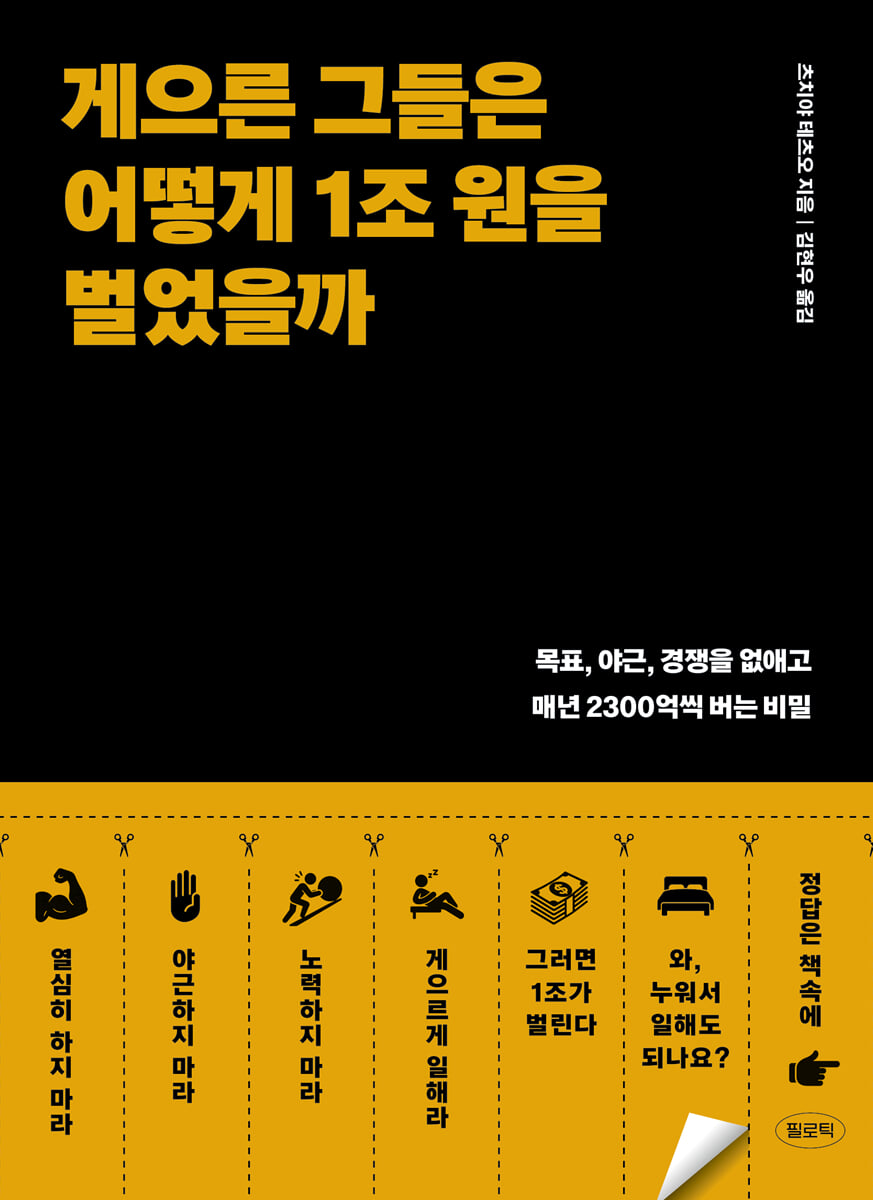
How did those lazy people earn 1 trillion won?
 |
Description
Book Introduction
★★★ Eliminate goals, overtime, and competition to achieve 1.8 trillion won in sales! ★★★
★★★ Walkman's "3 No's" Rule That Surpassed Uniqlo ★★★
★★★ A Miraculous Success Story Created by a 60-Year-Old Executive ★★★
"It's not about what to do more, but what to stop doing that creates real growth." "How the Lazy Made a Trillion Won" is a success strategy book that shows how the Japanese workwear brand Workman achieved results that surpassed Uniqlo by eliminating goal setting, overtime, and competition.
It contains the secrets of an ordinary workwear company that achieved sales of 1.8 trillion won and an operating profit margin of 17% for 10 consecutive years.
Author Tetsuo Tsuchiya took over a company in crisis at the age of 60 and introduced a "management without doing" that overturned conventional wisdom.
As a result of practicing the "14 Don'ts" such as working overtime, setting goals and deadlines, performing mandatory tasks, holding company events, competing for discounts, and managing customers, amazing changes occurred.
Since 2019, it has recorded more stores than Uniqlo, and at one point, it surpassed McDonald's Japan to become the largest company in terms of market capitalization on the JASDAQ.
For anyone who works hard but finds themselves stagnant, this book offers a completely different perspective.
The key to real growth is deciding what to stop doing, rather than trying to do more.
The 'ACTION worksheet' included in each part helps readers apply and practice the philosophy they don't do in their own lives.
★★★ Walkman's "3 No's" Rule That Surpassed Uniqlo ★★★
★★★ A Miraculous Success Story Created by a 60-Year-Old Executive ★★★
"It's not about what to do more, but what to stop doing that creates real growth." "How the Lazy Made a Trillion Won" is a success strategy book that shows how the Japanese workwear brand Workman achieved results that surpassed Uniqlo by eliminating goal setting, overtime, and competition.
It contains the secrets of an ordinary workwear company that achieved sales of 1.8 trillion won and an operating profit margin of 17% for 10 consecutive years.
Author Tetsuo Tsuchiya took over a company in crisis at the age of 60 and introduced a "management without doing" that overturned conventional wisdom.
As a result of practicing the "14 Don'ts" such as working overtime, setting goals and deadlines, performing mandatory tasks, holding company events, competing for discounts, and managing customers, amazing changes occurred.
Since 2019, it has recorded more stores than Uniqlo, and at one point, it surpassed McDonald's Japan to become the largest company in terms of market capitalization on the JASDAQ.
For anyone who works hard but finds themselves stagnant, this book offers a completely different perspective.
The key to real growth is deciding what to stop doing, rather than trying to do more.
The 'ACTION worksheet' included in each part helps readers apply and practice the philosophy they don't do in their own lives.
- You can preview some of the book's contents.
Preview
index
To change the world, please do nothing.
PART 1.
Enlightenment
A company that defies common sense: "The company that doesn't do it."
Chapter 1.
The moment I pressed the 'Don't Do' button, everything moved.
Chapter 2.
Why does 0 won advertising and 0% discount work better?
Discounts are a betrayal of customers. Even if you could make more, you don't.
Chapter 3.
The Art of Winning Without Fighting: Choose Your Battleground
How to Create Your Own Ocean | What to Keep and What to Let Go of?
ACTION 1.
The art of selection and concentration
PART 2.
find
Finding new opportunities through 'not doing'
Chapter 4.
Find opportunities no one has seen before
What is our real weapon? | Making our sharpest weapon stronger | Even blue oceans rot | How did we find the gap?
Chapter 5.
Planting a Flag in the Gap: Walkman Plus Implementation and Results
Aim low, start small | Even a simple packaging change can turn the tables | The real battle lies in product quality.
Chapter 6.
Money is hidden in 'abnormal values'
Customers' "Strange Behavior" Is an Opportunity | The Secret to Triple Sales Growth | From "Strange" to "Normal"
Chapter 7.
Building True Allies: How to Win Hearts, Not Money
For those who think they know their customers | The best marketers who work for free | The protagonists aren't "successful companies," but "30 ordinary people" | Products, spaces, and people | Take a break.
Don't give up on the mighty Amazon
ACTION 2.
Escaping the Trap of Success
PART 3.
change
16 Things That Were Hindering Your Growth
Chapter 8.
Break free from the shackles of goals and deadlines
Throw away the clock to get it right | Throw away your goals to run faster | 'Forcing yourself to work hard' is fake | Throw the rest of your goals in the trash
Chapter 9.
The problem is "talkative leaders" and "fake work."
Get rid of useless company events and dinners right now | Even Einstein made typos
A truly competent leader is one who doesn't show up | Manage with your feet, not your chair | How smart leaders ruin companies
Chapter 10.
Competing with true "Walkman-ness"
Not following the rules of the clothing business | Not changing designs | Not managing customers | The secret to a 99% re-contract rate | Trust, not a whip
ACTION 3.
Breaking Free from the Shackles of Deadlines and Goals
PART 4.
innovation
Data is more accurate than intuition
Chapter 11.
Data you must know to avoid
There Was No Data in the Walkman | Numbers Become a Mirror Reflecting the Organization | A Blueprint for Change Created by Two Years of Stallion
Chapter 12. Excel over AI: Why I Chose Simplicity Over Complexity
The Traps of Complex Tools: The Limitations of Experts and Tools | Solution ① Everyone's Weapon, Excel |
Solution ② Develop internal talent instead of external experts | The field is the source of data
The Master | The 6 Stages of Cultural Innovation Walkman | Even the Boss Can Make Mistakes | Don't Be Fooled by the Numbers, Look at the Reality
ACTION 4.
Data is your compass
PART 5.
continue
The power to see it through to the end
Chapter 13.
How to Build a Walkman-Style System: Choosing Evolution Over Perfection
① Don't pursue perfection from the beginning | In parking lot surveys
Hints found | One store, two signboards strategy | ② Do not allow only a few people to participate | ③ Have a goal, but no deadline | ④ Do not use difficult tests to keep people busy | ⑤ Do not expect results from new employees | ⑥ Do not fear failure
Chapter 14.
Develop players, not data spectators.
A clear carrot is given to those who use data wellㅣAn ordinary person is called 'data
Making it a 'Warrior' | Why employee-generated data changed the company | The real answer is revealed when you admit you don't know | Creating an environment where even ordinary people can complete the task.
ACTION 5.
The value of challenge without fear of failure
PART 6.
talk
Conditions for a long-lasting company
Chapter 15.
How is 'ambidextrous management' possible?
A happy meeting of 'knowledge exploration' and 'knowledge deepening' | Done with 'Excel' instead of expensive systems | The secret of the Walkman-style supply chain that breaks common sense | 90% return rate! The myth of the Walkman Plus created by a 2 million fandom | 'Don't work too hard!' The conditions for true innovation as told by Walkman | The Red Queen's Curse: Why Walkman doesn't benchmark competitors | Fans even participate in product development? The true role of Walkman ambassadors | Weak connections create innovation | Walkman's third blue ocean market | What is the 'sensemaking theory' essential for innovation? | 'Ordinary management by ordinary people' that doesn't require star players | Go far by letting go: Future servant leaders
ACTION 6.
Creating an Ambidextrous Growth Strategy
Conclusion: The Journey of "Not Doing" Is Not Yet Over
PART 1.
Enlightenment
A company that defies common sense: "The company that doesn't do it."
Chapter 1.
The moment I pressed the 'Don't Do' button, everything moved.
Chapter 2.
Why does 0 won advertising and 0% discount work better?
Discounts are a betrayal of customers. Even if you could make more, you don't.
Chapter 3.
The Art of Winning Without Fighting: Choose Your Battleground
How to Create Your Own Ocean | What to Keep and What to Let Go of?
ACTION 1.
The art of selection and concentration
PART 2.
find
Finding new opportunities through 'not doing'
Chapter 4.
Find opportunities no one has seen before
What is our real weapon? | Making our sharpest weapon stronger | Even blue oceans rot | How did we find the gap?
Chapter 5.
Planting a Flag in the Gap: Walkman Plus Implementation and Results
Aim low, start small | Even a simple packaging change can turn the tables | The real battle lies in product quality.
Chapter 6.
Money is hidden in 'abnormal values'
Customers' "Strange Behavior" Is an Opportunity | The Secret to Triple Sales Growth | From "Strange" to "Normal"
Chapter 7.
Building True Allies: How to Win Hearts, Not Money
For those who think they know their customers | The best marketers who work for free | The protagonists aren't "successful companies," but "30 ordinary people" | Products, spaces, and people | Take a break.
Don't give up on the mighty Amazon
ACTION 2.
Escaping the Trap of Success
PART 3.
change
16 Things That Were Hindering Your Growth
Chapter 8.
Break free from the shackles of goals and deadlines
Throw away the clock to get it right | Throw away your goals to run faster | 'Forcing yourself to work hard' is fake | Throw the rest of your goals in the trash
Chapter 9.
The problem is "talkative leaders" and "fake work."
Get rid of useless company events and dinners right now | Even Einstein made typos
A truly competent leader is one who doesn't show up | Manage with your feet, not your chair | How smart leaders ruin companies
Chapter 10.
Competing with true "Walkman-ness"
Not following the rules of the clothing business | Not changing designs | Not managing customers | The secret to a 99% re-contract rate | Trust, not a whip
ACTION 3.
Breaking Free from the Shackles of Deadlines and Goals
PART 4.
innovation
Data is more accurate than intuition
Chapter 11.
Data you must know to avoid
There Was No Data in the Walkman | Numbers Become a Mirror Reflecting the Organization | A Blueprint for Change Created by Two Years of Stallion
Chapter 12. Excel over AI: Why I Chose Simplicity Over Complexity
The Traps of Complex Tools: The Limitations of Experts and Tools | Solution ① Everyone's Weapon, Excel |
Solution ② Develop internal talent instead of external experts | The field is the source of data
The Master | The 6 Stages of Cultural Innovation Walkman | Even the Boss Can Make Mistakes | Don't Be Fooled by the Numbers, Look at the Reality
ACTION 4.
Data is your compass
PART 5.
continue
The power to see it through to the end
Chapter 13.
How to Build a Walkman-Style System: Choosing Evolution Over Perfection
① Don't pursue perfection from the beginning | In parking lot surveys
Hints found | One store, two signboards strategy | ② Do not allow only a few people to participate | ③ Have a goal, but no deadline | ④ Do not use difficult tests to keep people busy | ⑤ Do not expect results from new employees | ⑥ Do not fear failure
Chapter 14.
Develop players, not data spectators.
A clear carrot is given to those who use data wellㅣAn ordinary person is called 'data
Making it a 'Warrior' | Why employee-generated data changed the company | The real answer is revealed when you admit you don't know | Creating an environment where even ordinary people can complete the task.
ACTION 5.
The value of challenge without fear of failure
PART 6.
talk
Conditions for a long-lasting company
Chapter 15.
How is 'ambidextrous management' possible?
A happy meeting of 'knowledge exploration' and 'knowledge deepening' | Done with 'Excel' instead of expensive systems | The secret of the Walkman-style supply chain that breaks common sense | 90% return rate! The myth of the Walkman Plus created by a 2 million fandom | 'Don't work too hard!' The conditions for true innovation as told by Walkman | The Red Queen's Curse: Why Walkman doesn't benchmark competitors | Fans even participate in product development? The true role of Walkman ambassadors | Weak connections create innovation | Walkman's third blue ocean market | What is the 'sensemaking theory' essential for innovation? | 'Ordinary management by ordinary people' that doesn't require star players | Go far by letting go: Future servant leaders
ACTION 6.
Creating an Ambidextrous Growth Strategy
Conclusion: The Journey of "Not Doing" Is Not Yet Over
Detailed image

Into the book
Do you, too, believe that success requires doing more, faster, and more? Congratulations.
You are living in the same illusion as I did exactly 30 years ago.
---From the "Preface"
September 2018, a shopping mall on the outskirts of Tokyo.
I still can't forget the scenery of that day.
People were lining up from 5 a.m., before the store even opened.
What they were waiting for wasn't a luxury sale or limited edition sneakers.
The 'work clothes' worn by field workers were ordinary clothes sold at full price.
---From the "Preface"
Now I will uncover the secret and tell it to you.
Without a single ad or discount, how did the Walkman capture customers' hearts? Let's delve into the moments of shock and innovation I witnessed on the scene.
---From "The moment I pressed the 'Don't Do' button in Chapter 1, everything moved"
David did not defeat Goliath because he was stronger.
He changed the rules of fighting itself.
Instead of jumping into the sword and spear fight that the giant forced upon him, he chose to fight with a slingshot, which he was best at.
The same was true for the Walkman.
Instead of the obvious battleground of a large market that everyone covets, they chose a place where they could create and dominate the rules of the game and then dug deep.
---From "Chapter 3: The Art of Winning Without Fighting: Choose Your Battleground"
Walkman doesn't set deadlines for any tasks.
Instead, once you start something, you have to see it through to the end, even if it takes time.
If you force a deadline, your goal can easily change from 'doing it right' to 'meeting the deadline.'
If that happens, people will worry about their own appearance or external opinions rather than the essence of the work, which can ultimately lead to formal results.
If this process is repeated, trust is broken and the entire organization's momentum is weakened.
---From "Chapter 8: Breaking Free from the Shackles of Goals and Deadlines"
Work clothes are consumables that are used until they wear out.
The most important thing about consumables is reasonable price.
So, even when other clothing companies were talking about gross profit margins of 70 to 80 percent, Workman silently insisted on a margin of 35 percent.
From the outside, it might seem like an inefficient business.
However, despite the low margins, the overall operating profit margin remains high at 17 percent.
---From "Chapter 10: Competing with True 'Walkman-ness'"
Many companies claim to be driving data innovation by hiring external data scientists or implementing expensive and complex BI tools.
But in my view, this is one thing that can easily ruin the organizational culture.
Because data that only experts look at is ultimately meaningless.
You are living in the same illusion as I did exactly 30 years ago.
---From the "Preface"
September 2018, a shopping mall on the outskirts of Tokyo.
I still can't forget the scenery of that day.
People were lining up from 5 a.m., before the store even opened.
What they were waiting for wasn't a luxury sale or limited edition sneakers.
The 'work clothes' worn by field workers were ordinary clothes sold at full price.
---From the "Preface"
Now I will uncover the secret and tell it to you.
Without a single ad or discount, how did the Walkman capture customers' hearts? Let's delve into the moments of shock and innovation I witnessed on the scene.
---From "The moment I pressed the 'Don't Do' button in Chapter 1, everything moved"
David did not defeat Goliath because he was stronger.
He changed the rules of fighting itself.
Instead of jumping into the sword and spear fight that the giant forced upon him, he chose to fight with a slingshot, which he was best at.
The same was true for the Walkman.
Instead of the obvious battleground of a large market that everyone covets, they chose a place where they could create and dominate the rules of the game and then dug deep.
---From "Chapter 3: The Art of Winning Without Fighting: Choose Your Battleground"
Walkman doesn't set deadlines for any tasks.
Instead, once you start something, you have to see it through to the end, even if it takes time.
If you force a deadline, your goal can easily change from 'doing it right' to 'meeting the deadline.'
If that happens, people will worry about their own appearance or external opinions rather than the essence of the work, which can ultimately lead to formal results.
If this process is repeated, trust is broken and the entire organization's momentum is weakened.
---From "Chapter 8: Breaking Free from the Shackles of Goals and Deadlines"
Work clothes are consumables that are used until they wear out.
The most important thing about consumables is reasonable price.
So, even when other clothing companies were talking about gross profit margins of 70 to 80 percent, Workman silently insisted on a margin of 35 percent.
From the outside, it might seem like an inefficient business.
However, despite the low margins, the overall operating profit margin remains high at 17 percent.
---From "Chapter 10: Competing with True 'Walkman-ness'"
Many companies claim to be driving data innovation by hiring external data scientists or implementing expensive and complex BI tools.
But in my view, this is one thing that can easily ruin the organizational culture.
Because data that only experts look at is ultimately meaningless.
---From "Chapter 12: Excel over AI: Why I Chose Simplicity Over Complexity"
Publisher's Review
Do you believe that you have to work 'harder' to be successful?
Maybe that obvious statement
It might have ended 30 years ago.
We live in an age addicted to productivity and efficiency.
Just like a top that falls over if it stops, even stopping for a moment feels like falling behind.
In the success formula that shouts 'faster, more,' 'not doing' is often synonymous with failure or laziness.
But is that really true?
Here's a company that's turned industry wisdom on its head.
A place where the opening of a new store is postponed by a week just because someone says, “I think I’ll have to work overtime,” and where employees leave work at 6 o’clock sharp.
Workman is a Japanese workwear and outdoor wear brand.
The change in Walkman began in 2012 when Tetsuo Tsuchiya, who turned 60, took office as Managing Director.
At that time, Walkman was at a point where its growth was limited.
However, Tsuchiya introduced 'management without doing', which completely overturned conventional wisdom.
There are 14 things that the Walkman doesn't do.
No overtime, no sales goals, no performance requirements.
There are no stressful in-house events for employees, and executives are not required to come to work every day.
We do not compete with other companies, and we do not provide customer service or discount sales.
How did the "no-doing" strategy lead to success? The secret was focusing on the essentials.
Walkman eliminated all unnecessary elements and focused solely on providing real value to customers.
Based on the functional clothing know-how accumulated from manufacturing workwear, the company entered the outdoor market and created a new blue ocean.
Of particular note is the data-driven decision-making system called 'Excel Management'.
We analyze sales data from all stores in real time to understand customers' actual purchasing patterns and establish product development and store operation strategies based on this data.
The Walkman's success is also proven in numbers.
Starting in 2019, it began operating more stores than Uniqlo, and at one point surpassed McDonald's Japan to become the largest company in terms of market capitalization on the JASDAQ.
As of 2022, the company achieved remarkable results, with sales of KRW 1.8 trillion and an operating profit margin of 17%.
The '3 No' principles presented in this book can be applied not only to business management but also to personal life.
The philosophy of no goals, no effort, and no competition offers a new perspective on solving the stress and burnout experienced by modern people.
If existing minimalism books talked about 'organizing life,' this book shows a 'revolution in work.'
Rather than simply telling you to do less, it demonstrates with real-world examples how focusing on the essentials can produce overwhelming results.
This book is not simply a business strategy book.
An 'ACTION worksheet' included in each chapter helps readers create their own 'not-to-do' list and focus on what really matters.
After you finish this book, you will realize:
The secret to success is not 'more' but 'less'.
And that true growth doesn't begin with what you add, but with what you take away.
As the Walkman proved, sometimes 'not doing' is the most powerful competitive edge that no one can replicate.
Starting today, you too can create a 'don't do' list.
That small start will completely change your work and life.
Maybe that obvious statement
It might have ended 30 years ago.
We live in an age addicted to productivity and efficiency.
Just like a top that falls over if it stops, even stopping for a moment feels like falling behind.
In the success formula that shouts 'faster, more,' 'not doing' is often synonymous with failure or laziness.
But is that really true?
Here's a company that's turned industry wisdom on its head.
A place where the opening of a new store is postponed by a week just because someone says, “I think I’ll have to work overtime,” and where employees leave work at 6 o’clock sharp.
Workman is a Japanese workwear and outdoor wear brand.
The change in Walkman began in 2012 when Tetsuo Tsuchiya, who turned 60, took office as Managing Director.
At that time, Walkman was at a point where its growth was limited.
However, Tsuchiya introduced 'management without doing', which completely overturned conventional wisdom.
There are 14 things that the Walkman doesn't do.
No overtime, no sales goals, no performance requirements.
There are no stressful in-house events for employees, and executives are not required to come to work every day.
We do not compete with other companies, and we do not provide customer service or discount sales.
How did the "no-doing" strategy lead to success? The secret was focusing on the essentials.
Walkman eliminated all unnecessary elements and focused solely on providing real value to customers.
Based on the functional clothing know-how accumulated from manufacturing workwear, the company entered the outdoor market and created a new blue ocean.
Of particular note is the data-driven decision-making system called 'Excel Management'.
We analyze sales data from all stores in real time to understand customers' actual purchasing patterns and establish product development and store operation strategies based on this data.
The Walkman's success is also proven in numbers.
Starting in 2019, it began operating more stores than Uniqlo, and at one point surpassed McDonald's Japan to become the largest company in terms of market capitalization on the JASDAQ.
As of 2022, the company achieved remarkable results, with sales of KRW 1.8 trillion and an operating profit margin of 17%.
The '3 No' principles presented in this book can be applied not only to business management but also to personal life.
The philosophy of no goals, no effort, and no competition offers a new perspective on solving the stress and burnout experienced by modern people.
If existing minimalism books talked about 'organizing life,' this book shows a 'revolution in work.'
Rather than simply telling you to do less, it demonstrates with real-world examples how focusing on the essentials can produce overwhelming results.
This book is not simply a business strategy book.
An 'ACTION worksheet' included in each chapter helps readers create their own 'not-to-do' list and focus on what really matters.
After you finish this book, you will realize:
The secret to success is not 'more' but 'less'.
And that true growth doesn't begin with what you add, but with what you take away.
As the Walkman proved, sometimes 'not doing' is the most powerful competitive edge that no one can replicate.
Starting today, you too can create a 'don't do' list.
That small start will completely change your work and life.
GOODS SPECIFICS
- Date of issue: July 14, 2025
- Page count, weight, size: 264 pages | 343g | 142*195*20mm
- ISBN13: 9791198713681
- ISBN10: 1198713682
You may also like
카테고리
korean


korean

![GQ KOREA Mark (Monthly): December [2025]](http://librairie.coreenne.fr/cdn/shop/files/8ef265dbbfbf186523ed75ba7319009d.jpg?v=1765340328&width=3840)


