

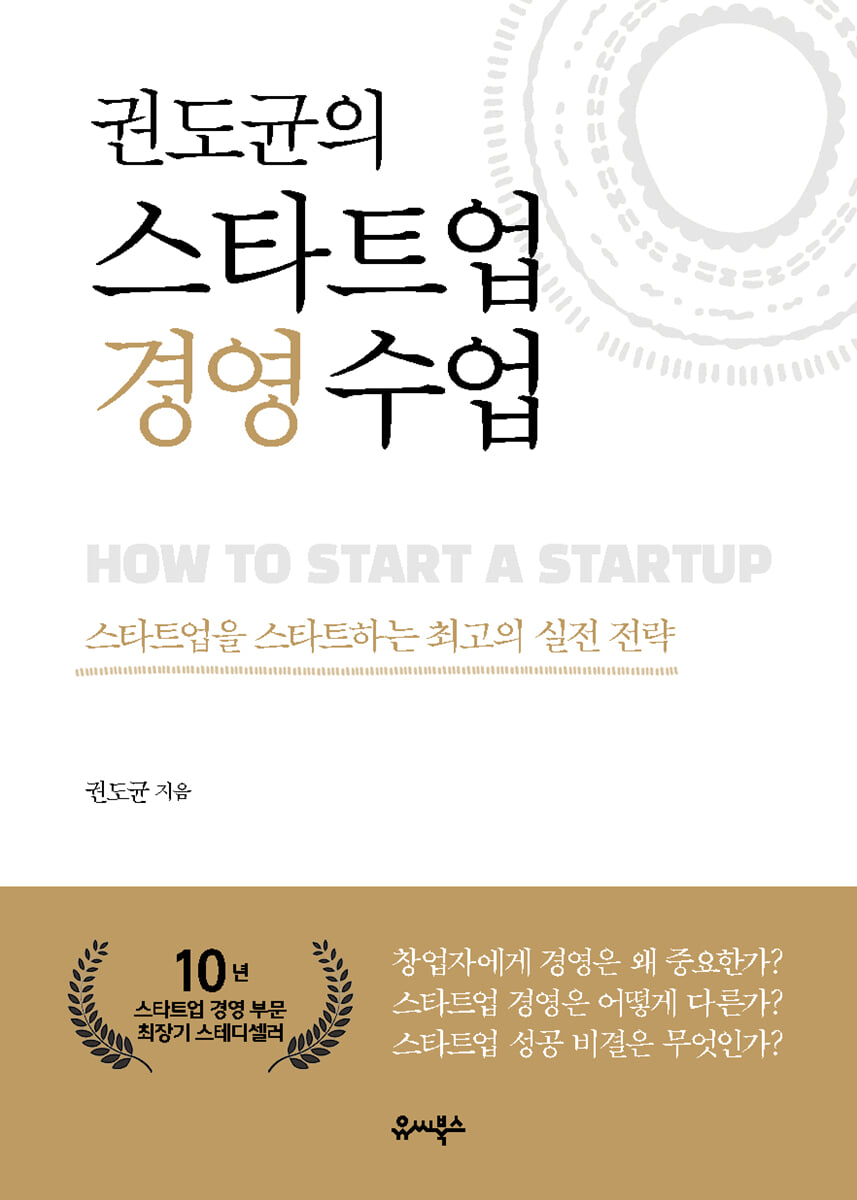
Kwon Do-gyun's Startup Management Class
 |
Description
Book Introduction
The most perfect practical mentoring for the 400 billion won startup myth!
This book contains the essence of startup management and strategies for success, introduced by Do-gyun Kwon, CEO of Primer, a pioneer and accelerator of startup incubators in Korea.
We introduce practical know-how gained through investing in and nurturing over 300 startups, including Lightning Market, Hogangnono, Daily Hotel, Soomgo, Lael, Style Share, and My Real Trip.
This book is a roadmap for success strategies from start to exit.
This book contains the essence of startup management and strategies for success, introduced by Do-gyun Kwon, CEO of Primer, a pioneer and accelerator of startup incubators in Korea.
We introduce practical know-how gained through investing in and nurturing over 300 startups, including Lightning Market, Hogangnono, Daily Hotel, Soomgo, Lael, Style Share, and My Real Trip.
This book is a roadmap for success strategies from start to exit.
- You can preview some of the book's contents.
Preview
index
Starting the lecture
Lecture 1: The Problem Is Management, Idiot! - Why Is Management Important to Entrepreneurs?
The problem is management, idiot! | It's different from both the management theory of large corporations and the rules of the West | Opportunities that seem like coincidences but are not | Following tedious processes | Start a new business like a startup | Don't make hasty judgments about your business and customers | Start with the intention of leaving
Lecture 2: Entrepreneurship Isn't a Choice, It's a Necessity - What Startups Teach Us
Everyone needs an entrepreneurial spirit | Experience entrepreneurship | Enlightenment breeds humility | Work is the best entrepreneurship academy | Look back on what you've done in your life | There's no good day to start a business | The irresistible desire to start a business | It looks easy when you don't know | Take advantage freely | You can't make the real out of a fake
Lecture 3: Entrepreneurial Spirit and Entrepreneurial Qualities - Who Becomes a Startup Manager?
Break down the current logic and system | Have your own altruistic mission | Be optimistic, proactive, responsible, and results-oriented | Overcome fear, laziness, and bureaucracy | Work in the field like a proxy | Embed value into your product
Top 4 Startups Don't Start with Ideas - Who Goes to Startups That Fail?
An idea is just an idea. Everyone is shouting 'world's first'. Focus on a specific problem of a specific customer. Find a dissatisfied customer. Where are our customers? Find a problem, not a solution. What you can't do without, what customers are suffering from. Daughters buy trends, mothers buy quality.
5. Float your boat on the flowing river - If you start a business, make it a success.
Measure and measure everything | Make your business hypothesis work | If it doesn't work, throw it away without hesitation | Float your boat on the flowing river | Don't do business, prepare for business | Don't get stuck in a well | Don't be fooled by adjectives
Lesson 6: Start Now, Right Now - The Powerful Energy of Startups
Decide what you need to do today and start right now | Don't fool yourself | Don't think you're moving forward | Create an inflection point connected to the present | Live as a digital nomad | Sign a co-founder contract | Negotiate and contract carefully
Lesson 7: Love Your Customers More Than Profits - Startup Marketing Strategy
Create a sharp weapon to penetrate small gaps | Observe and observe the passageway again | Satisfy the customer right in front of you first | Put love and sincerity before marketing | Don't measure customers in numbers | Be obsessed with customers like a maniac | Even just changing the price tag is innovation
Find collaborators, not just employees - who will you work with and how?
Go alone until you have consistent sales profits | Find someone who suits you | People don't change | Someone who helps subordinates while doing their own work | Look for the skills behind career and reputation | Let the North Star lead the organization | Convey the message of trust and working together | Growing an organization and increasing the number of employees are separate things
Lesson 9: Learn from Failure - What Startup Entrepreneurs Shouldn't Do
Beware of the 'first success syndrome' | Behind passion and enthusiasm are immaturity and arrogance | Accept the possibility that you are wrong | Their praise is a sign of ignorance | Organizations are built on action, not words | Do not interfere with employees' main work | Peaceful decision-making is wrong | Corporate culture is an implicit rule
From Learning Knowledge to Learning Action: 10 Essential Things Startup Managers Must Do
Design is more important than collecting, measuring, and analyzing. | Understand the meaning of numbers. | Ask questions that will lead to action. | Decide what not to do and be disciplined. | Wake up from the American Dream. | Continue effective learning.
Lesson 11: Survival Comes Before Vision - Startup Crisis Management
Don't try to work with the power of money | Don't rely on big companies | Start by making money | Don't lose your original intention | Investment is debt | Debt is debt | Survival is more important than vision
Success Awaits You in the 12th Quarter - Get to the Core of Business
Define your business from the customer's perspective | Remember that the number of members is a means, not a goal | Entrepreneurs, don't cheat | It will work out, it will work out, it will work out | Those with roots don't fall | A frog-like entrepreneur succeeds | The CEO's ethics are a mirror that reflects the company
Glossary of Terms
annotation
References
Lecture 1: The Problem Is Management, Idiot! - Why Is Management Important to Entrepreneurs?
The problem is management, idiot! | It's different from both the management theory of large corporations and the rules of the West | Opportunities that seem like coincidences but are not | Following tedious processes | Start a new business like a startup | Don't make hasty judgments about your business and customers | Start with the intention of leaving
Lecture 2: Entrepreneurship Isn't a Choice, It's a Necessity - What Startups Teach Us
Everyone needs an entrepreneurial spirit | Experience entrepreneurship | Enlightenment breeds humility | Work is the best entrepreneurship academy | Look back on what you've done in your life | There's no good day to start a business | The irresistible desire to start a business | It looks easy when you don't know | Take advantage freely | You can't make the real out of a fake
Lecture 3: Entrepreneurial Spirit and Entrepreneurial Qualities - Who Becomes a Startup Manager?
Break down the current logic and system | Have your own altruistic mission | Be optimistic, proactive, responsible, and results-oriented | Overcome fear, laziness, and bureaucracy | Work in the field like a proxy | Embed value into your product
Top 4 Startups Don't Start with Ideas - Who Goes to Startups That Fail?
An idea is just an idea. Everyone is shouting 'world's first'. Focus on a specific problem of a specific customer. Find a dissatisfied customer. Where are our customers? Find a problem, not a solution. What you can't do without, what customers are suffering from. Daughters buy trends, mothers buy quality.
5. Float your boat on the flowing river - If you start a business, make it a success.
Measure and measure everything | Make your business hypothesis work | If it doesn't work, throw it away without hesitation | Float your boat on the flowing river | Don't do business, prepare for business | Don't get stuck in a well | Don't be fooled by adjectives
Lesson 6: Start Now, Right Now - The Powerful Energy of Startups
Decide what you need to do today and start right now | Don't fool yourself | Don't think you're moving forward | Create an inflection point connected to the present | Live as a digital nomad | Sign a co-founder contract | Negotiate and contract carefully
Lesson 7: Love Your Customers More Than Profits - Startup Marketing Strategy
Create a sharp weapon to penetrate small gaps | Observe and observe the passageway again | Satisfy the customer right in front of you first | Put love and sincerity before marketing | Don't measure customers in numbers | Be obsessed with customers like a maniac | Even just changing the price tag is innovation
Find collaborators, not just employees - who will you work with and how?
Go alone until you have consistent sales profits | Find someone who suits you | People don't change | Someone who helps subordinates while doing their own work | Look for the skills behind career and reputation | Let the North Star lead the organization | Convey the message of trust and working together | Growing an organization and increasing the number of employees are separate things
Lesson 9: Learn from Failure - What Startup Entrepreneurs Shouldn't Do
Beware of the 'first success syndrome' | Behind passion and enthusiasm are immaturity and arrogance | Accept the possibility that you are wrong | Their praise is a sign of ignorance | Organizations are built on action, not words | Do not interfere with employees' main work | Peaceful decision-making is wrong | Corporate culture is an implicit rule
From Learning Knowledge to Learning Action: 10 Essential Things Startup Managers Must Do
Design is more important than collecting, measuring, and analyzing. | Understand the meaning of numbers. | Ask questions that will lead to action. | Decide what not to do and be disciplined. | Wake up from the American Dream. | Continue effective learning.
Lesson 11: Survival Comes Before Vision - Startup Crisis Management
Don't try to work with the power of money | Don't rely on big companies | Start by making money | Don't lose your original intention | Investment is debt | Debt is debt | Survival is more important than vision
Success Awaits You in the 12th Quarter - Get to the Core of Business
Define your business from the customer's perspective | Remember that the number of members is a means, not a goal | Entrepreneurs, don't cheat | It will work out, it will work out, it will work out | Those with roots don't fall | A frog-like entrepreneur succeeds | The CEO's ethics are a mirror that reflects the company
Glossary of Terms
annotation
References
Into the book
A healthy future is for CEOs who primarily talk about "things I didn't know I had," "things I was wrong about," and "things I learned from unexpected successes and failures."
What we know now is only what we have found out 'so far'.
Starting a business is a journey of research, experimentation, and learning.
---From "The problem with Lecture 1 is management, you idiot!"
Business opportunities are endless and eternal.
Because human desires are endless.
There is no need to rush.
Even if consumers are satisfied now, they soon feel thirsty for something more convenient, faster, cheaper, and more luxurious.
It is human nature to move on to better things.
When the evolution of human desires ceases, business opportunities cease as well.
But that never happens.
---From "Chapter 2: Entrepreneurship is not a choice, it's a necessity"
Feeling like it can't be done? Make it happen! Is there something like that right now? Make it happen! Are rules holding you back? Create new ones! Have you encountered obstacles? Try, try, and don't give up! Have you experienced limitations? See a higher vision! Accelerate and act on your thoughts.
This is the entrepreneurial spirit.'
---From "Lecture 3: Entrepreneurial Spirit and Entrepreneurial Qualities"
I call this the '5 Levels of Business Model Value'.
Level 1 is fun and interesting, level 2 is nice to have, level 3 is necessary, level 4 is essential, and level 5 is painful.
Plug in the values your business model pursues here.
Find out what your customers are 'painful about' or what they 'can't live without' in a certain field.
If you discover it and start that business, you will experience the joy of riding a rocket.
---From "Lecture 4: Startups Don't Start with Ideas"
Business is easy.
All you have to do is find a stream of water that flows from a high place to a low place and float your boat there.
The boat moves forward without rowing or turning on the engine.
If you come across a place with a big drop, the speed of success is so fast that you feel dizzy.
One morning you will wake up and find yourself a success.
---From "Chapter 5 Floating a Boat on the Flowing River"
I've often told entrepreneurs in the past, "Keep in mind that others won't make your money," but this time I want to say, "Good management is about hiring people who will make your money."
---From "Lesson 8: Find Collaborators, Not Employees"
The process of starting a business is a process of learning a kind of behavior.
Solving simple and easy problems for customers and products earns you a primary reward and weapons you can use in the next stage: a team and capital.
Solving the challenges and puzzles of the next level will grant you greater rewards and better weapons.
Entrepreneurs grow by experiencing learning new behaviors at each stage.
---From "Lesson 10: From Learning Knowledge to Learning Action"
When defining a business model, the most important question to ask is, "What is our business?"
Without a clear identity, we are swayed by trends and fads, succumb to the sweet temptation of sales, compromise under the pressure of competition, and drift like a kite with its string cut off, losing our way.
What we know now is only what we have found out 'so far'.
Starting a business is a journey of research, experimentation, and learning.
---From "The problem with Lecture 1 is management, you idiot!"
Business opportunities are endless and eternal.
Because human desires are endless.
There is no need to rush.
Even if consumers are satisfied now, they soon feel thirsty for something more convenient, faster, cheaper, and more luxurious.
It is human nature to move on to better things.
When the evolution of human desires ceases, business opportunities cease as well.
But that never happens.
---From "Chapter 2: Entrepreneurship is not a choice, it's a necessity"
Feeling like it can't be done? Make it happen! Is there something like that right now? Make it happen! Are rules holding you back? Create new ones! Have you encountered obstacles? Try, try, and don't give up! Have you experienced limitations? See a higher vision! Accelerate and act on your thoughts.
This is the entrepreneurial spirit.'
---From "Lecture 3: Entrepreneurial Spirit and Entrepreneurial Qualities"
I call this the '5 Levels of Business Model Value'.
Level 1 is fun and interesting, level 2 is nice to have, level 3 is necessary, level 4 is essential, and level 5 is painful.
Plug in the values your business model pursues here.
Find out what your customers are 'painful about' or what they 'can't live without' in a certain field.
If you discover it and start that business, you will experience the joy of riding a rocket.
---From "Lecture 4: Startups Don't Start with Ideas"
Business is easy.
All you have to do is find a stream of water that flows from a high place to a low place and float your boat there.
The boat moves forward without rowing or turning on the engine.
If you come across a place with a big drop, the speed of success is so fast that you feel dizzy.
One morning you will wake up and find yourself a success.
---From "Chapter 5 Floating a Boat on the Flowing River"
I've often told entrepreneurs in the past, "Keep in mind that others won't make your money," but this time I want to say, "Good management is about hiring people who will make your money."
---From "Lesson 8: Find Collaborators, Not Employees"
The process of starting a business is a process of learning a kind of behavior.
Solving simple and easy problems for customers and products earns you a primary reward and weapons you can use in the next stage: a team and capital.
Solving the challenges and puzzles of the next level will grant you greater rewards and better weapons.
Entrepreneurs grow by experiencing learning new behaviors at each stage.
---From "Lesson 10: From Learning Knowledge to Learning Action"
When defining a business model, the most important question to ask is, "What is our business?"
Without a clear identity, we are swayed by trends and fads, succumb to the sweet temptation of sales, compromise under the pressure of competition, and drift like a kite with its string cut off, losing our way.
---From "Lecture 12: Success Awaits"
Publisher's Review
A thorough study of the essence of startup management
Korea's first and best startup management bible
The revised edition of the book “Kwon Do-gyun’s Startup Management Class” (2015), in which Primer CEO Kwon Do-gyun wrote a roadmap of success strategies from start to exit based on his practical startup know-how, has been published.
CEO Kwon is a pioneer and representative mentor of startup incubators in Korea, having invested in and nurtured over 300 startups, including Beongaejangteo, Hogangnono, Daily Hotel, Soomgo, Lael, Style Share, and My Real Trip.
This book introduces the essence of startup management and success strategies based on practical know-how.
In the short history of startups, there have been many books covering success stories and startup manuals. However, there has been no book that addresses management strategies suited to the reality of Korean startups, moving beyond the management centered on large corporations.
CEO Kwon, who created a 400 billion won startup legend by growing Initech and Inicis into Korea's leading companies in the security and electronic payment sectors, introduces in this book "a management strategy unique to startups that differentiates them from large corporations" that succeeds in the "Korean reality."
This book is the management bible for Korean startups, written based on 10 years of hands-on experience in the startup field, wisdom gained from incubating over 300 startups for the next 15 years, and data compiled from studying with over 30,000 entrepreneurs and aspiring entrepreneurs.
“What startups need is not money and ideas!” he says, emphasizing that startups must get to the heart of the business to succeed.
Talking about the entrepreneurial spirit required of startup founders
The number of venture companies continues to increase every year.
Entrepreneurship is also booming in college towns.
However, amidst this surge in startup activity, voices of concern are also growing.
Not only are there only a handful of successful startups, but the entrepreneurial spirit among young people is still lacking to the point where they are considering entrepreneurship as a significant alternative when choosing a career path.
In the case of Silicon Valley, known as the Mecca of startups, various research and innovative programs are being developed, focusing on specialized management strategies, entrepreneurship, and marketing strategies for startups.
On the other hand, Korea lacks useful information for startups, both relatively and absolutely.
In the Korean startup environment, which differs significantly from both large corporations and the United States, the author began by analyzing what the numerous entrepreneurs he met while incubating startups were truly curious about and what they truly needed.
- Why is management important to entrepreneurs?
- How is startup management different?
- What is the secret to startup success?
All entrepreneurs want is one thing: success.
This book is very interesting and informative simply because the author himself has successfully started a business and shares his experience and practical strategies for successfully managing numerous startups as an incubator.
The author attributes his success to his 'entrepreneurial spirit that gets to the heart of business.'
Presenting a roadmap for success from start to exit.
The author attributes the lack of global startups in Korea to management.
An entrepreneur may start a business with an idea, capital, and passion, but to level up during the growth process, he or she needs a managerial mindset and management skills that match that.
The problem is that situations that fall short of initial expectations are repeated due to lack of study and ability in management.
However, we cannot blindly adopt the management strategies of successful large corporations.
We cannot even use examples from global foreign companies.
It's because of the Korean startup environment.
The author argues that entrepreneurial spirit is essential for founders to overcome the harsh conditions where government support is minimal and coexistence with conglomerates and large corporations is difficult, and to grow into a global company.
This book also covers how to build a successful startup without fail, how to generate results, how to unleash the powerful energy of a startup, how to develop differentiated startup marketing strategies, how to recruit collaborators (employees), how to lead an organization, and how to manage a startup crisis where survival is the top priority.
Finally, the author emphasizes once again that the ethics of a CEO are a mirror that reflects the company, and that it is important to get to the heart of business.
Because success awaits you there.
Korea's first and best startup management bible
The revised edition of the book “Kwon Do-gyun’s Startup Management Class” (2015), in which Primer CEO Kwon Do-gyun wrote a roadmap of success strategies from start to exit based on his practical startup know-how, has been published.
CEO Kwon is a pioneer and representative mentor of startup incubators in Korea, having invested in and nurtured over 300 startups, including Beongaejangteo, Hogangnono, Daily Hotel, Soomgo, Lael, Style Share, and My Real Trip.
This book introduces the essence of startup management and success strategies based on practical know-how.
In the short history of startups, there have been many books covering success stories and startup manuals. However, there has been no book that addresses management strategies suited to the reality of Korean startups, moving beyond the management centered on large corporations.
CEO Kwon, who created a 400 billion won startup legend by growing Initech and Inicis into Korea's leading companies in the security and electronic payment sectors, introduces in this book "a management strategy unique to startups that differentiates them from large corporations" that succeeds in the "Korean reality."
This book is the management bible for Korean startups, written based on 10 years of hands-on experience in the startup field, wisdom gained from incubating over 300 startups for the next 15 years, and data compiled from studying with over 30,000 entrepreneurs and aspiring entrepreneurs.
“What startups need is not money and ideas!” he says, emphasizing that startups must get to the heart of the business to succeed.
Talking about the entrepreneurial spirit required of startup founders
The number of venture companies continues to increase every year.
Entrepreneurship is also booming in college towns.
However, amidst this surge in startup activity, voices of concern are also growing.
Not only are there only a handful of successful startups, but the entrepreneurial spirit among young people is still lacking to the point where they are considering entrepreneurship as a significant alternative when choosing a career path.
In the case of Silicon Valley, known as the Mecca of startups, various research and innovative programs are being developed, focusing on specialized management strategies, entrepreneurship, and marketing strategies for startups.
On the other hand, Korea lacks useful information for startups, both relatively and absolutely.
In the Korean startup environment, which differs significantly from both large corporations and the United States, the author began by analyzing what the numerous entrepreneurs he met while incubating startups were truly curious about and what they truly needed.
- Why is management important to entrepreneurs?
- How is startup management different?
- What is the secret to startup success?
All entrepreneurs want is one thing: success.
This book is very interesting and informative simply because the author himself has successfully started a business and shares his experience and practical strategies for successfully managing numerous startups as an incubator.
The author attributes his success to his 'entrepreneurial spirit that gets to the heart of business.'
Presenting a roadmap for success from start to exit.
The author attributes the lack of global startups in Korea to management.
An entrepreneur may start a business with an idea, capital, and passion, but to level up during the growth process, he or she needs a managerial mindset and management skills that match that.
The problem is that situations that fall short of initial expectations are repeated due to lack of study and ability in management.
However, we cannot blindly adopt the management strategies of successful large corporations.
We cannot even use examples from global foreign companies.
It's because of the Korean startup environment.
The author argues that entrepreneurial spirit is essential for founders to overcome the harsh conditions where government support is minimal and coexistence with conglomerates and large corporations is difficult, and to grow into a global company.
This book also covers how to build a successful startup without fail, how to generate results, how to unleash the powerful energy of a startup, how to develop differentiated startup marketing strategies, how to recruit collaborators (employees), how to lead an organization, and how to manage a startup crisis where survival is the top priority.
Finally, the author emphasizes once again that the ethics of a CEO are a mirror that reflects the company, and that it is important to get to the heart of business.
Because success awaits you there.
GOODS SPECIFICS
- Date of issue: July 15, 2025
- Page count, weight, size: 316 pages | 150*210*30mm
- ISBN13: 9791197022463
- ISBN10: 1197022465
You may also like
카테고리
korean


korean

![GQ KOREA Mark (Monthly): December [2025]](http://librairie.coreenne.fr/cdn/shop/files/8ef265dbbfbf186523ed75ba7319009d.jpg?v=1765340328&width=3840)


