

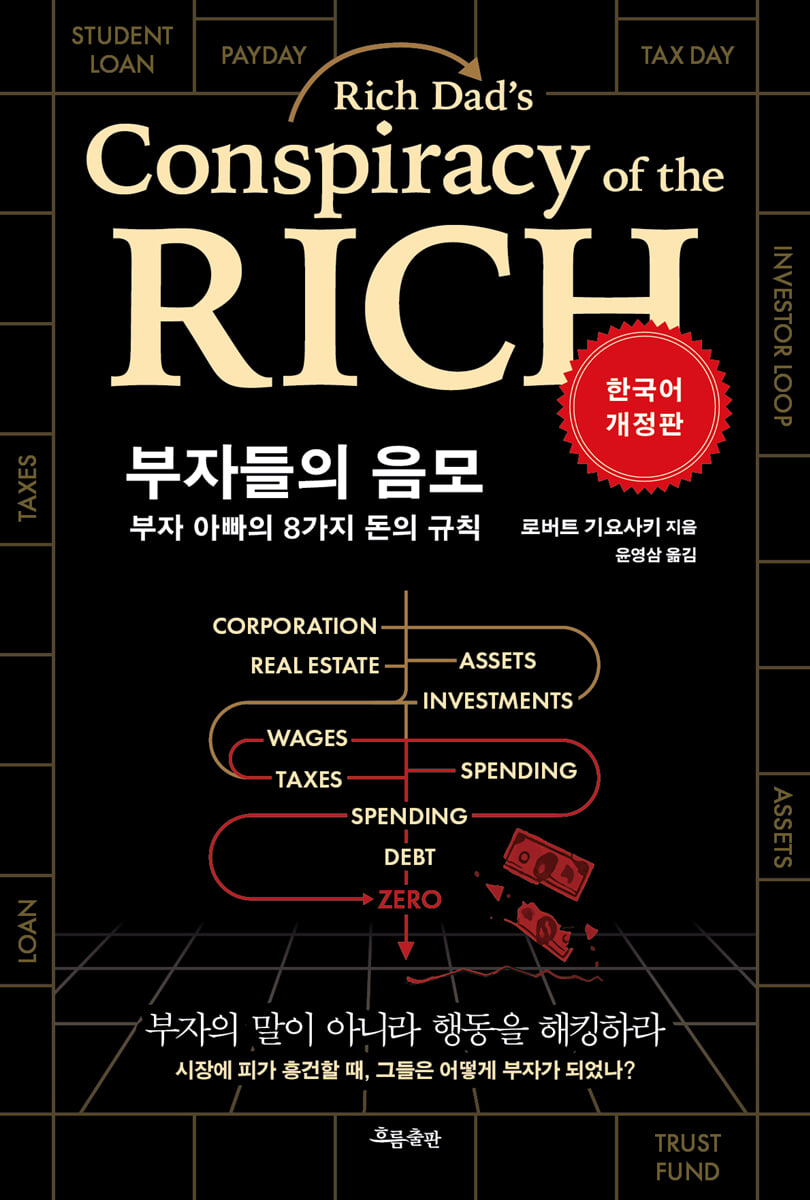
Conspiracy of the Rich
 |
Description
Book Introduction
Hack the actions of the rich, not their words.
- Rich Dad, the final edition of Kiyosaki's Introduction to the Study of Wealth
- Revised edition of the long-running bestseller published in 51 languages and 109 countries worldwide.
When the market is saturated, the wealthy change the rules of money to create a system that benefits them, and they take advantage of the lack of financial education and economic crisis to accumulate even greater wealth.
In "The Rich Conspiracy," Robert Kiyosaki reveals the hidden rules of money that the rich have built.
He emphasizes that focusing on securing cash flow is the path to true financial freedom, and introduces the "8 New Rules of Money" that anyone can apply to their lives.
Let's embark on a journey to financial freedom through his textbook on wealth, beloved by 40 million readers in 109 countries and 51 languages around the world.
- Rich Dad, the final edition of Kiyosaki's Introduction to the Study of Wealth
- Revised edition of the long-running bestseller published in 51 languages and 109 countries worldwide.
When the market is saturated, the wealthy change the rules of money to create a system that benefits them, and they take advantage of the lack of financial education and economic crisis to accumulate even greater wealth.
In "The Rich Conspiracy," Robert Kiyosaki reveals the hidden rules of money that the rich have built.
He emphasizes that focusing on securing cash flow is the path to true financial freedom, and introduces the "8 New Rules of Money" that anyone can apply to their lives.
Let's embark on a journey to financial freedom through his textbook on wealth, beloved by 40 million readers in 109 countries and 51 languages around the world.
- You can preview some of the book's contents.
Preview
index
Preface to the Revised Edition
Why I Wrote This Book: Stop Being Fooled by the Rich's Sweet Talk
Part 1: The Rich's Schemes
Chapter 1: Why America Failed
Chapter 2: The Rich's Conspiracy Against Education
Chapter 3: Banks Never Fail
Chapter 4: A Conspiracy to Steal Our Wealth
Chapter 5: The Invisible Hand That Obstructs Financial Education
Part 2: Hacking the Rich Man's Conspiracy
Chapter 6: Where Are We Now?
Chapter 7: Understand the Rules of the Game
Chapter 8: Print Your Own Money
Chapter 9: The Secret to Success: Sell!
Chapter 10: Build a Home for the Future
Chapter 11: Learn Financial Knowledge
Chapter 12: The Financial Lessons Rich Dad Doesn't Teach You in School
Epilogue: If you want to get rich, speak the language of the rich.
Acknowledgments: My first book written through direct interaction with readers online.
Why I Wrote This Book: Stop Being Fooled by the Rich's Sweet Talk
Part 1: The Rich's Schemes
Chapter 1: Why America Failed
Chapter 2: The Rich's Conspiracy Against Education
Chapter 3: Banks Never Fail
Chapter 4: A Conspiracy to Steal Our Wealth
Chapter 5: The Invisible Hand That Obstructs Financial Education
Part 2: Hacking the Rich Man's Conspiracy
Chapter 6: Where Are We Now?
Chapter 7: Understand the Rules of the Game
Chapter 8: Print Your Own Money
Chapter 9: The Secret to Success: Sell!
Chapter 10: Build a Home for the Future
Chapter 11: Learn Financial Knowledge
Chapter 12: The Financial Lessons Rich Dad Doesn't Teach You in School
Epilogue: If you want to get rich, speak the language of the rich.
Acknowledgments: My first book written through direct interaction with readers online.
Detailed image

Into the book
“What should I invest in and how?” This question is not easy to answer.
This is because each person's situation and the reality of the country they live in are different.
But I always give the same answer based on the 'rich dad' philosophy.
Whether you live in Seoul, Sydney, Los Angeles, or London, remember this:
“Before deciding what or how to invest, first invest in yourself.” This philosophy applies to everyone.
You too can put this philosophy into practice starting today.
It doesn't cost any money.
All it takes is a will to learn, consistent self-discipline, and the inner strength and determination to succeed.
And all this is already within you.
If you've read the Rich Dad series, you know that you are your own greatest asset.
We must train our minds to properly utilize the asset called 'I'.
By training your mind, you can seize opportunities that were previously invisible.
You can forge your own path even in times of inflation, recession, and volatile market conditions.
---From the "Preface to the Revised Edition"
It's truly mind-boggling that schools today don't teach us about money.
At best, they teach you how to write a budget, how to buy and sell stocks on the stock market, how to save money in the bank, and how a pension plan can secure your retirement.
All of these are ways to give back to the rich the money you earn.
Rich people never teach you how to make money.
---From "Part 1: The Rich Man's Scheme"
The bailouts the government provides to banks are nothing more than the powerful taking money from ordinary people and giving it to their wealthy friends.
This is money that is being used to cover up the mistakes, incompetence, and even outright fraud of one's friends.
This is by no means money to revive the economy.
Does this sound like a lie?
The January 26, 2009, Wall Street Journal article, “Big Banks See Their Loans Decrease,” reveals the truth.
An analysis of recently released fourth-quarter 2008 bank results shows that 10 of the 13 largest banks that benefited from the Troubled Asset Relief Program saw their excess loan balances fall by $46 billion, or 1.4 percent, compared to the third quarter.
This means that these banks swallowed up $148 billion of taxpayer money that the government gave them to lend to the people.
---From "Part 1: The Rich Man's Scheme"
If ordinary people who invest in mutual funds for the long term to achieve capital gains are called tuna, then the fund managers and professional traders who leisurely move between them and take commissions from their investment savings can be called sharks.
They appear on economic TV, recommend stocks, and inform people about whether stock prices are rising or falling, thereby attracting people to the stock market and encouraging them to pour more cash into stocks, bonds, and derivative products such as mutual funds.
This is to attract more tuna to their pools.
All of this is a derivative of the big game called the market.
Ninety percent of people are likely to become prey in the game played by these 10 percent.
---From "Part 2: Defeat the Conspiracy of the Rich"
The average person with a job is struggling with taxes, debt, inflation, and retirement savings.
Moreover, taxes and retirement savings are taken out of your paycheck before you even touch it.
In other words, someone else is taking the money I earn.
A huge amount of money taken from a tiny paycheck is disappearing somewhere.
It goes into the pockets of the super rich who planned this game.
But people don't notice.
Because I have never received any financial education.
If people knew where their salaries were going, they would revolt.
With proper financial education, people can minimize those costs and even use them to make money.
This is because each person's situation and the reality of the country they live in are different.
But I always give the same answer based on the 'rich dad' philosophy.
Whether you live in Seoul, Sydney, Los Angeles, or London, remember this:
“Before deciding what or how to invest, first invest in yourself.” This philosophy applies to everyone.
You too can put this philosophy into practice starting today.
It doesn't cost any money.
All it takes is a will to learn, consistent self-discipline, and the inner strength and determination to succeed.
And all this is already within you.
If you've read the Rich Dad series, you know that you are your own greatest asset.
We must train our minds to properly utilize the asset called 'I'.
By training your mind, you can seize opportunities that were previously invisible.
You can forge your own path even in times of inflation, recession, and volatile market conditions.
---From the "Preface to the Revised Edition"
It's truly mind-boggling that schools today don't teach us about money.
At best, they teach you how to write a budget, how to buy and sell stocks on the stock market, how to save money in the bank, and how a pension plan can secure your retirement.
All of these are ways to give back to the rich the money you earn.
Rich people never teach you how to make money.
---From "Part 1: The Rich Man's Scheme"
The bailouts the government provides to banks are nothing more than the powerful taking money from ordinary people and giving it to their wealthy friends.
This is money that is being used to cover up the mistakes, incompetence, and even outright fraud of one's friends.
This is by no means money to revive the economy.
Does this sound like a lie?
The January 26, 2009, Wall Street Journal article, “Big Banks See Their Loans Decrease,” reveals the truth.
An analysis of recently released fourth-quarter 2008 bank results shows that 10 of the 13 largest banks that benefited from the Troubled Asset Relief Program saw their excess loan balances fall by $46 billion, or 1.4 percent, compared to the third quarter.
This means that these banks swallowed up $148 billion of taxpayer money that the government gave them to lend to the people.
---From "Part 1: The Rich Man's Scheme"
If ordinary people who invest in mutual funds for the long term to achieve capital gains are called tuna, then the fund managers and professional traders who leisurely move between them and take commissions from their investment savings can be called sharks.
They appear on economic TV, recommend stocks, and inform people about whether stock prices are rising or falling, thereby attracting people to the stock market and encouraging them to pour more cash into stocks, bonds, and derivative products such as mutual funds.
This is to attract more tuna to their pools.
All of this is a derivative of the big game called the market.
Ninety percent of people are likely to become prey in the game played by these 10 percent.
---From "Part 2: Defeat the Conspiracy of the Rich"
The average person with a job is struggling with taxes, debt, inflation, and retirement savings.
Moreover, taxes and retirement savings are taken out of your paycheck before you even touch it.
In other words, someone else is taking the money I earn.
A huge amount of money taken from a tiny paycheck is disappearing somewhere.
It goes into the pockets of the super rich who planned this game.
But people don't notice.
Because I have never received any financial education.
If people knew where their salaries were going, they would revolt.
With proper financial education, people can minimize those costs and even use them to make money.
---From "Part 2: Defeat the Conspiracy of the Rich"
Publisher's Review
How did they get rich when the market was so saturated?
Hack the actions of the rich, not their words.
A revised edition of Robert Kiyosaki's "The Art of Wealth" textbook, published in 51 languages and 109 countries worldwide.
There is a saying we always hear at home, at school, and at work.
“Save it.
“Save as much as you earn.” We have been taught that only honesty, diligence, and spending within one’s means can make money.
But do the rich think that way? Robert Kiyosaki, author of the "Rich Dad Poor Dad" series, published in 91 languages and 109 countries worldwide, calls it a "rich conspiracy."
These words are ultimately nothing more than a trick to maximize the profits of the rich.
In fact, the rich have already changed the 'rules of money' to their advantage, and they have kept those rules strictly among themselves.
But ordinary people still blindly believe in and follow the outdated rules set forth by the rich, and suffer great losses whenever an economic crisis strikes.
The Conspiracy of the Rich seeks to trace the root cause of this financial crisis to the system created by the rich.
The book is largely divided into two parts.
In Part 1, Robert Kiyosaki delves into the history of finance to reveal how the rich have exploited ordinary people to accumulate wealth.
Part 2 guides you through specific methods to hack the rich's methods to achieve financial freedom and create your own cash flow.
As a real investor and successful businessman, Kiyosaki reveals for the first time in this book the realistic and effective investment strategies that built his wealth.
★ Rich Dad Poor Dad: Robert Kiyosaki's definitive guide to money and investing!
★★ A Korean revised edition of a book that has been a long-term Amazon bestseller since its publication in 2009!
Kiyosaki says that while there have been market ups and downs since the 2007 financial crisis in the United States, looking at it from a broader perspective, the world has entered an era of constant uncertainty.
While ordinary people are suffering great economic losses due to the sharp rise and fall of real estate prices, soaring gold prices, high unemployment, depleted pensions, and the decline of the middle class, the rich are accumulating even more wealth.
What do the rich know, and what do we not? Robert Kiyosaki argues that "this crisis was preordained because the rich changed the rules of money," and traces the root of the crisis to a "conspiracy of the rich."
Now is the time when the old rules of money that we knew don't apply.
To survive, you have to learn the new money rules that the rich follow.
When the United States abolished the gold standard in 1971, the dollar became a currency that could be printed infinitely without the constraints of gold.
Since the establishment of the Federal Reserve System in 1913, a monetary system that favored the wealthy had already been established, and their plan was fully realized with the abolition of the gold standard.
As a result, the economy experienced an unprecedented boom and asset prices soared.
But ordinary people, following the old rule of "live within your means," took out debt to buy houses, and suffered even greater losses during each crisis.
After the 2007 financial crisis, ordinary people lost everything, but the rich got richer.
In this book, Kiyosaki teaches readers new rules created by the rich, and emphasizes that only by following those rules can one achieve financial freedom.
There are two main ways in which the rich have increased their wealth through collusion with those in power.
First, the Federal Reserve and bailouts were essentially tools to protect the interests of the wealthy.
During the 2008 financial crisis, the government unconditionally injected massive amounts of public funds into large banks.
In the process, taxpayers' money was used to cover the losses of insolvent financial institutions and the wealthy.
Ultimately, the responsibility for the financial crisis was passed on to ordinary taxpayers.
Second, the lack of financial education is also intentional on the part of the wealthy.
The wealthy have forced a lifestyle that suits their own interests on ordinary people, teaching them to “get a good job,” “your home is your greatest asset,” “save and spend frugally,” and “use your retirement savings.”
This was ultimately a clever strategy to ensure that the money of ordinary people flowed into the pockets of the rich.
Kiyosaki warns that the current economic situation poses the risk of German-style hyperinflation.
Printing dollars without limit will eventually lead to a sharp decline in the value of the currency and inflation.
In Part 2 of this book, he details various investment methods that can help you secure a steady cash flow and build your own wealth even in these situations.
If you want true financial freedom, you must no longer rely on a paycheck and must be able to generate your own money whenever you want.
Rather than focusing on capital gains, you should focus on stable cash flow, build financial knowledge, and pioneer investment paths known only to the wealthy.
Ultimately, the way to survive and become wealthy in an economic crisis is to learn the new rules of money and take control of your own destiny.
★ “Do you still have no income other than your salary?”
★★ If you want to be rich, you must know how to print your own money.
While Part 1 delves into the hidden schemes of the wealthy and the "rules of money" they've changed, Part 2 presents concrete, practical investment know-how from millionaire investor and businessman Robert Kiyosaki on how to generate stable cash flow and build wealth even in times of crisis.
The concept that Kiyosaki emphasizes most in Part 2 is ‘cash flow.’
The modern economy is ultimately a “cash flow game.”
Most ordinary people still struggle to live within their paychecks, cutting back on spending and cutting up their credit cards.
But the rich, the top 10 percent who understand the true purpose of the game, focus on building a structure that provides a steady stream of money without requiring them to work.
In the book, Kiyosaki compares the case of a friend's couple with a completely different lifestyle from his own.
Tom and Karen, a couple who run a business, are constantly working to earn more money.
On the other hand, the Kiyosakis focus on increasing their assets rather than increasing the amount of work they do.
The income structures of the two couples show a very large difference as a result.
Tom and Karen only make money from the businesses they run.
If they don't do the work themselves, their income stops.
However, the Kiyosakis have a variety of cash flows from various assets, including businesses, publishing royalties, copyright and trademark income, real estate rentals, and stock dividends.
Kiyosaki also emphasizes to Korean readers, “Focus on securing cash flow rather than capital gains.”
To achieve this, you need to increase your financial IQ and solidify your financial knowledge.
With proper financial knowledge, you can create your own money by leveraging businesses, real estate, stocks, precious metals like gold and silver, and commodities like crude oil, in addition to traditional investment methods.
He ultimately argues that as economic conditions become more challenging and financial markets become more uncertain, those with more thorough financial knowledge will have greater opportunities to create greater wealth.
★ 8 New Money Rules from Rich Dad Kiyosaki
1.
Money is knowledge
2.
Learn how to use debt
3.
Learn to control your cash flow
4.
Prepare for tough times.
Then you will only enjoy good times
5.
What we need now is speed
6.
Learn the language of money
7.
Life is a team game.
Choose your team carefully
8.
As the value of money falls, learn to print your own money.
Hack the actions of the rich, not their words.
A revised edition of Robert Kiyosaki's "The Art of Wealth" textbook, published in 51 languages and 109 countries worldwide.
There is a saying we always hear at home, at school, and at work.
“Save it.
“Save as much as you earn.” We have been taught that only honesty, diligence, and spending within one’s means can make money.
But do the rich think that way? Robert Kiyosaki, author of the "Rich Dad Poor Dad" series, published in 91 languages and 109 countries worldwide, calls it a "rich conspiracy."
These words are ultimately nothing more than a trick to maximize the profits of the rich.
In fact, the rich have already changed the 'rules of money' to their advantage, and they have kept those rules strictly among themselves.
But ordinary people still blindly believe in and follow the outdated rules set forth by the rich, and suffer great losses whenever an economic crisis strikes.
The Conspiracy of the Rich seeks to trace the root cause of this financial crisis to the system created by the rich.
The book is largely divided into two parts.
In Part 1, Robert Kiyosaki delves into the history of finance to reveal how the rich have exploited ordinary people to accumulate wealth.
Part 2 guides you through specific methods to hack the rich's methods to achieve financial freedom and create your own cash flow.
As a real investor and successful businessman, Kiyosaki reveals for the first time in this book the realistic and effective investment strategies that built his wealth.
★ Rich Dad Poor Dad: Robert Kiyosaki's definitive guide to money and investing!
★★ A Korean revised edition of a book that has been a long-term Amazon bestseller since its publication in 2009!
Kiyosaki says that while there have been market ups and downs since the 2007 financial crisis in the United States, looking at it from a broader perspective, the world has entered an era of constant uncertainty.
While ordinary people are suffering great economic losses due to the sharp rise and fall of real estate prices, soaring gold prices, high unemployment, depleted pensions, and the decline of the middle class, the rich are accumulating even more wealth.
What do the rich know, and what do we not? Robert Kiyosaki argues that "this crisis was preordained because the rich changed the rules of money," and traces the root of the crisis to a "conspiracy of the rich."
Now is the time when the old rules of money that we knew don't apply.
To survive, you have to learn the new money rules that the rich follow.
When the United States abolished the gold standard in 1971, the dollar became a currency that could be printed infinitely without the constraints of gold.
Since the establishment of the Federal Reserve System in 1913, a monetary system that favored the wealthy had already been established, and their plan was fully realized with the abolition of the gold standard.
As a result, the economy experienced an unprecedented boom and asset prices soared.
But ordinary people, following the old rule of "live within your means," took out debt to buy houses, and suffered even greater losses during each crisis.
After the 2007 financial crisis, ordinary people lost everything, but the rich got richer.
In this book, Kiyosaki teaches readers new rules created by the rich, and emphasizes that only by following those rules can one achieve financial freedom.
There are two main ways in which the rich have increased their wealth through collusion with those in power.
First, the Federal Reserve and bailouts were essentially tools to protect the interests of the wealthy.
During the 2008 financial crisis, the government unconditionally injected massive amounts of public funds into large banks.
In the process, taxpayers' money was used to cover the losses of insolvent financial institutions and the wealthy.
Ultimately, the responsibility for the financial crisis was passed on to ordinary taxpayers.
Second, the lack of financial education is also intentional on the part of the wealthy.
The wealthy have forced a lifestyle that suits their own interests on ordinary people, teaching them to “get a good job,” “your home is your greatest asset,” “save and spend frugally,” and “use your retirement savings.”
This was ultimately a clever strategy to ensure that the money of ordinary people flowed into the pockets of the rich.
Kiyosaki warns that the current economic situation poses the risk of German-style hyperinflation.
Printing dollars without limit will eventually lead to a sharp decline in the value of the currency and inflation.
In Part 2 of this book, he details various investment methods that can help you secure a steady cash flow and build your own wealth even in these situations.
If you want true financial freedom, you must no longer rely on a paycheck and must be able to generate your own money whenever you want.
Rather than focusing on capital gains, you should focus on stable cash flow, build financial knowledge, and pioneer investment paths known only to the wealthy.
Ultimately, the way to survive and become wealthy in an economic crisis is to learn the new rules of money and take control of your own destiny.
★ “Do you still have no income other than your salary?”
★★ If you want to be rich, you must know how to print your own money.
While Part 1 delves into the hidden schemes of the wealthy and the "rules of money" they've changed, Part 2 presents concrete, practical investment know-how from millionaire investor and businessman Robert Kiyosaki on how to generate stable cash flow and build wealth even in times of crisis.
The concept that Kiyosaki emphasizes most in Part 2 is ‘cash flow.’
The modern economy is ultimately a “cash flow game.”
Most ordinary people still struggle to live within their paychecks, cutting back on spending and cutting up their credit cards.
But the rich, the top 10 percent who understand the true purpose of the game, focus on building a structure that provides a steady stream of money without requiring them to work.
In the book, Kiyosaki compares the case of a friend's couple with a completely different lifestyle from his own.
Tom and Karen, a couple who run a business, are constantly working to earn more money.
On the other hand, the Kiyosakis focus on increasing their assets rather than increasing the amount of work they do.
The income structures of the two couples show a very large difference as a result.
Tom and Karen only make money from the businesses they run.
If they don't do the work themselves, their income stops.
However, the Kiyosakis have a variety of cash flows from various assets, including businesses, publishing royalties, copyright and trademark income, real estate rentals, and stock dividends.
Kiyosaki also emphasizes to Korean readers, “Focus on securing cash flow rather than capital gains.”
To achieve this, you need to increase your financial IQ and solidify your financial knowledge.
With proper financial knowledge, you can create your own money by leveraging businesses, real estate, stocks, precious metals like gold and silver, and commodities like crude oil, in addition to traditional investment methods.
He ultimately argues that as economic conditions become more challenging and financial markets become more uncertain, those with more thorough financial knowledge will have greater opportunities to create greater wealth.
★ 8 New Money Rules from Rich Dad Kiyosaki
1.
Money is knowledge
2.
Learn how to use debt
3.
Learn to control your cash flow
4.
Prepare for tough times.
Then you will only enjoy good times
5.
What we need now is speed
6.
Learn the language of money
7.
Life is a team game.
Choose your team carefully
8.
As the value of money falls, learn to print your own money.
GOODS SPECIFICS
- Date of issue: July 1, 2025
- Page count, weight, size: 360 pages | 556g | 152*225*24mm
- ISBN13: 9788965967286
- ISBN10: 8965967287
You may also like
카테고리
korean


korean

![GQ KOREA Mark (Monthly): December [2025]](http://librairie.coreenne.fr/cdn/shop/files/8ef265dbbfbf186523ed75ba7319009d.jpg?v=1765340328&width=3840)


