

Trans-Eurasia, 22,000 km
 |
Description
Book Introduction
Donghae Port, from Vladivostok to Istanbul on Lake Baikal
Drive the Siberian Silk Road in the car 'Mojave'!!
Traces of the Korean people seen on the road, across borders and across time!
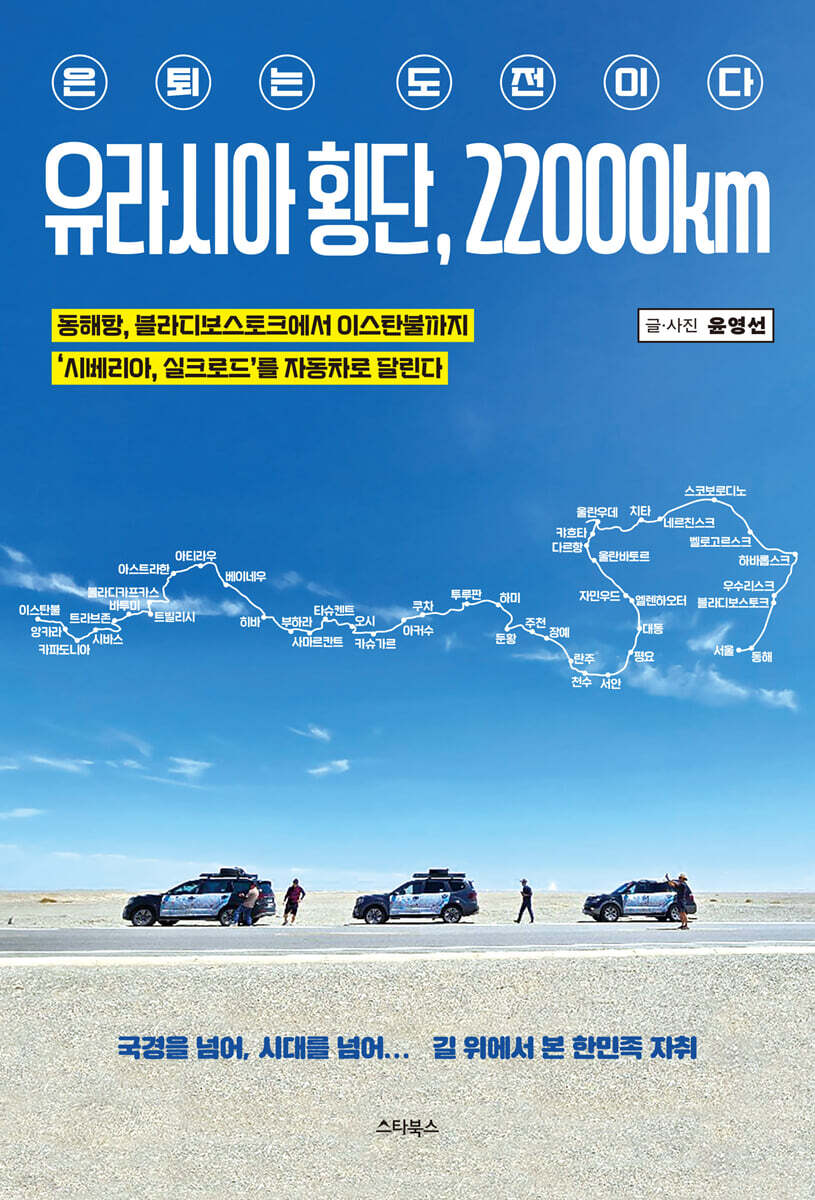
『22,000km Across Eurasia』 is a record of the author's challenge after retirement, in which three teams of three Mojave cars set off from the East Sea and traveled 22,000km by car through Siberia, Mongolia, China, Central Asia, and Istanbul for two months, following the footsteps of the Korean people. It vividly portrays the history of our people.
The author said in the preface:
There is a saying that goes, “You can buy a watch, but you can’t buy time.”
It means that you should not put off doing what you really want to do in life.
There is a wish I have had for a long time since my school days.
I wanted to experience firsthand what the Earth we live on was like. What new challenge should I try? As I pondered this, a dream from my school days suddenly came to mind.
I decided to pursue a dream that I had been unable to pursue due to being tied down by work.
It is a trip to the deep remote regions of the Asian continent where the traces and soul of the ancient Korean people's history still breathe.
When I was a student, 'History and Geography' were my favorite subjects.
We will travel along the Silk Road, an ancient trade, cultural, and religious route between the East and the West, follow the journey of the young Silla monk Hyecho 1,300 years ago, and visit the Mongolian Plateau, the stage for the activities of nomads who frequently invaded our country, and the Maritime Province and Siberia, which were the stages of the overseas independence movement during the Japanese colonial period.
“It is a journey that takes us deep into the heart of the Asian continent, including the Taklamakan Desert, known as the most harsh desert in the world; the Pamir Plateau, called the roof of the earth; the Tian Shan Mountains and Tian Shan Plateau; the Kyzylkum Desert in Central Asia; the Caspian Sea; and the Caucasus Mountains,” he said. “While looking for a meaningful event to celebrate our 40th wedding anniversary, my wife and I heard rumors of a “Siberia, Silk Road” cross-country trip, and we happily joined.”
'It was a small stroke of luck in my life to participate in the two-month trans-Eurasian road trip in July and August 2024,' he said.
Drive the Siberian Silk Road in the car 'Mojave'!!
Traces of the Korean people seen on the road, across borders and across time!
『22,000km Across Eurasia』 is a record of the author's challenge after retirement, in which three teams of three Mojave cars set off from the East Sea and traveled 22,000km by car through Siberia, Mongolia, China, Central Asia, and Istanbul for two months, following the footsteps of the Korean people. It vividly portrays the history of our people.
The author said in the preface:
There is a saying that goes, “You can buy a watch, but you can’t buy time.”
It means that you should not put off doing what you really want to do in life.
There is a wish I have had for a long time since my school days.
I wanted to experience firsthand what the Earth we live on was like. What new challenge should I try? As I pondered this, a dream from my school days suddenly came to mind.
I decided to pursue a dream that I had been unable to pursue due to being tied down by work.
It is a trip to the deep remote regions of the Asian continent where the traces and soul of the ancient Korean people's history still breathe.
When I was a student, 'History and Geography' were my favorite subjects.
We will travel along the Silk Road, an ancient trade, cultural, and religious route between the East and the West, follow the journey of the young Silla monk Hyecho 1,300 years ago, and visit the Mongolian Plateau, the stage for the activities of nomads who frequently invaded our country, and the Maritime Province and Siberia, which were the stages of the overseas independence movement during the Japanese colonial period.
“It is a journey that takes us deep into the heart of the Asian continent, including the Taklamakan Desert, known as the most harsh desert in the world; the Pamir Plateau, called the roof of the earth; the Tian Shan Mountains and Tian Shan Plateau; the Kyzylkum Desert in Central Asia; the Caspian Sea; and the Caucasus Mountains,” he said. “While looking for a meaningful event to celebrate our 40th wedding anniversary, my wife and I heard rumors of a “Siberia, Silk Road” cross-country trip, and we happily joined.”
'It was a small stroke of luck in my life to participate in the two-month trans-Eurasian road trip in July and August 2024,' he said.
index
Recommendation
prolog
Part 1.
First day heading to the continent
From Donghae Port to Vladivostok
International passenger ship to Vladivostok
Visit to the Vladivostok Independence Movement site
Vladivostok Tourism
Part 2.
Crossing the Siberian Plain
Forced migration of Koryo people, 'Rizdolnoye'
Khabarovsk on the Amur River
Running through the virgin forests of the Siberian Plains
Belogorsk, the 'Free City Massacre' of the Independence Army
Siberia burning in peat
Trans-Siberian battle
Romance and hardship on the pastoral plains
Relaxation on the pristine lake “Lake Baikal”
Chunwon Lee Gwang-su's novel "Yujeong" and the refreshing shamanism
Part 3.
Journey to Inner Mongolia
From Lake Baikal to Mongolia
Mongolian Plateau, the hometown of Genghis Khan
Tibetan Buddhism in Mongolia and Early Modern Mongolian History
Passing through the Mongolian Plateau and the Gobi Desert
Elenhot, a border city in Inner Mongolia, China
Taihang Mountain and Xuan Temple in Datong, Shanxi Province
Pingyao Ancient City of the Ming Dynasty
Part 4.
China's Silk Road section
Chang'an of the Tang Dynasty and Xi'an of the Ming Dynasty
The Silk Road begins in Xi'an
Loess Plateau and the Haseo Corridor
Jiayuguan, the westernmost gate of the Great Wall
Dunhuang, the Silk Road's "international transit trade" city
Dunhuang Grottoes and the Wangwu Heavenly Kingdom Hall
Jade Gate and Yang Gate, gateways to the Silk Road
From 'Hami' to 'Turpan'
Turpan's 'Gochang Ancient City, Jiao Ancient City'
Silk Road 'Otani' relics
Kucha, the ancient settlement of the Taklamakan Desert
Footsteps of the Ancient Silla People and the Kizil Caves
Kashgar, the holy city of the Uyghurs
The Pamir Plateau, the Roof of the Earth
Crossing the Tian Shan Mountains and the Tian Shan Plateau
Part 5.
Central Asian Silk Road section
Entry into Kyrgyzstan
Tashkent's Koryo Village
Samarkand Goguryeo ruins, the Afrasiab Museum
Remains of the Timurid Empire
Bukhara Acro (Castle), the ancient Silk Road capital
Khiva Castle and the Hardships of the Kyzylkum Desert
Kazakhstan in the northern Caspian Sea
Part 6.
South Russia and Georgia
Astrakhan, lower reaches of the Volga River in southern Russia
Beyond the Caucasus Mountains to Georgia
Tbilisi, Georgia tourism
Black Sea port “Batumi” and Turkey’s “Trabzon”
Part 7.
Destination: Turkey
Sivas and Cappadocia on the Anatolian Plateau
Ankara's Korean War Memorial arrives in Istanbul
Istanbul's Silk Road Friendship and Cooperation Monument
The end of the long journey and return home
prolog
Part 1.
First day heading to the continent
From Donghae Port to Vladivostok
International passenger ship to Vladivostok
Visit to the Vladivostok Independence Movement site
Vladivostok Tourism
Part 2.
Crossing the Siberian Plain
Forced migration of Koryo people, 'Rizdolnoye'
Khabarovsk on the Amur River
Running through the virgin forests of the Siberian Plains
Belogorsk, the 'Free City Massacre' of the Independence Army
Siberia burning in peat
Trans-Siberian battle
Romance and hardship on the pastoral plains
Relaxation on the pristine lake “Lake Baikal”
Chunwon Lee Gwang-su's novel "Yujeong" and the refreshing shamanism
Part 3.
Journey to Inner Mongolia
From Lake Baikal to Mongolia
Mongolian Plateau, the hometown of Genghis Khan
Tibetan Buddhism in Mongolia and Early Modern Mongolian History
Passing through the Mongolian Plateau and the Gobi Desert
Elenhot, a border city in Inner Mongolia, China
Taihang Mountain and Xuan Temple in Datong, Shanxi Province
Pingyao Ancient City of the Ming Dynasty
Part 4.
China's Silk Road section
Chang'an of the Tang Dynasty and Xi'an of the Ming Dynasty
The Silk Road begins in Xi'an
Loess Plateau and the Haseo Corridor
Jiayuguan, the westernmost gate of the Great Wall
Dunhuang, the Silk Road's "international transit trade" city
Dunhuang Grottoes and the Wangwu Heavenly Kingdom Hall
Jade Gate and Yang Gate, gateways to the Silk Road
From 'Hami' to 'Turpan'
Turpan's 'Gochang Ancient City, Jiao Ancient City'
Silk Road 'Otani' relics
Kucha, the ancient settlement of the Taklamakan Desert
Footsteps of the Ancient Silla People and the Kizil Caves
Kashgar, the holy city of the Uyghurs
The Pamir Plateau, the Roof of the Earth
Crossing the Tian Shan Mountains and the Tian Shan Plateau
Part 5.
Central Asian Silk Road section
Entry into Kyrgyzstan
Tashkent's Koryo Village
Samarkand Goguryeo ruins, the Afrasiab Museum
Remains of the Timurid Empire
Bukhara Acro (Castle), the ancient Silk Road capital
Khiva Castle and the Hardships of the Kyzylkum Desert
Kazakhstan in the northern Caspian Sea
Part 6.
South Russia and Georgia
Astrakhan, lower reaches of the Volga River in southern Russia
Beyond the Caucasus Mountains to Georgia
Tbilisi, Georgia tourism
Black Sea port “Batumi” and Turkey’s “Trabzon”
Part 7.
Destination: Turkey
Sivas and Cappadocia on the Anatolian Plateau
Ankara's Korean War Memorial arrives in Istanbul
Istanbul's Silk Road Friendship and Cooperation Monument
The end of the long journey and return home
Detailed image

Publisher's Review
Retirement is a challenge, crossing the Pamir Plateau and the Tian Shan Mountains by car!
The Silk Road and Eurasian Crossing: A Journey Filled with the Footsteps of the Korean People
『22,000km Crossing Eurasia』 is a two-month journey of three teams using three of the most durable 'Mojave' vehicles, starting from the East Sea, passing through Lake Baikal in Siberia, Mongolia, the Pamir Plateau, the Tian Shan Mountains and the Tian Shan Plateau along the Silk Road in China, and finally reaching Istanbul in Central Asia, Turkey, covering 22,000km.
Car travel comes with many inconveniences, including diesel fuel and urea water, insurance for each country, highway tolls, consulting fees for Chinese entry permits, and replacement of car parts before departure.
In the Gobi Desert of Inner Mongolia, parts were also airlifted from Seoul.
Since I had no experience with long-distance car trips through remote areas, I had a hard time bringing enough side dishes, snacks, and first aid kits from Seoul.
Fortunately, those countries have maintenance shops that are open on Saturdays, Sundays, and even late at night, which reduces inconvenience.
However, the unfriendly and inefficient administrative procedures of border officials working in remote areas such as deserts and plateaus made road travel even more difficult.
Therefore, everything in the world is a mixture of good and bad things.
The final stop on our Eurasian journey is the Hagia Sophia Museum in Istanbul.
The Hagia Sophia Museum, which has been used as a museum since 1934 after being a former Eastern Orthodox cathedral and Islamic mosque, is also famous for being a place where Christians and Muslims can enjoy history together, as Christian and Islamic cultures coexist.
The entrance fee to the Hagia Sophia Museum is 40 euros (60,000 won) instead of Turkish lira.
The Hagia Sophia Museum has long lines of tourists from all over the world waiting to buy tickets.
The Hagia Sophia Museum was built in the 6th century and has withstood several earthquakes.
The Ottoman Empire converted Hagia Sophia into a mosque in the 15th century, which it used for over 500 years.
The early modern Turkish Republic was transformed into a museum for tourists, charging high admission fees, allowing visitors to experience the power of its history and culture.
"Crossing Eurasia, 22,000km" is a challenge after retirement.
This book is a delightful travel book that allows readers to follow in the footsteps of our Korean people, confirming and taking pride in the history and culture that exists in Siberia, Lake Baikal, the Silk Road, and Eurasia. It is also a history book that encompasses culture and art.
As this was my first time crossing Eurasia by car, I had many difficulties with administrative procedures, such as being able to enter China only through Mongolia and only using a Chinese driver's license. However, upon arriving in Istanbul, my final destination, I felt as if I could fly and finished the crossing with a light heart. I rested and enjoyed my time in Istanbul, sent my car by boat, and returned to Korea to work on my manuscript for a year.
Therefore, this book is an excellent humanities travel guide for readers who enjoy traveling and are interested in history and culture.
The Silk Road and Eurasian Crossing: A Journey Filled with the Footsteps of the Korean People
『22,000km Crossing Eurasia』 is a two-month journey of three teams using three of the most durable 'Mojave' vehicles, starting from the East Sea, passing through Lake Baikal in Siberia, Mongolia, the Pamir Plateau, the Tian Shan Mountains and the Tian Shan Plateau along the Silk Road in China, and finally reaching Istanbul in Central Asia, Turkey, covering 22,000km.
Car travel comes with many inconveniences, including diesel fuel and urea water, insurance for each country, highway tolls, consulting fees for Chinese entry permits, and replacement of car parts before departure.
In the Gobi Desert of Inner Mongolia, parts were also airlifted from Seoul.
Since I had no experience with long-distance car trips through remote areas, I had a hard time bringing enough side dishes, snacks, and first aid kits from Seoul.
Fortunately, those countries have maintenance shops that are open on Saturdays, Sundays, and even late at night, which reduces inconvenience.
However, the unfriendly and inefficient administrative procedures of border officials working in remote areas such as deserts and plateaus made road travel even more difficult.
Therefore, everything in the world is a mixture of good and bad things.
The final stop on our Eurasian journey is the Hagia Sophia Museum in Istanbul.
The Hagia Sophia Museum, which has been used as a museum since 1934 after being a former Eastern Orthodox cathedral and Islamic mosque, is also famous for being a place where Christians and Muslims can enjoy history together, as Christian and Islamic cultures coexist.
The entrance fee to the Hagia Sophia Museum is 40 euros (60,000 won) instead of Turkish lira.
The Hagia Sophia Museum has long lines of tourists from all over the world waiting to buy tickets.
The Hagia Sophia Museum was built in the 6th century and has withstood several earthquakes.
The Ottoman Empire converted Hagia Sophia into a mosque in the 15th century, which it used for over 500 years.
The early modern Turkish Republic was transformed into a museum for tourists, charging high admission fees, allowing visitors to experience the power of its history and culture.
"Crossing Eurasia, 22,000km" is a challenge after retirement.
This book is a delightful travel book that allows readers to follow in the footsteps of our Korean people, confirming and taking pride in the history and culture that exists in Siberia, Lake Baikal, the Silk Road, and Eurasia. It is also a history book that encompasses culture and art.
As this was my first time crossing Eurasia by car, I had many difficulties with administrative procedures, such as being able to enter China only through Mongolia and only using a Chinese driver's license. However, upon arriving in Istanbul, my final destination, I felt as if I could fly and finished the crossing with a light heart. I rested and enjoyed my time in Istanbul, sent my car by boat, and returned to Korea to work on my manuscript for a year.
Therefore, this book is an excellent humanities travel guide for readers who enjoy traveling and are interested in history and culture.
GOODS SPECIFICS
- Date of issue: November 5, 2025
- Page count, weight, size: 480 pages | 152*224*30mm
- ISBN13: 9791157957835
- ISBN10: 1157957838
You may also like
카테고리
korean


korean

![GQ KOREA Mark (Monthly): December [2025]](http://librairie.coreenne.fr/cdn/shop/files/8ef265dbbfbf186523ed75ba7319009d.jpg?v=1765340328&width=3840)


