

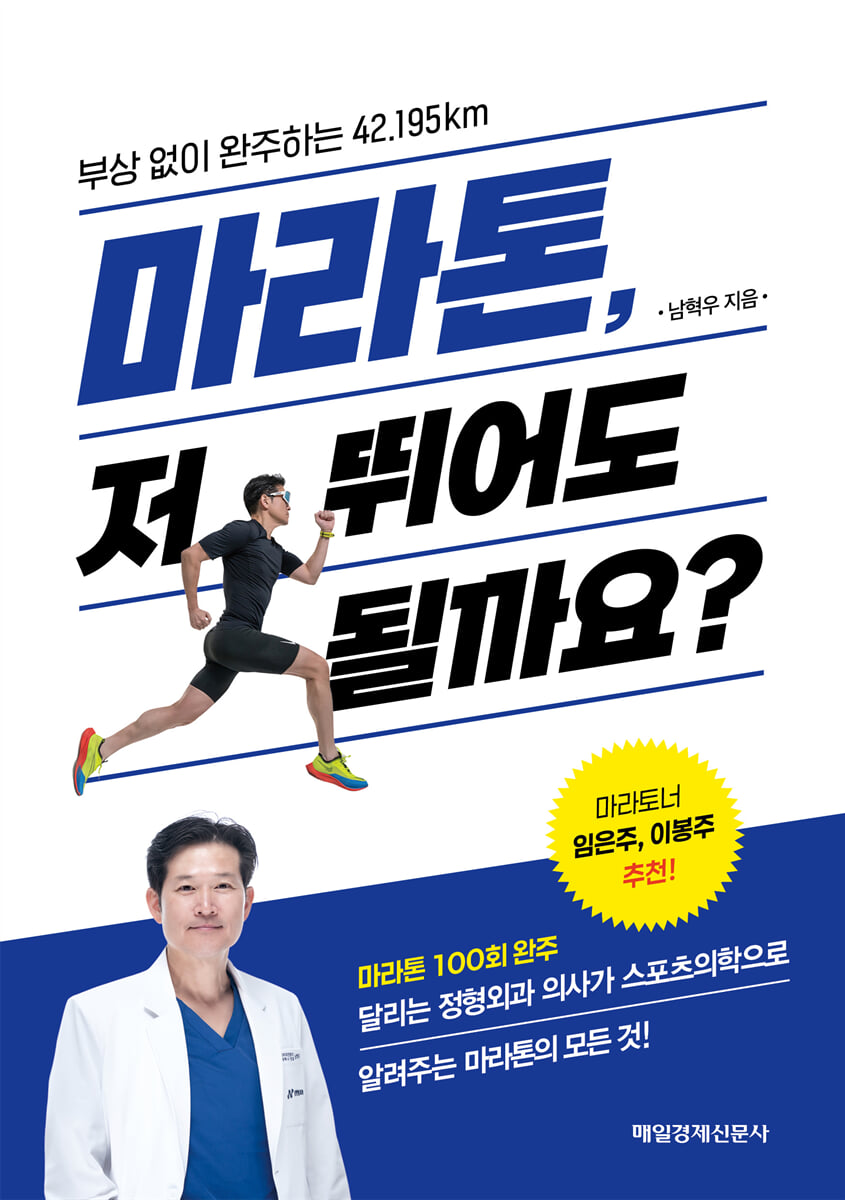
Marathon, can I run it?
 |
Description
Book Introduction
★ Former national marathon runners Im Eun-ju and Lee Bong-ju strongly recommend! ★
“I will finish at my own pace!”
A practical marathon guide covering the entire process from start to finish.
Marathons are no longer the exclusive domain of professional runners.
It has become a hobby that anyone who starts running can easily take up.
However, if you take on the challenge without any systematic information about completing a marathon, you may easily give up due to an unexpected injury.
Perhaps some runners already feel that the dream of completing a marathon is impossible due to the fear of frequent injuries.
The new book, "Marathon, Can I Run?" is the "most realistic and safe" introduction to marathon for all runners who dream of completing a marathon.
The author, a 100-time marathoner and orthopedic specialist, compiled practical physical training information for marathon running and know-how to train your mind for a healthy life, based on data from over 6,000 runners.
From how to choose running shoes to injury prevention posture, pre-marathon preparation routines, how to deal with emergencies that may arise during the race, and even post-run recovery and muscle strengthening, this book provides essential information for anyone preparing for a marathon in a friendly and in-depth manner.
Additionally, the book includes a "4-week? 8-week? 10km? Half? Full Course Training Program" designed based on the author's experience completing the course and medical knowledge, so that readers of any level can follow along at their own pace.
“Running is not just a trend; it has the power to transform our lives.”
Based on the running philosophy of the author, a mentor to runners, let's put into practice 'running for a healthy life, not a marathon to set a record' through this book.
“I will finish at my own pace!”
A practical marathon guide covering the entire process from start to finish.
Marathons are no longer the exclusive domain of professional runners.
It has become a hobby that anyone who starts running can easily take up.
However, if you take on the challenge without any systematic information about completing a marathon, you may easily give up due to an unexpected injury.
Perhaps some runners already feel that the dream of completing a marathon is impossible due to the fear of frequent injuries.
The new book, "Marathon, Can I Run?" is the "most realistic and safe" introduction to marathon for all runners who dream of completing a marathon.
The author, a 100-time marathoner and orthopedic specialist, compiled practical physical training information for marathon running and know-how to train your mind for a healthy life, based on data from over 6,000 runners.
From how to choose running shoes to injury prevention posture, pre-marathon preparation routines, how to deal with emergencies that may arise during the race, and even post-run recovery and muscle strengthening, this book provides essential information for anyone preparing for a marathon in a friendly and in-depth manner.
Additionally, the book includes a "4-week? 8-week? 10km? Half? Full Course Training Program" designed based on the author's experience completing the course and medical knowledge, so that readers of any level can follow along at their own pace.
“Running is not just a trend; it has the power to transform our lives.”
Based on the running philosophy of the author, a mentor to runners, let's put into practice 'running for a healthy life, not a marathon to set a record' through this book.
- You can preview some of the book's contents.
Preview
index
Recommendation
prolog
Chapter 1 5km.
What on earth is a marathon?
Is the marathon really a dangerous sport?
Why Humans Need Marathons
The benefits of running
Marathon: A Burden on the Heart or a Gift?
I heard that if you run a marathon, your knees will be ruined?
Doesn't running a marathon make you look older?
Chapter 2 10km.
Yeah, I'll try running a marathon too!
Health Checklist Before a Marathon
Running Shoe Selection Guide
How to Choose Shoes for Flat or Overpronated Runners
What kind of shoes are carbonized?
What kind of runner am I?
Injury-Free Running Form
What stretches should I do before running?
[Practice] 20km.
Training for a full-fledged marathon
4-Week Practice Program for Beginners
An 8-Week Program for Running 5K Injuries Free
Let's prepare for the 10km marathon.
Now it's the halfway mark! 20-week half marathon program
Challenge, full course marathon!
Chapter 3 30km.
Now is the day of the final battle
What is tapering?
What is Carboloading?
The Day Before the Competition: Build Your Confidence with Thorough Preparation
Race Day: Composure and Confidence Lead to a Successful Finish
Marathon Pace Strategy: 42.195km Isn't Just a Run
Problems you may encounter during a marathon and how to deal with them
How much rest should I take after a marathon?
Chapter 4 40km.
Tips for Running Injury-Free
Running is both an aerobic exercise and a full-body workout.
Strengthening exercises for muscle strengthening
What is alternative exercise?
How an Injured Runner Prepares for a Marathon
The Runner's Diet: What to Eat
Clinic Q&A: Frequently Asked Questions
Chapter 5: 2.195km left.
Mindset as a Runner
What is your growth rate?
RunBTI: Analyzing My Running Tendency
Epilogue
Americas
References
[Appendix] Marathon Practical Information
Marathon Pace Chart
VDOT projected marathon time chart
VDOT Basic Training Pace
prolog
Chapter 1 5km.
What on earth is a marathon?
Is the marathon really a dangerous sport?
Why Humans Need Marathons
The benefits of running
Marathon: A Burden on the Heart or a Gift?
I heard that if you run a marathon, your knees will be ruined?
Doesn't running a marathon make you look older?
Chapter 2 10km.
Yeah, I'll try running a marathon too!
Health Checklist Before a Marathon
Running Shoe Selection Guide
How to Choose Shoes for Flat or Overpronated Runners
What kind of shoes are carbonized?
What kind of runner am I?
Injury-Free Running Form
What stretches should I do before running?
[Practice] 20km.
Training for a full-fledged marathon
4-Week Practice Program for Beginners
An 8-Week Program for Running 5K Injuries Free
Let's prepare for the 10km marathon.
Now it's the halfway mark! 20-week half marathon program
Challenge, full course marathon!
Chapter 3 30km.
Now is the day of the final battle
What is tapering?
What is Carboloading?
The Day Before the Competition: Build Your Confidence with Thorough Preparation
Race Day: Composure and Confidence Lead to a Successful Finish
Marathon Pace Strategy: 42.195km Isn't Just a Run
Problems you may encounter during a marathon and how to deal with them
How much rest should I take after a marathon?
Chapter 4 40km.
Tips for Running Injury-Free
Running is both an aerobic exercise and a full-body workout.
Strengthening exercises for muscle strengthening
What is alternative exercise?
How an Injured Runner Prepares for a Marathon
The Runner's Diet: What to Eat
Clinic Q&A: Frequently Asked Questions
Chapter 5: 2.195km left.
Mindset as a Runner
What is your growth rate?
RunBTI: Analyzing My Running Tendency
Epilogue
Americas
References
[Appendix] Marathon Practical Information
Marathon Pace Chart
VDOT projected marathon time chart
VDOT Basic Training Pace
Detailed image

Into the book
Running has brought me health and a sense of accomplishment, but it has also repeatedly caused me to experience minor and major injuries, such as iliotibial band syndrome, plantar fasciitis, hamstring injuries, shin splints, and tensor fascia lata, which has made me realize the limits of my knowledge and experience.
It wasn't just a matter of being weak and starting late, but a misunderstanding and greed about running that were the main causes of the injury.
Amidst those injuries, I returned to the fundamentals of sports medicine.
Beyond my knowledge as an orthopedic specialist, I studied the causes and treatments of injuries by reading international papers to delve deeper into the specialized field of running.
While the main causes of injuries are overuse and overtraining, the root causes of recurring injuries are poor posture and a lack of understanding of injuries.
Correcting postures that cause injury and improving awareness of injuries can help prevent recurring injuries and even reduce medical expenses.
--- p.8, from “Prologue ‘Can I Run a Marathon?’”
Of course, it's pointless to compare it to extreme sports like wingsuiting, hang gliding, or motorcycle racing.
Up to 70% of wingsuit riders face a risk of death, while motorcycle racing has a mortality rate of around 100 per 100,000 people.
Compared to these sports, the marathon can be considered a relatively safe exercise.
--- p.16, 「Part 1.
From "What on earth is a marathon?"
Additionally, a recently published systematic literature review found that the prevalence of arthritis in people who regularly run was only about 3.5%.
This figure is much lower than the average prevalence rate of 10% in the general adult population, and is important evidence that overturns the existing perception that marathons put a strain on joints.
--- p.36, 「Part 1.
From "What on earth is a marathon?"
If you're just starting out running, the most important thing is habit.
A habit is an unconscious, automatic reflex-like behavior.
At first, I started running with a conscious decision to do it, but when my body got tired and I was busy with work, I naturally started making excuses.
Running can only be easily practiced if it becomes a habit unconsciously.
If you exercise consistently 2-3 times a week at a set time and place, it will become a good habit.
It is precisely this habit that is another reason why I can run consistently without being affected by any situation.
--- p.132, 「Practice.
From "Training for a Real Marathon"
From my experience meeting and treating many runners, I can say that running injuries are something that everyone experiences at least once, just like a cold.
What matters is how you accept the injury and how you overcome it.
I, too, have suffered countless injuries, fallen, and gotten back up again to get to where I am today.
The process of returning from injury is not a simple recovery.
It's a way to grow as a runner and an opportunity to learn something new.
By maintaining fitness through alternative and supplementary training, managing injuries, and maintaining a consistent running habit, runners can definitely take their performance to the next level.
And this period is also a great opportunity to reflect on yourself.
It's a time to reflect on why injuries occurred and to check what you might have missed in your own routine, including weekly mileage, interval intensity, weekly/monthly plan, race schedule, running form, and running surfaces.
It wasn't just a matter of being weak and starting late, but a misunderstanding and greed about running that were the main causes of the injury.
Amidst those injuries, I returned to the fundamentals of sports medicine.
Beyond my knowledge as an orthopedic specialist, I studied the causes and treatments of injuries by reading international papers to delve deeper into the specialized field of running.
While the main causes of injuries are overuse and overtraining, the root causes of recurring injuries are poor posture and a lack of understanding of injuries.
Correcting postures that cause injury and improving awareness of injuries can help prevent recurring injuries and even reduce medical expenses.
--- p.8, from “Prologue ‘Can I Run a Marathon?’”
Of course, it's pointless to compare it to extreme sports like wingsuiting, hang gliding, or motorcycle racing.
Up to 70% of wingsuit riders face a risk of death, while motorcycle racing has a mortality rate of around 100 per 100,000 people.
Compared to these sports, the marathon can be considered a relatively safe exercise.
--- p.16, 「Part 1.
From "What on earth is a marathon?"
Additionally, a recently published systematic literature review found that the prevalence of arthritis in people who regularly run was only about 3.5%.
This figure is much lower than the average prevalence rate of 10% in the general adult population, and is important evidence that overturns the existing perception that marathons put a strain on joints.
--- p.36, 「Part 1.
From "What on earth is a marathon?"
If you're just starting out running, the most important thing is habit.
A habit is an unconscious, automatic reflex-like behavior.
At first, I started running with a conscious decision to do it, but when my body got tired and I was busy with work, I naturally started making excuses.
Running can only be easily practiced if it becomes a habit unconsciously.
If you exercise consistently 2-3 times a week at a set time and place, it will become a good habit.
It is precisely this habit that is another reason why I can run consistently without being affected by any situation.
--- p.132, 「Practice.
From "Training for a Real Marathon"
From my experience meeting and treating many runners, I can say that running injuries are something that everyone experiences at least once, just like a cold.
What matters is how you accept the injury and how you overcome it.
I, too, have suffered countless injuries, fallen, and gotten back up again to get to where I am today.
The process of returning from injury is not a simple recovery.
It's a way to grow as a runner and an opportunity to learn something new.
By maintaining fitness through alternative and supplementary training, managing injuries, and maintaining a consistent running habit, runners can definitely take their performance to the next level.
And this period is also a great opportunity to reflect on yourself.
It's a time to reflect on why injuries occurred and to check what you might have missed in your own routine, including weekly mileage, interval intensity, weekly/monthly plan, race schedule, running form, and running surfaces.
--- p.282, 「Part 4.
From "Know-how to run without injury"
From "Know-how to run without injury"
Publisher's Review
“Marathon, can I run it too?”
This is a serious question that will be pondered by everyone from runners simply curious about the marathon, to those who have experience running but felt lost, to those who have suffered the pain of an injury while running hard.
Unlike short-distance running, the marathon is a high-intensity aerobic exercise that places a high burden on the musculoskeletal system as well as the cardiopulmonary function.
Therefore, rather than just starting out, it is essential to check your current health status and gradually adapt your physical strength.
"Marathon, Can I Run?" is a book that presents almost everything you need to prepare for a marathon, based on the medical insight and actual running experience of the author, an orthopedic specialist and 100-time marathon runner.
This book analyzes clinical data from treating numerous injured runners and provides specific information on a health checklist to check before starting a marathon, muscle strength and flexibility tests, areas at high risk for injury, and prevention methods.
The Most Trusted Marathon Guide from a Running Orthopedic Surgeon
The author wrote this book based on sports medicine research that analyzed data from over 6,000 runners.
It contains a balanced combination of personal running experience from completing 100 marathons and medical evidence, making it easy for even beginner runners to follow.
It accurately explains the correct running posture for injury prevention, how to choose running shoes, stretching methods, and the causes of injuries caused by overuse, overtraining, and incorrect posture from a medical perspective.
In particular, we provide 4-week and 8-week training programs for full-scale marathons, as well as 10km, half-course, and full-course training programs.
Based on the author's knowledge and experience, this systematically written training program will serve as an excellent training guide for both beginner runners and intermediate runners aiming to complete a marathon.
It also includes detailed information needed in real-life situations, such as tapering, carbo-loading, and pace strategy on race day.
42.195km: A surefire way to finish without injury
This book is written by an orthopedic specialist and explains how to complete a marathon without injury from a sports medicine perspective.
It provides detailed explanations of exercises to strengthen the muscles necessary for running, such as the hip joints, knees, calves, and ankles, and also presents specific training methods to prevent injuries in each area.
A muscle-strengthening program based on exercise physiology can provide real benefits not only to beginning runners but also to those struggling with repetitive injuries.
Additionally, the 'Clinic Q&A', which contains cases examined and treated by the author, has compiled the questions that runners are most curious about.
"Is midfoot striking always the right answer?", "Is cold compress better or hot compress better?", etc. The author provides clear and scientific answers based on his medical opinion and insight as a runner.
Marathon, now let's prepare for it!
Running is no longer just a sport for a select few.
However, there are many cases where people start running without preparation and then get scared by the endless track and give up.
This book provides the standards and direction for sustainable running that are essential for such runners.
In 'RunBTI: My Running Tendency Analysis', developed by the author himself, the 'RunBTI' test was created to help you figure out your running tendencies before starting a marathon.
This test is original content created by analyzing and researching data from approximately 8,000 runners who visit the author's hospital.
Readers will be able to identify their own runner type, find their own rhythm and pace, and steadily enter the marathon without giving up.
This is a serious question that will be pondered by everyone from runners simply curious about the marathon, to those who have experience running but felt lost, to those who have suffered the pain of an injury while running hard.
Unlike short-distance running, the marathon is a high-intensity aerobic exercise that places a high burden on the musculoskeletal system as well as the cardiopulmonary function.
Therefore, rather than just starting out, it is essential to check your current health status and gradually adapt your physical strength.
"Marathon, Can I Run?" is a book that presents almost everything you need to prepare for a marathon, based on the medical insight and actual running experience of the author, an orthopedic specialist and 100-time marathon runner.
This book analyzes clinical data from treating numerous injured runners and provides specific information on a health checklist to check before starting a marathon, muscle strength and flexibility tests, areas at high risk for injury, and prevention methods.
The Most Trusted Marathon Guide from a Running Orthopedic Surgeon
The author wrote this book based on sports medicine research that analyzed data from over 6,000 runners.
It contains a balanced combination of personal running experience from completing 100 marathons and medical evidence, making it easy for even beginner runners to follow.
It accurately explains the correct running posture for injury prevention, how to choose running shoes, stretching methods, and the causes of injuries caused by overuse, overtraining, and incorrect posture from a medical perspective.
In particular, we provide 4-week and 8-week training programs for full-scale marathons, as well as 10km, half-course, and full-course training programs.
Based on the author's knowledge and experience, this systematically written training program will serve as an excellent training guide for both beginner runners and intermediate runners aiming to complete a marathon.
It also includes detailed information needed in real-life situations, such as tapering, carbo-loading, and pace strategy on race day.
42.195km: A surefire way to finish without injury
This book is written by an orthopedic specialist and explains how to complete a marathon without injury from a sports medicine perspective.
It provides detailed explanations of exercises to strengthen the muscles necessary for running, such as the hip joints, knees, calves, and ankles, and also presents specific training methods to prevent injuries in each area.
A muscle-strengthening program based on exercise physiology can provide real benefits not only to beginning runners but also to those struggling with repetitive injuries.
Additionally, the 'Clinic Q&A', which contains cases examined and treated by the author, has compiled the questions that runners are most curious about.
"Is midfoot striking always the right answer?", "Is cold compress better or hot compress better?", etc. The author provides clear and scientific answers based on his medical opinion and insight as a runner.
Marathon, now let's prepare for it!
Running is no longer just a sport for a select few.
However, there are many cases where people start running without preparation and then get scared by the endless track and give up.
This book provides the standards and direction for sustainable running that are essential for such runners.
In 'RunBTI: My Running Tendency Analysis', developed by the author himself, the 'RunBTI' test was created to help you figure out your running tendencies before starting a marathon.
This test is original content created by analyzing and researching data from approximately 8,000 runners who visit the author's hospital.
Readers will be able to identify their own runner type, find their own rhythm and pace, and steadily enter the marathon without giving up.
GOODS SPECIFICS
- Date of issue: August 20, 2025
- Page count, weight, size: 340 pages | 570g | 148*210*21mm
- ISBN13: 9791164847976
You may also like
카테고리
korean


korean

![ELLE 엘르 스페셜 에디션 A형 : 12월 [2025]](http://librairie.coreenne.fr/cdn/shop/files/b8e27a3de6c9538896439686c6b0e8fb.jpg?v=1766436872&width=3840)


