

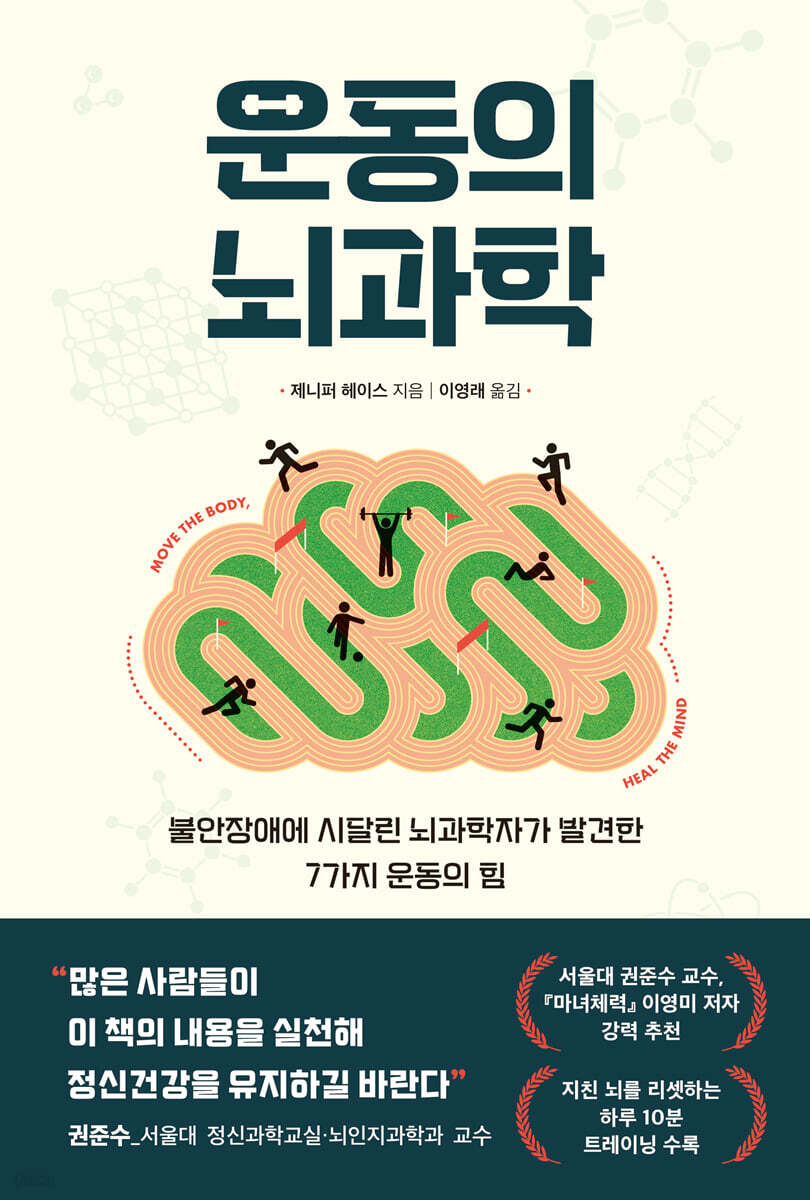
The Brain Science of Exercise
 |
Description
Book Introduction
“I hope many people put the contents of this book into practice. I sincerely hope that you can maintain your mental health.” Kwon Jun-su, Professor of Psychiatry and Cognitive Neuroscience at Seoul National University “My secret that I learned while exercising as an amateur We have obtained evidence that fits quite scientific logic! “Is this a book that contains theories and practical methods that I have not been able to present?” Lee Young-mi, author of "Witch's Stamina" Most of the problems in our lives A book that scientifically proves that exercise alone can solve all your problems! Can a simple walk increase brain capacity, and can endurance exercise extend lifespan? What happens to your brain when you exercise for an hour a week? How can you find the right intensity to maintain brain health? How can you eliminate brain inflammation, the true cause of mental illness? How can you exercise enjoyably and without stress, even if you have high blood pressure or heart disease? "The Brain Science of Exercise" is a "brain science-based exercise book" that explores from various perspectives how the surprising changes that occur in our brains when we move our bodies can help overcome depression, anxiety, and sleep disorders, and influence the improvement of concentration and creativity, as well as the delay in aging. The author of this book, Jennifer Hayes, is a neuroscientist with a PhD in cognitive neuroscience from McMaster University, a world-renowned university in Canada, and an associate professor of exercise science who has completed a triathlon. The author did not show any talent for sports from the beginning. He was an ordinary desk slacker who set exercise plans as his New Year's resolutions but always failed. The anxiety disorder that began when she was a graduate student resurfaced along with postpartum depression, and even completely ruined her marriage. The author, who had fallen to the bottom of life, unable to take care of himself or his precious daughter, discovered the power of exercise after accidentally riding a bicycle. The author, who studied brain science, went on to study intensively how exercise actually affects the brain and mind. That's why he has a PhD in cognitive neuroscience but is an associate professor in the Department of Kinesiology. In this book, he candidly shares his struggles with parenting and his marriage due to anxiety disorder, and dramatically describes how exercise rescued him when his life felt blocked on all sides. Based on the results of various brain science experiments conducted at the author's NeuroFit Lab and the latest exciting brain science information, the book emphasizes the power of exercise and introduces brain science-based exercise programs that readers can try themselves, leading readers into the world of exercise. |
- You can preview some of the book's contents.
Preview
index
Recommendation
Author's Note
Entering the Power of Exercise to Save Lives
Chapter 1: Why Can't We Break Free from Three-Day Resolutions?
Why is exercise so hard?
Slow and steady is the answer
How to find the right exercise intensity
First of all, it has to be fun
To overcome chronic stress
Some tips for those who find exercise burdensome
::: 10-Minute Daily Training for Beginners
Chapter 2: The Fastest Way to Get Out of Anxiety
Where does anxiety come from?
To escape from trauma
Exercise is a panacea for anxiety
How Fear Amplifies Pain
Focus on your body through your breathing
::: 10-Minute Daily Training to Overcome Fear
Chapter 3: A Body of Steel, a Mentally Strong Spirit
suffer from obsessive-compulsive disorder
Antidepressants, are you still taking them?
Depression has different causes.
Don't risk your life for small things.
What is the best antidepressant for drug-resistant patients?
How to change my hesitation about exercising
::: 10-Minute Daily Training to Heal Your Brain
Chapter 4: The Most Powerful Antidote to Addiction
Does exercise addiction really exist?
A weapon called Runner's High
Movement helps the brain recover.
The best offense is prevention
Breaking free from addiction by riding a bike
::: 10-Minute Daily Training to Fix Your Addicted Brain
Chapter 5: If you don't want to get old, exercise.
Age is a matter of the mind
Stereotypes about how the world views aging
You can't change your genes, but you can change your habits.
Aging 101: Protecting Your Brain and Slowing Aging
::: 10-Minute Daily Training to Stay Young Forever
Chapter 6: To you who is afraid of losing sleep
How is your sleep time?
If you want to fall asleep quickly
If you want to sleep deeply
::: 10-Minute Daily Training for Those Who Can't Sleep
Chapter 7: A Life of Focus and Creativity
Physical strength creates concentration
How to awaken your dormant creativity
Killing Two Birds at Once: Focus and Creativity
How to overcome the 'one-year barrier'
To save me from a life crisis
::: 10-Minute Daily Training to Double Your Focus and Creativity
Appendix 10-Minute Daily Training Movement Description
Acknowledgements
References
Author's Note
Entering the Power of Exercise to Save Lives
Chapter 1: Why Can't We Break Free from Three-Day Resolutions?
Why is exercise so hard?
Slow and steady is the answer
How to find the right exercise intensity
First of all, it has to be fun
To overcome chronic stress
Some tips for those who find exercise burdensome
::: 10-Minute Daily Training for Beginners
Chapter 2: The Fastest Way to Get Out of Anxiety
Where does anxiety come from?
To escape from trauma
Exercise is a panacea for anxiety
How Fear Amplifies Pain
Focus on your body through your breathing
::: 10-Minute Daily Training to Overcome Fear
Chapter 3: A Body of Steel, a Mentally Strong Spirit
suffer from obsessive-compulsive disorder
Antidepressants, are you still taking them?
Depression has different causes.
Don't risk your life for small things.
What is the best antidepressant for drug-resistant patients?
How to change my hesitation about exercising
::: 10-Minute Daily Training to Heal Your Brain
Chapter 4: The Most Powerful Antidote to Addiction
Does exercise addiction really exist?
A weapon called Runner's High
Movement helps the brain recover.
The best offense is prevention
Breaking free from addiction by riding a bike
::: 10-Minute Daily Training to Fix Your Addicted Brain
Chapter 5: If you don't want to get old, exercise.
Age is a matter of the mind
Stereotypes about how the world views aging
You can't change your genes, but you can change your habits.
Aging 101: Protecting Your Brain and Slowing Aging
::: 10-Minute Daily Training to Stay Young Forever
Chapter 6: To you who is afraid of losing sleep
How is your sleep time?
If you want to fall asleep quickly
If you want to sleep deeply
::: 10-Minute Daily Training for Those Who Can't Sleep
Chapter 7: A Life of Focus and Creativity
Physical strength creates concentration
How to awaken your dormant creativity
Killing Two Birds at Once: Focus and Creativity
How to overcome the 'one-year barrier'
To save me from a life crisis
::: 10-Minute Daily Training to Double Your Focus and Creativity
Appendix 10-Minute Daily Training Movement Description
Acknowledgements
References
Detailed image
.jpg)
Into the book
I've developed self-improvement principles based on the neuroscientific benefits of exercise.
The research-based exercises in this book will help you have a healthier brain.
We are confident that you will find yourself in a better state than before through various easy-to-follow and simple exercises.
This book is not just about exercise and the brain.
Rather, it is about navigating life.
There was a time when my life was filled with moments when it was hard to breathe, and I had to move my body to escape from them.
And now I'm taking a deep breath and enjoying life.
I hope exercise will be the antidote to your life, just as it was to mine.
You will become a more positive and resilient person.
You'll also find yourself more focused, more productive, and more meaningful relationships after exercising.
All these changes will really happen to you!
---「Entering.
From “The Power of Exercise to Save Life, pp. 17-18”
Exercise is your own journey to improve your fitness, not someone else's.
Therefore, you must determine the intensity of your exercise yourself.
Comparing yourself to others is not helpful, as the feeling of being "just right" depends on your individual lactate threshold.
For example, if you haven't moved much recently, simply walking can help you get past your lactate threshold.
That doesn't matter though.
The important thing is to gradually move away from your current lactate threshold.
Just move forward little by little, like a child learning to walk.
Just loiter in front of your house, walk around the neighborhood, and do it once, twice, three times.
Let's start with an exercise that you can comfortably tolerate, no matter what.
---「Chapter 1.
From “Why Can’t We Break Free from Three-Day Resolutions?”, p.42
The curious thing is that not everyone who experiences trauma develops PTSD, and not everyone who experiences fear develops an anxiety disorder.
What protects them? A neurotransmitter called neuropeptide Y, which aids recovery.
(…) Perhaps you are thinking, ‘I need NPY too.’
Fortunately, there is good news.
The fact is that you can create NPY through exercise.
How can exercise produce NPY and enhance recovery? One study tracked NPY changes in 12 young male rowers over a four-week training program.
(…) Researchers measured NPY before and after exercise and found that exercise at a consistent intensity led to an immediate increase in NPY that lasted for over 30 minutes. This means that exercise is essential to produce more NPY.
---「Chapter 2.
From "The Fastest Way to Get Out of Anxiety, p.63"
Our lab tracked changes in college students' mental health and inflammation over a six-week period during the most stressful time of the year: final exams.
(…) At the end of the grueling six weeks, the control group, which had been sedentary and did not exercise at all, were severely depressed enough to require treatment.
It was a shocking result, considering that none of them had ever suffered from a mental illness.
In contrast, the two exercise groups did not feel depressed even though they were exposed to the same psychological stress as the control group.
Students in the group that received moderate-intensity, sustained training in particular were the least stressed and had lower levels of inflammation as measured by blood tests.
---「Chapter 3.
From "A body of steel has a mentality of steel, p.109"
So how long does it take for a reward system to recover? Animal studies have shown that restoring a reward system takes significantly longer than destroying it.
(…) Recovery times vary greatly from person to person.
A study that followed 16 methamphetamine addicts for a year reveals this.
(…) What differences existed between them that led to such different outcomes? Surprisingly, there was no significant difference in their upbringing or history of drug abuse.
Many factors were similar, including age, education level, and duration of drug abuse.
But there was a crucial difference: the 10 addicts who successfully recovered from addiction, including Mike, had more dopamine receptors than those who failed.
If so, the solution appears to be in sight.
All we need to do is find a way to increase the number of receptors in the brains of recovering addicts.
Thankfully, there is a way! It's called moving your body.
---「Chapter 4.
From "The Most Powerful Antidote to Addiction, p.129"
You may have inherited genes that cause you to age more quickly than others.
But you shouldn't accept it as your fate.
Although one in four people inherit the eta4 type of apolipoprotein E (ApoE), which increases the risk of dementia, that does not mean they will inevitably develop dementia.
Conversely, inheriting healthy genes does not necessarily mean you are safe from dementia.
Why? Because lifestyle habits have a greater influence than genes.
As you can see, lifestyle habits are much more important than you think.
Our lab's research shows that without enough physical activity, healthy genes don't work at all.
A study of 1,600 older adults found that those who were less physically active had a similar risk of developing dementia as those with genetic predisposition.
These results suggest that not only genes but also lack of activity contributes to the development of dementia.
One thing to remember is that while you can't change your genes, you can change your lifestyle.
---「Chapter 5.
From “If you don’t want to get old, exercise, pp. 162-163”
The solution to this problem is simple.
Put your phone down and put on your sneakers.
Exercise resets the brain's clock.
Let's look at a study that analyzed the effects of exercise and sunlight on resetting the brain's clock.
(…) The light and movement worked synergistically to set Steve's brain clock back an hour and 20 minutes.
How can we apply these research findings to real-life situations? Exercise outdoors at the same time every day to align your brain's clock with real time.
The key is persistence.
That way, you can trust your exercise time as much as the sun.
You can fall asleep faster by aligning your brain's clock with reality.
---「Chapter 6.
From "To You Who Are Afraid of Losing Sleep, pp. 202-203"
Exercise trains the brain and strengthens executive functions like these.
The prefrontal cortex, which is supplied with sufficient blood sugar and oxygen, has better executive function than ever before.
This time is the best opportunity to examine your thoughts and discover errors in judgment.
You don't necessarily have to exercise for hours a day to achieve this.
Even just taking a quick break to move around can significantly improve your productivity.
Our lab has shown that taking short breaks, such as five minutes of exercise, while working on a task can make you more productive than working without breaks or resting statically.
We used the "brain reset workout" that included high-intensity movements introduced in Chapter 4's 10-Minute Workout a Day, but light movement and stretching will also produce good results.
This is because within 15 minutes of starting any level of exercise, blood flow containing oxygen increases within the prefrontal cortex.
The more intense and prolonged the exercise, the more rapidly the blood flow, including oxygen, increases.
The research-based exercises in this book will help you have a healthier brain.
We are confident that you will find yourself in a better state than before through various easy-to-follow and simple exercises.
This book is not just about exercise and the brain.
Rather, it is about navigating life.
There was a time when my life was filled with moments when it was hard to breathe, and I had to move my body to escape from them.
And now I'm taking a deep breath and enjoying life.
I hope exercise will be the antidote to your life, just as it was to mine.
You will become a more positive and resilient person.
You'll also find yourself more focused, more productive, and more meaningful relationships after exercising.
All these changes will really happen to you!
---「Entering.
From “The Power of Exercise to Save Life, pp. 17-18”
Exercise is your own journey to improve your fitness, not someone else's.
Therefore, you must determine the intensity of your exercise yourself.
Comparing yourself to others is not helpful, as the feeling of being "just right" depends on your individual lactate threshold.
For example, if you haven't moved much recently, simply walking can help you get past your lactate threshold.
That doesn't matter though.
The important thing is to gradually move away from your current lactate threshold.
Just move forward little by little, like a child learning to walk.
Just loiter in front of your house, walk around the neighborhood, and do it once, twice, three times.
Let's start with an exercise that you can comfortably tolerate, no matter what.
---「Chapter 1.
From “Why Can’t We Break Free from Three-Day Resolutions?”, p.42
The curious thing is that not everyone who experiences trauma develops PTSD, and not everyone who experiences fear develops an anxiety disorder.
What protects them? A neurotransmitter called neuropeptide Y, which aids recovery.
(…) Perhaps you are thinking, ‘I need NPY too.’
Fortunately, there is good news.
The fact is that you can create NPY through exercise.
How can exercise produce NPY and enhance recovery? One study tracked NPY changes in 12 young male rowers over a four-week training program.
(…) Researchers measured NPY before and after exercise and found that exercise at a consistent intensity led to an immediate increase in NPY that lasted for over 30 minutes. This means that exercise is essential to produce more NPY.
---「Chapter 2.
From "The Fastest Way to Get Out of Anxiety, p.63"
Our lab tracked changes in college students' mental health and inflammation over a six-week period during the most stressful time of the year: final exams.
(…) At the end of the grueling six weeks, the control group, which had been sedentary and did not exercise at all, were severely depressed enough to require treatment.
It was a shocking result, considering that none of them had ever suffered from a mental illness.
In contrast, the two exercise groups did not feel depressed even though they were exposed to the same psychological stress as the control group.
Students in the group that received moderate-intensity, sustained training in particular were the least stressed and had lower levels of inflammation as measured by blood tests.
---「Chapter 3.
From "A body of steel has a mentality of steel, p.109"
So how long does it take for a reward system to recover? Animal studies have shown that restoring a reward system takes significantly longer than destroying it.
(…) Recovery times vary greatly from person to person.
A study that followed 16 methamphetamine addicts for a year reveals this.
(…) What differences existed between them that led to such different outcomes? Surprisingly, there was no significant difference in their upbringing or history of drug abuse.
Many factors were similar, including age, education level, and duration of drug abuse.
But there was a crucial difference: the 10 addicts who successfully recovered from addiction, including Mike, had more dopamine receptors than those who failed.
If so, the solution appears to be in sight.
All we need to do is find a way to increase the number of receptors in the brains of recovering addicts.
Thankfully, there is a way! It's called moving your body.
---「Chapter 4.
From "The Most Powerful Antidote to Addiction, p.129"
You may have inherited genes that cause you to age more quickly than others.
But you shouldn't accept it as your fate.
Although one in four people inherit the eta4 type of apolipoprotein E (ApoE), which increases the risk of dementia, that does not mean they will inevitably develop dementia.
Conversely, inheriting healthy genes does not necessarily mean you are safe from dementia.
Why? Because lifestyle habits have a greater influence than genes.
As you can see, lifestyle habits are much more important than you think.
Our lab's research shows that without enough physical activity, healthy genes don't work at all.
A study of 1,600 older adults found that those who were less physically active had a similar risk of developing dementia as those with genetic predisposition.
These results suggest that not only genes but also lack of activity contributes to the development of dementia.
One thing to remember is that while you can't change your genes, you can change your lifestyle.
---「Chapter 5.
From “If you don’t want to get old, exercise, pp. 162-163”
The solution to this problem is simple.
Put your phone down and put on your sneakers.
Exercise resets the brain's clock.
Let's look at a study that analyzed the effects of exercise and sunlight on resetting the brain's clock.
(…) The light and movement worked synergistically to set Steve's brain clock back an hour and 20 minutes.
How can we apply these research findings to real-life situations? Exercise outdoors at the same time every day to align your brain's clock with real time.
The key is persistence.
That way, you can trust your exercise time as much as the sun.
You can fall asleep faster by aligning your brain's clock with reality.
---「Chapter 6.
From "To You Who Are Afraid of Losing Sleep, pp. 202-203"
Exercise trains the brain and strengthens executive functions like these.
The prefrontal cortex, which is supplied with sufficient blood sugar and oxygen, has better executive function than ever before.
This time is the best opportunity to examine your thoughts and discover errors in judgment.
You don't necessarily have to exercise for hours a day to achieve this.
Even just taking a quick break to move around can significantly improve your productivity.
Our lab has shown that taking short breaks, such as five minutes of exercise, while working on a task can make you more productive than working without breaks or resting statically.
We used the "brain reset workout" that included high-intensity movements introduced in Chapter 4's 10-Minute Workout a Day, but light movement and stretching will also produce good results.
This is because within 15 minutes of starting any level of exercise, blood flow containing oxygen increases within the prefrontal cortex.
The more intense and prolonged the exercise, the more rapidly the blood flow, including oxygen, increases.
---「Chapter 7.
From “Increasing Concentration for a Creative Life,” p.229
From “Increasing Concentration for a Creative Life,” p.229
Publisher's Review
In an era where one in three people suffers from depression,
Why we need to move
The modern human brain is at risk.
I'm stressed out from trying to keep up with the world that changes so quickly, and my sleep is always irregular and lacking.
Our free time is filled with short-form content and videos that provide instant pleasure, depriving our brains of oxygen and nutrients.
If you ask AI a difficult question, it will give you an answer right away, so there is no need to use your brain.
But it's strange.
I feel depressed and anxious.
To make matters worse, COVID-19 has caused one in three Koreans to show symptoms of depression.
"The Brain Science of Exercise" is a book that proves, using the latest brain science, that most problems in life can be solved through exercise, from mental illnesses like depression, anxiety, obsessive-compulsive disorder, and stress that shake us, to decreased concentration and creativity, insomnia, dementia, and aging.
The author, a neuroscientist and associate professor of kinesiology who suffered from anxiety disorder, vividly describes the disease, adding brain science experiments and research results to create a compelling and lively portrayal of how exercise can transform our lives.
A neuroscientist who cured obsessive-compulsive disorder and postpartum depression through exercise alone.
Talking about the physical and mental strength that will take charge of your next 10 years.
Dr. Janice Hayes, who has been studying brain science, had a special reason for becoming interested in exercise.
She had suffered from obsessive-compulsive disorder, a mental illness characterized by recurring thoughts or impulses, since she was a graduate student, and these symptoms worsened after she got married and started raising children.
Then one day, I happened to ride a bike and felt much better, and my obsessive-compulsive disorder gradually subsided.
Dr. Hayes then prepared for and challenged himself with a triathlon, and upon completing the race, his mental illness was completely cured, as if by magic.
She became deeply immersed in research on exercise, and in 2013, she founded the Neurofit Research Institute, which studies the interaction between exercise and the brain, and has since led it.
The original title of this book is “Move the body, Heal the mind,” which means “moving the body heals the mind.”
The author presents experimental results showing that exercising just one hour a week can prevent depression, and also presents a study showing that neuropeptide Y, a neurotransmitter released during exercise, protects the brain from trauma and anxiety.
What's more, he says anyone can experience a "runner's high" by maximizing endorphins and endocannabinoids and rescuing their addicted brains just by running long distances at low intensity.
The real cause of the mental illness we suffer from is inflammation, and exercise has an anti-inflammatory effect, so exercise is a ray of light and a solution in our lives.
As readers follow the numerous examples in this book of how exercise transformed the brain and developed mental strength, they will naturally realize that their problems stem from lack of muscle strength and sedentary lifestyle habits.
"This book is not a science book, it's a self-help book."
A book that explores the neuroscience of how exercise changes our lives.
For students and office workers who sit all day, it may be easy to say but difficult to put into practice to encourage them to make time for exercise.
However, the author says that it is okay to not exercise vigorously.
It is suggested that even just climbing up and down the stairs for a short while can calm a stressed mind, increase concentration, and increase efficiency.
This is because within 15 minutes of starting any level of exercise, blood flow containing oxygen increases to the prefrontal cortex, which is responsible for intellectual function.
Of course, for those with serious mental health issues, there is no medicine more effective than high-intensity exercise.
For example, consider the study of panic attack patients who underwent high-intensity interval training, which showed a 40 percent reduction in severity in just 12 days.
Are you scared by the word "high intensity"? Don't be.
It's just 1 minute of hard exercise, 1 minute of easy exercise, repeated 10 times.
Don't you think it's worth a try?
Fortunately, this book includes specific exercise programs in each chapter to help you overcome your fear of exercise and put it into practice.
If you follow the carefully planned movements as if you had a personal trainer right next to you, you too will be able to easily overcome the three-day and the 'one-year barrier' of resolutions.
The ultimate goal of this book is to help you live a better life by exercising according to your own needs.
That is why the author emphasizes that his book is a “self-help book” rather than a “science book.”
Let's listen to the author's voice as he talks about navigating life, not just about exercise and the brain.
Why we need to move
The modern human brain is at risk.
I'm stressed out from trying to keep up with the world that changes so quickly, and my sleep is always irregular and lacking.
Our free time is filled with short-form content and videos that provide instant pleasure, depriving our brains of oxygen and nutrients.
If you ask AI a difficult question, it will give you an answer right away, so there is no need to use your brain.
But it's strange.
I feel depressed and anxious.
To make matters worse, COVID-19 has caused one in three Koreans to show symptoms of depression.
"The Brain Science of Exercise" is a book that proves, using the latest brain science, that most problems in life can be solved through exercise, from mental illnesses like depression, anxiety, obsessive-compulsive disorder, and stress that shake us, to decreased concentration and creativity, insomnia, dementia, and aging.
The author, a neuroscientist and associate professor of kinesiology who suffered from anxiety disorder, vividly describes the disease, adding brain science experiments and research results to create a compelling and lively portrayal of how exercise can transform our lives.
A neuroscientist who cured obsessive-compulsive disorder and postpartum depression through exercise alone.
Talking about the physical and mental strength that will take charge of your next 10 years.
Dr. Janice Hayes, who has been studying brain science, had a special reason for becoming interested in exercise.
She had suffered from obsessive-compulsive disorder, a mental illness characterized by recurring thoughts or impulses, since she was a graduate student, and these symptoms worsened after she got married and started raising children.
Then one day, I happened to ride a bike and felt much better, and my obsessive-compulsive disorder gradually subsided.
Dr. Hayes then prepared for and challenged himself with a triathlon, and upon completing the race, his mental illness was completely cured, as if by magic.
She became deeply immersed in research on exercise, and in 2013, she founded the Neurofit Research Institute, which studies the interaction between exercise and the brain, and has since led it.
The original title of this book is “Move the body, Heal the mind,” which means “moving the body heals the mind.”
The author presents experimental results showing that exercising just one hour a week can prevent depression, and also presents a study showing that neuropeptide Y, a neurotransmitter released during exercise, protects the brain from trauma and anxiety.
What's more, he says anyone can experience a "runner's high" by maximizing endorphins and endocannabinoids and rescuing their addicted brains just by running long distances at low intensity.
The real cause of the mental illness we suffer from is inflammation, and exercise has an anti-inflammatory effect, so exercise is a ray of light and a solution in our lives.
As readers follow the numerous examples in this book of how exercise transformed the brain and developed mental strength, they will naturally realize that their problems stem from lack of muscle strength and sedentary lifestyle habits.
"This book is not a science book, it's a self-help book."
A book that explores the neuroscience of how exercise changes our lives.
For students and office workers who sit all day, it may be easy to say but difficult to put into practice to encourage them to make time for exercise.
However, the author says that it is okay to not exercise vigorously.
It is suggested that even just climbing up and down the stairs for a short while can calm a stressed mind, increase concentration, and increase efficiency.
This is because within 15 minutes of starting any level of exercise, blood flow containing oxygen increases to the prefrontal cortex, which is responsible for intellectual function.
Of course, for those with serious mental health issues, there is no medicine more effective than high-intensity exercise.
For example, consider the study of panic attack patients who underwent high-intensity interval training, which showed a 40 percent reduction in severity in just 12 days.
Are you scared by the word "high intensity"? Don't be.
It's just 1 minute of hard exercise, 1 minute of easy exercise, repeated 10 times.
Don't you think it's worth a try?
Fortunately, this book includes specific exercise programs in each chapter to help you overcome your fear of exercise and put it into practice.
If you follow the carefully planned movements as if you had a personal trainer right next to you, you too will be able to easily overcome the three-day and the 'one-year barrier' of resolutions.
The ultimate goal of this book is to help you live a better life by exercising according to your own needs.
That is why the author emphasizes that his book is a “self-help book” rather than a “science book.”
Let's listen to the author's voice as he talks about navigating life, not just about exercise and the brain.
GOODS SPECIFICS
- Date of issue: August 4, 2023
- Page count, weight, size: 336 pages | 510g | 152*225*20mm
- ISBN13: 9791139716009
- ISBN10: 113971600X
You may also like
카테고리
korean


korean

![ELLE 엘르 스페셜 에디션 A형 : 12월 [2025]](http://librairie.coreenne.fr/cdn/shop/files/b8e27a3de6c9538896439686c6b0e8fb.jpg?v=1766436872&width=3840)


