

The Science of Yoga
 |
Description
Book Introduction
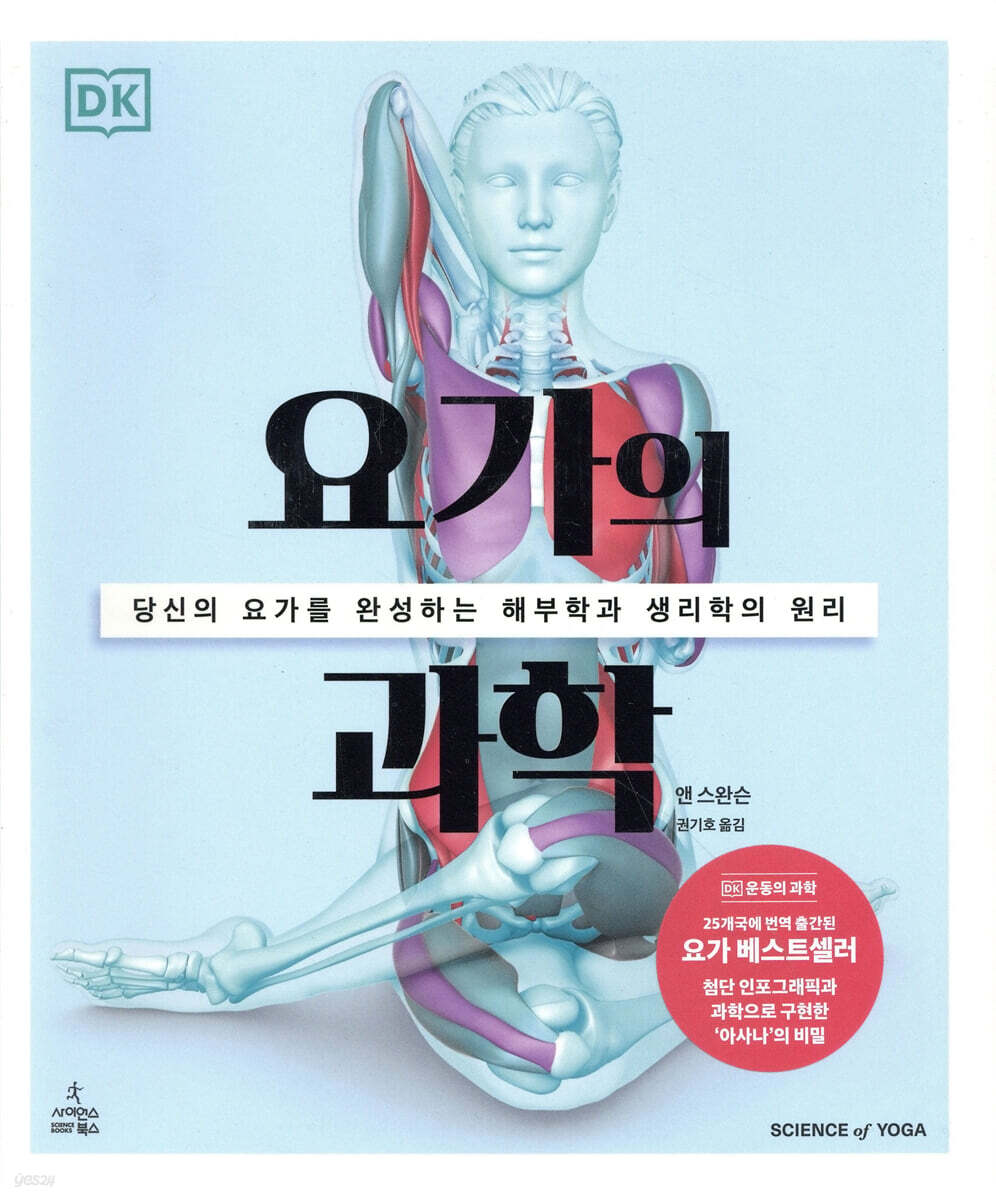
A New Yoga Guide to Scientifically Controlling Body and Mind Anne Swanson, who attempted to integrate yoga into the human body and mind through the eyes of a scientist, has published the fruits of her practice and research in The Science of Yoga. The author reveals that his habit of carrying a notebook and recording observations and analysis since childhood served as the basis for writing this book. The author, who studied art in college and then came across yoga to manage stress, initially wanted to achieve picture-perfect poses, but gradually realized that yoga is not about achieving 'perfect' poses, but about having a perfectly 'good' body and mind at every moment of the pose. The author traveled to India via China, where he met his teacher, Yogi Sivadas, and then completed a master's degree in yoga therapy at the University of Maryland School of Integrative Medicine, seeking to understand how yoga can transform lives through its methods and principles. "The Science of Yoga" is the culmination of author Ann Swanson's records of learning and teaching yoga, and is the most interesting introductory book to yoga that elucidates the "mystery of yoga" with scientific principles and evidence. While there has been significant growth in both quantity and quality in yoga research papers over the past several decades, yoga research as a scientific inquiry is still in its infancy. No matter how thorough the scientific research, it cannot compare to the personal experience of healing and transformation. The Science of Yoga, which contains the balanced perspective of an author with a unique background, has given birth to the 'Science of Exercise' series, which extracts the core essential for the non-face-to-face era, following 'Complete Human Body: The Encyclopedia of the Human Body' and 'The Principles of the Human Body: An Infographic Fact Guide to the Human Body' published by the prestigious British publisher DK. 『The Science of Yoga』, translated by Kwon Ki-ho, who participated in the translation of 『Complete Human Body』 and 『Human Body』, will be an essential yoga guide for both beginners and experts, recommended by Won Jeong-hye and Lee Dong-hwan, who have been practicing yoga and leading the way in spreading it in Korea for 30 years. |
index
Preface 6
Human Anatomy 8
From Cells to Systems 10 | Skeletal System 12 | Muscular System 18 | Nervous System 22 | Endocrine System 28 | Respiratory System 30 | Cardiovascular System 34 | Lymphatic System 36 | Digestive System 38 | Urinary System 40 | Reproductive System 41
Yoga Pose 42
Sitting Pose 44 || Master Pose Siddhasana 46 | Butterfly Pose Baddha Konasana 50 | Cat Pose Marjaryasana 54 | Cow Pose Bitilasana 56 | Cow's Head Pose Gomukhasana 60 | Seated Side Bend Parivrtta Janu Sirsasana 64 | Waist Twist Ardha Matsyendrasana 68 | Child's Pose Balasana 72 | Camel Pose Ustrasana 76 | Pigeon Pose Eka Pada Rajakapotasana 80
Standing Pose 84 || Mountain Pose Tadasana 86 | Standing Forward Bend Uttanasana 90 | Chair Pose Utkatasana 94 | Crescent Moon Pose Anjaneyasana 98 | Warrior Pose 2 Virabhadrasana II 102 | Warrior Pose 3 Virabhadrasana III 106 | Tree Pose Vrksasana 110 | Dancer Pose Natarajasana 114 | Triangle Pose Trikonasana 118
Upside-down pose 122 || Downward-facing dog pose Adho Mukha Svanasana1 24 | Handstand pose Sirsasana 128 | Shoulderstand pose Ardha Sarvangasana 132 | Bridge pose Setu Bandhasana 136 | Arch pose Urdhva Dhanurasana 140
Floor Pose 144 || Crane Pose Bakasana 146 | Plank Pose Kumbhakasana 150 | Side Plank Pose Vasisthasana 154 | Cobra Pose Bhujangasana 158 | Locust Pose Salabhasana 162 | Lying Toe Pull Pose Supta Padangusthasana 166 | Lying Waist Twist Pose Supta Matsyendrasana 170 |
Questions and Answers 174
Joints and Flexibility 176 | Spine Care 178 | Yoga for Each Life Stage 180 | Meditation 184 | Savasana (Complete Relaxation Pose) 186 | Stress 188 | Brain and Mental Health 192 | Chronic Pain 194 | Yoga Therapy 196 | Mental Transformation 198 | Latest Yoga Research 200 | Precautions 202
Glossary 206 | Index 208 | References 213 | Acknowledgments 216
Human Anatomy 8
From Cells to Systems 10 | Skeletal System 12 | Muscular System 18 | Nervous System 22 | Endocrine System 28 | Respiratory System 30 | Cardiovascular System 34 | Lymphatic System 36 | Digestive System 38 | Urinary System 40 | Reproductive System 41
Yoga Pose 42
Sitting Pose 44 || Master Pose Siddhasana 46 | Butterfly Pose Baddha Konasana 50 | Cat Pose Marjaryasana 54 | Cow Pose Bitilasana 56 | Cow's Head Pose Gomukhasana 60 | Seated Side Bend Parivrtta Janu Sirsasana 64 | Waist Twist Ardha Matsyendrasana 68 | Child's Pose Balasana 72 | Camel Pose Ustrasana 76 | Pigeon Pose Eka Pada Rajakapotasana 80
Standing Pose 84 || Mountain Pose Tadasana 86 | Standing Forward Bend Uttanasana 90 | Chair Pose Utkatasana 94 | Crescent Moon Pose Anjaneyasana 98 | Warrior Pose 2 Virabhadrasana II 102 | Warrior Pose 3 Virabhadrasana III 106 | Tree Pose Vrksasana 110 | Dancer Pose Natarajasana 114 | Triangle Pose Trikonasana 118
Upside-down pose 122 || Downward-facing dog pose Adho Mukha Svanasana1 24 | Handstand pose Sirsasana 128 | Shoulderstand pose Ardha Sarvangasana 132 | Bridge pose Setu Bandhasana 136 | Arch pose Urdhva Dhanurasana 140
Floor Pose 144 || Crane Pose Bakasana 146 | Plank Pose Kumbhakasana 150 | Side Plank Pose Vasisthasana 154 | Cobra Pose Bhujangasana 158 | Locust Pose Salabhasana 162 | Lying Toe Pull Pose Supta Padangusthasana 166 | Lying Waist Twist Pose Supta Matsyendrasana 170 |
Questions and Answers 174
Joints and Flexibility 176 | Spine Care 178 | Yoga for Each Life Stage 180 | Meditation 184 | Savasana (Complete Relaxation Pose) 186 | Stress 188 | Brain and Mental Health 192 | Chronic Pain 194 | Yoga Therapy 196 | Mental Transformation 198 | Latest Yoga Research 200 | Precautions 202
Glossary 206 | Index 208 | References 213 | Acknowledgments 216
Detailed image
.jpg)
Publisher's Review
A New Yoga Guide to Scientifically Controlling Body and Mind
Published in 20 countries worldwide, selling 240,000 copies
"The Science of Yoga" is the book I wanted to read when I first started practicing yoga.
During yoga classes, I was constantly asked, “Why?” while being instructed, “Exhale deeply to calm your nerves.” “This pose will boost your immune system.” “Raise your knees so they are above your ankles.”
―Ann Swanson, mind-body educator and certified yoga therapist
The fun of turning pages and piecing together a puzzle, gaining a comprehensive and holistic understanding - Lee Dong-hwan (President of Mediheal Integrated Yoga Association)
A Guide to "Home Training" in the Contactless Era - Won Jeong-hye (Founder of Echols Yoga, Meditation Yoga Expert)
It's been a while since the home training craze started to boost immunity.
You've probably been impatient, following along on a YouTube video or lying on your exercise mat after a yoga class.
“It’s such a waste of time.
“There’s a mountain of work to be done!” Anne Swanson, who attempted to integrate yoga into the human body and mind through the eyes of a scientist, also put the fruits of her experience and research into the book 『The Science of Yoga: The Principles of Anatomy and Physiology to Perfect Your Yoga』, published by Science Books.
The author reveals that his habit of carrying a notebook and recording observations and analysis since childhood served as the basis for writing this book.
The author, who studied art in college and then came across yoga to manage stress, initially wanted to achieve picture-perfect poses, but gradually realized that yoga is not about achieving 'perfect' poses, but about having a perfectly 'good' body and mind at every moment of the pose.
The author traveled to India via China, where he met his teacher, Yogi Sivadas, and then completed a master's degree in yoga therapy at the University of Maryland School of Integrative Medicine, seeking to understand how yoga can transform lives through its methods and principles.
"The Science of Yoga" is the culmination of author Ann Swanson's records of learning and teaching yoga, and is the most interesting introductory book to yoga that elucidates the "mystery of yoga" with scientific principles and evidence.
While there has been significant growth in both quantity and quality in yoga research papers over the past several decades, yoga research as a scientific inquiry is still in its infancy.
No matter how thorough the scientific research, it cannot compare to the personal experience of healing and transformation.
The Science of Yoga, which contains the balanced perspective of an author with a unique background, has given birth to the 'Science of Exercise' series, which extracts the core essential for the non-face-to-face era, following 'Complete Human Body: The Encyclopedia of the Human Body' and 'The Principles of the Human Body: An Infographic Fact Guide to the Human Body' published by the prestigious British publisher DK.
『The Science of Yoga』, translated by Kwon Ki-ho, who participated in the translation of 『Complete Human Body』 and 『Human Body』, will be an essential yoga guide for both beginners and experts, recommended by Won Jeong-hye and Lee Dong-hwan, who have been practicing yoga and leading the way in spreading it in Korea for 30 years.
The Effects of Yoga from an Anatomy and Physiology Perspective
The practice of yoga affects the whole body.
Unlike many existing yoga anatomy books and lectures that focus on the musculoskeletal system, The Science of Yoga analyzes the core effects and benefits of yoga on each human body system.
By studying the anatomical systems described in modern biology, you will be able to look more closely at your own body from an integrative perspective.
To understand the human body, which is a dynamic and living whole made up of various systems such as the skeletal, cardiovascular, respiratory, nervous, lymphatic, and urinary systems, one must understand the structure (anatomy) and operating principles (physiology) of the human body.
Yoga works on the spine in a unique way, increasing body awareness and improving overall posture.
The sudden release of tight shoulders when you do yoga poses that affect your feet may be due to the network of fascia distributed throughout the body.
The collagen fibers of the fascia that surround healthy muscles are woven in a cross-shaped lattice structure, but research has shown that the structural integrity of the fascia is lost when mobility decreases or aging occurs.
Yoga poses help to organize the fascia, allowing muscles to move more smoothly.
Modern science believes that bad habits and negative thinking patterns can be broken at any time, as the brain maintains its ability to adapt throughout life.
The enormous potential of yoga therapy is also being proven by brain research.
Yoga promotes relaxation by relieving anxiety and stress symptoms, while also affecting chronic pain, stress hormones, and self-regulation.
Just as exercise affects muscles, brain tissue can develop or shrink depending on stimulation.
Yoga practitioners claim that by controlling the breath, one can control everything about the human being.
Science is revealing that breathing is the gateway to regulating the nervous system.
Clinical studies have shown that yoga not only reduces the risk of heart disease, but also lowers blood pressure, cholesterol, and improves cardiovascular resilience.
Yoga can help reduce chronic inflammation and boost immunity, which can help reduce the frequency and severity of illness.
The body can heal itself, and yoga can help it do so.
Scientists estimate that long-term, regular yoga practice is most effective.
Accurate and detailed human body diagrams of 30 yoga asanas
DK's illustration and design team worked closely with the author to bring his ideas and sketches to life.
The beautiful, eye-catching images of the human body vividly depict the bones, ligaments, and muscles that are essential for each movement, in vivid detail. By visualizing or following the yoga poses in the book, which are rendered using CT-like images, you can sense the movement of joints and muscle changes, and visualize each movement in your mind.
By understanding the fundamentals of anatomy, physiology, and kinesiology, you will gain a deeper understanding of your own body and mind.
Part 2 introduces 30 carefully selected yoga poses (asanas), including easy movements for beginners as well as advanced application levels.
Sitting and kneeling poses, such as the master pose, cat pose, and child pose, are fundamental and meditative and often mark the beginning and end of yoga classes.
The sitting poses presented in The Science of Yoga demonstrate the many ways in which yoga provides physical benefits to the body.
By learning the applied postures, you can change your body and mind to feel stable and comfortable.
Standing poses such as dancer's pose, tree pose, and crescent moon pose have been carefully selected to help improve your body's posture and balance.
How well you control your body affects your energy levels, body awareness, self-confidence, and every anatomical system.
Continue practicing to relieve pain, reduce injury, improve posture, and enable optimal movement in all activities.
Inverted poses such as the handstand and the arch pose have physiological benefits such as improving blood circulation and helping lymph drainage by bringing the head lower than the heart.
Completely upside-down poses (inversion poses) are also a great adventure that gives you a completely new perspective.
Yoga poses performed on the floor include arm balancing poses, prone poses, and supine poses.
They range from intense and challenging poses like the plank to soft and delicate poses like the lying back twist, but no matter the intensity, all poses are great opportunities to explore your inner self.
Can I do yoga if I'm not flexible?
Is yoga good for kids?
Can I still do yoga when I'm older?
In Part 3, the author has carefully selected the most crucial questions and misunderstandings about body and mind, along with their answers, from questions she has received from her yoga students.
Originating in Indian traditions, the practice and wisdom of yoga emphasizes that anyone, whether spiritual, religious, or agnostic, can find health and peace.
Yoga has traditionally been considered a way to prepare the body for meditation.
Many yoga classes today incorporate mindfulness practices and meditative elements like Om chanting as a way to relax the body and mind.
There are over 900 yoga class programs in North America alone.
Scientific research shows that the benefits of meditation practice can also manifest in everyday life.
Yoga changes the way you look at stress and activates the relaxation response, which reduces the production of cortisol (the stress hormone).
Additionally, yoga practitioners are more likely to adopt healthy lifestyle habits, such as exercise, and yoga can reinforce positive behaviors, helping to break unhelpful thought and emotional patterns.
Many studies have addressed the question of whether yoga actually changes the brain.
Research has shown that specific brain regions are commonly affected by yoga-based mindfulness practices, and brain scans published in another 2018 study showed that yoga poses and meditation reduced the volume of the amygdala on the right side of the brain, which is closely linked to negative emotions and fear.
According to researchers at Stanford University, people who completed an eight-week mindfulness meditation program showed greater reductions in amygdala activity, which is associated with fear.
Yoga also has social and emotional benefits, helping you develop emotional awareness, emotional regulation and stress management, social awareness and relationship skills, and making conscious and confident decisions.
According to research from Harvard University and the Kripalu Center for Yoga and Health, using yoga as a therapeutic approach is a practical way to improve the physical and mental health of children and adolescents.
Applying the philosophy of yoga to your life can also help you find purpose and meaning in life, which are important for independent living and happiness.
By 2050, one-fifth of the world's population will be over 60, making it more important than ever to prepare for healthy aging through practices like yoga.
Just eight weeks of meditation practice can slow down age-related brain changes.
Studies have shown that older adults who practice yoga have improved flexibility, strength, balance, and functional activities such as rising from a chair.
How can you know if yoga research is credible? Not all yoga research is created equal, so it's best to approach it critically.
What type of study is it? What is the sample size? Is there a control group, and if so, what type? What are the conclusions of yoga studies? Keep in mind that extraordinary claims require extraordinary evidence.
That's why many yoga researchers use euphemisms like, "Yoga can improve you," or, "This means yoga helps."
As interest in yoga research grows, scientists continue to question the results.
Is there scientific evidence supporting the therapeutic benefits of yoga therapy? The vast majority of scientific yoga research focuses on its therapeutic benefits, particularly for chronic, lifestyle-related conditions, one of the world's most pressing health problems.
Although some of the therapeutic benefits of yoga are not fully understood by Western scientific research, the quality of research is improving.
One reason the yoga therapy profession is growing so rapidly is the growing demand for highly trained professionals who can work with specialized professionals, such as cancer treatment specialists.
Yoga therapy is generally effective in improving symptoms, such as pain relief.
The lifestyle and mindset changes that come from practicing yoga can help people move toward living vibrant lives free from the constraints of illness.
Acute pain, such as an ankle sprain or a slip-and-fall injury, usually requires rest to heal.
In this case, you can avoid or change the yoga pose.
For chronic pain, mind-body practices like yoga have been shown to be a safe complement to medical treatment.
The goal of yoga is not to perfect a yoga pose or learn a specific technique, but to enjoy the journey of self-exploration.
Everyone has different bones and body types, so when people practice yoga, their postures will look different.
Yoga is very easy to modify poses to suit each individual.
You can do simple breathing exercises, or you can modify any yoga pose using a chair, bolster, or blanket.
Any activity that causes pain, worsens existing pain, or causes numbness should be avoided.
Especially after trauma, sprains, fractures, or surgery, you should consult a medical professional to determine what is right for you, or practice with a certified yoga practitioner, after you have had time to recover.
Yoga poses have a profound effect on the anatomical structure of muscles and bones, as well as on the nerves, psychology, and physical vitality.
Beyond simply enjoying the sensations of relaxation and meditation, yoga ultimately affects every system in the body, optimizing its function.
Published in 20 countries worldwide, selling 240,000 copies
"The Science of Yoga" is the book I wanted to read when I first started practicing yoga.
During yoga classes, I was constantly asked, “Why?” while being instructed, “Exhale deeply to calm your nerves.” “This pose will boost your immune system.” “Raise your knees so they are above your ankles.”
―Ann Swanson, mind-body educator and certified yoga therapist
The fun of turning pages and piecing together a puzzle, gaining a comprehensive and holistic understanding - Lee Dong-hwan (President of Mediheal Integrated Yoga Association)
A Guide to "Home Training" in the Contactless Era - Won Jeong-hye (Founder of Echols Yoga, Meditation Yoga Expert)
It's been a while since the home training craze started to boost immunity.
You've probably been impatient, following along on a YouTube video or lying on your exercise mat after a yoga class.
“It’s such a waste of time.
“There’s a mountain of work to be done!” Anne Swanson, who attempted to integrate yoga into the human body and mind through the eyes of a scientist, also put the fruits of her experience and research into the book 『The Science of Yoga: The Principles of Anatomy and Physiology to Perfect Your Yoga』, published by Science Books.
The author reveals that his habit of carrying a notebook and recording observations and analysis since childhood served as the basis for writing this book.
The author, who studied art in college and then came across yoga to manage stress, initially wanted to achieve picture-perfect poses, but gradually realized that yoga is not about achieving 'perfect' poses, but about having a perfectly 'good' body and mind at every moment of the pose.
The author traveled to India via China, where he met his teacher, Yogi Sivadas, and then completed a master's degree in yoga therapy at the University of Maryland School of Integrative Medicine, seeking to understand how yoga can transform lives through its methods and principles.
"The Science of Yoga" is the culmination of author Ann Swanson's records of learning and teaching yoga, and is the most interesting introductory book to yoga that elucidates the "mystery of yoga" with scientific principles and evidence.
While there has been significant growth in both quantity and quality in yoga research papers over the past several decades, yoga research as a scientific inquiry is still in its infancy.
No matter how thorough the scientific research, it cannot compare to the personal experience of healing and transformation.
The Science of Yoga, which contains the balanced perspective of an author with a unique background, has given birth to the 'Science of Exercise' series, which extracts the core essential for the non-face-to-face era, following 'Complete Human Body: The Encyclopedia of the Human Body' and 'The Principles of the Human Body: An Infographic Fact Guide to the Human Body' published by the prestigious British publisher DK.
『The Science of Yoga』, translated by Kwon Ki-ho, who participated in the translation of 『Complete Human Body』 and 『Human Body』, will be an essential yoga guide for both beginners and experts, recommended by Won Jeong-hye and Lee Dong-hwan, who have been practicing yoga and leading the way in spreading it in Korea for 30 years.
The Effects of Yoga from an Anatomy and Physiology Perspective
The practice of yoga affects the whole body.
Unlike many existing yoga anatomy books and lectures that focus on the musculoskeletal system, The Science of Yoga analyzes the core effects and benefits of yoga on each human body system.
By studying the anatomical systems described in modern biology, you will be able to look more closely at your own body from an integrative perspective.
To understand the human body, which is a dynamic and living whole made up of various systems such as the skeletal, cardiovascular, respiratory, nervous, lymphatic, and urinary systems, one must understand the structure (anatomy) and operating principles (physiology) of the human body.
Yoga works on the spine in a unique way, increasing body awareness and improving overall posture.
The sudden release of tight shoulders when you do yoga poses that affect your feet may be due to the network of fascia distributed throughout the body.
The collagen fibers of the fascia that surround healthy muscles are woven in a cross-shaped lattice structure, but research has shown that the structural integrity of the fascia is lost when mobility decreases or aging occurs.
Yoga poses help to organize the fascia, allowing muscles to move more smoothly.
Modern science believes that bad habits and negative thinking patterns can be broken at any time, as the brain maintains its ability to adapt throughout life.
The enormous potential of yoga therapy is also being proven by brain research.
Yoga promotes relaxation by relieving anxiety and stress symptoms, while also affecting chronic pain, stress hormones, and self-regulation.
Just as exercise affects muscles, brain tissue can develop or shrink depending on stimulation.
Yoga practitioners claim that by controlling the breath, one can control everything about the human being.
Science is revealing that breathing is the gateway to regulating the nervous system.
Clinical studies have shown that yoga not only reduces the risk of heart disease, but also lowers blood pressure, cholesterol, and improves cardiovascular resilience.
Yoga can help reduce chronic inflammation and boost immunity, which can help reduce the frequency and severity of illness.
The body can heal itself, and yoga can help it do so.
Scientists estimate that long-term, regular yoga practice is most effective.
Accurate and detailed human body diagrams of 30 yoga asanas
DK's illustration and design team worked closely with the author to bring his ideas and sketches to life.
The beautiful, eye-catching images of the human body vividly depict the bones, ligaments, and muscles that are essential for each movement, in vivid detail. By visualizing or following the yoga poses in the book, which are rendered using CT-like images, you can sense the movement of joints and muscle changes, and visualize each movement in your mind.
By understanding the fundamentals of anatomy, physiology, and kinesiology, you will gain a deeper understanding of your own body and mind.
Part 2 introduces 30 carefully selected yoga poses (asanas), including easy movements for beginners as well as advanced application levels.
Sitting and kneeling poses, such as the master pose, cat pose, and child pose, are fundamental and meditative and often mark the beginning and end of yoga classes.
The sitting poses presented in The Science of Yoga demonstrate the many ways in which yoga provides physical benefits to the body.
By learning the applied postures, you can change your body and mind to feel stable and comfortable.
Standing poses such as dancer's pose, tree pose, and crescent moon pose have been carefully selected to help improve your body's posture and balance.
How well you control your body affects your energy levels, body awareness, self-confidence, and every anatomical system.
Continue practicing to relieve pain, reduce injury, improve posture, and enable optimal movement in all activities.
Inverted poses such as the handstand and the arch pose have physiological benefits such as improving blood circulation and helping lymph drainage by bringing the head lower than the heart.
Completely upside-down poses (inversion poses) are also a great adventure that gives you a completely new perspective.
Yoga poses performed on the floor include arm balancing poses, prone poses, and supine poses.
They range from intense and challenging poses like the plank to soft and delicate poses like the lying back twist, but no matter the intensity, all poses are great opportunities to explore your inner self.
Can I do yoga if I'm not flexible?
Is yoga good for kids?
Can I still do yoga when I'm older?
In Part 3, the author has carefully selected the most crucial questions and misunderstandings about body and mind, along with their answers, from questions she has received from her yoga students.
Originating in Indian traditions, the practice and wisdom of yoga emphasizes that anyone, whether spiritual, religious, or agnostic, can find health and peace.
Yoga has traditionally been considered a way to prepare the body for meditation.
Many yoga classes today incorporate mindfulness practices and meditative elements like Om chanting as a way to relax the body and mind.
There are over 900 yoga class programs in North America alone.
Scientific research shows that the benefits of meditation practice can also manifest in everyday life.
Yoga changes the way you look at stress and activates the relaxation response, which reduces the production of cortisol (the stress hormone).
Additionally, yoga practitioners are more likely to adopt healthy lifestyle habits, such as exercise, and yoga can reinforce positive behaviors, helping to break unhelpful thought and emotional patterns.
Many studies have addressed the question of whether yoga actually changes the brain.
Research has shown that specific brain regions are commonly affected by yoga-based mindfulness practices, and brain scans published in another 2018 study showed that yoga poses and meditation reduced the volume of the amygdala on the right side of the brain, which is closely linked to negative emotions and fear.
According to researchers at Stanford University, people who completed an eight-week mindfulness meditation program showed greater reductions in amygdala activity, which is associated with fear.
Yoga also has social and emotional benefits, helping you develop emotional awareness, emotional regulation and stress management, social awareness and relationship skills, and making conscious and confident decisions.
According to research from Harvard University and the Kripalu Center for Yoga and Health, using yoga as a therapeutic approach is a practical way to improve the physical and mental health of children and adolescents.
Applying the philosophy of yoga to your life can also help you find purpose and meaning in life, which are important for independent living and happiness.
By 2050, one-fifth of the world's population will be over 60, making it more important than ever to prepare for healthy aging through practices like yoga.
Just eight weeks of meditation practice can slow down age-related brain changes.
Studies have shown that older adults who practice yoga have improved flexibility, strength, balance, and functional activities such as rising from a chair.
How can you know if yoga research is credible? Not all yoga research is created equal, so it's best to approach it critically.
What type of study is it? What is the sample size? Is there a control group, and if so, what type? What are the conclusions of yoga studies? Keep in mind that extraordinary claims require extraordinary evidence.
That's why many yoga researchers use euphemisms like, "Yoga can improve you," or, "This means yoga helps."
As interest in yoga research grows, scientists continue to question the results.
Is there scientific evidence supporting the therapeutic benefits of yoga therapy? The vast majority of scientific yoga research focuses on its therapeutic benefits, particularly for chronic, lifestyle-related conditions, one of the world's most pressing health problems.
Although some of the therapeutic benefits of yoga are not fully understood by Western scientific research, the quality of research is improving.
One reason the yoga therapy profession is growing so rapidly is the growing demand for highly trained professionals who can work with specialized professionals, such as cancer treatment specialists.
Yoga therapy is generally effective in improving symptoms, such as pain relief.
The lifestyle and mindset changes that come from practicing yoga can help people move toward living vibrant lives free from the constraints of illness.
Acute pain, such as an ankle sprain or a slip-and-fall injury, usually requires rest to heal.
In this case, you can avoid or change the yoga pose.
For chronic pain, mind-body practices like yoga have been shown to be a safe complement to medical treatment.
The goal of yoga is not to perfect a yoga pose or learn a specific technique, but to enjoy the journey of self-exploration.
Everyone has different bones and body types, so when people practice yoga, their postures will look different.
Yoga is very easy to modify poses to suit each individual.
You can do simple breathing exercises, or you can modify any yoga pose using a chair, bolster, or blanket.
Any activity that causes pain, worsens existing pain, or causes numbness should be avoided.
Especially after trauma, sprains, fractures, or surgery, you should consult a medical professional to determine what is right for you, or practice with a certified yoga practitioner, after you have had time to recover.
Yoga poses have a profound effect on the anatomical structure of muscles and bones, as well as on the nerves, psychology, and physical vitality.
Beyond simply enjoying the sensations of relaxation and meditation, yoga ultimately affects every system in the body, optimizing its function.
GOODS SPECIFICS
- Date of issue: January 1, 2021
- Format: Hardcover book binding method guide
- Page count, weight, size: 216 pages | 656g | 204*238*20mm
- ISBN13: 9791190403399
- ISBN10: 1190403390
You may also like
카테고리
korean


korean

![GQ KOREA Mark (Monthly): December [2025]](http://librairie.coreenne.fr/cdn/shop/files/8ef265dbbfbf186523ed75ba7319009d.jpg?v=1765340328&width=3840)


