

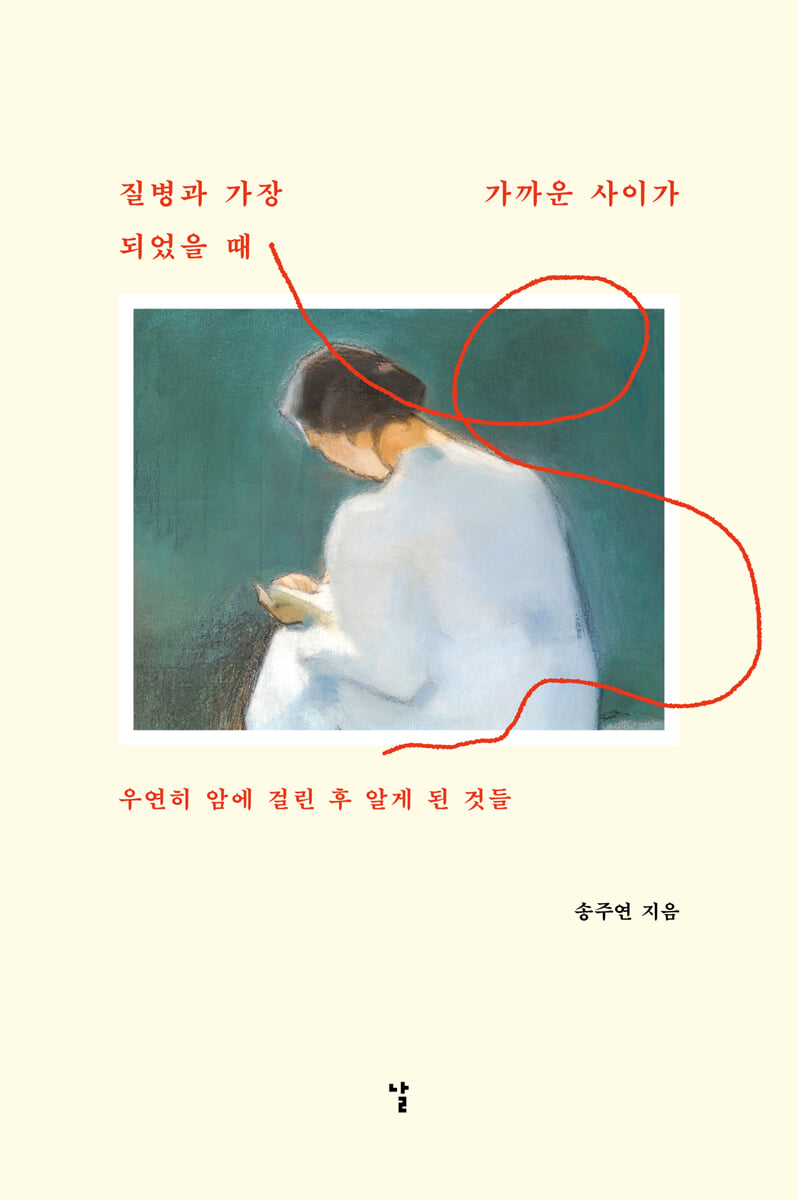
When you become closest to the disease
 |
Description
Book Introduction
“We all have our own unique story.”
A story of 'post-traumatic growth' that has permeated me as a 'cancer survivor'!
On a rainy wedding anniversary, the author, a psychological counselor who cares for people's hearts, became a 'cancer patient'.
This book is a record of the author's time as a 'cancer survivor' after one day suddenly being diagnosed with an unfamiliar disease.
There is a prevalent social stigma surrounding cancer because it is directly linked to death.
As the author experiences this disease, which is as much misunderstood as it is feared, he comes to realize how our daily lives are woven around health and how diverse emotions and issues are intertwined in caring for it.
The author does not try to 'survive' cancer, but rather strives to make his life 'valuable' while living with cancer.
'It wasn't because of the cancer,' but paradoxically, the cancer treatment process was a journey for the author to become freer than before and find a more 'true version of himself.'
A story of 'post-traumatic growth' that has permeated me as a 'cancer survivor'!
On a rainy wedding anniversary, the author, a psychological counselor who cares for people's hearts, became a 'cancer patient'.
This book is a record of the author's time as a 'cancer survivor' after one day suddenly being diagnosed with an unfamiliar disease.
There is a prevalent social stigma surrounding cancer because it is directly linked to death.
As the author experiences this disease, which is as much misunderstood as it is feared, he comes to realize how our daily lives are woven around health and how diverse emotions and issues are intertwined in caring for it.
The author does not try to 'survive' cancer, but rather strives to make his life 'valuable' while living with cancer.
'It wasn't because of the cancer,' but paradoxically, the cancer treatment process was a journey for the author to become freer than before and find a more 'true version of himself.'
- You can preview some of the book's contents.
Preview
index
Author's Note: Is Cancer Really the End of Life?
Chapter 1.
Being sick
Rainy wedding anniversary
What on earth was the problem?
I have cancer
If you live like that, you'll get cancer
Chapter 2.
Caring
Which hospital has a short hospital stay?
Why is it uncomfortable to be cared for?
Between independence and dependence
Care also requires distance
Chapter 3.
Being together
The time when I meet you
Love makes things more difficult
It's okay if you just stay there
A world where it's okay to be sick
Chapter 4.
Living
I am sick and healthy
To my sorry body
Not because of cancer, though
I decided to experience myself a little more
Chapter 1.
Being sick
Rainy wedding anniversary
What on earth was the problem?
I have cancer
If you live like that, you'll get cancer
Chapter 2.
Caring
Which hospital has a short hospital stay?
Why is it uncomfortable to be cared for?
Between independence and dependence
Care also requires distance
Chapter 3.
Being together
The time when I meet you
Love makes things more difficult
It's okay if you just stay there
A world where it's okay to be sick
Chapter 4.
Living
I am sick and healthy
To my sorry body
Not because of cancer, though
I decided to experience myself a little more
Detailed image
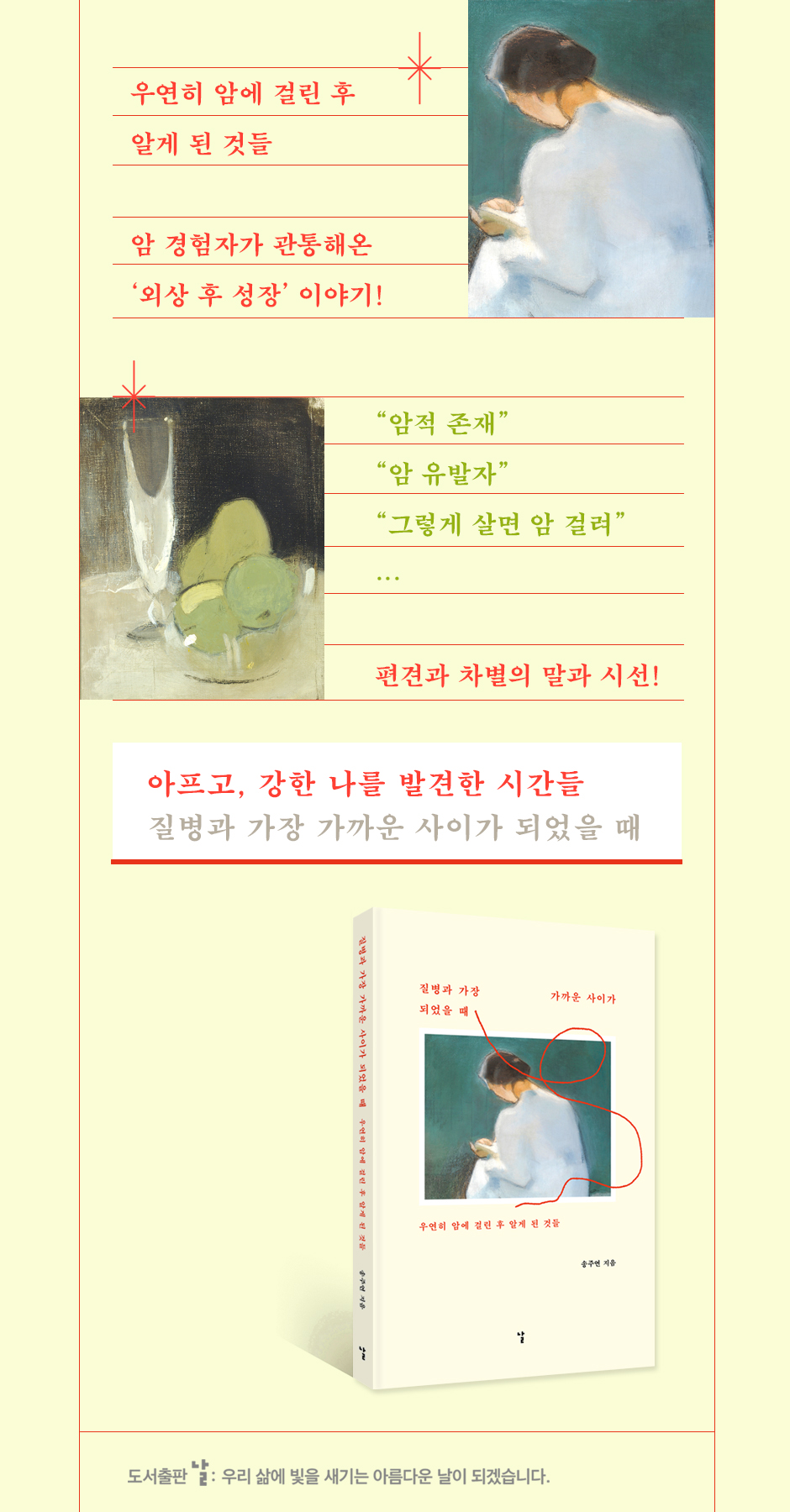
Into the book
In fact, we do not view cancer as a simple disease.
Cancer brings to mind 'death'.
At the same time, cancer represents 'bad things'.
Various media outlets refer to things that have a negative impact on society, such as crime, poverty, and drugs, as 'cancerous entities.'
Terms related to cancer are similar to those used in 'war'.
As the expression 'people who have overcome cancer' suggests, cancer is an 'enemy' that must be fought and defeated, and terms such as 'radiation therapy' and 'chemotherapy', which are representative cancer treatment methods, are also terms frequently heard in war.
--- p.22
However, I was also afraid of what would happen if it was revealed that I had cancer.
The Korean society that I have experienced and seen so far is one in which anyone who reveals their 'weakness' or 'difference' is easily exposed to prejudice and discrimination.
There were so many people who experienced prejudice and discrimination because they looked a little different from others, because their family structure was different from the 'normal family', because their sexual orientation or gender identity was different from the majority, or even because they were women, elderly, or children.
So, many people in Korea live 'covering' their identity without being able to reveal it.
--- p.40
A dentist I know personally once said this in private:
When patients with serious illnesses come to the hospital, they say that they feel better after cursing at the hospital staff by saying things like, “That guy is going to get oral cancer!”
Although he spoke about his professional stress and emphasized his identity as a dentist, he portrayed 'cancer' as a disease that only 'bad people' get.
Even though I knew he was saying it to make me laugh, I couldn't hide my displeased expression.
--- pp.50-51
Not just around here.
When searching for information about cancer on various online media such as YouTube, videos with titles like “Lifestyle tips to avoid getting cancer” and “If you do this, you will get cancer.”
All of this is personalizing the disease.
In other words, they are saying that neglect of self-care, such as lifestyle or eating habits, is the cause of the disease.
These expressions are not only untrue, but they also cause people who are already in pain to feel guilty and ashamed.
--- p.52
Our society has a strong tendency to demonize disease.
It's as if health is viewed as 'good' and disease as 'evil'.
But illness is a constant part of life, and just getting older makes us sick.
Disease is not an 'evil', but a condition of human life.
Overlooking this and emphasizing only 'health' can only be seen as a psychological anxiety about disease, aging, and death at work.
--- pp.54-55
But is caregiving really a woman's job?
Feminists, who view the world from a patriarchal perspective, have long emphasized that no one, from infants to the elderly, can survive without relying on someone.
People depend on each other and live in relationships.
We cannot survive without the daily acts of care: preparing meals, cleaning, and doing laundry.
Without care, we would not be able to work properly to earn the money we so covet in a capitalist society, let alone survive.
Only by knowing how to take care of oneself and others can humans survive and form relationships.
Care is not just a woman's responsibility; it is a virtue that all human beings must uphold.
--- pp.65-66
I really hope this world comes to be like this.
So, I sincerely hope that sick mothers will no longer have to seek out hospitals with shorter hospital stays, that all sick people will be able to receive care without feeling guilty, and that caring for someone will become natural and expected regardless of gender.
--- p.69
This kind of self-absorbed care is dangerous for both the caregiver and the care recipient.
When caregivers become so absorbed in the 'caregiving' that they feel their own lives are disappearing and cannot bear this state, tragic events such as 'caregiving murder' can occur.
Additionally, in caregiving relationships, a situation of 'codependence' often occurs, where both the caregiver and the care recipient lose themselves due to excessive dependence.
--- p.95
But now I know.
This means that treating my body well like this does not necessarily lead to a 'healthy life'.
Despite these efforts, I am still a 'weak being' who will inevitably grow old and die, and illness can strike at any time and for no reason.
So I always tried to remember that taking care of my body might not only prevent disease but also slow down aging.
I kept in mind that what I did for myself was not to 'control' disease and aging, but simply to 'treat' myself with kindness and thus live a better everyday life.
--- pp.108-109
On the other hand, I also felt that the term 'survivor' distorted my cancer experience.
What was important to me during the treatment process wasn't simply 'surviving'.
It was more important for me to integrate my cancer experience into my identity and maintain my unique daily life as a person.
But the word 'survivor' gives the impression that for people with cancer, surviving is all that matters, and nothing else matters.
It seemed like I had to do my best just to survive.
--- p.135
In a society that 'oppresses' the body like this, the body is treated as a 'tool' to achieve results in the mind's studies or work.
When your body tells you it needs rest, you pour on caffeine, and when you feel stressed, you drink alcohol to exhaust yourself.
Or, in order to have an appearance that is well-received by others, they suppress their desire to eat, go on a diet, and force themselves to exercise to build a body.
At first glance, it may seem like taking care of your body, but these are actions that are based on a kind of self-loathing rather than respect for your body.
However, thanks to the side effects of radiation therapy, I started to observe and feel my body while doing Pilates and I thought my body was really amazing.
The movement of the interconnected muscles was mysterious.
I could finally feel the existence of my body.
--- p.157
Anything can happen in life.
I myself also have contradictory aspects.
Also, I now know that many things in life are closer to the truth when connected with 'and' rather than 'but'.
Once I accepted this, my life became more peaceful than before.
Perhaps this is the 'post-traumatic growth' I achieved through my cancer experience.
I am sick and strong.
Life is rough and quiet.
Cancer brings to mind 'death'.
At the same time, cancer represents 'bad things'.
Various media outlets refer to things that have a negative impact on society, such as crime, poverty, and drugs, as 'cancerous entities.'
Terms related to cancer are similar to those used in 'war'.
As the expression 'people who have overcome cancer' suggests, cancer is an 'enemy' that must be fought and defeated, and terms such as 'radiation therapy' and 'chemotherapy', which are representative cancer treatment methods, are also terms frequently heard in war.
--- p.22
However, I was also afraid of what would happen if it was revealed that I had cancer.
The Korean society that I have experienced and seen so far is one in which anyone who reveals their 'weakness' or 'difference' is easily exposed to prejudice and discrimination.
There were so many people who experienced prejudice and discrimination because they looked a little different from others, because their family structure was different from the 'normal family', because their sexual orientation or gender identity was different from the majority, or even because they were women, elderly, or children.
So, many people in Korea live 'covering' their identity without being able to reveal it.
--- p.40
A dentist I know personally once said this in private:
When patients with serious illnesses come to the hospital, they say that they feel better after cursing at the hospital staff by saying things like, “That guy is going to get oral cancer!”
Although he spoke about his professional stress and emphasized his identity as a dentist, he portrayed 'cancer' as a disease that only 'bad people' get.
Even though I knew he was saying it to make me laugh, I couldn't hide my displeased expression.
--- pp.50-51
Not just around here.
When searching for information about cancer on various online media such as YouTube, videos with titles like “Lifestyle tips to avoid getting cancer” and “If you do this, you will get cancer.”
All of this is personalizing the disease.
In other words, they are saying that neglect of self-care, such as lifestyle or eating habits, is the cause of the disease.
These expressions are not only untrue, but they also cause people who are already in pain to feel guilty and ashamed.
--- p.52
Our society has a strong tendency to demonize disease.
It's as if health is viewed as 'good' and disease as 'evil'.
But illness is a constant part of life, and just getting older makes us sick.
Disease is not an 'evil', but a condition of human life.
Overlooking this and emphasizing only 'health' can only be seen as a psychological anxiety about disease, aging, and death at work.
--- pp.54-55
But is caregiving really a woman's job?
Feminists, who view the world from a patriarchal perspective, have long emphasized that no one, from infants to the elderly, can survive without relying on someone.
People depend on each other and live in relationships.
We cannot survive without the daily acts of care: preparing meals, cleaning, and doing laundry.
Without care, we would not be able to work properly to earn the money we so covet in a capitalist society, let alone survive.
Only by knowing how to take care of oneself and others can humans survive and form relationships.
Care is not just a woman's responsibility; it is a virtue that all human beings must uphold.
--- pp.65-66
I really hope this world comes to be like this.
So, I sincerely hope that sick mothers will no longer have to seek out hospitals with shorter hospital stays, that all sick people will be able to receive care without feeling guilty, and that caring for someone will become natural and expected regardless of gender.
--- p.69
This kind of self-absorbed care is dangerous for both the caregiver and the care recipient.
When caregivers become so absorbed in the 'caregiving' that they feel their own lives are disappearing and cannot bear this state, tragic events such as 'caregiving murder' can occur.
Additionally, in caregiving relationships, a situation of 'codependence' often occurs, where both the caregiver and the care recipient lose themselves due to excessive dependence.
--- p.95
But now I know.
This means that treating my body well like this does not necessarily lead to a 'healthy life'.
Despite these efforts, I am still a 'weak being' who will inevitably grow old and die, and illness can strike at any time and for no reason.
So I always tried to remember that taking care of my body might not only prevent disease but also slow down aging.
I kept in mind that what I did for myself was not to 'control' disease and aging, but simply to 'treat' myself with kindness and thus live a better everyday life.
--- pp.108-109
On the other hand, I also felt that the term 'survivor' distorted my cancer experience.
What was important to me during the treatment process wasn't simply 'surviving'.
It was more important for me to integrate my cancer experience into my identity and maintain my unique daily life as a person.
But the word 'survivor' gives the impression that for people with cancer, surviving is all that matters, and nothing else matters.
It seemed like I had to do my best just to survive.
--- p.135
In a society that 'oppresses' the body like this, the body is treated as a 'tool' to achieve results in the mind's studies or work.
When your body tells you it needs rest, you pour on caffeine, and when you feel stressed, you drink alcohol to exhaust yourself.
Or, in order to have an appearance that is well-received by others, they suppress their desire to eat, go on a diet, and force themselves to exercise to build a body.
At first glance, it may seem like taking care of your body, but these are actions that are based on a kind of self-loathing rather than respect for your body.
However, thanks to the side effects of radiation therapy, I started to observe and feel my body while doing Pilates and I thought my body was really amazing.
The movement of the interconnected muscles was mysterious.
I could finally feel the existence of my body.
--- p.157
Anything can happen in life.
I myself also have contradictory aspects.
Also, I now know that many things in life are closer to the truth when connected with 'and' rather than 'but'.
Once I accepted this, my life became more peaceful than before.
Perhaps this is the 'post-traumatic growth' I achieved through my cancer experience.
I am sick and strong.
Life is rough and quiet.
--- pp.181-182
Publisher's Review
“I can’t go back to my old life anymore.”
On my rainy wedding anniversary, I became a cancer patient.
The author is a psychological counselor who has been working to heal people's minds for a long time.
Then, on his wedding anniversary, he is unexpectedly diagnosed with breast cancer.
In an instant, I became a 'cancer patient', something I had only heard about.
However, the author cannot easily reveal to people that he has cancer.
It's somehow embarrassing to know that I have cancer.
Because I thought that showing weakness was no different from exposing myself to prejudice and discrimination in our society.
There were people who looked at the author, a cancer patient, as she was and supported her, but people's careless remarks, such as "You got cancer because you didn't take care of yourself" and "If you live like that, you'll get cancer," left big and small scars on the author's heart.
The mere fact that he has cancer causes people to start viewing him through the frame of what a cancer patient would do.
However, not everyone with a disease can be defined solely by their identity as a ‘patient.’
In this context, the author emphasizes that social minorities, such as sexual minorities and people with disabilities, also have their own unique stories that are different from the majority.
What the author hoped for was an attitude that would listen to his 'unique experience' and support him as a 'person' rather than a 'cancer patient'.
“If I lose my health, do I lose everything?”
Thinking about dehealth in a health-centered society
Why did it seem so difficult for the author to acknowledge his identity as a cancer patient?
Even though the author had previously suffered from other illnesses and had undergone numerous surgeries, cancer brought about a completely different feeling in him.
Why do we treat cancer so seriously?
That is probably due to the fear and anxiety about survival, which is that 'cancer means death.'
But the cancer the author experienced was different.
Of course, it was very different from his previous life, but the author maintained his daily life in his own way even during treatment, and this was not much different from that of other cancer patients he observed.
Therefore, in the author's eyes, the social system that is thoroughly centered on 'health' cannot help but seem to be reluctant to acknowledge that patients also have the 'right to be sick.'
For the author, cancer treatment was not entirely about 'surviving'.
It was more important to live each day with value, even while living with illness.
In this context, the author proposes a new term, ‘cancer experiencer,’ rather than the ominous term ‘cancer survivor.’
Is dependence really that bad?
About some uncomfortable care
As a woman and a counselor, the author, who has always cared for others, finds herself in the position of being ‘cared for’ by someone after being diagnosed with breast cancer.
'It wasn't because of cancer,' but cancer treatment allowed me to personally experience many issues of care that I had never thought deeply about before.
For him, caregiving was often an uncomfortable, often female-centered responsibility that fell unfairly on certain groups.
In fact, the author also had difficulty accepting care at first.
It was because I felt like my daily life was being controlled, as if I was in a dominant relationship.
But paradoxically, as we realize that true independence comes from proper dependence, we gradually learn how to 'properly depend' on others.
Care is a circular process, and the author, who thought she was only receiving care, actually was ‘taking care of’ her family, her pet dog, and her clients.
This new understanding of care extends beyond the individual level of the author to the social concept of 'care ethics.'
Anyone can become ill at any time and find themselves in a situation where they need care, as the author did.
The author points out that the world can move forward in a better direction if society does not overlook this reality and willingly reaches out to those in need of care.
“Even though I’m sick, I’m still me.”
Things that changed with disease and things that didn't change
We think that when we get cancer, our lives will change completely and we will no longer be able to enjoy the normal happiness we had before.
Previously, we tended to simply judge many aspects of life by the dichotomy of 'good' and 'bad'.
But since being diagnosed with cancer, the author has experienced that the boundaries between pain and health, care and being cared for, joy and sorrow are blurred and often coexist.
Even the lives of cancer patients, who are thought to be most in touch with death, were not always bleak, although they were often gray.
Above all, the author rediscovered his own 'body', which he had suppressed and treated carelessly, and began to respect his physical needs, and he was able to enjoy a 'sick but healthy' state.
Also, the process of watching myself 'becoming' rather than my previous self struggling to 'become' something was a journey of growing into a more 'true me'.
The cancer diagnosis was a turning point, allowing the author to let go of his old self and find a new self.
One day, the author, who went on a trip to the East Sea, thought while looking at the sea that sparkled calmly even as the wind swept across the shore.
Life is rough but calm, we are sick and strong.
On my rainy wedding anniversary, I became a cancer patient.
The author is a psychological counselor who has been working to heal people's minds for a long time.
Then, on his wedding anniversary, he is unexpectedly diagnosed with breast cancer.
In an instant, I became a 'cancer patient', something I had only heard about.
However, the author cannot easily reveal to people that he has cancer.
It's somehow embarrassing to know that I have cancer.
Because I thought that showing weakness was no different from exposing myself to prejudice and discrimination in our society.
There were people who looked at the author, a cancer patient, as she was and supported her, but people's careless remarks, such as "You got cancer because you didn't take care of yourself" and "If you live like that, you'll get cancer," left big and small scars on the author's heart.
The mere fact that he has cancer causes people to start viewing him through the frame of what a cancer patient would do.
However, not everyone with a disease can be defined solely by their identity as a ‘patient.’
In this context, the author emphasizes that social minorities, such as sexual minorities and people with disabilities, also have their own unique stories that are different from the majority.
What the author hoped for was an attitude that would listen to his 'unique experience' and support him as a 'person' rather than a 'cancer patient'.
“If I lose my health, do I lose everything?”
Thinking about dehealth in a health-centered society
Why did it seem so difficult for the author to acknowledge his identity as a cancer patient?
Even though the author had previously suffered from other illnesses and had undergone numerous surgeries, cancer brought about a completely different feeling in him.
Why do we treat cancer so seriously?
That is probably due to the fear and anxiety about survival, which is that 'cancer means death.'
But the cancer the author experienced was different.
Of course, it was very different from his previous life, but the author maintained his daily life in his own way even during treatment, and this was not much different from that of other cancer patients he observed.
Therefore, in the author's eyes, the social system that is thoroughly centered on 'health' cannot help but seem to be reluctant to acknowledge that patients also have the 'right to be sick.'
For the author, cancer treatment was not entirely about 'surviving'.
It was more important to live each day with value, even while living with illness.
In this context, the author proposes a new term, ‘cancer experiencer,’ rather than the ominous term ‘cancer survivor.’
Is dependence really that bad?
About some uncomfortable care
As a woman and a counselor, the author, who has always cared for others, finds herself in the position of being ‘cared for’ by someone after being diagnosed with breast cancer.
'It wasn't because of cancer,' but cancer treatment allowed me to personally experience many issues of care that I had never thought deeply about before.
For him, caregiving was often an uncomfortable, often female-centered responsibility that fell unfairly on certain groups.
In fact, the author also had difficulty accepting care at first.
It was because I felt like my daily life was being controlled, as if I was in a dominant relationship.
But paradoxically, as we realize that true independence comes from proper dependence, we gradually learn how to 'properly depend' on others.
Care is a circular process, and the author, who thought she was only receiving care, actually was ‘taking care of’ her family, her pet dog, and her clients.
This new understanding of care extends beyond the individual level of the author to the social concept of 'care ethics.'
Anyone can become ill at any time and find themselves in a situation where they need care, as the author did.
The author points out that the world can move forward in a better direction if society does not overlook this reality and willingly reaches out to those in need of care.
“Even though I’m sick, I’m still me.”
Things that changed with disease and things that didn't change
We think that when we get cancer, our lives will change completely and we will no longer be able to enjoy the normal happiness we had before.
Previously, we tended to simply judge many aspects of life by the dichotomy of 'good' and 'bad'.
But since being diagnosed with cancer, the author has experienced that the boundaries between pain and health, care and being cared for, joy and sorrow are blurred and often coexist.
Even the lives of cancer patients, who are thought to be most in touch with death, were not always bleak, although they were often gray.
Above all, the author rediscovered his own 'body', which he had suppressed and treated carelessly, and began to respect his physical needs, and he was able to enjoy a 'sick but healthy' state.
Also, the process of watching myself 'becoming' rather than my previous self struggling to 'become' something was a journey of growing into a more 'true me'.
The cancer diagnosis was a turning point, allowing the author to let go of his old self and find a new self.
One day, the author, who went on a trip to the East Sea, thought while looking at the sea that sparkled calmly even as the wind swept across the shore.
Life is rough but calm, we are sick and strong.
GOODS SPECIFICS
- Date of issue: November 10, 2025
- Page count, weight, size: 184 pages | 226g | 133*200*12mm
- ISBN13: 9791168103924
- ISBN10: 1168103924
You may also like
카테고리
korean


korean

![ELLE 엘르 스페셜 에디션 A형 : 12월 [2025]](http://librairie.coreenne.fr/cdn/shop/files/b8e27a3de6c9538896439686c6b0e8fb.jpg?v=1766436872&width=3840)


