

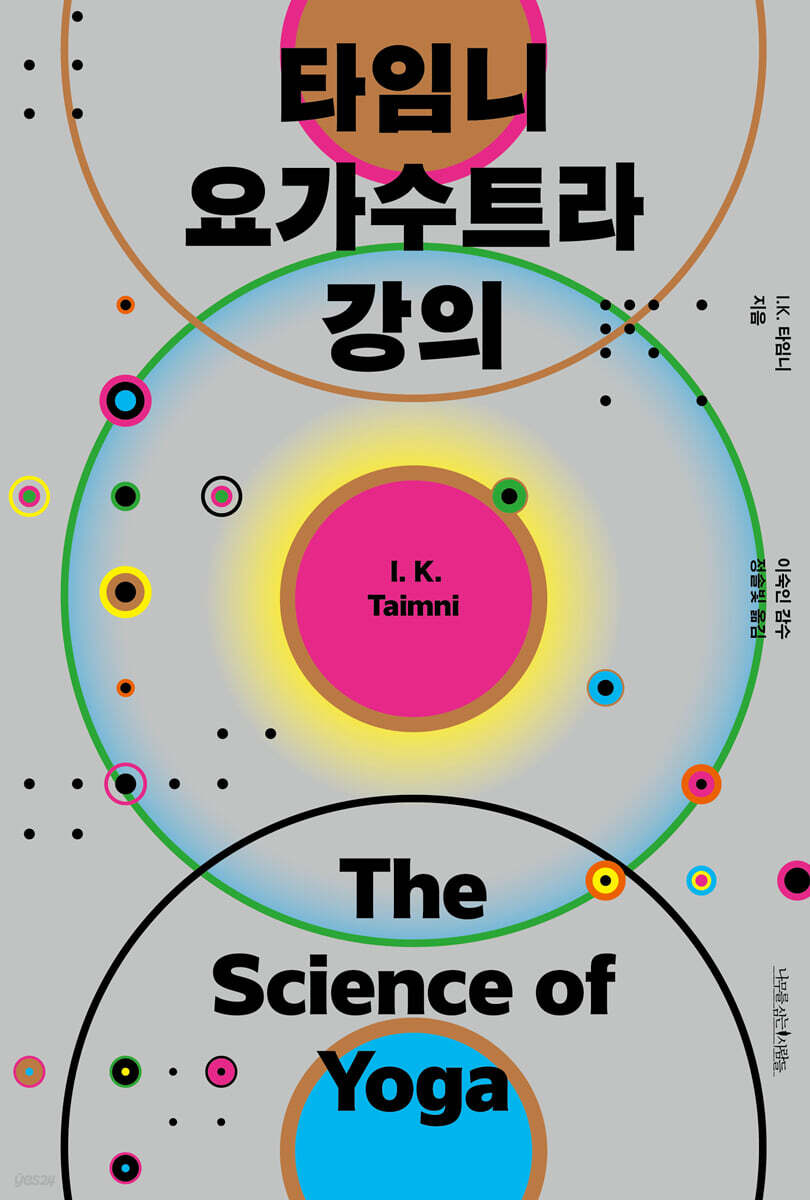
Timeni Yoga Sutra Lecture
 |
Description
Book Introduction
Wisdom that shines brighter in the age of material science
How is the Yoga Sutra different when read by scientists?
I., a scientist and philosopher
K. Timeney's interpretation of "The Science of Yoga" with embodied wisdom, the very book that yoga students used to read in English, has been published in Korean.
The philosopher of religion Karel Werner has praised the book, saying it is “free from the flaws and incompetence common in most popular literature promoting yoga, and I recommend it as a valuable introduction to yoga.”
Through "Timey's Yoga Sutra Lectures," you will be able to understand the philosophical and practical essence of "Yoga Sutra" in a concise yet clear manner.
How is the Yoga Sutra different when read by scientists?
I., a scientist and philosopher
K. Timeney's interpretation of "The Science of Yoga" with embodied wisdom, the very book that yoga students used to read in English, has been published in Korean.
The philosopher of religion Karel Werner has praised the book, saying it is “free from the flaws and incompetence common in most popular literature promoting yoga, and I recommend it as a valuable introduction to yoga.”
Through "Timey's Yoga Sutra Lectures," you will be able to understand the philosophical and practical essence of "Yoga Sutra" in a concise yet clear manner.
- You can preview some of the book's contents.
Preview
Detailed image

Into the book
I-10
When you wake up, your physical brain becomes mentally active as before.
When you put a car in neutral, the engine continues to run, but it's like the car isn't moving.
Similarly, in Nidra, there is no pratya in the physical brain, but the mental activity is transferred to a finer vehicle and continues as before.
It's just that the brain is in neutral gear.
II-19
There are gold rings, bracelets, necklaces, etc. on the living room table.
We can simply see them as separate objects, like a child would.
This corresponds to the Visheshya stage.
Next, we can see them as ornaments.
This is the Abhishesha stage.
Now, as the goldsmith sees it, we can see both common materials and individual identities at the same time.
This is the linga stage.
Finally, we look at them as if they were thieves.
A thief only sees gold.
This is similar to the Aringa stage.
At this stage the yogi primarily perceives divine consciousness, and from his perspective all objects are nothing but vrittis or transformations.
III-3
Great musicians create their best work when they completely lose themselves in their work.
Inventors solve the biggest problems without any self-consciousness that they are solving the problem.
In some way, the disappearance of self-consciousness opens the door to a new world that is normally inaccessible.
When Dhyana passes into Samadhi and the door to the real world opens, something similar happens on a much higher level.
Patanjali calls this phenomenon of losing self-consciousness Svar?pa ??nyam iva.
It is as if the 'form of one's own' or essential properties disappear.
When self-consciousness disappears, what remains? Only the object of meditation remains.
This is the meaning of Artha-m?tra-Nirbh?sa?.
IV-3
Let's say we have a beaker full of sugar solution.
We can change sugar into alcohol by mixing certain types of leavening agents into the solution, and we can also change it into carbon by adding strong sulfuric acid.
But you can't turn sugar into mercury.
Because chemically, sugar has no potential to turn into mercury.
What does this law have to do with yoga? The yogi must... ...discover the root causes that create various external forms and eliminate the underlying causes.
The trend in modern society is to only address superficial causes and try to somehow escape from the current difficulties.
This leads us nowhere, and it keeps bringing up old problems in new and different forms.
When you wake up, your physical brain becomes mentally active as before.
When you put a car in neutral, the engine continues to run, but it's like the car isn't moving.
Similarly, in Nidra, there is no pratya in the physical brain, but the mental activity is transferred to a finer vehicle and continues as before.
It's just that the brain is in neutral gear.
II-19
There are gold rings, bracelets, necklaces, etc. on the living room table.
We can simply see them as separate objects, like a child would.
This corresponds to the Visheshya stage.
Next, we can see them as ornaments.
This is the Abhishesha stage.
Now, as the goldsmith sees it, we can see both common materials and individual identities at the same time.
This is the linga stage.
Finally, we look at them as if they were thieves.
A thief only sees gold.
This is similar to the Aringa stage.
At this stage the yogi primarily perceives divine consciousness, and from his perspective all objects are nothing but vrittis or transformations.
III-3
Great musicians create their best work when they completely lose themselves in their work.
Inventors solve the biggest problems without any self-consciousness that they are solving the problem.
In some way, the disappearance of self-consciousness opens the door to a new world that is normally inaccessible.
When Dhyana passes into Samadhi and the door to the real world opens, something similar happens on a much higher level.
Patanjali calls this phenomenon of losing self-consciousness Svar?pa ??nyam iva.
It is as if the 'form of one's own' or essential properties disappear.
When self-consciousness disappears, what remains? Only the object of meditation remains.
This is the meaning of Artha-m?tra-Nirbh?sa?.
IV-3
Let's say we have a beaker full of sugar solution.
We can change sugar into alcohol by mixing certain types of leavening agents into the solution, and we can also change it into carbon by adding strong sulfuric acid.
But you can't turn sugar into mercury.
Because chemically, sugar has no potential to turn into mercury.
What does this law have to do with yoga? The yogi must... ...discover the root causes that create various external forms and eliminate the underlying causes.
The trend in modern society is to only address superficial causes and try to somehow escape from the current difficulties.
This leads us nowhere, and it keeps bringing up old problems in new and different forms.
--- From the text
Publisher's Review
Interpreting the contents of the Yoga Sutras as simply and clearly as possible, yet with depth.
Patanjali's Yoga Sutra is the most fundamental classic of yoga.
However, there are two high barriers to entry for yogis studying yoga philosophy to read the Yoga Sutras.
First, the Yoga Sutra was written in Sanskrit 2,000 years ago, and second, because it condenses the vast spirit of yoga into just 196 short verses, the possibilities for interpretation are endless.
So, many commentaries have been published so far, and even commentaries that interpret the commentaries have been published.
A scientist, Hindu philosopher, and theosophist, Timeni interprets the Yoga Sutras in a modern, concrete language that is clear, simple, yet profound.
In the preface, Timeni states, “I have written this book to present correct, balanced and clear concepts so that anyone can understand the fundamental teachings of yoga.”
An outstanding interpretation that crosses science, the occult, and Hindu thought.
Timani, the author of this book, was an intellectual from the East during the colonial era, born in India in 1898 and studying abroad at the University of London in England.
After returning to his home country, he spent his entire life as a professor of chemistry at the University of Allahabad, India. He was a scientist who studied cutting-edge fields of his time, as well as a spiritual philosopher, and in particular, a theosophist and yoga scholar.
His "Timeni Yoga Sutra Lectures" are still being introduced in many languages around the world, and his commentary, which encompasses the ideas of Sankhya, Vedanta, yoga philosophy, and Western science, theology, and theosophy, is considered to be very logical and unique.
His clear interpretation of samadhi, his cosmological understanding of the yoga god 'Isvara', and his explanation of the mantra 'Om' associating it with energy and vibration are outstanding.
His interpretations are not esoteric, but they make the Yoga Sutras easy to understand.
Beyond being informative, it is also interesting and fun.
Book structure
Volume 1 Samadhi Pada, The Path of Samadhi
Covers the general properties and techniques of yoga.
In fact, it is intended to answer the question, 'What is yoga?'
Since Samadhi (samādhi) is an essential technique of yoga, it naturally occupies the most important position among the various topics covered in Volume 1.
Volume 2, S?dhana P?da, The Path of Practice
The first part deals with the philosophy of Klesha (suffering) and answers the question, 'Why should one practice yoga?'
It offers an insightful analysis of the human condition and the suffering and unhappiness inherent in it.
The second half covers the first five yoga practices called Bahira?ga, or external practices.
These practices are preparatory in nature and their purpose is to make the practitioner fit for the practice of samadhi.
Volume 3: Vibh?ti P?da, The Path of Supernatural Powers
The first part covers the remaining three practices of the yoga technique called Antara?ga, or inner practice.
Through this, the practitioner attains samadhi, all the mysteries of the yogic life are solved, and Siddhi (supernatural powers) are acquired.
Volume 4: Kaivalya Pada, The Path to Liberation
Explains all the philosophical issues involved in the study and practice of yoga.
It deals briefly but systematically with the nature of perception, desire and its binding force, liberation and its consequences, etc.
All these topics are directly or indirectly related to the attainment of Kaivalya (liberation).
A book recommended to all those who dream of freedom of mind.
[Author's Note]
People who start yoga to solve problems related to their 'inner' life may face serious difficulties.
They may find all the systems of yoga interesting and even fascinating, but many of them may feel too mystical and cumbersome to apply in everyday life.
However, in many cases, the ambiguity in yoga literature arises not from its profundity, but from the gap between the teachings of yoga and what the general public is familiar with.
Therefore, interpreting the ancient yoga teachings from a modern perspective makes the subject much easier to understand.
Especially today, scientific discoveries are of great help in understanding the yogic life.
Because there is a certain relationship between the laws of higher life and life in the material world, as in the well-known occult maxim, 'As above, so below.'
Therefore, what is needed for the general public learning yoga is a correct and balanced explanation of all aspects of yoga from a modern perspective.
Although many aspects of yoga are beyond intellectual understanding, serious readers with an open mind and an enthusiastic attitude, familiar with the major currents of philosophy and religion, will find a deeper and broader world of yoga philosophy and techniques.
-I.
K. Timeney
[Editor's Note]
The strength of this book is, above all, Timeni's view on samadhi, the pinnacle of all meditation and the object of mystical exploration.
Samadhi, also known as samadhi, is the ultimate goal and raison d'être of yoga practice, a meditation of union with the superconscious mind.
Readers are encouraged to consult the diagrams and commentaries throughout Volume 1, especially Sutras 17 and 18, and to examine the stages and meaning of yoga meditation several times along the expanded journey of consciousness after Samadhi in Volume 3, Sutras 1-15, and Book 4.
In particular, I cannot help but say that the explanations of Sampragyata Samadhi and Asampragyata Samadhi, the three Parinamas, and the stages of meditation have been of immense help to me, as someone who has been practicing yoga meditation for more than half of my life.
-Lee Sook-in (Director of yoga studio 'Raja Yoga House', yoga practitioner)
[Translator's Note]
The original text of Patanjali's Yoga Sutra is concise and difficult to understand, and there are numerous commentaries that explain the original text.
Among them, Timeni's annotations were impressive in that they explained the yoga practice process in objective and clear language, befitting the original title, 'The Science of Yoga.'
The excellence of Timeni's commentary lies in its ability to help beginners intellectually understand the subject of 'samadhi', which can be considered too difficult and mysterious to grasp.
I translated this book because I thought it would be so helpful to practitioners who have experienced similar struggles as I have or are confused at the beginning of their yoga journey. When you put the intellectual understanding you gain from this book into practice in your own life, you will gain a true understanding of the Yoga Sutras, which speak beyond the intellect.
-Jeong Solbit
Patanjali's Yoga Sutra is the most fundamental classic of yoga.
However, there are two high barriers to entry for yogis studying yoga philosophy to read the Yoga Sutras.
First, the Yoga Sutra was written in Sanskrit 2,000 years ago, and second, because it condenses the vast spirit of yoga into just 196 short verses, the possibilities for interpretation are endless.
So, many commentaries have been published so far, and even commentaries that interpret the commentaries have been published.
A scientist, Hindu philosopher, and theosophist, Timeni interprets the Yoga Sutras in a modern, concrete language that is clear, simple, yet profound.
In the preface, Timeni states, “I have written this book to present correct, balanced and clear concepts so that anyone can understand the fundamental teachings of yoga.”
An outstanding interpretation that crosses science, the occult, and Hindu thought.
Timani, the author of this book, was an intellectual from the East during the colonial era, born in India in 1898 and studying abroad at the University of London in England.
After returning to his home country, he spent his entire life as a professor of chemistry at the University of Allahabad, India. He was a scientist who studied cutting-edge fields of his time, as well as a spiritual philosopher, and in particular, a theosophist and yoga scholar.
His "Timeni Yoga Sutra Lectures" are still being introduced in many languages around the world, and his commentary, which encompasses the ideas of Sankhya, Vedanta, yoga philosophy, and Western science, theology, and theosophy, is considered to be very logical and unique.
His clear interpretation of samadhi, his cosmological understanding of the yoga god 'Isvara', and his explanation of the mantra 'Om' associating it with energy and vibration are outstanding.
His interpretations are not esoteric, but they make the Yoga Sutras easy to understand.
Beyond being informative, it is also interesting and fun.
Book structure
Volume 1 Samadhi Pada, The Path of Samadhi
Covers the general properties and techniques of yoga.
In fact, it is intended to answer the question, 'What is yoga?'
Since Samadhi (samādhi) is an essential technique of yoga, it naturally occupies the most important position among the various topics covered in Volume 1.
Volume 2, S?dhana P?da, The Path of Practice
The first part deals with the philosophy of Klesha (suffering) and answers the question, 'Why should one practice yoga?'
It offers an insightful analysis of the human condition and the suffering and unhappiness inherent in it.
The second half covers the first five yoga practices called Bahira?ga, or external practices.
These practices are preparatory in nature and their purpose is to make the practitioner fit for the practice of samadhi.
Volume 3: Vibh?ti P?da, The Path of Supernatural Powers
The first part covers the remaining three practices of the yoga technique called Antara?ga, or inner practice.
Through this, the practitioner attains samadhi, all the mysteries of the yogic life are solved, and Siddhi (supernatural powers) are acquired.
Volume 4: Kaivalya Pada, The Path to Liberation
Explains all the philosophical issues involved in the study and practice of yoga.
It deals briefly but systematically with the nature of perception, desire and its binding force, liberation and its consequences, etc.
All these topics are directly or indirectly related to the attainment of Kaivalya (liberation).
A book recommended to all those who dream of freedom of mind.
[Author's Note]
People who start yoga to solve problems related to their 'inner' life may face serious difficulties.
They may find all the systems of yoga interesting and even fascinating, but many of them may feel too mystical and cumbersome to apply in everyday life.
However, in many cases, the ambiguity in yoga literature arises not from its profundity, but from the gap between the teachings of yoga and what the general public is familiar with.
Therefore, interpreting the ancient yoga teachings from a modern perspective makes the subject much easier to understand.
Especially today, scientific discoveries are of great help in understanding the yogic life.
Because there is a certain relationship between the laws of higher life and life in the material world, as in the well-known occult maxim, 'As above, so below.'
Therefore, what is needed for the general public learning yoga is a correct and balanced explanation of all aspects of yoga from a modern perspective.
Although many aspects of yoga are beyond intellectual understanding, serious readers with an open mind and an enthusiastic attitude, familiar with the major currents of philosophy and religion, will find a deeper and broader world of yoga philosophy and techniques.
-I.
K. Timeney
[Editor's Note]
The strength of this book is, above all, Timeni's view on samadhi, the pinnacle of all meditation and the object of mystical exploration.
Samadhi, also known as samadhi, is the ultimate goal and raison d'être of yoga practice, a meditation of union with the superconscious mind.
Readers are encouraged to consult the diagrams and commentaries throughout Volume 1, especially Sutras 17 and 18, and to examine the stages and meaning of yoga meditation several times along the expanded journey of consciousness after Samadhi in Volume 3, Sutras 1-15, and Book 4.
In particular, I cannot help but say that the explanations of Sampragyata Samadhi and Asampragyata Samadhi, the three Parinamas, and the stages of meditation have been of immense help to me, as someone who has been practicing yoga meditation for more than half of my life.
-Lee Sook-in (Director of yoga studio 'Raja Yoga House', yoga practitioner)
[Translator's Note]
The original text of Patanjali's Yoga Sutra is concise and difficult to understand, and there are numerous commentaries that explain the original text.
Among them, Timeni's annotations were impressive in that they explained the yoga practice process in objective and clear language, befitting the original title, 'The Science of Yoga.'
The excellence of Timeni's commentary lies in its ability to help beginners intellectually understand the subject of 'samadhi', which can be considered too difficult and mysterious to grasp.
I translated this book because I thought it would be so helpful to practitioners who have experienced similar struggles as I have or are confused at the beginning of their yoga journey. When you put the intellectual understanding you gain from this book into practice in your own life, you will gain a true understanding of the Yoga Sutras, which speak beyond the intellect.
-Jeong Solbit
GOODS SPECIFICS
- Date of issue: October 15, 2025
- Page count, weight, size: 576 pages | 820g | 152*225*28mm
- ISBN13: 9791193156322
- ISBN10: 1193156327
You may also like
카테고리
korean


korean

![ELLE 엘르 스페셜 에디션 A형 : 12월 [2025]](http://librairie.coreenne.fr/cdn/shop/files/b8e27a3de6c9538896439686c6b0e8fb.jpg?v=1766436872&width=3840)


