

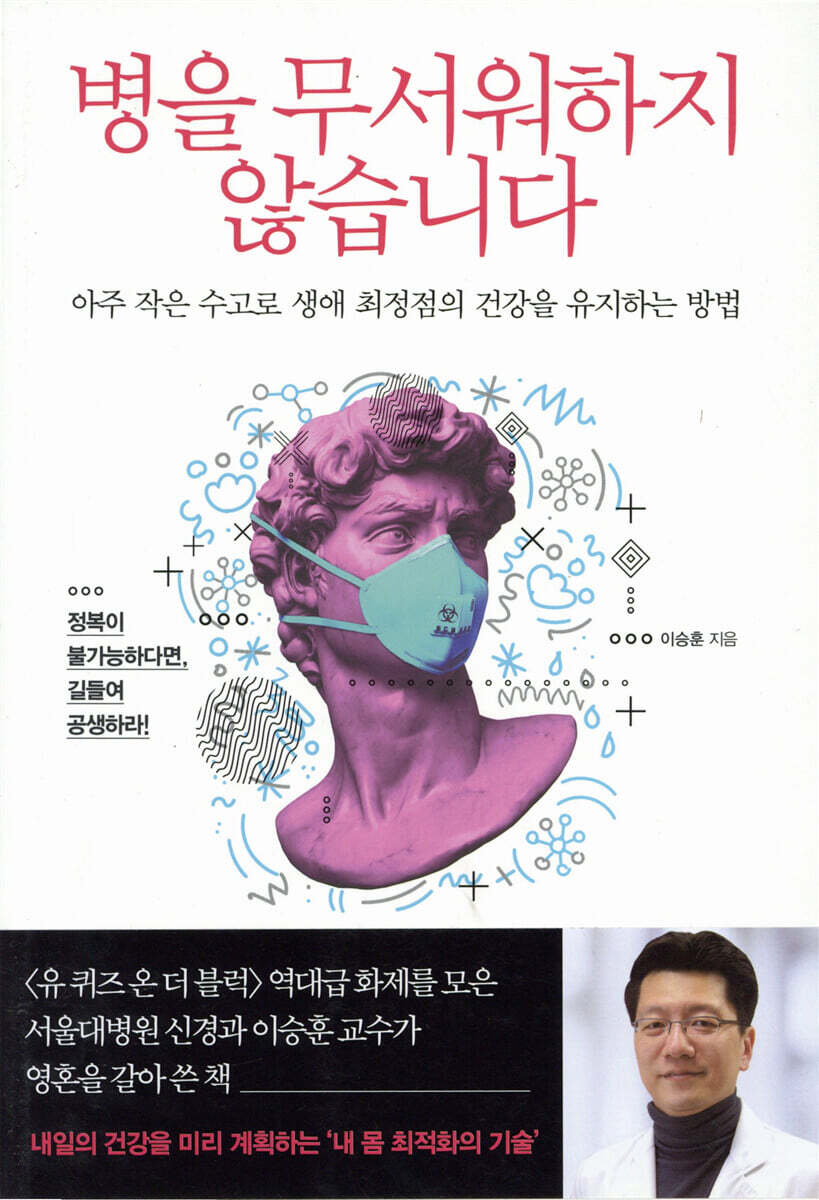
I'm not afraid of illness
 |
Description
Book Introduction
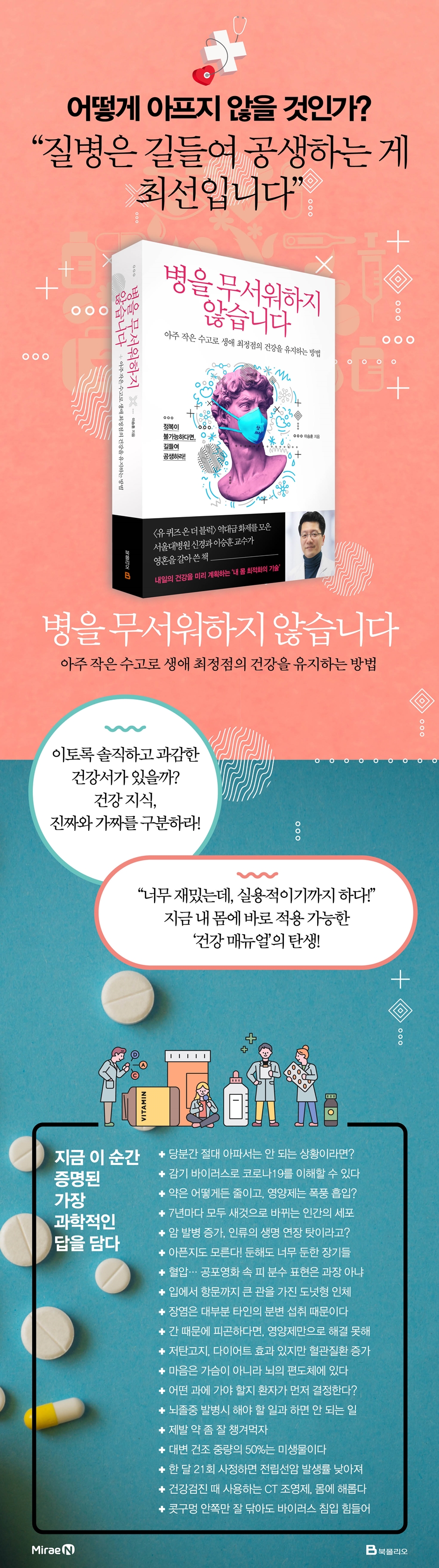
“We all carry illness. “They just don’t recognize it” What exactly is disease? Is it possible to tame it and coexist with it? Around the time when I was getting tired of the word 'corona' and becoming indifferent to it. As humanity experiences the (relatively) low fatality rate of variant viruses, it begins to worry about endemics. Assuming that extinction was impossible, our choices could only flow in one direction. 'Let's take control.' In fact, countries around the world began to accept the coronavirus as an endemic disease, suppressing vague fears. This is because the future benefit of ‘human development’, which must continue without interruption, is greater than the short-term benefits that can be obtained through control and obligation. I wonder what this annoying guy will be like to us in ten or twenty years. We all need to accept the 'fact' that we will all develop various diseases as we live, and as individuals, we need to establish proper ways to deal with them. To achieve this, we must have an attitude of scientific awareness, both as individuals and as members of the human community, of the nature of disease. This is precisely why the author wrote this book. He had no recollection of ever seeing any explanations in medical books or attending lectures on the meaning of disease while attending medical school. I browsed through a variety of domestic and international books on disease at large bookstores, but it was difficult to find a book that examined the nature of disease, accepted it, and intuitively explained how to live as healthily as possible. Ultimately, the book "I'm Not Afraid of Illness" is a book that I wrote with all my heart and soul as a doctor, with the thought of "let's write it myself." |
- You can preview some of the book's contents.
Preview
index
INTRO Are you taking a leave of absence because you have a cold?
Taking a break from school because you have a cold? 17 | What is disease? 20 | I don't want to take medicine, but can I take supplements? 26 | When will cancer be conquered? 30 | The dream of longevity 36
PART 1 What is the human body?
Do you feel and live according to the state of your internal organs? 45 | How Human Organs Work: Respiration 53 | How Human Organs Work: Circulation 59 | How Human Organs Work: Ingestion, Digestion, Absorption, and Excretion 69 | How Human Organs Work: The Metabolic Center, the Liver 77 | How Human Organs Work: The Brain 89
PART 2 What is Disease?
Dr. Seunghoon Lee's New Disease Classification System 107
PART 3 At least I'll make sure you don't collapse from a stroke.
What does stroke mean? 123 | The Fear of Stroke: Let's Understand It and Fear It Properly 128 | What is Neurology and Stroke? 134 | Same as Myocardial Infarction: Large-Vessel Atherosclerosis 145 | A Disease Existing Only in the Brain: Small-Vessel Occlusion 157 | The Heart is the Culprit, the Brain is the Victim: Cardiogenic Embolism 172 | Mini-Stroke? Let's Just Treat It as a Prodromal Symptom 184 | What is a Blood Clot? A Very Easy Understanding 192 | Stroke Caused by Poverty and Hypertension: Intracerebral Hemorrhage 199 | A Time Bomb Exploding: Subarachnoid Hemorrhage 211 | Diagnosis and Treatment: Is Self-Diagnosis Necessary? 226 | At Least, We'll Keep You from Falling Down from a Stroke 244
PART 4 Cancer is Life, It's Not So Far Off
What the heck is cancer? Is cancer a life? 275 | Understanding carcinogens through a global cancer incidence chart 286 | Health screenings: For whom? 306
PART 5: I absolutely cannot afford to get sick for the time being! What should I do?
For those preparing for a once-in-a-lifetime situation: 329 | What is a cold? 332 | How to avoid catching a cold for at least a few days 347 | Understanding COVID-19 through the common cold virus 362 | Don't they teach about colds in medical school? 376
PART 6 Finally, a story I really want to tell my readers
I Know My Body Best 387 | The Potential and Limitations of Healthy Diets 396 | Isn't It Best to Avoid Medication as Much as Possible? 402 | Are E-Cigarettes Better Than Cigarettes? 411 | Is an Appropriate Weight Just Appearance or a Healthy Weight? 415 | Does the COVID-19 Vaccine Cause Stroke? 425 | Are There Really Famous Doctors in Korea? 435
Taking a break from school because you have a cold? 17 | What is disease? 20 | I don't want to take medicine, but can I take supplements? 26 | When will cancer be conquered? 30 | The dream of longevity 36
PART 1 What is the human body?
Do you feel and live according to the state of your internal organs? 45 | How Human Organs Work: Respiration 53 | How Human Organs Work: Circulation 59 | How Human Organs Work: Ingestion, Digestion, Absorption, and Excretion 69 | How Human Organs Work: The Metabolic Center, the Liver 77 | How Human Organs Work: The Brain 89
PART 2 What is Disease?
Dr. Seunghoon Lee's New Disease Classification System 107
PART 3 At least I'll make sure you don't collapse from a stroke.
What does stroke mean? 123 | The Fear of Stroke: Let's Understand It and Fear It Properly 128 | What is Neurology and Stroke? 134 | Same as Myocardial Infarction: Large-Vessel Atherosclerosis 145 | A Disease Existing Only in the Brain: Small-Vessel Occlusion 157 | The Heart is the Culprit, the Brain is the Victim: Cardiogenic Embolism 172 | Mini-Stroke? Let's Just Treat It as a Prodromal Symptom 184 | What is a Blood Clot? A Very Easy Understanding 192 | Stroke Caused by Poverty and Hypertension: Intracerebral Hemorrhage 199 | A Time Bomb Exploding: Subarachnoid Hemorrhage 211 | Diagnosis and Treatment: Is Self-Diagnosis Necessary? 226 | At Least, We'll Keep You from Falling Down from a Stroke 244
PART 4 Cancer is Life, It's Not So Far Off
What the heck is cancer? Is cancer a life? 275 | Understanding carcinogens through a global cancer incidence chart 286 | Health screenings: For whom? 306
PART 5: I absolutely cannot afford to get sick for the time being! What should I do?
For those preparing for a once-in-a-lifetime situation: 329 | What is a cold? 332 | How to avoid catching a cold for at least a few days 347 | Understanding COVID-19 through the common cold virus 362 | Don't they teach about colds in medical school? 376
PART 6 Finally, a story I really want to tell my readers
I Know My Body Best 387 | The Potential and Limitations of Healthy Diets 396 | Isn't It Best to Avoid Medication as Much as Possible? 402 | Are E-Cigarettes Better Than Cigarettes? 411 | Is an Appropriate Weight Just Appearance or a Healthy Weight? 415 | Does the COVID-19 Vaccine Cause Stroke? 425 | Are There Really Famous Doctors in Korea? 435
Detailed image
Into the book
[The Amazing Power of Blood Pressure] The heart's ejection pressure is usually expressed as 100 to 140 mmHg based on a mercury sphygmomanometer.
Simply put, it means the pressure that pushes up mercury, a liquid metal, by about 10 to 14 centimeters.
Since the specific gravity of mercury is 13.6, converting this to water, it means the pressure that pushes water up 13.6 to 19.0 meters.
For reference, blood has a specific gravity of 1.053, which is almost the same as water.
If a truly cleanly severed carotid artery were to occur, the blood gushing out like a fountain more than 13 meters high would not be something that only happens in the movies.
---From "PART 1: What is the Human Body?"
[About atrial fibrillation] Myocardial infarction, one of the causes of cardiogenic infarction, is caused by atherosclerosis of the coronary artery.
You just need to be careful of risk factors such as high blood pressure, diabetes, hyperlipidemia, obesity, and smoking, or treat them properly on a regular basis.
However, it is difficult to say that atrial fibrillation can be prevented with certainty.
Because it is one of the most common types of arrhythmia that occurs in the elderly.
In other words, as life expectancy increases, the likelihood of atrial fibrillation occurring naturally along with the aging of the myocardium inevitably increases.
For example, it is said that drinking increases the occurrence of atrial fibrillation, so abstaining from drinking may have some effect.
However, this does not mean that we can expect complete prevention of outbreaks.
Above all, early diagnosis is difficult because patients with atrial fibrillation rarely experience any symptoms.
It is not a condition that causes chest pain like angina, and it is not common for it to manifest as fainting.
Most of the time we don't know until it's quite advanced.
Ultimately, you will need to have an electrocardiogram regularly every year.
---From "PART 3 At least I'll make sure you don't collapse from a stroke"
[Please take your medicine!] I want to say this before I go into detail about the risk factors.
Please take some medicine.
People with high blood pressure, diabetes, hyperlipidemia, and atrial fibrillation should take medications to control each condition, along with anticoagulants.
Of course, the principle is to try to improve lifestyle habits without resorting to harsh measures in the early stages of risk factors.
However, if you go beyond that stage and decide that medication is necessary, it is much more beneficial to take the medication properly without feeling any resistance.
This means that you should carefully decide whether to take the medication or not at first, but once you decide, you must take it properly.
People who take their medication regularly do not develop further risk factors.
There are also many people who are controlled with just one drug for their entire lives.
On the other hand, if you do not take your medication properly, your high blood pressure, diabetes, etc. will worsen and eventually, it will get worse so quickly that even if you take 3-4 different medications, it will not be enough to stop it with just one medication.
---From "PART 3 At least I'll make sure you don't collapse from a stroke"
[Constipation is this scary] If genetics and inflammatory bowel disease are considered uncontrollable factors, what are the fundamental causes that make diet and adenomatous polyps risk factors? I think it's constipation.
Carcinogens associated with the development of colon cancer will clearly be exposed through feces.
The feces in the large intestine are made up of bacteria, which account for 50 percent of the dry weight, along with indigestible waste from the food we eat.
If it is a substance that is unnecessary and needs to be excreted from the body, it is beneficial to health to excrete it at the appropriate time rather than storing it for a long time unnecessarily.
However, due to various factors, if the stool remains in the large intestine for a long time, the frequency of unnecessary contact between the large intestine and various substances present in the stool also increases.
---From "PART 4 Cancer is also life, it's not entirely wrong"
[21 times a month!?] According to a survey of 31,925 health professionals conducted by Harvard University in 2016, men who ejaculated more than 21 times a month had a significantly lower incidence of prostate cancer than those who ejaculated 4 to 7 times.
Surprisingly, this same pattern was observed in those aged 20 to 29.
This shows that prostate cancer can be prevented by ejaculating at an appropriate level from a young age.
The relationship between ejaculation and the development of prostate cancer is now a major issue, as a study conducted in Australia confirmed similar results.
Of course, there are studies that refute this and neutral research results, so it is still difficult to accept it as an established theory.
---From "PART 4 Cancer is also life, it's not entirely wrong"
[For the day you absolutely must not get sick] It is well known that colds are usually easily cured by the body's immune response.
However, if you have an important event coming up, there is a high possibility that even a slight change in your condition could lead to catching a cold and ruining the event.
It's inevitable that an event can be ruined by inadequate preparation, but it's wise to anticipate and prevent situations where a cold can cause problems.
But doctors don't know much about colds, contrary to what you might think.
Even I never learned about colds in medical school.
Ordinary people will not understand.
However, colds are not taught in internal medicine, pediatrics, or otolaryngology classes.
We'll discuss the reason later, but anyway, you shouldn't just trust doctors when it comes to colds.
In the next topic, we will take a closer look at what a cold is.
And let's try to create an 'absolute prevention method' to prevent colds, even if it's just for a few days.
Simply put, it means the pressure that pushes up mercury, a liquid metal, by about 10 to 14 centimeters.
Since the specific gravity of mercury is 13.6, converting this to water, it means the pressure that pushes water up 13.6 to 19.0 meters.
For reference, blood has a specific gravity of 1.053, which is almost the same as water.
If a truly cleanly severed carotid artery were to occur, the blood gushing out like a fountain more than 13 meters high would not be something that only happens in the movies.
---From "PART 1: What is the Human Body?"
[About atrial fibrillation] Myocardial infarction, one of the causes of cardiogenic infarction, is caused by atherosclerosis of the coronary artery.
You just need to be careful of risk factors such as high blood pressure, diabetes, hyperlipidemia, obesity, and smoking, or treat them properly on a regular basis.
However, it is difficult to say that atrial fibrillation can be prevented with certainty.
Because it is one of the most common types of arrhythmia that occurs in the elderly.
In other words, as life expectancy increases, the likelihood of atrial fibrillation occurring naturally along with the aging of the myocardium inevitably increases.
For example, it is said that drinking increases the occurrence of atrial fibrillation, so abstaining from drinking may have some effect.
However, this does not mean that we can expect complete prevention of outbreaks.
Above all, early diagnosis is difficult because patients with atrial fibrillation rarely experience any symptoms.
It is not a condition that causes chest pain like angina, and it is not common for it to manifest as fainting.
Most of the time we don't know until it's quite advanced.
Ultimately, you will need to have an electrocardiogram regularly every year.
---From "PART 3 At least I'll make sure you don't collapse from a stroke"
[Please take your medicine!] I want to say this before I go into detail about the risk factors.
Please take some medicine.
People with high blood pressure, diabetes, hyperlipidemia, and atrial fibrillation should take medications to control each condition, along with anticoagulants.
Of course, the principle is to try to improve lifestyle habits without resorting to harsh measures in the early stages of risk factors.
However, if you go beyond that stage and decide that medication is necessary, it is much more beneficial to take the medication properly without feeling any resistance.
This means that you should carefully decide whether to take the medication or not at first, but once you decide, you must take it properly.
People who take their medication regularly do not develop further risk factors.
There are also many people who are controlled with just one drug for their entire lives.
On the other hand, if you do not take your medication properly, your high blood pressure, diabetes, etc. will worsen and eventually, it will get worse so quickly that even if you take 3-4 different medications, it will not be enough to stop it with just one medication.
---From "PART 3 At least I'll make sure you don't collapse from a stroke"
[Constipation is this scary] If genetics and inflammatory bowel disease are considered uncontrollable factors, what are the fundamental causes that make diet and adenomatous polyps risk factors? I think it's constipation.
Carcinogens associated with the development of colon cancer will clearly be exposed through feces.
The feces in the large intestine are made up of bacteria, which account for 50 percent of the dry weight, along with indigestible waste from the food we eat.
If it is a substance that is unnecessary and needs to be excreted from the body, it is beneficial to health to excrete it at the appropriate time rather than storing it for a long time unnecessarily.
However, due to various factors, if the stool remains in the large intestine for a long time, the frequency of unnecessary contact between the large intestine and various substances present in the stool also increases.
---From "PART 4 Cancer is also life, it's not entirely wrong"
[21 times a month!?] According to a survey of 31,925 health professionals conducted by Harvard University in 2016, men who ejaculated more than 21 times a month had a significantly lower incidence of prostate cancer than those who ejaculated 4 to 7 times.
Surprisingly, this same pattern was observed in those aged 20 to 29.
This shows that prostate cancer can be prevented by ejaculating at an appropriate level from a young age.
The relationship between ejaculation and the development of prostate cancer is now a major issue, as a study conducted in Australia confirmed similar results.
Of course, there are studies that refute this and neutral research results, so it is still difficult to accept it as an established theory.
---From "PART 4 Cancer is also life, it's not entirely wrong"
[For the day you absolutely must not get sick] It is well known that colds are usually easily cured by the body's immune response.
However, if you have an important event coming up, there is a high possibility that even a slight change in your condition could lead to catching a cold and ruining the event.
It's inevitable that an event can be ruined by inadequate preparation, but it's wise to anticipate and prevent situations where a cold can cause problems.
But doctors don't know much about colds, contrary to what you might think.
Even I never learned about colds in medical school.
Ordinary people will not understand.
However, colds are not taught in internal medicine, pediatrics, or otolaryngology classes.
We'll discuss the reason later, but anyway, you shouldn't just trust doctors when it comes to colds.
In the next topic, we will take a closer look at what a cold is.
And let's try to create an 'absolute prevention method' to prevent colds, even if it's just for a few days.
---From "PART 5: A Situation Where You Must Not Get Sick for the Time Being! What Should I Do?"
Publisher's Review
An important day where you absolutely must stay healthy!
Will I be able to maintain my best physical condition?
"The Art of Optimizing My Body": Planning for Tomorrow's Health
When Professor Lee Seung-hoon appeared on “You Quiz on the Block,” he was asked, “What is your unique way to stay healthy?”
His answer was “I take medicine,” which shocked the cast and crew as well as the viewers.
To put it more precisely, it can be said that it is doing what should be done and not doing what should not be done.
He says that 'poor guesses' based on inaccurate and shallow knowledge are what ruin our health.
He believes the right way to stay healthy is to strictly follow the dosage and directions for taking medication, maintain lifestyle habits based on medical recommendations, and distance yourself from unproven commercial and non-medical knowledge.
"I'm Not Afraid of Disease" is a book that contains the essence of prevention and treatment methods, medical statistics data, and the latest research materials that Professor Seunghoon Lee personally practices.
Based on the maximum medical knowledge that can be proven in modern medicine, we present specific methods that can be put into practice by the general public in their daily lives.
Will I be able to maintain my best physical condition?
"The Art of Optimizing My Body": Planning for Tomorrow's Health
When Professor Lee Seung-hoon appeared on “You Quiz on the Block,” he was asked, “What is your unique way to stay healthy?”
His answer was “I take medicine,” which shocked the cast and crew as well as the viewers.
To put it more precisely, it can be said that it is doing what should be done and not doing what should not be done.
He says that 'poor guesses' based on inaccurate and shallow knowledge are what ruin our health.
He believes the right way to stay healthy is to strictly follow the dosage and directions for taking medication, maintain lifestyle habits based on medical recommendations, and distance yourself from unproven commercial and non-medical knowledge.
"I'm Not Afraid of Disease" is a book that contains the essence of prevention and treatment methods, medical statistics data, and the latest research materials that Professor Seunghoon Lee personally practices.
Based on the maximum medical knowledge that can be proven in modern medicine, we present specific methods that can be put into practice by the general public in their daily lives.
GOODS SPECIFICS
- Publication date: March 20, 2022
- Page count, weight, size: 458 pages | 824g | 153*224*26mm
- ISBN13: 9791168411098
- ISBN10: 1168411092
You may also like
카테고리
korean


korean

![ELLE 엘르 스페셜 에디션 A형 : 12월 [2025]](http://librairie.coreenne.fr/cdn/shop/files/b8e27a3de6c9538896439686c6b0e8fb.jpg?v=1766436872&width=3840)


