

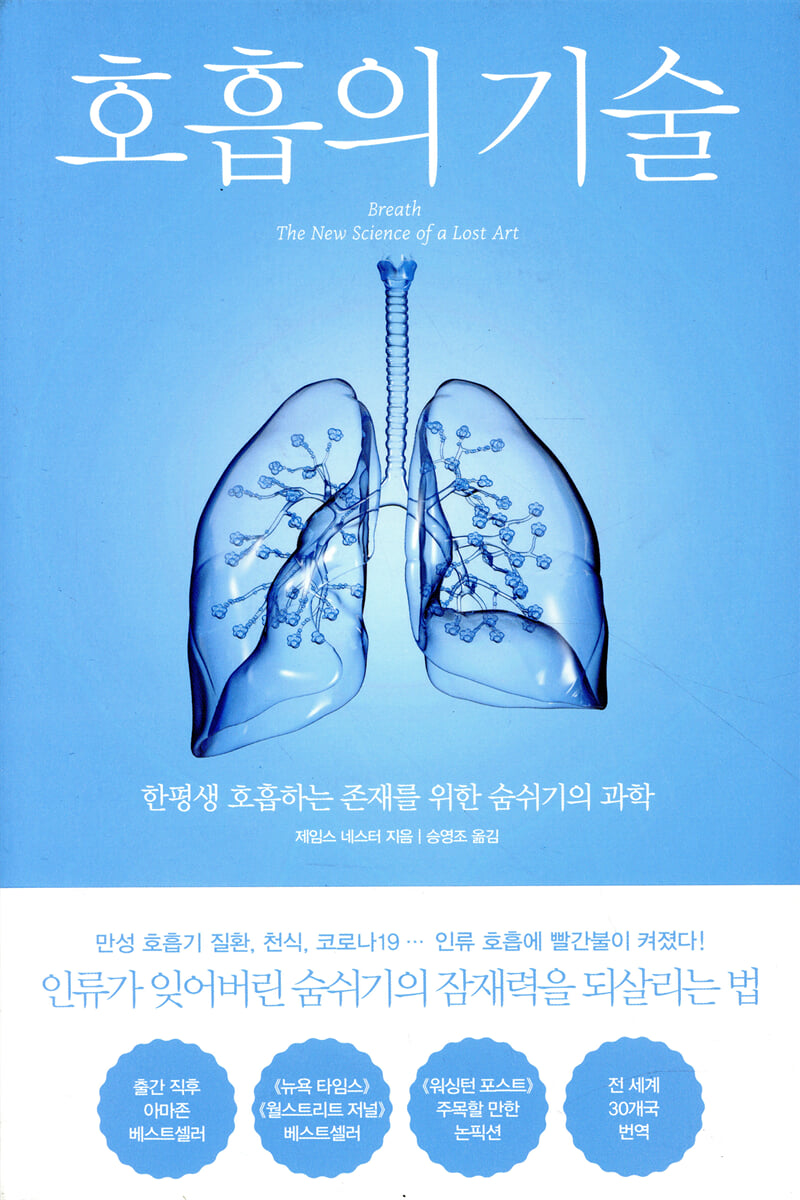
The art of breathing
 |
Description
Book Introduction
Until I breathe my last breath,
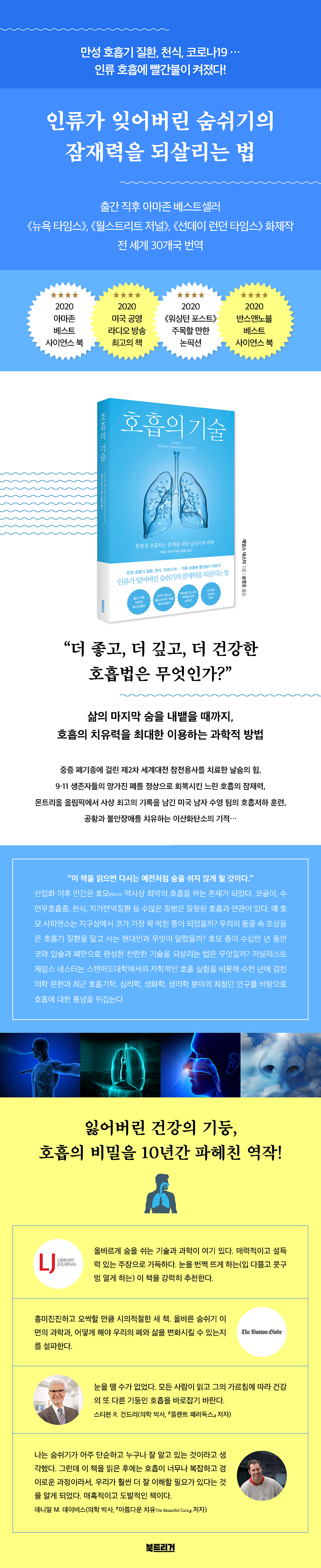
A scientific method that maximizes the healing power of breathing.
- Amazon Best Science Book of 2020
- Best Books on Public Radio in the U.S. 2020
- 2020 [Washington Post] Notable Nonfiction
- 2020 Barnes & Noble Best Science Book
Since industrialization, humans have become the worst breathers in the history of Homo.
Many conditions, including snoring, sleep apnea, asthma, and autoimmune diseases, have been linked to poor breathing.
Why did Homo sapiens become the most congested species on Earth? How did our cave ancestors differ from modern humans, who suffer from respiratory ailments? How can we revive the brilliant skills our species has perfected over hundreds of thousands of years with just our noses, lips, and lungs? Journalist James Nestor overturns conventional wisdom about breathing, drawing on his self-inflicted breathing experiments at Stanford University, thousands of years of medical literature, and cutting-edge research in respiratory science, psychology, biochemistry, and physiology.
A scientific method that maximizes the healing power of breathing.
- Amazon Best Science Book of 2020
- Best Books on Public Radio in the U.S. 2020
- 2020 [Washington Post] Notable Nonfiction
- 2020 Barnes & Noble Best Science Book
Since industrialization, humans have become the worst breathers in the history of Homo.
Many conditions, including snoring, sleep apnea, asthma, and autoimmune diseases, have been linked to poor breathing.
Why did Homo sapiens become the most congested species on Earth? How did our cave ancestors differ from modern humans, who suffer from respiratory ailments? How can we revive the brilliant skills our species has perfected over hundreds of thousands of years with just our noses, lips, and lungs? Journalist James Nestor overturns conventional wisdom about breathing, drawing on his self-inflicted breathing experiments at Stanford University, thousands of years of medical literature, and cutting-edge research in respiratory science, psychology, biochemistry, and physiology.
- You can preview some of the book's contents.
Preview
index
Prologue: A 10-Year Journey
Part 1 Experiment
1.
The worst breather in the animal kingdom
2.
Mouth breathing
Part 2: The Art and Science of Lost Breath
3.
nose
4.
exhale
5.
slow
6.
Less
7.
Chewing
Part 3 Breathing Plus
8.
Sometimes more
9.
hold your breath
10.
In search of the origins of the practice method
Epilogue: The End of a Breathtaking Journey
Part 1 Experiment
1.
The worst breather in the animal kingdom
2.
Mouth breathing
Part 2: The Art and Science of Lost Breath
3.
nose
4.
exhale
5.
slow
6.
Less
7.
Chewing
Part 3 Breathing Plus
8.
Sometimes more
9.
hold your breath
10.
In search of the origins of the practice method
Epilogue: The End of a Breathtaking Journey
Detailed image
Into the book
Few scientists have begun to study breathing.
But a few of them found out the truth.
Humans have undergone changes in their breathing ability over the course of a long evolutionary process, and it has been discovered that our breathing method has significantly worsened since the advent of industrial society.
This is actually not something they discovered, but rather something their breath discovered.
We started our research only after learning that 90 percent of us, probably myself, my readers, and almost everyone we know, are not breathing properly.
They realized that the ever-growing list of chronic diseases, and the fact that they were worsening, were all due to poor breathing.
--- p.19, from "Prologue: A Ten-Year Journey"
Mouth breathing changes the shape of the human body, but what's worse is that it also distorts the airway.
When you breathe in through your mouth, the pressure of your breath decreases, causing the soft tissues at the back of your mouth to relax and bend inward, reducing the overall space and making breathing more difficult.
Mouth breathing calls for more mouth breathing.
If you inhale through your nose, the opposite happens.
The air pressure against all the loose tissues in the back of your throat widens your airway, making breathing easier.
After a while, these tissues and muscles adjust to open more widely.
Nasal breathing calls for nasal breathing again.
--- p.57~58, 「2.
From "Mouth Breathing"
The lungs themselves lose about 12 percent of their capacity between the ages of 30 and 50.
It declines more rapidly with age, and is much worse in women than in men.
If you live to be 80, you will breathe 30 percent less air than you did in your 20s.
So you have no choice but to breathe faster and harder.
These breathing habits lead to chronic diseases such as high blood pressure, immune disorders, and anxiety disorders.
--- p.92, 「4.
From "Exhalation"
In the average adult, the diaphragm moves only slightly, about 10 percent of its range of motion, when breathing, which puts excessive strain on the heart and increases blood pressure, which can promote circulatory disease.
By increasing this breathing volume and stretching the diaphragm to 50 to 70 percent of its range of motion, you reduce cardiovascular stress and allow your body to function more efficiently.
For this reason, the diaphragm is sometimes called the “second heart.”
This is because the diaphragm not only beats to its own rhythm, but also influences the rate and force of the heartbeat.
--- p.100, 「4.
From "Exhalation"
Heavy, rapid breathing expels carbon dioxide.
Breathing more vigorously than your metabolism requires can quickly reduce the amount of blood flowing to your muscles, tissues, and organs.
Then you may feel dizzy, have convulsions, have a headache, or even lose consciousness.
These tissues become damaged if they do not receive a consistent blood supply for a long enough period of time.
--- p.119, 「5.
From "Slow"
The changes triggered by the rapid industrialization of wild foods about 300 years ago have had serious consequences.
In just a few generations since eating such food, modern humans have become the worst breathers in history among Homo species, and indeed the worst breathers in the animal kingdom.
--- p.161, 「7.
From "Chewing"
The best way to keep human tissues healthy is to mimic the reactions that evolved in Earth's early aerobic life, specifically by continually flooding our bodies with oxygen, a "strong electron acceptor."
The trick is to breathe slowly, less, and through your nose.
This balances the concentration of respiratory gases within the body, delivering as much oxygen as possible to as many tissues as possible, maximizing the electronic reactivity of our cells.
But a few of them found out the truth.
Humans have undergone changes in their breathing ability over the course of a long evolutionary process, and it has been discovered that our breathing method has significantly worsened since the advent of industrial society.
This is actually not something they discovered, but rather something their breath discovered.
We started our research only after learning that 90 percent of us, probably myself, my readers, and almost everyone we know, are not breathing properly.
They realized that the ever-growing list of chronic diseases, and the fact that they were worsening, were all due to poor breathing.
--- p.19, from "Prologue: A Ten-Year Journey"
Mouth breathing changes the shape of the human body, but what's worse is that it also distorts the airway.
When you breathe in through your mouth, the pressure of your breath decreases, causing the soft tissues at the back of your mouth to relax and bend inward, reducing the overall space and making breathing more difficult.
Mouth breathing calls for more mouth breathing.
If you inhale through your nose, the opposite happens.
The air pressure against all the loose tissues in the back of your throat widens your airway, making breathing easier.
After a while, these tissues and muscles adjust to open more widely.
Nasal breathing calls for nasal breathing again.
--- p.57~58, 「2.
From "Mouth Breathing"
The lungs themselves lose about 12 percent of their capacity between the ages of 30 and 50.
It declines more rapidly with age, and is much worse in women than in men.
If you live to be 80, you will breathe 30 percent less air than you did in your 20s.
So you have no choice but to breathe faster and harder.
These breathing habits lead to chronic diseases such as high blood pressure, immune disorders, and anxiety disorders.
--- p.92, 「4.
From "Exhalation"
In the average adult, the diaphragm moves only slightly, about 10 percent of its range of motion, when breathing, which puts excessive strain on the heart and increases blood pressure, which can promote circulatory disease.
By increasing this breathing volume and stretching the diaphragm to 50 to 70 percent of its range of motion, you reduce cardiovascular stress and allow your body to function more efficiently.
For this reason, the diaphragm is sometimes called the “second heart.”
This is because the diaphragm not only beats to its own rhythm, but also influences the rate and force of the heartbeat.
--- p.100, 「4.
From "Exhalation"
Heavy, rapid breathing expels carbon dioxide.
Breathing more vigorously than your metabolism requires can quickly reduce the amount of blood flowing to your muscles, tissues, and organs.
Then you may feel dizzy, have convulsions, have a headache, or even lose consciousness.
These tissues become damaged if they do not receive a consistent blood supply for a long enough period of time.
--- p.119, 「5.
From "Slow"
The changes triggered by the rapid industrialization of wild foods about 300 years ago have had serious consequences.
In just a few generations since eating such food, modern humans have become the worst breathers in history among Homo species, and indeed the worst breathers in the animal kingdom.
--- p.161, 「7.
From "Chewing"
The best way to keep human tissues healthy is to mimic the reactions that evolved in Earth's early aerobic life, specifically by continually flooding our bodies with oxygen, a "strong electron acceptor."
The trick is to breathe slowly, less, and through your nose.
This balances the concentration of respiratory gases within the body, delivering as much oxygen as possible to as many tissues as possible, maximizing the electronic reactivity of our cells.
--- p.270, 「10.
From “In Search of the Origin of Practice”
From “In Search of the Origin of Practice”
Publisher's Review
“What is a better, deeper, healthier way to breathe?”
A masterpiece that has uncovered the secrets of breathing, the lost pillar of health, for 10 years.
“If you breathe, you are alive; if you stop breathing, you are dead.” This book begins by overturning the conventional wisdom that considers breathing a passive, simple act.
For those who have lived their entire lives breathing unconsciously, breathing might seem like a big deal.
However, the middle-aged author, who had been struggling with respiratory problems, began to pay attention to the role of breathing after attending a breathing technique class at the recommendation of a doctor.
I simply closed my eyes and breathed for an hour, following the instructor's instructions. However, I experienced a noticeable change in my condition and opened my eyes to the potential of my breathing.
In fact, in modern medicine, the study of breathing techniques and the quality of breathing is nothing less than “uncharted territory waiting to be mapped out and mapped.”
The process of breathing involves both anatomy and physiology, yet no branch of science has ever explored it thoroughly.
Modern pulmonologists primarily study specific respiratory diseases such as lung cancer and emphysema, while physicians focus on treating emergency patients.
The more the author delves into this topic, the more he discovers that breathing techniques have been neglected.
Only a few people recognized the importance of breathing and began to study it.
Topics these researchers are exploring outside of mainstream respiratory medicine include:
The effects of mouth and nose breathing on exercise endurance and energy efficiency, the link between breathing and sleep, the effects of rapid, rapid breathing on blood flow, treatments for anxiety disorders using chemoreceptors and respiratory fear alarm circuits, models of modern human airway health using measurements from ancient skulls… .
The author delves into the science behind breathing, spending a full decade among the medical and scientific community's most outlandish researchers.
It overturns the mainstream respiratory science view that there is no significant difference in breathing rate or whether the breathing passage is through the mouth, nose, or windpipe, and suggests a better, deeper, and healthier way of breathing.
This book presents readers with a new scientific story about breathing, showing that breathing is the very pillar that supports health.
Is there science hidden even in the breathing we do without thinking?
“Good Breathing, Bad Breathing” Learned from a Breathing Explorer
What is the difference between nasal and mouth breathing? How does lung capacity relate to lifespan? What is the optimal breath rate per minute? What changes occur when we breathe slowly? What are the effects of complete exhalation? The author meticulously examines how our bodies take in air to derive energy and how that air affects our tissues, delving into the evolutionary and medical history of breathing, as well as anatomy, physiology, and physics.
The author, a journalist, is admirable for his dedication to studying and digesting the complex subject of the human body, tackling a vast array of books, scientific articles, interviews, and papers by professional researchers, and weaving them into writing.
Sometimes they even resort to self-destructive experiments.
In an experiment conducted in collaboration with the head of Stanford University's Department of Rhinology, the authors blocked their nostrils with silicone and breathed exclusively through their mouths for ten days, observing with their own eyes how physiological data changed depending on how they breathed.
The results of the experiment are surprising.
After 240 hours of mouth breathing, the author's stress-related hormone levels skyrocketed, the number of diphtheria bacteria in his nose increased, his blood pressure soared, and his heart rate variability plummeted (a decrease in heart rate variability indicates a reduced ability of the body to adapt to environmental changes).
With 40 percent of the population today suffering from chronic nasal congestion, he concludes:
“Chronic mouth breathing is completely abnormal.”
In addition, the author proves the potential of breathing techniques through several studies.
By following this book's journey of biologically analyzing the act of breathing and measuring its effects through an understanding of the structure and operating principles of the human body, you will be able to organically understand the importance of breathing, which we repeat 25,000 times a day, and why so much can change depending on how we breathe.
A red light has been turned on for human breathing, which has been on a downward path since industrialization!
What evolutionary blow has human breathing taken?
Nose breathing is the basis of healthy breathing, so much so that it can be said that no other breathing technique is effective unless you can breathe through your nose.
However, as humans went through a long evolutionary process, changes occurred in the skull and oral structure, which became an obstacle to nasal breathing.
It is highly likely that ancient people did not suffer from the respiratory problems that modern people suffer from, such as chronic respiratory diseases, nasal congestion, rhinitis, sinusitis, sleep apnea, and snoring.
This is because, unlike modern people, ancient people had a large jaw, a large mouth (oral cavity), and a wide airway, allowing for smooth nasal breathing.
Moreover, as food became industrialized and became soft and thick, it exacerbated modern people's respiratory problems.
This is because the face becomes narrower and the jaw becomes smaller as chewing behavior is significantly reduced.
The author seeks out scholars who have compared ancient and modern skulls to uncover the truth, and even goes so far as to infiltrate a forbidden Parisian crypt to personally examine the skull specimen of “Patient Zero,” a turning point in the mass destruction of facial features among the bone tombs of 19th-century cholera victims.
This book believes that it would be difficult to fundamentally resolve the problem of breathing without an evolutionary examination of our bodies, and it tenaciously traces the evolutionary impact of human breathing.
It also offers practical solutions on how we can overcome these obstacles and reclaim our breath as a species.
Examples include maintaining good posture, chewing on hard objects, and “mewing,” a type of tongue-stretching exercise.
Recently, some dentists have argued that to remove airway obstructions and restore small oral functions, attention should be paid to the muscle function of the orofacial area and to the stimulation of chewing.
By analyzing changes in the face and airway after wearing an orthodontic appliance that enhances chewing stimulation for a year, the authors show that hundreds of years of evolutionary damage can be repaired.
“The ability to breathe is a measure of health and longevity.”
To restore a weak heart, a weakened respiratory system, and a wounded immune system.
A delightful and friendly exploration of breathing in the pandemic era
There is ample evidence that breathing is the key to health and longevity.
In particular, lung capacity is closely related to life expectancy.
According to the Framingham Study, a 70-year longitudinal study focused on heart disease in the 1980s, the smaller and less efficient the lungs were, the sooner the subjects became ill and died.
“Bigger lungs mean longer lifespan.” But as we age, our lungs begin to deteriorate.
Lung capacity decreases by about 12 percent between ages 30 and 50 as the ribs gradually collapse inward and the muscle fibers surrounding the lungs weaken.
So, as we get older, we have no choice but to breathe faster and harder.
So should we accept this aging process as a given? The author argues otherwise.
By maximizing the power of exhalation, the range of motion of the diaphragm increases, allowing the lungs to expand as much as possible.
In the 1950s, at a Veterans Administration hospital in New Jersey, USA, there were cases of patients with severe emphysema improving their condition by increasing their lung capacity simply through exhalation training. Even today, freedivers increase their lung capacity by 30 to 40 percent through breathing techniques and dive tens of meters underwater without apnea.
This book focuses on the transformative power of breathing, thoroughly demonstrating and explaining it through real-life examples and scientific research.
It also systematically explains the health benefits of breathing slowly and less deeply, as well as specific breathing techniques that can be practiced in daily life.
Isn't it amazing that just by making small adjustments to how you breathe, you can improve your athletic performance, rejuvenate your organs, overcome snoring and asthma, and even correct scoliosis?
None of this may seem easy, but it is certainly possible.
Of course, breathing techniques are not a panacea.
Yet, the author insists that breathing techniques are “the best way to keep your body in balance so that minor problems don’t turn into serious health problems.”
These days, with wearing masks becoming a daily routine due to COVID-19, breathing issues are bound to become even more important.
If you understand the fundamental science of breathing, including its dynamics and physiology, through this book, you will be able to more proactively respond to the crisis facing humanity's breathing that is right before our eyes.
A masterpiece that has uncovered the secrets of breathing, the lost pillar of health, for 10 years.
“If you breathe, you are alive; if you stop breathing, you are dead.” This book begins by overturning the conventional wisdom that considers breathing a passive, simple act.
For those who have lived their entire lives breathing unconsciously, breathing might seem like a big deal.
However, the middle-aged author, who had been struggling with respiratory problems, began to pay attention to the role of breathing after attending a breathing technique class at the recommendation of a doctor.
I simply closed my eyes and breathed for an hour, following the instructor's instructions. However, I experienced a noticeable change in my condition and opened my eyes to the potential of my breathing.
In fact, in modern medicine, the study of breathing techniques and the quality of breathing is nothing less than “uncharted territory waiting to be mapped out and mapped.”
The process of breathing involves both anatomy and physiology, yet no branch of science has ever explored it thoroughly.
Modern pulmonologists primarily study specific respiratory diseases such as lung cancer and emphysema, while physicians focus on treating emergency patients.
The more the author delves into this topic, the more he discovers that breathing techniques have been neglected.
Only a few people recognized the importance of breathing and began to study it.
Topics these researchers are exploring outside of mainstream respiratory medicine include:
The effects of mouth and nose breathing on exercise endurance and energy efficiency, the link between breathing and sleep, the effects of rapid, rapid breathing on blood flow, treatments for anxiety disorders using chemoreceptors and respiratory fear alarm circuits, models of modern human airway health using measurements from ancient skulls… .
The author delves into the science behind breathing, spending a full decade among the medical and scientific community's most outlandish researchers.
It overturns the mainstream respiratory science view that there is no significant difference in breathing rate or whether the breathing passage is through the mouth, nose, or windpipe, and suggests a better, deeper, and healthier way of breathing.
This book presents readers with a new scientific story about breathing, showing that breathing is the very pillar that supports health.
Is there science hidden even in the breathing we do without thinking?
“Good Breathing, Bad Breathing” Learned from a Breathing Explorer
What is the difference between nasal and mouth breathing? How does lung capacity relate to lifespan? What is the optimal breath rate per minute? What changes occur when we breathe slowly? What are the effects of complete exhalation? The author meticulously examines how our bodies take in air to derive energy and how that air affects our tissues, delving into the evolutionary and medical history of breathing, as well as anatomy, physiology, and physics.
The author, a journalist, is admirable for his dedication to studying and digesting the complex subject of the human body, tackling a vast array of books, scientific articles, interviews, and papers by professional researchers, and weaving them into writing.
Sometimes they even resort to self-destructive experiments.
In an experiment conducted in collaboration with the head of Stanford University's Department of Rhinology, the authors blocked their nostrils with silicone and breathed exclusively through their mouths for ten days, observing with their own eyes how physiological data changed depending on how they breathed.
The results of the experiment are surprising.
After 240 hours of mouth breathing, the author's stress-related hormone levels skyrocketed, the number of diphtheria bacteria in his nose increased, his blood pressure soared, and his heart rate variability plummeted (a decrease in heart rate variability indicates a reduced ability of the body to adapt to environmental changes).
With 40 percent of the population today suffering from chronic nasal congestion, he concludes:
“Chronic mouth breathing is completely abnormal.”
In addition, the author proves the potential of breathing techniques through several studies.
By following this book's journey of biologically analyzing the act of breathing and measuring its effects through an understanding of the structure and operating principles of the human body, you will be able to organically understand the importance of breathing, which we repeat 25,000 times a day, and why so much can change depending on how we breathe.
A red light has been turned on for human breathing, which has been on a downward path since industrialization!
What evolutionary blow has human breathing taken?
Nose breathing is the basis of healthy breathing, so much so that it can be said that no other breathing technique is effective unless you can breathe through your nose.
However, as humans went through a long evolutionary process, changes occurred in the skull and oral structure, which became an obstacle to nasal breathing.
It is highly likely that ancient people did not suffer from the respiratory problems that modern people suffer from, such as chronic respiratory diseases, nasal congestion, rhinitis, sinusitis, sleep apnea, and snoring.
This is because, unlike modern people, ancient people had a large jaw, a large mouth (oral cavity), and a wide airway, allowing for smooth nasal breathing.
Moreover, as food became industrialized and became soft and thick, it exacerbated modern people's respiratory problems.
This is because the face becomes narrower and the jaw becomes smaller as chewing behavior is significantly reduced.
The author seeks out scholars who have compared ancient and modern skulls to uncover the truth, and even goes so far as to infiltrate a forbidden Parisian crypt to personally examine the skull specimen of “Patient Zero,” a turning point in the mass destruction of facial features among the bone tombs of 19th-century cholera victims.
This book believes that it would be difficult to fundamentally resolve the problem of breathing without an evolutionary examination of our bodies, and it tenaciously traces the evolutionary impact of human breathing.
It also offers practical solutions on how we can overcome these obstacles and reclaim our breath as a species.
Examples include maintaining good posture, chewing on hard objects, and “mewing,” a type of tongue-stretching exercise.
Recently, some dentists have argued that to remove airway obstructions and restore small oral functions, attention should be paid to the muscle function of the orofacial area and to the stimulation of chewing.
By analyzing changes in the face and airway after wearing an orthodontic appliance that enhances chewing stimulation for a year, the authors show that hundreds of years of evolutionary damage can be repaired.
“The ability to breathe is a measure of health and longevity.”
To restore a weak heart, a weakened respiratory system, and a wounded immune system.
A delightful and friendly exploration of breathing in the pandemic era
There is ample evidence that breathing is the key to health and longevity.
In particular, lung capacity is closely related to life expectancy.
According to the Framingham Study, a 70-year longitudinal study focused on heart disease in the 1980s, the smaller and less efficient the lungs were, the sooner the subjects became ill and died.
“Bigger lungs mean longer lifespan.” But as we age, our lungs begin to deteriorate.
Lung capacity decreases by about 12 percent between ages 30 and 50 as the ribs gradually collapse inward and the muscle fibers surrounding the lungs weaken.
So, as we get older, we have no choice but to breathe faster and harder.
So should we accept this aging process as a given? The author argues otherwise.
By maximizing the power of exhalation, the range of motion of the diaphragm increases, allowing the lungs to expand as much as possible.
In the 1950s, at a Veterans Administration hospital in New Jersey, USA, there were cases of patients with severe emphysema improving their condition by increasing their lung capacity simply through exhalation training. Even today, freedivers increase their lung capacity by 30 to 40 percent through breathing techniques and dive tens of meters underwater without apnea.
This book focuses on the transformative power of breathing, thoroughly demonstrating and explaining it through real-life examples and scientific research.
It also systematically explains the health benefits of breathing slowly and less deeply, as well as specific breathing techniques that can be practiced in daily life.
Isn't it amazing that just by making small adjustments to how you breathe, you can improve your athletic performance, rejuvenate your organs, overcome snoring and asthma, and even correct scoliosis?
None of this may seem easy, but it is certainly possible.
Of course, breathing techniques are not a panacea.
Yet, the author insists that breathing techniques are “the best way to keep your body in balance so that minor problems don’t turn into serious health problems.”
These days, with wearing masks becoming a daily routine due to COVID-19, breathing issues are bound to become even more important.
If you understand the fundamental science of breathing, including its dynamics and physiology, through this book, you will be able to more proactively respond to the crisis facing humanity's breathing that is right before our eyes.
GOODS SPECIFICS
- Publication date: February 19, 2021
- Page count, weight, size: 412 pages | 556g | 145*217*30mm
- ISBN13: 9791189799366
- ISBN10: 1189799367
You may also like
카테고리
korean


korean

![GQ KOREA Mark (Monthly): December [2025]](http://librairie.coreenne.fr/cdn/shop/files/8ef265dbbfbf186523ed75ba7319009d.jpg?v=1765340328&width=3840)


