

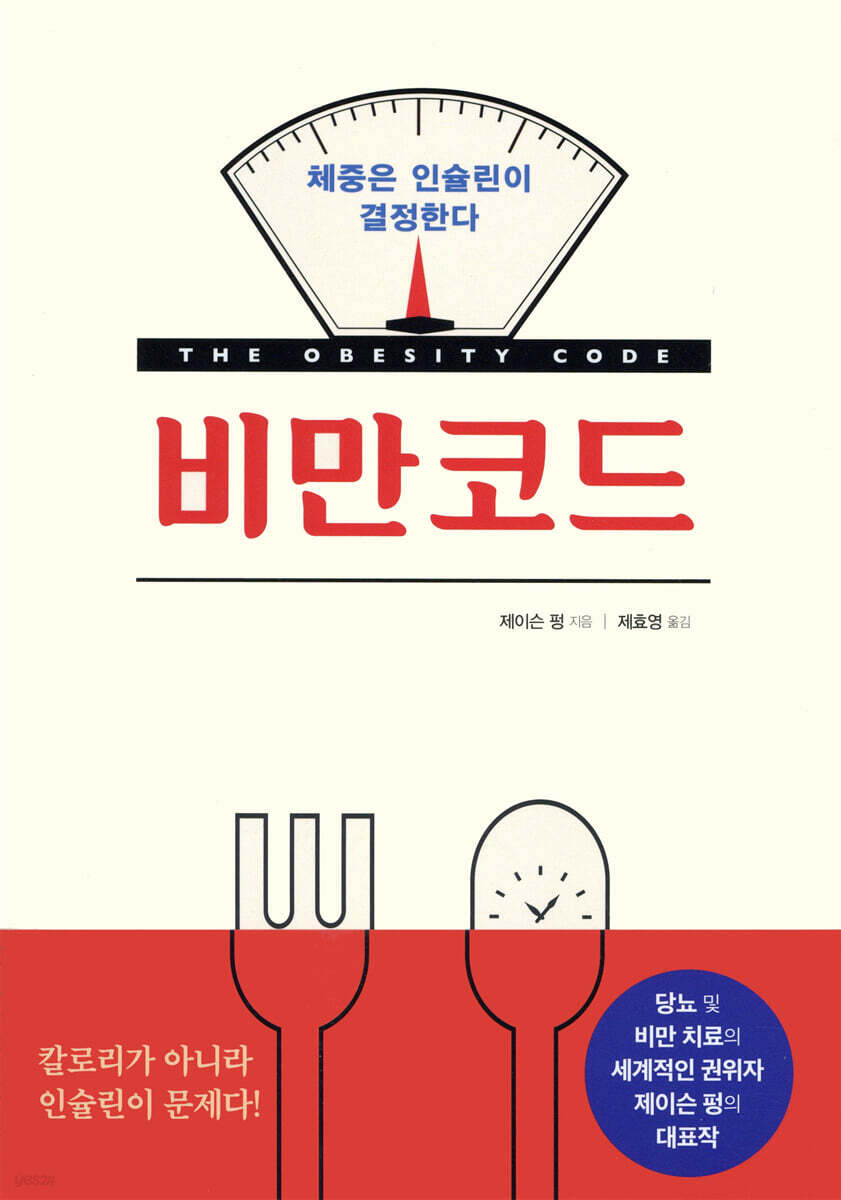
Obesity Code
 |
Description
Book Introduction
Obesity is caused by insulin!
Even if you lose weight through a successful diet, after a certain amount of time, your weight will return to its original level.
It's not because we're weak-willed or lack self-control.
It is absolutely not true that you gain weight by eating a lot and moving less.
The human body system always tries to maintain the weight that is set in our body.
When we lose weight through dieting, our body systems desperately try to replenish that amount.
No matter how strong one's will, one cannot fight and win against the body's automatic systems.
So why was our weight set so high in the first place? The author explains that insulin determines our weight, and our poor eating habits have led us to overly increase our insulin resistance.
The only way to maintain weight loss is to lower your body's set point.
How can I lower it?
In this book, Jason Fung, a world authority on type 2 diabetes and obesity treatment, explains 'how to break the insulin vicious cycle and reset your weight', 'a five-step practice method to control your insulin pattern', and 'how to maintain a healthy weight on a continuous basis' through this.
Even if you lose weight through a successful diet, after a certain amount of time, your weight will return to its original level.
It's not because we're weak-willed or lack self-control.
It is absolutely not true that you gain weight by eating a lot and moving less.
The human body system always tries to maintain the weight that is set in our body.
When we lose weight through dieting, our body systems desperately try to replenish that amount.
No matter how strong one's will, one cannot fight and win against the body's automatic systems.
So why was our weight set so high in the first place? The author explains that insulin determines our weight, and our poor eating habits have led us to overly increase our insulin resistance.
The only way to maintain weight loss is to lower your body's set point.
How can I lower it?
In this book, Jason Fung, a world authority on type 2 diabetes and obesity treatment, explains 'how to break the insulin vicious cycle and reset your weight', 'a five-step practice method to control your insulin pattern', and 'how to maintain a healthy weight on a continuous basis' through this.
- You can preview some of the book's contents.
Preview
index
PART 1 The Obesity Epidemic
Chapter 1: How Obesity Became an Epidemic
Chapter 2 Obesity and Genetics
PART 2 THE CALORIES TRICKETS
Chapter 3: The Fallacy of Calorie Reduction
Chapter 4 Misconceptions About Exercise
Chapter 5: The Paradox of Overeating
PART 3 A NEW OBESITY MODEL
Chapter 6: A New Hope
Chapter 7 Insulin
Chapter 8 Cortisol
Chapter 9: The Atkins Diet's Rise in Popularity
Chapter 10: Insulin Resistance
PART 4 Obesity as a Social Phenomenon
Chapter 11: Large Food Companies and Diabetes and Obesity
Chapter 12 Poverty and Obesity
Chapter 13 Childhood Obesity
PART 5 Wrong Eating Habits
Chapter 14: The Deadly Effects of Fructose
Chapter 15: Myths About Diet Sodas
Chapter 16 Carbohydrates and Fiber
Chapter 17 Protein
Chapter 18 Fatphobia
PART 6 SOLUTION
Chapter 19: What Should I Eat?
Chapter 20: When Should I Eat It?
Appendix A Sample One-Week Meal Plan
Appendix B: Fasting Practice Guide
Appendix C Meditation and Sleep
Chapter 1: How Obesity Became an Epidemic
Chapter 2 Obesity and Genetics
PART 2 THE CALORIES TRICKETS
Chapter 3: The Fallacy of Calorie Reduction
Chapter 4 Misconceptions About Exercise
Chapter 5: The Paradox of Overeating
PART 3 A NEW OBESITY MODEL
Chapter 6: A New Hope
Chapter 7 Insulin
Chapter 8 Cortisol
Chapter 9: The Atkins Diet's Rise in Popularity
Chapter 10: Insulin Resistance
PART 4 Obesity as a Social Phenomenon
Chapter 11: Large Food Companies and Diabetes and Obesity
Chapter 12 Poverty and Obesity
Chapter 13 Childhood Obesity
PART 5 Wrong Eating Habits
Chapter 14: The Deadly Effects of Fructose
Chapter 15: Myths About Diet Sodas
Chapter 16 Carbohydrates and Fiber
Chapter 17 Protein
Chapter 18 Fatphobia
PART 6 SOLUTION
Chapter 19: What Should I Eat?
Chapter 20: When Should I Eat It?
Appendix A Sample One-Week Meal Plan
Appendix B: Fasting Practice Guide
Appendix C Meditation and Sleep
Into the book
I am a nephrologist.
The most common causes of kidney disease, which I specialize in, are type 2 diabetes and obesity, which is linked to diabetes.
I have seen many patients who started insulin treatment for diabetes gain weight.
Of course, patients are also worried.
“Doctor, you keep telling me I need to lose weight, but the insulin you prescribed is making me gain weight.
“How does this treatment help?” For a long time, I couldn’t give a satisfactory answer to this question.
Like many doctors, I believed that weight gain was the result of an imbalance in calorie intake.
I thought it was because I ate a lot and moved less.
If that's true, why am I gaining so much weight because of the insulin I'm prescribed?
--- From the "Preface"
Complex hormonal imbalances and high blood insulin levels are the root causes of obesity.
A baby's hormonal characteristics are influenced by the maternal environment it encounters before birth, and this is related to whether the baby has high blood insulin levels and whether it will become obese later in life.
If obesity is the result of an imbalance in calorie intake, then diet and exercise are voluntary behaviors, so there is no way to explain such a clear genetic influence.
Viewing obesity as a result of hormonal imbalances can help us more accurately explain these genetic influences.
--- 「02.
From “Obesity and Genetics”
If you eat less, a vicious cycle begins.
If you start eating less, you will lose some weight.
This slows down metabolism and increases hunger.
So the weight starts to come back on.
This means you have to work twice as hard to eat less, which means you have to work even harder than before.
Then you lose some weight, but your total energy expenditure decreases again and you feel more hungry.
So I gain weight again.
I have to try to eat less again and work harder than before.
This cycle continues until it becomes unbearable.
The body is cold, tired, and hungry, and obsessed with counting how many calories it has consumed.
The worst part is that the weight will inevitably return to its original state.
Then, at some point, we start eating the way we used to.
However, since the human body's metabolism is greatly weakened, even if you just eat the same food as before, your weight will increase rapidly and you will return to the weight you had when you first started dieting or even gain more than that.
The influence of hormones is directly reflected in our actions.
However, friends, family, and medical professionals secretly blame the person, saying, "It's the person's fault."
We ourselves feel like failures.
--- 「03.
From “The Errors of Calorie Reduction”
The method to test the hypothesis that 'insulin causes obesity' is simple.
If we experimentally give insulin to a group of people and measure whether they gain weight, we can prove causality.
Therefore, the key question in this experiment can be summarized as follows.
Will insulin make you fat? The answer to this question is a resounding "yes!"
Patients who regularly take insulin and the doctors who prescribe it are already well aware of this terrible truth: the more insulin you take, the more severely you become obese.
Insulin causes obesity.
This has been confirmed in numerous studies conducted mostly on diabetic patients.
Insulin is the cause of obesity.
--- 「07.
Among "Insulin"
Starting a low-fat diet when both the essential conditions for developing insulin resistance—high levels and sustained insulin secretion—are already met further increases refined carbohydrate intake.
This causes weight gain as it acts as a stimulant that further increases insulin levels.
In the process of becoming obese, the number of meals you eat is twice as important as the food you eat.
Yet, we obsess over what foods we eat and pay little attention to when we should eat them.
--- 「10.
Among “insulin resistance”
Regular fasting has been shown to significantly improve insulin sensitivity by consistently lowering insulin levels.
This result is like the missing piece in the weight loss puzzle.
Most diets limit the intake of foods that increase insulin levels, but do not address insulin resistance.
So initially, weight loss occurs, but due to insulin resistance, both insulin levels and body weight remain high.
Since insulin resistance occurs when both conditions of persistence and high concentration are present, fasting can effectively reduce insulin resistance.
The most common causes of kidney disease, which I specialize in, are type 2 diabetes and obesity, which is linked to diabetes.
I have seen many patients who started insulin treatment for diabetes gain weight.
Of course, patients are also worried.
“Doctor, you keep telling me I need to lose weight, but the insulin you prescribed is making me gain weight.
“How does this treatment help?” For a long time, I couldn’t give a satisfactory answer to this question.
Like many doctors, I believed that weight gain was the result of an imbalance in calorie intake.
I thought it was because I ate a lot and moved less.
If that's true, why am I gaining so much weight because of the insulin I'm prescribed?
--- From the "Preface"
Complex hormonal imbalances and high blood insulin levels are the root causes of obesity.
A baby's hormonal characteristics are influenced by the maternal environment it encounters before birth, and this is related to whether the baby has high blood insulin levels and whether it will become obese later in life.
If obesity is the result of an imbalance in calorie intake, then diet and exercise are voluntary behaviors, so there is no way to explain such a clear genetic influence.
Viewing obesity as a result of hormonal imbalances can help us more accurately explain these genetic influences.
--- 「02.
From “Obesity and Genetics”
If you eat less, a vicious cycle begins.
If you start eating less, you will lose some weight.
This slows down metabolism and increases hunger.
So the weight starts to come back on.
This means you have to work twice as hard to eat less, which means you have to work even harder than before.
Then you lose some weight, but your total energy expenditure decreases again and you feel more hungry.
So I gain weight again.
I have to try to eat less again and work harder than before.
This cycle continues until it becomes unbearable.
The body is cold, tired, and hungry, and obsessed with counting how many calories it has consumed.
The worst part is that the weight will inevitably return to its original state.
Then, at some point, we start eating the way we used to.
However, since the human body's metabolism is greatly weakened, even if you just eat the same food as before, your weight will increase rapidly and you will return to the weight you had when you first started dieting or even gain more than that.
The influence of hormones is directly reflected in our actions.
However, friends, family, and medical professionals secretly blame the person, saying, "It's the person's fault."
We ourselves feel like failures.
--- 「03.
From “The Errors of Calorie Reduction”
The method to test the hypothesis that 'insulin causes obesity' is simple.
If we experimentally give insulin to a group of people and measure whether they gain weight, we can prove causality.
Therefore, the key question in this experiment can be summarized as follows.
Will insulin make you fat? The answer to this question is a resounding "yes!"
Patients who regularly take insulin and the doctors who prescribe it are already well aware of this terrible truth: the more insulin you take, the more severely you become obese.
Insulin causes obesity.
This has been confirmed in numerous studies conducted mostly on diabetic patients.
Insulin is the cause of obesity.
--- 「07.
Among "Insulin"
Starting a low-fat diet when both the essential conditions for developing insulin resistance—high levels and sustained insulin secretion—are already met further increases refined carbohydrate intake.
This causes weight gain as it acts as a stimulant that further increases insulin levels.
In the process of becoming obese, the number of meals you eat is twice as important as the food you eat.
Yet, we obsess over what foods we eat and pay little attention to when we should eat them.
--- 「10.
Among “insulin resistance”
Regular fasting has been shown to significantly improve insulin sensitivity by consistently lowering insulin levels.
This result is like the missing piece in the weight loss puzzle.
Most diets limit the intake of foods that increase insulin levels, but do not address insulin resistance.
So initially, weight loss occurs, but due to insulin resistance, both insulin levels and body weight remain high.
Since insulin resistance occurs when both conditions of persistence and high concentration are present, fasting can effectively reduce insulin resistance.
--- 「20.
From "When should I eat"
From "When should I eat"
Publisher's Review
Insulin determines our body's optimal weight
The author, a world authority on diabetes and obesity treatment, reveals that the cause of obesity is insulin.
The author says that it is insulin that determines what our body's optimal weight value should be.
The author, a world authority on the treatment of type 2 diabetes and obesity, writes in the book, “Anyone can become 100% obese.
They claim that the eating habits of modern Western society have the same obese effect as 'continuous insulin administration', saying, "All you have to do is inject insulin" or "If you inject even the right amount of insulin continuously, you will definitely become obese."
The habit of eating small amounts frequently at any time, sugar in all foods, and refined grains are three things that act like continuous insulin injections in our bodies, so we cannot escape obesity.
The author suggests that the only way to escape obesity is to improve our eating habits, such as limiting sugar and refined grains, ensuring fasting periods, and implementing a systematic fasting program to allow our body systems to automatically reset their own ideal body weight.
Part 1: The Obesity Epidemic examines the spread of obesity and the impact of family history, analyzing how these two pieces of information can reveal underlying causes. Part 2: The Calorie Deception delves into current caloric theories, including research on exercise and excessive food intake.
It also highlights the current lack of understanding of obesity. Part 3, A New Model of Obesity, introduces a hormonal theory that clearly explains obesity as a medical problem.
In particular, we explain the crucial role of insulin in weight regulation and the powerful influence of insulin resistance. In Part 4: Obesity as a Social Phenomenon, we examine how the hormonal theory of obesity can explain some of its characteristics.
Why is obesity linked to poverty? How can we solve the problem of childhood obesity? PART 5: Unhealthy Diets explores the role of three macronutrients—fat, protein, and carbohydrates—in weight gain.
We also examine the effects of fructose and artificial sweeteners, a major cause of weight gain. Part 6: Solutions explains that obesity is caused by a hormonal imbalance resulting from high blood insulin levels, and provides guidance on how to address this issue on a sustained basis.
Dietary guidelines are presented to lower insulin levels by reducing the intake of added sugars and refined grains, maintaining a moderate intake of protein, and increasing the intake of healthy fats and fiber.
Intermittent fasting is an effective way to treat insulin resistance while avoiding the negative effects of calorie-restricted diets, and stress management and improved sleep can also help reduce cortisol levels and manage insulin.
The author, a world authority on diabetes and obesity treatment, reveals that the cause of obesity is insulin.
The author says that it is insulin that determines what our body's optimal weight value should be.
The author, a world authority on the treatment of type 2 diabetes and obesity, writes in the book, “Anyone can become 100% obese.
They claim that the eating habits of modern Western society have the same obese effect as 'continuous insulin administration', saying, "All you have to do is inject insulin" or "If you inject even the right amount of insulin continuously, you will definitely become obese."
The habit of eating small amounts frequently at any time, sugar in all foods, and refined grains are three things that act like continuous insulin injections in our bodies, so we cannot escape obesity.
The author suggests that the only way to escape obesity is to improve our eating habits, such as limiting sugar and refined grains, ensuring fasting periods, and implementing a systematic fasting program to allow our body systems to automatically reset their own ideal body weight.
Part 1: The Obesity Epidemic examines the spread of obesity and the impact of family history, analyzing how these two pieces of information can reveal underlying causes. Part 2: The Calorie Deception delves into current caloric theories, including research on exercise and excessive food intake.
It also highlights the current lack of understanding of obesity. Part 3, A New Model of Obesity, introduces a hormonal theory that clearly explains obesity as a medical problem.
In particular, we explain the crucial role of insulin in weight regulation and the powerful influence of insulin resistance. In Part 4: Obesity as a Social Phenomenon, we examine how the hormonal theory of obesity can explain some of its characteristics.
Why is obesity linked to poverty? How can we solve the problem of childhood obesity? PART 5: Unhealthy Diets explores the role of three macronutrients—fat, protein, and carbohydrates—in weight gain.
We also examine the effects of fructose and artificial sweeteners, a major cause of weight gain. Part 6: Solutions explains that obesity is caused by a hormonal imbalance resulting from high blood insulin levels, and provides guidance on how to address this issue on a sustained basis.
Dietary guidelines are presented to lower insulin levels by reducing the intake of added sugars and refined grains, maintaining a moderate intake of protein, and increasing the intake of healthy fats and fiber.
Intermittent fasting is an effective way to treat insulin resistance while avoiding the negative effects of calorie-restricted diets, and stress management and improved sleep can also help reduce cortisol levels and manage insulin.
GOODS SPECIFICS
- Date of publication: October 20, 2018
- Page count, weight, size: 408 pages | 589g | 153*220*21mm
- ISBN13: 9791189199500
- ISBN10: 1189199505
You may also like
카테고리
korean


korean

![GQ KOREA Mark (Monthly): December [2025]](http://librairie.coreenne.fr/cdn/shop/files/8ef265dbbfbf186523ed75ba7319009d.jpg?v=1765340328&width=3840)


