

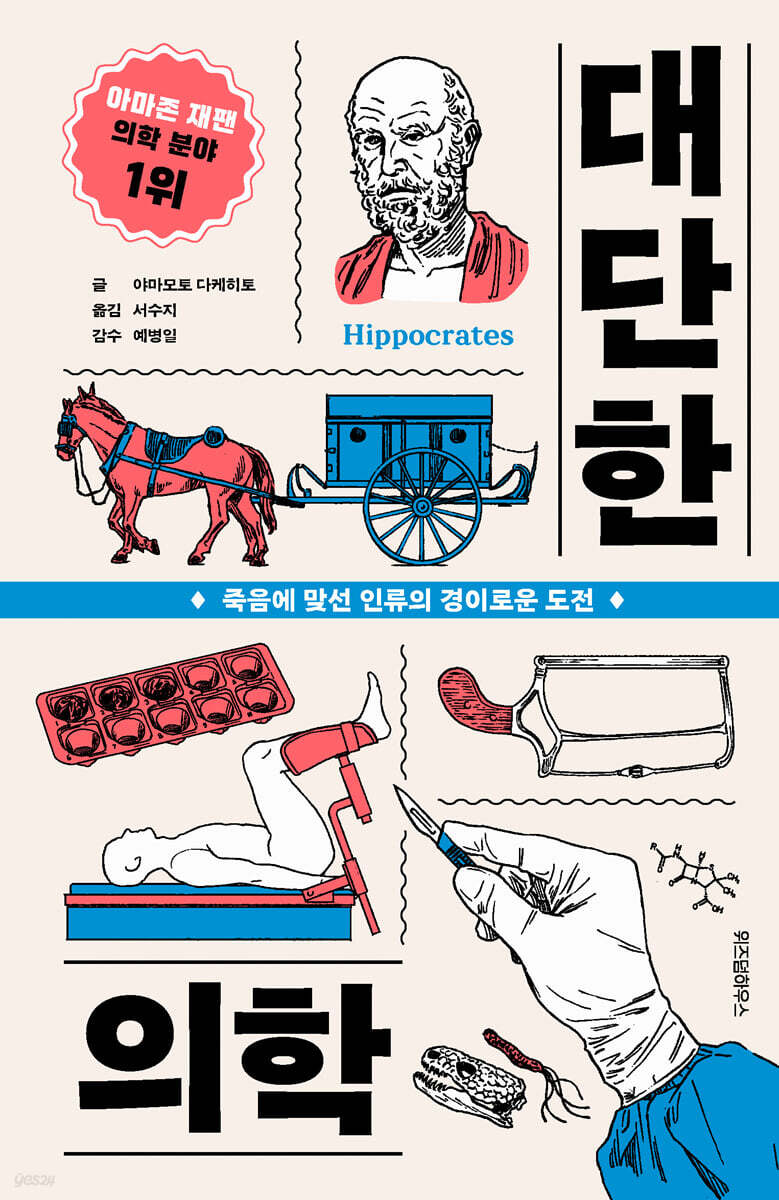
Great medicine
 |
Description
Book Introduction
Ranked #1 in the medical category on Amazon Japan immediately after publication
A book written by doctors and recommended by doctors!
The best guide to understanding the world of medicine
An era where even a stopped heart can be made to beat again and the head can be opened for surgery.
Modern medicine is amazing and wonderful.
But just a hundred years ago, people didn't even know that germs existed, and doctors performed surgeries without washing their hands.
So how did humanity gather wisdom and reach its current achievements?
Written by practicing physicians and recommended by other physicians, "Great Medicine" covers nearly every aspect of medicine, from the relatable questions about the body to the struggles of doctors to save patients, the advancement of medical technology, and the development of various diseases and new drugs.
By blending medical knowledge with experience and insight from the medical field, he leads readers into the vast and fascinating world of medicine.
A book written by doctors and recommended by doctors!
The best guide to understanding the world of medicine
An era where even a stopped heart can be made to beat again and the head can be opened for surgery.
Modern medicine is amazing and wonderful.
But just a hundred years ago, people didn't even know that germs existed, and doctors performed surgeries without washing their hands.
So how did humanity gather wisdom and reach its current achievements?
Written by practicing physicians and recommended by other physicians, "Great Medicine" covers nearly every aspect of medicine, from the relatable questions about the body to the struggles of doctors to save patients, the advancement of medical technology, and the development of various diseases and new drugs.
By blending medical knowledge with experience and insight from the medical field, he leads readers into the vast and fascinating world of medicine.
- You can preview some of the book's contents.
Preview
index
preface
Chapter 1: The Secrets of Our Body
Why do I feel dizzy when I suddenly stand up?
The left and right eyes see different worlds
A disturbance of consciousness called 'delirium'
The inside of the nose looks different than expected
Where is the hardest part of the body?
There are no detours on the food path.
The difference between inhalation and exhalation
The wonderful and complex structure of the neck
Being weak to alcohol is genetic
What does it mean when your heart stops?
Aortic aneurysm
A dreaded disease in which fat accumulates in the liver
If you know it, it's a great digestive juice
How is it determined how hard a change is?
Organs you can live without, organs you can't live without
The important role of the kidneys in sustaining life
Difference between veins and arteries
A new 'trauma' that has emerged in modern times
Chapter 2: Groundbreaking Drugs, Sophisticated Human Body
A new medicine born from poison
The antibiotic that changed history
The emergence of a groundbreaking new drug
The world's first hormone extraction
The new medicine that worked miracles
The History of Morphine, Opium, and Painkillers
A drug born from bomb development
Make a medicine to treat gastric ulcers
Histamine and 'pseudoallergies'
A time when people lost their lives to gastroenteritis
A medicine born from cow's disease
Chapter 3: Amazing Surgeons
Beginning of surgical treatment
Infectious diseases and amputations
Quick surgical skills and the world's first ambulance
The real-life model for Doctor Dolittle
The first doctor to be awarded the title of Baron
Cleanliness and the Nightingale
The surgical giant who first successfully performed stomach cancer surgery
The most popular tool in the medical field
Drugs that were popular recreational items
Chapter 4: The Great Surgery
The transformation and development of the scalpel
A device for cutting and sewing intestines
The Importance of Gauze: An Operating Room Essential
Move the field using gravity
A new type of surgery driven by robots
Chapter 5 Threats to the Human Body
Tragic virus outbreak
invisible threat
People who have identified risk factors for lung cancer
Life-destroying rays
A disease that is sure to kill you if you get it
Neurotoxic terrorist attack
Conclusion
Work Recommendation
A Brief History of Medicine
Chapter 1: The Secrets of Our Body
Why do I feel dizzy when I suddenly stand up?
The left and right eyes see different worlds
A disturbance of consciousness called 'delirium'
The inside of the nose looks different than expected
Where is the hardest part of the body?
There are no detours on the food path.
The difference between inhalation and exhalation
The wonderful and complex structure of the neck
Being weak to alcohol is genetic
What does it mean when your heart stops?
Aortic aneurysm
A dreaded disease in which fat accumulates in the liver
If you know it, it's a great digestive juice
How is it determined how hard a change is?
Organs you can live without, organs you can't live without
The important role of the kidneys in sustaining life
Difference between veins and arteries
A new 'trauma' that has emerged in modern times
Chapter 2: Groundbreaking Drugs, Sophisticated Human Body
A new medicine born from poison
The antibiotic that changed history
The emergence of a groundbreaking new drug
The world's first hormone extraction
The new medicine that worked miracles
The History of Morphine, Opium, and Painkillers
A drug born from bomb development
Make a medicine to treat gastric ulcers
Histamine and 'pseudoallergies'
A time when people lost their lives to gastroenteritis
A medicine born from cow's disease
Chapter 3: Amazing Surgeons
Beginning of surgical treatment
Infectious diseases and amputations
Quick surgical skills and the world's first ambulance
The real-life model for Doctor Dolittle
The first doctor to be awarded the title of Baron
Cleanliness and the Nightingale
The surgical giant who first successfully performed stomach cancer surgery
The most popular tool in the medical field
Drugs that were popular recreational items
Chapter 4: The Great Surgery
The transformation and development of the scalpel
A device for cutting and sewing intestines
The Importance of Gauze: An Operating Room Essential
Move the field using gravity
A new type of surgery driven by robots
Chapter 5 Threats to the Human Body
Tragic virus outbreak
invisible threat
People who have identified risk factors for lung cancer
Life-destroying rays
A disease that is sure to kill you if you get it
Neurotoxic terrorist attack
Conclusion
Work Recommendation
A Brief History of Medicine
Detailed image

Into the book
The universal structures necessary for survival are the same, but the Creator's 'play' is exerted to the extent that it does not affect survival.
A physician must deeply understand the universal structure of the human body and adapt to the Creator's playful diversity.
This is the fun and profoundness of medicine.
---p.5
Those close to a patient are often shocked when they witness symptoms of a significant change in consciousness, such as delirium.
It's natural to feel anxious when someone you care about says something out of the blue or becomes aggressive.
In times like these, knowledge can be a strength.
Because sufficient knowledge reduces anxiety.
---p.37
We drink water every day and gulp down salty ramen broth.
Even this seemingly everyday occurrence is thanks to our body's amazing ability to regulate itself.
The salt concentration in our blood is about 0.9 percent, which is similar to that of regular soybean paste soup.
If you add more water to the soybean paste soup, it will become bland, and if you add more soybean paste, it will become salty.
The concentration changes easily.
But our bodies are different.
---p.123
It was the first time in human history that home game consoles were becoming popular.
Of course, this type of trauma had never been recorded in the history of medicine before.
The American doctor who wrote the paper suggested naming this new injury 'Nintendinitis'.
'-tis' is a suffix meaning '-salt', and it is preceded by the name of the game console Nintendo.
In short, it is 'Nintendo-itis'.
---p.134
What's most interesting is that this valuable substance was already present in our bodies long before humans began using steroids.
The process by which humans, the lords of all creation, use their wisdom to invent all kinds of medicines may seem like creating something out of nothing.
However, if you look closely, most of them are nothing more than rediscoveries of substances that already existed in nature, including the human body.
---p.180
Humanity has been waging war against each other for a long time, constantly inflicting wounds on each other.
In the days before antibiotics, serious wounds in war often resulted in immediate infection and death.
So, on the battlefield, amputation of limbs was often performed to prevent the spread of infection.
It was a time when, terribly, there was no anesthesia technology.
---p.241
What image comes to mind when people hear the word "surgery" these days? Probably a single, clean, dust-free operation in a clean operating room.
I can't help but think of medical staff wearing gowns, masks, hats, and gloves.
It is also natural to use sterilized surgical instruments.
Joe.
You would imagine it looking clean in some way.
But this concept of 'cleanliness' is very modern.
Because until at least the 18th century, doctors operated with their bare hands, without masks or hats, using the same instruments they used on one patient and the same instruments on the next.
At that time, European surgeons performed operations wearing black suit coats that reached just above the knees, and because they were not washed, blood would constantly stain their clothes and harden as if coated.
---p.264
Today we take for granted the existence of local anesthesia.
By injecting only a small amount of medication, a person can undergo surgery without feeling any pain for a certain period of time.
Treatments such as tooth extraction and surgery to remove tumors by cutting the skin with a scalpel are all performed painlessly.
Behind the scenes of cocaine, which can be called a miracle drug, there was a surgeon's life-threatening struggle.
---p.285
Today's surgeons are realizing just how technology-friendly surgery is.
Not only giants like Koher and Halstead, who pioneered surgical horizons, but even Jem, who laid the foundation for laparoscopic surgery, could not have imagined a future like today.
We have the privilege of having a front-row seat to a moment when surgery is experiencing its fastest growth in history.
---p.335
The discipline that has developed greatly over the past half century or so is ‘dynamics.’
It is an academic discipline that analyzes various health-related situations for adults, identifies the factors that influence them, and helps establish social countermeasures.
---p.356
Medicine is a discipline that was originally designed to enrich life.
We cannot assume that 'abundance' is the same as 'extension of life'.
If medicine is about entering a fight where defeat is certain, called death, then isn't "a wonderful defeat" also part of medicine's role?
---p.393
The advancement of learning is like a tower built by the accumulation of small steps.
All the people listed here have made achievements worthy of their names.
However, their achievements were never achieved solely through their own efforts.
With the support of many others and the evaluation of later generations, it has made its mark in history.
It left a mark.
Even if a genius emerges once every 100 years, he or she can only demonstrate genius based on the knowledge available in the era in which he or she was born.
A physician must deeply understand the universal structure of the human body and adapt to the Creator's playful diversity.
This is the fun and profoundness of medicine.
---p.5
Those close to a patient are often shocked when they witness symptoms of a significant change in consciousness, such as delirium.
It's natural to feel anxious when someone you care about says something out of the blue or becomes aggressive.
In times like these, knowledge can be a strength.
Because sufficient knowledge reduces anxiety.
---p.37
We drink water every day and gulp down salty ramen broth.
Even this seemingly everyday occurrence is thanks to our body's amazing ability to regulate itself.
The salt concentration in our blood is about 0.9 percent, which is similar to that of regular soybean paste soup.
If you add more water to the soybean paste soup, it will become bland, and if you add more soybean paste, it will become salty.
The concentration changes easily.
But our bodies are different.
---p.123
It was the first time in human history that home game consoles were becoming popular.
Of course, this type of trauma had never been recorded in the history of medicine before.
The American doctor who wrote the paper suggested naming this new injury 'Nintendinitis'.
'-tis' is a suffix meaning '-salt', and it is preceded by the name of the game console Nintendo.
In short, it is 'Nintendo-itis'.
---p.134
What's most interesting is that this valuable substance was already present in our bodies long before humans began using steroids.
The process by which humans, the lords of all creation, use their wisdom to invent all kinds of medicines may seem like creating something out of nothing.
However, if you look closely, most of them are nothing more than rediscoveries of substances that already existed in nature, including the human body.
---p.180
Humanity has been waging war against each other for a long time, constantly inflicting wounds on each other.
In the days before antibiotics, serious wounds in war often resulted in immediate infection and death.
So, on the battlefield, amputation of limbs was often performed to prevent the spread of infection.
It was a time when, terribly, there was no anesthesia technology.
---p.241
What image comes to mind when people hear the word "surgery" these days? Probably a single, clean, dust-free operation in a clean operating room.
I can't help but think of medical staff wearing gowns, masks, hats, and gloves.
It is also natural to use sterilized surgical instruments.
Joe.
You would imagine it looking clean in some way.
But this concept of 'cleanliness' is very modern.
Because until at least the 18th century, doctors operated with their bare hands, without masks or hats, using the same instruments they used on one patient and the same instruments on the next.
At that time, European surgeons performed operations wearing black suit coats that reached just above the knees, and because they were not washed, blood would constantly stain their clothes and harden as if coated.
---p.264
Today we take for granted the existence of local anesthesia.
By injecting only a small amount of medication, a person can undergo surgery without feeling any pain for a certain period of time.
Treatments such as tooth extraction and surgery to remove tumors by cutting the skin with a scalpel are all performed painlessly.
Behind the scenes of cocaine, which can be called a miracle drug, there was a surgeon's life-threatening struggle.
---p.285
Today's surgeons are realizing just how technology-friendly surgery is.
Not only giants like Koher and Halstead, who pioneered surgical horizons, but even Jem, who laid the foundation for laparoscopic surgery, could not have imagined a future like today.
We have the privilege of having a front-row seat to a moment when surgery is experiencing its fastest growth in history.
---p.335
The discipline that has developed greatly over the past half century or so is ‘dynamics.’
It is an academic discipline that analyzes various health-related situations for adults, identifies the factors that influence them, and helps establish social countermeasures.
---p.356
Medicine is a discipline that was originally designed to enrich life.
We cannot assume that 'abundance' is the same as 'extension of life'.
If medicine is about entering a fight where defeat is certain, called death, then isn't "a wonderful defeat" also part of medicine's role?
---p.393
The advancement of learning is like a tower built by the accumulation of small steps.
All the people listed here have made achievements worthy of their names.
However, their achievements were never achieved solely through their own efforts.
With the support of many others and the evaluation of later generations, it has made its mark in history.
It left a mark.
Even if a genius emerges once every 100 years, he or she can only demonstrate genius based on the knowledge available in the era in which he or she was born.
---p.417
Publisher's Review
“Even I, a liberal arts major, was completely absorbed in reading it!”
“A medical book that reads like an essay”
An Amazon Medical Bestseller for a reason!
A full-fledged introduction to medicine that doctors will admire and liberal arts students will enjoy reading!
"Great Medicine" is a medical textbook that became a bestseller immediately after its publication.
The book, which is a general knowledge book that expands from everyday questions like “Why do I feel dizzy when I suddenly stand up after sitting down?” and “Does the more I drink, the more I get dizzy?”, to medical knowledge, attracted readers.
This is thanks to the fact that it was written in a way that anyone can understand, while containing the perspective of a doctor who sees patients every day and experiences the changes in the medical field.
It also stands out for its friendly approach, using everyday moments and surprising anecdotes from history rather than difficult medical terms.
Thanks to this, Amazon reader reviews are full of comments like, “I read it in one sitting,” and “The material is interesting and sticks in my head.”
However, the content is not light.
This book awakens new ideas about my body and the medical technology I have enjoyed, to the point that Yuji Ikegaya, a professor of pharmacy and brain researcher at the University of Tokyo, said, “The embarrassment of realizing that I actually knew nothing about my own body, which I thought I knew so well, stimulates my intellectual pleasure nerves.”
This book clearly demonstrates that, as Professor Ye Byeong-il of Yonsei University Wonju College of Medicine said, “medicine is both a cutting-edge discipline and an interesting story in itself.”
Amputating limbs without anesthesia was the treatment?
If you look closely, medicine has become so great that it hasn't been that long!
Until the medical technology we take for granted arrived to us
Diagnosis and treatment are so commonplace to us today.
But until just a century ago, doctors operated without washing their hands, and they didn't even know that bacteria existed, let alone that they could cause disease.
There was a time when cutting off a patient's limbs and burning them with fire without anesthesia was considered 'treatment'.
What kind of mistakes, sacrifices, challenges, and discoveries did humanity have to endure before common sense was overturned and life-saving technologies became a reality?
Robert Koch, who first discovered that the cause of infectious diseases was invisible bacteria.
Edward Jenner, the first person in history to invent vaccination.
Georg Kelling, who drilled a small hole in the ship and looked inside the body… .
Their ideas and adventures were all against the common sense of the time.
But their seemingly strange challenge soon became a technique that saved countless lives.
Thanks to Koch's discoveries, humanity finally knew who its enemy was, Jenner saved humanity from smallpox, and laparoscopic surgery, as Kelling predicted, replaced open surgery.
《Great Medicine》 contains the struggles of countless people who took medicine to the next level.
The author's wish to convey "the 'spirit' of medicine, which does not give up on the human body that is collapsing in vain, but strives to protect it to the end" is indeed evident throughout the book.
The mystery of the human body, advancements in medical technology and development of new drugs,
Even the giants of the medical world who brought about a paradigm shift…
An intellectual journey exploring the vast world of medicine
Moreover, this book covers almost every topic that constitutes medicine, from the structure and function of the human body to critical moments in the history of medicine, the creation of new drugs, the evolution of medical technology, and various factors that threaten us.
It is a map that guides you through the entire world of medicine, not just partial knowledge.
Because it covers a wide range of topics, it's a friendly introductory book for everyone, from teenagers who are interested in medicine and the work of doctors to adults who want to learn more about their bodies.
Medicine is both a cutting-edge technology and a record of those who struggle, fail, and try again to save a life.
Above all, it is a story that touches our reality.
As you explore the vast world of medicine, you will be filled with intellectual curiosity and a deep sense of emotion.
And by the time you close the book, you'll have chewed over the 'real reason' why medicine is so great.
“A medical book that reads like an essay”
An Amazon Medical Bestseller for a reason!
A full-fledged introduction to medicine that doctors will admire and liberal arts students will enjoy reading!
"Great Medicine" is a medical textbook that became a bestseller immediately after its publication.
The book, which is a general knowledge book that expands from everyday questions like “Why do I feel dizzy when I suddenly stand up after sitting down?” and “Does the more I drink, the more I get dizzy?”, to medical knowledge, attracted readers.
This is thanks to the fact that it was written in a way that anyone can understand, while containing the perspective of a doctor who sees patients every day and experiences the changes in the medical field.
It also stands out for its friendly approach, using everyday moments and surprising anecdotes from history rather than difficult medical terms.
Thanks to this, Amazon reader reviews are full of comments like, “I read it in one sitting,” and “The material is interesting and sticks in my head.”
However, the content is not light.
This book awakens new ideas about my body and the medical technology I have enjoyed, to the point that Yuji Ikegaya, a professor of pharmacy and brain researcher at the University of Tokyo, said, “The embarrassment of realizing that I actually knew nothing about my own body, which I thought I knew so well, stimulates my intellectual pleasure nerves.”
This book clearly demonstrates that, as Professor Ye Byeong-il of Yonsei University Wonju College of Medicine said, “medicine is both a cutting-edge discipline and an interesting story in itself.”
Amputating limbs without anesthesia was the treatment?
If you look closely, medicine has become so great that it hasn't been that long!
Until the medical technology we take for granted arrived to us
Diagnosis and treatment are so commonplace to us today.
But until just a century ago, doctors operated without washing their hands, and they didn't even know that bacteria existed, let alone that they could cause disease.
There was a time when cutting off a patient's limbs and burning them with fire without anesthesia was considered 'treatment'.
What kind of mistakes, sacrifices, challenges, and discoveries did humanity have to endure before common sense was overturned and life-saving technologies became a reality?
Robert Koch, who first discovered that the cause of infectious diseases was invisible bacteria.
Edward Jenner, the first person in history to invent vaccination.
Georg Kelling, who drilled a small hole in the ship and looked inside the body… .
Their ideas and adventures were all against the common sense of the time.
But their seemingly strange challenge soon became a technique that saved countless lives.
Thanks to Koch's discoveries, humanity finally knew who its enemy was, Jenner saved humanity from smallpox, and laparoscopic surgery, as Kelling predicted, replaced open surgery.
《Great Medicine》 contains the struggles of countless people who took medicine to the next level.
The author's wish to convey "the 'spirit' of medicine, which does not give up on the human body that is collapsing in vain, but strives to protect it to the end" is indeed evident throughout the book.
The mystery of the human body, advancements in medical technology and development of new drugs,
Even the giants of the medical world who brought about a paradigm shift…
An intellectual journey exploring the vast world of medicine
Moreover, this book covers almost every topic that constitutes medicine, from the structure and function of the human body to critical moments in the history of medicine, the creation of new drugs, the evolution of medical technology, and various factors that threaten us.
It is a map that guides you through the entire world of medicine, not just partial knowledge.
Because it covers a wide range of topics, it's a friendly introductory book for everyone, from teenagers who are interested in medicine and the work of doctors to adults who want to learn more about their bodies.
Medicine is both a cutting-edge technology and a record of those who struggle, fail, and try again to save a life.
Above all, it is a story that touches our reality.
As you explore the vast world of medicine, you will be filled with intellectual curiosity and a deep sense of emotion.
And by the time you close the book, you'll have chewed over the 'real reason' why medicine is so great.
GOODS SPECIFICS
- Date of issue: July 30, 2025
- Page count, weight, size: 424 pages | 584g | 130*200*25mm
- ISBN13: 9791171714445
- ISBN10: 1171714440
You may also like
카테고리
korean


korean

![GQ KOREA Mark (Monthly): December [2025]](http://librairie.coreenne.fr/cdn/shop/files/8ef265dbbfbf186523ed75ba7319009d.jpg?v=1765340328&width=3840)


