

The basics of intervals
 |
Description
Book Introduction
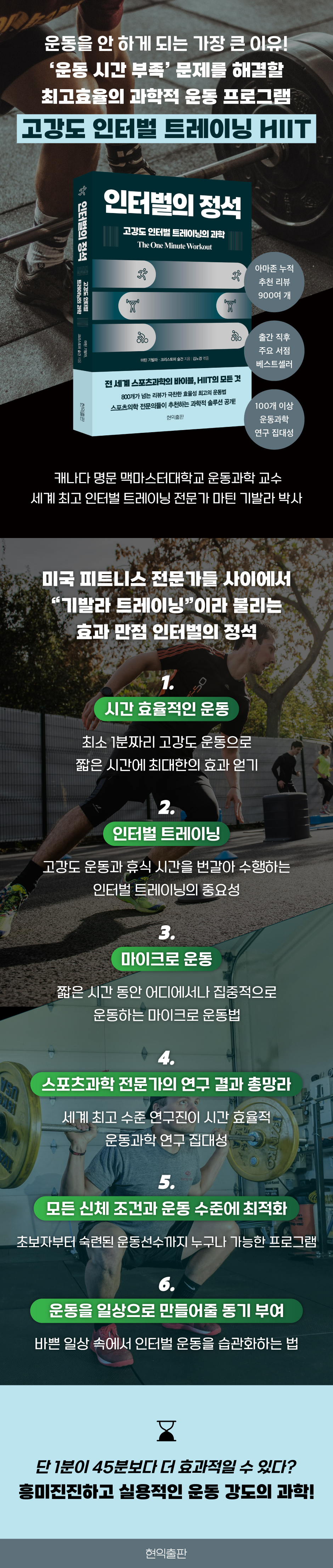
The solution to the biggest reason for not getting enough exercise: 'time'!
The most effective interval training method, referenced by thousands of exercise scientists worldwide.
A compilation of interval research from the world's most authoritative exercise scientists.
The author, Dr. Martin Gibala, was a young researcher in the field of exercise physiology who was so active that he had little time for exercise.
The experience sparked a passion for high-intensity interval training (HIIT), which allows people to maintain fitness with just a few minutes of intense exercise.
Since then, he has conducted experiments that have led to an explosive growth in research on 'ultra-low-weight exercise', establishing himself as a world authority on exercise science that produces maximum results in the shortest amount of time.
This book answers this question by covering the world's first ideal interval training method.
“How short and efficient can we exercise?” And the journey to find that answer is what makes us true exercise experts.
The author's numerous case studies demonstrate that very short, high-intensity workouts are the most effective form of exercise.
It also shatters the common belief that high-intensity exercise is only for those who are good at it, and reveals that intensity is more important than time.
Readers will understand how incredibly effective high-intensity interval training is in preventing various diseases and improving physical fitness.
In particular, the majority of people who lead a sedentary lifestyle can achieve the same benefits as 150 minutes of endurance exercise with just 3 minutes of high-intensity exercise.
Furthermore, this book provides eight different interval training programs and four workouts tailored to your individual needs and preferences, allowing you to exercise effectively without having to go all out every time.
A must-read for exercise science research, first read and strongly recommended by exercise experts and sports medicine doctors around the world!
The most effective interval training method, referenced by thousands of exercise scientists worldwide.
A compilation of interval research from the world's most authoritative exercise scientists.
The author, Dr. Martin Gibala, was a young researcher in the field of exercise physiology who was so active that he had little time for exercise.
The experience sparked a passion for high-intensity interval training (HIIT), which allows people to maintain fitness with just a few minutes of intense exercise.
Since then, he has conducted experiments that have led to an explosive growth in research on 'ultra-low-weight exercise', establishing himself as a world authority on exercise science that produces maximum results in the shortest amount of time.
This book answers this question by covering the world's first ideal interval training method.
“How short and efficient can we exercise?” And the journey to find that answer is what makes us true exercise experts.
The author's numerous case studies demonstrate that very short, high-intensity workouts are the most effective form of exercise.
It also shatters the common belief that high-intensity exercise is only for those who are good at it, and reveals that intensity is more important than time.
Readers will understand how incredibly effective high-intensity interval training is in preventing various diseases and improving physical fitness.
In particular, the majority of people who lead a sedentary lifestyle can achieve the same benefits as 150 minutes of endurance exercise with just 3 minutes of high-intensity exercise.
Furthermore, this book provides eight different interval training programs and four workouts tailored to your individual needs and preferences, allowing you to exercise effectively without having to go all out every time.
A must-read for exercise science research, first read and strongly recommended by exercise experts and sports medicine doctors around the world!
index
CHAPTER 1 Is just a few minutes of exercise a week enough?
CHAPTER 2: PRINCIPLES OF EXERCISE INTENSITY
CHAPTER 3 Where It All Started
CHAPTER 4 Beyond Simple Fitness
CHAPTER 5 HIGH-INTENSITY ACTIVITIES
CHAPTER 6: Fun and Fast Workouts: 8 Simple yet Effective Exercises
CHAPTER 7: How Little Can You Exercise? 4 Powerful Micro-Exercises
CHAPTER 8 HIGH-INTENSITY NUTRITION
CHAPTER 9: THE FUTURE OF INTERVAL TRAINING
Acknowledgements
CHAPTER 2: PRINCIPLES OF EXERCISE INTENSITY
CHAPTER 3 Where It All Started
CHAPTER 4 Beyond Simple Fitness
CHAPTER 5 HIGH-INTENSITY ACTIVITIES
CHAPTER 6: Fun and Fast Workouts: 8 Simple yet Effective Exercises
CHAPTER 7: How Little Can You Exercise? 4 Powerful Micro-Exercises
CHAPTER 8 HIGH-INTENSITY NUTRITION
CHAPTER 9: THE FUTURE OF INTERVAL TRAINING
Acknowledgements
Detailed image
Publisher's Review
No matter how busy you are, you can still find a few minutes to exercise!
A scientific solution to achieve explosive results with short workouts!
A must-read for exercise science, a book enthusiastically read by countless sports medicine experts worldwide.
There is a trade-off between the intensity and duration of exercise.
While sprinting isn't for everyone, if you can squeeze in some intense exercise in a short amount of time, you can achieve some highly effective results.
One study he conducted had people exercise very hard for one minute, which included three 20-second bursts of activity with short recovery periods.
Even including warm-up and cool-down, the total exercise time is only 10 minutes, 3 times a week.
Compared to general recommended exercise amounts, this represents a very small investment of exercise and time, yet it has been shown to yield significant health benefits.
When asked why he emphasizes the value of short exercise sessions, Professor Gibala points to the lack of time as the biggest barrier to exercise participation.
While this may be a simple excuse for some, many people are actually busy and short on time, making it difficult to find enough time to exercise.
So, the author explains various research results that support the fact that even just 10 minutes of brisk exercise during lunch, such as climbing stairs, can have various health benefits, even though many people give up exercising because they cannot find time to exercise for about an hour every day.
It doesn't really matter what type of exercise you do.
His lab has also experimented with stair climbing, showing that briskly climbing stairs or simply walking up them can provide intermittent exercise benefits.
Of course, running and swimming are also good.
This book emphasizes that it is better to fit exercise into your life, that is, to naturally incorporate exercise into your life rather than trying to fit your life into exercise.
There is no such thing as a free lunch.
If you want to achieve short-term explosive exercise effects, you need to exercise frequently, for a long time, and intensely.
This book doesn't claim that interval training is the answer to all types of exercise.
Exercise methods vary from person to person, and intermittent high-intensity exercise is just one exercise option.
However, if you're pressed for time and only have 10 minutes, intermittent exercise can be a great option for maintaining and ideally improving your fitness.
The author, a world-renowned exercise scientist, also practices interval training himself, usually not exercising for more than 30 minutes.
This book focuses on the principles of intervals.
Interval training isn't limited to a specific exercise; it encompasses a variety of cardio-focused and weight-bearing exercises, so it can even be applied to flexibility exercises like Pilates and yoga.
Simply apply the science of interval training to your favorite workouts.
Is just one minute of high-intensity exercise really enough?
A compilation of various research results proving the effectiveness of exercise over time!
Interval programs that can be adapted to each individual's needs and physical condition!
Professor Martin Gibala, head of the Department of Kinesiology at McMaster University, a prestigious university in Canada, has been conducting research for many years to determine whether short, high-intensity interval training has the same effect as long-term, moderate-intensity exercise.
I've been advocating the benefits of interval training since before it became as popular as it is now.
The problem with high-intensity intervals is that, frankly, they're incredibly difficult.
It's really hard to get your body up to that level of intensity, especially if you're not in peak condition.
Critics of interval training argue that while a little exercise is better than no exercise at all, longer workouts are generally better, and that these high-intensity workouts can be too difficult or dangerous, especially for people who need more exercise, such as the elderly or overweight.
That's why the authors and their team undertook a multi-faceted study to determine how much shorter exercise sessions could be, and whether the same health benefits could still be achieved in such a short period of time.
Ultimately, it has been proven that short-term high-intensity interval training can produce fitness gains that go beyond the effects of continuous exercise.
One piece of evidence is a sports medicine paper that showed that when overweight men and women who usually lead a sedentary lifestyle exercised for 10 minutes three times a week for 6 weeks, including just 1 minute of high-intensity sprinting, their endurance improved by more than 10%, their blood pressure decreased, their muscle activity improved, and in the case of men, their blood sugar levels also improved.
In a study designed to achieve rapid weight loss and muscle gain, both groups that did three 20-second bursts of high-intensity exercise three times a week for 12 weeks and those that did 150 minutes of continuous exercise per week improved objectively measured cardiovascular endurance in the laboratory by nearly 20%, with no difference between the two groups.
The two groups showed similar improvements in blood sugar control and insulin sensitivity, while the control group, which did not exercise, showed no changes.
The results of this study suggest that both groups achieved the same level of health improvement, even though the total exercise time was significantly different.
Professor Gibala's goal is to make exercise time-efficient so that anyone can incorporate it into their daily lives.
He experiments with a wide range of populations, from professional athletes to middle-aged sedentary people, and presents practical explanations of the scientific principles behind his results, along with new strategies for improving fitness in surprisingly short periods of time, including 12 interval workouts and 4 micro-workouts tailored to your individual needs, fitness level, and preferences.
A scientific solution to achieve explosive results with short workouts!
A must-read for exercise science, a book enthusiastically read by countless sports medicine experts worldwide.
There is a trade-off between the intensity and duration of exercise.
While sprinting isn't for everyone, if you can squeeze in some intense exercise in a short amount of time, you can achieve some highly effective results.
One study he conducted had people exercise very hard for one minute, which included three 20-second bursts of activity with short recovery periods.
Even including warm-up and cool-down, the total exercise time is only 10 minutes, 3 times a week.
Compared to general recommended exercise amounts, this represents a very small investment of exercise and time, yet it has been shown to yield significant health benefits.
When asked why he emphasizes the value of short exercise sessions, Professor Gibala points to the lack of time as the biggest barrier to exercise participation.
While this may be a simple excuse for some, many people are actually busy and short on time, making it difficult to find enough time to exercise.
So, the author explains various research results that support the fact that even just 10 minutes of brisk exercise during lunch, such as climbing stairs, can have various health benefits, even though many people give up exercising because they cannot find time to exercise for about an hour every day.
It doesn't really matter what type of exercise you do.
His lab has also experimented with stair climbing, showing that briskly climbing stairs or simply walking up them can provide intermittent exercise benefits.
Of course, running and swimming are also good.
This book emphasizes that it is better to fit exercise into your life, that is, to naturally incorporate exercise into your life rather than trying to fit your life into exercise.
There is no such thing as a free lunch.
If you want to achieve short-term explosive exercise effects, you need to exercise frequently, for a long time, and intensely.
This book doesn't claim that interval training is the answer to all types of exercise.
Exercise methods vary from person to person, and intermittent high-intensity exercise is just one exercise option.
However, if you're pressed for time and only have 10 minutes, intermittent exercise can be a great option for maintaining and ideally improving your fitness.
The author, a world-renowned exercise scientist, also practices interval training himself, usually not exercising for more than 30 minutes.
This book focuses on the principles of intervals.
Interval training isn't limited to a specific exercise; it encompasses a variety of cardio-focused and weight-bearing exercises, so it can even be applied to flexibility exercises like Pilates and yoga.
Simply apply the science of interval training to your favorite workouts.
Is just one minute of high-intensity exercise really enough?
A compilation of various research results proving the effectiveness of exercise over time!
Interval programs that can be adapted to each individual's needs and physical condition!
Professor Martin Gibala, head of the Department of Kinesiology at McMaster University, a prestigious university in Canada, has been conducting research for many years to determine whether short, high-intensity interval training has the same effect as long-term, moderate-intensity exercise.
I've been advocating the benefits of interval training since before it became as popular as it is now.
The problem with high-intensity intervals is that, frankly, they're incredibly difficult.
It's really hard to get your body up to that level of intensity, especially if you're not in peak condition.
Critics of interval training argue that while a little exercise is better than no exercise at all, longer workouts are generally better, and that these high-intensity workouts can be too difficult or dangerous, especially for people who need more exercise, such as the elderly or overweight.
That's why the authors and their team undertook a multi-faceted study to determine how much shorter exercise sessions could be, and whether the same health benefits could still be achieved in such a short period of time.
Ultimately, it has been proven that short-term high-intensity interval training can produce fitness gains that go beyond the effects of continuous exercise.
One piece of evidence is a sports medicine paper that showed that when overweight men and women who usually lead a sedentary lifestyle exercised for 10 minutes three times a week for 6 weeks, including just 1 minute of high-intensity sprinting, their endurance improved by more than 10%, their blood pressure decreased, their muscle activity improved, and in the case of men, their blood sugar levels also improved.
In a study designed to achieve rapid weight loss and muscle gain, both groups that did three 20-second bursts of high-intensity exercise three times a week for 12 weeks and those that did 150 minutes of continuous exercise per week improved objectively measured cardiovascular endurance in the laboratory by nearly 20%, with no difference between the two groups.
The two groups showed similar improvements in blood sugar control and insulin sensitivity, while the control group, which did not exercise, showed no changes.
The results of this study suggest that both groups achieved the same level of health improvement, even though the total exercise time was significantly different.
Professor Gibala's goal is to make exercise time-efficient so that anyone can incorporate it into their daily lives.
He experiments with a wide range of populations, from professional athletes to middle-aged sedentary people, and presents practical explanations of the scientific principles behind his results, along with new strategies for improving fitness in surprisingly short periods of time, including 12 interval workouts and 4 micro-workouts tailored to your individual needs, fitness level, and preferences.
GOODS SPECIFICS
- Date of issue: February 28, 2025
- Page count, weight, size: 272 pages | 152*225*20mm
- ISBN13: 9791193217917
- ISBN10: 1193217911
You may also like
카테고리
korean


korean

![GQ KOREA Mark (Monthly): December [2025]](http://librairie.coreenne.fr/cdn/shop/files/8ef265dbbfbf186523ed75ba7319009d.jpg?v=1765340328&width=3840)


