

Tennis Inner Game
 |
Description
Book Introduction
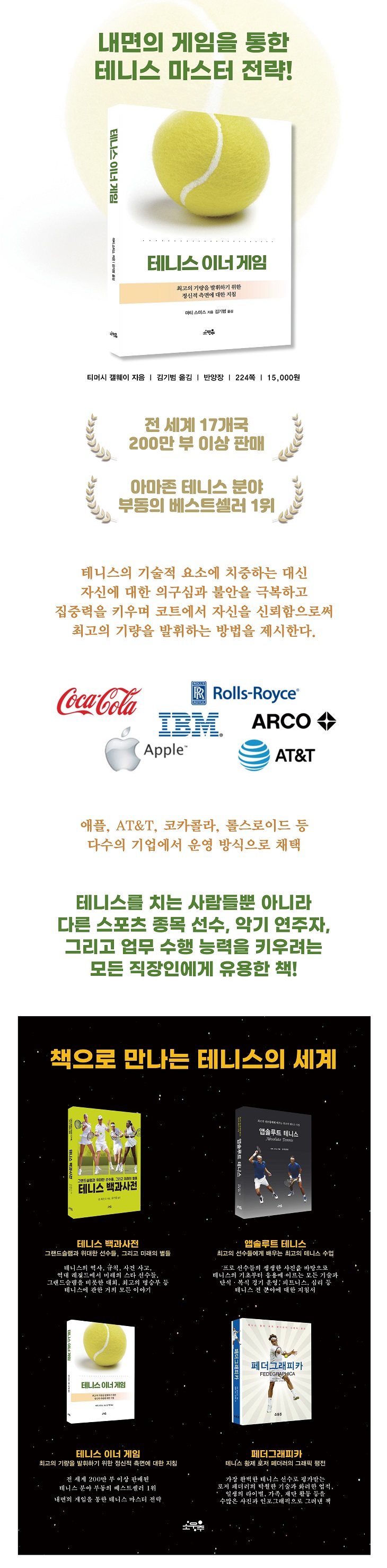
First published in 1974, this best-selling tennis book has remained for over 50 years. Instead of focusing on the technical aspects of tennis, author Timothy Galway shows how to overcome self-doubt and anxiety, develop focus, and trust yourself on the court to achieve your best performance. The most natural and effective way to learn and do something is to use our intuitive abilities, just like a baby learning to walk. All you have to do is let go of the habits that get in the way and let your body do its thing. In other words, the pursuit of Inner Game is to discover and develop the potential inherent in humans. Now let's explore that path using tennis as a tool. |
- You can preview some of the book's contents.
Preview
index
introduction
Entering
Chapter 1: On the Mental Aspects of Tennis
Chapter 2: The Discovery of Two Selves
Chapter 3: Silencing Self 1
Chapter 4: Trusting Your Self 2
Chapter 5: Discovery of Technology
Chapter 6: Changing Habits
Chapter 7: Immersion: Learning to Focus
Chapter 8: Games on the Court
Chapter 9 The Meaning of Competition
Chapter 10: The Inner Game Outside the Court
Entering
Chapter 1: On the Mental Aspects of Tennis
Chapter 2: The Discovery of Two Selves
Chapter 3: Silencing Self 1
Chapter 4: Trusting Your Self 2
Chapter 5: Discovery of Technology
Chapter 6: Changing Habits
Chapter 7: Immersion: Learning to Focus
Chapter 8: Games on the Court
Chapter 9 The Meaning of Competition
Chapter 10: The Inner Game Outside the Court
Detailed image
Into the book
The inner game is the mental game that a player plays against obstacles such as loss of concentration, tension, low self-confidence, and self-blame.
Simply put, it's about overcoming all the mental habits that keep you from performing at your best.
--- p.15
"Tennis is a sport where the psychological element is important, so you need to develop mental strength" or "If you don't have confidence and a competitive spirit, you'll lose" are common, tired pieces of advice, but they don't really help solve the problem.
How on earth can one develop 'confidence' and 'mental strength'?
--- p.19
Why do movements that aren't particularly difficult require unnecessary effort? This isn't just Dorothy's problem; it's something we all experience.
What goes through her mind from the moment she hears the coach's instructions until the swing ends? After the lesson, I was able to find a clue to the answer to this question.
She had so much on her mind! She was so focused on swinging as I instructed her that she couldn't focus on the ball.
At that moment, I decided.
I won't be talking much when I teach tennis anymore.
--- p.22
We can assume that every player has two 'selves' in his head.
The first self, 'I', seems to be the one who gives orders, and the second self, 'I', seems to be the one who carries out actions.
And again, 'I' evaluate that action.
To make the distinction more clear, let's call the 'command-giver' 'Self 1' and the 'actor' 'Self 2'.
--- p.30
Before we conclude our discussion of the judgment, there is something to be said about "positive thinking."
The “bad” side of negative thinking is often discussed today.
There are countless books and articles out there advising us to transform negative thinking into positive thinking.
Instead of thinking of yourself as ugly and unhappy, tell yourself that you are attractive and happy.
However, replacing "negative hypnosis" with "positive hypnosis" only helps a little in the short term and the effects do not last long.
--- p.56
To see the strokes as they are, there is no need to assign meaning to them as “good” or “bad.”
The results of the stroke are the same.
Even if the ball goes out, it does not have to be defined as a “bad” event.
You just need to check how far the ball is off the line.
Not making a judgment does not mean that we cannot see the essence of the case.
Excluding judgment means not adding or subtracting anything from the facts before our eyes.
You just need to see it as it is, without any distortion.
This way, your mind can be in a more peaceful state.
--- p.59
We must free ourselves from emotional reactions to success and failure.
Let's keep in mind what the goal is and be objective about the outcome.
Then put the sub in again.
Don't be surprised if you miss a mark or try to correct your mistake.
This is the most important point.
Let's focus again and empty our minds and serve.
If you trust your body and mind completely without consciously trying to hit the can or correct your mistakes, you will see your serve improve on its own.
You will experience Ego 2 moving and learning on its own without any direction from anyone.
--- p.83
Players who experience what it means to “empty their mind” and give control to Ego 2 will not only hit more accurate and powerful shots, but will also be able to relax and enjoy themselves in fast-moving situations.
But, wanting to recreate this state, I thought, "Now I know the secret of the game.
Sometimes, when you think, "I just need to relax now," Ego 1 is summoned again.
The moment you 'try' to relax, true 'relaxation' disappears and is replaced by a strange phenomenon called 'trying to relax'.
Because ‘relaxation’ is something that can be achieved by leaving it alone, and is never something that can be achieved through “effort” or “intention.”
--- p.140
Concentration isn't something you can achieve by staring intently.
It is not something that can be obtained by forcing or worrying about it.
When you become interested, you naturally become focused.
If that happens, you will inevitably be drawn to the object of your interest.
It doesn't require any special effort, it's a state of mind that's relaxed, and it doesn't require any tension or control.
Let's get into a state of concentration by looking at the tennis ball.
If you put too much force into your eyes, you are trying too hard.
If you find yourself berating yourself for not being able to focus, you may be being overly controlling.
Let the ball catch your eye.
Then, the tension in your body and mind will be released, and you will remain in a comfortable state.
--- p.151
Best effort is different from Ego 1 trying too hard.
This means focus, determination, and trusting your body to "do it."
It means trying your best physically and mentally.
Here too, competition and cooperation become one.
--- p.204
When I'm only interested in winning, I end up worrying about things I can't completely control.
Winning or losing in an external match depends not only on my own skills but also on the opponent's skills and effort.
If you become emotionally attached to outcomes you cannot control, you will become anxious and overly stressed.
But how much effort you are willing to put into winning is entirely up to you.
You can do your best at every moment.
Since we don't feel anxious about things we can control, if we just try to do our best at every point, anxiety will no longer be a problem.
As a result, the energy that was previously spent unnecessarily on anxiety can now be used to earn points.
This will also maximize your chances of winning in external games.
--- p.205
What does it mean to play the inner game? It means emptying your mind at every moment and focusing on the here and now, in this moment, is what truly determines victory or defeat.
Simply put, it's about overcoming all the mental habits that keep you from performing at your best.
--- p.15
"Tennis is a sport where the psychological element is important, so you need to develop mental strength" or "If you don't have confidence and a competitive spirit, you'll lose" are common, tired pieces of advice, but they don't really help solve the problem.
How on earth can one develop 'confidence' and 'mental strength'?
--- p.19
Why do movements that aren't particularly difficult require unnecessary effort? This isn't just Dorothy's problem; it's something we all experience.
What goes through her mind from the moment she hears the coach's instructions until the swing ends? After the lesson, I was able to find a clue to the answer to this question.
She had so much on her mind! She was so focused on swinging as I instructed her that she couldn't focus on the ball.
At that moment, I decided.
I won't be talking much when I teach tennis anymore.
--- p.22
We can assume that every player has two 'selves' in his head.
The first self, 'I', seems to be the one who gives orders, and the second self, 'I', seems to be the one who carries out actions.
And again, 'I' evaluate that action.
To make the distinction more clear, let's call the 'command-giver' 'Self 1' and the 'actor' 'Self 2'.
--- p.30
Before we conclude our discussion of the judgment, there is something to be said about "positive thinking."
The “bad” side of negative thinking is often discussed today.
There are countless books and articles out there advising us to transform negative thinking into positive thinking.
Instead of thinking of yourself as ugly and unhappy, tell yourself that you are attractive and happy.
However, replacing "negative hypnosis" with "positive hypnosis" only helps a little in the short term and the effects do not last long.
--- p.56
To see the strokes as they are, there is no need to assign meaning to them as “good” or “bad.”
The results of the stroke are the same.
Even if the ball goes out, it does not have to be defined as a “bad” event.
You just need to check how far the ball is off the line.
Not making a judgment does not mean that we cannot see the essence of the case.
Excluding judgment means not adding or subtracting anything from the facts before our eyes.
You just need to see it as it is, without any distortion.
This way, your mind can be in a more peaceful state.
--- p.59
We must free ourselves from emotional reactions to success and failure.
Let's keep in mind what the goal is and be objective about the outcome.
Then put the sub in again.
Don't be surprised if you miss a mark or try to correct your mistake.
This is the most important point.
Let's focus again and empty our minds and serve.
If you trust your body and mind completely without consciously trying to hit the can or correct your mistakes, you will see your serve improve on its own.
You will experience Ego 2 moving and learning on its own without any direction from anyone.
--- p.83
Players who experience what it means to “empty their mind” and give control to Ego 2 will not only hit more accurate and powerful shots, but will also be able to relax and enjoy themselves in fast-moving situations.
But, wanting to recreate this state, I thought, "Now I know the secret of the game.
Sometimes, when you think, "I just need to relax now," Ego 1 is summoned again.
The moment you 'try' to relax, true 'relaxation' disappears and is replaced by a strange phenomenon called 'trying to relax'.
Because ‘relaxation’ is something that can be achieved by leaving it alone, and is never something that can be achieved through “effort” or “intention.”
--- p.140
Concentration isn't something you can achieve by staring intently.
It is not something that can be obtained by forcing or worrying about it.
When you become interested, you naturally become focused.
If that happens, you will inevitably be drawn to the object of your interest.
It doesn't require any special effort, it's a state of mind that's relaxed, and it doesn't require any tension or control.
Let's get into a state of concentration by looking at the tennis ball.
If you put too much force into your eyes, you are trying too hard.
If you find yourself berating yourself for not being able to focus, you may be being overly controlling.
Let the ball catch your eye.
Then, the tension in your body and mind will be released, and you will remain in a comfortable state.
--- p.151
Best effort is different from Ego 1 trying too hard.
This means focus, determination, and trusting your body to "do it."
It means trying your best physically and mentally.
Here too, competition and cooperation become one.
--- p.204
When I'm only interested in winning, I end up worrying about things I can't completely control.
Winning or losing in an external match depends not only on my own skills but also on the opponent's skills and effort.
If you become emotionally attached to outcomes you cannot control, you will become anxious and overly stressed.
But how much effort you are willing to put into winning is entirely up to you.
You can do your best at every moment.
Since we don't feel anxious about things we can control, if we just try to do our best at every point, anxiety will no longer be a problem.
As a result, the energy that was previously spent unnecessarily on anxiety can now be used to earn points.
This will also maximize your chances of winning in external games.
--- p.205
What does it mean to play the inner game? It means emptying your mind at every moment and focusing on the here and now, in this moment, is what truly determines victory or defeat.
--- p.205
Publisher's Review
All games are divided into external games and internal games.
The external game is about overcoming difficulties and achieving external achievements by competing against opposing players.
In this regard, you will receive various technical advice such as how to toss when serving, how to swing the racket when making forehand and backhand strokes, and how much backswing is good for a volley.
But even if we learn this in our heads, we cannot easily apply it to actual games.
Why is this so? In this book, the author argues that we should focus on the relatively overlooked inner game, the inner game.
The inner game is the mental game that a player plays against obstacles such as loss of concentration, tension, low self-confidence, and self-blame.
That is, overcoming all the mental habits that prevent you from performing at your best.
For players participating in the inner game, the skill of focusing in a relaxed state is of utmost importance.
Then you will discover the true foundation of confidence and that not trying too hard is the secret to winning the game.
In a state of calm mind, when the body and mind become one, all of one's abilities are naturally displayed.
The undisputed #1 bestseller in tennis
A method adopted by many companies, including Apple, Coca-Cola, AT&T, and Rolls-Royce.
"The Inner Game of Tennis" has been translated into 17 languages and sold over 2 million copies, and subsequent books introducing the inner game method have been published in other fields such as golf, skiing, music, work, and stress management.
Additionally, the Inner Game method has been adopted by numerous companies, including Apple, AT&T, Coca-Cola, and Rolls-Royce, and is recognized as the foundation for a new field of business management and life attitude coaching.
Galway says that while playing, negative thoughts that criticize oneself are undesirable, and positive evaluations are also undesirable.
So, what's the most effective way to improve your performance? It's to accept your true form, undistorted and free from judgment, visualize your desired state in your mind, and practice consistently.
What is important here is that practice should not be psychologically hindered by self-criticism or self-praise.
The author is not suggesting that we should not pay attention to our tennis strokes.
On the contrary, he says that one should simply feel and perceive one's strokes without any judgment, that is, without classifying them as bad or good.
'Ego 1' vs.
Self 2
Galway says that every human being has two selves.
'Ego 1' constantly judges one's actions and scolds or praises them depending on the results.
Meanwhile, on the other side, there is the acting self, 'Self 2', who plays tennis while constantly being conscious of the nagging of Self 1.
Self 2 has an amazing ability, an innate ability, much like a baby learning to walk, without any guidance or judgment from its parents.
However, as long as Self 1 judges Self 2's abilities negatively or perceives them positively and gives instructions, Self 2 cannot learn naturally or effectively.
What we need to do is silence Ego 1 and trust the innate learning ability of our bodies and minds.
'Relaxed Focus' for Optimal Performance
What is emphasized in the inner game is 'concentration'.
It's about focusing on the present moment, the moment you exist, without dwelling on past mistakes or fearing a future that hasn't even arrived.
Concentration means the ability to keep your mind from wandering away from you.
It doesn't mean that you don't think, but that you actively lead your own thoughts.
It takes confidence in yourself to suppress distracting thoughts and focus fully on listening to others.
Like watching every single movement of a tennis ball without paying attention to the worries, desires, and instructions of Self 1.
For a true victory that transcends victory or defeat
What does it mean to win the Inner Game? Now, it's your turn to find the answer.
If you learn how to win the inner game and what it means through "Tennis' Inner Game," you will be able to experience true victory regardless of the outcome of the match.
The external game is about overcoming difficulties and achieving external achievements by competing against opposing players.
In this regard, you will receive various technical advice such as how to toss when serving, how to swing the racket when making forehand and backhand strokes, and how much backswing is good for a volley.
But even if we learn this in our heads, we cannot easily apply it to actual games.
Why is this so? In this book, the author argues that we should focus on the relatively overlooked inner game, the inner game.
The inner game is the mental game that a player plays against obstacles such as loss of concentration, tension, low self-confidence, and self-blame.
That is, overcoming all the mental habits that prevent you from performing at your best.
For players participating in the inner game, the skill of focusing in a relaxed state is of utmost importance.
Then you will discover the true foundation of confidence and that not trying too hard is the secret to winning the game.
In a state of calm mind, when the body and mind become one, all of one's abilities are naturally displayed.
The undisputed #1 bestseller in tennis
A method adopted by many companies, including Apple, Coca-Cola, AT&T, and Rolls-Royce.
"The Inner Game of Tennis" has been translated into 17 languages and sold over 2 million copies, and subsequent books introducing the inner game method have been published in other fields such as golf, skiing, music, work, and stress management.
Additionally, the Inner Game method has been adopted by numerous companies, including Apple, AT&T, Coca-Cola, and Rolls-Royce, and is recognized as the foundation for a new field of business management and life attitude coaching.
Galway says that while playing, negative thoughts that criticize oneself are undesirable, and positive evaluations are also undesirable.
So, what's the most effective way to improve your performance? It's to accept your true form, undistorted and free from judgment, visualize your desired state in your mind, and practice consistently.
What is important here is that practice should not be psychologically hindered by self-criticism or self-praise.
The author is not suggesting that we should not pay attention to our tennis strokes.
On the contrary, he says that one should simply feel and perceive one's strokes without any judgment, that is, without classifying them as bad or good.
'Ego 1' vs.
Self 2
Galway says that every human being has two selves.
'Ego 1' constantly judges one's actions and scolds or praises them depending on the results.
Meanwhile, on the other side, there is the acting self, 'Self 2', who plays tennis while constantly being conscious of the nagging of Self 1.
Self 2 has an amazing ability, an innate ability, much like a baby learning to walk, without any guidance or judgment from its parents.
However, as long as Self 1 judges Self 2's abilities negatively or perceives them positively and gives instructions, Self 2 cannot learn naturally or effectively.
What we need to do is silence Ego 1 and trust the innate learning ability of our bodies and minds.
'Relaxed Focus' for Optimal Performance
What is emphasized in the inner game is 'concentration'.
It's about focusing on the present moment, the moment you exist, without dwelling on past mistakes or fearing a future that hasn't even arrived.
Concentration means the ability to keep your mind from wandering away from you.
It doesn't mean that you don't think, but that you actively lead your own thoughts.
It takes confidence in yourself to suppress distracting thoughts and focus fully on listening to others.
Like watching every single movement of a tennis ball without paying attention to the worries, desires, and instructions of Self 1.
For a true victory that transcends victory or defeat
What does it mean to win the Inner Game? Now, it's your turn to find the answer.
If you learn how to win the inner game and what it means through "Tennis' Inner Game," you will be able to experience true victory regardless of the outcome of the match.
GOODS SPECIFICS
- Publication date: September 26, 2022
- Page count, weight, size: 224 pages | 382g | 145*215*13mm
- ISBN13: 9791189895099
- ISBN10: 1189895099
You may also like
카테고리
korean


korean

![GQ KOREA Mark (Monthly): December [2025]](http://librairie.coreenne.fr/cdn/shop/files/8ef265dbbfbf186523ed75ba7319009d.jpg?v=1765340328&width=3840)


