

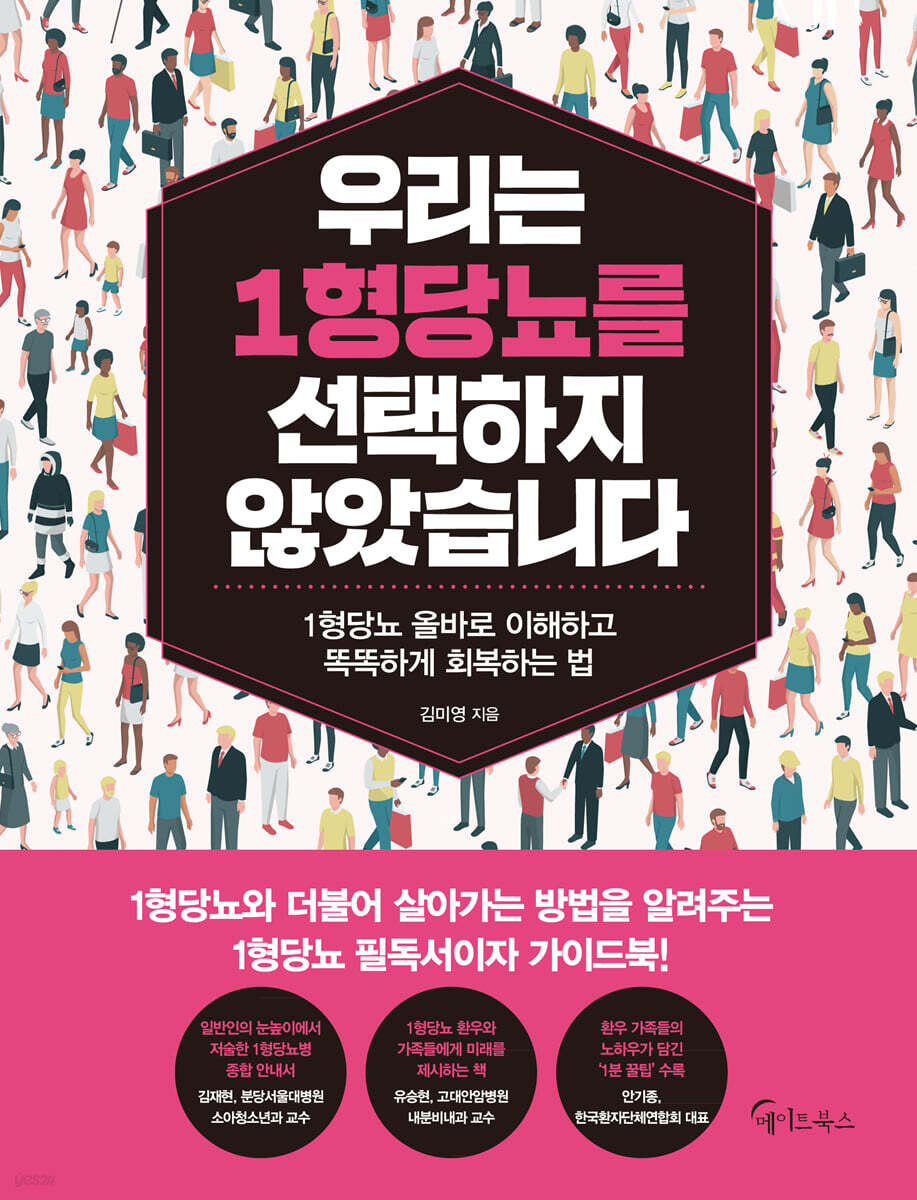
We did not choose type 1 diabetes
 |
Description
Book Introduction
Teaching you how to live with type 1 diabetes A must-read and guidebook for type 1 diabetes! This book is a comprehensive guide to type 1 diabetes written from the perspective of the general public. The sudden onset of type 1 diabetes completely changes the lives of patients and their families. The author argues that just as difficult problems can be solved through understanding the principles through education, diseases that require self-management also require education. Because it is not a question of knowledge, but a question of survival. Accordingly, the author has carefully selected the essential information about type 1 diabetes and compiled it into a single book. This book is useful not only for people with type 1 diabetes, but also for those who want to understand them without prejudice. This book aims to help people adapt to type 1 diabetes and lead happy lives. Because it is a disease that cannot be cured and requires lifelong blood sugar management, patients with type 1 diabetes and their families inevitably experience numerous trials and errors. The author provides practical help to patients and their families by including know-how in each chapter in the form of '1-minute tips', such as 'How to manage type 1 diabetes and what mindset to have'. Many people with type 1 diabetes will read this book and it will be an opportunity for them to come out of the shadows and into the light. |
- You can preview some of the book's contents.
Preview
index
Recommendation
Author's Note_ We are not waiting
Chapter 1: Misconceptions and Truths Surrounding Type 1 Diabetes
It's no one's fault that you have type 1 diabetes.
What is type 1 diabetes and what are its symptoms?
Type 1 and type 2 diabetes are clearly different.
Type 1 diabetes, is it curable?
What is the path to recovery for type 1 diabetes?
Why isn't pancreas/islet transplantation the answer?
Diabetes is a problem because blood sugar is high, so why does hypoglycemia occur?
My first child has type 1 diabetes. Can I still have a second child?
Why the Infant and Childcare Act and the School Health Act needed to be revised
Chapter 2: Adapting to and Living with Type 1 Diabetes
What should I do while hospitalized for type 1 diabetes?
What should I prepare when I leave the hospital after being diagnosed with type 1 diabetes?
How long will my hair fall out and when will I gain weight again?
Why don't I feel symptoms of low blood sugar?
How should I care for my teeth?
When can I start self-injecting?
Why does the insulin dose change each time?
Why does lipohypertrophy occur?
What is the honeymoon period in type 1 diabetes?
Should I let people around me know that I have type 1 diabetes?
How do I explain type 1 diabetes to people around me?
How do I explain type 1 diabetes to my teacher?
How should I prepare for my trip?
How should I prepare for a picnic or field trip?
How should I treat the siblings of a child with type 1 diabetes?
Chapter 3: The Starting Point for Type 1 Diabetes Recovery
What is Night Scout?
What is a continuous glucose monitoring system?
What are insulin pumps and digital insulin pens?
What is an artificial pancreas system?
Chapter 4: How to Manage Blood Sugar Smartly
APS is needed for blood sugar management
There are foods I don't eat, but there are no foods I can't eat.
There are exercises I don't do, but there are no exercises I can't do.
How do you manage your blood sugar when you're sick?
When should children take the initiative in managing their blood sugar?
Chapter 5: Living with Type 1 Diabetes
People come first, disease is only a part of it.
Patient groups are a necessary and sufficient condition for recovery from type 1 diabetes.
Patients must be at the center
We need to prepare for the future medical environment.
Things I'd like to advise people with type 1 diabetes and their families.
Chapter 6: Type 1 Diabetes: How We Recovered
Type 1 diabetes has been both a suffering and a gift to us.
This is the first time I've seen a patient with type 1 diabetes in their sixties.
Lessons from Overcoming Type 1 Diabetes
The ordeal of type 1 diabetes brought our family together.
Getting to know type 1 diabetes
A sixteen-year-old girl's harsh winter turns into a warm spring.
Appendix_ Celebrities who overcame type 1 diabetes
Author's Note_ We are not waiting
Chapter 1: Misconceptions and Truths Surrounding Type 1 Diabetes
It's no one's fault that you have type 1 diabetes.
What is type 1 diabetes and what are its symptoms?
Type 1 and type 2 diabetes are clearly different.
Type 1 diabetes, is it curable?
What is the path to recovery for type 1 diabetes?
Why isn't pancreas/islet transplantation the answer?
Diabetes is a problem because blood sugar is high, so why does hypoglycemia occur?
My first child has type 1 diabetes. Can I still have a second child?
Why the Infant and Childcare Act and the School Health Act needed to be revised
Chapter 2: Adapting to and Living with Type 1 Diabetes
What should I do while hospitalized for type 1 diabetes?
What should I prepare when I leave the hospital after being diagnosed with type 1 diabetes?
How long will my hair fall out and when will I gain weight again?
Why don't I feel symptoms of low blood sugar?
How should I care for my teeth?
When can I start self-injecting?
Why does the insulin dose change each time?
Why does lipohypertrophy occur?
What is the honeymoon period in type 1 diabetes?
Should I let people around me know that I have type 1 diabetes?
How do I explain type 1 diabetes to people around me?
How do I explain type 1 diabetes to my teacher?
How should I prepare for my trip?
How should I prepare for a picnic or field trip?
How should I treat the siblings of a child with type 1 diabetes?
Chapter 3: The Starting Point for Type 1 Diabetes Recovery
What is Night Scout?
What is a continuous glucose monitoring system?
What are insulin pumps and digital insulin pens?
What is an artificial pancreas system?
Chapter 4: How to Manage Blood Sugar Smartly
APS is needed for blood sugar management
There are foods I don't eat, but there are no foods I can't eat.
There are exercises I don't do, but there are no exercises I can't do.
How do you manage your blood sugar when you're sick?
When should children take the initiative in managing their blood sugar?
Chapter 5: Living with Type 1 Diabetes
People come first, disease is only a part of it.
Patient groups are a necessary and sufficient condition for recovery from type 1 diabetes.
Patients must be at the center
We need to prepare for the future medical environment.
Things I'd like to advise people with type 1 diabetes and their families.
Chapter 6: Type 1 Diabetes: How We Recovered
Type 1 diabetes has been both a suffering and a gift to us.
This is the first time I've seen a patient with type 1 diabetes in their sixties.
Lessons from Overcoming Type 1 Diabetes
The ordeal of type 1 diabetes brought our family together.
Getting to know type 1 diabetes
A sixteen-year-old girl's harsh winter turns into a warm spring.
Appendix_ Celebrities who overcame type 1 diabetes
Detailed image

Into the book
If you have a first-degree relative with type 1 diabetes, your relative risk of developing type 1 diabetes increases by about 10 times.
However, the prevalence of type 1 diabetes in Asian races such as Koreans, Japanese, and Chinese is very low, less than 0.1%.
Therefore, even if the relative risk increases tenfold, it is very rare to have a family member with type 1 diabetes.
When evaluated based on genetic predisposition such as family history, Koreans have a much lower genetic predisposition to type 1 diabetes compared to type 2 diabetes.
---p.41
The half-life of insulin normally secreted from the pancreas is short, at 3 to 5 minutes.
However, if the half-life of insulin injected externally is shortened, the occurrence of hypoglycemia is reduced, but there is a disadvantage of having to inject insulin frequently.
To overcome these drawbacks, using insulin injections with long half-lives and durations of action increases the risk of unexpected hypoglycemia.
---p.56
Prescriptions, tax invoices, transaction statements/purchase receipts, and medical expense payment claims are submitted by visiting a branch office of the National Health Insurance Corporation, by mail, or via the Internet (medical expense computerized claim system).
Usually, the medical expenses are deposited into the account written on the payment claim within 2 to 5 days after application.
If the medical expenses are not deposited after two weeks, you can call the National Health Insurance Corporation to which you submitted the documents.
---p.78
Looking at the child's blood sugar level, it was generally hyperglycemic.
So, we lowered the blood sugar very gradually so that the body could properly recognize the normal blood sugar range.
In such cases, it is better to lower blood sugar levels gradually to give our bodies time to adapt rather than just looking at the numbers and rapidly lowering them to normal levels.
---p.87
Do not inject large amounts of insulin into one area at once.
Especially for insulin pump users, the needle stays in one place for about three days.
Therefore, it is recommended to inject insulin in small doses and slow down the injection speed so that it is injected slowly.
Pump needles should not be used in the same area for more than 4 days, and their positions should be changed so that they do not overlap.
---p.99
You should always carry your medical certificate with you.
So it's a good idea to put it in your bag with your passport or wallet.
Instead of packing all your other items in one bag, divide them into 2-3 travel bags.
This is because you need to have consumables available at all times in case you lose your bag or check it in.
---p.123
The xDrip+ or Spike app collects blood sugar data from a continuous glucose monitor using a smartphone or smartwatch and uploads it to the cloud, which can then be linked to the Nightscout web app or APS app.
For the Glimp app, you can collect data from a continuous glucose monitor that collects blood sugar levels via NFC or upload data using a Bluetooth device (MiaoMiao, Bubble, BluCon). After uploading, you can connect it in the same way as xDrip+ or Spike.
---p.150
When you enter a remote injection command in text, you must reply by combining a number string (6 digits) generated in real time through the OTP app linked to the master app and a pre-determined number string (3-4 digits) to enable remote injection.
Therefore, unauthorized persons cannot perform remote injections.
---p.164
Insulin sensitivity can be affected by poor diet, but often the cause is unknown.
For women, sensitivity may vary depending on ovulation or menstrual cycle, and for adolescents, sensitivity may vary during rapid growth periods.
Because insulin sensitivity varies due to uncontrollable variables, it may take some trial and error to get a feel for it.
---p.180
The best way is to lower your blood sugar with a small dose of insulin, then when your blood sugar is back in the normal range, inject the insulin for the food again and eat the food.
However, if you cannot wait, inject ultra-rapid-acting insulin rather than rapid-acting insulin.
Ultra-rapid-acting insulin has a faster onset than rapid-acting insulin.
So it's useful when you need to eat food in a hurry.
---p.205
The reasons for the existence of patient groups may vary depending on the disease.
Yet, there is only one thing in common.
The point is that patient groups are absolutely necessary for patients.
Type 1 diabetes has a long duration of illness, so management should not be neglected at any time.
Above all, it is important to create a medical, technological, and social environment that can effectively manage blood sugar levels.
---p.234
Among continuous glucose monitors, there are some that do not require calibration or do not require calibration at all.
However, these products may require calibration when used.
For products that do not have compensation, if there is a large difference between the actual blood sugar level and the sensor blood sugar level, you will need to check your blood sugar level more frequently while wearing the device or remove the expensive sensor.
Another product can be calibrated, but if there is a large difference between the sensor blood sugar and the actual blood sugar check result, the blood sugar level will not be displayed for a certain period of time after calibration and recalibration is not possible.
---p.257
Type 1 diabetes is probably the disease for which the most patient-generated health data (PGHD) can be collected.
In the past, the cloud database company used by people with type 1 diabetes was an overseas company, and the DB size that could be used (500MB) was limited.
There was also an issue where the DB had to be moved according to the company's policy.
Additionally, because I personally managed the data, the data was fragmented and could not be properly utilized for treatment or research.
So, a service (T1pal) that manages Night Scout data for a fee has appeared overseas.
---p.261
However, if parents waver in front of their child who is about to enter a period of storm and stress, it is obvious that the child will not be able to overcome the strong winds.
That is why parents must first accept diabetes.
If even parents can't accept diabetes, how can they expect their children to accept it? Accepting and recovering from diabetes isn't a grand task.
The process of recovering from diabetes is to fully look after the child and to provide parents with interest and support for the child's future with diabetes.
---pp.279-280
The fact that I am good at math is also related to the fact that I have type 1 diabetes.
Type 1 diabetics must determine the amount of insulin by looking at and calculating blood sugar levels as well as carbohydrate intake.
So, naturally, you have to become familiar with numbers.
However, the prevalence of type 1 diabetes in Asian races such as Koreans, Japanese, and Chinese is very low, less than 0.1%.
Therefore, even if the relative risk increases tenfold, it is very rare to have a family member with type 1 diabetes.
When evaluated based on genetic predisposition such as family history, Koreans have a much lower genetic predisposition to type 1 diabetes compared to type 2 diabetes.
---p.41
The half-life of insulin normally secreted from the pancreas is short, at 3 to 5 minutes.
However, if the half-life of insulin injected externally is shortened, the occurrence of hypoglycemia is reduced, but there is a disadvantage of having to inject insulin frequently.
To overcome these drawbacks, using insulin injections with long half-lives and durations of action increases the risk of unexpected hypoglycemia.
---p.56
Prescriptions, tax invoices, transaction statements/purchase receipts, and medical expense payment claims are submitted by visiting a branch office of the National Health Insurance Corporation, by mail, or via the Internet (medical expense computerized claim system).
Usually, the medical expenses are deposited into the account written on the payment claim within 2 to 5 days after application.
If the medical expenses are not deposited after two weeks, you can call the National Health Insurance Corporation to which you submitted the documents.
---p.78
Looking at the child's blood sugar level, it was generally hyperglycemic.
So, we lowered the blood sugar very gradually so that the body could properly recognize the normal blood sugar range.
In such cases, it is better to lower blood sugar levels gradually to give our bodies time to adapt rather than just looking at the numbers and rapidly lowering them to normal levels.
---p.87
Do not inject large amounts of insulin into one area at once.
Especially for insulin pump users, the needle stays in one place for about three days.
Therefore, it is recommended to inject insulin in small doses and slow down the injection speed so that it is injected slowly.
Pump needles should not be used in the same area for more than 4 days, and their positions should be changed so that they do not overlap.
---p.99
You should always carry your medical certificate with you.
So it's a good idea to put it in your bag with your passport or wallet.
Instead of packing all your other items in one bag, divide them into 2-3 travel bags.
This is because you need to have consumables available at all times in case you lose your bag or check it in.
---p.123
The xDrip+ or Spike app collects blood sugar data from a continuous glucose monitor using a smartphone or smartwatch and uploads it to the cloud, which can then be linked to the Nightscout web app or APS app.
For the Glimp app, you can collect data from a continuous glucose monitor that collects blood sugar levels via NFC or upload data using a Bluetooth device (MiaoMiao, Bubble, BluCon). After uploading, you can connect it in the same way as xDrip+ or Spike.
---p.150
When you enter a remote injection command in text, you must reply by combining a number string (6 digits) generated in real time through the OTP app linked to the master app and a pre-determined number string (3-4 digits) to enable remote injection.
Therefore, unauthorized persons cannot perform remote injections.
---p.164
Insulin sensitivity can be affected by poor diet, but often the cause is unknown.
For women, sensitivity may vary depending on ovulation or menstrual cycle, and for adolescents, sensitivity may vary during rapid growth periods.
Because insulin sensitivity varies due to uncontrollable variables, it may take some trial and error to get a feel for it.
---p.180
The best way is to lower your blood sugar with a small dose of insulin, then when your blood sugar is back in the normal range, inject the insulin for the food again and eat the food.
However, if you cannot wait, inject ultra-rapid-acting insulin rather than rapid-acting insulin.
Ultra-rapid-acting insulin has a faster onset than rapid-acting insulin.
So it's useful when you need to eat food in a hurry.
---p.205
The reasons for the existence of patient groups may vary depending on the disease.
Yet, there is only one thing in common.
The point is that patient groups are absolutely necessary for patients.
Type 1 diabetes has a long duration of illness, so management should not be neglected at any time.
Above all, it is important to create a medical, technological, and social environment that can effectively manage blood sugar levels.
---p.234
Among continuous glucose monitors, there are some that do not require calibration or do not require calibration at all.
However, these products may require calibration when used.
For products that do not have compensation, if there is a large difference between the actual blood sugar level and the sensor blood sugar level, you will need to check your blood sugar level more frequently while wearing the device or remove the expensive sensor.
Another product can be calibrated, but if there is a large difference between the sensor blood sugar and the actual blood sugar check result, the blood sugar level will not be displayed for a certain period of time after calibration and recalibration is not possible.
---p.257
Type 1 diabetes is probably the disease for which the most patient-generated health data (PGHD) can be collected.
In the past, the cloud database company used by people with type 1 diabetes was an overseas company, and the DB size that could be used (500MB) was limited.
There was also an issue where the DB had to be moved according to the company's policy.
Additionally, because I personally managed the data, the data was fragmented and could not be properly utilized for treatment or research.
So, a service (T1pal) that manages Night Scout data for a fee has appeared overseas.
---p.261
However, if parents waver in front of their child who is about to enter a period of storm and stress, it is obvious that the child will not be able to overcome the strong winds.
That is why parents must first accept diabetes.
If even parents can't accept diabetes, how can they expect their children to accept it? Accepting and recovering from diabetes isn't a grand task.
The process of recovering from diabetes is to fully look after the child and to provide parents with interest and support for the child's future with diabetes.
---pp.279-280
The fact that I am good at math is also related to the fact that I have type 1 diabetes.
Type 1 diabetics must determine the amount of insulin by looking at and calculating blood sugar levels as well as carbohydrate intake.
So, naturally, you have to become familiar with numbers.
---p.321
Publisher's Review
From blood sugar management, device usage, and related systems,
Master it in just one volume!
This book consists of a total of six chapters.
Chapter 1, 'Misconceptions and Truths Surrounding Type 1 Diabetes' explains what type 1 diabetes is, what its symptoms are, and what misconceptions people have.
Chapter 2, “Adapting to and Living with Type 1 Diabetes,” explains in detail how to manage type 1 diabetes, a disease that is difficult to cure.
It is comprised of practical, helpful content, such as what to do while hospitalized, dental and skin care, and what to prepare for picnics or travel.
Chapter 3, “Starting Point for Type 1 Diabetes Recovery,” provides information on diabetes management devices such as continuous glucose monitoring devices, insulin pumps, and artificial pancreas systems.
Chapter 4, “How to Manage Blood Sugar Smartly,” explains in detail how to manage blood sugar levels differently depending on the situation, such as when you are sick or exercising.
Chapter 5, “How to Live in the Future with Type 1 Diabetes,” provides guidance on what roles type 1 diabetes patients, their families, medical professionals, and medical companies should play in creating a future medical environment.
Chapter 6, “Type 1 Diabetes, That’s How We Recovered,” shows the vivid stories of patients with type 1 diabetes and their families battling the disease.
It vividly conveys their stories, from the emotions they felt when diagnosed with type 1 diabetes, to the difficulties of managing blood sugar, to the honest feelings of families who have patients.
The appendix, “Celebrities Who Overcame Type 1 Diabetes,” presents examples of people with type 1 diabetes who are active in various fields, including mountaineers, Supreme Court justices, writers, and athletes.
Their stories will give hope to people with type 1 diabetes and their families.
I believe that many people with type 1 diabetes will read this book and find a way out of the shadows and into the light. I am grateful to the author, and I am glad that I know such a good person.
_Changhoon, 21 years of type 1 diabetes
Master it in just one volume!
This book consists of a total of six chapters.
Chapter 1, 'Misconceptions and Truths Surrounding Type 1 Diabetes' explains what type 1 diabetes is, what its symptoms are, and what misconceptions people have.
Chapter 2, “Adapting to and Living with Type 1 Diabetes,” explains in detail how to manage type 1 diabetes, a disease that is difficult to cure.
It is comprised of practical, helpful content, such as what to do while hospitalized, dental and skin care, and what to prepare for picnics or travel.
Chapter 3, “Starting Point for Type 1 Diabetes Recovery,” provides information on diabetes management devices such as continuous glucose monitoring devices, insulin pumps, and artificial pancreas systems.
Chapter 4, “How to Manage Blood Sugar Smartly,” explains in detail how to manage blood sugar levels differently depending on the situation, such as when you are sick or exercising.
Chapter 5, “How to Live in the Future with Type 1 Diabetes,” provides guidance on what roles type 1 diabetes patients, their families, medical professionals, and medical companies should play in creating a future medical environment.
Chapter 6, “Type 1 Diabetes, That’s How We Recovered,” shows the vivid stories of patients with type 1 diabetes and their families battling the disease.
It vividly conveys their stories, from the emotions they felt when diagnosed with type 1 diabetes, to the difficulties of managing blood sugar, to the honest feelings of families who have patients.
The appendix, “Celebrities Who Overcame Type 1 Diabetes,” presents examples of people with type 1 diabetes who are active in various fields, including mountaineers, Supreme Court justices, writers, and athletes.
Their stories will give hope to people with type 1 diabetes and their families.
I believe that many people with type 1 diabetes will read this book and find a way out of the shadows and into the light. I am grateful to the author, and I am glad that I know such a good person.
_Changhoon, 21 years of type 1 diabetes
GOODS SPECIFICS
- Date of issue: May 6, 2022
- Page count, weight, size: 328 pages | 614g | 165*215*20mm
- ISBN13: 9791160023725
- ISBN10: 1160023727
You may also like
카테고리
korean


korean

![GQ KOREA Mark (Monthly): December [2025]](http://librairie.coreenne.fr/cdn/shop/files/8ef265dbbfbf186523ed75ba7319009d.jpg?v=1765340328&width=3840)


