

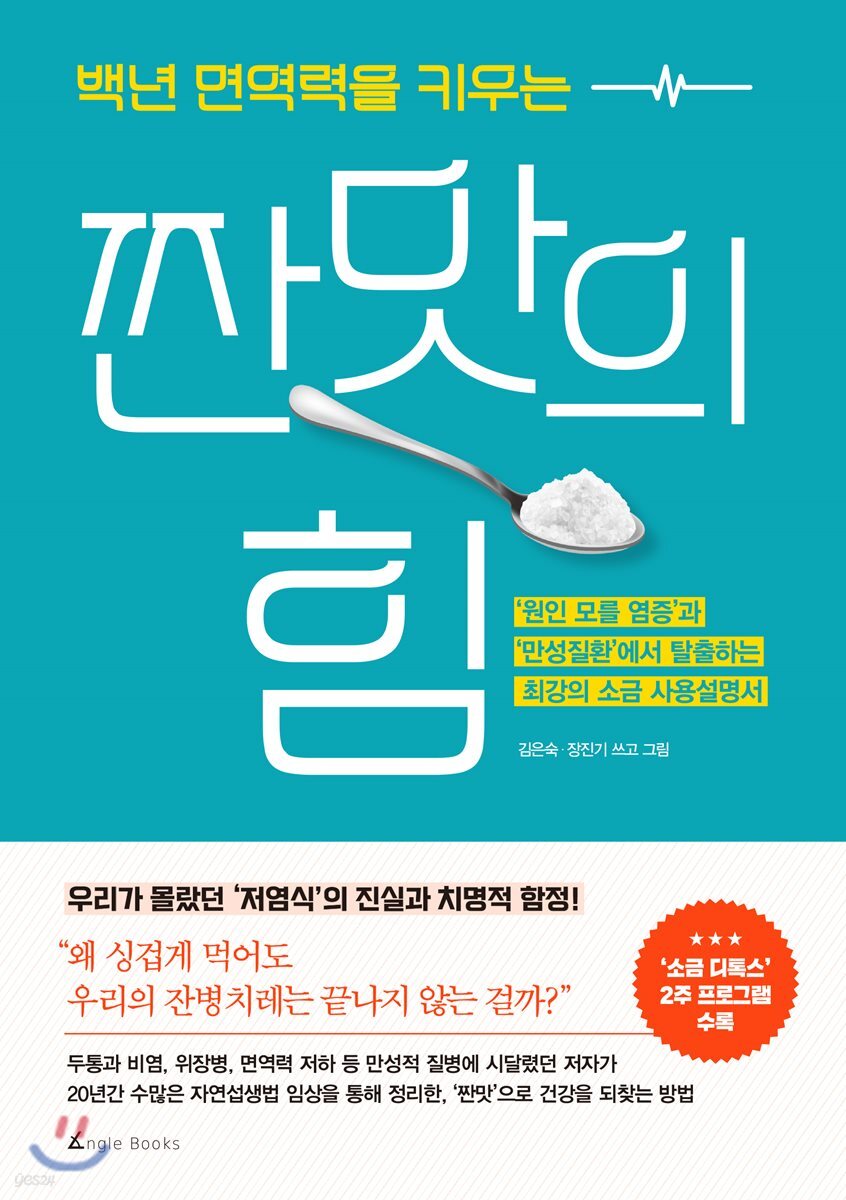
The power of salty taste that boosts immunity for 100 years
 |
Description
Book Introduction
Salty, how much do I know?
A society that sells anxiety, salt becomes a scapegoat
The nocebo effect is just as great as the placebo effect.
Nocebo refers to a negative effect that is the opposite of the placebo effect, also known as the placebo effect.
Unlike the placebo effect, where symptoms improve with just a simple potion or vitamin supplement, there are many cases where simply being diagnosed with a disease can lead to a rapid decline in physical strength, resulting in negative outcomes.
What is more frightening than disease is the 'fear' of worrying about something that has not even happened.
If you believe that something will be harmful, you are more likely to get sick.
Likewise, if you keep hearing negative information about salt, you start to think that even a little salt in food is excessive and bad for your health.
There are even people who make sure to check their blood pressure on days when they eat something salty.
When you eat salty food, you end up drinking a lot of water. However, when your body swells, many people become anxious and fear that their kidneys may be damaged.
The 'low-salt' diet, which started in kindergarten, continues through elementary school, middle school, and high school.
Sodium toxicity education and the "eat less salty" movement are always included in school lunch menu notifications for elementary, middle, and high schools, and are now essential guidelines for a healthy diet.
From morning cultural programs to news and health programs, late-night documentaries, and even lines from dramas.
In hospitals, schools, public institutions, and even the mass media, salt has become the enemy of health and the cause of disease.
Furthermore, the generation that grew up not liking salt has now become parents raising children. Even during pregnancy, they are eating a low-salt diet and are making a great effort to feed their children bland, unseasoned baby food for their health.
But why are atopic dermatitis, rhinitis, and all kinds of inflammatory and allergic diseases only increasing?
A society that sells anxiety, salt becomes a scapegoat
The nocebo effect is just as great as the placebo effect.
Nocebo refers to a negative effect that is the opposite of the placebo effect, also known as the placebo effect.
Unlike the placebo effect, where symptoms improve with just a simple potion or vitamin supplement, there are many cases where simply being diagnosed with a disease can lead to a rapid decline in physical strength, resulting in negative outcomes.
What is more frightening than disease is the 'fear' of worrying about something that has not even happened.
If you believe that something will be harmful, you are more likely to get sick.
Likewise, if you keep hearing negative information about salt, you start to think that even a little salt in food is excessive and bad for your health.
There are even people who make sure to check their blood pressure on days when they eat something salty.
When you eat salty food, you end up drinking a lot of water. However, when your body swells, many people become anxious and fear that their kidneys may be damaged.
The 'low-salt' diet, which started in kindergarten, continues through elementary school, middle school, and high school.
Sodium toxicity education and the "eat less salty" movement are always included in school lunch menu notifications for elementary, middle, and high schools, and are now essential guidelines for a healthy diet.
From morning cultural programs to news and health programs, late-night documentaries, and even lines from dramas.
In hospitals, schools, public institutions, and even the mass media, salt has become the enemy of health and the cause of disease.
Furthermore, the generation that grew up not liking salt has now become parents raising children. Even during pregnancy, they are eating a low-salt diet and are making a great effort to feed their children bland, unseasoned baby food for their health.
But why are atopic dermatitis, rhinitis, and all kinds of inflammatory and allergic diseases only increasing?
- You can preview some of the book's contents.
Preview
index
Recommendation | Salt, the fundamental principle that governs our lives · 2
Enter | Just adding saltiness can transform a day that weighs a ton. · 6
The Trap of Salt Deficiency | Discovering the 'Secret of Saltiness' | Your Body Already Knows
Salt Intolerance Checklist | Recognizing Your Body's Salt Deficiency Signals · 22
Part 1/ Is saltiness really the enemy of our health?
Chapter 1: The Secret of Saltiness Hidden in Our Bodies: The Saltiness of Blood, Sweat, and Tears
We Need Salt to Live 27 | Salt Intake is a Brain-Determined Matter 30 | No Two Bodies Are the Same 33 | It's Okay to Eat Salty, No, It's Okay to Eat Salty 36 | Saltiness, Salting Power, Salting Energy 39 | The Body's Wisdom, a Constant Dynamic Balance 43 | Salt and High Blood Pressure: A Changing Paradigm 46 | The Freedom to Season to Your Own Taste 51 | A Society That Sells Anxiety: Salt Becomes a Sacrificial Lamb 54 | We Need a Different Language 58
Chapter 2: There is no such thing as an "unnecessary taste" in the world: The interaction between taste and the body.
When the 'liver' is right, 'taste' and 'body' survive. 61 | There's a reason why we're drawn to it. 66 | The secret to health hidden in 'taste'. 69 | Finding body balance through taste. 72 | Medicine or poison. 74
Tip 1: Knowing the Principles of Taste and Energy: 77 Things You Should Know to Help Your Body
Chapter 3: Wise You, Question Scientific Evidence: The Unknown Attributes of Statistics
Scientifically Proven? 86 | Why Do Statistical Numbers Shrink When Standing Before Them? 92 | Is the Recommended Daily Intake of Sodium Really "Recommended"? 95 | Do Koreans Eat Salty Foods? The "Korean Paradox" 97 | Reducing Sodium Intake by 3g Could Save 3 Trillion Won in Annual Medical Costs? 101 | Sodiophobia Born in an Era of 10 Million Hypertension Patients 106 | Self-Regulation Mechanisms 110 | More Important Than Blood Pressure Numbers 113
Tip 2: Types of High Blood Pressure from a Natural Diet Perspective·118
Chapter 4: How Salt Became a Public Enemy: The Fatal Misunderstanding of Saltiness
The First Generation Fearing Salt 122 | The 'Invention' or 'Discovery' of High Blood Pressure 125 | Replaying It More Simply and Provocatively 129 | Will You Believe It When You See It in Numbers? 133 | The War on Salt: It's Time to End It 137 | The Wholeness of Life Unknowable to Mechanical and Analytical Thinking 141
Tip 3: When Water and Salt Are 'Absolutely' Necessary · 145
Part 2: The Ultimate Salt User Manual for Saving Your Body
Chapter 5 My Body Wants Salt: Clear, Clean, and Inflammatory
Salt, the Basic Ingredient of Life 152
Tip 4: Salty Taste, The Five Elements: Water and Salt·155
Treating Inflammation with Salt 163 | Making Hard and Hard Soft and Soft 189 | Making Turbid and Clear 195 | Particles of Light That Warm People 207 | Fight Dryness! 211 | Salt is an Aphrodisiac, Kidney and Essence 214 | Salt is a Natural Digestive Agent 223
Tip 5: How to Use Salt from Head to Toe·229
Chapter 6: The Brain-Changing Power of Salt: The Salty Taste That Clears the Mind
A Stiff Body Stiffens the Mind 233 | Salt Affects Brain Activity? 239 | Electrolyte Imbalances Lead to Dull Mind 247 | The Power to Drive Away Fear 251 | The Fire Within Must Be Tempered with Water 254
Chapter 7: How Much Salt Should I Eat and How Should I Eat It to Live Healthy?: Salty Balance for My Body
Is drinking more water good for your health? 261 | Do you need to eat salt separately from your meals? 266 | Eating salty foods makes you fat? 272 | Is low-sodium salt good for your health? 276 | Is sodium in processed foods more of a problem? 284 | Is natural salt really salt? 287 | Are there some people who don't tolerate salt well? 291 | A salt-free diet is the worst combination for vegetarians. 296 | What should I do if I've gained weight from eating salty foods? 298
Tip 6: Signs You Should Reduce or Stop Salt Intake · 301
Chapter 8: Salt, Embedded in Our Lives in Various Forms: Enhancing the "Salt Power" in Everyday Life
Salt Intake by Time of Day 304 | Salt Intake by Season 306 | Salt Needed During Pregnancy, Childbirth, and Growth 308 | Animals Need Salt Too 316
Going Out | The Return of Salty Flavors, Salt Comes Again · 322
Appendix | The 2-Week Salt Detox Program to Transform Your Body · 325
America · 340
References ·3 42
Enter | Just adding saltiness can transform a day that weighs a ton. · 6
The Trap of Salt Deficiency | Discovering the 'Secret of Saltiness' | Your Body Already Knows
Salt Intolerance Checklist | Recognizing Your Body's Salt Deficiency Signals · 22
Part 1/ Is saltiness really the enemy of our health?
Chapter 1: The Secret of Saltiness Hidden in Our Bodies: The Saltiness of Blood, Sweat, and Tears
We Need Salt to Live 27 | Salt Intake is a Brain-Determined Matter 30 | No Two Bodies Are the Same 33 | It's Okay to Eat Salty, No, It's Okay to Eat Salty 36 | Saltiness, Salting Power, Salting Energy 39 | The Body's Wisdom, a Constant Dynamic Balance 43 | Salt and High Blood Pressure: A Changing Paradigm 46 | The Freedom to Season to Your Own Taste 51 | A Society That Sells Anxiety: Salt Becomes a Sacrificial Lamb 54 | We Need a Different Language 58
Chapter 2: There is no such thing as an "unnecessary taste" in the world: The interaction between taste and the body.
When the 'liver' is right, 'taste' and 'body' survive. 61 | There's a reason why we're drawn to it. 66 | The secret to health hidden in 'taste'. 69 | Finding body balance through taste. 72 | Medicine or poison. 74
Tip 1: Knowing the Principles of Taste and Energy: 77 Things You Should Know to Help Your Body
Chapter 3: Wise You, Question Scientific Evidence: The Unknown Attributes of Statistics
Scientifically Proven? 86 | Why Do Statistical Numbers Shrink When Standing Before Them? 92 | Is the Recommended Daily Intake of Sodium Really "Recommended"? 95 | Do Koreans Eat Salty Foods? The "Korean Paradox" 97 | Reducing Sodium Intake by 3g Could Save 3 Trillion Won in Annual Medical Costs? 101 | Sodiophobia Born in an Era of 10 Million Hypertension Patients 106 | Self-Regulation Mechanisms 110 | More Important Than Blood Pressure Numbers 113
Tip 2: Types of High Blood Pressure from a Natural Diet Perspective·118
Chapter 4: How Salt Became a Public Enemy: The Fatal Misunderstanding of Saltiness
The First Generation Fearing Salt 122 | The 'Invention' or 'Discovery' of High Blood Pressure 125 | Replaying It More Simply and Provocatively 129 | Will You Believe It When You See It in Numbers? 133 | The War on Salt: It's Time to End It 137 | The Wholeness of Life Unknowable to Mechanical and Analytical Thinking 141
Tip 3: When Water and Salt Are 'Absolutely' Necessary · 145
Part 2: The Ultimate Salt User Manual for Saving Your Body
Chapter 5 My Body Wants Salt: Clear, Clean, and Inflammatory
Salt, the Basic Ingredient of Life 152
Tip 4: Salty Taste, The Five Elements: Water and Salt·155
Treating Inflammation with Salt 163 | Making Hard and Hard Soft and Soft 189 | Making Turbid and Clear 195 | Particles of Light That Warm People 207 | Fight Dryness! 211 | Salt is an Aphrodisiac, Kidney and Essence 214 | Salt is a Natural Digestive Agent 223
Tip 5: How to Use Salt from Head to Toe·229
Chapter 6: The Brain-Changing Power of Salt: The Salty Taste That Clears the Mind
A Stiff Body Stiffens the Mind 233 | Salt Affects Brain Activity? 239 | Electrolyte Imbalances Lead to Dull Mind 247 | The Power to Drive Away Fear 251 | The Fire Within Must Be Tempered with Water 254
Chapter 7: How Much Salt Should I Eat and How Should I Eat It to Live Healthy?: Salty Balance for My Body
Is drinking more water good for your health? 261 | Do you need to eat salt separately from your meals? 266 | Eating salty foods makes you fat? 272 | Is low-sodium salt good for your health? 276 | Is sodium in processed foods more of a problem? 284 | Is natural salt really salt? 287 | Are there some people who don't tolerate salt well? 291 | A salt-free diet is the worst combination for vegetarians. 296 | What should I do if I've gained weight from eating salty foods? 298
Tip 6: Signs You Should Reduce or Stop Salt Intake · 301
Chapter 8: Salt, Embedded in Our Lives in Various Forms: Enhancing the "Salt Power" in Everyday Life
Salt Intake by Time of Day 304 | Salt Intake by Season 306 | Salt Needed During Pregnancy, Childbirth, and Growth 308 | Animals Need Salt Too 316
Going Out | The Return of Salty Flavors, Salt Comes Again · 322
Appendix | The 2-Week Salt Detox Program to Transform Your Body · 325
America · 340
References ·3 42
Detailed image
Publisher's Review
Sodium intake is 2g per day?
Common Misconceptions About Salt 1
Is the World Health Organization's recommended daily intake of 5g of salt (2g of sodium) truly adequate? There's considerable criticism that the recommended daily intake itself lacks scientific basis.
Even the Institute of Medicine (IOM), which established sodium reduction guidelines in 2005 and influenced many organizations, recently released a report (May 2014) stating that there is insufficient scientific evidence to support the health benefits of daily intake of less than 2,300 mg.
In fact, there are different opinions about the daily salt requirement.
Surprisingly, the same amount of salt intake is recommended for Africans and Arctic people, and for meat-eaters and vegetarians.
However, salt intake should vary from person to person depending on the natural environment, such as climate and soil, and the food they eat.
This is because people are different depending on their physical constitution, age, work, where they live, and other factors.
We must recognize that some people need a lot of salt and others need little, and that there are days when we need a lot and days when we don't.
While our country's health authorities are pursuing a low-salt diet policy based on standards set by the World Health Organization and the United States, voices are also being raised in the United States, arguing that salt intake should be increased, as in Korea and Japan.
Some argue that the U.S. should end its low-salt diet policy, citing the fact that countries with high salt intake, such as Korea, Japan, and France, have lower rates of obesity and cardiovascular disease.
David A. McCarran, former president of the American Society of Hypertension.
Dr. McCarron said, “Salt intake is a matter for the brain to decide, not a matter for policy intervention.”
Salt, which is considered the main culprit of adult diseases such as high blood pressure, diabetes, and obesity, has actually been considered more precious than gold for thousands of years and has played an important role in our meals and lives.
Therefore, we need to move beyond the dichotomous perspective of whether salt is medicine or poison and properly examine the true efficacy and role of salt.
The Salt-High Blood Pressure Link: Unsubstantiated Numbers
Common Misconceptions About Salt 2
A recent study found that half of the people in the world say that salt intake raises their blood pressure, while half of the people in the world say that reducing salt intake does not affect their blood pressure at all.
Many of the experiments cited as scientific evidence for our prejudice and misunderstanding about salt were criticized and discarded at the time.
The same goes for the representative experiments, the 'William Kempner experiment' and the 'Lewis Dahl experiment', which is famous for its research on salt and high blood pressure.
The 1945 William Kempner experiment is one such example.
To prove that high blood pressure is caused by sodium, he treated 500 patients by severely restricting protein, fat, salt, and water, and prescribing a diet centered on vegetables and fruits with high potassium content.
Kempner reported that his patients improved with this treatment, but later it was revealed that many patients died and hundreds of patients worsened so much that more than half refused the treatment.
_ [From the text]
There is a study related to salt and high blood pressure called Lewis Dahl's experiment.
He is known as the first person to officially declare that salt causes high blood pressure in humans, having studied how high blood pressure progressed when salt was fed to laboratory rats in the 1950s.
The results of an experiment showing that salt causes high blood pressure were announced, but the problem with the experiment itself was revealed when it was revealed that the rats were fed an amount of salt equivalent to 50 times the amount consumed by Americans during the experiment.
Even after that, it was revealed that in domestic and international experiments, salt doses tens of times higher than human standards were administered, and there were many problems with the experimental setup itself, such as restricting water intake or preventing excretion.
_ [From the text]
“Vitamin C deficiency only causes certain diseases, but salt deficiency is life-threatening.
More than 98% of high blood pressure cases in Japanese people are not related to salt.
It's a problem with the kidneys, hormones, blood vessels, or blood.
“For the majority of Japanese people, reducing salt intake is meaningless, and in fact, reducing salt intake is likely to pose a significant health risk,” said Dr. Kyuzo Aoki, recipient of the Chiba Award, the highest award given by the American College of Cardiology and the American Society of Hypertension.
Although it has only recently been introduced in Korea, in other countries, including the United States and Europe, there is a growing voice from medical experts and scholars who claim that low-salt diet policies are not helpful to health at all and are even dangerous.
Furthermore, the argument that artificially restricting salt intake is not scientifically sound and, above all, practically impossible is gaining traction.
Numbers can be manipulated in any way to prove the intended purpose.
Depending on what you want to highlight, the numbers will inevitably vary as you design the experiment itself, select the samples, and obtain the data.
Today, we are flooded with pollutants such as radiation, fine dust, heavy metals, and environmental hormones.
The answer to removing and detoxifying the toxins that accumulate in our bodies lies in salt.
Salt plays a role in removing impurities, sterilizing, and detoxifying, i.e., 'detoxing'.
A clean body and mind greatly improves the quality of life.
Starting today, let's clear up misconceptions about salt through this book and learn how to use salt that's right for you from head to toe, thereby building a body that's resistant to inflammation.
Salty, salty power, squeezing energy!
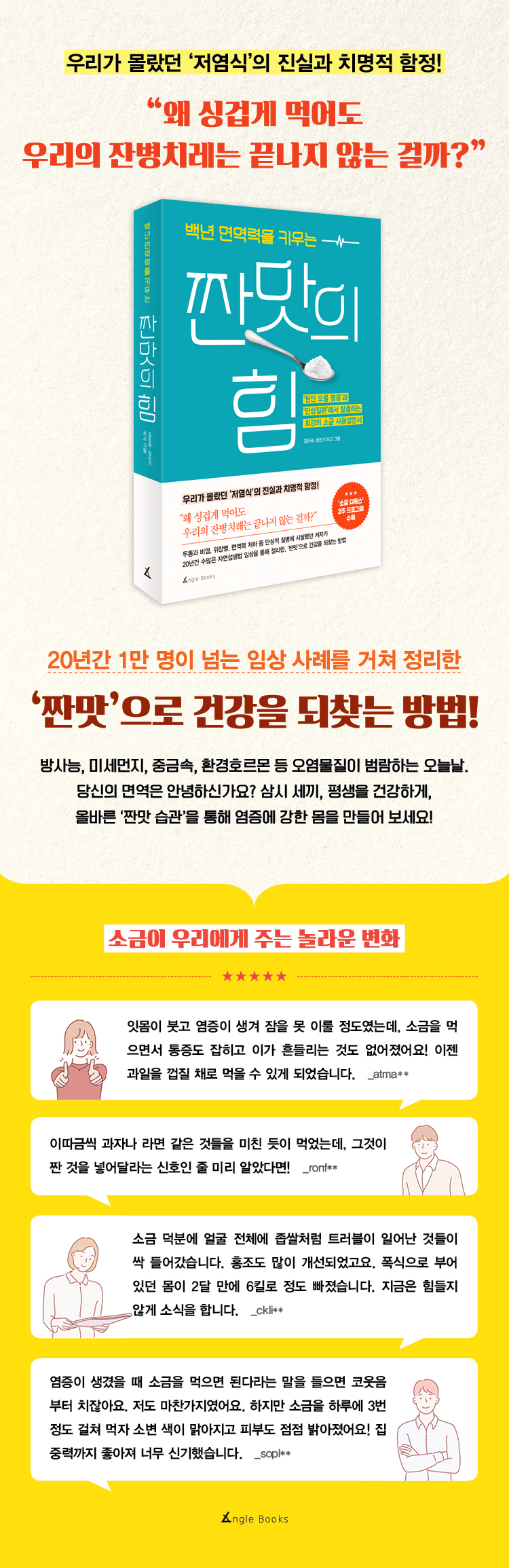
Based on 20 years of clinical experience with numerous natural remedies
How to regain your health with salty taste!
If there is a lack of salt in the body, it becomes inflammation.
Inflammation occurs in various places, such as gastritis, colitis, rhinitis, otitis media, prostatitis, and periodontitis.
If you can't squeeze out the dregs and become new, you're essentially dead.
Life is constantly being replaced by new cells, and nothing stays the same forever.
To live a life that is renewed and alive through constant flow like this, the power of water and salt is absolutely necessary.
As more of this strength is needed, the taste buds naturally seek out salty flavors.
This book is not written based on theoretical assumptions or generalizations based on a few personal experiences.
This is what I realized and organized while experiencing the cases of over 10,000 people who regained their health through salt among those who visited the center over the past 20 years.
People who have been practicing together for a short period of time, ranging from a few months to a long period of time, 10 to 20 years.
The stories are as diverse as the diseases themselves, from those who improved their digestion and gained energy simply by clearing up misconceptions about salt and seasoning it to their taste, to those who stopped having pus, improved their skin, and were free from inflammation and pain by eating more than a few dozen grams of salt a day.
Salt and water are essential when squeezing out all the impurities that come with life.
This book collects only the cases of people who lost their health while actively following a 'low-salt diet' and then regained their health by increasing their salt intake, among the numerous cases related to salt.
Due to the nature of the center, which is based on the motto of health independence, there are very few cases that pass by in a short period of time, and the content is observed and monitored for at least 3-6 months to 10 years or more.
Salt was like the last piece of a complex puzzle, the key that opened the door to health.
Your body already knows!
Just adding saltiness can change a day that was already heavy!
The book is largely divided into two parts.
Part 1 is about misconceptions about salt and the debate over salt and salt intake.
We explore how salt, once prized as precious as gold, came to be so misunderstood.
Misconceptions about salt are also related to blind spots in statistics and errors in scientific evidence.
We also look at research results that refute the 'salt restriction theory'.
For media reports, I checked the source and, in the case of papers or columns, I checked the original content on the relevant website before citing it.
Those who have cleared up or no longer have any misunderstandings about salt can start reading from Part 2.
Part 2 is about the relationship between our body and salt, and the role of salt.
The symptoms and physiological principles of salt deficiency are covered along with actual cases of improvement.
We will examine what changes occur in the body and mind when there is a lack or excess of salt, and what the signals are.
Based on the principles of yin-yang and the five elements, it is explained with a focus on the salty taste and kidney and bladder energy corresponding to water energy.
It also contains practical information related to salt intake and various ways to use salt that can be applied in real life.
A 'salt tea recipe' is also included in the appendix as a practical method for the '2-week salt detox'.
In addition, the dynamic relationship between taste and energy from the perspective of natural diet was summarized separately.
To understand saltiness, you must know the balance of the six tastes, including sweetness and bitterness.
Health ultimately comes from ‘balance.’
No matter how good salt is, if it is out of balance with other elements, it can be harmful to your health.
Therefore, we will also look at the 'Six Flavors Diet', the principles and dynamics of taste energy, and how to balance the body with taste.
Additionally, we have included specific examples of people who have found and maintained health through salt, so that you can see specific symptoms and how to use salt at a glance.
No matter how important salt is, it is essential to consume other nutrients evenly through food.
Here, basic nutrition centered on grains, eating what you want to eat according to your taste, and lifestyle changes such as exercise methods briefly introduced in the appendix of this book, walking, and raising your body temperature must be combined.
For those unfamiliar with the Five Elements principle, please refer to the ‘Principle of Taste’ in the book.
Common Misconceptions About Salt 1
Is the World Health Organization's recommended daily intake of 5g of salt (2g of sodium) truly adequate? There's considerable criticism that the recommended daily intake itself lacks scientific basis.
Even the Institute of Medicine (IOM), which established sodium reduction guidelines in 2005 and influenced many organizations, recently released a report (May 2014) stating that there is insufficient scientific evidence to support the health benefits of daily intake of less than 2,300 mg.
In fact, there are different opinions about the daily salt requirement.
Surprisingly, the same amount of salt intake is recommended for Africans and Arctic people, and for meat-eaters and vegetarians.
However, salt intake should vary from person to person depending on the natural environment, such as climate and soil, and the food they eat.
This is because people are different depending on their physical constitution, age, work, where they live, and other factors.
We must recognize that some people need a lot of salt and others need little, and that there are days when we need a lot and days when we don't.
While our country's health authorities are pursuing a low-salt diet policy based on standards set by the World Health Organization and the United States, voices are also being raised in the United States, arguing that salt intake should be increased, as in Korea and Japan.
Some argue that the U.S. should end its low-salt diet policy, citing the fact that countries with high salt intake, such as Korea, Japan, and France, have lower rates of obesity and cardiovascular disease.
David A. McCarran, former president of the American Society of Hypertension.
Dr. McCarron said, “Salt intake is a matter for the brain to decide, not a matter for policy intervention.”
Salt, which is considered the main culprit of adult diseases such as high blood pressure, diabetes, and obesity, has actually been considered more precious than gold for thousands of years and has played an important role in our meals and lives.
Therefore, we need to move beyond the dichotomous perspective of whether salt is medicine or poison and properly examine the true efficacy and role of salt.
The Salt-High Blood Pressure Link: Unsubstantiated Numbers
Common Misconceptions About Salt 2
A recent study found that half of the people in the world say that salt intake raises their blood pressure, while half of the people in the world say that reducing salt intake does not affect their blood pressure at all.
Many of the experiments cited as scientific evidence for our prejudice and misunderstanding about salt were criticized and discarded at the time.
The same goes for the representative experiments, the 'William Kempner experiment' and the 'Lewis Dahl experiment', which is famous for its research on salt and high blood pressure.
The 1945 William Kempner experiment is one such example.
To prove that high blood pressure is caused by sodium, he treated 500 patients by severely restricting protein, fat, salt, and water, and prescribing a diet centered on vegetables and fruits with high potassium content.
Kempner reported that his patients improved with this treatment, but later it was revealed that many patients died and hundreds of patients worsened so much that more than half refused the treatment.
_ [From the text]
There is a study related to salt and high blood pressure called Lewis Dahl's experiment.
He is known as the first person to officially declare that salt causes high blood pressure in humans, having studied how high blood pressure progressed when salt was fed to laboratory rats in the 1950s.
The results of an experiment showing that salt causes high blood pressure were announced, but the problem with the experiment itself was revealed when it was revealed that the rats were fed an amount of salt equivalent to 50 times the amount consumed by Americans during the experiment.
Even after that, it was revealed that in domestic and international experiments, salt doses tens of times higher than human standards were administered, and there were many problems with the experimental setup itself, such as restricting water intake or preventing excretion.
_ [From the text]
“Vitamin C deficiency only causes certain diseases, but salt deficiency is life-threatening.
More than 98% of high blood pressure cases in Japanese people are not related to salt.
It's a problem with the kidneys, hormones, blood vessels, or blood.
“For the majority of Japanese people, reducing salt intake is meaningless, and in fact, reducing salt intake is likely to pose a significant health risk,” said Dr. Kyuzo Aoki, recipient of the Chiba Award, the highest award given by the American College of Cardiology and the American Society of Hypertension.
Although it has only recently been introduced in Korea, in other countries, including the United States and Europe, there is a growing voice from medical experts and scholars who claim that low-salt diet policies are not helpful to health at all and are even dangerous.
Furthermore, the argument that artificially restricting salt intake is not scientifically sound and, above all, practically impossible is gaining traction.
Numbers can be manipulated in any way to prove the intended purpose.
Depending on what you want to highlight, the numbers will inevitably vary as you design the experiment itself, select the samples, and obtain the data.
Today, we are flooded with pollutants such as radiation, fine dust, heavy metals, and environmental hormones.
The answer to removing and detoxifying the toxins that accumulate in our bodies lies in salt.
Salt plays a role in removing impurities, sterilizing, and detoxifying, i.e., 'detoxing'.
A clean body and mind greatly improves the quality of life.
Starting today, let's clear up misconceptions about salt through this book and learn how to use salt that's right for you from head to toe, thereby building a body that's resistant to inflammation.
Salty, salty power, squeezing energy!
Based on 20 years of clinical experience with numerous natural remedies
How to regain your health with salty taste!
If there is a lack of salt in the body, it becomes inflammation.
Inflammation occurs in various places, such as gastritis, colitis, rhinitis, otitis media, prostatitis, and periodontitis.
If you can't squeeze out the dregs and become new, you're essentially dead.
Life is constantly being replaced by new cells, and nothing stays the same forever.
To live a life that is renewed and alive through constant flow like this, the power of water and salt is absolutely necessary.
As more of this strength is needed, the taste buds naturally seek out salty flavors.
This book is not written based on theoretical assumptions or generalizations based on a few personal experiences.
This is what I realized and organized while experiencing the cases of over 10,000 people who regained their health through salt among those who visited the center over the past 20 years.
People who have been practicing together for a short period of time, ranging from a few months to a long period of time, 10 to 20 years.
The stories are as diverse as the diseases themselves, from those who improved their digestion and gained energy simply by clearing up misconceptions about salt and seasoning it to their taste, to those who stopped having pus, improved their skin, and were free from inflammation and pain by eating more than a few dozen grams of salt a day.
Salt and water are essential when squeezing out all the impurities that come with life.
This book collects only the cases of people who lost their health while actively following a 'low-salt diet' and then regained their health by increasing their salt intake, among the numerous cases related to salt.
Due to the nature of the center, which is based on the motto of health independence, there are very few cases that pass by in a short period of time, and the content is observed and monitored for at least 3-6 months to 10 years or more.
Salt was like the last piece of a complex puzzle, the key that opened the door to health.
Your body already knows!
Just adding saltiness can change a day that was already heavy!
The book is largely divided into two parts.
Part 1 is about misconceptions about salt and the debate over salt and salt intake.
We explore how salt, once prized as precious as gold, came to be so misunderstood.
Misconceptions about salt are also related to blind spots in statistics and errors in scientific evidence.
We also look at research results that refute the 'salt restriction theory'.
For media reports, I checked the source and, in the case of papers or columns, I checked the original content on the relevant website before citing it.
Those who have cleared up or no longer have any misunderstandings about salt can start reading from Part 2.
Part 2 is about the relationship between our body and salt, and the role of salt.
The symptoms and physiological principles of salt deficiency are covered along with actual cases of improvement.
We will examine what changes occur in the body and mind when there is a lack or excess of salt, and what the signals are.
Based on the principles of yin-yang and the five elements, it is explained with a focus on the salty taste and kidney and bladder energy corresponding to water energy.
It also contains practical information related to salt intake and various ways to use salt that can be applied in real life.
A 'salt tea recipe' is also included in the appendix as a practical method for the '2-week salt detox'.
In addition, the dynamic relationship between taste and energy from the perspective of natural diet was summarized separately.
To understand saltiness, you must know the balance of the six tastes, including sweetness and bitterness.
Health ultimately comes from ‘balance.’
No matter how good salt is, if it is out of balance with other elements, it can be harmful to your health.
Therefore, we will also look at the 'Six Flavors Diet', the principles and dynamics of taste energy, and how to balance the body with taste.
Additionally, we have included specific examples of people who have found and maintained health through salt, so that you can see specific symptoms and how to use salt at a glance.
No matter how important salt is, it is essential to consume other nutrients evenly through food.
Here, basic nutrition centered on grains, eating what you want to eat according to your taste, and lifestyle changes such as exercise methods briefly introduced in the appendix of this book, walking, and raising your body temperature must be combined.
For those unfamiliar with the Five Elements principle, please refer to the ‘Principle of Taste’ in the book.
GOODS SPECIFICS
- Date of issue: January 30, 2019
- Page count, weight, size: 348 pages | 474g | 150*210*23mm
- ISBN13: 9791187512394
- ISBN10: 1187512397
You may also like
카테고리
korean


korean

![ELLE 엘르 스페셜 에디션 A형 : 12월 [2025]](http://librairie.coreenne.fr/cdn/shop/files/b8e27a3de6c9538896439686c6b0e8fb.jpg?v=1766436872&width=3840)


