

I am a dog trainer.
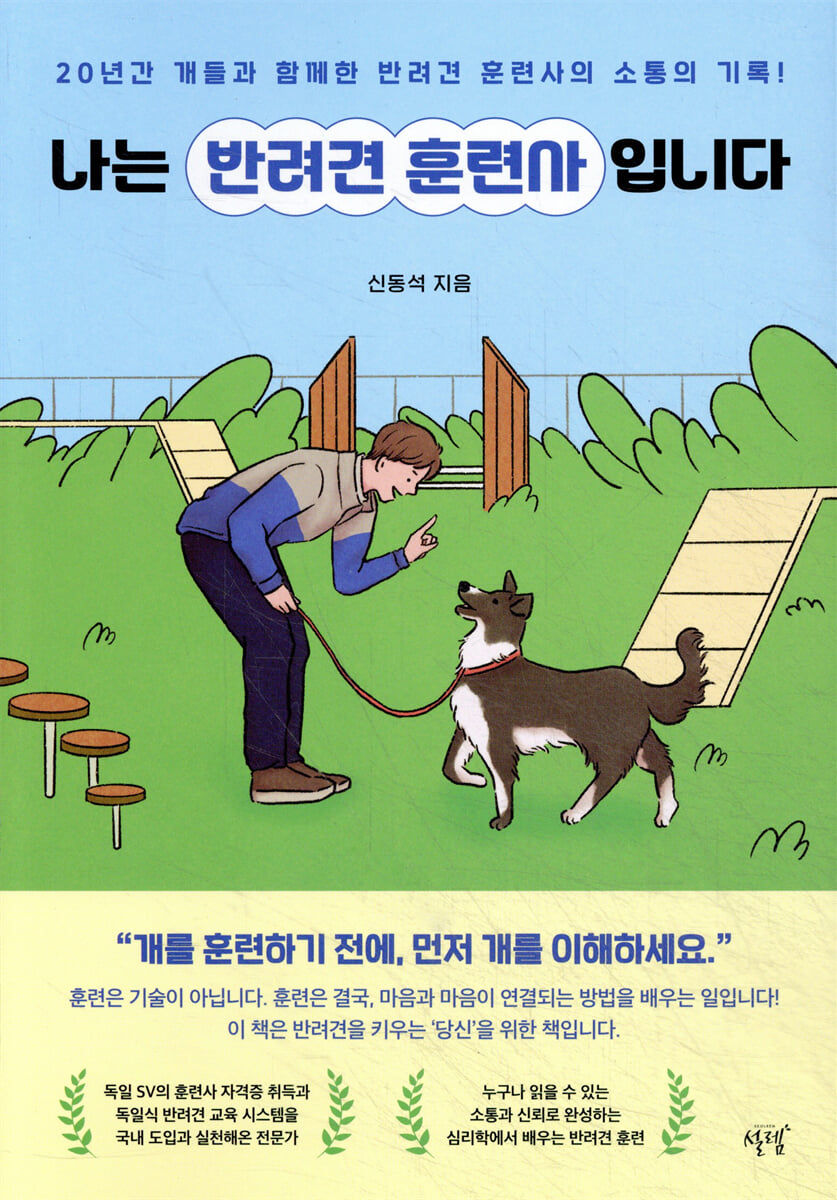 |
Description
Book Introduction
“Before you train a dog, first understand your dog.”
*****
Training is not a skill.
Training is, after all,
It's about learning how to connect hearts and minds!
******
This book is about how to 'understand' your dog.
This is a story about the 'attitude' that guardians who live together must learn!
Training isn't just for dogs.
Training is also an education for the guardians themselves.
Love is just the beginning, living together requires 'understanding' and 'responsibility'.
Dogs don't talk like people.
Their language is the little glances and actions.
Therefore, before ‘teaching’, guardians must first learn ‘how to read’.
To truly understand dogs, you need to understand their instincts and learning principles, and to change problem behavior, trust must come before discipline.
This book is the story of my journey with my dogs for over 20 years.
And it is a record of the time shared with the people who were with them.
For those who thought, "Training is for professionals" or "My child won't be able to do it," the first thing that will change the moment you read this book will be "you," not your dog.
When you change, your dog will definitely change too.
The change will not be just a behavior, but an experience that changes the way you love.
*****
Training is not a skill.
Training is, after all,
It's about learning how to connect hearts and minds!
******
This book is about how to 'understand' your dog.
This is a story about the 'attitude' that guardians who live together must learn!
Training isn't just for dogs.
Training is also an education for the guardians themselves.
Love is just the beginning, living together requires 'understanding' and 'responsibility'.
Dogs don't talk like people.
Their language is the little glances and actions.
Therefore, before ‘teaching’, guardians must first learn ‘how to read’.
To truly understand dogs, you need to understand their instincts and learning principles, and to change problem behavior, trust must come before discipline.
This book is the story of my journey with my dogs for over 20 years.
And it is a record of the time shared with the people who were with them.
For those who thought, "Training is for professionals" or "My child won't be able to do it," the first thing that will change the moment you read this book will be "you," not your dog.
When you change, your dog will definitely change too.
The change will not be just a behavior, but an experience that changes the way you love.
index
Prologue: I am a dog trainer · 4
Chapter 1: The Weight of the Name "Trainer"
The Child Who Loved Animals: Why I Became a Trainer · 14
Between Love and Regret, My Decision to Go to Germany · 17
Learning the Essentials of Training Through Meeting Real Dogs · 21
My First Test in Life · 25
Things More Important Than Being a Good Trainer · 29
The Dogs I Met, The Philosophy I Learned · 32
Chapter 2: Principles of Psychology for Understanding Companion Dogs
Understanding Dog Instincts · 38
What Do Dogs Think? · 42
Dogs of the same breed, with different personalities · 46
Calming Signals: Learning the Language of Dogs · 51
How Do Dogs Learn? Classical Conditioning and Operant Conditioning · 60
Friends who learn by imitating: Types of guardians and imitation learning · 63
Even difficult training becomes easier when you break it down one by one. Self-efficacy and formative skills · 70
Three Behavior Modification Methods: Flood Control, Desensitization, and Counterconditioning · 76
Why Familiar Behaviors Disappear: Extinction and Reinforcement Schedules · 81
Chapter 3: If you love your dog, you should know this.
Promise with Your Dog · 92
It doesn't happen overnight · 98
Different training methods apply · 103
108 Things You Should Know Before Getting a Dog
Love Alone Isn't Enough · 117
Consistency is the Best Training · 122
Chapter 4: The One Who Needs to Change Before Their Dogs: Their Guardians
If you want to change, you must change yourself first. · 126
Training doesn't end with the trainer · 130
90% of training failures are actually the fault of the guardians · 134
Explain, Don't Scold · 137
Anxiety, frustration, anticipation, and even quiet hope · 141
'Problem Behavior' Isn't the Problem · 147
Chapter 5: A Day with Your Dog, Starting Now
"Following" Training: Making Walking More Enjoyable · 152
A child who runs when called: "Come here" education · 157
"Wait" Education: Building Patience and Stability · 160
Toilet Training: No Toilet Accidents · 165
The Power of Living Together: Socialization Education · 169
"Mobility Education" for Children Afraid of Cars · 173
Chapter 6: Correcting Problem Behavior: How to Change Your Dog's Behavior
How to correct excessive barking · 180
Correcting Aggression: Biting People · 185
Correcting the Stress-Expressed "Biting" · 190
I can't be alone. How to fix separation anxiety · 195
Correcting Excessive Possessiveness When "It's Mine!" Goes Too Far? 199
I don't eat rice. Correcting 'picky eating and eating habits' · 203
Every grooming, bathing, and nail trimming is a battle. Correcting 'touch sensitivity' · 207
Chapter 7: Walking with Your Dog
How Are Trainers Trained? · 212
The Reality of Starting a Trainer Business · 216
Even trainers ultimately meet people · 219
Is Korea's pet culture okay as it is? · 222
Epilogue: Raising a Dog Is a Responsibility · 225
Chapter 1: The Weight of the Name "Trainer"
The Child Who Loved Animals: Why I Became a Trainer · 14
Between Love and Regret, My Decision to Go to Germany · 17
Learning the Essentials of Training Through Meeting Real Dogs · 21
My First Test in Life · 25
Things More Important Than Being a Good Trainer · 29
The Dogs I Met, The Philosophy I Learned · 32
Chapter 2: Principles of Psychology for Understanding Companion Dogs
Understanding Dog Instincts · 38
What Do Dogs Think? · 42
Dogs of the same breed, with different personalities · 46
Calming Signals: Learning the Language of Dogs · 51
How Do Dogs Learn? Classical Conditioning and Operant Conditioning · 60
Friends who learn by imitating: Types of guardians and imitation learning · 63
Even difficult training becomes easier when you break it down one by one. Self-efficacy and formative skills · 70
Three Behavior Modification Methods: Flood Control, Desensitization, and Counterconditioning · 76
Why Familiar Behaviors Disappear: Extinction and Reinforcement Schedules · 81
Chapter 3: If you love your dog, you should know this.
Promise with Your Dog · 92
It doesn't happen overnight · 98
Different training methods apply · 103
108 Things You Should Know Before Getting a Dog
Love Alone Isn't Enough · 117
Consistency is the Best Training · 122
Chapter 4: The One Who Needs to Change Before Their Dogs: Their Guardians
If you want to change, you must change yourself first. · 126
Training doesn't end with the trainer · 130
90% of training failures are actually the fault of the guardians · 134
Explain, Don't Scold · 137
Anxiety, frustration, anticipation, and even quiet hope · 141
'Problem Behavior' Isn't the Problem · 147
Chapter 5: A Day with Your Dog, Starting Now
"Following" Training: Making Walking More Enjoyable · 152
A child who runs when called: "Come here" education · 157
"Wait" Education: Building Patience and Stability · 160
Toilet Training: No Toilet Accidents · 165
The Power of Living Together: Socialization Education · 169
"Mobility Education" for Children Afraid of Cars · 173
Chapter 6: Correcting Problem Behavior: How to Change Your Dog's Behavior
How to correct excessive barking · 180
Correcting Aggression: Biting People · 185
Correcting the Stress-Expressed "Biting" · 190
I can't be alone. How to fix separation anxiety · 195
Correcting Excessive Possessiveness When "It's Mine!" Goes Too Far? 199
I don't eat rice. Correcting 'picky eating and eating habits' · 203
Every grooming, bathing, and nail trimming is a battle. Correcting 'touch sensitivity' · 207
Chapter 7: Walking with Your Dog
How Are Trainers Trained? · 212
The Reality of Starting a Trainer Business · 216
Even trainers ultimately meet people · 219
Is Korea's pet culture okay as it is? · 222
Epilogue: Raising a Dog Is a Responsibility · 225
Detailed image

Into the book
I began my journey as a trainer in earnest when I entered a dog school as an apprentice. It was a repetitive cycle of caring for, exercising, and training dogs from dawn to dusk.
My body was tired and my hands and feet were always covered in wounds, but I was so happy every day I spent with the dogs.
It was a time when I felt more grateful than I did when things were difficult.
But as time passed, within that happiness, an uncomfortable and strange feeling began to rise.
In 1997, training methods in Korea were very different from today.
Training prioritized experience over knowledge, and experience meant repetition of corporal punishment.
At that time, there was almost no systematic training theory or psychological approach, and it was closer to 'training' than education.
The main method of 'controlling' dogs was to yell at them for barking and to pull hard on the leash or spank the buttocks of dogs that did not sit.
I was taught that it was an effective method, and everyone around me learned and followed suit, so I was no exception.
At first, I didn't know much about training methods, so I just trained the dogs forcefully by hitting them as I was taught.
--- p.17~18
The way trainers treat dogs in Germany is very different from what I saw in Korea.
It was not centered on corporal punishment, but rather on ‘training that provides opportunities.’
Rather than scolding the dog when it does something wrong, create an environment that allows the dog to do the right thing.
Through the process of waiting, praising, and repeating, the dog develops self-esteem and learns to control its own behavior.
At that time, I already had a trainer's license in Korea and was confident that I was quite good at training.
But the moment I saw the first training scene in Germany, I realized.
'I knew nothing about dogs.' Their training was not simply about controlling or obeying dogs.
Scenes unfolding before my eyes every day, as if an invisible conversation were taking place between a dog and a person.
And what really surprised me the most was the ‘relationship’ between the guardian and the dog.
--- p.21
I lived in Germany and encountered real training and real dogs.
I felt for the first time that training is not simply about giving orders to a dog, but about how to build a relationship between a person and a dog, and that the trust built within that relationship is the beginning and the whole of training.
And as I watched their training methods, I realized that my training philosophy completely changed.
What I learned in Korea is, 'If you give an order, you have to obey, and if you don't obey, you'll be shocked.
It was a simple structure of 'and you have to satisfy them to get a reward', but what I learned in Germany was a much deeper level of trust and communication.
It's not just about creating a 'dog that listens well', but a 'dog that lives with people'.
This is the real training I've been dreaming of.
--- p.24
Among them, there are two tests that are most memorable.
One is VDH's 'Hundefuhrerschein', the other is SV's 'Ubungsleiter'.
'Hundefurerschein' is Germany's official handler qualification exam.
It is divided into a written and a practical test. The written test consists of 30 multiple-choice questions, and the practical test is an on-site test that involves handling a companion dog.
I took the test with Germans, and since my German isn't perfect, I studied the rules and sample questions almost by heart.
Even though I was still unsure, surprisingly, I got first place in the written test and first place in the practical test, and passed the final exam in first place.
The joy was indescribable.
But what was more valuable than that was the experience of ‘doing it.’
This is because it was the result of a foreigner who was not even good at German and kept challenging himself until the end.
Another challenge was the 'Weebungslighter'.
Even in Germany, it is the highest level of trainer certification, held by only 10% of trainers, and uniquely, it confers both the qualification to train dogs and the qualification to train their guardians.
In other words, it is a training exam that allows you to teach people. The written exam is entirely subjective, and requires you to analyze your values and philosophy as a trainer, as well as your training and behavior.
The practical skills require a high level of perfection in all areas of obedience, search, and defense.
As I prepared for this exam, I literally ran into the very nature of training and my own limitations, and had to start from the ground up, refining and polishing everything.
But when I finally passed the exam and received my certificate, I realized something.
The result was not due to great skill, but to courage that overcame fear.
--- p.26
A trainer cannot become one just by being good at techniques.
The strength to endure failure, the will to overcome embarrassment and try again, and above all, the responsibility to repay the gaze of the dog that believed in me and followed me to the end.
They have to come together to become a true trainer. I fell, but I got back up.
And every time, what got me up were the dogs I trained with. It was as if they were talking to me.
“It’s okay, we can try again.” This whole process made me stronger and created a trainer called ‘me.’
Training isn't all about technique.
It's about trust, patience, and relationships. And the title "trainer" is a prestigious title, more so than a certificate, held only by those who have not given up on the process.
--- p.27~28
When someone asks me what makes a good trainer, I always answer, "Observational skills and sincerity come before certification."
Of course, qualifications are important.
It is a testament to the recognition of professionalism, and I myself have realized its value by passing several exams in Germany.
But the dog doesn't trust me just because of a piece of paper.
What a dog trusts is the person's 'attitude'. I think the first quality a trainer should have is emotional control.
Dogs are very sensitive animals.
A person's facial expression, gestures, and even tone of voice can have a huge impact.
The trainer must guide that sensitive creature.
So the first thing I need is the ability to control my emotions.
--- p.29
What impressed me most in Germany was the high standard of the guardians, to the point where there was no need for a separate 'trainer'.
When I went to the training club, there was a really good person handling the dogs, so I naturally assumed he was a trainer.
So I followed along and learned, and I also asked questions about various things.
It was the same in other clubs.
I believed that he was a much more experienced and skilled trainer than I was, as he trained so well, so I asked him questions diligently and learned with sincerity.
But as time passed and we became closer, we realized that they were not trainers.
They were people with ordinary jobs, such as nurses, teachers, and engineers, and they were guardians who loved their dogs.
I was really surprised.
'He trains so well, but he's not a trainer?' It was unbelievable.
--- p.33
The beginning of dog training is not ‘teaching’ but ‘understanding’.
There is a reason for behavior that seems problematic.
And most of the reason is because they are dogs and have natural instincts.
Understanding instincts will reduce the number of times your dog is unfairly scolded, and the direction of training will become clearer.
Instead of treating our dogs as 'little people', we should understand and look at them as 'dogs'.
They may not speak like humans and may express their emotions differently, but they are still capable of communicating with us.
Unlike humans who communicate through language, they live in the world through instinct and senses.
--- p.40
Dogs engage in emotion-based learning.
More important than the commands are the guardian's facial expressions, tone of voice, gestures, and overall atmosphere.
Some dogs feel more reassured by their guardian's gaze or smile than by a simple "good job."
So education is not just about passing on commands, it is also a process of sharing emotions.
A dog that came to the training center in the past did not respond at all to the command “Wait!”, but when the owner said “Wait~” in a calm tone and showed the dog an open palm, the dog stopped on its own.
This is not simply understanding the command, but reading and responding to the 'mood and signals'.
Dogs don't learn words, they learn situations and emotions.
So the most important role a guardian should play is not to be a ‘good guardian,’ but to be a ‘trustworthy guide.’
--- p.44
Companion dogs also have ‘personalities’.
And temperament is innate.
In psychology, 'temperament' refers to genetically inherited emotional responses and behavioral tendencies.
If we compare it to a person, it is like the foundation of personality.
The same goes for companion dogs.
No matter how many times you do the same training, some children learn quickly, some watch for a while and then react cautiously, and still others look at you with a look that says, "Why should I do this?"
So, training that sticks to just one method for all dogs is not effective.
Good training is closer to 'fitting well' than 'teaching well'.
--- p.47
The 'parasympathetic nervous system' is responsible for stability and recovery, lowering the heart rate, aiding digestion, and transitioning to a state of rest.
Calming signals are natural self-soothing behaviors that induce activation of the parasympathetic nervous system.
Dogs activate their parasympathetic nervous system through body language to calm themselves and send signals to others to 'calm down'.
‘Body language’ is also a language that reads a dog’s mind.
You can tell a dog's emotional state that day just by looking at its tail, and you can guess what situation a dog is in just by looking at its eyes or the tension in its body.
--- p.54
Our dogs speak to us every day: with their tails, their eyes, their posture.
Now, it is time for us, the guardians, to read those words a little more carefully.
Training should be based on conversation, not repetition of commands.
Before giving a command, first read the body language your dog is sending.
That would be the beginning of true education.
I never scold a dog in the training room if he turns his back and tries to run away during training.
Let's start by looking at what the child is trying to say now.
Because conversation always begins with ‘understanding.’
Calming signals are stronger than words.
We must learn it, understand it, and respect it.
--- p.59
The biggest difference between these two types of conditioning is that classical conditioning is passive learning centered on 'emotions' and 'expectations', while operant conditioning is active learning centered on 'behavior' and 'results'.
For example, classical conditioning is learning “what will happen in this situation?”, while operant conditioning is learning “what will happen if I do this?”
In actual training, these two are used together.
For example, if a guardian tells a dog, “Sit!” and gives it a treat when it sits, this is operant conditioning.
However, if this behavior is repeated and the word “sit!” itself creates “expectation” and “positive emotions,” then it becomes classical conditioning.
--- p.61
Ultimately, what matters is the balance between affection and control.
In order for companion dogs to become members of society and welcomed as companion animals by both dog owners and non-dog owners, they must go beyond being simply "lovable beings" to become "beings suitable for coexistence."
I really want to say this.
A companion dog is a mirror of its owner.
Depending on how we speak, how we look at others, and how we approach them, we become completely different beings.
Training is not a matter of technique.
Ultimately, it's a matter of relationships and communicating emotions.
And our dogs are always watching us.
They remember our facial expressions, our tone of voice, and our attitude.
So what kind of guardians should we be? And what kind of behavior should we display? The answer is simple.
A partner to learn together.
A friend who forgives mistakes and celebrates successes with you. Ultimately, your dog's behavior begins with you, the guardian.
--- p.69
Dogs may be slow, but they are steady.
So training is not accomplished through impatience, but through patience.
And what grows in that patience is not just a skill, but the confidence to live together.
Finally, sculpting has a positive effect not only on the dog but also on the guardian.
As guardians repeatedly experience that 'I can change my child,' they will gain confidence in training and enjoy education.
Ultimately, training is a way for everyone to grow together.
The goal of training is not just to teach your dog to sit and stand.
Spending that time together gives both the dog and the guardian the confidence that 'I can do it.'
That belief is where real training begins.
--- p.75
Training is the art of repetition and consistency.
It is just as difficult to make a dog do something as it is to make it not do something.
Especially behaviors that involve interest or reward do not disappear easily.
This is because when a guardian reacts emotionally, it often becomes a reward.
Ultimately, extinction isn't simply ignoring a behavior; it's the process of helping your dog realize that the reward for that behavior has disappeared.
And spontaneous recovery is also an opportunity to reaffirm that realization.
There's something I always tell parents.
“Dogs remember longer than you think.
And that memory comes back to me once in a while.
That's when the real test comes." Training is never-ending, but it's also an opportunity to build a deeper bond and trust with your dog.
--- p.84
A skilled trainer plans this process very precisely, step by step.
That's why dogs follow their trainer's words so amazingly well.
On the other hand, guardians are often perplexed when their dogs suddenly stop giving treats and refuse to train unless they are holding a treat.
Then he asks:
“Why does it work so well at dog school when it didn’t work at home?” The reason is right here.
This is because the trainer applies the appropriate reinforcement schedule at the right time, and the guardian rewards without knowing the principle well.
Caregivers often attempt training only when they have treats in hand.
This method causes the dog to focus solely on the treat, and will quickly break down if the environment changes or the reward is removed.
On the other hand, trainers first introduce the concept with continuous reinforcement, then maintain expectations by applying fixed and variable ratios, and finally make training habitual with fixed and variable intervals.
--- p.87
Real training should be done at home, not in the training ground, and under the care of a guardian.
In order for a dog to maintain stable behavior even when the trainer is not present, consistent trust must be shown rather than momentary emotions.
There is something I really want to tell the guardians who are reading this book.
Dog training cannot be achieved by a trainer alone.
Education is only 'complete' when the guardian puts it into practice in his or her own life.
So before you say, “I don’t think my child is doing well,” you should first reflect on yourself and ask yourself, “Was I training the same way and with the same attitude today?”
It is important to remember that the success of training depends not on the intelligence of the dog, but on the hands of the person teaching the dog.
--- p.95
Training is not just the responsibility of one guardian; it is a collaborative effort that requires the entire family to communicate signals to their dog in unison.
The most effective training is the simplest and most consistent training.
Clarity in training gives your dog a sense of security.
Dogs quickly learn “this is acceptable behavior” and “this is not acceptable behavior” and learn to regulate their own behavior within their relationship with their guardians.
By maintaining this consistency, your dog will grow into a wonderful social member, capable of self-regulation in any situation. Training isn't about teaching "skills," but rather learning "how to live together."
When our family treats our dogs with one voice, one signal, and one rule, our dogs live the most stable and happy lives in the world we create.
--- p.116
The important thing is to respect your dog.
In any case, you must approach it with respect for your dog's personality and emotions.
It is dangerous to use shock training blindly just because it is fast, or to try to solve everything with just snacks.
Training is a process of building trust between dog and guardian.
A person who thinks about "How can I make them understand?" rather than "How can I teach them?" is a truly good trainer and guardian.
Training methods are not techniques, but choices that create a relationship between dog and owner.
The wiser the choice, the more 'complete' the training will be.
--- p.107
The entire process of living together between a companion dog and its owner begins with a ‘relationship.’
Without relationships, there can be no family, no training.
Companion dogs are not creatures that follow someone's commands like a machine.
Only when we trust each other, communicate, and share our emotions can we truly begin to 'train'.
So before teaching commands, you must first open your mind.
Before you can expect obedience, you must first build trust. That's why the first step to real training isn't "Sit!" or "Wait!"
The first thing to do is 'friendship training', that is, making it so that your dog can trust you and approach you comfortably.
Then, call their name and use basic language like “No!” and “Right!” to indicate boundaries and directions. These three things: naming, becoming friendly, and indicating the boundaries of right and wrong.
Only when this is properly built up can more complex training such as “Sit!”, “Wait!”, and “Bring it!” be possible.
--- p.109
Training is about learning how to be a family.
Control without trust only leaves anxiety and conflict.
But control based on trust creates stability and freedom.
The emotions a dog feels when it looks at its owner, the emotions a dog feels when its owner calls its dog, these small emotional connections accumulate and we become a family.
And when this foundation is firmly established, all future training and routines will flow much more smoothly and naturally.
Let's remember this again.
'Training' is not 'making people do what you say', but 'learning how to live together'.
And the beginning is very simple.
Getting close, calling each other by name, and respecting each other's boundaries.
The very first conversation between a pet and its owner.
That small beginning changes all your future training, all your relationships, all your life.
--- p.116
“It was an action.”, “I missed something.” No dog has a bad heart.
Dogs do not deliberately rebel, seek revenge, or intentionally harass people.
It is not an animal capable of such complex emotions.
Dogs are simply trying to express themselves and survive in the way they can at that moment.
There is no problem.
I just don't know 'how'.
So what we need to do is not to scold them, but to change them in the right way.
A guardian once said this to me:
“Teacher, at first I really thought this child was the problem.
But now I know.
This child wasn't in trouble, he just needed help.
"I smiled when I heard that.
The training was over, but the real change was just beginning.
Problem behavior is actually a message.
‘Barking’ is an expression of loneliness, ‘biting’ is a stress relief, and ‘running around’ is an expression of pent-up energy.
Training is not about suppressing problems, but rather understanding and resolving their causes.
--- p.149
There are many different types of distractions outdoors.
Other dogs, people, food smells, etc.
In times like these, it is difficult to have them walk beside you from beginning to end.
At first, it is best to let them walk beside you for 2-3 minutes, and then let them walk freely for the rest of the time.
And as you get used to it, gradually increase the time you walk next to it.
In this way, you can naturally convey the message, “You are not walking alone, you are walking with me.”
The most important thing is consistency and patience.
Same commands, same rules, same reward system.
By repeating this, the dog will learn the rhythm of its guardian and build trust.
Positive reinforcement using treats is much more effective than coercion or corporal punishment.
If a walk becomes stressful, those feelings may eventually be directed at the caregiver.
--- p.155
If you use “Come here!” when clipping your dog’s nails or giving him a bath, there is a very high chance that he will run away afterwards.
“Come here!” should only be used as a signal of love, trust, and reward, not as a punishing command.
Until it becomes a habit.
When these three things are faithfully followed: 'consistent commands', 'immediate rewards', and 'positive associations', the dog will become convinced that 'good things will happen if you respond to this command'.
In this way, training is completed one by one.
“Come here!” is not just a simple technique, it is a time to confirm the relationship between the guardian and the dog.
Every time a dog approaches its owner, the owner feels moved to think, “Yes, you are a dog that communicates with me.” At that moment, the distance between them goes beyond mere physical space and even their hearts become closer.
--- p.159
'Wait' is not just a training exercise to stop an action.
This is training to teach your dog how to control his emotions.
“Wait!” is a powerful emotional regulation skill in a variety of situations, especially during stimulating situations such as during a walk, before throwing a ball, or when a treat is presented.
Ultimately, it leads to the positive learning that 'good things happen when you wait.'
One guardian said:
“At first, I wondered why my child was so impatient.
But after repeating the wait training, I found out that the child was calmer than I thought.” The key to the ‘wait’ training is consistency and the timing of rewards that connect success with praise.
When you fail, don't be discouraged, just try again.
'Wait' is a very special training that teaches your dog 'how to govern himself'.
--- p.179
Toilet training isn't just about keeping the house clean.
It is the process of a companion dog learning how to 'wait', 'express', and 'receive praise'.
It is also training for the guardian to understand the dog and read its signals.
Rather than expecting quick results, remember that it takes time to form a habit.
Mistakes are part of growth, and real learning happens when we wait and support them.
The moment your dog looks up at you after comfortably defecating in a designated spot, training becomes more than just a technique; it becomes an expression of trust and relationship.
And let's remember.
The beginning of toilet training is not blaming others for mistakes, but rather finding a solution together.
--- p.168
Finally, the most important thing to consider when becoming a dog trainer is self-confidence in answering the question, “Do I really want to do this?”
Being a trainer isn't just about loving dogs.
They have to spend more time interacting with people than dogs, and they constantly face unexpected situations in the field.
So this work requires not only dreams and will, but also patience, sincerity, and courage.
A good trainer isn't made overnight.
It is absolutely necessary to go through a process of self-improvement through physical contact and meeting numerous dogs and people.
Even if the path may be a little slow, walking steadily is the only way to grow into a true trainer.
--- p.214
While one's own specialized field is essential, overall training skills are essential, and now a business-oriented mindset is also essential.
In addition to being well-trained, you must be able to handle multiple roles, including facility management, staff management, marketing, and customer service.
In short, training capacity alone cannot sustain a training center.
Therefore, anyone preparing to start a training business must objectively assess their strengths and weaknesses and prepare various capabilities.
Of course, it's not all difficult.
As you build trust, you'll start to build regular customers, and the rewards you feel as a trainer when you see more and more guardians empathizing with your training philosophy are indescribable.
The greatest value of this job is when the dogs I've trained change and their guardians smile and say, "Thank you so much."
Starting a business as a trainer goes beyond simply having a job; it carries a deeper meaning: establishing your own philosophy and living your life based on that philosophy.
Reality is harsh, but if you can quietly walk your own path within it, becoming a trainer will certainly be a wonderful path.
--- p.218
As I progress through the training, I often feel like I've become a psychologist.
When I see the expressions on the faces of guardians who say things like, “He’s been so disobedient lately,” “He only does this to me,” or “Did I do something wrong?”, I realize that this isn’t just a simple training issue.
This is because the dog's behavior directly reflects the owner's emotions, daily life, relationships, and lifestyle habits.
Some days, the guardians even shed tears.
After a while of talking, the talk about training disappears and instead, more stories about one's own life emerge.
I think it is the trainer's role to listen to such stories until the end.
Because real training begins when you understand both the dog and the person.
My body was tired and my hands and feet were always covered in wounds, but I was so happy every day I spent with the dogs.
It was a time when I felt more grateful than I did when things were difficult.
But as time passed, within that happiness, an uncomfortable and strange feeling began to rise.
In 1997, training methods in Korea were very different from today.
Training prioritized experience over knowledge, and experience meant repetition of corporal punishment.
At that time, there was almost no systematic training theory or psychological approach, and it was closer to 'training' than education.
The main method of 'controlling' dogs was to yell at them for barking and to pull hard on the leash or spank the buttocks of dogs that did not sit.
I was taught that it was an effective method, and everyone around me learned and followed suit, so I was no exception.
At first, I didn't know much about training methods, so I just trained the dogs forcefully by hitting them as I was taught.
--- p.17~18
The way trainers treat dogs in Germany is very different from what I saw in Korea.
It was not centered on corporal punishment, but rather on ‘training that provides opportunities.’
Rather than scolding the dog when it does something wrong, create an environment that allows the dog to do the right thing.
Through the process of waiting, praising, and repeating, the dog develops self-esteem and learns to control its own behavior.
At that time, I already had a trainer's license in Korea and was confident that I was quite good at training.
But the moment I saw the first training scene in Germany, I realized.
'I knew nothing about dogs.' Their training was not simply about controlling or obeying dogs.
Scenes unfolding before my eyes every day, as if an invisible conversation were taking place between a dog and a person.
And what really surprised me the most was the ‘relationship’ between the guardian and the dog.
--- p.21
I lived in Germany and encountered real training and real dogs.
I felt for the first time that training is not simply about giving orders to a dog, but about how to build a relationship between a person and a dog, and that the trust built within that relationship is the beginning and the whole of training.
And as I watched their training methods, I realized that my training philosophy completely changed.
What I learned in Korea is, 'If you give an order, you have to obey, and if you don't obey, you'll be shocked.
It was a simple structure of 'and you have to satisfy them to get a reward', but what I learned in Germany was a much deeper level of trust and communication.
It's not just about creating a 'dog that listens well', but a 'dog that lives with people'.
This is the real training I've been dreaming of.
--- p.24
Among them, there are two tests that are most memorable.
One is VDH's 'Hundefuhrerschein', the other is SV's 'Ubungsleiter'.
'Hundefurerschein' is Germany's official handler qualification exam.
It is divided into a written and a practical test. The written test consists of 30 multiple-choice questions, and the practical test is an on-site test that involves handling a companion dog.
I took the test with Germans, and since my German isn't perfect, I studied the rules and sample questions almost by heart.
Even though I was still unsure, surprisingly, I got first place in the written test and first place in the practical test, and passed the final exam in first place.
The joy was indescribable.
But what was more valuable than that was the experience of ‘doing it.’
This is because it was the result of a foreigner who was not even good at German and kept challenging himself until the end.
Another challenge was the 'Weebungslighter'.
Even in Germany, it is the highest level of trainer certification, held by only 10% of trainers, and uniquely, it confers both the qualification to train dogs and the qualification to train their guardians.
In other words, it is a training exam that allows you to teach people. The written exam is entirely subjective, and requires you to analyze your values and philosophy as a trainer, as well as your training and behavior.
The practical skills require a high level of perfection in all areas of obedience, search, and defense.
As I prepared for this exam, I literally ran into the very nature of training and my own limitations, and had to start from the ground up, refining and polishing everything.
But when I finally passed the exam and received my certificate, I realized something.
The result was not due to great skill, but to courage that overcame fear.
--- p.26
A trainer cannot become one just by being good at techniques.
The strength to endure failure, the will to overcome embarrassment and try again, and above all, the responsibility to repay the gaze of the dog that believed in me and followed me to the end.
They have to come together to become a true trainer. I fell, but I got back up.
And every time, what got me up were the dogs I trained with. It was as if they were talking to me.
“It’s okay, we can try again.” This whole process made me stronger and created a trainer called ‘me.’
Training isn't all about technique.
It's about trust, patience, and relationships. And the title "trainer" is a prestigious title, more so than a certificate, held only by those who have not given up on the process.
--- p.27~28
When someone asks me what makes a good trainer, I always answer, "Observational skills and sincerity come before certification."
Of course, qualifications are important.
It is a testament to the recognition of professionalism, and I myself have realized its value by passing several exams in Germany.
But the dog doesn't trust me just because of a piece of paper.
What a dog trusts is the person's 'attitude'. I think the first quality a trainer should have is emotional control.
Dogs are very sensitive animals.
A person's facial expression, gestures, and even tone of voice can have a huge impact.
The trainer must guide that sensitive creature.
So the first thing I need is the ability to control my emotions.
--- p.29
What impressed me most in Germany was the high standard of the guardians, to the point where there was no need for a separate 'trainer'.
When I went to the training club, there was a really good person handling the dogs, so I naturally assumed he was a trainer.
So I followed along and learned, and I also asked questions about various things.
It was the same in other clubs.
I believed that he was a much more experienced and skilled trainer than I was, as he trained so well, so I asked him questions diligently and learned with sincerity.
But as time passed and we became closer, we realized that they were not trainers.
They were people with ordinary jobs, such as nurses, teachers, and engineers, and they were guardians who loved their dogs.
I was really surprised.
'He trains so well, but he's not a trainer?' It was unbelievable.
--- p.33
The beginning of dog training is not ‘teaching’ but ‘understanding’.
There is a reason for behavior that seems problematic.
And most of the reason is because they are dogs and have natural instincts.
Understanding instincts will reduce the number of times your dog is unfairly scolded, and the direction of training will become clearer.
Instead of treating our dogs as 'little people', we should understand and look at them as 'dogs'.
They may not speak like humans and may express their emotions differently, but they are still capable of communicating with us.
Unlike humans who communicate through language, they live in the world through instinct and senses.
--- p.40
Dogs engage in emotion-based learning.
More important than the commands are the guardian's facial expressions, tone of voice, gestures, and overall atmosphere.
Some dogs feel more reassured by their guardian's gaze or smile than by a simple "good job."
So education is not just about passing on commands, it is also a process of sharing emotions.
A dog that came to the training center in the past did not respond at all to the command “Wait!”, but when the owner said “Wait~” in a calm tone and showed the dog an open palm, the dog stopped on its own.
This is not simply understanding the command, but reading and responding to the 'mood and signals'.
Dogs don't learn words, they learn situations and emotions.
So the most important role a guardian should play is not to be a ‘good guardian,’ but to be a ‘trustworthy guide.’
--- p.44
Companion dogs also have ‘personalities’.
And temperament is innate.
In psychology, 'temperament' refers to genetically inherited emotional responses and behavioral tendencies.
If we compare it to a person, it is like the foundation of personality.
The same goes for companion dogs.
No matter how many times you do the same training, some children learn quickly, some watch for a while and then react cautiously, and still others look at you with a look that says, "Why should I do this?"
So, training that sticks to just one method for all dogs is not effective.
Good training is closer to 'fitting well' than 'teaching well'.
--- p.47
The 'parasympathetic nervous system' is responsible for stability and recovery, lowering the heart rate, aiding digestion, and transitioning to a state of rest.
Calming signals are natural self-soothing behaviors that induce activation of the parasympathetic nervous system.
Dogs activate their parasympathetic nervous system through body language to calm themselves and send signals to others to 'calm down'.
‘Body language’ is also a language that reads a dog’s mind.
You can tell a dog's emotional state that day just by looking at its tail, and you can guess what situation a dog is in just by looking at its eyes or the tension in its body.
--- p.54
Our dogs speak to us every day: with their tails, their eyes, their posture.
Now, it is time for us, the guardians, to read those words a little more carefully.
Training should be based on conversation, not repetition of commands.
Before giving a command, first read the body language your dog is sending.
That would be the beginning of true education.
I never scold a dog in the training room if he turns his back and tries to run away during training.
Let's start by looking at what the child is trying to say now.
Because conversation always begins with ‘understanding.’
Calming signals are stronger than words.
We must learn it, understand it, and respect it.
--- p.59
The biggest difference between these two types of conditioning is that classical conditioning is passive learning centered on 'emotions' and 'expectations', while operant conditioning is active learning centered on 'behavior' and 'results'.
For example, classical conditioning is learning “what will happen in this situation?”, while operant conditioning is learning “what will happen if I do this?”
In actual training, these two are used together.
For example, if a guardian tells a dog, “Sit!” and gives it a treat when it sits, this is operant conditioning.
However, if this behavior is repeated and the word “sit!” itself creates “expectation” and “positive emotions,” then it becomes classical conditioning.
--- p.61
Ultimately, what matters is the balance between affection and control.
In order for companion dogs to become members of society and welcomed as companion animals by both dog owners and non-dog owners, they must go beyond being simply "lovable beings" to become "beings suitable for coexistence."
I really want to say this.
A companion dog is a mirror of its owner.
Depending on how we speak, how we look at others, and how we approach them, we become completely different beings.
Training is not a matter of technique.
Ultimately, it's a matter of relationships and communicating emotions.
And our dogs are always watching us.
They remember our facial expressions, our tone of voice, and our attitude.
So what kind of guardians should we be? And what kind of behavior should we display? The answer is simple.
A partner to learn together.
A friend who forgives mistakes and celebrates successes with you. Ultimately, your dog's behavior begins with you, the guardian.
--- p.69
Dogs may be slow, but they are steady.
So training is not accomplished through impatience, but through patience.
And what grows in that patience is not just a skill, but the confidence to live together.
Finally, sculpting has a positive effect not only on the dog but also on the guardian.
As guardians repeatedly experience that 'I can change my child,' they will gain confidence in training and enjoy education.
Ultimately, training is a way for everyone to grow together.
The goal of training is not just to teach your dog to sit and stand.
Spending that time together gives both the dog and the guardian the confidence that 'I can do it.'
That belief is where real training begins.
--- p.75
Training is the art of repetition and consistency.
It is just as difficult to make a dog do something as it is to make it not do something.
Especially behaviors that involve interest or reward do not disappear easily.
This is because when a guardian reacts emotionally, it often becomes a reward.
Ultimately, extinction isn't simply ignoring a behavior; it's the process of helping your dog realize that the reward for that behavior has disappeared.
And spontaneous recovery is also an opportunity to reaffirm that realization.
There's something I always tell parents.
“Dogs remember longer than you think.
And that memory comes back to me once in a while.
That's when the real test comes." Training is never-ending, but it's also an opportunity to build a deeper bond and trust with your dog.
--- p.84
A skilled trainer plans this process very precisely, step by step.
That's why dogs follow their trainer's words so amazingly well.
On the other hand, guardians are often perplexed when their dogs suddenly stop giving treats and refuse to train unless they are holding a treat.
Then he asks:
“Why does it work so well at dog school when it didn’t work at home?” The reason is right here.
This is because the trainer applies the appropriate reinforcement schedule at the right time, and the guardian rewards without knowing the principle well.
Caregivers often attempt training only when they have treats in hand.
This method causes the dog to focus solely on the treat, and will quickly break down if the environment changes or the reward is removed.
On the other hand, trainers first introduce the concept with continuous reinforcement, then maintain expectations by applying fixed and variable ratios, and finally make training habitual with fixed and variable intervals.
--- p.87
Real training should be done at home, not in the training ground, and under the care of a guardian.
In order for a dog to maintain stable behavior even when the trainer is not present, consistent trust must be shown rather than momentary emotions.
There is something I really want to tell the guardians who are reading this book.
Dog training cannot be achieved by a trainer alone.
Education is only 'complete' when the guardian puts it into practice in his or her own life.
So before you say, “I don’t think my child is doing well,” you should first reflect on yourself and ask yourself, “Was I training the same way and with the same attitude today?”
It is important to remember that the success of training depends not on the intelligence of the dog, but on the hands of the person teaching the dog.
--- p.95
Training is not just the responsibility of one guardian; it is a collaborative effort that requires the entire family to communicate signals to their dog in unison.
The most effective training is the simplest and most consistent training.
Clarity in training gives your dog a sense of security.
Dogs quickly learn “this is acceptable behavior” and “this is not acceptable behavior” and learn to regulate their own behavior within their relationship with their guardians.
By maintaining this consistency, your dog will grow into a wonderful social member, capable of self-regulation in any situation. Training isn't about teaching "skills," but rather learning "how to live together."
When our family treats our dogs with one voice, one signal, and one rule, our dogs live the most stable and happy lives in the world we create.
--- p.116
The important thing is to respect your dog.
In any case, you must approach it with respect for your dog's personality and emotions.
It is dangerous to use shock training blindly just because it is fast, or to try to solve everything with just snacks.
Training is a process of building trust between dog and guardian.
A person who thinks about "How can I make them understand?" rather than "How can I teach them?" is a truly good trainer and guardian.
Training methods are not techniques, but choices that create a relationship between dog and owner.
The wiser the choice, the more 'complete' the training will be.
--- p.107
The entire process of living together between a companion dog and its owner begins with a ‘relationship.’
Without relationships, there can be no family, no training.
Companion dogs are not creatures that follow someone's commands like a machine.
Only when we trust each other, communicate, and share our emotions can we truly begin to 'train'.
So before teaching commands, you must first open your mind.
Before you can expect obedience, you must first build trust. That's why the first step to real training isn't "Sit!" or "Wait!"
The first thing to do is 'friendship training', that is, making it so that your dog can trust you and approach you comfortably.
Then, call their name and use basic language like “No!” and “Right!” to indicate boundaries and directions. These three things: naming, becoming friendly, and indicating the boundaries of right and wrong.
Only when this is properly built up can more complex training such as “Sit!”, “Wait!”, and “Bring it!” be possible.
--- p.109
Training is about learning how to be a family.
Control without trust only leaves anxiety and conflict.
But control based on trust creates stability and freedom.
The emotions a dog feels when it looks at its owner, the emotions a dog feels when its owner calls its dog, these small emotional connections accumulate and we become a family.
And when this foundation is firmly established, all future training and routines will flow much more smoothly and naturally.
Let's remember this again.
'Training' is not 'making people do what you say', but 'learning how to live together'.
And the beginning is very simple.
Getting close, calling each other by name, and respecting each other's boundaries.
The very first conversation between a pet and its owner.
That small beginning changes all your future training, all your relationships, all your life.
--- p.116
“It was an action.”, “I missed something.” No dog has a bad heart.
Dogs do not deliberately rebel, seek revenge, or intentionally harass people.
It is not an animal capable of such complex emotions.
Dogs are simply trying to express themselves and survive in the way they can at that moment.
There is no problem.
I just don't know 'how'.
So what we need to do is not to scold them, but to change them in the right way.
A guardian once said this to me:
“Teacher, at first I really thought this child was the problem.
But now I know.
This child wasn't in trouble, he just needed help.
"I smiled when I heard that.
The training was over, but the real change was just beginning.
Problem behavior is actually a message.
‘Barking’ is an expression of loneliness, ‘biting’ is a stress relief, and ‘running around’ is an expression of pent-up energy.
Training is not about suppressing problems, but rather understanding and resolving their causes.
--- p.149
There are many different types of distractions outdoors.
Other dogs, people, food smells, etc.
In times like these, it is difficult to have them walk beside you from beginning to end.
At first, it is best to let them walk beside you for 2-3 minutes, and then let them walk freely for the rest of the time.
And as you get used to it, gradually increase the time you walk next to it.
In this way, you can naturally convey the message, “You are not walking alone, you are walking with me.”
The most important thing is consistency and patience.
Same commands, same rules, same reward system.
By repeating this, the dog will learn the rhythm of its guardian and build trust.
Positive reinforcement using treats is much more effective than coercion or corporal punishment.
If a walk becomes stressful, those feelings may eventually be directed at the caregiver.
--- p.155
If you use “Come here!” when clipping your dog’s nails or giving him a bath, there is a very high chance that he will run away afterwards.
“Come here!” should only be used as a signal of love, trust, and reward, not as a punishing command.
Until it becomes a habit.
When these three things are faithfully followed: 'consistent commands', 'immediate rewards', and 'positive associations', the dog will become convinced that 'good things will happen if you respond to this command'.
In this way, training is completed one by one.
“Come here!” is not just a simple technique, it is a time to confirm the relationship between the guardian and the dog.
Every time a dog approaches its owner, the owner feels moved to think, “Yes, you are a dog that communicates with me.” At that moment, the distance between them goes beyond mere physical space and even their hearts become closer.
--- p.159
'Wait' is not just a training exercise to stop an action.
This is training to teach your dog how to control his emotions.
“Wait!” is a powerful emotional regulation skill in a variety of situations, especially during stimulating situations such as during a walk, before throwing a ball, or when a treat is presented.
Ultimately, it leads to the positive learning that 'good things happen when you wait.'
One guardian said:
“At first, I wondered why my child was so impatient.
But after repeating the wait training, I found out that the child was calmer than I thought.” The key to the ‘wait’ training is consistency and the timing of rewards that connect success with praise.
When you fail, don't be discouraged, just try again.
'Wait' is a very special training that teaches your dog 'how to govern himself'.
--- p.179
Toilet training isn't just about keeping the house clean.
It is the process of a companion dog learning how to 'wait', 'express', and 'receive praise'.
It is also training for the guardian to understand the dog and read its signals.
Rather than expecting quick results, remember that it takes time to form a habit.
Mistakes are part of growth, and real learning happens when we wait and support them.
The moment your dog looks up at you after comfortably defecating in a designated spot, training becomes more than just a technique; it becomes an expression of trust and relationship.
And let's remember.
The beginning of toilet training is not blaming others for mistakes, but rather finding a solution together.
--- p.168
Finally, the most important thing to consider when becoming a dog trainer is self-confidence in answering the question, “Do I really want to do this?”
Being a trainer isn't just about loving dogs.
They have to spend more time interacting with people than dogs, and they constantly face unexpected situations in the field.
So this work requires not only dreams and will, but also patience, sincerity, and courage.
A good trainer isn't made overnight.
It is absolutely necessary to go through a process of self-improvement through physical contact and meeting numerous dogs and people.
Even if the path may be a little slow, walking steadily is the only way to grow into a true trainer.
--- p.214
While one's own specialized field is essential, overall training skills are essential, and now a business-oriented mindset is also essential.
In addition to being well-trained, you must be able to handle multiple roles, including facility management, staff management, marketing, and customer service.
In short, training capacity alone cannot sustain a training center.
Therefore, anyone preparing to start a training business must objectively assess their strengths and weaknesses and prepare various capabilities.
Of course, it's not all difficult.
As you build trust, you'll start to build regular customers, and the rewards you feel as a trainer when you see more and more guardians empathizing with your training philosophy are indescribable.
The greatest value of this job is when the dogs I've trained change and their guardians smile and say, "Thank you so much."
Starting a business as a trainer goes beyond simply having a job; it carries a deeper meaning: establishing your own philosophy and living your life based on that philosophy.
Reality is harsh, but if you can quietly walk your own path within it, becoming a trainer will certainly be a wonderful path.
--- p.218
As I progress through the training, I often feel like I've become a psychologist.
When I see the expressions on the faces of guardians who say things like, “He’s been so disobedient lately,” “He only does this to me,” or “Did I do something wrong?”, I realize that this isn’t just a simple training issue.
This is because the dog's behavior directly reflects the owner's emotions, daily life, relationships, and lifestyle habits.
Some days, the guardians even shed tears.
After a while of talking, the talk about training disappears and instead, more stories about one's own life emerge.
I think it is the trainer's role to listen to such stories until the end.
Because real training begins when you understand both the dog and the person.
--- p.221
Publisher's Review
A record of communication from a dog trainer who has worked with dogs for 20 years!
This book is for you, the person who raises a companion dog!
Please understand your dog better than now and love him more warmly.
Now, it's your turn to take that first step!
Training is not about teaching commands.
Training is a process of learning how to read minds and understand each other.
This book is not just a training manual.
This is a story about how to 'understand' a living creature called a companion dog, and the 'attitude' that must be learned first from the perspective of a 'guardian' in order to live together.
I have compiled the training philosophy and psychological theories that I have learned through my field experience and direct study in Germany into a book that is 'easy for anyone to read.'
I decided to write this book because the faces of the countless companion dogs I've met throughout my life, and even more guardians, came to mind.
They all loved their dogs.
But sometimes, that love was clumsy because we didn't know how to do it, and sometimes, excessive love made the child more anxious.
The most important thing I could say at that time was, “Love alone is not enough.
It was just one word: “Understanding is needed.”
Training isn't just for dogs.
Training is also an education for the guardians themselves.
Love is just the beginning, living together requires 'understanding' and 'responsibility'.
If the only reason you opened this book was because of your dog's behavioral problems, then your concerns are well-founded.
Dogs don't talk like people.
Their language is the little glances and actions.
Therefore, before ‘teaching’, guardians must first learn ‘how to read’.
To truly understand dogs, you need to understand their instincts and learning principles, and to change problem behaviors, trust must come before discipline.
This book is for you, the person who raises a companion dog!
Please understand your dog better than now and love him more warmly.
Now, it's your turn to take that first step!
Training is not about teaching commands.
Training is a process of learning how to read minds and understand each other.
This book is not just a training manual.
This is a story about how to 'understand' a living creature called a companion dog, and the 'attitude' that must be learned first from the perspective of a 'guardian' in order to live together.
I have compiled the training philosophy and psychological theories that I have learned through my field experience and direct study in Germany into a book that is 'easy for anyone to read.'
I decided to write this book because the faces of the countless companion dogs I've met throughout my life, and even more guardians, came to mind.
They all loved their dogs.
But sometimes, that love was clumsy because we didn't know how to do it, and sometimes, excessive love made the child more anxious.
The most important thing I could say at that time was, “Love alone is not enough.
It was just one word: “Understanding is needed.”
Training isn't just for dogs.
Training is also an education for the guardians themselves.
Love is just the beginning, living together requires 'understanding' and 'responsibility'.
If the only reason you opened this book was because of your dog's behavioral problems, then your concerns are well-founded.
Dogs don't talk like people.
Their language is the little glances and actions.
Therefore, before ‘teaching’, guardians must first learn ‘how to read’.
To truly understand dogs, you need to understand their instincts and learning principles, and to change problem behaviors, trust must come before discipline.
GOODS SPECIFICS
- Date of issue: September 1, 2025
- Page count, weight, size: 226 pages | 146*209*20mm
- ISBN13: 9791167852793
- ISBN10: 1167852796
You may also like
카테고리
korean


korean

![GQ KOREA Mark (Monthly): December [2025]](http://librairie.coreenne.fr/cdn/shop/files/8ef265dbbfbf186523ed75ba7319009d.jpg?v=1765340328&width=3840)


