

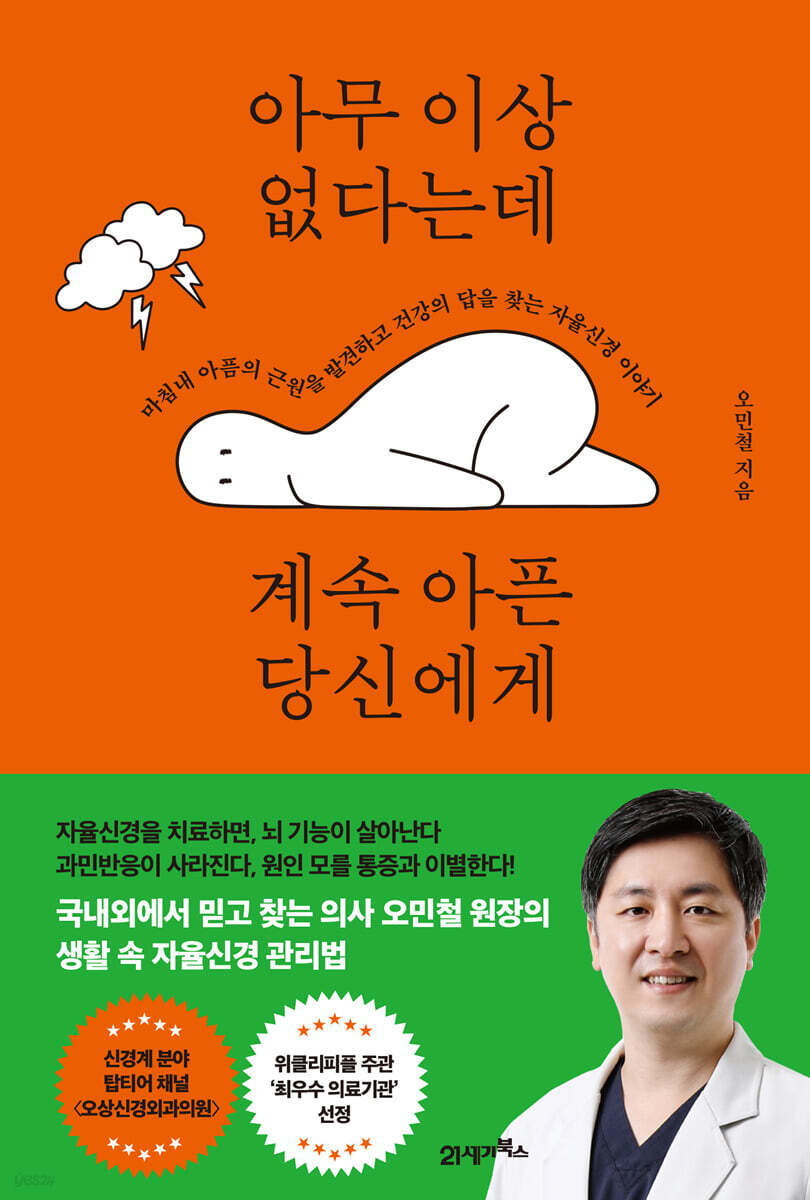
To you who is still sick even though there is nothing wrong
 |
Description
Book Introduction
Time to add health to my life, the '100-Year Life' series.
Treating the autonomic nervous system revives brain function.
Hypersensitivity disappears, and unexplained pain is said to be gone!
Director Oh Min-cheol, a trusted and sought-after doctor from home and abroad
How to manage your autonomic nervous system in daily life
All the knowledge you need to live a healthy life is gathered together! The fourth book in the "100-Year-Old Life" series, a fascinating knowledge experience presented by Korea's leading medical team, has been published.
The Life 100-Year-Old Series provides the most practical health and cultural content for the 100-year lifespan era, carefully selecting the best medical knowledge in Korea.
It is a family brand of the 'Life's Best Rivers' series, a knowledge and culture brand that allows you to encounter the best knowledge content in everyday life through online lectures, YouTube, and podcasts.
Neuropathic symptoms cause pain throughout our body.
There are dozens of different types, from headaches to stomachaches, flushing, and fibromyalgia.
“To You Who Still Feels Painful Even When You Say There’s Nothing Wrong” diagnoses the cause of these neurotic symptoms as “dysautonomous nervous system disorder” and seeks out a treatment method.
Director Oh Min-cheol, a neurosurgeon who has focused on researching and treating the autonomic nervous system, was in charge of writing the book.
If stress is wreaking havoc on your body, or if you're experiencing psychological issues beyond physical discomfort, you'll find answers in this book.
Treating the autonomic nervous system revives brain function.
Hypersensitivity disappears, and unexplained pain is said to be gone!
Director Oh Min-cheol, a trusted and sought-after doctor from home and abroad
How to manage your autonomic nervous system in daily life
All the knowledge you need to live a healthy life is gathered together! The fourth book in the "100-Year-Old Life" series, a fascinating knowledge experience presented by Korea's leading medical team, has been published.
The Life 100-Year-Old Series provides the most practical health and cultural content for the 100-year lifespan era, carefully selecting the best medical knowledge in Korea.
It is a family brand of the 'Life's Best Rivers' series, a knowledge and culture brand that allows you to encounter the best knowledge content in everyday life through online lectures, YouTube, and podcasts.
Neuropathic symptoms cause pain throughout our body.
There are dozens of different types, from headaches to stomachaches, flushing, and fibromyalgia.
“To You Who Still Feels Painful Even When You Say There’s Nothing Wrong” diagnoses the cause of these neurotic symptoms as “dysautonomous nervous system disorder” and seeks out a treatment method.
Director Oh Min-cheol, a neurosurgeon who has focused on researching and treating the autonomic nervous system, was in charge of writing the book.
If stress is wreaking havoc on your body, or if you're experiencing psychological issues beyond physical discomfort, you'll find answers in this book.
- You can preview some of the book's contents.
Preview
index
Introduction: It's not personality, it's nerves.
Part 1: Nervous nerves
Chapter 1: The Invisible Hand of My Body, the Autonomic Nervous System
The link between stress and the autonomic nervous system
Feeling sick for no reason? Everything you need to know about dysautonomia.
Chapter 2 When your head feels stuffy
I feel suffocated, like my head is foggy.
Chronic fatigue is a daily occurrence.
I have a hard time falling asleep.
If you drink energy drinks when you're tired, you'll get even more tired.
I have no problem with my ears, but I am suffering from tinnitus.
Chapter 3: The Encyclopedia of All the Pain in the World
I have a bad headache and I feel dizzy.
My headaches recur in regular cycles.
Why does my head only hurt on one side?
My eyes are so sore
Part 2: There's also a blush in emotions
Chapter 1 To you, whose heart races at the slightest moment
I get startled and my heart pounds easily.
My chest feels tight and it's hard to breathe.
Is panic disorder also a form of autonomic dysfunction?
Chapter 2: A blushing face is also a disease
My face is burning up and I'm in pain.
I had severe flushing after spinal surgery.
The cold sweat won't stop
Part 3: The nerves of people with sensitive bodies and minds
Chapter 1 I thought it was a problem inside
My stomach is so sensitive that I even got depressed.
I feel bloated and dizzy
I live with indigestion
Chapter 2: The Identity of Intangible Pain
My arms hurt like they've been electrocuted.
Pain persists after shingles
When the weather gets cold, my body hurts.
My whole body hurts, but the hospital says there's nothing wrong.
Are your headaches and dizziness due to forward head posture?
Is there a connection between posture and skin problems?
Chapter 3: The Autonomic Nervous System is Everywhere
The rebellion that occurs when the immune system breaks down
Parkinson's disease warning
Hair loss is also a nerve problem
My tongue feels like it's burning
How long should I take tranquilizers?
supplement
Restoring the Autonomic Nervous System: Hospital Treatments That Work Well Together with Self-Care
The body, like a battery, needs to be recharged.
How to Control Your Autonomic Nervous System Without Medication
Injection treatment that provides temporary relief to the nerves
TMS therapy to stimulate the brain
Aromatherapy that controls with scent
Stem cells, the elixir of life within my body
Outgoing post
Part 1: Nervous nerves
Chapter 1: The Invisible Hand of My Body, the Autonomic Nervous System
The link between stress and the autonomic nervous system
Feeling sick for no reason? Everything you need to know about dysautonomia.
Chapter 2 When your head feels stuffy
I feel suffocated, like my head is foggy.
Chronic fatigue is a daily occurrence.
I have a hard time falling asleep.
If you drink energy drinks when you're tired, you'll get even more tired.
I have no problem with my ears, but I am suffering from tinnitus.
Chapter 3: The Encyclopedia of All the Pain in the World
I have a bad headache and I feel dizzy.
My headaches recur in regular cycles.
Why does my head only hurt on one side?
My eyes are so sore
Part 2: There's also a blush in emotions
Chapter 1 To you, whose heart races at the slightest moment
I get startled and my heart pounds easily.
My chest feels tight and it's hard to breathe.
Is panic disorder also a form of autonomic dysfunction?
Chapter 2: A blushing face is also a disease
My face is burning up and I'm in pain.
I had severe flushing after spinal surgery.
The cold sweat won't stop
Part 3: The nerves of people with sensitive bodies and minds
Chapter 1 I thought it was a problem inside
My stomach is so sensitive that I even got depressed.
I feel bloated and dizzy
I live with indigestion
Chapter 2: The Identity of Intangible Pain
My arms hurt like they've been electrocuted.
Pain persists after shingles
When the weather gets cold, my body hurts.
My whole body hurts, but the hospital says there's nothing wrong.
Are your headaches and dizziness due to forward head posture?
Is there a connection between posture and skin problems?
Chapter 3: The Autonomic Nervous System is Everywhere
The rebellion that occurs when the immune system breaks down
Parkinson's disease warning
Hair loss is also a nerve problem
My tongue feels like it's burning
How long should I take tranquilizers?
supplement
Restoring the Autonomic Nervous System: Hospital Treatments That Work Well Together with Self-Care
The body, like a battery, needs to be recharged.
How to Control Your Autonomic Nervous System Without Medication
Injection treatment that provides temporary relief to the nerves
TMS therapy to stimulate the brain
Aromatherapy that controls with scent
Stem cells, the elixir of life within my body
Outgoing post
Detailed image

Into the book
As the word 'autonomous' suggests, the autonomic nervous system refers to the nerves that operate on their own without our awareness.
Our bodies regulate their own responses, such as controlling blood pressure, breathing, digesting food, secreting hormones, and regulating body temperature, when their internal state changes or when they are stimulated from the outside.
Even if we don't pay attention to it, our body automatically maintains balance and plays an important role in keeping our lives safe.
--- p.23, from “The Link Between Stress and the Autonomic Nervous System”
When you get a headache, the first thing you worry about is whether there is something wrong with your brain, but in fact, most headaches are not problems with the brain itself.
99% of headaches are not caused by serious conditions such as cerebral hemorrhage or brain tumors, and the main causes are muscle tension, nerve compression, vascular problems, and autonomic nervous system imbalances.
Additionally, tension headaches are not just a problem confined to the head.
As headaches recur, the sympathetic nerves become more excited and the state of tension persists.
As a result, it is often accompanied by not only headaches, but also chest tightness, palpitations, and indigestion.
--- p.72, from “I have a severe headache and feel dizzy”
The spine is not just a simple support structure, but a 'nerve passage' closely connected to the nervous system, so spinal health can be seen as directly linked to the health of the autonomic nervous system.
Spinal surgery usually involves cutting muscles at the front or back of the spine and shaving or removing part of the vertebrae where there is a herniated disc or stenosis.
During this process, damage to the muscles, ligaments, and tendons surrounding the spine is inevitable, and adhesions or stiffness around the spine also commonly occur.
--- p.125, from “Redness worsened after spinal surgery”
If the sympathetic nervous system is continuously activated due to stress, poor posture, or hormonal changes, the body's tension may not be relieved, which may worsen the pain.
If sympathetic hyperactivity becomes chronic, the nervous system becomes hypersensitive and the central nervous system's ability to regulate pain decreases, which can lead to fibromyalgia.
Additionally, when the sympathetic nerves are overactivated, there is a decrease in serotonin secretion, a decrease in growth hormone, and a decrease in the stress response of adrenal cortex hormones.
These changes all coincide with physiological characteristics commonly found in patients with fibromyalgia.
--- p.170, from “My whole body hurts, but the hospital said there was no problem”
Many people ask, 'Isn't this injection treatment only effective for a short time?'
In reality, local anesthetics only work for about 30 minutes to 1-2 hours, so it is understandable that such questions arise.
However, this treatment aims to go beyond simply relieving symptoms during that time and restore the balance between the brain and the autonomic nervous system by repeatedly resting the sensitive sympathetic nerves.
There is an explanation I often give to patients in my outpatient clinic.
“Just as taking a 30-minute nap when you’re really tired helps you relax, giving your nerves a short rest also helps them recover their functions.”
Our bodies regulate their own responses, such as controlling blood pressure, breathing, digesting food, secreting hormones, and regulating body temperature, when their internal state changes or when they are stimulated from the outside.
Even if we don't pay attention to it, our body automatically maintains balance and plays an important role in keeping our lives safe.
--- p.23, from “The Link Between Stress and the Autonomic Nervous System”
When you get a headache, the first thing you worry about is whether there is something wrong with your brain, but in fact, most headaches are not problems with the brain itself.
99% of headaches are not caused by serious conditions such as cerebral hemorrhage or brain tumors, and the main causes are muscle tension, nerve compression, vascular problems, and autonomic nervous system imbalances.
Additionally, tension headaches are not just a problem confined to the head.
As headaches recur, the sympathetic nerves become more excited and the state of tension persists.
As a result, it is often accompanied by not only headaches, but also chest tightness, palpitations, and indigestion.
--- p.72, from “I have a severe headache and feel dizzy”
The spine is not just a simple support structure, but a 'nerve passage' closely connected to the nervous system, so spinal health can be seen as directly linked to the health of the autonomic nervous system.
Spinal surgery usually involves cutting muscles at the front or back of the spine and shaving or removing part of the vertebrae where there is a herniated disc or stenosis.
During this process, damage to the muscles, ligaments, and tendons surrounding the spine is inevitable, and adhesions or stiffness around the spine also commonly occur.
--- p.125, from “Redness worsened after spinal surgery”
If the sympathetic nervous system is continuously activated due to stress, poor posture, or hormonal changes, the body's tension may not be relieved, which may worsen the pain.
If sympathetic hyperactivity becomes chronic, the nervous system becomes hypersensitive and the central nervous system's ability to regulate pain decreases, which can lead to fibromyalgia.
Additionally, when the sympathetic nerves are overactivated, there is a decrease in serotonin secretion, a decrease in growth hormone, and a decrease in the stress response of adrenal cortex hormones.
These changes all coincide with physiological characteristics commonly found in patients with fibromyalgia.
--- p.170, from “My whole body hurts, but the hospital said there was no problem”
Many people ask, 'Isn't this injection treatment only effective for a short time?'
In reality, local anesthetics only work for about 30 minutes to 1-2 hours, so it is understandable that such questions arise.
However, this treatment aims to go beyond simply relieving symptoms during that time and restore the balance between the brain and the autonomic nervous system by repeatedly resting the sensitive sympathetic nerves.
There is an explanation I often give to patients in my outpatient clinic.
“Just as taking a 30-minute nap when you’re really tired helps you relax, giving your nerves a short rest also helps them recover their functions.”
--- p.222, from “Injection treatment that gives the nerves a moment of rest”
Publisher's Review
The hospital said I was fine, but why do I still feel sick?
Headache, fatigue, indigestion…
Neurological symptoms that even doctors didn't know about are all due to the "autonomic nervous system."
Modern people's daily lives are filled with pain and symptoms, big and small.
If you go to the hospital for a checkup due to sudden pain, there is no obvious abnormality, and the doctor prescribes medication, saying it is due to stress.
But even if you take medicine, the symptoms do not go away.
“To You Who Still Feels Pain Even When You Say There’s Nothing Wrong” is a book for those who find themselves in such frustrating situations.
This book states that many diseases that were previously considered stress-related can all be explained by 'dysautonomous nervous system disorder.'
The autonomic nervous system is a system that regulates basic life activities such as blood pressure, heart rate, body temperature, breathing, and digestion.
The sympathetic nerves, which are responsible for tension, and the parasympathetic nerves, which are responsible for relaxation, are intertwined and influence our bodily functions and mood in an invisible way.
However, stress disrupts the balance of the autonomic nervous system.
The imbalance between the sympathetic and parasympathetic nerves can cause headaches, tinnitus, chronic fatigue, facial flushing, heart palpitations, stomach pain, shortness of breath, and even stroke, Parkinson's disease, and dementia.
Author Oh Min-cheol says that true recovery begins when we focus on restoring the balance of the autonomic nervous system rather than focusing on eliminating stressors.
Dr. Oh's patients say that even though they had been to several hospitals without any improvement in their symptoms, they found new lives after receiving treatment for their autonomic nervous system.
This book contains a comprehensive discussion of the causes, management, and treatment of autonomic nervous system dysfunction, based on the author's clinical experience and patient cases of over 10 years of treating autonomic nervous system disorders.
The beginning of true healing that restores balance between body and mind
Building a stress-resistant body
Part 1 of this book explains basic concepts of the autonomic nervous system and the symptoms and causes of dysautonomia, while Part 2 connects emotions and dysautonomia.
The autonomic nervous system is involved not only in the body's physiological responses, but also in symptoms that were previously considered mental problems, such as mood swings, flushing, panic attacks, and anxiety disorders.
For readers who blame their "sensitive nature," the section of this book on managing "emotional flushing" provides a direct solution.
Part 3 addresses issues on the "peripheral nerve wire," including chronic pain, digestive problems, hair loss, immune problems, early signs of Parkinson's disease, and drug dependence.
The book's greatest insight is its integrative perspective that the peripheral nervous system, the immune system, and the sensory system are all connected to the autonomic nervous system.
If the entire body is connected as a single system and the autonomic nervous system is the one that directs it, then simply managing the autonomic nervous system could significantly improve the quality of life of modern people.
The book offers a wide range of alternatives for easing the autonomic nervous system, including five-minute deep breathing, regular sleep, diet management, steaming, and therapy.
The 'Appendix' containing the latest hospital treatment information will serve as a practical guide for patients.
The moment you close this book, you can take the first step toward breaking free from the daily grind of vague neurotic symptoms and taking control of your health.
Headache, fatigue, indigestion…
Neurological symptoms that even doctors didn't know about are all due to the "autonomic nervous system."
Modern people's daily lives are filled with pain and symptoms, big and small.
If you go to the hospital for a checkup due to sudden pain, there is no obvious abnormality, and the doctor prescribes medication, saying it is due to stress.
But even if you take medicine, the symptoms do not go away.
“To You Who Still Feels Pain Even When You Say There’s Nothing Wrong” is a book for those who find themselves in such frustrating situations.
This book states that many diseases that were previously considered stress-related can all be explained by 'dysautonomous nervous system disorder.'
The autonomic nervous system is a system that regulates basic life activities such as blood pressure, heart rate, body temperature, breathing, and digestion.
The sympathetic nerves, which are responsible for tension, and the parasympathetic nerves, which are responsible for relaxation, are intertwined and influence our bodily functions and mood in an invisible way.
However, stress disrupts the balance of the autonomic nervous system.
The imbalance between the sympathetic and parasympathetic nerves can cause headaches, tinnitus, chronic fatigue, facial flushing, heart palpitations, stomach pain, shortness of breath, and even stroke, Parkinson's disease, and dementia.
Author Oh Min-cheol says that true recovery begins when we focus on restoring the balance of the autonomic nervous system rather than focusing on eliminating stressors.
Dr. Oh's patients say that even though they had been to several hospitals without any improvement in their symptoms, they found new lives after receiving treatment for their autonomic nervous system.
This book contains a comprehensive discussion of the causes, management, and treatment of autonomic nervous system dysfunction, based on the author's clinical experience and patient cases of over 10 years of treating autonomic nervous system disorders.
The beginning of true healing that restores balance between body and mind
Building a stress-resistant body
Part 1 of this book explains basic concepts of the autonomic nervous system and the symptoms and causes of dysautonomia, while Part 2 connects emotions and dysautonomia.
The autonomic nervous system is involved not only in the body's physiological responses, but also in symptoms that were previously considered mental problems, such as mood swings, flushing, panic attacks, and anxiety disorders.
For readers who blame their "sensitive nature," the section of this book on managing "emotional flushing" provides a direct solution.
Part 3 addresses issues on the "peripheral nerve wire," including chronic pain, digestive problems, hair loss, immune problems, early signs of Parkinson's disease, and drug dependence.
The book's greatest insight is its integrative perspective that the peripheral nervous system, the immune system, and the sensory system are all connected to the autonomic nervous system.
If the entire body is connected as a single system and the autonomic nervous system is the one that directs it, then simply managing the autonomic nervous system could significantly improve the quality of life of modern people.
The book offers a wide range of alternatives for easing the autonomic nervous system, including five-minute deep breathing, regular sleep, diet management, steaming, and therapy.
The 'Appendix' containing the latest hospital treatment information will serve as a practical guide for patients.
The moment you close this book, you can take the first step toward breaking free from the daily grind of vague neurotic symptoms and taking control of your health.
GOODS SPECIFICS
- Date of issue: June 27, 2025
- Page count, weight, size: 252 pages | 356g | 142*210*17mm
- ISBN13: 9791173573446
- ISBN10: 1173573445
You may also like
카테고리
korean


korean

![GQ KOREA Mark (Monthly): December [2025]](http://librairie.coreenne.fr/cdn/shop/files/8ef265dbbfbf186523ed75ba7319009d.jpg?v=1765340328&width=3840)


