

Ten-day trip to Italy
 |
Description
Book Introduction
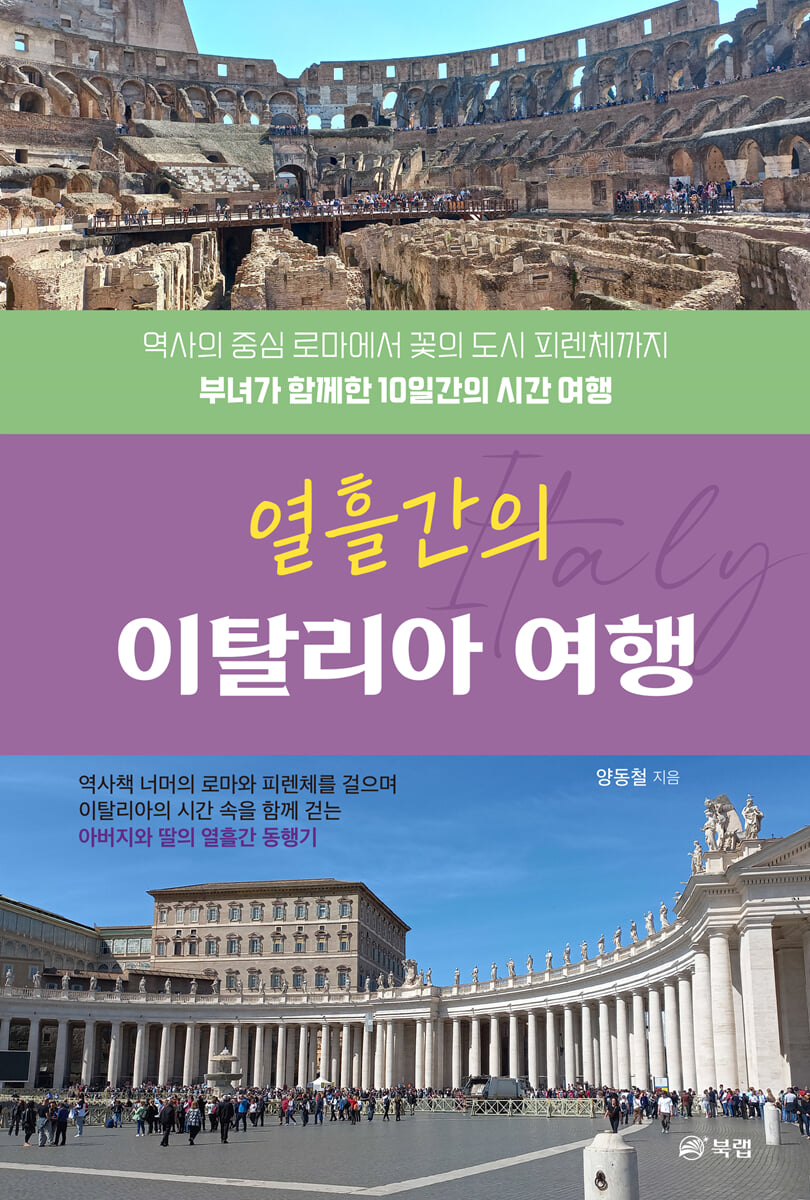
From Rome, the center of history, to Florence, the city of flowers
A 10-day time travel with a mother and daughter
Walking through Rome and Florence beyond the history books
Walking through Italian time together
A ten-day journey with a father and daughter
In Italy, the birthplace of the Renaissance
A sentimental daughter who loves art and a history buff who dreams of ancient Rome
Breaking down the generational barrier and being moved together
It was art and ruins that stood on the foundation of a thousand years of time!
The author of 『Ten Days of Paris Stroll』 wrote it from the perspective of 『Yeolha Diary』
10-day Italian travelogue
The author of “Ten Days in Paris” heads to Italy this time.
The birthplace of the Renaissance and the land where the ancient Roman Empire once stood.
Following the remaining traces of ancient Rome, the steps up Palatine Hill lead from the Vatican to the Sorrento Peninsula and then to Florence, the city of flowers.
The author is passionate about conveying the travel destinations he has seen, heard, and felt during his journey, tracing the history of ancient Rome, the evolution of the Italian Peninsula, and the birth and spread of the Renaissance.
The great and magnificent era when it was said that all roads lead to Rome has passed, but the ruins of the city still remain, welcoming travelers.
As you wander through Italy, following the thrill of tracing a lost city of history, the new experiences of an unfamiliar land, and the emotions felt while viewing art and architecture, you will soon feel as if you are standing in an exotic alley with the author. The conversations between the father and daughter, interspersed throughout the text, add vividness to the record.
Rather than introducing stereotypical tourist attractions or restaurants, this ten-day travelogue will offer a different perspective from travel guides, allowing you to slowly enjoy Italy's history and scenery as if taking a stroll.
A 10-day time travel with a mother and daughter
Walking through Rome and Florence beyond the history books
Walking through Italian time together
A ten-day journey with a father and daughter
In Italy, the birthplace of the Renaissance
A sentimental daughter who loves art and a history buff who dreams of ancient Rome
Breaking down the generational barrier and being moved together
It was art and ruins that stood on the foundation of a thousand years of time!
The author of 『Ten Days of Paris Stroll』 wrote it from the perspective of 『Yeolha Diary』
10-day Italian travelogue
The author of “Ten Days in Paris” heads to Italy this time.
The birthplace of the Renaissance and the land where the ancient Roman Empire once stood.
Following the remaining traces of ancient Rome, the steps up Palatine Hill lead from the Vatican to the Sorrento Peninsula and then to Florence, the city of flowers.
The author is passionate about conveying the travel destinations he has seen, heard, and felt during his journey, tracing the history of ancient Rome, the evolution of the Italian Peninsula, and the birth and spread of the Renaissance.
The great and magnificent era when it was said that all roads lead to Rome has passed, but the ruins of the city still remain, welcoming travelers.
As you wander through Italy, following the thrill of tracing a lost city of history, the new experiences of an unfamiliar land, and the emotions felt while viewing art and architecture, you will soon feel as if you are standing in an exotic alley with the author. The conversations between the father and daughter, interspersed throughout the text, add vividness to the record.
Rather than introducing stereotypical tourist attractions or restaurants, this ten-day travelogue will offer a different perspective from travel guides, allowing you to slowly enjoy Italy's history and scenery as if taking a stroll.
- You can preview some of the book's contents.
Preview
index
Header
01.
Exploring Ancient Rome
02.
Vatican pilgrimage
03.
A Taste of the Sorrento Peninsula
04.
First greetings from Florence
05.
Tuscany picnic
06.
Florence's historic center
07.
Uffizi Gallery
08.
Tour Tivoli
09.
Exploring Rome again
Conclusion
01.
Exploring Ancient Rome
02.
Vatican pilgrimage
03.
A Taste of the Sorrento Peninsula
04.
First greetings from Florence
05.
Tuscany picnic
06.
Florence's historic center
07.
Uffizi Gallery
08.
Tour Tivoli
09.
Exploring Rome again
Conclusion
Into the book
But how should we view the relocation of the capital to Constantinople? Depending on one's perspective, wasn't it a fatal blow to the city of Rome? After the relocation, Rome, a remote city, fell into decline, becoming a target of destruction and plunder, and becoming a ruin.
The ancient Rome we see today is nothing but ruins.
As a result, the beginning of the ruins was the move of the capital to Constantinople.
I stood in front of the Arch of Constantine and looked at the distant view.
The proudly standing triumphal arch is surrounded on all sides by the ruins of the old city of Rome.
Below the Arc de Triomphe, people from all over the world are bustling about.
--- p.35
There is another painting by Artemisia Gentileschi in the 'Iliad Room'.
This painting is of Saint Mary Magdalene, a woman more familiar to me as Mary Magdalene.
At first glance, the woman in the painting resembles Judith from “Judith and the Maid” that we just passed by.
Both had broad foreheads and distinct features, and their necks, shoulders, and slightly exposed upper chests were plump enough to be seen.
The skin is smooth and white.
The biggest difference between the two women is their facial expressions.
Judith is extremely tense given the circumstances, but the expression on Saint Mary's face is difficult to describe in a single word.
Maria, sitting on a chair, has her eyes wide open and is looking at someone above her at a 45 degree angle.
Her mouth is tightly shut, but her eyes and expression speak volumes.
It's an expression that seems sad, like it's desperately hoping for something, or if you look at it another way, it seems like it's resentful.
--- p.167
The most representative space in the Palazzo Vecchio where Giorgio Vasari played both a directorial and leading role is the Salone dei Cinquecento, known to us as the 500-person room.
This is a large auditorium.
This place, whose name comes from the fact that 500 representatives gathered here to discuss state affairs during the Florentine Republic, was a symbol of the Florentine Republic.
It would have functioned similarly to today's National Assembly plenary hall.
However, when Cosimo I became the Grand Duke and the system of hereditary monarchy was established, the character of this place changed significantly, becoming a place where the Grand Duke met with the public and a place to worship the Medici family.
To this end, Giorgio Vasari recreated the auditorium.
At that time, the 500-person room seemed to have a chaotic atmosphere.
One side of the long wall was adorned with an unfinished painting by Leonardo da Vinci, while the other side was adorned with an unfinished painting by Michelangelo.
The two paintings, in which the two masters competed against each other, were left unfinished for a long time, and no one touched them.
The ancient Rome we see today is nothing but ruins.
As a result, the beginning of the ruins was the move of the capital to Constantinople.
I stood in front of the Arch of Constantine and looked at the distant view.
The proudly standing triumphal arch is surrounded on all sides by the ruins of the old city of Rome.
Below the Arc de Triomphe, people from all over the world are bustling about.
--- p.35
There is another painting by Artemisia Gentileschi in the 'Iliad Room'.
This painting is of Saint Mary Magdalene, a woman more familiar to me as Mary Magdalene.
At first glance, the woman in the painting resembles Judith from “Judith and the Maid” that we just passed by.
Both had broad foreheads and distinct features, and their necks, shoulders, and slightly exposed upper chests were plump enough to be seen.
The skin is smooth and white.
The biggest difference between the two women is their facial expressions.
Judith is extremely tense given the circumstances, but the expression on Saint Mary's face is difficult to describe in a single word.
Maria, sitting on a chair, has her eyes wide open and is looking at someone above her at a 45 degree angle.
Her mouth is tightly shut, but her eyes and expression speak volumes.
It's an expression that seems sad, like it's desperately hoping for something, or if you look at it another way, it seems like it's resentful.
--- p.167
The most representative space in the Palazzo Vecchio where Giorgio Vasari played both a directorial and leading role is the Salone dei Cinquecento, known to us as the 500-person room.
This is a large auditorium.
This place, whose name comes from the fact that 500 representatives gathered here to discuss state affairs during the Florentine Republic, was a symbol of the Florentine Republic.
It would have functioned similarly to today's National Assembly plenary hall.
However, when Cosimo I became the Grand Duke and the system of hereditary monarchy was established, the character of this place changed significantly, becoming a place where the Grand Duke met with the public and a place to worship the Medici family.
To this end, Giorgio Vasari recreated the auditorium.
At that time, the 500-person room seemed to have a chaotic atmosphere.
One side of the long wall was adorned with an unfinished painting by Leonardo da Vinci, while the other side was adorned with an unfinished painting by Michelangelo.
The two paintings, in which the two masters competed against each other, were left unfinished for a long time, and no one touched them.
--- p.257
GOODS SPECIFICS
- Date of issue: June 26, 2025
- Page count, weight, size: 362 pages | 619g | 152*225*20mm
- ISBN13: 9791172246860
- ISBN10: 1172246866
You may also like
카테고리
korean


korean

![ELLE 엘르 스페셜 에디션 A형 : 12월 [2025]](http://librairie.coreenne.fr/cdn/shop/files/b8e27a3de6c9538896439686c6b0e8fb.jpg?v=1766436872&width=3840)


