

New Behavior Encyclopedia
 |
Description
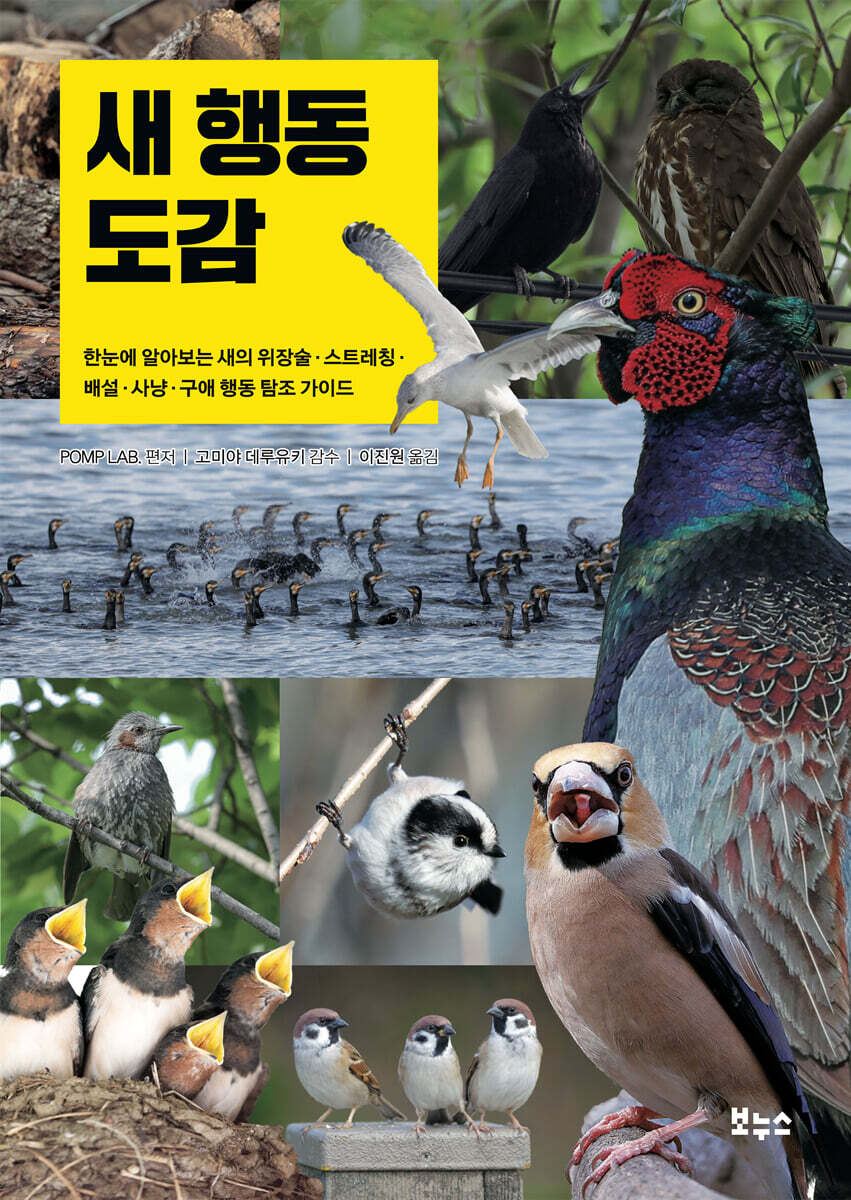
Book Introduction
If you look closely at the behavior of birds, there are things that make you wonder, 'Why do they act that way?' and 'What does it mean?'
Although they may seem novel and amusing to humans, most bird behaviors are intentionally designed for courtship or survival.
Through this book, let's discover new charms by examining the unique behavior of each bird.
Although they may seem novel and amusing to humans, most bird behaviors are intentionally designed for courtship or survival.
Through this book, let's discover new charms by examining the unique behavior of each bird.
- You can preview some of the book's contents.
Preview
index
What are the birds doing?
prolog
Basic knowledge about birds: The more you know, the more you want to know
What kind of animal is a bird?
Bird body structure and measurement methods
Distinction between resident and migratory birds
The relationship between bird ecology and appearance
Bird ecology and natural environment
Capture the Moment! New Behavior Encyclopedia
Structure of this chapter
Moment Capture ① Why does it do that? It suddenly raises its feathers on its head! … A magpie
Moment Capture ② Why is it like that? Oh my, I thought it was a tree branch? … A seagull
COLUMN Birds with Excellent 'Mimetic' Abilities
COLUMN Are owls easy to find?
Moment Capture ③ Why is it doing that? It's flapping its wings... Is it hurt or something!? ... White-crowned crane
Moment Capture ④ Why is she doing that? She's striking a ballerina-like pose... Why the heck?
COLUMN The real purpose of this action is to 'dry feathers'
Learn more about basic bird behaviors
① Feather picking / Head scratching ② Stretching
Why does it do that? It spits out the fruit it worked so hard to eat! … A woodpecker
Moment Capture ⑥ Why is that happening? Is that shit or pee? … Direct hit
COLUMN What You Can Learn from Bird Poop
Moment Capture ⑦ Why is it doing that? It keeps its mouth open and its neck trembles… A freshwater cormorant
Moment Capture ⑧ Why is that? Why do they become rounder in winter? … Storks
Moment Capture ⑨ Why is it doing that? It runs on water! … Water coot
COLUMN Birds Running on Water
Learn more about basic bird behaviors
③ Moving on the ground ④ Drinking water
Moment Capture ⑩ Why is it doing that? Hovering in mid-air? … Kingfisher
Moment Capture ⑪ Why is it doing that? One foot trembles in the water… Little Egret
Moment Capture ⑫ Why is it doing that? It keeps following the tractor around… Hwangro
Moment Capture ⑬ Why is he doing that? He goes to pick up something he dropped in the air… A crow
Moment Capture ⑭ Why do they do that? They don't eat the fruit from the tree, but bury it in a hole... a magpie
COLUMN Food storage behavior of birds that carry plant seeds
COLUMN Cognitive Abilities of Birds Storing Food
Moment Capture ⑮ Why is it doing that? It spreads its feathers and flaps its wings… The Great White Wagtail
COLUMN Birds' Unique Courtship Behaviors
Moment Capture 16 Why is he doing that? He's running wild! … Pheasant
Learn more about basic bird behaviors
⑤ Crying and chirping ⑥ Flight
Moment Capture 17 Why does it do that? It plucks the fur of other animals… The Great-billed Crow
COLUMN A bird that steals another bird's nest
Moment Capture 18 Why does it do that? It keeps giving its chicks something… a turtledove
COLUMN A bird that takes on the responsibility of raising other birds
Moment Capture 19 Why is it doing that? It's coming out of the nest with something in its mouth...
Moment Capture 20 Why is he doing that? Is he playing with the ball? … Every
COLUMN Trying to stand alone by imitating the behavior of other birds
What are you doing with the extra moments captured?
Glossary of Terms Growth Stages and Roles / Ecology / Feathers and Forms / Unique Feathers
Commentary What are the birds doing?
Want to know more about the 86 bird species featured in this book?
Common egret / White-crowned crane / Heron / Flycatcher
Black-crowned crane / Common cormorant / Sparrow coot / Kingfisher / Little egret
Yellow-crowned crane / Crow / White-crowned crane / Pheasant / Large-billed crow
Wood pigeon / tit / hawk / brown booby / warbler / warbler cousin / thrush
Black-browed tern / stork / black-tailed gull / wren
Little Plover / Wood-billed Warbler / Broad-billed Warbler / Yellow-throated Bunting
Great egret / Great egret / White-crowned crane / Eastern white-eye / Shrike / Bunting / Osprey
Sea swan / Sea swan / Common swan / Common swan
Northern Scops Owl / Red-breasted Sandpiper / Red-billed Gull / Blackstone's Fishing Owl
Cuckoo / Sandpiper / Black-crowned Crane / Screech-owl
Black-crowned crane / Little woodpecker / Little crane / Little tern
Black-crowned crane / Eagle owl / Woodpecker / African penguin
Common egret / Common egret / Australian pelican / Great plover
Woodpecker / Black-faced Flycatcher / Black-faced Crow / Black-legged Swallow
Herring gull / swallow / swan / barred owl
Common tit / Mallard / Common oriole / Bar-tailed godwit
Great Bowerbill / Great Pelican / Great Warbler / Great Warbler
Great flamingo / Red-crowned crane / Oriental stork / Kestrel
Whistling / White-cheeked Duck
Let's keep a birdwatching journal
Search
Helpful Resources
prolog
Basic knowledge about birds: The more you know, the more you want to know
What kind of animal is a bird?
Bird body structure and measurement methods
Distinction between resident and migratory birds
The relationship between bird ecology and appearance
Bird ecology and natural environment
Capture the Moment! New Behavior Encyclopedia
Structure of this chapter
Moment Capture ① Why does it do that? It suddenly raises its feathers on its head! … A magpie
Moment Capture ② Why is it like that? Oh my, I thought it was a tree branch? … A seagull
COLUMN Birds with Excellent 'Mimetic' Abilities
COLUMN Are owls easy to find?
Moment Capture ③ Why is it doing that? It's flapping its wings... Is it hurt or something!? ... White-crowned crane
Moment Capture ④ Why is she doing that? She's striking a ballerina-like pose... Why the heck?
COLUMN The real purpose of this action is to 'dry feathers'
Learn more about basic bird behaviors
① Feather picking / Head scratching ② Stretching
Why does it do that? It spits out the fruit it worked so hard to eat! … A woodpecker
Moment Capture ⑥ Why is that happening? Is that shit or pee? … Direct hit
COLUMN What You Can Learn from Bird Poop
Moment Capture ⑦ Why is it doing that? It keeps its mouth open and its neck trembles… A freshwater cormorant
Moment Capture ⑧ Why is that? Why do they become rounder in winter? … Storks
Moment Capture ⑨ Why is it doing that? It runs on water! … Water coot
COLUMN Birds Running on Water
Learn more about basic bird behaviors
③ Moving on the ground ④ Drinking water
Moment Capture ⑩ Why is it doing that? Hovering in mid-air? … Kingfisher
Moment Capture ⑪ Why is it doing that? One foot trembles in the water… Little Egret
Moment Capture ⑫ Why is it doing that? It keeps following the tractor around… Hwangro
Moment Capture ⑬ Why is he doing that? He goes to pick up something he dropped in the air… A crow
Moment Capture ⑭ Why do they do that? They don't eat the fruit from the tree, but bury it in a hole... a magpie
COLUMN Food storage behavior of birds that carry plant seeds
COLUMN Cognitive Abilities of Birds Storing Food
Moment Capture ⑮ Why is it doing that? It spreads its feathers and flaps its wings… The Great White Wagtail
COLUMN Birds' Unique Courtship Behaviors
Moment Capture 16 Why is he doing that? He's running wild! … Pheasant
Learn more about basic bird behaviors
⑤ Crying and chirping ⑥ Flight
Moment Capture 17 Why does it do that? It plucks the fur of other animals… The Great-billed Crow
COLUMN A bird that steals another bird's nest
Moment Capture 18 Why does it do that? It keeps giving its chicks something… a turtledove
COLUMN A bird that takes on the responsibility of raising other birds
Moment Capture 19 Why is it doing that? It's coming out of the nest with something in its mouth...
Moment Capture 20 Why is he doing that? Is he playing with the ball? … Every
COLUMN Trying to stand alone by imitating the behavior of other birds
What are you doing with the extra moments captured?
Glossary of Terms Growth Stages and Roles / Ecology / Feathers and Forms / Unique Feathers
Commentary What are the birds doing?
Want to know more about the 86 bird species featured in this book?
Common egret / White-crowned crane / Heron / Flycatcher
Black-crowned crane / Common cormorant / Sparrow coot / Kingfisher / Little egret
Yellow-crowned crane / Crow / White-crowned crane / Pheasant / Large-billed crow
Wood pigeon / tit / hawk / brown booby / warbler / warbler cousin / thrush
Black-browed tern / stork / black-tailed gull / wren
Little Plover / Wood-billed Warbler / Broad-billed Warbler / Yellow-throated Bunting
Great egret / Great egret / White-crowned crane / Eastern white-eye / Shrike / Bunting / Osprey
Sea swan / Sea swan / Common swan / Common swan
Northern Scops Owl / Red-breasted Sandpiper / Red-billed Gull / Blackstone's Fishing Owl
Cuckoo / Sandpiper / Black-crowned Crane / Screech-owl
Black-crowned crane / Little woodpecker / Little crane / Little tern
Black-crowned crane / Eagle owl / Woodpecker / African penguin
Common egret / Common egret / Australian pelican / Great plover
Woodpecker / Black-faced Flycatcher / Black-faced Crow / Black-legged Swallow
Herring gull / swallow / swan / barred owl
Common tit / Mallard / Common oriole / Bar-tailed godwit
Great Bowerbill / Great Pelican / Great Warbler / Great Warbler
Great flamingo / Red-crowned crane / Oriental stork / Kestrel
Whistling / White-cheeked Duck
Let's keep a birdwatching journal
Search
Helpful Resources
Detailed image

Publisher's Review
Bird watching becomes more enjoyable!
The more you look, the more you want to know the secrets of bird behavior.
When I walk along a quiet road in the morning, I sometimes listen to the sound of birds chirping from somewhere.
I wonder what kind of bird makes this sound? What is its name?
We don't usually notice them because they fly away as soon as we get close, but surprisingly, birds live very close to us.
If you go into the forest, you will find mountain birds singing beautiful songs, and if you go to the mudflats or the coast, you will find sandpipers and shorebirds looking for food or resting by the water's edge.
These are birds that we would never have noticed before, but if we observe them closely, we will finally realize that they are living right around us.
Observing birds gliding leisurely through the high sky makes you feel the mystery of nature and life.
Birds have made their bodies light, leaving only the minimum structures necessary for survival in order to fly in the sky.
Birds, having walked their own path of evolution, live in a world far beyond our imagination.
Through this book, let's discover a new charm by examining the gestures and behavior of birds, which are still mysterious to us.
Why do birds do this?
There's a reason for all the bird gestures you passed by without knowing!
There is a saying, 'bird's-eye view'.
It means 'a person as stupid and foolish as a bird.'
But contrary to this negative perception, birds are actually very intelligent.
All the bird behaviors that may seem strange at first glance are the result of meticulous research for survival.
Have you ever seen a sparrow with a round, plump body in winter? The reason sparrows become so large in winter is because they create air pockets within their feathers to maintain body temperature.
To our eyes, it just looks cute, but in fact, it is a survival strategy of sparrows to somehow overcome the harsh season.
There are also water birds that catch fish by using bait.
The black-crowned crane has an impressive decorative feather like a ribbon on the back of its head.
This bird uses a wide variety of baits when foraging, and its proud appearance after catching a fish resembles that of a fisherman who has landed a big fish.
The way birds express their love in nature is truly beautiful, mysterious, and full of personality.
Great egrets perform a courtship dance with elegant gestures, while warblers and great hornbills make complex and beautiful sounds to show off their charm.
The snail eats poisonous insects on purpose to get rid of parasites in its body and show off its healthy beauty.
If you look closely at the behavior of birds like this, there are things that make you wonder, 'Why do they act that way?' and 'What does it mean?'
Although they may seem novel and amusing to humans, most bird behaviors are intentionally designed for courtship or survival.
Let's discover new charms by observing the unique behavior of each bird.
Capturing the moment a bird lives!
A birdwatching guide to understanding bird camouflage, stretching, excretion, hunting, and courtship behaviors at a glance.
This book contains vivid photographs of birds captured in the moment.
There are many photos that capture the sound of the food duck's wings flapping and its clear cry so realistically that you can almost hear it.
As you turn each page, you can admire the birds' various movements and, through detailed explanations, understand the characteristics and processes of how they behave depending on the situation.
It also contains information necessary for observing birds, such as the structure of birds, basic terminology, differences between summer and winter feathers, types of bird beaks, and appearance.
It includes all ecological information, including where the birds mainly stay, when they appear, and what they eat.
The appendix provides easy-to-understand ecological information on the 86 species of birds featured in the book.
The scientific name of the bird.
Classification by name, size, and mobility.
The distribution area is indicated in detail.
Using the appendix will help you determine information about the bird you are curious about more quickly and accurately.
It also includes a birding journal and instructions for keeping a birding journal that can be used when you go out to find birds around you or for birding activities.
It will be a good guide for those who are just beginning to take an interest in birds and for birders who capture birds with binoculars.
The more you look, the more you want to know the secrets of bird behavior.
When I walk along a quiet road in the morning, I sometimes listen to the sound of birds chirping from somewhere.
I wonder what kind of bird makes this sound? What is its name?
We don't usually notice them because they fly away as soon as we get close, but surprisingly, birds live very close to us.
If you go into the forest, you will find mountain birds singing beautiful songs, and if you go to the mudflats or the coast, you will find sandpipers and shorebirds looking for food or resting by the water's edge.
These are birds that we would never have noticed before, but if we observe them closely, we will finally realize that they are living right around us.
Observing birds gliding leisurely through the high sky makes you feel the mystery of nature and life.
Birds have made their bodies light, leaving only the minimum structures necessary for survival in order to fly in the sky.
Birds, having walked their own path of evolution, live in a world far beyond our imagination.
Through this book, let's discover a new charm by examining the gestures and behavior of birds, which are still mysterious to us.
Why do birds do this?
There's a reason for all the bird gestures you passed by without knowing!
There is a saying, 'bird's-eye view'.
It means 'a person as stupid and foolish as a bird.'
But contrary to this negative perception, birds are actually very intelligent.
All the bird behaviors that may seem strange at first glance are the result of meticulous research for survival.
Have you ever seen a sparrow with a round, plump body in winter? The reason sparrows become so large in winter is because they create air pockets within their feathers to maintain body temperature.
To our eyes, it just looks cute, but in fact, it is a survival strategy of sparrows to somehow overcome the harsh season.
There are also water birds that catch fish by using bait.
The black-crowned crane has an impressive decorative feather like a ribbon on the back of its head.
This bird uses a wide variety of baits when foraging, and its proud appearance after catching a fish resembles that of a fisherman who has landed a big fish.
The way birds express their love in nature is truly beautiful, mysterious, and full of personality.
Great egrets perform a courtship dance with elegant gestures, while warblers and great hornbills make complex and beautiful sounds to show off their charm.
The snail eats poisonous insects on purpose to get rid of parasites in its body and show off its healthy beauty.
If you look closely at the behavior of birds like this, there are things that make you wonder, 'Why do they act that way?' and 'What does it mean?'
Although they may seem novel and amusing to humans, most bird behaviors are intentionally designed for courtship or survival.
Let's discover new charms by observing the unique behavior of each bird.
Capturing the moment a bird lives!
A birdwatching guide to understanding bird camouflage, stretching, excretion, hunting, and courtship behaviors at a glance.
This book contains vivid photographs of birds captured in the moment.
There are many photos that capture the sound of the food duck's wings flapping and its clear cry so realistically that you can almost hear it.
As you turn each page, you can admire the birds' various movements and, through detailed explanations, understand the characteristics and processes of how they behave depending on the situation.
It also contains information necessary for observing birds, such as the structure of birds, basic terminology, differences between summer and winter feathers, types of bird beaks, and appearance.
It includes all ecological information, including where the birds mainly stay, when they appear, and what they eat.
The appendix provides easy-to-understand ecological information on the 86 species of birds featured in the book.
The scientific name of the bird.
Classification by name, size, and mobility.
The distribution area is indicated in detail.
Using the appendix will help you determine information about the bird you are curious about more quickly and accurately.
It also includes a birding journal and instructions for keeping a birding journal that can be used when you go out to find birds around you or for birding activities.
It will be a good guide for those who are just beginning to take an interest in birds and for birders who capture birds with binoculars.
GOODS SPECIFICS
- Date of issue: March 10, 2025
- Page count, weight, size: 184 pages | 340g | 142*200*13mm
- ISBN13: 9788964947296
You may also like
카테고리
korean


korean

![GQ KOREA Mark (Monthly): December [2025]](http://librairie.coreenne.fr/cdn/shop/files/8ef265dbbfbf186523ed75ba7319009d.jpg?v=1765340328&width=3840)


