

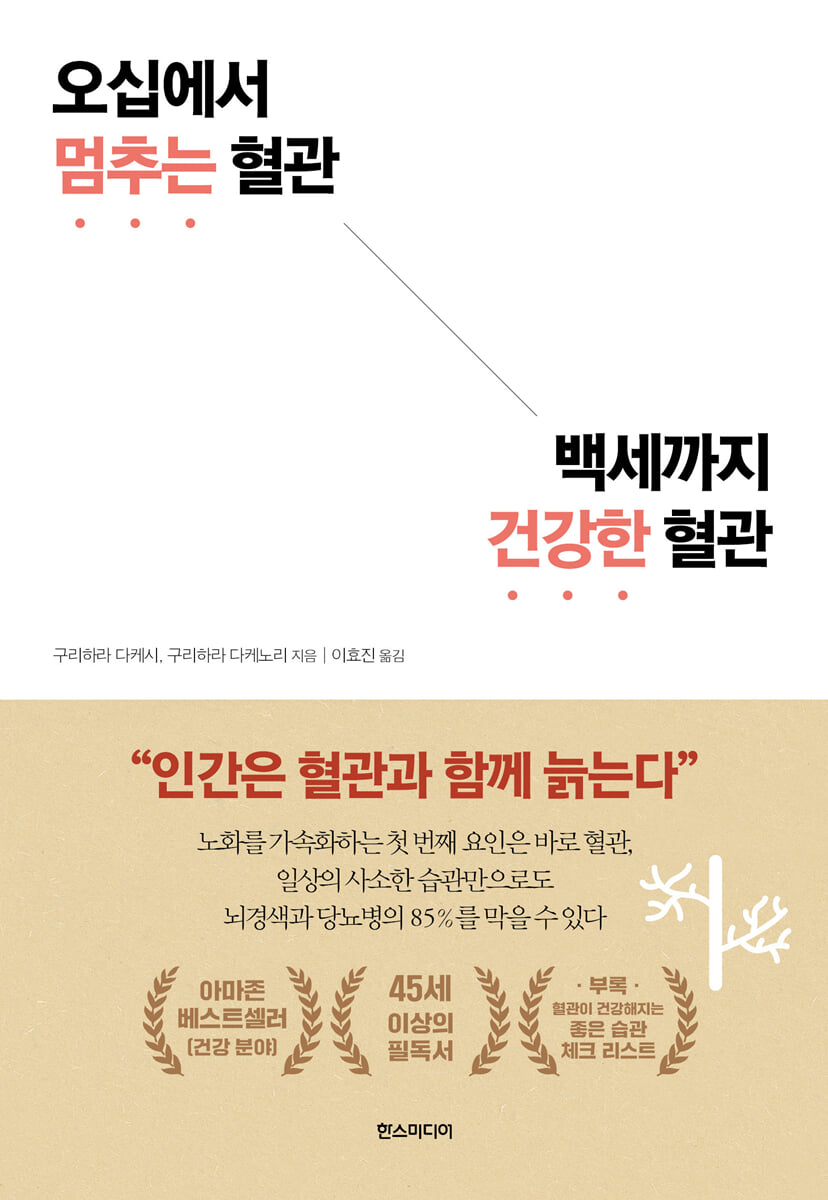
Blood vessels that stop functioning at fifty and remain healthy until the age of 100
 |
Description
Book Introduction
“Humans age along with their blood vessels.”
The first factor that accelerates aging is blood vessels. 85% of cerebral infarction and diabetes can be prevented by simply following small daily habits.
Blood vessels are vital roads that stretch throughout our bodies, serving as our body's infrastructure! This book reveals simple, yet complete secrets to maintaining and improving the health of these vital infrastructures!
The first factor that accelerates aging is blood vessels. 85% of cerebral infarction and diabetes can be prevented by simply following small daily habits.
Blood vessels are vital roads that stretch throughout our bodies, serving as our body's infrastructure! This book reveals simple, yet complete secrets to maintaining and improving the health of these vital infrastructures!
- You can preview some of the book's contents.
Preview
index
Introduction: Anyone can age more slowly by slowing the aging of blood vessels.
Chapter 1: Humans Age Along with Their Blood Vessels
Cerebral infarction and dementia are not brain diseases?!
The 100-year lifespan is not a dream.
I want to live a long and healthy life
Cerebral infarction is not a brain disease, but a vascular disease.
Dementia is closely related to vascular health.
Let's learn about the structure and role of blood vessels, including arteries, veins, and capillaries.
If you connected all the blood vessels in a person, it would be as long as twice the circumference of the Earth.
There is something called arteriosclerosis, but why isn't there something called venous sclerosis?
What is the delicate and important role of capillary tissue?
What does it mean when blood vessels age?
Differences between young and aged blood vessels
Blood pressure and blood sugar levels are key
How to prevent fatal diseases
Creating good habits for your blood vessels starts in your 40s.
It doesn't matter if it's a bit noisy.
It is important to be conscious
As soon as possible! Let's start today.
Chapter 2: Habits to do as soon as you wake up in the morning
When I wake up in the morning, I rinse my mouth.
Is your mouth dirtier than your anus right after waking up in the morning?
Periodontal bacteria destroy the intestinal environment
Receive morning sunlight
Smoothly transitions the autonomic nervous system
It's not 'go to bed early and wake up early', it's 'wake up early and go to bed early'
Stroke the stomach in a semicircle
The intestines are the second brain. Let's improve the intestinal environment.
Colon massage that works immediately
Make a sound like 'Ah~'
Why is conversation important?
Singing is also good
Measure blood pressure
Home blood pressure is becoming more important
What kind of home blood pressure monitor is good to use?
Measure twice and don't measure a third time
Eat a full breakfast
65% of men who live alone skip breakfast.
Eat breakfast with protein, carbohydrates, milk, and tea
Let's do squats while sitting
The basic principle is to train large muscles.
Recommended exercise that produces vasodilators: seated squats
Tongue cleaning in 5 seconds
The mouth is the place with the most bacteria.
Effective Tongue Cleaning Methods
Tongue Rotation Exercise: Training Your Tongue to Prevent Mouth Breathing
Chapter 3: Habits to be aware of when eating
Start by eating meat or vegetables
Increase protein and reduce carbohydrates and salt.
Cells greedily absorb what they first eat.
Eat as slowly as possible.
Eating too quickly can damage your blood vessels.
Enjoy a meal with someone
Chew 20 times
Chewing Well Is Important: The Benefits of Saliva
Prevents dementia
I only eat noodles once a week.
More than 70% of people eat noodles at least once a week.
It's best to avoid udon and ramen late at night.
Rice and soybean paste soup are eaten last
The secret to slowing carbohydrate absorption
Eat raw vegetables at the end
The final meal to prevent vascular aging
Finally, add vegetables to clean the mouth and speed
Don't sprinkle soy sauce, dip it in the sauce and eat it.
Salt is the biggest enemy of blood vessels.
Lifestyle tips to reduce salt intake
Gradually reduce the amount of soybean paste used in soybean paste soup.
Let your taste buds adapt little by little
A secret item that fills your stomach with a refreshing taste
Replace with natural salt
Table salt is 100% pure salt.
Prevent aging of blood vessels by consuming precious minerals.
For snacks, eat chocolate with a high cocoa content.
Living on snacks is a shortcut to lifestyle diseases.
Cacao polyphenols have amazing effects!
I carry around green tea in a plastic bottle.
Childhood diabetes is on the rise
The catechin benefits of green tea cannot be ignored.
Eat fruit only in the morning
Shine Muscat worsens the numbers
Smoothies are more dangerous
Chew gum after meals
Chewing gum increases blood flow to the brain.
Recommended gums and their effects
Drink alcohol in moderation
It's better to drink than not to drink.
The Best Amount of Alcohol for Your Health
Enjoy alcohol slowly with snacks
Drink sweet potato soju or red wine
Sweet potato soju helps dissolve blood clots
No access to strong cans
Start the drinking party with fried chicken or green beans
Carbohydrate-rich potato salad and yakisoba are ordered later.
When drinking alcohol, drink the same amount of water.
What skills do people who can't drink alcohol lack?
Water is needed to break down alcohol.
The best snack to pair with red wine is nuts.
L-arginine is a good substance that helps produce nitric oxide.
How to Take L-Arginine
Eat two eggs every day
Health Index Albumin
Cholesterol levels actually go down
Eat cheap meat
Meat fat is not the cause of neutral fat.
Pay attention to the good ingredients in chicken breast.
Always keep canned mackerel on hand
Why Inuit Don't Suffer from Vascular Disease
Enjoy a variety of dishes with canned mackerel
Chapter 4: Good Habits to Do During the Day
Sometimes I press my chin
A hunched back reduces lung capacity by more than 30%.
Prevent turtle neck by habitually pressing your chin.
If you have been sitting for more than an hour, get up from your seat.
Economy Class Syndrome is happening in the office.
Drink 1 liter of water a day
2,300ml of water is lost per day
What is the minimum amount of water you absolutely must replenish each day?
Open your palms toward the sun
Prevents osteoporosis in many women
How to Get Vitamin D Beyond Food
When you grab the bus handle, lift your heels.
How does the blood that has traveled to the toes return to the heart?
Train your second heart
Do the towel grip exercise
A groundbreaking theory that won the Nobel Prize
Generating nitric oxide using a towel
Lunch is eaten at a distant place.
People who eat lunch at their desks should be careful.
Walk for 10 minutes after eating
Try to overtake the person walking in front of you
People who walk slowly are more likely to need care
Muscles weaken without me knowing it.
Decreased muscle strength = decreased blood vessel strength
Turn down the cooling
People with cold hands and feet often have vascular problems.
Why is my body cold?
Take a deep breath through your nose
Mouth breathing worsens blood quality
'Drowin' breathing technique that can be done anywhere
Don't get annoyed by little things
Don't try too hard, just do it in moderation
High blood pressure is difficult to detect
Laugh or sing once a day
Activate your brain with old gag shows and nostalgic melodies.
I enjoy doing word puzzles as a hobby.
It's important to try to think of something instead of looking it up on your smartphone.
Get a dental checkup once every six months
The achievements of the '8020 Movement'
Going to the dentist feels like going to a beauty salon.
Chapter 5: Bathing, Brushing Teeth, and Sleeping Habits That Benefit Your Health
Soak in a bathtub filled with lukewarm water for 15 minutes.
Bathing changes the parasympathetic nervous system to a dominant state.
It is best to bathe an hour before going to bed.
A hot spring tourist destination famous for its bicarbonate hot springs
Massage your calves in the bathtub
Massage with praise and gratitude
Next, massage your shoulders after your calves.
Remove debris with an interdental brush before going to bed
More than half of people brush their teeth for less than 3 minutes.
Use an interdental brush when brushing your teeth before going to bed.
Call a friend
When you get home, forget about the hard times and think only about the happy things.
I don't eat late-night snacks
Increased risk of developing reflux esophagitis
People who eat a lot of fatty foods may suffer from excessive stomach acid.
Take a walk with your dog
Beware of blood sugar spikes after dinner
I can sleep comfortably
When I get home, I turn off my smartphone.
Protect yourself from digital violence
Blue light reduces sleep quality
Write a short diary
Create a routine before bed
It also helps prevent dementia
Massage your salivary glands before going to bed
Three salivary glands that help secrete saliva
Press firmly on three salivary glands
Darken the room
Darkening the room releases sleep hormones.
Conclusion
Chapter 1: Humans Age Along with Their Blood Vessels
Cerebral infarction and dementia are not brain diseases?!
The 100-year lifespan is not a dream.
I want to live a long and healthy life
Cerebral infarction is not a brain disease, but a vascular disease.
Dementia is closely related to vascular health.
Let's learn about the structure and role of blood vessels, including arteries, veins, and capillaries.
If you connected all the blood vessels in a person, it would be as long as twice the circumference of the Earth.
There is something called arteriosclerosis, but why isn't there something called venous sclerosis?
What is the delicate and important role of capillary tissue?
What does it mean when blood vessels age?
Differences between young and aged blood vessels
Blood pressure and blood sugar levels are key
How to prevent fatal diseases
Creating good habits for your blood vessels starts in your 40s.
It doesn't matter if it's a bit noisy.
It is important to be conscious
As soon as possible! Let's start today.
Chapter 2: Habits to do as soon as you wake up in the morning
When I wake up in the morning, I rinse my mouth.
Is your mouth dirtier than your anus right after waking up in the morning?
Periodontal bacteria destroy the intestinal environment
Receive morning sunlight
Smoothly transitions the autonomic nervous system
It's not 'go to bed early and wake up early', it's 'wake up early and go to bed early'
Stroke the stomach in a semicircle
The intestines are the second brain. Let's improve the intestinal environment.
Colon massage that works immediately
Make a sound like 'Ah~'
Why is conversation important?
Singing is also good
Measure blood pressure
Home blood pressure is becoming more important
What kind of home blood pressure monitor is good to use?
Measure twice and don't measure a third time
Eat a full breakfast
65% of men who live alone skip breakfast.
Eat breakfast with protein, carbohydrates, milk, and tea
Let's do squats while sitting
The basic principle is to train large muscles.
Recommended exercise that produces vasodilators: seated squats
Tongue cleaning in 5 seconds
The mouth is the place with the most bacteria.
Effective Tongue Cleaning Methods
Tongue Rotation Exercise: Training Your Tongue to Prevent Mouth Breathing
Chapter 3: Habits to be aware of when eating
Start by eating meat or vegetables
Increase protein and reduce carbohydrates and salt.
Cells greedily absorb what they first eat.
Eat as slowly as possible.
Eating too quickly can damage your blood vessels.
Enjoy a meal with someone
Chew 20 times
Chewing Well Is Important: The Benefits of Saliva
Prevents dementia
I only eat noodles once a week.
More than 70% of people eat noodles at least once a week.
It's best to avoid udon and ramen late at night.
Rice and soybean paste soup are eaten last
The secret to slowing carbohydrate absorption
Eat raw vegetables at the end
The final meal to prevent vascular aging
Finally, add vegetables to clean the mouth and speed
Don't sprinkle soy sauce, dip it in the sauce and eat it.
Salt is the biggest enemy of blood vessels.
Lifestyle tips to reduce salt intake
Gradually reduce the amount of soybean paste used in soybean paste soup.
Let your taste buds adapt little by little
A secret item that fills your stomach with a refreshing taste
Replace with natural salt
Table salt is 100% pure salt.
Prevent aging of blood vessels by consuming precious minerals.
For snacks, eat chocolate with a high cocoa content.
Living on snacks is a shortcut to lifestyle diseases.
Cacao polyphenols have amazing effects!
I carry around green tea in a plastic bottle.
Childhood diabetes is on the rise
The catechin benefits of green tea cannot be ignored.
Eat fruit only in the morning
Shine Muscat worsens the numbers
Smoothies are more dangerous
Chew gum after meals
Chewing gum increases blood flow to the brain.
Recommended gums and their effects
Drink alcohol in moderation
It's better to drink than not to drink.
The Best Amount of Alcohol for Your Health
Enjoy alcohol slowly with snacks
Drink sweet potato soju or red wine
Sweet potato soju helps dissolve blood clots
No access to strong cans
Start the drinking party with fried chicken or green beans
Carbohydrate-rich potato salad and yakisoba are ordered later.
When drinking alcohol, drink the same amount of water.
What skills do people who can't drink alcohol lack?
Water is needed to break down alcohol.
The best snack to pair with red wine is nuts.
L-arginine is a good substance that helps produce nitric oxide.
How to Take L-Arginine
Eat two eggs every day
Health Index Albumin
Cholesterol levels actually go down
Eat cheap meat
Meat fat is not the cause of neutral fat.
Pay attention to the good ingredients in chicken breast.
Always keep canned mackerel on hand
Why Inuit Don't Suffer from Vascular Disease
Enjoy a variety of dishes with canned mackerel
Chapter 4: Good Habits to Do During the Day
Sometimes I press my chin
A hunched back reduces lung capacity by more than 30%.
Prevent turtle neck by habitually pressing your chin.
If you have been sitting for more than an hour, get up from your seat.
Economy Class Syndrome is happening in the office.
Drink 1 liter of water a day
2,300ml of water is lost per day
What is the minimum amount of water you absolutely must replenish each day?
Open your palms toward the sun
Prevents osteoporosis in many women
How to Get Vitamin D Beyond Food
When you grab the bus handle, lift your heels.
How does the blood that has traveled to the toes return to the heart?
Train your second heart
Do the towel grip exercise
A groundbreaking theory that won the Nobel Prize
Generating nitric oxide using a towel
Lunch is eaten at a distant place.
People who eat lunch at their desks should be careful.
Walk for 10 minutes after eating
Try to overtake the person walking in front of you
People who walk slowly are more likely to need care
Muscles weaken without me knowing it.
Decreased muscle strength = decreased blood vessel strength
Turn down the cooling
People with cold hands and feet often have vascular problems.
Why is my body cold?
Take a deep breath through your nose
Mouth breathing worsens blood quality
'Drowin' breathing technique that can be done anywhere
Don't get annoyed by little things
Don't try too hard, just do it in moderation
High blood pressure is difficult to detect
Laugh or sing once a day
Activate your brain with old gag shows and nostalgic melodies.
I enjoy doing word puzzles as a hobby.
It's important to try to think of something instead of looking it up on your smartphone.
Get a dental checkup once every six months
The achievements of the '8020 Movement'
Going to the dentist feels like going to a beauty salon.
Chapter 5: Bathing, Brushing Teeth, and Sleeping Habits That Benefit Your Health
Soak in a bathtub filled with lukewarm water for 15 minutes.
Bathing changes the parasympathetic nervous system to a dominant state.
It is best to bathe an hour before going to bed.
A hot spring tourist destination famous for its bicarbonate hot springs
Massage your calves in the bathtub
Massage with praise and gratitude
Next, massage your shoulders after your calves.
Remove debris with an interdental brush before going to bed
More than half of people brush their teeth for less than 3 minutes.
Use an interdental brush when brushing your teeth before going to bed.
Call a friend
When you get home, forget about the hard times and think only about the happy things.
I don't eat late-night snacks
Increased risk of developing reflux esophagitis
People who eat a lot of fatty foods may suffer from excessive stomach acid.
Take a walk with your dog
Beware of blood sugar spikes after dinner
I can sleep comfortably
When I get home, I turn off my smartphone.
Protect yourself from digital violence
Blue light reduces sleep quality
Write a short diary
Create a routine before bed
It also helps prevent dementia
Massage your salivary glands before going to bed
Three salivary glands that help secrete saliva
Press firmly on three salivary glands
Darken the room
Darkening the room releases sleep hormones.
Conclusion
Detailed image

Into the book
Let me pose a question.
Where in the body does cerebrovascular disease occur? Some might answer, "Of course, it's the brain."
But the correct answer is 'vascular disease'.
When blood vessels are damaged by high blood pressure or diabetes, they can easily burst or become blocked.
Cerebrovascular disease is a disorder that occurs in the narrow blood vessels in the brain.
The brain is filled with many narrow blood vessels that can easily become blocked.
And heart disease, which causes blood vessels around the heart to burst or become blocked, accounts for 4.5% of the causes of care needs.
People with vascular problems have a relatively higher risk of developing cerebrovascular and cardiovascular diseases.
While the mortality rate from cerebrovascular disease is decreasing, the number of patients continues to increase.
--- From “Chapter 1: Humans Age Together with Their Blood Vessels”
Some people find it bothersome to measure their blood pressure every morning.
But when talking about vascular health, measuring blood pressure cannot be left out.
It is a good idea to check frequently, if not every morning.
Medical opinion is also changing to place more importance on home blood pressure measured at home rather than on blood pressure measured in a hospital examination room.
This is because at home, blood pressure can be measured under the same conditions every day.
At the hospital, you have to wait a long time, so you get tired and nervous, and your blood pressure is often measured higher than normal.
However, you can measure it comfortably at home.
A big advantage is that measurements can be taken at the same time and under the same conditions.
Also, recently, home blood pressure monitors have been developed to be convenient and highly accurate.
If it's easy to use and measures accurately, there's no reason not to use it.
--- From "Chapter 2: Habits to do as soon as you wake up in the morning"
The most fundamental thing in vascular health is diet.
Simply put, you need to get enough protein and cut down on carbohydrates and salt.
Many people worry about cholesterol, but what's important is the ratio of good cholesterol, high-density lipoprotein (HDL), to bad cholesterol, low-density lipoprotein (LDL). Even if your LDL cholesterol is somewhat high, if your HDL cholesterol is high, there's no need to worry.
--- From “Chapter 3 Habits to be Conscious of When Eating”
Osteoporosis is on the rise among the elderly.
Women, in particular, tend to have lower calcium levels after menopause, so they suffer from osteoporosis more often than men.
When bones become weak, they can easily break even with a slight fall.
Strong bones are essential for a healthy life.
Although bones are mainly composed of calcium and protein, vitamins K2 and D play a role in strengthening bones.
This is an essential nutrient for maintaining strong bones effectively.
Where in the body does cerebrovascular disease occur? Some might answer, "Of course, it's the brain."
But the correct answer is 'vascular disease'.
When blood vessels are damaged by high blood pressure or diabetes, they can easily burst or become blocked.
Cerebrovascular disease is a disorder that occurs in the narrow blood vessels in the brain.
The brain is filled with many narrow blood vessels that can easily become blocked.
And heart disease, which causes blood vessels around the heart to burst or become blocked, accounts for 4.5% of the causes of care needs.
People with vascular problems have a relatively higher risk of developing cerebrovascular and cardiovascular diseases.
While the mortality rate from cerebrovascular disease is decreasing, the number of patients continues to increase.
--- From “Chapter 1: Humans Age Together with Their Blood Vessels”
Some people find it bothersome to measure their blood pressure every morning.
But when talking about vascular health, measuring blood pressure cannot be left out.
It is a good idea to check frequently, if not every morning.
Medical opinion is also changing to place more importance on home blood pressure measured at home rather than on blood pressure measured in a hospital examination room.
This is because at home, blood pressure can be measured under the same conditions every day.
At the hospital, you have to wait a long time, so you get tired and nervous, and your blood pressure is often measured higher than normal.
However, you can measure it comfortably at home.
A big advantage is that measurements can be taken at the same time and under the same conditions.
Also, recently, home blood pressure monitors have been developed to be convenient and highly accurate.
If it's easy to use and measures accurately, there's no reason not to use it.
--- From "Chapter 2: Habits to do as soon as you wake up in the morning"
The most fundamental thing in vascular health is diet.
Simply put, you need to get enough protein and cut down on carbohydrates and salt.
Many people worry about cholesterol, but what's important is the ratio of good cholesterol, high-density lipoprotein (HDL), to bad cholesterol, low-density lipoprotein (LDL). Even if your LDL cholesterol is somewhat high, if your HDL cholesterol is high, there's no need to worry.
--- From “Chapter 3 Habits to be Conscious of When Eating”
Osteoporosis is on the rise among the elderly.
Women, in particular, tend to have lower calcium levels after menopause, so they suffer from osteoporosis more often than men.
When bones become weak, they can easily break even with a slight fall.
Strong bones are essential for a healthy life.
Although bones are mainly composed of calcium and protein, vitamins K2 and D play a role in strengthening bones.
This is an essential nutrient for maintaining strong bones effectively.
--- "Chapter 4: Good Habits to Do During the Day"
Publisher's Review
Anyone can age more slowly by slowing the aging of blood vessels.
In this era of the 100-year lifespan, the 20 to 30 years after age 60 are so long that they can no longer be called the “rest of one’s life.”
However, each person's situation in which they face old age is different.
While there are people who live a healthy second life even after turning 60, there are also many people who have a difficult life in their 50s or 60s due to cerebral infarction, diabetes, etc.
In particular, some people think that cerebral infarction is something that 'we don't know how to prevent' or 'it's a disease that happens when you're unlucky', but this is because the microvessels inside the brain cannot be seen directly.
Unlike other organs, blood vessels are something that we cannot directly examine or check their current condition.
It is easy to think of cerebral infarction as a disease of the brain, but to be precise, it is a disease of the blood vessels.
When blood vessels become weak or injured, the narrow blood vessels can easily break or become blocked, which can ultimately lead to cerebrovascular diseases such as cerebral infarction, cerebral hemorrhage, or subarachnoid hemorrhage.
Also, if the blood vessels around the heart become cut off or blocked, it can cause heart disease.
Many people generally know the importance of blood and blood flow, but it is meaningless if the blood vessels that carry the blood are not healthy.
Blood vessels are important roads that spread throughout our body, like the infrastructure of our body.
If the thick aorta is like a highway, the capillaries can be thought of as narrow roads in residential areas.
Of course, each organ has capillaries, and because of these blood vessels, the organs are healthy and perform their respective roles.
What would happen if such an important road collapsed or collapsed?
It's a terrifying situation to imagine, where you won't be able to live the rest of your life freely according to your own will.
This means that the more we can slow down the aging of our blood vessels, the more we can slow down the aging of our body as a whole.
This is why everyone over 45 should be concerned about their blood vessel management.
Will you create a blood vessel that stops at fifty?
Will we be able to maintain healthy blood vessels until we reach 100 years of age?
The important thing is that blood vessels can also be managed sufficiently.
This does not require highly specialized knowledge or complex techniques that ordinary people cannot easily follow.
Anyone can do this by making just a few changes to their habits in their everyday lives.
This book, "Blood vessels that stop dying at 50 and stay healthy until you're 100," focuses on the "blood vessels," which are an important infrastructure in our body, and introduces the secrets to maintaining healthy blood vessels and making them even better.
They say it's a secret, but it's not difficult at all.
It doesn't take much time and isn't restricted by location.
The secrets introduced in the book are easy for anyone to try, and all you need to do is be a little conscious and make them a habit in your daily life.
Specifically, you just need to make a few small changes to your usual behaviors, such as your ‘morning habits’, ‘eating habits’, ‘daytime habits’, and ‘bathing, brushing teeth, and sleeping habits’.
You don't have to do everything perfectly from the beginning.
Just choose the item that you think you can do.
At first, I started with a light heart, thinking I would try only 5 things.
Just being conscious of what you have to do will make a difference.
Even if you can't do it every day, if you keep repeating it, your blood vessels will become younger without you even realizing it.
And after these five become habits, you can gradually increase the number of good habits to eight or ten.
[Special Appendix] Checklist of Good Habits for Healthy Blood Vessels
This book introduces a checklist that can be conveniently used in three steps to help you develop the 'good habits that make your blood vessels healthy'.
(See QR code in the text)
In this era of the 100-year lifespan, the 20 to 30 years after age 60 are so long that they can no longer be called the “rest of one’s life.”
However, each person's situation in which they face old age is different.
While there are people who live a healthy second life even after turning 60, there are also many people who have a difficult life in their 50s or 60s due to cerebral infarction, diabetes, etc.
In particular, some people think that cerebral infarction is something that 'we don't know how to prevent' or 'it's a disease that happens when you're unlucky', but this is because the microvessels inside the brain cannot be seen directly.
Unlike other organs, blood vessels are something that we cannot directly examine or check their current condition.
It is easy to think of cerebral infarction as a disease of the brain, but to be precise, it is a disease of the blood vessels.
When blood vessels become weak or injured, the narrow blood vessels can easily break or become blocked, which can ultimately lead to cerebrovascular diseases such as cerebral infarction, cerebral hemorrhage, or subarachnoid hemorrhage.
Also, if the blood vessels around the heart become cut off or blocked, it can cause heart disease.
Many people generally know the importance of blood and blood flow, but it is meaningless if the blood vessels that carry the blood are not healthy.
Blood vessels are important roads that spread throughout our body, like the infrastructure of our body.
If the thick aorta is like a highway, the capillaries can be thought of as narrow roads in residential areas.
Of course, each organ has capillaries, and because of these blood vessels, the organs are healthy and perform their respective roles.
What would happen if such an important road collapsed or collapsed?
It's a terrifying situation to imagine, where you won't be able to live the rest of your life freely according to your own will.
This means that the more we can slow down the aging of our blood vessels, the more we can slow down the aging of our body as a whole.
This is why everyone over 45 should be concerned about their blood vessel management.
Will you create a blood vessel that stops at fifty?
Will we be able to maintain healthy blood vessels until we reach 100 years of age?
The important thing is that blood vessels can also be managed sufficiently.
This does not require highly specialized knowledge or complex techniques that ordinary people cannot easily follow.
Anyone can do this by making just a few changes to their habits in their everyday lives.
This book, "Blood vessels that stop dying at 50 and stay healthy until you're 100," focuses on the "blood vessels," which are an important infrastructure in our body, and introduces the secrets to maintaining healthy blood vessels and making them even better.
They say it's a secret, but it's not difficult at all.
It doesn't take much time and isn't restricted by location.
The secrets introduced in the book are easy for anyone to try, and all you need to do is be a little conscious and make them a habit in your daily life.
Specifically, you just need to make a few small changes to your usual behaviors, such as your ‘morning habits’, ‘eating habits’, ‘daytime habits’, and ‘bathing, brushing teeth, and sleeping habits’.
You don't have to do everything perfectly from the beginning.
Just choose the item that you think you can do.
At first, I started with a light heart, thinking I would try only 5 things.
Just being conscious of what you have to do will make a difference.
Even if you can't do it every day, if you keep repeating it, your blood vessels will become younger without you even realizing it.
And after these five become habits, you can gradually increase the number of good habits to eight or ten.
[Special Appendix] Checklist of Good Habits for Healthy Blood Vessels
This book introduces a checklist that can be conveniently used in three steps to help you develop the 'good habits that make your blood vessels healthy'.
(See QR code in the text)
GOODS SPECIFICS
- Date of issue: April 11, 2024
- Page count, weight, size: 208 pages | 362g | 145*210*14mm
- ISBN13: 9791193712221
- ISBN10: 119371222X
You may also like
카테고리
korean


korean

![ELLE 엘르 스페셜 에디션 A형 : 12월 [2025]](http://librairie.coreenne.fr/cdn/shop/files/b8e27a3de6c9538896439686c6b0e8fb.jpg?v=1766436872&width=3840)


