

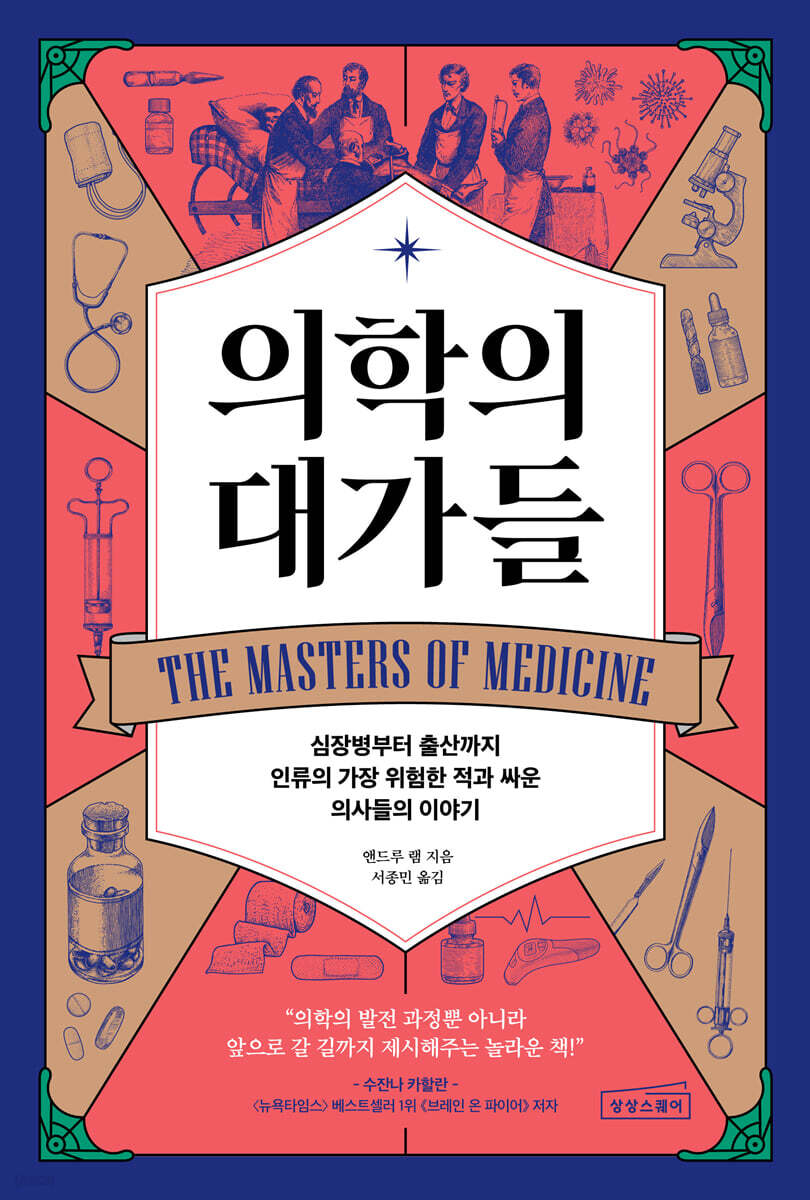
Masters of Medicine
 |
Description
Book Introduction
Strongly recommended by Lee Nak-jun, a medical YouTube channel specializing in "Doctor Friends." Historic moments in medicine that saved millions of lives The story of the heroes who created that moment "Masters of Medicine" tells the story of heroes who made monumental achievements in the history of medicine but never received acclaim. The surgeons who killed patients one after another in the race to operate on beating hearts and paved the way for heart transplants; the New York surgeon whose "heretical" idea of deliberately infecting patients to cure them inspired a cancer cure; the Hungarian doctor who solved the greatest mystery of a mother dying in childbirth, only to be ostracized for his discovery. They marked a milestone in humanity's endless quest to cure the sick, alleviate suffering, and delay death. This book tells the story so vividly that it feels like you are witnessing it right there. Vividness is the book's greatest strength. If it had simply listed the history and development of medicine, this book would not have been so fascinating. The author vividly captures the thoughts and desires of people struggling to achieve outstanding achievements within the circumstances and limitations of the times. As you read, you will naturally find yourself feeling like you are reading a medical novel. And at the end of each chapter, the reader will be amazed to realize that all these stories are not fiction, but fact. Additionally, motivation for human development and medical advancement will naturally arise. As a general introduction to medicine, a fascinating exploration of history, and a book that stimulates interest in medicine, there is no better book. The author, a practicing physician and writer, fully demonstrates his medical knowledge and eloquent writing skills in this book. In particular, he properly displayed the virtue of moderation. He did not flaunt his medical knowledge, but rather wrote a vivid description and an objective, broad perspective, without overusing difficult technical terms or abstruse medical knowledge. Thanks to this, after reading this book, you will find yourself reading it with a wide range of knowledge about medicine while maintaining immersion and interest. This book can be said to be one that truly shows the joy that reading can bring. "Masters of Medicine" is organized by the world's most common and deadliest diseases. 1) Heart disease: It is considered the world's number one predator and is considered one of the most serious diseases, well known even to the general public. 2) Infectious diseases: These are persistent diseases that threaten global health more than any other disease. 3) Cancer: A pernicious enemy of mankind, it strikes not only the elderly but also children and affects every family. 4) Trauma: It can appear anywhere and will undoubtedly remain even after all other illnesses have been conquered. 5) Childbirth: The pain of childbirth is as dangerous as the disease itself. Before doctors uncovered the secrets of childbirth and overturned its flawed practices, childbirth was the single most deadly event for mothers and children. These diseases are still common around us today. Thanks to the medical masters featured in this book, we can now understand the true nature of these diseases and avoid situations that can lead to death without treatment. This fact will resonate deeply with readers. It will provide patients currently battling illness and their guardians with the strength to never give up hope, and it will provide an opportunity for young people contemplating their future to pursue their dreams of medicine. Today, the average life expectancy worldwide is 73.4 years. This figure is almost double that of the early 20th century. If you're curious about what led to such miraculous results, I highly recommend reading this book. And I hope you feel a surge of emotion as you walk through the history of sweat and blood that humanity has walked. "Masters of Medicine" will provide you with the intellectual pleasure and immersive excitement you must experience at least once in your life. It will be a choice you will never regret. |
- You can preview some of the book's contents.
Preview
index
Seomun Nature's Secret
Chapter 1: Heart Disease_ Heretic Son
Chapter 2 Diabetes_ The Peeing Devil
Chapter 3 Bacterial Infections_ The Magic Bullet
Chapter 4 Viral Infections_ Pandemics
Chapter 5: Cancer - A Confusingly Complex Arrangement
Chapter 6: Trauma: The only winner in war is medicine.
Chapter 7: Birth_ The Mysterious Killer
Conclusion: Masters of Medicine
Acknowledgements
annotation
References
Image copyright
Search
Chapter 1: Heart Disease_ Heretic Son
Chapter 2 Diabetes_ The Peeing Devil
Chapter 3 Bacterial Infections_ The Magic Bullet
Chapter 4 Viral Infections_ Pandemics
Chapter 5: Cancer - A Confusingly Complex Arrangement
Chapter 6: Trauma: The only winner in war is medicine.
Chapter 7: Birth_ The Mysterious Killer
Conclusion: Masters of Medicine
Acknowledgements
annotation
References
Image copyright
Search
Detailed image
.jpg)
Into the book
As with all other aspects of human history, the continued progress of medicine is not guaranteed.
The great medical achievements that have saved millions of lives and alleviated untold suffering were neither planned nor inevitable.
Rather, it is far from that.
These significant advances were made by one or a few individuals who were always prone to error.
Through persistence, skill, and sometimes sheer luck, they took risks and discovered important things in ways no one had tried before or succeeded in.
--- p.10, from the "Preface"
He realized that he had proven for the first time in history that injecting contrast dye into a coronary artery did not kill the patient.
(...) Later that day, Sons returned to the office and declared to his colleagues.
“We have revolutionized cardiology!”
--- p.34~35, from “Heart Disease - The Heretic Son”
To a non-surgeon, heart surgery seems like nothing more than a miracle.
Heart surgery is passionate, bloody, and beautiful.
The hands of a cardiac surgeon are swift, precise, and beautiful, but wherever they touch, a passionate scene unfolds.
--- p.44, from “Heart Disease - The Heretic Son”
Anyone who sees this miraculous sight for the first time feels a strong sense of awe.
Even God could not have known that we would do this.
But human diligence and courage made this possible.
--- p.45~46, from “Heart Disease - The Heretic Son”
(...) But even during this time, Collip continued to devote himself to research day and night.
Just a few days later, one night in mid-January, Collip succeeded in producing his first nearly pure extract.
(...) At this moment, Colin became the first person in history to actually see in physical form what the team would later call 'insulin.'
--- p.100, from “Diabetes - The Peeing Devil”
The quest to discover and conquer the unknown microbes that have claimed millions of lives throughout human history is a story of unparalleled feat and a struggle that continues to this day.
Masters like Pasteur, Koch, Ehrlich, Fleming, Florey, Chain, and Heatley were both brilliant and flawed people.
Their adventures are filled with astonishingly daring endeavors and accomplishments, and at times tainted by arrogance, conflict, and petty resentment.
Their competitive nature has caused many fights, but it has also clearly helped them reach greater heights.
They left us tools to protect ourselves against an invisible, persistent enemy.
I hope we have the sense to use that gift well.
--- p.190, from "Bacterial Infections - The Magic Bullet"
But in fact, both of them were protagonists who achieved numerous victories.
Thanks to these two men, Americans didn't have to spend their summers in fear.
Just as the rivalry between Pasteur and Koch fueled their respective great achievements, the rivalry between Salk and Sabin ultimately proved beneficial to humanity.
Thanks to these two men and the research teams they led, hundreds of thousands of lives have been saved, and millions of children have been spared paralysis.
--- p.242~243, from “Viral Infection - Pandemics”
Groove attempted to use X-rays to treat an elderly woman whose breast cancer had recurred after a mastectomy.
Groove treated the tumor for 18 consecutive days.
It was a painful treatment for the patient, but fortunately the tumor gradually shrank.
The patient later died from brain metastases, but the positive early results encouraged Grove to try X-ray therapy in other patients with localized tumors.
It was the moment when 'radiation therapy', a new method of treating cancer, was born.
--- p.267, from “Cancer - A Bafflingly Complex Arrangement”
The operating room of the 19th century had a gloomy atmosphere.
The most prestigious surgeons operated in large university hospitals, and the operations were performed in places like the Roman amphitheater.
(...)
They did not have a separate step for washing hands.
Washing your hands before surgery didn't make sense, and even if you did wash them, it seemed logical to wash them after surgery.
Surgical instruments were used on multiple patients without being washed.
--- p.330, from “Trauma - The only winner in war is medicine”
There was only one factor that spurred dramatic advances in trauma treatment: war.
The two disastrous world wars created countless types of trauma.
It was so serious and diverse that it made all the conflicts humans had experienced before seem trivial.
Of course, the World War II did not only bring new injuries.
Soldiers suffered gunshot wounds, stab wounds, bleeding, and fractures, just like in any other war.
Still, these losses could have been helped by decades of slow but clear advances in triage, surgical techniques, speed of treatment, and infection control.
These are developments that would have been achieved in the civilian sector at some point, even if at a slower pace, even without war.
What the two world wars truly presented to doctors, however, was the opportunity to confront on a large scale new and gruesome types of injury never before encountered.
The history of this era vividly proves the adage that 'the only winner in war is medicine.'
--- p.349~350, from “Trauma - The only winner in war is medicine”
About 30 minutes after giving birth, bleeding began.
As blood began to leak from the sac, Croft faced a dire crisis and was forced to make a difficult decision.
(...)
Croft inserted his finger into the vagina and scraped the placenta from the uterine wall.
Charlotte cried out in pain.
(...) But after 25 minutes, when the placenta still hadn't come out on its own, Croft scraped it out with her hands.
Then more bleeding occurred.
--- p.389, from "Childbirth - The Mysterious Murderer"
This is the beautiful characteristic of humanity.
Some of us have the potential to make brilliant intellectual leaps, the courage to take enormous risks, and the will to stand up for our beliefs in the face of ridicule and rejection.
This unique quality offers hope to those who fear that humans will one day be replaced by advanced robots or artificial intelligence.
The ability to come up with new ideas and sometimes take irrational risks is what makes humanity irreplaceable, despite all its flaws and failures.
--- p.452, from “Conclusion - Masters of Medicine”
Where will the next heretics in medicine emerge, and how can we support their advancement?
The great medical achievements that have saved millions of lives and alleviated untold suffering were neither planned nor inevitable.
Rather, it is far from that.
These significant advances were made by one or a few individuals who were always prone to error.
Through persistence, skill, and sometimes sheer luck, they took risks and discovered important things in ways no one had tried before or succeeded in.
--- p.10, from the "Preface"
He realized that he had proven for the first time in history that injecting contrast dye into a coronary artery did not kill the patient.
(...) Later that day, Sons returned to the office and declared to his colleagues.
“We have revolutionized cardiology!”
--- p.34~35, from “Heart Disease - The Heretic Son”
To a non-surgeon, heart surgery seems like nothing more than a miracle.
Heart surgery is passionate, bloody, and beautiful.
The hands of a cardiac surgeon are swift, precise, and beautiful, but wherever they touch, a passionate scene unfolds.
--- p.44, from “Heart Disease - The Heretic Son”
Anyone who sees this miraculous sight for the first time feels a strong sense of awe.
Even God could not have known that we would do this.
But human diligence and courage made this possible.
--- p.45~46, from “Heart Disease - The Heretic Son”
(...) But even during this time, Collip continued to devote himself to research day and night.
Just a few days later, one night in mid-January, Collip succeeded in producing his first nearly pure extract.
(...) At this moment, Colin became the first person in history to actually see in physical form what the team would later call 'insulin.'
--- p.100, from “Diabetes - The Peeing Devil”
The quest to discover and conquer the unknown microbes that have claimed millions of lives throughout human history is a story of unparalleled feat and a struggle that continues to this day.
Masters like Pasteur, Koch, Ehrlich, Fleming, Florey, Chain, and Heatley were both brilliant and flawed people.
Their adventures are filled with astonishingly daring endeavors and accomplishments, and at times tainted by arrogance, conflict, and petty resentment.
Their competitive nature has caused many fights, but it has also clearly helped them reach greater heights.
They left us tools to protect ourselves against an invisible, persistent enemy.
I hope we have the sense to use that gift well.
--- p.190, from "Bacterial Infections - The Magic Bullet"
But in fact, both of them were protagonists who achieved numerous victories.
Thanks to these two men, Americans didn't have to spend their summers in fear.
Just as the rivalry between Pasteur and Koch fueled their respective great achievements, the rivalry between Salk and Sabin ultimately proved beneficial to humanity.
Thanks to these two men and the research teams they led, hundreds of thousands of lives have been saved, and millions of children have been spared paralysis.
--- p.242~243, from “Viral Infection - Pandemics”
Groove attempted to use X-rays to treat an elderly woman whose breast cancer had recurred after a mastectomy.
Groove treated the tumor for 18 consecutive days.
It was a painful treatment for the patient, but fortunately the tumor gradually shrank.
The patient later died from brain metastases, but the positive early results encouraged Grove to try X-ray therapy in other patients with localized tumors.
It was the moment when 'radiation therapy', a new method of treating cancer, was born.
--- p.267, from “Cancer - A Bafflingly Complex Arrangement”
The operating room of the 19th century had a gloomy atmosphere.
The most prestigious surgeons operated in large university hospitals, and the operations were performed in places like the Roman amphitheater.
(...)
They did not have a separate step for washing hands.
Washing your hands before surgery didn't make sense, and even if you did wash them, it seemed logical to wash them after surgery.
Surgical instruments were used on multiple patients without being washed.
--- p.330, from “Trauma - The only winner in war is medicine”
There was only one factor that spurred dramatic advances in trauma treatment: war.
The two disastrous world wars created countless types of trauma.
It was so serious and diverse that it made all the conflicts humans had experienced before seem trivial.
Of course, the World War II did not only bring new injuries.
Soldiers suffered gunshot wounds, stab wounds, bleeding, and fractures, just like in any other war.
Still, these losses could have been helped by decades of slow but clear advances in triage, surgical techniques, speed of treatment, and infection control.
These are developments that would have been achieved in the civilian sector at some point, even if at a slower pace, even without war.
What the two world wars truly presented to doctors, however, was the opportunity to confront on a large scale new and gruesome types of injury never before encountered.
The history of this era vividly proves the adage that 'the only winner in war is medicine.'
--- p.349~350, from “Trauma - The only winner in war is medicine”
About 30 minutes after giving birth, bleeding began.
As blood began to leak from the sac, Croft faced a dire crisis and was forced to make a difficult decision.
(...)
Croft inserted his finger into the vagina and scraped the placenta from the uterine wall.
Charlotte cried out in pain.
(...) But after 25 minutes, when the placenta still hadn't come out on its own, Croft scraped it out with her hands.
Then more bleeding occurred.
--- p.389, from "Childbirth - The Mysterious Murderer"
This is the beautiful characteristic of humanity.
Some of us have the potential to make brilliant intellectual leaps, the courage to take enormous risks, and the will to stand up for our beliefs in the face of ridicule and rejection.
This unique quality offers hope to those who fear that humans will one day be replaced by advanced robots or artificial intelligence.
The ability to come up with new ideas and sometimes take irrational risks is what makes humanity irreplaceable, despite all its flaws and failures.
--- p.452, from “Conclusion - Masters of Medicine”
Where will the next heretics in medicine emerge, and how can we support their advancement?
--- p.453, from “Conclusion - Masters of Medicine”
Publisher's Review
《Masters of Medicine》 is organized by the most common and deadliest diseases in the world.
1) Heart disease: It is considered the world's number one predator and is considered one of the most serious diseases, well known even to the general public.
2) Infectious diseases: These are persistent diseases that threaten global health more than any other disease.
3) Cancer: A pernicious enemy of mankind, it strikes not only the elderly but also children and affects every family.
4) Trauma: It can appear anywhere and will certainly remain even after conquering all diseases.
5) Childbirth: The pain of childbirth is just as dangerous as the disease itself.
Before doctors uncovered the secrets of childbirth and overturned its flawed practices, childbirth was the single most deadly event for mothers and children.
These diseases are still common around us today.
Thanks to the medical masters featured in this book, we can now understand the true nature of these diseases and avoid situations that can lead to death without treatment.
This fact will resonate deeply with readers.
It will provide patients currently battling illness and their guardians with the strength to never give up hope, and it will provide an opportunity for young people contemplating their future to pursue their dreams of medicine.
Today, the average life expectancy worldwide is 73.4 years.
This figure is almost double that of the early 20th century.
If you're curious about what led to such miraculous results, I highly recommend reading this book.
And I hope you feel a surge of emotion as you walk through the history of sweat and blood that humanity has walked.
《Masters of Medicine》 will provide you with the intellectual pleasure and immersive excitement you must experience at least once in your lifetime.
It will be a choice you will never regret.
The innovations in modern medicine created by one person, one accidental discovery, one mistake.
Where will the next heretic in the medical field emerge?
In 1929, Werner Forssmann, a 24-year-old German intern, theorized that a catheter (a thin tube) could be threaded through a vein in the arm to the heart.
At the time, when the importance of the coronary arteries was just being realized, it was a very radical idea, and deliberately inserting a foreign object such as a catheter into the heart was considered a madness that would lead the patient to death.
Forsmann's superiors were naturally against the implementation of this extraordinary idea, but Forsmann secretly planned to experiment on himself and carried out the self-experimentation.
To everyone's shock, Forsman's experiment was a success.
It was the first demonstration that it was possible to connect a pipe to the previously untouchable inner sanctum of the heart without killing the patient.
What if Forsman had followed his superior's orders? Perhaps someone else would have discovered it eventually, even if it took time. But before that, hundreds, thousands, tens of thousands of people would have suffered and died from inexplicable pain.
It's not just Forceman.
Thanks to the so-called "heretics" who caused a stir in the medical world, such as Edward Jenner, who deliberately conducted experiments in which people were inoculated with smallpox, William Colley, who intentionally infected patients with deadly bacteria, and Ignaz Semmelweis, who lost his life in pursuit of truth and science, we were able to survive the world's most deadly diseases.
These are not crazy people.
They simply believed strongly in concepts, practices, and ideas to which they were completely committed, and with an obsessive, unwavering will to develop and spread them to others.
The next heretic in the medical world isn't far away.
Elementary, middle, and high school students who dream of becoming doctors, medical students who have advanced to medical school, and people who are on the path to becoming doctors can all become the next Idan-ah.
No, it could even be you, or someone next to you.
If we look into the paths of the 'medical masters', our heroes and predecessors, on this seemingly endless road, we will be able to draw a more concrete picture of how we will live and what dreams we will have in the future.
If we recall that even those who are now hailed as heroes were initially students who walked the same path as me, this is not just an unrealistic, far-fetched story.
I hope to find my future self in the stories of heroes.
We have now made medical advances so great that they dwarf the many amazing achievements of the past two centuries.
Moreover, whether medicine will continue to advance in the future depends on the members of the next generation.
Just as the history of medicine has unfolded through countless explorations, discoveries, successes, and failures, it will continue to make innovative advancements in the future.
This book will serve as a guide to guide modern medicine along this path.
1) Heart disease: It is considered the world's number one predator and is considered one of the most serious diseases, well known even to the general public.
2) Infectious diseases: These are persistent diseases that threaten global health more than any other disease.
3) Cancer: A pernicious enemy of mankind, it strikes not only the elderly but also children and affects every family.
4) Trauma: It can appear anywhere and will certainly remain even after conquering all diseases.
5) Childbirth: The pain of childbirth is just as dangerous as the disease itself.
Before doctors uncovered the secrets of childbirth and overturned its flawed practices, childbirth was the single most deadly event for mothers and children.
These diseases are still common around us today.
Thanks to the medical masters featured in this book, we can now understand the true nature of these diseases and avoid situations that can lead to death without treatment.
This fact will resonate deeply with readers.
It will provide patients currently battling illness and their guardians with the strength to never give up hope, and it will provide an opportunity for young people contemplating their future to pursue their dreams of medicine.
Today, the average life expectancy worldwide is 73.4 years.
This figure is almost double that of the early 20th century.
If you're curious about what led to such miraculous results, I highly recommend reading this book.
And I hope you feel a surge of emotion as you walk through the history of sweat and blood that humanity has walked.
《Masters of Medicine》 will provide you with the intellectual pleasure and immersive excitement you must experience at least once in your lifetime.
It will be a choice you will never regret.
The innovations in modern medicine created by one person, one accidental discovery, one mistake.
Where will the next heretic in the medical field emerge?
In 1929, Werner Forssmann, a 24-year-old German intern, theorized that a catheter (a thin tube) could be threaded through a vein in the arm to the heart.
At the time, when the importance of the coronary arteries was just being realized, it was a very radical idea, and deliberately inserting a foreign object such as a catheter into the heart was considered a madness that would lead the patient to death.
Forsmann's superiors were naturally against the implementation of this extraordinary idea, but Forsmann secretly planned to experiment on himself and carried out the self-experimentation.
To everyone's shock, Forsman's experiment was a success.
It was the first demonstration that it was possible to connect a pipe to the previously untouchable inner sanctum of the heart without killing the patient.
What if Forsman had followed his superior's orders? Perhaps someone else would have discovered it eventually, even if it took time. But before that, hundreds, thousands, tens of thousands of people would have suffered and died from inexplicable pain.
It's not just Forceman.
Thanks to the so-called "heretics" who caused a stir in the medical world, such as Edward Jenner, who deliberately conducted experiments in which people were inoculated with smallpox, William Colley, who intentionally infected patients with deadly bacteria, and Ignaz Semmelweis, who lost his life in pursuit of truth and science, we were able to survive the world's most deadly diseases.
These are not crazy people.
They simply believed strongly in concepts, practices, and ideas to which they were completely committed, and with an obsessive, unwavering will to develop and spread them to others.
The next heretic in the medical world isn't far away.
Elementary, middle, and high school students who dream of becoming doctors, medical students who have advanced to medical school, and people who are on the path to becoming doctors can all become the next Idan-ah.
No, it could even be you, or someone next to you.
If we look into the paths of the 'medical masters', our heroes and predecessors, on this seemingly endless road, we will be able to draw a more concrete picture of how we will live and what dreams we will have in the future.
If we recall that even those who are now hailed as heroes were initially students who walked the same path as me, this is not just an unrealistic, far-fetched story.
I hope to find my future self in the stories of heroes.
We have now made medical advances so great that they dwarf the many amazing achievements of the past two centuries.
Moreover, whether medicine will continue to advance in the future depends on the members of the next generation.
Just as the history of medicine has unfolded through countless explorations, discoveries, successes, and failures, it will continue to make innovative advancements in the future.
This book will serve as a guide to guide modern medicine along this path.
GOODS SPECIFICS
- Date of issue: September 27, 2023
- Page count, weight, size: 536 pages | 763g | 152*225*35mm
- ISBN13: 9791192389400
- ISBN10: 1192389409
You may also like
카테고리
korean


korean

![GQ KOREA Mark (Monthly): December [2025]](http://librairie.coreenne.fr/cdn/shop/files/8ef265dbbfbf186523ed75ba7319009d.jpg?v=1765340328&width=3840)


