

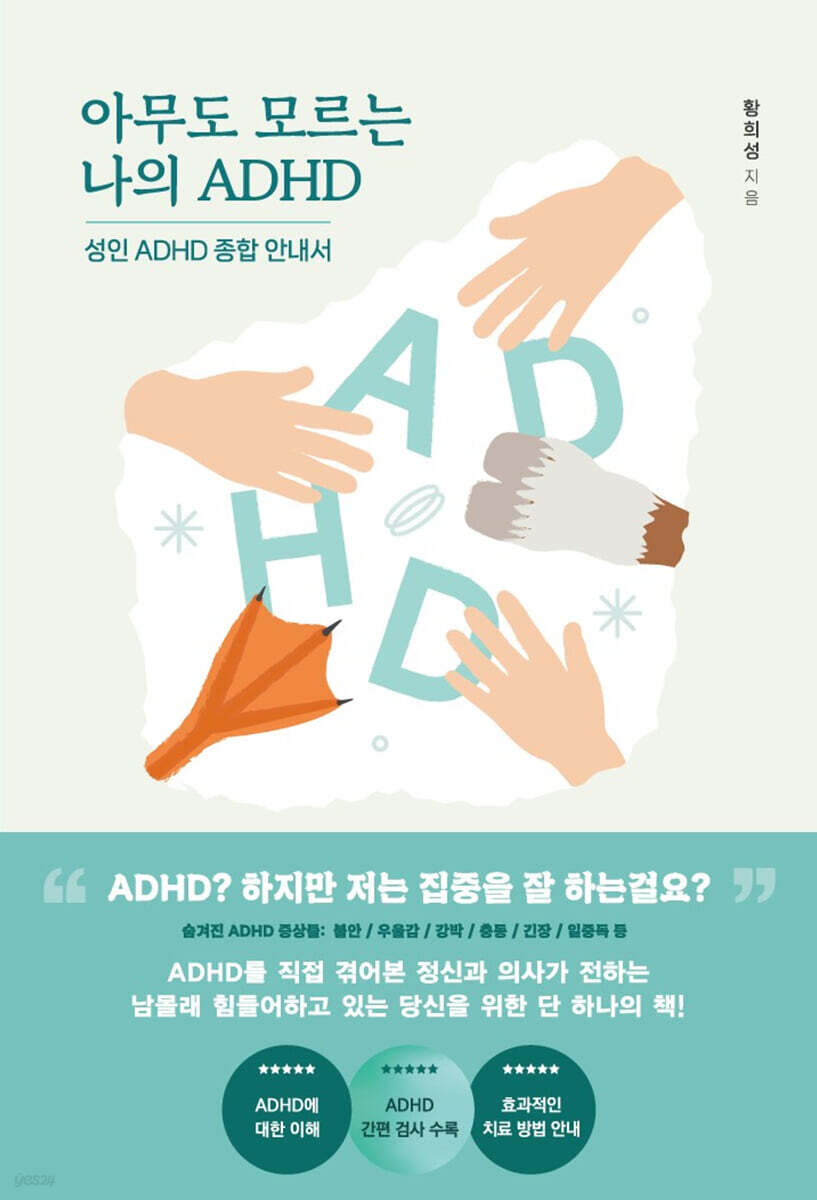
My ADHD that no one knows about
 |
Description
Book Introduction
Attention-deficit hyperactivity disorder, commonly referred to as ADHD, was officially included in the DSM-III in 1980, opening the way to properly explaining many symptoms that had previously been considered personality disorders.
Especially since the 2000s, with the rapid development of brain science, it has been confirmed that ADHD, which was previously limited to some children, is essentially caused by brain abnormalities.
According to various statistics, ADHD symptoms, which affect approximately 6.76% of adults worldwide, are rarely diagnosed due to lack of awareness and aversion to psychiatry.
The actual domestic adult ADHD treatment rate was found to be only 0.76% as of 2017.
In this situation, the need for a book that can guide the diagnosis and treatment of adult ADHD in Korea is increasingly emphasized.
Although there are introductory books introducing adult ADHD in many developed countries, including the United States and Japan, publishing and authoring activities are still weak in Korea.
This book, 『My ADHD No One Knows About』 by Dr. Hwang Hee-seong, is significant in that it is a popular book on adult ADHD that was reconstructed based on the doctor's own experience.
According to him, adult ADHD is both a crisis and an opportunity.
It's a booby trap that holds me back, but at the same time, it's a treasure trove of boundless passion and creative energy.
Through "My ADHD No One Knows About," the author encourages readers to improve their own quality of life and turn what they have considered their lifelong shortcomings into strengths, thus opening a new chapter in their lives.
Especially since the 2000s, with the rapid development of brain science, it has been confirmed that ADHD, which was previously limited to some children, is essentially caused by brain abnormalities.
According to various statistics, ADHD symptoms, which affect approximately 6.76% of adults worldwide, are rarely diagnosed due to lack of awareness and aversion to psychiatry.
The actual domestic adult ADHD treatment rate was found to be only 0.76% as of 2017.
In this situation, the need for a book that can guide the diagnosis and treatment of adult ADHD in Korea is increasingly emphasized.
Although there are introductory books introducing adult ADHD in many developed countries, including the United States and Japan, publishing and authoring activities are still weak in Korea.
This book, 『My ADHD No One Knows About』 by Dr. Hwang Hee-seong, is significant in that it is a popular book on adult ADHD that was reconstructed based on the doctor's own experience.
According to him, adult ADHD is both a crisis and an opportunity.
It's a booby trap that holds me back, but at the same time, it's a treasure trove of boundless passion and creative energy.
Through "My ADHD No One Knows About," the author encourages readers to improve their own quality of life and turn what they have considered their lifelong shortcomings into strengths, thus opening a new chapter in their lives.
- You can preview some of the book's contents.
Preview
index
Part 1 - Do I Have ADHD?
Chapter 1. ADHD? But I'm good at concentrating?
Chapter 2.
39 years of curiosity, a life of hiding my differences from others.
(1) A child who feels inadequate and can only study
(2) A boy trapped in studying and addiction
(3) Failure to do something, self-reproach, and then failure
(4) After 39 years, I was diagnosed with ADHD.
Chapter 3.
Diagnostic criteria and screening tests, but numerous symptoms
(1) About the DSM-5 diagnostic criteria
(2) Adult ADHD Self-Report Scale Symptom Checklist v.1.1
(3) Margm Adult ADHD Self-Report Checklist 1.05
Chapter 4. Misconceptions, Prejudices, and Stereotypes About ADHD
(1) Is ADHD a real disease?
(2) Does ADHD really need treatment?
(3) Can ADHD also occur in adults?
(4) Is ADHD a genetic or environmental factor?
(5) Is ADHD a problem of will?
(6) People with ADHD have trouble concentrating?
(7) People with ADHD can’t work?
Part 2 - ADHD and the Truth You Didn't Know
Chapter 1.
History, Changing Concepts, and Confusion
(1) A brief history of ADHD
(2) Difficulties in diagnosing adult ADHD
Chapter 2.
Attention and Executive Function: Everyone Knows, But Nobody Does
(1) What is attention?
(2) What is executive function?
Chapter 3.
Brain Structure and Neurotransmitters in Adult ADHD
(1) Structural and functional differences in the ADHD brain
Chapter 4.
And the symptoms of ADHD that no one taught you about
(1) A new concept of ADHD
(2) Things to keep in mind before recognizing ADHD symptoms
(3) Various ADHD characteristics
Chapter 5.
ADHD: Other Mental Disorders That Are This Difficult
(1) Major depressive disorder (depression)
(2) Borderline personality disorder
(3) Obsessive-compulsive disorder (OCD)
(4) Bipolar disorder
(5) Anxiety disorder
(6) Intermittent explosive disorder (intermittent explosive disorder)
(7) Impulse control problems
(8) Tic disorder
(9) Restless legs syndrome
Part 3 - Diagnosis and Treatment of Adult ADHD
Chapter 1.
Diagnostic methods, accurate but not excessive
(1) Computerized tests: Comprehensive Attention Test (CAT) and Computerized Neurocognitive Test (CNSVS)
(2) Quantitative EEG test
(3) Comprehensive psychological examination
Chapter 2.
Drug treatment, putting my brain at ease
(1) Desirable approach to ADHD drug treatment
(2) Types and mechanisms of ADHD drugs
(3) Effects and side effects of ADHD medication
Chapter 3.
Cognitive Behavioral Therapy: The Thoughts and Behaviors I Need to Change
(1) Overview of cognitive behavioral therapy
(2) Application of cognitive behavioral therapy
Chapter 4.
Mindfulness meditation to enhance awareness and develop metacognition
(1) Mindfulness training to help with ADHD
(2) The importance of metacognition
Part 4 - My ADHD Was This Hard
Chapter 1.
Depression: Why am I always feeling down and lethargic?
(1) Patients with recurrent depression and lethargy, and those with trichotillomania since childhood
(2) Cases of recurrent depression of unknown cause, in which symptoms were observed due to medication use
(3) Variations in concentration depending on mood, complex synergy of symptoms
(4) Chronic depression, severe lethargy.
Possibility of brain abnormality rather than psychological abnormality
(5) Persistence of severe depression since adolescence
Chapter 2.
Borderline Personality Disorder: Is It Really My Personality?
(1) Diagnosis of unclear borderline personality disorder
(2) Uncontrolled suicidal impulses and mood swings
Chapter 3.
Obsessive-compulsive disorder: the thought won't stop, and you have to do it.
(1) ADHD, where obsessive-compulsive disorder was the main cause of visits
(2) Repetitive, uncontrolled anxious thoughts, self-harm, and drinking
(3) Borderline obsessive-compulsive disorder, schizophrenia, and ADHD
Chapter 4.
Bipolar II Disorder: The Unstable Moods Are So Distressing
(1) Winter vacation depression
(2) Chronic depression, marked drug-induced hypomania, and accidental harm
(3) Depression → Bipolar disorder → and ADHD
Chapter 5.
Anxiety Disorder: Feeling anxious, tense, short of breath, chest pain, and worry
(1) Concealment of ADHD due to superior abilities and coping styles
(2) Tension, suffocation, insomnia
(3) Excessive anxiety about the future and environmental changes
Chapter 6.
Impulsivity Issues: Are Only Impatient People Impulsive?
(1) Chronic depression and difficulty controlling impulses
(2) Anger explosions that occur only at home
(3) Chronic binge eating and vomiting
Chapter 7.
Workaholic: Can't stop working, and resting is painful.
(1) Congenital and familial congenital addiction
Chapter 8.
Atypical Patterns: What Exactly About Me Does It Make Me ADHD?
(1) Sudden increase in sexual desire
(2) Both parents and siblings have ADHD, but...
(3) Patients suffering from chronic leg numbness
Chapter 9.
And the final riddle: auditory hallucinations and delusions
(1) Unresolved hallucinations, delusions, and suicide attempts
(2) History of treatment for delusions of relation and persecution, and schizophrenia
Going out words
Chapter 1. ADHD? But I'm good at concentrating?
Chapter 2.
39 years of curiosity, a life of hiding my differences from others.
(1) A child who feels inadequate and can only study
(2) A boy trapped in studying and addiction
(3) Failure to do something, self-reproach, and then failure
(4) After 39 years, I was diagnosed with ADHD.
Chapter 3.
Diagnostic criteria and screening tests, but numerous symptoms
(1) About the DSM-5 diagnostic criteria
(2) Adult ADHD Self-Report Scale Symptom Checklist v.1.1
(3) Margm Adult ADHD Self-Report Checklist 1.05
Chapter 4. Misconceptions, Prejudices, and Stereotypes About ADHD
(1) Is ADHD a real disease?
(2) Does ADHD really need treatment?
(3) Can ADHD also occur in adults?
(4) Is ADHD a genetic or environmental factor?
(5) Is ADHD a problem of will?
(6) People with ADHD have trouble concentrating?
(7) People with ADHD can’t work?
Part 2 - ADHD and the Truth You Didn't Know
Chapter 1.
History, Changing Concepts, and Confusion
(1) A brief history of ADHD
(2) Difficulties in diagnosing adult ADHD
Chapter 2.
Attention and Executive Function: Everyone Knows, But Nobody Does
(1) What is attention?
(2) What is executive function?
Chapter 3.
Brain Structure and Neurotransmitters in Adult ADHD
(1) Structural and functional differences in the ADHD brain
Chapter 4.
And the symptoms of ADHD that no one taught you about
(1) A new concept of ADHD
(2) Things to keep in mind before recognizing ADHD symptoms
(3) Various ADHD characteristics
Chapter 5.
ADHD: Other Mental Disorders That Are This Difficult
(1) Major depressive disorder (depression)
(2) Borderline personality disorder
(3) Obsessive-compulsive disorder (OCD)
(4) Bipolar disorder
(5) Anxiety disorder
(6) Intermittent explosive disorder (intermittent explosive disorder)
(7) Impulse control problems
(8) Tic disorder
(9) Restless legs syndrome
Part 3 - Diagnosis and Treatment of Adult ADHD
Chapter 1.
Diagnostic methods, accurate but not excessive
(1) Computerized tests: Comprehensive Attention Test (CAT) and Computerized Neurocognitive Test (CNSVS)
(2) Quantitative EEG test
(3) Comprehensive psychological examination
Chapter 2.
Drug treatment, putting my brain at ease
(1) Desirable approach to ADHD drug treatment
(2) Types and mechanisms of ADHD drugs
(3) Effects and side effects of ADHD medication
Chapter 3.
Cognitive Behavioral Therapy: The Thoughts and Behaviors I Need to Change
(1) Overview of cognitive behavioral therapy
(2) Application of cognitive behavioral therapy
Chapter 4.
Mindfulness meditation to enhance awareness and develop metacognition
(1) Mindfulness training to help with ADHD
(2) The importance of metacognition
Part 4 - My ADHD Was This Hard
Chapter 1.
Depression: Why am I always feeling down and lethargic?
(1) Patients with recurrent depression and lethargy, and those with trichotillomania since childhood
(2) Cases of recurrent depression of unknown cause, in which symptoms were observed due to medication use
(3) Variations in concentration depending on mood, complex synergy of symptoms
(4) Chronic depression, severe lethargy.
Possibility of brain abnormality rather than psychological abnormality
(5) Persistence of severe depression since adolescence
Chapter 2.
Borderline Personality Disorder: Is It Really My Personality?
(1) Diagnosis of unclear borderline personality disorder
(2) Uncontrolled suicidal impulses and mood swings
Chapter 3.
Obsessive-compulsive disorder: the thought won't stop, and you have to do it.
(1) ADHD, where obsessive-compulsive disorder was the main cause of visits
(2) Repetitive, uncontrolled anxious thoughts, self-harm, and drinking
(3) Borderline obsessive-compulsive disorder, schizophrenia, and ADHD
Chapter 4.
Bipolar II Disorder: The Unstable Moods Are So Distressing
(1) Winter vacation depression
(2) Chronic depression, marked drug-induced hypomania, and accidental harm
(3) Depression → Bipolar disorder → and ADHD
Chapter 5.
Anxiety Disorder: Feeling anxious, tense, short of breath, chest pain, and worry
(1) Concealment of ADHD due to superior abilities and coping styles
(2) Tension, suffocation, insomnia
(3) Excessive anxiety about the future and environmental changes
Chapter 6.
Impulsivity Issues: Are Only Impatient People Impulsive?
(1) Chronic depression and difficulty controlling impulses
(2) Anger explosions that occur only at home
(3) Chronic binge eating and vomiting
Chapter 7.
Workaholic: Can't stop working, and resting is painful.
(1) Congenital and familial congenital addiction
Chapter 8.
Atypical Patterns: What Exactly About Me Does It Make Me ADHD?
(1) Sudden increase in sexual desire
(2) Both parents and siblings have ADHD, but...
(3) Patients suffering from chronic leg numbness
Chapter 9.
And the final riddle: auditory hallucinations and delusions
(1) Unresolved hallucinations, delusions, and suicide attempts
(2) History of treatment for delusions of relation and persecution, and schizophrenia
Going out words
Detailed image

Into the book
ADHD is not a disease.
It may have also worked as a positive factor, helping you study more diligently. ADHD medication doesn't enhance your abilities, but rather helps you develop your natural abilities.
Medicine is not taken to cure illness, but to maintain comfort and health.
--- From "ADHD? But I'm good at concentrating?"
At first, the diagnosis of ADHD was only made to a few people who had been diagnosed with ADHD at other hospitals and to those whose symptoms were clear enough to be included in textbooks.
By listening to their daily lives, I was able to find out symptoms that were beyond the diagnostic criteria.
As I studied books and papers about it, checked with fellow doctors, and repeated this process countless times, the scope of ADHD that I knew gradually expanded.
By looking at the slightly broader scope, we were able to see new symptoms in people, and ADHD was discovered among people who had previously been diagnosed with depression but had not improved.
The effectiveness of ADHD treatment for these people was remarkable.
This is because people who had been struggling for 10, 20, or even their entire lives before coming to me have gotten better.
--- From "39 Years of Curiosity, a Life Hidden from Being Different from Others"
After opening a hospital and becoming convinced that I had ADHD, I started taking medication.
(...) Not only I, but my family also felt the effects of the medicine and our family relationships changed a lot.
This made me rethink the diagnostic criteria for ADHD.
At least the current author absolutely does not meet the criteria for ADHD diagnosis.
Even though I felt the drug was having a great effect, there was little change in my attention span.
It is currently very unclear whether there is a problem with attention.
When I first came to the hospital, I tested myself with the attention tests CAT and CNSVS, and the results were normal or better than normal.
Still, I had some challenges with ADHD, and I wasn't even aware of them until I started taking medication.
In general, since ADHD is about 'not being able to concentrate', many people think that they are bad at studying or working or are lazy.
This is a stereotype that hinders the detection of ADHD and causes resistance to diagnosis.
In conclusion, the presence of ADHD has very little correlation with academic ability, level of functioning, or degree of achievement.
It may be completely absent, or rather, ADHD may be associated with high achievement.
--- From “Misconceptions, Prejudices, and Stereotypes About ADHD”
ADHD doesn't always interfere with daily life; it can vary greatly depending on the individual and their environment. It's well known that even people with ADHD who previously had no problems with their lives can experience difficulties as they advance through grades, enter college, find a job, or change jobs. Even those with severe ADHD may not require treatment in a low-stress environment, while even mild ADHD symptoms may require treatment in a competitive and stressful environment.
It may have also worked as a positive factor, helping you study more diligently. ADHD medication doesn't enhance your abilities, but rather helps you develop your natural abilities.
Medicine is not taken to cure illness, but to maintain comfort and health.
--- From "ADHD? But I'm good at concentrating?"
At first, the diagnosis of ADHD was only made to a few people who had been diagnosed with ADHD at other hospitals and to those whose symptoms were clear enough to be included in textbooks.
By listening to their daily lives, I was able to find out symptoms that were beyond the diagnostic criteria.
As I studied books and papers about it, checked with fellow doctors, and repeated this process countless times, the scope of ADHD that I knew gradually expanded.
By looking at the slightly broader scope, we were able to see new symptoms in people, and ADHD was discovered among people who had previously been diagnosed with depression but had not improved.
The effectiveness of ADHD treatment for these people was remarkable.
This is because people who had been struggling for 10, 20, or even their entire lives before coming to me have gotten better.
--- From "39 Years of Curiosity, a Life Hidden from Being Different from Others"
After opening a hospital and becoming convinced that I had ADHD, I started taking medication.
(...) Not only I, but my family also felt the effects of the medicine and our family relationships changed a lot.
This made me rethink the diagnostic criteria for ADHD.
At least the current author absolutely does not meet the criteria for ADHD diagnosis.
Even though I felt the drug was having a great effect, there was little change in my attention span.
It is currently very unclear whether there is a problem with attention.
When I first came to the hospital, I tested myself with the attention tests CAT and CNSVS, and the results were normal or better than normal.
Still, I had some challenges with ADHD, and I wasn't even aware of them until I started taking medication.
In general, since ADHD is about 'not being able to concentrate', many people think that they are bad at studying or working or are lazy.
This is a stereotype that hinders the detection of ADHD and causes resistance to diagnosis.
In conclusion, the presence of ADHD has very little correlation with academic ability, level of functioning, or degree of achievement.
It may be completely absent, or rather, ADHD may be associated with high achievement.
--- From “Misconceptions, Prejudices, and Stereotypes About ADHD”
ADHD doesn't always interfere with daily life; it can vary greatly depending on the individual and their environment. It's well known that even people with ADHD who previously had no problems with their lives can experience difficulties as they advance through grades, enter college, find a job, or change jobs. Even those with severe ADHD may not require treatment in a low-stress environment, while even mild ADHD symptoms may require treatment in a competitive and stressful environment.
--- From "And the Symptoms of ADHD That No One Taught You About"
Publisher's Review
“Huh? ADHD? Me? But I’m good at concentrating.”
When people talk about ADHD, they often think of it as something that appears in childhood and is associated with difficulty concentrating and lack of attention.
In reality, many adults show ADHD symptoms, but they live with it as a personality trait or individuality.
It's common for everyone to have limitations in focusing solely on one thing and to feel the urge to satisfy their own needs.
That's why, even if you think, 'Could I have ADHD?', you tend to consistently think, 'But I'm good at concentrating, right?', 'Hey, what's a grown adult with ADHD?', or 'Everyone else lives like that, right?'
Then, when self-reproach and inexplicable anxiety suddenly come upon us, such as, “Why am I worse than others?” or “Why am I different from others?”, we often suffer because we cannot find the reason.
The First Step to Understanding Adult ADHD
The author of this book, Director Hwang Hee-seong, wrote “My ADHD That No One Knows About” based on his own experience as a doctor and the cases of patients he has met, hoping that many people would easily understand ADHD and, through this, understand themselves and be understood by others.
It is true that books on ADHD currently published in South Korea are not popular compared to those in other advanced countries such as the United States and Japan.
Many ADHD patients, seeking to understand themselves and find comfort in stories of others who share their condition, often find themselves confronted only with books on ADHD for children or thick, specialized medical texts.
In this reality, this book can be said to be a popular introduction to ADHD that easily covers the misconceptions and truths about ADHD, along with case studies of people showing symptoms of ADHD.
The author hopes that this book will provide comfort and understanding to many ADHD patients, and even give them a second chance at life. He hopes that this book will fulfill that role.
When people talk about ADHD, they often think of it as something that appears in childhood and is associated with difficulty concentrating and lack of attention.
In reality, many adults show ADHD symptoms, but they live with it as a personality trait or individuality.
It's common for everyone to have limitations in focusing solely on one thing and to feel the urge to satisfy their own needs.
That's why, even if you think, 'Could I have ADHD?', you tend to consistently think, 'But I'm good at concentrating, right?', 'Hey, what's a grown adult with ADHD?', or 'Everyone else lives like that, right?'
Then, when self-reproach and inexplicable anxiety suddenly come upon us, such as, “Why am I worse than others?” or “Why am I different from others?”, we often suffer because we cannot find the reason.
The First Step to Understanding Adult ADHD
The author of this book, Director Hwang Hee-seong, wrote “My ADHD That No One Knows About” based on his own experience as a doctor and the cases of patients he has met, hoping that many people would easily understand ADHD and, through this, understand themselves and be understood by others.
It is true that books on ADHD currently published in South Korea are not popular compared to those in other advanced countries such as the United States and Japan.
Many ADHD patients, seeking to understand themselves and find comfort in stories of others who share their condition, often find themselves confronted only with books on ADHD for children or thick, specialized medical texts.
In this reality, this book can be said to be a popular introduction to ADHD that easily covers the misconceptions and truths about ADHD, along with case studies of people showing symptoms of ADHD.
The author hopes that this book will provide comfort and understanding to many ADHD patients, and even give them a second chance at life. He hopes that this book will fulfill that role.
GOODS SPECIFICS
- Date of issue: June 1, 2023
- Page count, weight, size: 296 pages | 140*209*20mm
- ISBN13: 9791198318718
- ISBN10: 1198318716
You may also like
카테고리
korean


korean

![GQ KOREA Mark (Monthly): December [2025]](http://librairie.coreenne.fr/cdn/shop/files/8ef265dbbfbf186523ed75ba7319009d.jpg?v=1765340328&width=3840)


