

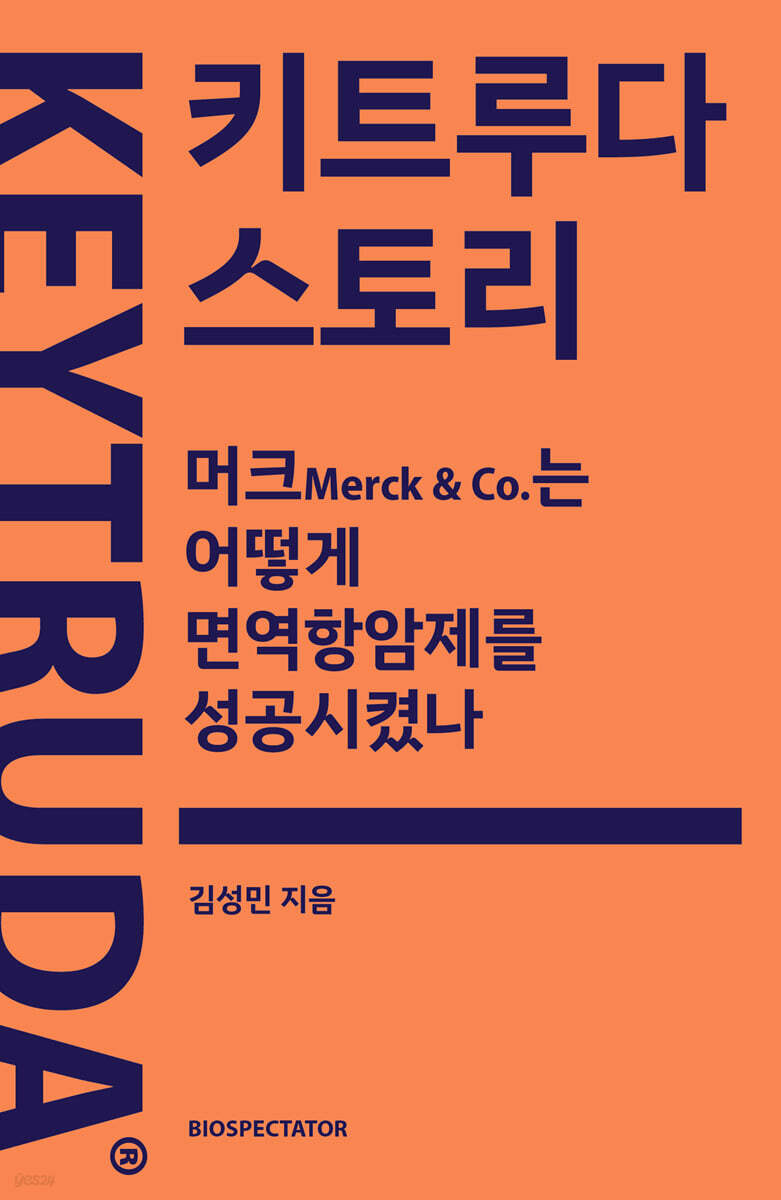
Keytruda Story
 |
Description
Book Introduction
Merck & Co.'s Keytruda, an immunotherapy drug that is changing the framework of cancer treatment, is currently considered the most advanced immunotherapy drug in 2022.
We examine the science and strategy behind how Keytruda was developed into today's new anticancer drug.
We examine the science and strategy behind how Keytruda was developed into today's new anticancer drug.
- You can preview some of the book's contents.
Preview
index
Introduction 005
I Merck and BMS 21
New Edition 23
Lung cancer 24
Non-small cell lung cancer (NSCLC) 25
Non-small cell lung cancer treatment 29
Targeted anticancer drug 32
KEYNOTE-024 35
KEYNOTE-189, KEYNOTE-407 38
II Pembrolizumab and ipilimumab 51
AstraZeneca and Roche 53
The Past of Merck and BMS 56
Tegenero and CD28 antibody 58
Pembrolizumab 60
Ipilimumab 62
Yervoy® 64
Opdivo® 68
Keytruda® 69
KEYNOTE-001 71
III 5% and 50% 83
Biomarker-based immunotherapy 85
PD-L1 expression 5 vs.
50 88
MSI-H/dMMR 91
101 Practical Challenges of Biomarkers in New Drug Development
IV PD-L1 and TMB 109
Magic Bullet Frame 111
TMB 112
Keytruda's Reversal 116
Prospective and retrospective studies 122
Scientific Fact 126
Complete Remission (CR) 100% 129
V TNBC 141
Breast cancer 143
Herceptin® 144
Jose Baselga 149
TNBC 155
Tecentriq and Abraxane 159
Combination of chemotherapy and Keytruda 163
Antibody-drug conjugate (ADC) 169
Conservatism in Science 173
VIOXX® Incident 176
VI Renal Cancer 195
Kidney cancer 197
sunitinib and pazopanib 203
Opdivo 208, a kidney cancer treatment
PD-1+TKI vs. PD-1+CTLA-4 211
Keytruda and axitinib, Keytruda and lenvatinib 216
HIF-α 220
VII What Made Keytruda Possible 235
Framing 237
Roger M. Perlmutter
Perlmutter) 239
Combination administration 244
Regulatory Agency 251
256 people
Stage 1-3A non-small cell lung cancer 260
Recent data from Roche, BMS, and Merck 266
Preoperative and Postoperative Adjuvant Therapy 271
The Trap of Mechanism 272
Data Barrier 274
The Strict Craftsman 277
Search 285
I Merck and BMS 21
New Edition 23
Lung cancer 24
Non-small cell lung cancer (NSCLC) 25
Non-small cell lung cancer treatment 29
Targeted anticancer drug 32
KEYNOTE-024 35
KEYNOTE-189, KEYNOTE-407 38
II Pembrolizumab and ipilimumab 51
AstraZeneca and Roche 53
The Past of Merck and BMS 56
Tegenero and CD28 antibody 58
Pembrolizumab 60
Ipilimumab 62
Yervoy® 64
Opdivo® 68
Keytruda® 69
KEYNOTE-001 71
III 5% and 50% 83
Biomarker-based immunotherapy 85
PD-L1 expression 5 vs.
50 88
MSI-H/dMMR 91
101 Practical Challenges of Biomarkers in New Drug Development
IV PD-L1 and TMB 109
Magic Bullet Frame 111
TMB 112
Keytruda's Reversal 116
Prospective and retrospective studies 122
Scientific Fact 126
Complete Remission (CR) 100% 129
V TNBC 141
Breast cancer 143
Herceptin® 144
Jose Baselga 149
TNBC 155
Tecentriq and Abraxane 159
Combination of chemotherapy and Keytruda 163
Antibody-drug conjugate (ADC) 169
Conservatism in Science 173
VIOXX® Incident 176
VI Renal Cancer 195
Kidney cancer 197
sunitinib and pazopanib 203
Opdivo 208, a kidney cancer treatment
PD-1+TKI vs. PD-1+CTLA-4 211
Keytruda and axitinib, Keytruda and lenvatinib 216
HIF-α 220
VII What Made Keytruda Possible 235
Framing 237
Roger M. Perlmutter
Perlmutter) 239
Combination administration 244
Regulatory Agency 251
256 people
Stage 1-3A non-small cell lung cancer 260
Recent data from Roche, BMS, and Merck 266
Preoperative and Postoperative Adjuvant Therapy 271
The Trap of Mechanism 272
Data Barrier 274
The Strict Craftsman 277
Search 285
Into the book
Immunotherapy was a revolutionary new drug concept, and Keytruda proved its innovative concept through KEYNOTE-024.
In a normal case, we would start with clinical development to miraculously cure the disease by administering a new innovative drug alone, but Merck was different.
The direction has also been set toward combining existing chemotherapy drugs with the innovative new drug Keytruda.
And Merck's direction was right.
Although several drugs, including Roche's Tecentriq® (ingredient name: atezolizumab) and BMS' Opdivo® (ingredient name: nivolumab), have been approved as first-line treatments for non-small cell lung cancer, Merck's Keytruda has earned the honor of being the first non-small cell lung cancer treatment that can be prescribed regardless of PD-L1.
--- pp.38~39
Lung cancer is a common and dangerous cancer.
Cancer has a high incidence and mortality rate, a high recurrence rate, and a complex treatment process based on surgery and systemic therapy, all of which increase the demand for therapeutics.
Among all cancer treatment development fields, lung cancer is one of the fields that attracts the most researchers.
Of course, it is also one of the areas in which new drug development companies spend the most on research.
In other words, competition among global pharmaceutical companies to develop new lung cancer drugs is fierce.
--- p.53
In 2006, TeGenero of Germany conducted a phase 1 clinical trial in which six subjects were administered a superagonist antibody (TGN1412) that activates the CD28 receptor.
And all six people who received the antibodies were transferred to the intensive care unit.
Because the side effects appeared immediately.
Less than 90 minutes after administering the antibody, symptoms such as headache, muscle pain, diarrhea, and high blood pressure appeared, which were side effects due to a systemic inflammatory response.
It was cytokine release syndrome.
After 12 to 16 hours, the lungs were damaged and kidney failure occurred.
He was in critical condition with disseminated blood coagulation causing thrombosis and bleeding.11 Severe lymphocyte and monocyte depletion was observed within 24 hours after administration.
All patients were transferred directly to the intensive care unit and received intensive care.
Officials who witnessed the incident described it as a disaster.
This was because it happened at a time when Herceptin appeared and expectations for antibody drugs were growing.
After this incident, Tegenero struggled and eventually went bankrupt within four months.
--- p.58
The concept of biomarker-based anticancer drugs is attractive, but there are many challenges in developing new drugs.
First of all, the problem is recruiting patients to conduct clinical trials.
For example, in an early-stage clinical trial testing PD-1 antibodies in solid tumors, only 1 in 33 patients with colorectal cancer had the MSI-H/dMMR biomarker.
Looking at the results alone, Merck's insight was outstanding in seeing the value of the biomarker in just one out of 33 people.
However, being excellent means that it is not easy and that the risks are high.
--- p.101
Merck focused on the physical and objective facts of the treatment scene: who chooses a drug and why.
Clearly, Keytruda can be prescribed to all patients with MSH-H/dMMR cancer.
This was an innovative initiative that broke the framework of cancer treatment, which was divided into existing departments.
But not all innovations change the field all at once.
In the field of cancer treatment, cancer is still classified by department, and each department has a frame of specific treatment for specific cancer.
To put its innovation into practice, Merck was willing to take a more convenient approach for healthcare professionals: changing the label.
It is an attitude that focuses more on what is actually happening and a tendency to place greater value on the facts that are happening on the ground.
--- p.137
Why bother conducting a comparative clinical trial with unpredictable results? While Keytruda monotherapy yielded better clinical results, the clinical trial results also suggested that the Yervoy combination could be even more effective.
Did Merck overconfidently believe Keytruda would automatically outperform Yervoy? The risks involved in such a situation, given its already dominant position, are significant, and the potential benefits are unclear.
So, perhaps they were genuinely curious? Could it be that Merck conducted a comparative clinical trial because they were genuinely curious about which drug was superior, Yervoy or Keytruda? It's a question any scientist, engineer, or researcher would readily wonder about.
The reason for curiosity is not that complicated.
It would be sufficient to say something like, ‘We need to compare to create a better treatment.’
It is true that science only sees as much as it knows, and moves only as much as it sees.
Merck seems to move only as much as he knows and sees.
Keytruda's KEYNOTE-001 clinical trial, which enrolled 1,260 patients with non-small cell lung cancer and melanoma, may also seem like a bold, reckless, and aggressive strategy.
However, if the reason is 'I want to know exactly and confirm', then it makes sense.
The number 1,260 may have been just what Merck could see, know, and move.
It may not have been a special decision, but rather an obvious one.
--- pp.179~180
Merck held itself to the highest standards of science, and suffered enormous losses as a result.
Nevertheless, a similar clinical design was applied again to Keytruda.
Merck conducted a clinical trial comparing the effectiveness of Keytruda and Yervoy combination therapy with the effectiveness of Keytruda alone.
Perhaps it's because they're still confident despite the great challenges they've faced, but Merck's decision is undoubtedly honest with science.
It was in 2011 that Merck began developing a new drug, Keytruda, in a new way.
But perhaps more appropriate adjectives than 'new' would be 'still', 'properly', 'straightforward' or 'according to the principles'.
--- p.185
Merck responded immediately when issues arose during clinical trials and continued to adjust clinical development designs and data analysis.
We also regularly provided the FDA with data requested to protect patients and ensured statistical rigor.
Active communication reduced mistakes and misunderstandings.
Merck was methodologically innovative, designing adaptive clinical trials, rapidly prioritizing and betting on specific cancers, and actively communicating with regulators. However, it was more rigorous and conservative than most when it came to scientifically setting PD-L1 criteria and critically evaluating Keytruda's efficacy.
--- p.256
Merck is flexible and generous when it comes to scientific facts.
If there is solid evidence or new facts that have been discovered, they seem willing to accept new hypotheses, regardless of what they previously held.
However, he is stubborn when it comes to proving scientific hypotheses.
They are willing to take risks to see precise and clear causal relationships. If BMS is like an aristocratic family, unyielding in its thinking but generous in attracting talented individuals, Merck is like a family of meticulous craftsmen, focused solely on creating quality products.
In a normal case, we would start with clinical development to miraculously cure the disease by administering a new innovative drug alone, but Merck was different.
The direction has also been set toward combining existing chemotherapy drugs with the innovative new drug Keytruda.
And Merck's direction was right.
Although several drugs, including Roche's Tecentriq® (ingredient name: atezolizumab) and BMS' Opdivo® (ingredient name: nivolumab), have been approved as first-line treatments for non-small cell lung cancer, Merck's Keytruda has earned the honor of being the first non-small cell lung cancer treatment that can be prescribed regardless of PD-L1.
--- pp.38~39
Lung cancer is a common and dangerous cancer.
Cancer has a high incidence and mortality rate, a high recurrence rate, and a complex treatment process based on surgery and systemic therapy, all of which increase the demand for therapeutics.
Among all cancer treatment development fields, lung cancer is one of the fields that attracts the most researchers.
Of course, it is also one of the areas in which new drug development companies spend the most on research.
In other words, competition among global pharmaceutical companies to develop new lung cancer drugs is fierce.
--- p.53
In 2006, TeGenero of Germany conducted a phase 1 clinical trial in which six subjects were administered a superagonist antibody (TGN1412) that activates the CD28 receptor.
And all six people who received the antibodies were transferred to the intensive care unit.
Because the side effects appeared immediately.
Less than 90 minutes after administering the antibody, symptoms such as headache, muscle pain, diarrhea, and high blood pressure appeared, which were side effects due to a systemic inflammatory response.
It was cytokine release syndrome.
After 12 to 16 hours, the lungs were damaged and kidney failure occurred.
He was in critical condition with disseminated blood coagulation causing thrombosis and bleeding.11 Severe lymphocyte and monocyte depletion was observed within 24 hours after administration.
All patients were transferred directly to the intensive care unit and received intensive care.
Officials who witnessed the incident described it as a disaster.
This was because it happened at a time when Herceptin appeared and expectations for antibody drugs were growing.
After this incident, Tegenero struggled and eventually went bankrupt within four months.
--- p.58
The concept of biomarker-based anticancer drugs is attractive, but there are many challenges in developing new drugs.
First of all, the problem is recruiting patients to conduct clinical trials.
For example, in an early-stage clinical trial testing PD-1 antibodies in solid tumors, only 1 in 33 patients with colorectal cancer had the MSI-H/dMMR biomarker.
Looking at the results alone, Merck's insight was outstanding in seeing the value of the biomarker in just one out of 33 people.
However, being excellent means that it is not easy and that the risks are high.
--- p.101
Merck focused on the physical and objective facts of the treatment scene: who chooses a drug and why.
Clearly, Keytruda can be prescribed to all patients with MSH-H/dMMR cancer.
This was an innovative initiative that broke the framework of cancer treatment, which was divided into existing departments.
But not all innovations change the field all at once.
In the field of cancer treatment, cancer is still classified by department, and each department has a frame of specific treatment for specific cancer.
To put its innovation into practice, Merck was willing to take a more convenient approach for healthcare professionals: changing the label.
It is an attitude that focuses more on what is actually happening and a tendency to place greater value on the facts that are happening on the ground.
--- p.137
Why bother conducting a comparative clinical trial with unpredictable results? While Keytruda monotherapy yielded better clinical results, the clinical trial results also suggested that the Yervoy combination could be even more effective.
Did Merck overconfidently believe Keytruda would automatically outperform Yervoy? The risks involved in such a situation, given its already dominant position, are significant, and the potential benefits are unclear.
So, perhaps they were genuinely curious? Could it be that Merck conducted a comparative clinical trial because they were genuinely curious about which drug was superior, Yervoy or Keytruda? It's a question any scientist, engineer, or researcher would readily wonder about.
The reason for curiosity is not that complicated.
It would be sufficient to say something like, ‘We need to compare to create a better treatment.’
It is true that science only sees as much as it knows, and moves only as much as it sees.
Merck seems to move only as much as he knows and sees.
Keytruda's KEYNOTE-001 clinical trial, which enrolled 1,260 patients with non-small cell lung cancer and melanoma, may also seem like a bold, reckless, and aggressive strategy.
However, if the reason is 'I want to know exactly and confirm', then it makes sense.
The number 1,260 may have been just what Merck could see, know, and move.
It may not have been a special decision, but rather an obvious one.
--- pp.179~180
Merck held itself to the highest standards of science, and suffered enormous losses as a result.
Nevertheless, a similar clinical design was applied again to Keytruda.
Merck conducted a clinical trial comparing the effectiveness of Keytruda and Yervoy combination therapy with the effectiveness of Keytruda alone.
Perhaps it's because they're still confident despite the great challenges they've faced, but Merck's decision is undoubtedly honest with science.
It was in 2011 that Merck began developing a new drug, Keytruda, in a new way.
But perhaps more appropriate adjectives than 'new' would be 'still', 'properly', 'straightforward' or 'according to the principles'.
--- p.185
Merck responded immediately when issues arose during clinical trials and continued to adjust clinical development designs and data analysis.
We also regularly provided the FDA with data requested to protect patients and ensured statistical rigor.
Active communication reduced mistakes and misunderstandings.
Merck was methodologically innovative, designing adaptive clinical trials, rapidly prioritizing and betting on specific cancers, and actively communicating with regulators. However, it was more rigorous and conservative than most when it came to scientifically setting PD-L1 criteria and critically evaluating Keytruda's efficacy.
--- p.256
Merck is flexible and generous when it comes to scientific facts.
If there is solid evidence or new facts that have been discovered, they seem willing to accept new hypotheses, regardless of what they previously held.
However, he is stubborn when it comes to proving scientific hypotheses.
They are willing to take risks to see precise and clear causal relationships. If BMS is like an aristocratic family, unyielding in its thinking but generous in attracting talented individuals, Merck is like a family of meticulous craftsmen, focused solely on creating quality products.
--- p.279
Publisher's Review
Keytruda development process
If you are curious about research notes and meeting minutes
Keytruda® (active ingredient: pembrolizumab) is an immunotherapy drug.
The human immune system has the ability to eliminate cancer, and immunotherapy is a new drug that utilizes the body's immune system's ability to eliminate cancer.
While targeted anticancer drugs target the special properties of specific cancers and eliminate them, immunotherapy drugs utilize the immune system's mechanism to eliminate almost all cancers, so they can be prescribed to treat various types of cancer.
For example, Merck & Co.'s Keytruda is available for treatment of almost all cancers as of 2022.
For this reason, Keytruda is sometimes called a ‘miracle anticancer drug.’
However, this book removed the adjective ‘miraculous’ that was attached to Kitruda.
Instead, they added the modifiers 'scientific' or 'strategic'.
〈〈The Keytruda Story - How Merck & Co. Succeeded with Immunotherapy〉〉 does not contain a dramatic story of new drug development success and failure that unfolds like a movie.
It's more like minutes of complex and boring meetings that you'd expect to see piled up on a desk in a biotech lab or a pharmaceutical company's strategic planning office, waiting for you when you go to work today.
This is not a story about new drug development, where dramatic situations that are difficult to encounter once in a lifetime unfold, but rather a story about research and strategic planning, where clinical trial data must be reviewed daily and decisions must be made on how to execute a limited budget.
It wasn't the first
While most new drugs carry the title of “first,” Keytruda is not the first immuno-oncology drug.
The first immuno-oncology drugs were Yervoy® (ingredient name: ipilimumab) and Opdivo® (ingredient name: nivolumab) from Bristol Myers Squibb (BMS).
Merck's Keytruda was a project that started several years later than BMS's Yervoy or Opdivo.
It might be easy to dismiss it as a "just a few years difference," but in the world of new drug research, where new technologies and patents are released daily, a few years can make an irreversible difference.
In fact, around the time BMS was launching its immuno-oncology drug into the world, Merck even tried to sell the idea and technology for immuno-oncology drugs it had accidentally acquired through a merger and acquisition process to another company.
As of 2021, even global pharmaceutical companies like Merck, which invest nearly 20 trillion won annually in R&D alone, do not accurately understand the concept and value of immuno-oncology drugs.
So, it seemed natural that Merck, having lost several years of time, would fall far behind in the race to develop new immuno-oncology drugs.
However, as of 2022, Merck's Keytruda has surpassed BMS's Yervoy and Opdivo to become the most prescribed and most profitable immuno-oncology drug.
As the subtitle suggests, this book is a process of finding answers to specific and realistic questions: "How did Merck succeed in developing immuno-oncology drugs?"
It's not over yet
〈〈Keytruda Story - How Merck & Co. Succeeded in Immune Oncology〉〉 contains over 40 graphs, tables, and illustrations related to the development of Keytruda to help understand the concepts.
It covers data from 26 Keytruda clinical trials and 12 Opdivo clinical trials, as well as 55 major drugs, including immuno-oncology drugs.
These are all clinical trial data that prove the new drug development process, milestone data that demonstrates the will to develop a new drug, and communication with regulatory agencies that allow candidates from the lab to be brought to hospitals where patients are and prescribed as new drugs.
In addition, it contains a sketch of the field in 2022, where new anticancer drug development is taking place, such as major clinical trials taking place on the topic of immuno-oncology drugs including Keytruda in 2022, an introduction and current analysis of the mechanism of new anticancer drugs with new concepts, and the possibility of applying immuno-oncology drugs to areas where suitable treatments have not been found, such as triple-negative breast cancer (TNBC).
One of the reasons this book removed the adjective "miracle drug" from Keytruda is that, despite Keytruda's effectiveness in the fight against cancer, we are still losing to cancer every day.
This is similar to the attitude shown by Merck, which made Keytruda successful.
Merck is conducting a clinical trial to compare the efficacy of Keytruda, which is currently being prescribed in clinical settings, with that of immuno-oncology drugs from competitor BMS.
If comparative clinical trials yield less efficacy data than competing drugs, Merck will be acting in a way that will negatively impact the reputation and sales of its own Keytruda.
However, Merck's actions are a starting point for finding the 'correct answer' that 'Keytruda is not yet a perfect treatment' and 'new drug development is for giving patients a better life' from Merck and Keytruda.
Since the development of new anticancer drugs is not over yet, the goal of "The Keytruda Story - How Merck & Co. Succeeded in Immunotherapy" is to help numerous Korean biotech and pharmaceutical companies that are struggling on the road to new drug development.
Rather than neatly completing a wonderful success story and presenting it in a visually appealing way, I intend to convey the busy daily life of anticancer drug development in laboratories and clinical trials through Keytruda.
As no new anticancer drug, including Keytruda, has been perfected yet, and even Merck was once unaware of the value of immuno-oncology, “The Keytruda Story - How Merck & Co. Succeeded in Immuno-Oncology” emphasizes that there is still hope for Korea’s new drug development biotech and pharmaceutical companies.
The science of immunity, the market of anticancer drugs
And the success of Keytruda
This book consists of seven chapters.
Chapter 1.
Merck and BMS introduce the framework for cancer treatment reconfigured by Keytruda, focusing on lung cancer, the most important cancer.
The three clinical trials that established Keytruda within the basic framework of lung cancer treatment are the main characters.
Chapter 2.
In 'Pembrolizumab and Ipilimumab', we read the differences between Merck and BMS surrounding the development of immuno-oncology drugs.
We look at the early development history of immuno-oncology drugs by BMS, which first recognized the potential, and Merck, which started late.
Chapter 3.
'5% and 50%' shows the different biomarker strategies chosen by Merck and BMS, and the different results this difference created.
In the following chapter, "Chapter 4. PD-L1 and TMB," we trace the resulting differences in stance and attitude across new drug development research, including biomarker strategies.
Chapter 5. TNBC examines Merck's current status as it seeks to find a way forward with Keytruda in the area of TNBC treatment development, where a clear solution has yet to be found.
Chapter 6.
In 'Kidney Cancer', we explore why BMS is leading the way in the development of kidney cancer treatments and examine what clinical trials and strategies Keytruda is using to develop kidney cancer treatments.
Finally, Chapter 7.
In 'What Made Keytruda Possible', we examine the conditions that made Keytruda possible in 2022.
This is the story of Merck's approach to science and strategy, their understanding of clinical practice, the framework for new drug development, communication with regulatory agencies, and the people who made Keytruda possible.
If you are curious about research notes and meeting minutes
Keytruda® (active ingredient: pembrolizumab) is an immunotherapy drug.
The human immune system has the ability to eliminate cancer, and immunotherapy is a new drug that utilizes the body's immune system's ability to eliminate cancer.
While targeted anticancer drugs target the special properties of specific cancers and eliminate them, immunotherapy drugs utilize the immune system's mechanism to eliminate almost all cancers, so they can be prescribed to treat various types of cancer.
For example, Merck & Co.'s Keytruda is available for treatment of almost all cancers as of 2022.
For this reason, Keytruda is sometimes called a ‘miracle anticancer drug.’
However, this book removed the adjective ‘miraculous’ that was attached to Kitruda.
Instead, they added the modifiers 'scientific' or 'strategic'.
〈〈The Keytruda Story - How Merck & Co. Succeeded with Immunotherapy〉〉 does not contain a dramatic story of new drug development success and failure that unfolds like a movie.
It's more like minutes of complex and boring meetings that you'd expect to see piled up on a desk in a biotech lab or a pharmaceutical company's strategic planning office, waiting for you when you go to work today.
This is not a story about new drug development, where dramatic situations that are difficult to encounter once in a lifetime unfold, but rather a story about research and strategic planning, where clinical trial data must be reviewed daily and decisions must be made on how to execute a limited budget.
It wasn't the first
While most new drugs carry the title of “first,” Keytruda is not the first immuno-oncology drug.
The first immuno-oncology drugs were Yervoy® (ingredient name: ipilimumab) and Opdivo® (ingredient name: nivolumab) from Bristol Myers Squibb (BMS).
Merck's Keytruda was a project that started several years later than BMS's Yervoy or Opdivo.
It might be easy to dismiss it as a "just a few years difference," but in the world of new drug research, where new technologies and patents are released daily, a few years can make an irreversible difference.
In fact, around the time BMS was launching its immuno-oncology drug into the world, Merck even tried to sell the idea and technology for immuno-oncology drugs it had accidentally acquired through a merger and acquisition process to another company.
As of 2021, even global pharmaceutical companies like Merck, which invest nearly 20 trillion won annually in R&D alone, do not accurately understand the concept and value of immuno-oncology drugs.
So, it seemed natural that Merck, having lost several years of time, would fall far behind in the race to develop new immuno-oncology drugs.
However, as of 2022, Merck's Keytruda has surpassed BMS's Yervoy and Opdivo to become the most prescribed and most profitable immuno-oncology drug.
As the subtitle suggests, this book is a process of finding answers to specific and realistic questions: "How did Merck succeed in developing immuno-oncology drugs?"
It's not over yet
〈〈Keytruda Story - How Merck & Co. Succeeded in Immune Oncology〉〉 contains over 40 graphs, tables, and illustrations related to the development of Keytruda to help understand the concepts.
It covers data from 26 Keytruda clinical trials and 12 Opdivo clinical trials, as well as 55 major drugs, including immuno-oncology drugs.
These are all clinical trial data that prove the new drug development process, milestone data that demonstrates the will to develop a new drug, and communication with regulatory agencies that allow candidates from the lab to be brought to hospitals where patients are and prescribed as new drugs.
In addition, it contains a sketch of the field in 2022, where new anticancer drug development is taking place, such as major clinical trials taking place on the topic of immuno-oncology drugs including Keytruda in 2022, an introduction and current analysis of the mechanism of new anticancer drugs with new concepts, and the possibility of applying immuno-oncology drugs to areas where suitable treatments have not been found, such as triple-negative breast cancer (TNBC).
One of the reasons this book removed the adjective "miracle drug" from Keytruda is that, despite Keytruda's effectiveness in the fight against cancer, we are still losing to cancer every day.
This is similar to the attitude shown by Merck, which made Keytruda successful.
Merck is conducting a clinical trial to compare the efficacy of Keytruda, which is currently being prescribed in clinical settings, with that of immuno-oncology drugs from competitor BMS.
If comparative clinical trials yield less efficacy data than competing drugs, Merck will be acting in a way that will negatively impact the reputation and sales of its own Keytruda.
However, Merck's actions are a starting point for finding the 'correct answer' that 'Keytruda is not yet a perfect treatment' and 'new drug development is for giving patients a better life' from Merck and Keytruda.
Since the development of new anticancer drugs is not over yet, the goal of "The Keytruda Story - How Merck & Co. Succeeded in Immunotherapy" is to help numerous Korean biotech and pharmaceutical companies that are struggling on the road to new drug development.
Rather than neatly completing a wonderful success story and presenting it in a visually appealing way, I intend to convey the busy daily life of anticancer drug development in laboratories and clinical trials through Keytruda.
As no new anticancer drug, including Keytruda, has been perfected yet, and even Merck was once unaware of the value of immuno-oncology, “The Keytruda Story - How Merck & Co. Succeeded in Immuno-Oncology” emphasizes that there is still hope for Korea’s new drug development biotech and pharmaceutical companies.
The science of immunity, the market of anticancer drugs
And the success of Keytruda
This book consists of seven chapters.
Chapter 1.
Merck and BMS introduce the framework for cancer treatment reconfigured by Keytruda, focusing on lung cancer, the most important cancer.
The three clinical trials that established Keytruda within the basic framework of lung cancer treatment are the main characters.
Chapter 2.
In 'Pembrolizumab and Ipilimumab', we read the differences between Merck and BMS surrounding the development of immuno-oncology drugs.
We look at the early development history of immuno-oncology drugs by BMS, which first recognized the potential, and Merck, which started late.
Chapter 3.
'5% and 50%' shows the different biomarker strategies chosen by Merck and BMS, and the different results this difference created.
In the following chapter, "Chapter 4. PD-L1 and TMB," we trace the resulting differences in stance and attitude across new drug development research, including biomarker strategies.
Chapter 5. TNBC examines Merck's current status as it seeks to find a way forward with Keytruda in the area of TNBC treatment development, where a clear solution has yet to be found.
Chapter 6.
In 'Kidney Cancer', we explore why BMS is leading the way in the development of kidney cancer treatments and examine what clinical trials and strategies Keytruda is using to develop kidney cancer treatments.
Finally, Chapter 7.
In 'What Made Keytruda Possible', we examine the conditions that made Keytruda possible in 2022.
This is the story of Merck's approach to science and strategy, their understanding of clinical practice, the framework for new drug development, communication with regulatory agencies, and the people who made Keytruda possible.
GOODS SPECIFICS
- Publication date: October 14, 2022
- Page count, weight, size: 292 pages | 140*215*20mm
- ISBN13: 9791191768046
- ISBN10: 119176804X
You may also like
카테고리
korean


korean

![ELLE 엘르 스페셜 에디션 A형 : 12월 [2025]](http://librairie.coreenne.fr/cdn/shop/files/b8e27a3de6c9538896439686c6b0e8fb.jpg?v=1766436872&width=3840)


