

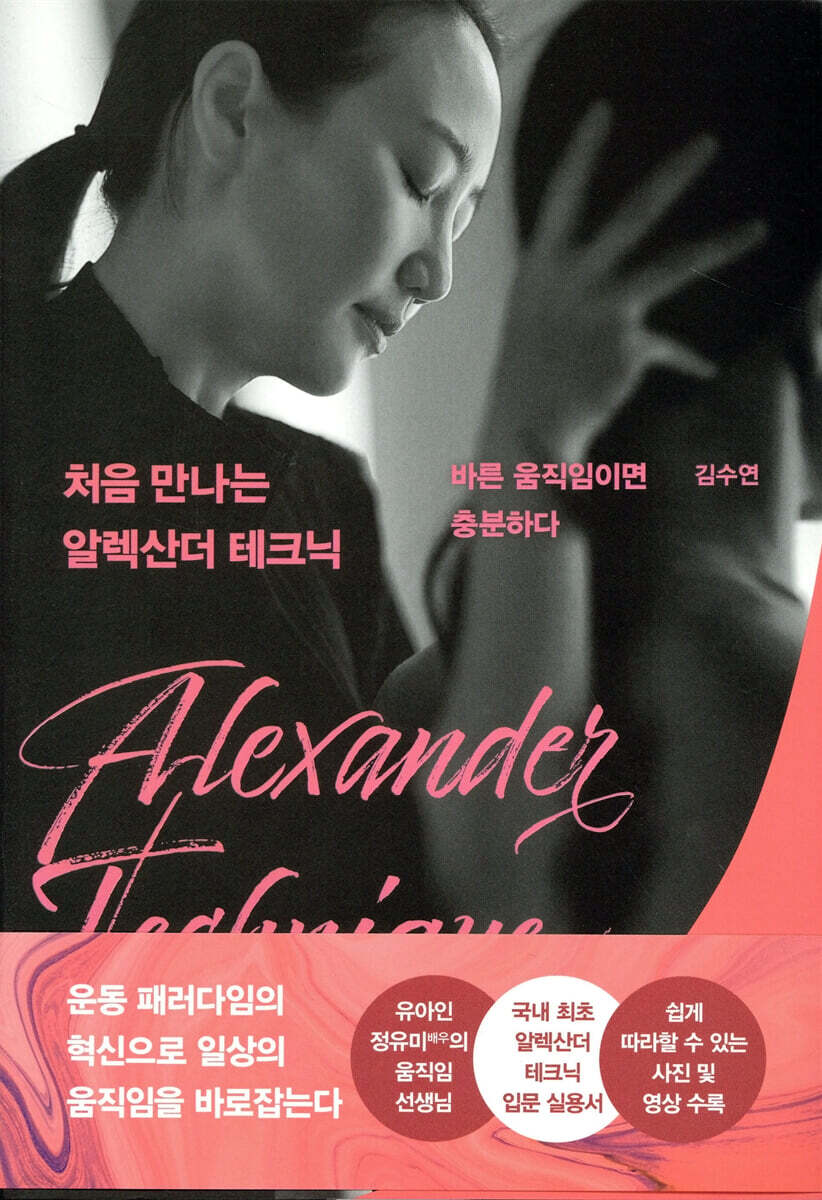
First encounter with the Alexander Technique
 |
Description
Book Introduction
Yoo Ah-in and Jung Yu-mi (actors) How to Use Your Body: An Alexander Technique Instructor Innovation in the exercise paradigm Correct your daily movements! Relieve unnecessary tension Prevents pain, fatigue and imbalance All about correct posture and movement 『First Encounter with Alexander Technique』, which helps you find the right posture and movements such as 'sitting, lying down, standing, and walking', reduces pain and tension, and leads you to use your body efficiently, has been published by Panmi-dong. The Alexander Technique is a 130-year-old somatic therapy that changes the habits of the body and mind. It is highly effective in treating neck and back pain and various chronic diseases, correcting posture, calming the mind, improving insomnia, and enhancing concentration. It also improves breathing, vocalization, posture, and movement skills, and has been adopted as a regular subject at world-renowned art schools such as Yale University, New York University, and Juilliard School of Music, and is gaining popularity as a method not only for actors, dancers, vocalists, and musicians, but also for thinkers and politicians. "First Encounter with the Alexander Technique" is Korea's first practical introductory book on the Alexander Technique, designed to allow the application of the Alexander Technique in everyday life. The author, an Alexander Technique expert, teaches step-by-step how to use your body and mind to find the posture and movement that suits your body. The book covers breathing and sensation, standing and sitting postures that combine stability and dynamism, soft yet elastic sitting, standing, and walking movements, and even body and mind habits for modern people who have overactive sympathetic nerves and cannot easily relax, and even the Alexander Technique as a 'life skill'. This book will serve as a solid guide for readers who understand the importance of proper posture and movement, but are unsure how to break free from unconscious and habitual situations and find better ways to use their bodies. |
- You can preview some of the book's contents.
Preview
index
Entering
[PART 1: Relaxation Techniques]
CHAPTER 1 BREATHING
How am I breathing?
Understanding the Lungs, Ribs, and Diaphragm
Semi-subain, return to your breathing body
Activities for better 'breathing'
▷ PRACTICE - Becoming aware of your lungs | Becoming aware of your rib cage movement | Becoming aware of your diaphragm movement | Lying in semi-supine position | Whisper-ah breathing | Silent lalala breathing | Semi-supine pose using a chair | Semi-supine pose using a wall
CHAPTER 2 Senses
There is an 'internal sense' that is different from the five senses?
Understanding Proprioception
Body Scanning: Recognize Your Body as It Is
Activities that awaken 'proprioception'
▷ PRACTICE - Identifying Sensory Perception Errors | Body Scanning | Visual Body Scanning
[PART 2: The Art of Posture]
CHAPTER 3 The Secretary
What is correct standing posture?
Finding the right alignment: head, atlas, and foot
Primary control, the body's organic relationships are important.
Activities for a better 'seogi'
▷ PRACTICE - Recognizing the Weight of Your Head | Finding the Starting Point of Your Head | Finding the Bones of Your Feet | Finding the Arches of Your Feet | Meeting Your Shaking Self
CHAPTER 4 Sitting
Is the 'correct sitting' I know really correct?
Meet the ischial bone, the 'sitting bone'
Direction, optimal support - allow minimal compression
Activities for Better Sitting
▷ PRACTICE - Finding Your Sit Bone | Understanding Directions | Sitting Using Directions | Sitting in a Backless Chair | Sitting in a Backless Chair
PART 3 The Art of Movement
CHAPTER 5 Sitting and Standing
How am I bending my body?
Understanding the Hip-Knee-Ankle Joint
Monkey Pose: Realize Tension Integration
Activities for better 'sitting and standing'
▷ PRACTICE - Locating the Hip Joint | Moving from Standing to Sitting | Moving from Sitting to Standing | Lifting Objects
CHAPTER 6 WALKING
Does 'walking' change depending on emotions?
Understanding the Coordination of the Tibia, Talus, and Legs
Grounding, Befriending Gravity and Walking
Activities for a better 'walk'
▷ PRACTICE - Lying Rocking | Wall Rocking | Grounding Walking | Progression Walking | Backward Walking
[PART 4 Life Skills]
CHAPTER 7 Body Habits
What should I do first to change my habits?
Become aware of your body's habits
Inhibition, a positive NO for new choices
Activities to change 'body habits'
▷ PRACTICE - Become aware of habits you weren't aware of | Sitting in stressful situations
CHAPTER 8 Habits of the Mind
Do sensations, thoughts, and emotions create mental habits?
Activities to change 'mental habits'
▷ PRACTICE - Riding the Subway During a Rush Hour | Stage Fright Simulation
Coming out
Acknowledgements
References
Detailed image

Into the book
We are never properly trained to move and use our bodies when sitting, standing, or walking.
Even when buying new electronic devices, we meticulously review the manuals and check their functions. But haven't we ever considered the manual for our own bodies, which laboriously move every moment? This book is a "body user manual" to help you recover from your neglect.
---p.9
'The lungs are not just located in a part of the torso, they fill the torso!' Just this shift in thinking begins the shift to deep breathing.
Just by becoming aware of the lungs within our bodies, the forgotten movements of the lungs expand, awakening us to the possibility of encountering deeper breaths.
---p.26
The head, which weighs 4 to 6 kg, is located at the top of our body and is a very important control tower.
Below the head, the spine is supported by a vertical structure, and muscles also wrap vertically around the spine in the direction of the spine.
What if I were to use my head-spine vertical structure in a compressive manner, like a brick building? The weight of my head would compress my neck, the weight of my upper body would compress my lower back, and the weight of my entire body would compress my feet.
---p.99
The reason we practice sitting on a chair without a backrest is so that we don't have to rely on the backrest.
When you sit leaning back in a chair with a backrest, it's easy to habitually sit with your sit bones behind you.
Then you will end up sitting with your back hunched over.
Therefore, if you are trying to practice sitting for the first time, we recommend that you first practice on a chair without a backrest.
---p.165
Many people know the knee joint as the ‘patella.’
The kneecap is a bone, not a joint.
The knee joint is located inside the kneecap.
Because it is a rolling joint, it moves by sliding rather than folding.
When performing a bending movement, if you break away from the misconception that 'the hip joint and knee joint are bent' and move with the awareness that 'the hip joint is rolling and the knee is sliding', you can perform the movement more smoothly and without tension.
---p.195
Let's think about how we overuse our physical and mental energy. We could compare it to a computer with too many windows open.
If you have too many programs running constantly, your computer will eventually freeze up.
If you want to use a frozen computer again, you will have to reboot it.
How can you avoid having to reboot? First, you need to be able to close unnecessary windows on your computer while it's still running smoothly.
The same goes for our bodies and minds.
We need to recognize when we are overusing our bodies and minds and make the choice to stop.
Even when buying new electronic devices, we meticulously review the manuals and check their functions. But haven't we ever considered the manual for our own bodies, which laboriously move every moment? This book is a "body user manual" to help you recover from your neglect.
---p.9
'The lungs are not just located in a part of the torso, they fill the torso!' Just this shift in thinking begins the shift to deep breathing.
Just by becoming aware of the lungs within our bodies, the forgotten movements of the lungs expand, awakening us to the possibility of encountering deeper breaths.
---p.26
The head, which weighs 4 to 6 kg, is located at the top of our body and is a very important control tower.
Below the head, the spine is supported by a vertical structure, and muscles also wrap vertically around the spine in the direction of the spine.
What if I were to use my head-spine vertical structure in a compressive manner, like a brick building? The weight of my head would compress my neck, the weight of my upper body would compress my lower back, and the weight of my entire body would compress my feet.
---p.99
The reason we practice sitting on a chair without a backrest is so that we don't have to rely on the backrest.
When you sit leaning back in a chair with a backrest, it's easy to habitually sit with your sit bones behind you.
Then you will end up sitting with your back hunched over.
Therefore, if you are trying to practice sitting for the first time, we recommend that you first practice on a chair without a backrest.
---p.165
Many people know the knee joint as the ‘patella.’
The kneecap is a bone, not a joint.
The knee joint is located inside the kneecap.
Because it is a rolling joint, it moves by sliding rather than folding.
When performing a bending movement, if you break away from the misconception that 'the hip joint and knee joint are bent' and move with the awareness that 'the hip joint is rolling and the knee is sliding', you can perform the movement more smoothly and without tension.
---p.195
Let's think about how we overuse our physical and mental energy. We could compare it to a computer with too many windows open.
If you have too many programs running constantly, your computer will eventually freeze up.
If you want to use a frozen computer again, you will have to reboot it.
How can you avoid having to reboot? First, you need to be able to close unnecessary windows on your computer while it's still running smoothly.
The same goes for our bodies and minds.
We need to recognize when we are overusing our bodies and minds and make the choice to stop.
---pp.270~271
Publisher's Review
Correcting poor posture and movement patterns can bring about positive changes in your overall life.
On the MBC program “I Live Alone,” actor Yoo Ah-in said of the Alexander Technique, “It completely changed my philosophy and paradigm on exercise,” and mentioned that it helped him change his perception of his body and improve his ability to control his body.
The Alexander Technique, which is a regular subject at world-renowned art schools such as Yale University, New York University, and Juilliard School, is also the training method of numerous actors and singers, including Benedict Cumberbatch, Hugh Jackman, Keanu Reeves, Juliette Binoche, Paul McCartney, Sting, and Madonna.
By learning the Alexander Technique and becoming more aware of your body and movements, you will be able to eliminate unnecessary pressure and tension on your body, bringing about changes in all areas of your life.
For example, what if a violinist learned the Alexander Technique? Not only would it correct everyday posture and movement errors, freeing them from accumulated tension, fatigue, and pain, but it could also positively transform playing methods ingrained through long practice.
Just by practicing the right posture and movements, such as ‘sitting, lying down, standing, and walking,’ you will discover a new ‘me’ that has changed.
These changes occur simultaneously in all areas where the body and mind are used, such as work in the office, exercise including running and working out, and speaking and singing.
A new concept of exercise that you can easily learn by following along with photos and videos.
The Alexander Technique is not an exercise that involves performing repetitive, stereotyped movements, but rather a cognitive exercise that involves noticing and learning the fundamental factors that influence movement and exercise in the 'movement planning stage' before the actual movement occurs.
Accordingly, the book is structured so that you can check your current condition in each chapter, such as sitting, standing, and walking, understand the body's anatomical structure and movement mechanism, and experience this through activities to find a way to use your body that suits you.
The Alexander Technique encourages you to let go of bad posture and unnecessary tension in your body, allowing better posture and movement to develop naturally, rather than trying to force yourself into good posture.
While this approach may feel unfamiliar, the book provides a wealth of photos and video clips for each theory and activity, making it easy for anyone to understand and master the Alexander Technique.
As you follow the colorful exploration activities, anatomical illustrations, and self-monitoring checklists, you'll naturally grasp the Alexander Technique's philosophy: "If you stop moving incorrectly, correct posture and movement will follow naturally."
*What is the Alexander Technique?
Somatics therapy, developed by Frederick Matthias Alexander, has been widely used as a posture and movement education method in the UK, Germany, and the US for the past 130 years.
Through the stimulus-response process, we discover our own habitual patterns and help us regain our original, flexible and healthy self by recognizing our entrenched body and mind habits, tension, pain, trauma, etc.
Helps you find better postures and movements on your own, change your habits, and apply them to your daily life.
It is effective in managing pain, improving breathing and voice, correcting posture, enhancing performance, calming the mind, alleviating insomnia, and improving concentration.
“A person who always maintains a fixed posture cannot grow.
Anyone who has learned the Alexander Technique and experienced a state of balance
“The correct posture of a week ago cannot be the same as the correct posture of today.” - FM
Alexander
On the MBC program “I Live Alone,” actor Yoo Ah-in said of the Alexander Technique, “It completely changed my philosophy and paradigm on exercise,” and mentioned that it helped him change his perception of his body and improve his ability to control his body.
The Alexander Technique, which is a regular subject at world-renowned art schools such as Yale University, New York University, and Juilliard School, is also the training method of numerous actors and singers, including Benedict Cumberbatch, Hugh Jackman, Keanu Reeves, Juliette Binoche, Paul McCartney, Sting, and Madonna.
By learning the Alexander Technique and becoming more aware of your body and movements, you will be able to eliminate unnecessary pressure and tension on your body, bringing about changes in all areas of your life.
For example, what if a violinist learned the Alexander Technique? Not only would it correct everyday posture and movement errors, freeing them from accumulated tension, fatigue, and pain, but it could also positively transform playing methods ingrained through long practice.
Just by practicing the right posture and movements, such as ‘sitting, lying down, standing, and walking,’ you will discover a new ‘me’ that has changed.
These changes occur simultaneously in all areas where the body and mind are used, such as work in the office, exercise including running and working out, and speaking and singing.
A new concept of exercise that you can easily learn by following along with photos and videos.
The Alexander Technique is not an exercise that involves performing repetitive, stereotyped movements, but rather a cognitive exercise that involves noticing and learning the fundamental factors that influence movement and exercise in the 'movement planning stage' before the actual movement occurs.
Accordingly, the book is structured so that you can check your current condition in each chapter, such as sitting, standing, and walking, understand the body's anatomical structure and movement mechanism, and experience this through activities to find a way to use your body that suits you.
The Alexander Technique encourages you to let go of bad posture and unnecessary tension in your body, allowing better posture and movement to develop naturally, rather than trying to force yourself into good posture.
While this approach may feel unfamiliar, the book provides a wealth of photos and video clips for each theory and activity, making it easy for anyone to understand and master the Alexander Technique.
As you follow the colorful exploration activities, anatomical illustrations, and self-monitoring checklists, you'll naturally grasp the Alexander Technique's philosophy: "If you stop moving incorrectly, correct posture and movement will follow naturally."
*What is the Alexander Technique?
Somatics therapy, developed by Frederick Matthias Alexander, has been widely used as a posture and movement education method in the UK, Germany, and the US for the past 130 years.
Through the stimulus-response process, we discover our own habitual patterns and help us regain our original, flexible and healthy self by recognizing our entrenched body and mind habits, tension, pain, trauma, etc.
Helps you find better postures and movements on your own, change your habits, and apply them to your daily life.
It is effective in managing pain, improving breathing and voice, correcting posture, enhancing performance, calming the mind, alleviating insomnia, and improving concentration.
“A person who always maintains a fixed posture cannot grow.
Anyone who has learned the Alexander Technique and experienced a state of balance
“The correct posture of a week ago cannot be the same as the correct posture of today.” - FM
Alexander
GOODS SPECIFICS
- Date of issue: May 4, 2022
- Page count, weight, size: 308 pages | 622g | 162*235*20mm
- ISBN13: 9791170521365
- ISBN10: 1170521363
You may also like
카테고리
korean


korean

![GQ KOREA Mark (Monthly): December [2025]](http://librairie.coreenne.fr/cdn/shop/files/8ef265dbbfbf186523ed75ba7319009d.jpg?v=1765340328&width=3840)


