

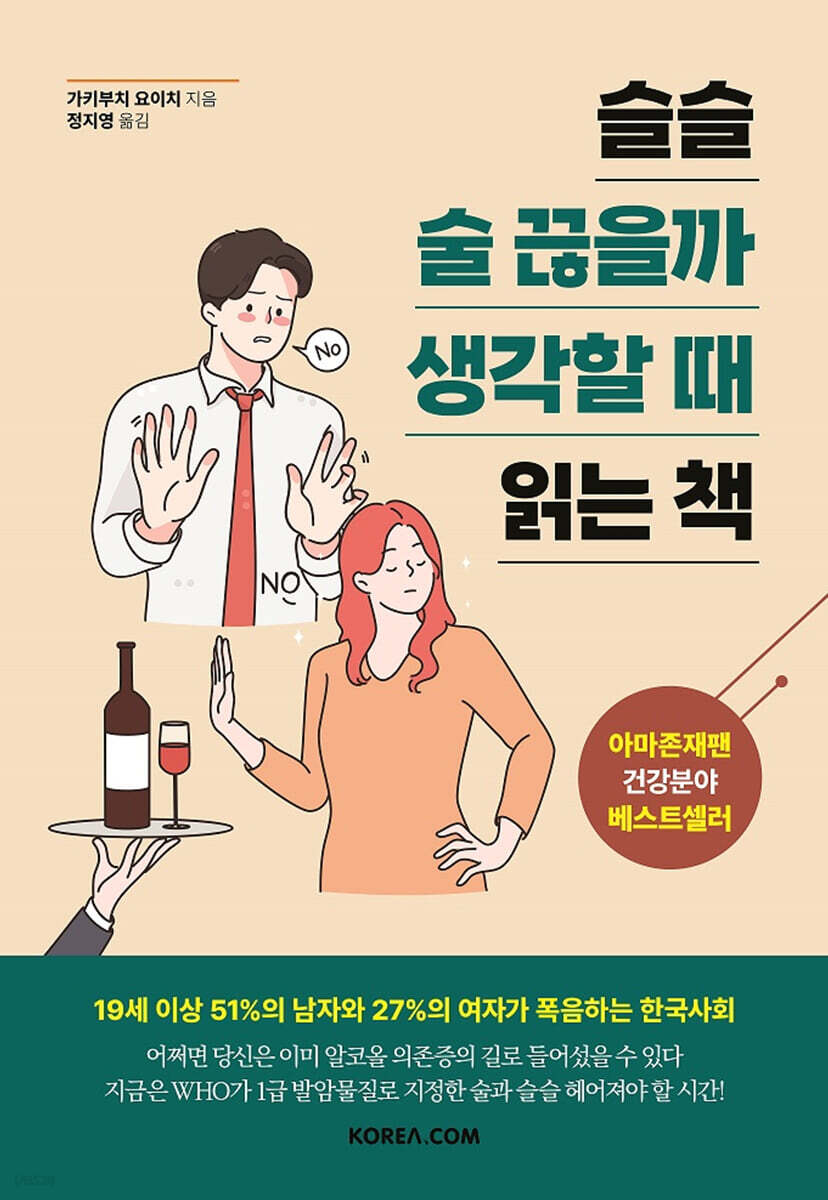
A book to read when you're thinking about quitting drinking
 |
Description
Book Introduction
WHO warns! Alcohol is the biggest health risk!
- People who drink every day are at risk for alcohol dependence.
- Modern people are often tired, and the reason is alcohol.
- Alcohol and depression go hand in hand.
- The reason why people at high risk for alcohol avoid and hide
How to help someone in your family or friends who is a little strange
⇒ When you start abstinence, your brain learns in 90 days.
In Korea, an average of 14 people die every day due to alcohol, and the socioeconomic cost of drinking amounts to 10 trillion won (Statistics Korea [2020 Cause of Death Statistics]). The National Cancer Institute, an affiliate of the WHO, has designated alcohol as a Group 1 carcinogen.
Alcohol is a major health risk factor that can cause various types of cancer as well as depression and dementia.
The idea that light drinking is good for your health has become an outdated idea.
Alcohol is a more dangerous addictive substance than illegal drugs.
Before alcohol consumes your life, read this book and quit drinking easily!
- People who drink every day are at risk for alcohol dependence.
- Modern people are often tired, and the reason is alcohol.
- Alcohol and depression go hand in hand.
- The reason why people at high risk for alcohol avoid and hide
How to help someone in your family or friends who is a little strange
⇒ When you start abstinence, your brain learns in 90 days.
In Korea, an average of 14 people die every day due to alcohol, and the socioeconomic cost of drinking amounts to 10 trillion won (Statistics Korea [2020 Cause of Death Statistics]). The National Cancer Institute, an affiliate of the WHO, has designated alcohol as a Group 1 carcinogen.
Alcohol is a major health risk factor that can cause various types of cancer as well as depression and dementia.
The idea that light drinking is good for your health has become an outdated idea.
Alcohol is a more dangerous addictive substance than illegal drugs.
Before alcohol consumes your life, read this book and quit drinking easily!
- You can preview some of the book's contents.
Preview
index
Preface: To avoid ruining your life, choose a life without alcohol.
Chap 1.
The relationship between alcohol and humans continues to change.
The story of mankind being close to alcohol is a thing of the past.
--Choosing not to drink alcohol is a global trend.
It's already been a long time since you had to be careful if you couldn't drink alcohol.
Communicate in the break room rather than over drinks
In a culture where alcohol is coerced, victims are endless.
People who drink alcohol every day are clearly potential alcoholics.
High-alcohol, easy-to-drink alcohol is a shortcut to addiction.
Why are our alcohol policies so complacent?
Drinking and making mistakes is no longer acceptable.
--Drunk Driving Accident Case 1: The Case That Tightened DUI Standards
--Drunk Driving Accident Case 2: The Case That Led to Strengthening Punishment for Hit-and-Run and Aiding and Abetting
What type of person is more likely to become addicted to alcohol?
--A person who is stubborn and a perfectionist
--A person who is called a good person, a model student
--A person who easily gets absorbed in one thing
Drinking problems become more serious with age.
WHO warns alcohol is the biggest risk factor for health problems.
Smoking used to be allowed on trains: common sense suddenly changes
Chap 2.
Danger Signs You Need to Know Right Now
There are high-risk drinkers among ordinary office workers.
A typical pattern of alcohol addiction while working
Beware of taking unannounced vacation on Mondays.
Danger signs of suspected addiction
Five Misconceptions About Alcohol and Alcoholism
The saying, "Alcohol is the best medicine" is a phrase used for tax purposes.
Risk of addiction as determined by usual drinking amount
--What is an appropriate amount of drinking that is not excessive?
--What is the high-risk drinking amount that can lead to alcohol dependence?
Know your baseline drinking limit
Find out your dependence level with a global standard test.
[Note on Prohibition 1] Check the Safety of Your Drinking Habits with the "Alcohol Use Disorder Screening Test"
Scoring method for alcohol use disorder screening test and measures for each score
Chap 3.
What happens to your body when you drink alcohol?
There are many people who are weak to alcohol.
People who are prone to alcohol dependence and those who are not
What does it mean when alcohol becomes stronger?
Why Race May Differ in Risk of Alcoholism
The high dependence on alcohol surpasses that of illegal drugs.
If you want to drink when you wake up in the morning, it's a red flag.
Don't miss the mental and physical signs of addiction.
The body of a person who always drinks alcohol is always worn out from alcohol breakdown.
Knowing but not being able to stop is dopamine's doing
There are also alternative ways to replenish dopamine deficiency.
The close relationship between alcohol and depression
Various disorders caused by drinking alcohol
--You become more talkative, your drinking habits become worse.
--I don't remember drinking alcohol.
-- repeating the same thing over and over again
--The gait is unsteady and unsteady.
--Urinary incontinence occurs
It is advisable to quit drinking as soon as possible.
Chap 4.
Life-Changing! Seven Benefits of Quitting Alcohol
Before quitting drinking, let's look at the pros and cons from a multifaceted perspective.
[Abstinence Note 2] Understanding the Benefits and Disadvantages of Drinking Alcohol
Benefit 1 of Quitting Alcohol: You'll Get a Better Night's Sleep
The benefits of not drinking alcohol are evident in the refreshing mornings.
Benefit 2 of Quitting Alcohol: Reduced Dinner Size and Weight
--The abstinence diet can make you look younger.
Benefit 3 of Quitting Alcohol: Improved Skin Condition
--Active oxygen radicals cause inflammation in organs and skin.
--The skin becomes flaky due to diuretic action and vitamin B deficiency.
Sleep disorders are also a cause of skin problems.
Benefit 4 of Quitting Alcohol: You'll Spend Less
Benefit 5 of Quitting Alcohol: Reduced Risk of Lifestyle Diseases and Cancer
Benefit 6 of Quitting Alcohol: Clearer Thinking
Benefit 7 of Quitting Alcohol: You'll Have More Free Time
There are absolutely no physical disadvantages to abstinence and absolutely no benefits to drinking.
Chap 5.
Quitting drinking isn't difficult if you create a structure that becomes a habit.
STEP 1.
Essential Preparation for the Week: Things to Do Beforehand
Proceed while feeling the results through visualization.
[Drinking Note 3] Keep a Drinking Diary
--1.
Handwrite on paper
--2.
Enter data using computer software
--3.
Use a dedicated app to cut down on drinking
Recording Tip 1.
Create your own checklist
Recording Tip 2.
Set goals and objectives without overdoing it.
-- Make the purpose clear
--Make a specific plan for moderate drinking.
Knowing what triggers drinking will definitely increase your chances of success.
STEP 2.
Situational Tips for Cutting Back on Drinking: Tailored, Effective Coping Strategies
--How to control alcohol consumption
How to behave well at a drinking party
--Looking for a replacement for alcohol
--Keep the alcohol out of sight
--Indispensable exchanges with colleagues
--Inspire motivation with rewards
--Change your usual perception
--Relax without building up stress
--Use supplements
--Overcome the desire to drink
--Imagine yourself looking better when you're not drinking
When you start abstinence, your brain learns in 90 days.
If you let go of one dependency, it's easy to let go of the other dependency.
Chap 6.
The pain you have to endure when you can't say goodbye to alcohol
There is a big difference between abstinence and fasting.
What are the criteria for determining alcohol dependence?
The progression of addiction is reflected in daily life.
Alcohol dependence is a psychiatric disorder
Why High-Risk Drinkers Are More Reluctant to Seek Treatment
There is also a mental illness that makes it difficult to trust others.
There is recovery from alcoholism, but no cure.
I truly believe that being sober is happiness.
Depending on your circumstances, you can take the path to recovery.
Efforts to eliminate stigma surrounding drug addiction
If you feel that someone close to you is strange
The faster those around you respond, the faster your recovery will be.
Chap 1.
The relationship between alcohol and humans continues to change.
The story of mankind being close to alcohol is a thing of the past.
--Choosing not to drink alcohol is a global trend.
It's already been a long time since you had to be careful if you couldn't drink alcohol.
Communicate in the break room rather than over drinks
In a culture where alcohol is coerced, victims are endless.
People who drink alcohol every day are clearly potential alcoholics.
High-alcohol, easy-to-drink alcohol is a shortcut to addiction.
Why are our alcohol policies so complacent?
Drinking and making mistakes is no longer acceptable.
--Drunk Driving Accident Case 1: The Case That Tightened DUI Standards
--Drunk Driving Accident Case 2: The Case That Led to Strengthening Punishment for Hit-and-Run and Aiding and Abetting
What type of person is more likely to become addicted to alcohol?
--A person who is stubborn and a perfectionist
--A person who is called a good person, a model student
--A person who easily gets absorbed in one thing
Drinking problems become more serious with age.
WHO warns alcohol is the biggest risk factor for health problems.
Smoking used to be allowed on trains: common sense suddenly changes
Chap 2.
Danger Signs You Need to Know Right Now
There are high-risk drinkers among ordinary office workers.
A typical pattern of alcohol addiction while working
Beware of taking unannounced vacation on Mondays.
Danger signs of suspected addiction
Five Misconceptions About Alcohol and Alcoholism
The saying, "Alcohol is the best medicine" is a phrase used for tax purposes.
Risk of addiction as determined by usual drinking amount
--What is an appropriate amount of drinking that is not excessive?
--What is the high-risk drinking amount that can lead to alcohol dependence?
Know your baseline drinking limit
Find out your dependence level with a global standard test.
[Note on Prohibition 1] Check the Safety of Your Drinking Habits with the "Alcohol Use Disorder Screening Test"
Scoring method for alcohol use disorder screening test and measures for each score
Chap 3.
What happens to your body when you drink alcohol?
There are many people who are weak to alcohol.
People who are prone to alcohol dependence and those who are not
What does it mean when alcohol becomes stronger?
Why Race May Differ in Risk of Alcoholism
The high dependence on alcohol surpasses that of illegal drugs.
If you want to drink when you wake up in the morning, it's a red flag.
Don't miss the mental and physical signs of addiction.
The body of a person who always drinks alcohol is always worn out from alcohol breakdown.
Knowing but not being able to stop is dopamine's doing
There are also alternative ways to replenish dopamine deficiency.
The close relationship between alcohol and depression
Various disorders caused by drinking alcohol
--You become more talkative, your drinking habits become worse.
--I don't remember drinking alcohol.
-- repeating the same thing over and over again
--The gait is unsteady and unsteady.
--Urinary incontinence occurs
It is advisable to quit drinking as soon as possible.
Chap 4.
Life-Changing! Seven Benefits of Quitting Alcohol
Before quitting drinking, let's look at the pros and cons from a multifaceted perspective.
[Abstinence Note 2] Understanding the Benefits and Disadvantages of Drinking Alcohol
Benefit 1 of Quitting Alcohol: You'll Get a Better Night's Sleep
The benefits of not drinking alcohol are evident in the refreshing mornings.
Benefit 2 of Quitting Alcohol: Reduced Dinner Size and Weight
--The abstinence diet can make you look younger.
Benefit 3 of Quitting Alcohol: Improved Skin Condition
--Active oxygen radicals cause inflammation in organs and skin.
--The skin becomes flaky due to diuretic action and vitamin B deficiency.
Sleep disorders are also a cause of skin problems.
Benefit 4 of Quitting Alcohol: You'll Spend Less
Benefit 5 of Quitting Alcohol: Reduced Risk of Lifestyle Diseases and Cancer
Benefit 6 of Quitting Alcohol: Clearer Thinking
Benefit 7 of Quitting Alcohol: You'll Have More Free Time
There are absolutely no physical disadvantages to abstinence and absolutely no benefits to drinking.
Chap 5.
Quitting drinking isn't difficult if you create a structure that becomes a habit.
STEP 1.
Essential Preparation for the Week: Things to Do Beforehand
Proceed while feeling the results through visualization.
[Drinking Note 3] Keep a Drinking Diary
--1.
Handwrite on paper
--2.
Enter data using computer software
--3.
Use a dedicated app to cut down on drinking
Recording Tip 1.
Create your own checklist
Recording Tip 2.
Set goals and objectives without overdoing it.
-- Make the purpose clear
--Make a specific plan for moderate drinking.
Knowing what triggers drinking will definitely increase your chances of success.
STEP 2.
Situational Tips for Cutting Back on Drinking: Tailored, Effective Coping Strategies
--How to control alcohol consumption
How to behave well at a drinking party
--Looking for a replacement for alcohol
--Keep the alcohol out of sight
--Indispensable exchanges with colleagues
--Inspire motivation with rewards
--Change your usual perception
--Relax without building up stress
--Use supplements
--Overcome the desire to drink
--Imagine yourself looking better when you're not drinking
When you start abstinence, your brain learns in 90 days.
If you let go of one dependency, it's easy to let go of the other dependency.
Chap 6.
The pain you have to endure when you can't say goodbye to alcohol
There is a big difference between abstinence and fasting.
What are the criteria for determining alcohol dependence?
The progression of addiction is reflected in daily life.
Alcohol dependence is a psychiatric disorder
Why High-Risk Drinkers Are More Reluctant to Seek Treatment
There is also a mental illness that makes it difficult to trust others.
There is recovery from alcoholism, but no cure.
I truly believe that being sober is happiness.
Depending on your circumstances, you can take the path to recovery.
Efforts to eliminate stigma surrounding drug addiction
If you feel that someone close to you is strange
The faster those around you respond, the faster your recovery will be.
Detailed image
.jpg)
Into the book
To be blunt, if you drink because you think, "Wouldn't it be good for your health to drink a little bit?", change that thought immediately.
As I will explain in more detail later, from a medical perspective, drinking alcohol may provide temporary psychological benefits, but it has no physical health benefits at all.
This is the truth about drinking that I want to convey first.
Even the more you drink, the more risks you take, including serious illnesses, accidents, and troubles at home and work.
As an alcohol addiction specialist, I see patients every day who have developed a variety of health problems, including health impairments, due to their persistent drinking.
Although he is a very ordinary office worker, many people who are alcoholics also come to him.
--- p.
6
1.
Opportunity to drink alcohol only when there is an event
2.
Drinking habit of drinking regularly even when there is no event
3.
An accompaniment to a drink customarily served with dinner
In case 1, if the frequency of events is low, the risk of problems occurring is not very high.
2 is professionally called capacity dependent.
Even if there is no noticeable damage while the amount does not increase, if you feel lonely, bored, or empty without drinking, as mentioned before, it is a sign that the chronic side effect of dependence has progressed one step further.
For reference, pattern 3 is the most common pattern among habitual drinking types.
You might think, 'No way,' but strictly speaking, 2 and 3 are potential alcohol dependence symptoms.
--- pp.
34~35
Alcohol also has a sedative effect, similar to an anesthetic, so when the alcohol wears off, the brain becomes excited.
Withdrawal symptoms are most evident in the morning.
If you drink alcohol as an accompaniment to dinner, your blood alcohol level will gradually decrease while you sleep, so you will experience physical and mental symptoms when you wake up.
Let's say you can't stand the discomfort in your body, so you drink again.
If the symptoms stop and you feel better at that time, it can be considered that you have already progressed to full-blown alcohol dependence.
Whether or not the symptoms subside when drinking alcohol in the morning is an important point in determining dependence. If drinking alcohol in the morning becomes a habit, you will not be able to stop drinking all day.
--- pp.
65~66
If you were asked, "Which is more harmful, stimulants or alcohol?" What would you say? You might unhesitatingly answer, "stimulants." However, from the perspective of "high dependence," that's not necessarily the case.
Alcohol is a legal drug, so there is a perception that it is safer and less harmful than illegal drugs such as amphetamines (stimulants) or cocaine. However, just because it is legal does not mean that it can be used with confidence.
As the use of illegal drugs by celebrities became a social issue in the media, it became known how bad and scary drugs like cocaine are, but alcohol can be said to be even more dangerous because it is highly addictive and legal.
Alcohol is also called a 'terminal drug'.
As the saying goes, 'terminal = final destination', there are many cases where people who have used various drugs in the past end up becoming alcoholics.
--- pp.
107~109
Drinking usually begins when college students or working adults have more opportunities to drink at social gatherings. Regardless of whether they like it or not, they start to feel better and enjoy themselves while drinking, and they gradually become more addicted to it.
The process of progressing to a state of inability to quit varies for each person, but it is common for alcohol consumption to increase as it is cost-effective to relieve intense work-related stress.
In women, alcohol often becomes addictive when used to manage mental health issues such as depression or eating disorders.
People with severe alcohol dependence often have psychological problems as well.
To soothe anxiety and pain, we continue to anesthetize our brains with alcohol.
In the meantime, tolerance develops, the amount of alcohol consumed increases, and physical dependence also becomes stronger.
Tolerance means that alcohol's effect on the brain has diminished, so you don't get the same effects as before unless you drink more alcohol.
--- pp.
114~115
There is another interesting topic in understanding the relationship between alcohol dependence and the environment.
Rat Park is a famous animal experiment in the United States.
It was previously known that the brain has plasticity and that once alcohol addiction occurs, it degenerates and does not return to its original state.
However, some researchers questioned this theory and tried to change the environment so that people would not want to take the drug.
What would happen if rats, confined in cramped cages, were placed in a natural, comfortable environment? Researchers created a rat park and tested it.
What were the results? Mice that had been fed only the drug morphine while in our facility lost interest in morphine when they arrived at the Rat Park.
Animals at Rat Park, which has cozy homes and social spaces, showed little desire for drugs.
These results demonstrate that a change in environment can lead to recovery from drug addiction.
--- pp.
234~235
While medical institutions specializing in the treatment of alcohol dependence and outpatient clinics for reducing drinking are increasing nationwide, they are far from meeting the potential need.
We still have a long way to go before we can have an environment where we can easily receive advice from our doctors about abstinence.
Until then, I wrote this book with the hope of quickly providing accurate information to those in need of treatment so that they can put it into practice.
There have already been many published guides written by experts on reducing alcohol consumption, but we are proud to say that this is the first book to go all the way to abstinence.
Abstaining from alcohol (=drugs) due to its side effects is the basis of health management.
I sincerely hope that people will pay attention to the side effects of alcohol as a drug and learn proper methods of abstinence.
As I will explain in more detail later, from a medical perspective, drinking alcohol may provide temporary psychological benefits, but it has no physical health benefits at all.
This is the truth about drinking that I want to convey first.
Even the more you drink, the more risks you take, including serious illnesses, accidents, and troubles at home and work.
As an alcohol addiction specialist, I see patients every day who have developed a variety of health problems, including health impairments, due to their persistent drinking.
Although he is a very ordinary office worker, many people who are alcoholics also come to him.
--- p.
6
1.
Opportunity to drink alcohol only when there is an event
2.
Drinking habit of drinking regularly even when there is no event
3.
An accompaniment to a drink customarily served with dinner
In case 1, if the frequency of events is low, the risk of problems occurring is not very high.
2 is professionally called capacity dependent.
Even if there is no noticeable damage while the amount does not increase, if you feel lonely, bored, or empty without drinking, as mentioned before, it is a sign that the chronic side effect of dependence has progressed one step further.
For reference, pattern 3 is the most common pattern among habitual drinking types.
You might think, 'No way,' but strictly speaking, 2 and 3 are potential alcohol dependence symptoms.
--- pp.
34~35
Alcohol also has a sedative effect, similar to an anesthetic, so when the alcohol wears off, the brain becomes excited.
Withdrawal symptoms are most evident in the morning.
If you drink alcohol as an accompaniment to dinner, your blood alcohol level will gradually decrease while you sleep, so you will experience physical and mental symptoms when you wake up.
Let's say you can't stand the discomfort in your body, so you drink again.
If the symptoms stop and you feel better at that time, it can be considered that you have already progressed to full-blown alcohol dependence.
Whether or not the symptoms subside when drinking alcohol in the morning is an important point in determining dependence. If drinking alcohol in the morning becomes a habit, you will not be able to stop drinking all day.
--- pp.
65~66
If you were asked, "Which is more harmful, stimulants or alcohol?" What would you say? You might unhesitatingly answer, "stimulants." However, from the perspective of "high dependence," that's not necessarily the case.
Alcohol is a legal drug, so there is a perception that it is safer and less harmful than illegal drugs such as amphetamines (stimulants) or cocaine. However, just because it is legal does not mean that it can be used with confidence.
As the use of illegal drugs by celebrities became a social issue in the media, it became known how bad and scary drugs like cocaine are, but alcohol can be said to be even more dangerous because it is highly addictive and legal.
Alcohol is also called a 'terminal drug'.
As the saying goes, 'terminal = final destination', there are many cases where people who have used various drugs in the past end up becoming alcoholics.
--- pp.
107~109
Drinking usually begins when college students or working adults have more opportunities to drink at social gatherings. Regardless of whether they like it or not, they start to feel better and enjoy themselves while drinking, and they gradually become more addicted to it.
The process of progressing to a state of inability to quit varies for each person, but it is common for alcohol consumption to increase as it is cost-effective to relieve intense work-related stress.
In women, alcohol often becomes addictive when used to manage mental health issues such as depression or eating disorders.
People with severe alcohol dependence often have psychological problems as well.
To soothe anxiety and pain, we continue to anesthetize our brains with alcohol.
In the meantime, tolerance develops, the amount of alcohol consumed increases, and physical dependence also becomes stronger.
Tolerance means that alcohol's effect on the brain has diminished, so you don't get the same effects as before unless you drink more alcohol.
--- pp.
114~115
There is another interesting topic in understanding the relationship between alcohol dependence and the environment.
Rat Park is a famous animal experiment in the United States.
It was previously known that the brain has plasticity and that once alcohol addiction occurs, it degenerates and does not return to its original state.
However, some researchers questioned this theory and tried to change the environment so that people would not want to take the drug.
What would happen if rats, confined in cramped cages, were placed in a natural, comfortable environment? Researchers created a rat park and tested it.
What were the results? Mice that had been fed only the drug morphine while in our facility lost interest in morphine when they arrived at the Rat Park.
Animals at Rat Park, which has cozy homes and social spaces, showed little desire for drugs.
These results demonstrate that a change in environment can lead to recovery from drug addiction.
--- pp.
234~235
While medical institutions specializing in the treatment of alcohol dependence and outpatient clinics for reducing drinking are increasing nationwide, they are far from meeting the potential need.
We still have a long way to go before we can have an environment where we can easily receive advice from our doctors about abstinence.
Until then, I wrote this book with the hope of quickly providing accurate information to those in need of treatment so that they can put it into practice.
There have already been many published guides written by experts on reducing alcohol consumption, but we are proud to say that this is the first book to go all the way to abstinence.
Abstaining from alcohol (=drugs) due to its side effects is the basis of health management.
I sincerely hope that people will pay attention to the side effects of alcohol as a drug and learn proper methods of abstinence.
--- pp.
245~246
245~246
Publisher's Review
Think about yourself now that you've quit drinking. How do you feel?
If you've ever felt thoughts like, "I feel empty, like I've lost something precious," "I feel like my day won't end if I can't have a cold beer after work," or "What fun would life be without alcohol?", you might be borderline alcoholic!
If you've ever had a night of heavy drinking, found yourself with a churning stomach and a headache the day after, unable to remember how you got home, and thinking, "Oh, I really need to quit drinking!", then this is a must-read.
Even if you drink a small amount of alcohol every day, saying, "I don't drink much, I just have a can a day to feel good," you can become close to alcohol dependence due to your complacent thoughts about alcohol.
The author of this book, a psychiatrist who has been treating alcoholism for 17 years, points out that he has met a variety of alcohol-dependent patients, many of whom are very ordinary office workers.
Alcohol is a 'legal drug', not a food or a luxury item.
It makes you feel good while drinking, making you keep reaching for alcohol to enjoy that good feeling.
However, very slowly, as the frequency and amount of alcohol consumed increases, anyone reaches a point where they cannot refuse alcohol against their will.
Warning Signs of Alcohol Dependence and Habits for Successful Abstinence
This article introduces the Alcohol Use Disorder Screening Test, which allows you to assess the level of risk in your drinking patterns, and the corresponding scoring strategies. This globally standardized test, developed by the WHO, aims to identify and address drinking patterns that are detrimental to your health early on.
We also look at the five types of alcohol constitutions, including those who are prone to alcohol dependence and those who are not, those who are strong against alcohol, those who are weak against alcohol, and those who are prone to alcohol dependence.
We also learn about the warning signs of possible addiction and the various disorders that can arise from drinking alcohol.
As alcohol continues to enter the body, aging accelerates and organs throughout the body are damaged.
If you continue to drink beyond a certain limit and damage your liver or pancreas, you will not be able to return to your original health even if you stop drinking later.
Knowing what triggers your drinking can increase your chances of success in quitting drinking.
We guide you through observing and visualizing the reasons and triggers for drinking alcohol and developing countermeasures based on your drinking patterns.
Alcohol is difficult to quit with just strong willpower.
With a proper understanding of alcohol, a powerful drug, you're well on your way to abstinence!
People often think that people with weak willpower are more likely to become dependent on alcohol, but this is a big misconception.
Rather, people with stubborn or perfectionistic personalities are more likely to become addicted to alcohol.
Additionally, alcohol is readily available to anyone over the age of 20, so some people who grew up in extremely ordinary families use alcohol to relieve stress and are unable to quit.
Although it may seem like they grew up in an affluent environment, they actually feel lonely or isolated due to problems such as parental discord, family drinking problems, and domestic violence, and they turn to alcohol to soothe that feeling.
If you live a life where you only care about what others think, and you always suppress and endure your true feelings, and your thoughts and actions do not match, you may end up relying on alcohol to control that imbalanced mind.
There are many different situations that lead to alcohol dependence.
The more you rely on alcohol, the more likely you are to become addicted to it due to an unhealthy state of mind and way of thinking.
Ultimately, drinking problems are very closely related to mental problems.
You can't quit drinking with just strong willpower.
This is why it is important to know the harmful effects of alcohol as a drug and why people drink too much.
Abstinence is 10% willpower and 90% planning! If you understand the structure of your body and practice the abstinence lifestyle suggested in this book, you'll find yourself thinking, "A life without alcohol is boring," rather than, "A life without alcohol is truly wonderful."
If you've ever felt thoughts like, "I feel empty, like I've lost something precious," "I feel like my day won't end if I can't have a cold beer after work," or "What fun would life be without alcohol?", you might be borderline alcoholic!
If you've ever had a night of heavy drinking, found yourself with a churning stomach and a headache the day after, unable to remember how you got home, and thinking, "Oh, I really need to quit drinking!", then this is a must-read.
Even if you drink a small amount of alcohol every day, saying, "I don't drink much, I just have a can a day to feel good," you can become close to alcohol dependence due to your complacent thoughts about alcohol.
The author of this book, a psychiatrist who has been treating alcoholism for 17 years, points out that he has met a variety of alcohol-dependent patients, many of whom are very ordinary office workers.
Alcohol is a 'legal drug', not a food or a luxury item.
It makes you feel good while drinking, making you keep reaching for alcohol to enjoy that good feeling.
However, very slowly, as the frequency and amount of alcohol consumed increases, anyone reaches a point where they cannot refuse alcohol against their will.
Warning Signs of Alcohol Dependence and Habits for Successful Abstinence
This article introduces the Alcohol Use Disorder Screening Test, which allows you to assess the level of risk in your drinking patterns, and the corresponding scoring strategies. This globally standardized test, developed by the WHO, aims to identify and address drinking patterns that are detrimental to your health early on.
We also look at the five types of alcohol constitutions, including those who are prone to alcohol dependence and those who are not, those who are strong against alcohol, those who are weak against alcohol, and those who are prone to alcohol dependence.
We also learn about the warning signs of possible addiction and the various disorders that can arise from drinking alcohol.
As alcohol continues to enter the body, aging accelerates and organs throughout the body are damaged.
If you continue to drink beyond a certain limit and damage your liver or pancreas, you will not be able to return to your original health even if you stop drinking later.
Knowing what triggers your drinking can increase your chances of success in quitting drinking.
We guide you through observing and visualizing the reasons and triggers for drinking alcohol and developing countermeasures based on your drinking patterns.
Alcohol is difficult to quit with just strong willpower.
With a proper understanding of alcohol, a powerful drug, you're well on your way to abstinence!
People often think that people with weak willpower are more likely to become dependent on alcohol, but this is a big misconception.
Rather, people with stubborn or perfectionistic personalities are more likely to become addicted to alcohol.
Additionally, alcohol is readily available to anyone over the age of 20, so some people who grew up in extremely ordinary families use alcohol to relieve stress and are unable to quit.
Although it may seem like they grew up in an affluent environment, they actually feel lonely or isolated due to problems such as parental discord, family drinking problems, and domestic violence, and they turn to alcohol to soothe that feeling.
If you live a life where you only care about what others think, and you always suppress and endure your true feelings, and your thoughts and actions do not match, you may end up relying on alcohol to control that imbalanced mind.
There are many different situations that lead to alcohol dependence.
The more you rely on alcohol, the more likely you are to become addicted to it due to an unhealthy state of mind and way of thinking.
Ultimately, drinking problems are very closely related to mental problems.
You can't quit drinking with just strong willpower.
This is why it is important to know the harmful effects of alcohol as a drug and why people drink too much.
Abstinence is 10% willpower and 90% planning! If you understand the structure of your body and practice the abstinence lifestyle suggested in this book, you'll find yourself thinking, "A life without alcohol is boring," rather than, "A life without alcohol is truly wonderful."
GOODS SPECIFICS
- Publication date: December 15, 2021
- Page count, weight, size: 248 pages | 352g | 145*210*17mm
- ISBN13: 9791190488310
- ISBN10: 1190488310
You may also like
카테고리
korean


korean

![GQ KOREA Mark (Monthly): December [2025]](http://librairie.coreenne.fr/cdn/shop/files/8ef265dbbfbf186523ed75ba7319009d.jpg?v=1765340328&width=3840)


